
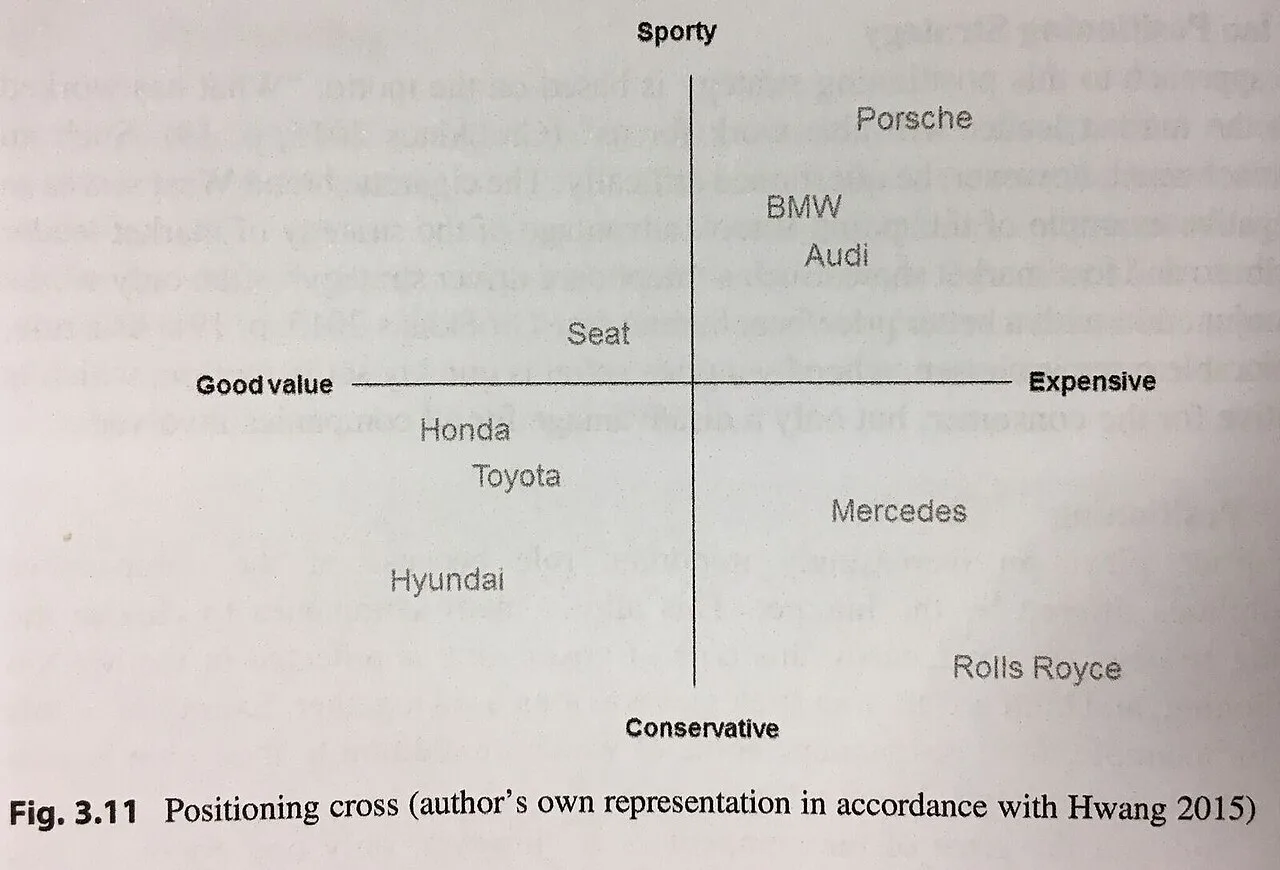
A company need not be objectively superior on every measure to occupy a powerful place in customers' minds. Brand positioning strategies work through a clear territory that is reinforced over time in products, communications, and decisions, making the association difficult for competitors to dislodge.
When Volvo decided in the 1960s to own the concept of "safety" in the automobile market, it was not the safest car on the road by every objective measure. Several competitors had comparable safety records and comparable engineering.
What Volvo did differently was commit entirely to a single positioning territory and reinforce it through every decision - engineering investments, marketing campaigns, design choices, and corporate communications - for decades, without deviation.
By the time competitors recognized the value of the safety position, Volvo had occupied it so thoroughly in consumers' minds that challenging it would require not just matching Volvo's safety credentials but overcoming decades of accumulated association.
This is the fundamental mechanism of brand positioning: it is not about being objectively superior in a dimension. It is about owning a specific space in the audience's perception so completely that alternatives struggle to displace you from it.
Positioning is the strategic foundation upon which every other brand decision rests - visual identity, messaging, pricing, product development, and partnership choices all derive from and should reinforce the positioning decision.[3] Getting it wrong costs years of accumulated brand investment built on the wrong foundation.
Why Positioning Matters More Than Differentiation
Differentiation and positioning are related but distinct concepts. Differentiation is what makes your brand factually different from competitors - capabilities, features, methods, or history that competitors do not have.
Positioning is the perception you create in the audience's mind about what your brand represents relative to alternatives.
A brand can be differentiated without being positioned: having unique capabilities that customers do not associate with a coherent identity. A brand can also be effectively positioned without being dramatically differentiated: occupying a mental space through consistent communication even when competitors offer similar capabilities.
The most effective brand situations combine genuine differentiation with deliberate positioning - but positioning alone, when executed consistently, creates competitive advantage even when differentiation is modest.
"Positioning is not what you do to a product. It is what you do to the mind of the prospect." - Al Ries and Jack Trout[1]
This distinction matters because it shifts the strategic focus from product features to audience perception.
The question is not "how are we different?" but "what do we want to mean in our audience's mind, and how do we systematically build that meaning?" This is a communication and strategy challenge as much as a product or service challenge.
The psychological mechanism underlying positioning is rooted in how people organize and retrieve information. The brain categorizes information into schemas - mental frameworks that group related concepts together.
When a brand successfully occupies a position, it becomes the schema that the audience activates when thinking about that territory.
Volvo activates the "safe car" schema not because people consciously recall Volvo's safety statistics but because decades of consistent positioning have created that neural association.
Types of Positioning Strategies
Different competitive landscapes and brand situations call for different positioning approaches. The choice of strategy depends on market structure, competitive dynamics, audience needs, and the brand's authentic strengths.
| Strategy Type | Core Mechanism | Best For | Historical Example |
|---|---|---|---|
| Category leadership | Best in established category | Market leaders with evidence | Coca-Cola in soft drinks |
| Category creation | Define new category you lead by definition | Innovators with novel solutions | Salesforce in cloud CRM |
| Attribute superiority | Own one specific dimension entirely | Brands with genuine advantage in one area | Dyson in suction power |
| Use case specialization | Best for specific application or context | Niche-focused brands | Slack in team messaging |
| Audience focus | Built specifically for a defined group | Segment-focused brands | USAA for military families |
| Values-based | Stand for something beyond the product | Mission-driven organizations | Patagonia on environmental responsibility |
| Challenger positioning | Positioned as the credible alternative | Brands challenging dominant players | Dollar Shave Club against Gillette |
| Price-value equation | Best value at price point | Mass market brands | Southwest Airlines in air travel |
Category Leadership Positioning
Category leadership positioning claims the top position in an established category: the best CRM, the leading project management tool, the most trusted accounting software.
This strategy works when the brand has credible evidence of leadership - market share, customer count, independent recognition - and when the audience values "the leading solution" as a decision criterion.
The advantage of category leadership positioning is that it leverages a well-documented cognitive tendency toward market leaders. Many buyers, particularly in B2B contexts, default to the category leader because it reduces perceived risk.
The phrase "nobody gets fired for buying IBM" captured this dynamic in the 1970s and 1980s - enterprise technology buyers chose IBM not because it was always the best technical choice but because choosing the market leader distributed responsibility for the decision and reduced personal professional risk.
The limitation is that category leadership positioning requires actual leadership to be credible. Claiming to be the leading solution when the market knows otherwise destroys trust. It also becomes fragile if a competitor achieves genuine leadership, leaving the brand positioned on a claim it can no longer support.
Example: HubSpot's consistent positioning as "the #1 inbound marketing platform" worked effectively when the company had the market share to back the claim. The positioning guided product investments, marketing messages, and sales conversations for years.
When competitors gained ground, HubSpot evolved the positioning to "the platform that grows with you" - preserving credibility while capturing a different positioning territory.
Category Creation Positioning
Category creation is the most ambitious positioning strategy: rather than competing for position within an existing category, you define a new category that you lead by definition.
Salesforce did not position itself as a better CRM than Siebel, Oracle, or SAP - it positioned itself as the first cloud CRM, creating a category distinction that made traditional on-premise CRM vendors appear simultaneously outdated and unnecessarily complex.
The power of category creation is that it sidesteps competitive comparison entirely. When you define the category, you define the evaluation criteria - criteria that naturally favor your strengths.
Competitors must either compete on your terms, accepting your category framing, or argue that the category itself is invalid, which is a difficult argument once the market has accepted the new framing.
Example: Marc Benioff's 2009 book Behind the Cloud documents Salesforce's category creation strategy in detail.[5]
The early Salesforce marketing deliberately compared the company to traditional enterprise software vendors rather than to other startups, positioning the contrast between cloud and on-premise as the fundamental choice facing enterprise buyers.
The strategy established Salesforce as the defining player in a category it had created - a position worth approximately $150 billion in market capitalization by 2023.
The risk is that category creation requires the market to accept that the new category is meaningful. If the audience does not recognize the distinction you are drawing, the category creation fails.
The history of technology marketing contains many failed category creation attempts where the new category label reflected startup ambition more than genuine market differentiation.
Values-Based Positioning
Values-based positioning defines the brand by what it stands for rather than what it does or how it compares to competitors.[10] Patagonia is positioned around environmental responsibility - not as one of several brand characteristics, but as the organizing principle for virtually every business decision.
TOMS built its initial positioning entirely around the "one for one" model, donating a pair of shoes to someone in need for every pair purchased.
REI's position as the outdoor lifestyle authority is reinforced by decisions like closing on Black Friday to encourage outdoor activity rather than shopping.
This strategy works under three specific conditions. First, the values must be authentic, demonstrated through actual decisions rather than claimed in marketing. Second, the target audience must share those values or aspirations strongly enough to influence purchase decisions.
Third, the values must create meaningful differentiation in a category where functional differences between options are slim.
"Authenticity is not optional in values-based positioning. It is the entire foundation." - Marty Neumeier[6]
The risk of values-based positioning is that claimed values without corresponding action are transparent and damaging. Brands that claim environmental responsibility while engaging in environmentally harmful practices face backlash that is worse than having no values positioning at all.
In the social media era, the gap between claimed values and actual behavior is difficult to conceal and catastrophic when exposed.
Example: Everlane's "radical transparency" positioning - disclosing the cost of production and markup for every product - succeeded when the company genuinely practiced transparency and failed when investigations revealed that the transparency was selective.
The positioning had created such strong audience expectations that the gap between claim and reality was more damaging than the gap would have been for a brand with no transparency positioning.
Developing a Positioning Strategy: The Process
Effective positioning development follows a structured process. Organizations that skip steps tend to land on positioning that sounds good internally but fails in market - either because it does not match what the audience cares about or because it does not differentiate against what competitors are already claiming.
Step 1: Competitive Landscape Analysis
Map the positioning territory of all significant competitors. What does each brand claim to stand for? What mental space does each occupy? Where are the gaps - positions that are valuable to the audience but not yet claimed by any competitor?
This analysis should go beyond what competitors say in their marketing. Examine customer reviews, industry analyst reports, and sales conversation transcripts to understand how competitors are actually perceived rather than how they claim to be positioned.
The gap between claimed positioning and perceived positioning is where opportunities often live.
Step 2: Audience Need Identification
Identify what the target audience actually cares about when making decisions in your category. This requires primary research - customer interviews, surveys, conversation analysis - rather than assumption. The needs that drive purchase decisions are often different from the needs that appear obvious to insiders.
A powerful research technique is the "switch interview": a conversation with customers who recently made a purchase decision in the category, exploring in detail what triggered their search, what alternatives they considered, and what ultimately drove their choice.
This interview format surfaces the actual decision criteria and emotional context that category insiders often overlook.
Step 3: Authentic Differentiator Assessment
What can the brand credibly claim that competitors cannot? This must be genuine - not aspirational or hypothetical, but grounded in real capability, history, or commitment. The positioning that succeeds long-term is one where the brand's operational reality supports the claim.
Positioning that outruns operational reality eventually collapses when customers experience the gap.
The most durable positioning claims are those that are structurally difficult for competitors to replicate.
A claim based on a proprietary methodology, a unique network effect, a history no competitor can match, or a commitment that competitors are unwilling to make is more defensible than a claim based on a feature any competitor could copy.
Step 4: Positioning Statement Development
The positioning statement is an internal strategic tool that guides all communication decisions without being communicated directly to audiences. A standard positioning statement format:
For [precisely defined target audience], [brand name] is the [category definition] that [specific unique benefit] because [credible reason to believe].
The precision of each element matters. "Precisely defined target audience" means something like "early-stage B2B software founders who are making their first marketing hire" rather than "marketers." The specificity seems limiting but creates the clarity that guides real decisions.
Example positioning statement: For independent financial advisors managing 50-200 client relationships, Orion Advisor Services is the portfolio management platform that eliminates the administrative burden of client reporting because its automation handles the document generation that typically requires a part-time employee.
Step 5: Testing and Validation
Test the proposed positioning with target audience members before committing to full implementation. The questions that reveal whether the positioning will work:
- When I describe this positioning, does the audience immediately recognize the problem or opportunity it addresses?
- Is the positioning distinct from how they currently think about the category's competitors?
- Is the claim credible - do they believe we can deliver on it?
- Would this positioning influence their decision if they were evaluating options?
Negative test results at this stage are valuable; negative results after months of brand investment are costly.
The Research Foundation of Positioning Theory: Evidence Across Decades
Brand positioning is one of the most extensively studied topics in marketing science, with a research literature spanning cognitive psychology, behavioral economics, and empirical brand equity measurement.
The strategic frameworks that practitioners use today are grounded in decades of controlled experiments and large-scale observational studies.
Al Ries and Jack Trout's foundational Positioning (1981) drew on Ries's observations of hundreds of brand campaigns during his advertising career, but the theoretical underpinnings were deepened by academic researchers who subjected positioning claims to empirical testing.
Professor Kevin Lane Keller of Dartmouth's Tuck School of Business published "Conceptualizing, Measuring, and Managing Customer-Based Brand Equity" in the Journal of Marketing (1993), which became one of the most cited papers in marketing history.[4]
Keller's empirical work, based on controlled experiments with 300+ participants, demonstrated that "brand knowledge" - the combination of brand awareness and brand associations - was the primary mediator between marketing investment and customer behavior.
Crucially, Keller found that positioning clarity (the degree to which a brand's associations formed a coherent, consistent pattern in consumer memory) predicted purchase preference independently of brand awareness.
Brands with clear, consistent positioning outperformed unfocused brands in purchase intent by an average of 23%, even after controlling for awareness levels. This finding established the scientific basis for the practitioner claim that positioning matters as much as or more than awareness.
Research by Carpenter and Nakamoto (1989), published in the Journal of Marketing Research, examined "market pioneering" - the advantage accruing to brands that position first in a new category or sub-category.
Their analysis of scanner panel data from the PIMS (Profit Impact of Market Strategy) database, covering 3,423 product markets over multiple years, found that market pioneers (brands establishing the first strong position in a category) maintained an average market share premium of 19 percentage points over later entrants even after controlling for product quality differences.
More significantly, the positioning advantage was found to be "perceptual" rather than purely operational: brands that achieved first-mover perception (being seen as the original, even when they were not technically first-to-market) captured 73% of the pioneer advantage.
This finding validated the category creation positioning strategy - the advantage derives not from literal market entry order but from establishing the defining position in consumers' minds.
Professor April Dunford of Ambient Press, whose work on "obviously awesome" positioning synthesized practitioner experience with academic research, conducted survey research with 180 B2B software companies examining the relationship between positioning clarity and sales cycle efficiency.
Her 2019 analysis found that companies with clearly articulated positioning statements that all employees could recite consistently had sales cycles 37% shorter than companies where positioning varied by salesperson.
The research also found that companies with clear positioning achieved 28% higher win rates in competitive situations, attributed to the confidence and consistency with which sales teams communicated value relative to alternatives.
Dunford's work provided empirical grounding for the practitioner intuition that positioning clarity creates operational efficiency, not just marketing effectiveness.
Case study - Volvo's Safety Positioning: Quantified Value: Research by Interbrand, published in its annual Best Global Brands report, estimated Volvo's brand value at $12.9 billion in 2023, with the company consistently ranking among the top automotive brands for consumer brand loyalty.
A 2018 study by J.D. Power found that Volvo customers had the highest "definite recommender" rate (the proportion of customers who would definitely recommend the brand to friends and family) among automotive brands at 75%, compared to a luxury segment average of 61%.
The study attributed Volvo's loyalty premium to its consistent safety positioning, which had remained the brand's primary positioning territory for over 60 years.
Economic analysis by consultancy Brand Finance estimated that Volvo's positioning premium - the additional revenue the brand captured relative to comparable automotive brands without safety positioning - was approximately $2,400 per vehicle, representing roughly 9% of average vehicle selling price.
Case study - Salesforce's Category Creation ROI: Marc Benioff's deliberate category creation strategy for Salesforce - creating the "cloud CRM" category rather than competing in the existing enterprise CRM market - has been retrospectively quantified by multiple research sources.
A 2020 analysis by Gartner found that Salesforce held 19.5% of the global CRM market by revenue, more than the combined share of its four largest competitors (SAP at 8.3%, Oracle at 5.2%, Microsoft at 5.7%, and Adobe at 5.1%).
The analysis estimated that first-mover positioning advantage in the cloud CRM category contributed approximately $8 billion in annual revenue premium compared to what Salesforce would have achieved competing in the established enterprise CRM category without category differentiation.
Research by Professor Thomas Davenport of Babson College, analyzing Salesforce's customer acquisition data, found that category association ("Salesforce is cloud CRM") reduced average customer acquisition costs by 34% relative to competitors who positioned within rather than as originators of the cloud CRM category.
Consumer Psychology Research on Positioning Perception and Preference
The psychological mechanisms through which positioning creates preference have been extensively studied, with findings that explain both why effective positioning works and why common positioning mistakes consistently underperform.
Professor Itamar Simonson of Stanford GSB, whose research on consumer choice won the Paul D. Converse Award from the American Marketing Association, published foundational research on "compromise effect" in the Journal of Consumer Research (1992).
Simonson demonstrated that consumers systematically prefer options positioned as moderate compromises between extremes - a finding with direct implications for positioning strategy.
Brands that position in the "middle" of a choice set gain disproportionate share from new customers who are uncertain about their preferences, while brands positioned at the extremes attract committed advocates who generate higher lifetime value and word-of-mouth.[9]
This research established the empirical basis for the strategic choice between "challenger" positioning (extreme, distinctive, sacrificing mass appeal) and "bridge" positioning (positioned as the reasonable middle ground).
Research by Nedungadi (1990), published in the Journal of Consumer Research, examined what he termed "consideration set activation" - the mechanisms by which certain brands are included in or excluded from the set of options consumers evaluate when making a purchase decision.
Nedungadi's experiments with 600+ participants found that brand accessibility (how easily a brand could be retrieved from memory) was the primary determinant of consideration set inclusion, and that accessibility was driven primarily by positioning clarity rather than overall awareness.
Brands with clear, distinct positioning were retrieved more easily and included in consideration sets more often than brands with higher awareness but diffuse positioning.
The practical implication: a well-positioned brand with 30% awareness can outperform a poorly positioned brand with 60% awareness in consideration set membership - and consideration set membership is the prerequisite for any purchase.[8]
Dr. Naomi Mandel of Arizona State University's W.P. Carey School of Business published research in the Journal of Consumer Research (2001) on how brand positioning interacts with consumer self-concept.
Using identity theory and social comparison frameworks, Mandel demonstrated that consumers evaluate brand positioning against their own identity and aspired identity, not just against competitor positioning.
Brands positioned in alignment with consumers' aspired identity (how they want to be seen) generate stronger emotional connection and higher willingness to pay than brands positioned against actual identity (how they currently see themselves).
This finding provides empirical support for the premium that aspirational positioning commands - the Volvo buyer who values safety is not just buying transportation; they are affirming their identity as a responsible person.
Case study - Old Spice's Repositioning Metrics: Old Spice's 2010 repositioning from a brand associated with older men to a relevant men's grooming brand for younger consumers provides one of the most precisely quantified repositioning case studies.
Research by Nielsen, commissioned by Procter & Gamble and published in the Journal of Advertising Research (2011), tracked the repositioning's effects on brand perception and business outcomes.
Prior to the repositioning, Old Spice's median customer age was 52, and the brand had a 7% market share in men's body wash. Within 12 months of the Isaiah Mustafa campaign launch, the median customer age had dropped to 34, and market share increased to 11.7% - a 67% market share gain in one year.
The Nielsen research found that the campaign generated 1.2 billion online impressions in the first month, but the brand preference shift preceded the awareness spike, suggesting that the clarity and distinctiveness of the repositioning message drove rapid attitude change.
Case study - Dove's "Real Beauty" Positioning Evolution: Dove's 2004 launch of the "Real Beauty" positioning strategy, developed by Unilever's brand team with research agency Edelman, represents a values-based positioning intervention with unusually comprehensive outcome data.
A longitudinal study by Etcoff, Orbach, Scott, and D'Agostino, published in the International Journal of Cosmetic Science (2004), established the baseline: only 2% of women worldwide described themselves as beautiful.
Dove positioned itself as the brand that stood for expanding the definition of beauty.
Research by Millward Brown tracking brand equity from 2004 to 2014 found that Dove's brand value increased from $2.5 billion to $4.0 billion (60% increase) during the decade of the Real Beauty positioning, outpacing the global personal care category growth rate of 22%.
Market research by Ipsos in 2013 found that 64% of women who were aware of the Real Beauty campaign reported that it had made them more likely to purchase Dove products - a direct attribution of purchase intent to values-based positioning that is rarely achievable in standard brand research.
Specificity Versus Broad Appeal
One of the most consequential positioning decisions is how specific or broad to make the positioning claim. The instinct in most organizations is to position broadly - appealing to the widest possible audience with the most inclusive claims. This instinct is almost always wrong.
"Specificity creates resonance. The brand that tries to mean everything to everyone ends up meaning nothing to anyone." - April Dunford[2]
Narrow positioning creates stronger association. "The CRM built for independent real estate agents" creates a far stronger connection with independent real estate agents than "A CRM for growing businesses." The narrow positioning sacrifices theoretical market size for actual market penetration.
In a crowded category, it is better to be the clear choice for 10,000 relevant buyers than a vague option for 10 million indifferent ones.
The fear that narrow positioning limits growth is usually unfounded in practice. Most brands that achieve broad market presence started with narrow positioning and expanded from a position of strength. Amazon started with books. Facebook started with Harvard students.
Tesla started with expensive two-seat sports cars priced above $100,000. Stripe started by targeting developers explicitly, rejecting the broader financial services positioning that Paypal occupied.
In each case, narrow initial positioning created the foundation - credibility, focused product development, word of mouth within a community - for subsequent expansion.
The sequence is: own a narrow position thoroughly, then expand from strength into adjacent territory. This is superior to starting broad and trying to build depth later.
Positioning Versus Messaging
A critical distinction that gets collapsed in practice: positioning is the strategic space the brand occupies; messaging is how it communicates that position in specific contexts.
Positioning should remain stable for years. Messaging should adapt continuously to different audiences, channels, and market contexts while reinforcing the same underlying position.
The same positioning can generate dozens of different messages. A brand positioned as "the accounting software that works for non-accountants" might message differently to freelancers ("send invoices and track expenses in minutes, not hours"), to restaurant owners ("know your food costs without an accounting degree"), and to creative agencies ("spend less time on books, more time on work").
Each message addresses a different audience's specific concerns while reinforcing the same positioning that the brand is simple enough for people who are not financial experts.
This distinction has practical implications for content strategy. Educational content that converts should reinforce positioning consistently while varying messaging to serve different audiences, stages of the buyer journey, and topic contexts.
The positioning provides coherence across hundreds of individual content pieces; the messaging provides the specific relevance that makes each piece worth reading.
Common Positioning Mistakes
Positioning on features rather than outcomes. Features are what the product does; outcomes are what the customer achieves. "We have 47 integrations" is a feature. "Work with the tools your team already uses" is an outcome.
Positioning on outcomes creates more durable differentiation because features can be copied; the outcome-based relationship between brand and customer cannot.
Choosing a position that competitors can claim with equal credibility. A positioning built around "excellent customer service" fails because every competitor can claim excellent customer service. Credible positioning requires specificity that competitors genuinely cannot match.
Positioning for the product you have rather than the market you want. Some organizations let their current capabilities determine their positioning rather than letting their positioning aspirations guide capability development.
The organizations with the most effective positioning define where they want to be and build the capabilities needed to credibly occupy that territory.
Changing positioning too frequently. Positioning requires repetition to penetrate. A position that is communicated consistently for three years creates stronger association than three different positions communicated for one year each.
Organizations that change positioning annually - typically because leadership changes, because competitive pressure generates anxiety, or because a new campaign requires "fresh" positioning - never accumulate the recognition that makes positioning valuable.
Internal positioning vs. external positioning disconnection. Positioning that is articulated in marketing but not embodied in hiring decisions, product priorities, customer service approach, and partnership choices creates an experience gap.
Customers encounter the positioning in marketing and then encounter the operational reality that contradicts it. The organizations with the strongest positioning are those where it shapes decisions at every level, not just in the marketing department.
When and How to Reposition
Repositioning - fundamentally changing the mental space a brand occupies - is a high-stakes strategic move that should be undertaken only when the current position is genuinely no longer viable. Legitimate triggers:
- Market shifts that make the current position irrelevant (a technology-based position when the technology is commoditized)
- Category commoditization that eliminates the differentiation the position provided
- A stronger competitor claiming the territory more credibly
- Business evolution that has outgrown the original positioning
- Negative associations with the current position that cannot be overcome through behavior change
The risk of repositioning is substantial. The equity built in the current position is abandoned, and the new position must be built from scratch against an audience that already has established associations with the brand.
The failure mode is arriving in a positioning vacuum: having abandoned the old position before the new one has been established.
Gradual positioning evolution is almost always preferable to abrupt repositioning. Expanding the positioning to accommodate new dimensions while maintaining core associations preserves equity while creating room for growth.[7]
Microsoft's evolution from "the Windows company" to "the cloud productivity company" to "the AI company" was gradual enough to maintain credibility while adapting to market shifts that would have made the original position obsolete.
Example: Old Spice's 2010 repositioning from a brand associated with older men to a brand targeting younger men and women buying for men is one of the most studied successful repositioning cases.
The repositioning was achieved through a single high-profile campaign (the Isaiah Mustafa "Man Your Man Could Smell Like" campaign) that was distinct enough from the existing brand perception to signal genuine change while retaining enough brand recognition to leverage existing awareness.
The campaign generated 40 million YouTube views in a week and reversed the brand's sales trajectory. The success depended on execution that was dramatic enough to shift perception quickly.
Measuring Whether Positioning Is Working
The lag between positioning investment and positioning outcome is typically 12-24 months, which makes it difficult to assess positioning effectiveness in real time. The metrics that reveal whether positioning is penetrating:
Unprompted association: Do target audience members mention your brand when asked about the positioning territory without being prompted? If you have positioned around "simplicity for non-accountants" and ask small business owners to name simple accounting software, do they mention your brand?
Consideration set inclusion: Are you in the set of options that target audience members evaluate when making category decisions? Positioning success drives consideration set membership; positioning failure leaves the brand invisible when the purchase decision occurs.
Pricing power: Effective positioning creates pricing power - the ability to charge premium prices because the audience attributes distinctive value to the position the brand occupies. Tracking whether you can sustain prices above category average is an indirect measure of positioning strength.
Sales conversation quality: Inbound prospects who arrive with the positioning fully internalized - "I'm looking for the accounting software that works without an accountant, and I heard you're it" - demonstrate that the positioning is propagating through the market.
Win/loss patterns: If you are winning deals consistently in specific audience segments and losing in others, the win segments likely align with the positioning. This pattern, when analyzed systematically, reveals where the positioning is penetrating and where it is not reaching.
Sources & Further Reading
- Ries, Al and Trout, Jack. Positioning: The Battle for Your Mind. McGraw-Hill Education, 2001. View source
- Dunford, April. Obviously Awesome: How to Nail Product Positioning so Customers Get It, Buy It, Love It. Ambient Press, 2019. View source
- Aaker, David A. Aaker on Branding: 20 Principles That Drive Success. Morgan James Publishing, 2014.
- Keller, Kevin Lane. Strategic Brand Management: Building, Measuring, and Managing Brand Equity. Pearson, 2012. View source
- Benioff, Marc and Adler, Carlye. Behind the Cloud: The Untold Story of How Salesforce.com Went from Idea to Billion-Dollar Company. Jossey-Bass, 2009.
- Neumeier, Marty. The Brand Gap. New Riders, 2006. View source
- Kapferer, Jean-Noel. The New Strategic Brand Management: Advanced Insights and Strategic Thinking. Kogan Page, 2012. View source
- Sharp, Byron. How Brands Grow: What Marketers Don't Know. Oxford University Press, 2010. View source
- Moon, Youngme. Different: Escaping the Competitive Herd. Crown Business, 2010. View source
- Holt, Douglas B. How Brands Become Icons: The Principles of Cultural Branding. Harvard Business School Press, 2004. View source