
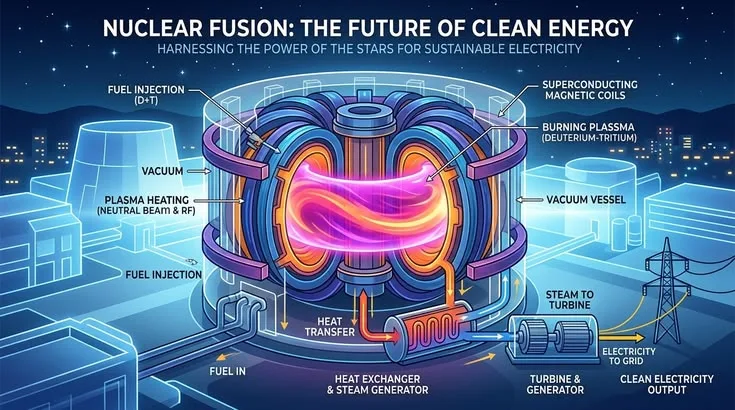
Nuclear fusion releases energy when light nuclei combine, the process that powers stars but requires extreme conditions on Earth. Recent laser experiments demonstrated ignition and target-level energy gain, not a net-power plant.
Magnetic and inertial designs pursue different routes to confine plasma, while practical electricity still depends on solving efficiency, materials, tritium, cost, and scale-up challenges.
At 1:03 a.m. on December 5, 2022, in a control room at the National Ignition Facility at Lawrence Livermore National Laboratory in California, a sequence of 192 laser beams fired simultaneously.
Each beam was focused onto a gold cylinder the size of a pencil eraser containing a frozen pellet of hydrogen isotopes the size of a peppercorn.
In the 10 billionths of a second that followed, the pellet was compressed to 100 times the density of lead and heated to temperatures exceeding those at the center of the sun.
What happened next had never happened before in a controlled experiment on Earth: a fusion chain reaction ignited and spread through the fuel, releasing 3.15 megajoules of fusion energy from a 2.05-megajoule laser input.[2]
"We have crossed the threshold," said Kim Budil, the laboratory's director, at the press conference the following week. For the first time in history, a terrestrial fusion experiment had produced more energy from the fusion reaction than had been delivered to initiate it.
The joke about fusion being perpetually thirty years away had been running since the Eisenhower administration, when physicists first proposed harnessing the power of the sun in an earthbound device.[4] It had been funny, and then rueful, and then bitter. Now, at least one crucial threshold had been crossed.
The question that followed - for scientists, engineers, investors, policymakers, and everyone watching the energy transition with growing urgency - was what the Livermore result actually meant. It was not a power plant.
The laser system consumed roughly 300 megajoules to deliver the 2.05 megajoules that reached the target.
The net gain, measured from wall socket to fusion output, was deeply negative. But it demonstrated something that decades of theoretical argument had asserted and experiments had not yet confirmed: that a controlled fusion reaction on Earth could achieve ignition. The physics worked. The engineering remained to be built.
"Energy production from nuclear fusion is not a question of whether, but of when and how." - Tony Donné, EUROfusion Programme Manager (2022)
Key Definitions
Nuclear fusion: The process by which two light atomic nuclei merge to form a heavier nucleus, releasing energy determined by the mass difference between reactants and products (E=mc2). The energy source of stars.
Nuclear fission: The opposite process: a heavy nucleus splits into two lighter nuclei, releasing energy. The basis of all currently operating nuclear power plants.
Binding energy curve: The relationship between atomic mass number and the binding energy per nucleon. Iron-56 sits at the peak; lighter nuclei release energy by fusing toward it; heavier nuclei release energy by fissioning toward it.
Deuterium: An isotope of hydrogen containing one proton and one neutron (D or 2H). Naturally occurring in seawater at approximately 1 part in 6,400 hydrogen atoms. The primary fusion fuel.
Tritium: An isotope of hydrogen containing one proton and two neutrons (T or 3H). Radioactive with a 12.3-year half-life. Rare in nature; must be bred from lithium in a fusion reactor.
Plasma: The fourth state of matter - a gas so hot that electrons are stripped from atomic nuclei, producing a fluid of free electrons and positively charged ions that responds strongly to electromagnetic fields.
Coulomb barrier: The electrostatic repulsion between two positively charged nuclei that must be overcome for fusion to occur. Requires extreme temperatures (~100 million degrees Celsius) to bridge through quantum tunneling at sufficient rates.
Tokamak: A toroidal (donut-shaped) magnetic confinement device for fusion plasma, developed in the Soviet Union in the 1950s. The dominant design in current magnetic confinement fusion research.
Ignition (fusion): The condition in which the fusion plasma heats itself primarily through the energy deposited by fusion products (alpha particles), rather than requiring continuous external heating - a self-sustaining burn.
Lawson criterion: The combined requirement for plasma density, temperature, and confinement time (the "triple product") needed for fusion to produce more energy than is put in - the physical threshold that decades of experiments have worked to reach.[1]
Fusion Confinement Approaches Compared
| Approach | How plasma is confined | Key device | Status (2024) | Key advantage | Key challenge |
|---|---|---|---|---|---|
| Tokamak (magnetic) | Toroidal magnetic field + poloidal field from plasma current; nested toroidal surfaces | ITER (under construction, Cadarache, France); JET (UK, retired 2023) | ITER targeting first plasma ~2025; D-T operation ~2035 | Largest experimental basis; most physics understood | Cost and scale; disruptions; tritium breeding |
| Stellarator (magnetic) | External coils provide all confinement without plasma current; steady state by design | Wendelstein 7-X (Germany) | Research-stage; W7-X set plasma records 2023 | No disruption risk; true steady-state operation | Complex manufacturing; less physics baseline than tokamak |
| Inertial confinement (ICF / laser) | High-powered lasers compress and heat fuel pellet to fusion conditions in nanoseconds | NIF (Livermore, USA) | December 2022: first ignition (Q>1 target gain) achieved | Demonstration of ignition; no long-confinement challenge | 300 MJ in for 3.15 MJ out (wall-plug efficiency near zero); driver efficiency |
| Inertial with Z-pinch variant | Pulsed magnetic fields rapidly compress plasma | Z Machine (Sandia, USA); Zap Energy (startup) | Research-stage; Zap sheared-flow Z-pinch showed promise | Simpler geometry than tokamak; potentially lower cost | Pulsed operation; engineering scale-up unclear |
| High-field compact tokamak | Same tokamak physics but with high-temperature superconductors enabling much stronger fields and smaller size | SPARC (Commonwealth Fusion Systems / MIT) | SPARC construction began 2021; target first plasma ~2025 | Faster development; lower cost per unit; modular | Unproven at fusion scale; requires extreme magnets |
| Private sector / other approaches | Various: field-reversed configuration, magnetized target fusion, plasma jet | TAE Technologies, Helion Energy, General Fusion | Pre-commercial; several seeking Q>1 | Commercial capital; speed; innovation diversity | Most approaches less mature than tokamak; fuel cycle questions |
The Physics of Fusion
The sun is a fusion reactor. In its core, under gravitational pressure that reaches 250 billion times atmospheric pressure and at temperatures of 15 million degrees Celsius, hydrogen nuclei fuse into helium through a multi-step process.
This process releases the energy that has powered our star for 4.6 billion years and will continue to do so for another five.
The energy output is determined by Einstein's mass-energy equivalence: the helium nucleus produced by fusion is very slightly less massive than the hydrogen nuclei that formed it, and the missing mass is converted into energy at the rate E=mc2.
Even the tiny mass difference between reactants and products generates an immense energy release - roughly a million times more energy per unit mass than chemical reactions such as burning fossil fuels.
On Earth, the fusion reaction being pursued by virtually all current experimental programs is not the proton-proton chain that powers the sun (which is far too slow for terrestrial reactors) but the D-T reaction: the fusion of deuterium and tritium to produce a helium-4 nucleus and a high-energy neutron.
This reaction is chosen because it proceeds at the lowest temperatures of any fusion reaction (around 100 million degrees Celsius, compared to hundreds of millions for other reactions) and at the highest reaction rate, making it the most practical near-term fusion fuel cycle.
The 17.6 MeV of energy released per D-T fusion reaction is carried mostly by the neutron (14.1 MeV) and partly by the helium nucleus (3.5 MeV, the "alpha particle").
In a magnetic confinement reactor, the alpha particle is trapped by the magnetic field and deposits its energy in the plasma, helping to sustain the temperature - this is the "self-heating" mechanism that makes ignition possible.
The neutron, being uncharged, escapes the magnetic field and deposits its energy in a surrounding blanket, where it is used to generate steam for electricity and to breed new tritium fuel.
The challenge begins with the Coulomb barrier. Two protons approaching each other experience an electrostatic repulsion that increases as the inverse square of the distance between them.
For fusion to occur, the nuclei must be brought within approximately 10^-15 meters (about one femtometer) of each other - the range of the strong nuclear force.
Getting there requires either extreme thermal energy (very high temperature) or quantum tunneling, the quantum mechanical phenomenon by which particles can penetrate barriers they classically cannot cross.
At 100 million degrees Celsius, thermal velocities are high enough that quantum tunneling occurs at a sufficient rate to sustain a fusion reaction.[5]
But 100 million degrees Celsius is a temperature at which no material in the universe is solid - everything is plasma. The engineering problem of fusion is fundamentally the problem of how to contain and control a plasma at these temperatures without the material walls of the containing vessel being destroyed on contact.
Magnetic Confinement: The Tokamak
The principle behind magnetic confinement is that charged particles moving through a magnetic field follow curved paths, spiraling around magnetic field lines rather than traveling in straight lines.
If the magnetic field can be arranged so that its field lines form closed surfaces - surfaces that loop back on themselves without touching the vessel walls - then plasma particles spiraling along those field lines can be trapped away from material surfaces indefinitely.
The tokamak achieves this through a combination of two magnetic field components. A toroidal (circular) magnetic field, produced by external electromagnets arranged around the donut-shaped vessel, runs parallel to the donut's central axis.
A poloidal (perpendicular) field, produced by driving electrical current through the plasma itself, wraps around the tube of the donut.
The combination of these two fields produces helically twisted field lines that wind around the torus without crossing the vessel wall, forming a set of nested toroidal surfaces on which the plasma is confined.[3]
The Joint European Torus (JET), located in Culham, England, was for decades the world's largest tokamak and held the world record for fusion energy output. In February 2022, JET set a new record of 59 megajoules of fusion energy over five seconds - a more than doubling of its previous record set in 1997.
The achievement validated the machine's enhanced beryllium and tungsten plasma-facing components, demonstrating that the design choices made for ITER are sound, and providing a confidence-boosting result before JET was retired later that year.
ITER - the International Thermonuclear Experimental Reactor - is the next step in the magnetic confinement program. Being constructed in Cadarache, France, it is the product of a collaboration involving 35 nations at a cost now estimated at approximately 20 billion.
ITER is 800 cubic meters of plasma volume - ten times the plasma volume of JET - and is designed to achieve Q=10: 500 megawatts of fusion power output from 50 megawatts of heating input.[10]
It will not generate electricity; it is an experiment in demonstrating burning plasma physics and validating the engineering systems needed for a demonstration power plant.
First plasma using hydrogen was planned for 2025, but construction delays have pushed the schedule; full deuterium-tritium operations are now projected for the 2035-2040 window.
Inertial Confinement: Lasers and Implosion
The alternative to magnetic confinement is inertial confinement fusion (ICF), in which a small target of fusion fuel is compressed and heated so rapidly that fusion occurs before the plasma has time to fly apart.
The principle is not to confine the plasma over time but to initiate and complete the fusion reaction faster than inertia allows the plasma to disassemble - the plasma's own mass is the "confinement."
At the National Ignition Facility, 192 laser beams totaling up to 2.15 megajoules of energy are focused through two laser entrance holes in a gold hohlraum. The gold heats rapidly, emitting X-rays that illuminate the DT-fuel capsule suspended at the center.
The X-ray drive ablates (vaporizes) the outer shell of the fuel capsule, and by Newton's third law, the ablating outer shell pushes the remaining shell inward - imploding the fuel to 100 times the density of lead at velocities of hundreds of kilometers per second.[7]
At the center of the implosion, a hot spot forms, reaching fusion-relevant temperatures, and the fusion chain reaction ignites.
The December 2022 result - 3.15 megajoules from a 2.05-megajoule laser input - was a scientific milestone of fundamental importance. Subsequent experiments in 2023 improved on it: a July 2023 shot produced approximately 3.88 megajoules.
The trajectory suggests that the NIF's understanding of the implosion physics is maturing rapidly.
Whether the NIF's specific approach - large laser driver, gold hohlraum, cryogenic DT capsule - can be developed into a practical power plant is a separate question; the laser efficiency (about 10-15% wall-plug to light) and the requirement for new target capsules at each shot present significant engineering challenges.
But the physics of ignition is now demonstrated.
The Private Fusion Race
The private fusion sector has undergone a transformation since approximately 2015, when a combination of falling costs for advanced manufacturing, breakthrough progress in high-temperature superconductors, and renewed investor interest created conditions for a new generation of fusion companies.
The Fusion Industry Association counted over 40 private companies globally in 2023, with total investment exceeding $6 billion - a remarkable figure for a field that had been almost entirely government-funded for six decades.[8]
Commonwealth Fusion Systems (CFS), founded by MIT researchers in 2018, represents perhaps the most technically credible private bet on tokamak fusion.
The key enabling technology is high-temperature superconducting (HTS) magnets: a class of superconductors that have critical temperatures above that achievable with liquid nitrogen (around 77 Kelvin).
Fusion HTS magnets are actually cooled to around 20 Kelvin, rather than the liquid helium temperatures required by conventional superconductors.
HTS magnets can produce far stronger magnetic fields than conventional superconducting magnets, and since the plasma pressure that can be confined scales as the square of the magnetic field strength, stronger magnets enable a much smaller (and cheaper) tokamak to achieve fusion conditions.[6]
CFS demonstrated a 20-tesla HTS magnet in September 2021 - the strongest fusion-relevant magnet ever built - validating the approach. Their SPARC device, designed to demonstrate Q>2 fusion conditions, is under construction with a target of first plasma in the late 2020s.
Helion Energy, based in Washington State, has raised over $2.8 billion and signed a 2023 power purchase agreement with Microsoft - the first commercial fusion power purchase agreement in history, with Microsoft agreeing to purchase electricity from a Helion fusion plant expected to come online around 2028.
Helion's approach uses field-reversed configuration (FRC) fusion, in which self-contained magnetic plasma balls are compressed by external magnetic fields to fusion conditions.
The company's seventh device, Polaris, is designed to demonstrate net electricity production from fusion - a milestone no fusion experiment has yet achieved.
TAE Technologies, founded in 1998, is pursuing hydrogen-boron fusion - a reaction that produces no neutrons and could therefore generate electricity directly through charged particle interactions rather than through conventional steam turbines.
Hydrogen-boron fusion requires higher temperatures and reaction rates than D-T fusion, making it technically more challenging but potentially transformative if achieved.
Fuel, Waste, and Safety
The fusion fuel cycle's advantages over fission deserve concrete elaboration. Deuterium is present in seawater at a concentration of approximately 1 part in 6,400 hydrogen atoms, meaning every cubic kilometer of seawater contains approximately 34 million tons of deuterium.
Global ocean volumes are around 1.335 billion cubic kilometers. The deuterium in the oceans could, in principle, supply current global energy demand for billions of years.
Tritium is not naturally abundant - its 12.3-year half-life means it decays too quickly to accumulate - but it can be bred inside a fusion reactor's blanket by bombarding lithium-6 with the 14.1-MeV neutrons produced by D-T fusion.
Known lithium reserves (plus lithium dissolved in seawater) are sufficient to supply tritium for thousands of years of fusion power at current energy consumption rates.
The radioactive waste comparison with fission is significant. Fission reactors produce high-level radioactive waste - primarily actinides including plutonium - with half-lives of tens of thousands to millions of years, requiring geological storage.
Fusion reactors produce no actinides and no long-lived fission products. The primary radioactive waste from a fusion reactor would be the structural materials of the reactor vessel, activated by neutron bombardment.
With careful materials selection, this material decays to levels safe for conventional recycling within approximately 100 years - a radically more manageable waste problem.
The safety characteristics of fusion differ fundamentally from fission. A fission reactor contains a self-sustaining chain reaction that must be actively controlled; loss of control can lead to runaway heating and meltdown.
A fusion reactor contains at any moment only a few grams of plasma - a tiny amount of fuel - and the plasma is inherently fragile.
If plasma confinement is lost for any reason (technical failure, earthquake, operator error), the plasma cools instantly and fusion stops.
There is no mechanism by which a fusion reactor can produce a Chernobyl or Fukushima scenario.
The worst plausible accident in a fusion reactor would be a small release of the tritium inventory (tens of kilograms, comparable in radiological terms to existing medical and industrial tritium sources), far below the scale of fission accidents.
The Remaining Challenges
The physics of fusion ignition has been demonstrated. The engineering of a commercial fusion power plant has not. The gap between these two things is substantial.
The tritium breeding blanket is the most critical unresolved engineering challenge. A commercial D-T fusion power plant must breed its own tritium from lithium within the blanket surrounding the plasma, using the neutrons produced by fusion reactions.
The blanket must achieve a tritium breeding ratio (TBR) greater than one - producing more tritium than is consumed - while simultaneously extracting heat for electricity generation and withstanding the intense neutron flux.
No integrated tritium breeding blanket has been operated in a fusion environment at scale. ITER includes test blanket modules specifically to study tritium breeding, and this data will be essential for designing commercial reactors.
Neutron damage to structural materials is the second major challenge. The 14.1-MeV neutrons produced by D-T fusion are far more energetic than the neutrons in fission reactors and create far more displacement damage in structural materials.[9]
Over years of operation, plasma-facing components and structural materials will be progressively degraded, requiring maintenance and replacement.
Designing materials that maintain structural integrity under fusion neutron bombardment - and developing remote handling systems for the intensely radioactive activated components - are engineering problems that have not been fully solved.
The economics of fusion power remain undemonstrated. The capital cost of the first fusion power plants will be extremely high; the trajectory of cost reduction as manufacturing scales is highly uncertain.
Fusion will have to compete with renewable energy sources - solar photovoltaic and wind, whose costs have fallen dramatically since 2010 and continue to fall - making the economic case harder than it appeared in the 1970s when fusion research was accelerated as a response to the oil crisis.
The most optimistic assessment is that fusion can provide baseload firm power complementary to variable renewables; the pessimistic view is that fusion will always be too expensive to compete with mature renewable technologies.
See also: How Nuclear Energy Works, How Climate Change Works, What Is Quantum Mechanics
Sources & Further Reading
- Lawson, J. D. (1957). Some criteria for a power producing thermonuclear reactor. Proceedings of the Physical Society B, 70(1), 6-10. DOI: 10.1088/0370-1301/70/1/303
- Abu-Shawareb, H., et al. (NIF Team). (2022). Lawson criterion for ignition exceeded in an inertial fusion experiment. Physical Review Letters, 129, 075001. DOI: 10.1103/PhysRevLett.129.075001
- Ongena, J., Koch, R., Wolf, R., & Zohm, H. (2016). Magnetic-confinement fusion. Nature Physics, 12, 398-410. DOI: 10.1038/nphys3736
- Meade, D. (2010). 50 years of fusion research. Nuclear Fusion, 50, 014004. DOI: 10.1088/0029-5515/50/1/014004
- Freidberg, J. P. (2007). Plasma Physics and Fusion Energy. Cambridge University Press. DOI: 10.1017/CBO9780511755705
- Sorbom, B. N., et al. (2015). ARC: A compact, high-field, fusion nuclear science facility and demonstration power plant with demountable magnets. Fusion Engineering and Design, 100, 378-405. DOI: 10.1016/j.fusengdes.2015.07.008
- Nuckolls, J., Wood, L., Thiessen, A., & Zimmerman, G. (1972). Laser compression of matter to super-high densities: thermonuclear (CTR) applications. Nature, 239, 139-142. DOI: 10.1038/239139a0
- Fusion Industry Association. (2023). The Global Fusion Industry in 2023. FIA.
- Zinkle, S. J., & Was, G. S. (2013). Materials challenges in nuclear energy. Acta Materialia, 61(3), 735-758. DOI: 10.1016/j.actamat.2012.11.004
- ITER Organization. (2024). ITER Technical Basis. ITER. View source