
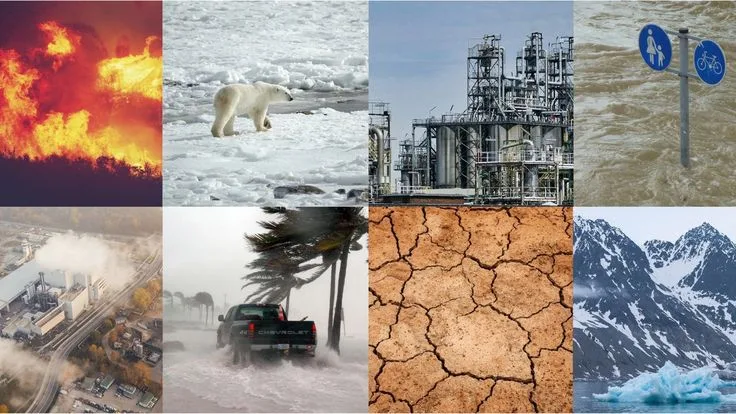
The enhanced greenhouse effect is warming the planet because human emissions add heat-trapping gases, especially carbon dioxide, to the atmosphere. Climate change fundamentals include the distinction between natural greenhouse warming and its human-driven intensification, the roles of feedbacks and radiative forcing, and the differing lifetimes of greenhouse gases. Reducing emissions limits future warming, while remaining impacts require adaptation.
Climate change is the long-term shift in global temperatures and weather patterns driven primarily by human emissions of greenhouse gases, especially carbon dioxide (CO2) from burning fossil fuels.
The mechanism is straightforward physics: certain gases in the atmosphere absorb and re-emit infrared radiation (heat) from Earth's surface, warming the planet.
Since the Industrial Revolution, human activity has increased atmospheric CO2 from 280 parts per million (ppm) to over 420 ppm - a level not seen on Earth for at least 3 million years.
This enhanced greenhouse effect has already warmed the planet by approximately 1.2 degrees Celsius above pre-industrial levels, with cascading consequences for sea levels, weather extremes, ecosystems, and human civilization.
Understanding climate change requires understanding four things: the physics of how greenhouse gases trap heat, the evidence that humans are causing the warming, the feedback mechanisms that amplify it, and the scale of the challenge of stopping it.
The Testimony That Crystallized a Crisis
On June 23, 1988, NASA scientist James Hansen testified before the US Senate Committee on Energy and Natural Resources. Outside, Washington DC sweltered in a record heat wave.
Inside, Hansen told the senators something that had been building in the scientific literature for decades: the greenhouse effect was no longer a future threat. It had arrived. The planet was warming, and human emissions of CO2 were the cause.
Hansen's testimony was not a sudden announcement but a crystallization of understanding that had been developing since the 19th century. In 1824, Jean-Baptiste Fourier had calculated that Earth should be far colder than it is - something in the atmosphere must be trapping heat.
In 1859, John Tyndall experimentally confirmed that water vapor and CO2 absorb infrared radiation. In 1896, Svante Arrhenius calculated that doubling atmospheric CO2 would warm the Earth by 5-6 degrees Celsius - a remarkably close prediction to modern estimates of approximately 3 degrees Celsius.
By 1988, atmospheric CO2 had risen from pre-industrial levels of about 280 ppm to 350 ppm, and the fingerprints of greenhouse warming were appearing in temperature records, sea level measurements, and glacial observations.
By 2024, CO2 had reached 422 ppm, and the consequences predicted by Hansen and his colleagues were unfolding with alarming precision.
"We are conducting a vast geophysical experiment of a kind that could not have happened in the past nor be reproduced in the future.
Within a few centuries we are returning to the atmosphere and oceans the concentrated organic carbon stored in sedimentary rocks over hundreds of millions of years." - Roger Revelle and Hans Suess, Tellus, 1957
Key Definitions
Greenhouse effect - The process by which the atmosphere absorbs and re-emits infrared (heat) radiation from Earth's surface, warming the planet. Solar radiation passes through the atmosphere and warms the surface. The surface emits infrared radiation upward.
Greenhouse gases absorb this infrared radiation and re-emit it in all directions, including back toward Earth.
Without the natural greenhouse effect, Earth's average surface temperature would be approximately -18 degrees Celsius instead of the current +15 degrees Celsius - a difference of 33 degrees that makes life as we know it possible.
Enhanced greenhouse effect - The intensification of the natural greenhouse effect due to human emissions of greenhouse gases, primarily CO2 from burning fossil fuels. The enhanced greenhouse effect is the mechanism driving global warming.
Greenhouse gas (GHG) - A gas that absorbs and re-emits infrared radiation. The major human-produced greenhouse gases, their sources, and their relative warming contributions are:
| Greenhouse Gas | Chemical Formula | Primary Human Sources | Share of Human Emissions | Atmospheric Lifetime |
|---|---|---|---|---|
| Carbon dioxide | CO2 | Fossil fuel combustion, deforestation | ~76% | Hundreds to thousands of years |
| Methane | CH4 | Livestock, natural gas leaks, landfills, rice paddies | ~16% | ~12 years |
| Nitrous oxide | N2O | Agriculture (fertilizers), combustion | ~6% | ~114 years |
| Fluorinated gases | Various (HFCs, PFCs, SF6) | Refrigeration, industry | ~2% | Varies (years to millennia) |
Water vapor is the most abundant natural greenhouse gas, but its atmospheric concentration is controlled by temperature (warmer air holds more moisture), making it a feedback rather than a forcing agent.
Global Warming Potential (GWP) - A measure of how much energy a gas absorbs over a given time period, relative to CO2. Methane has a GWP of 28-36 over 100 years - it traps 28-36 times more heat per molecule than CO2 but persists in the atmosphere for only about 12 years.
Nitrous oxide has a GWP of 273. Some fluorinated gases have GWPs in the thousands.
CO2 equivalent (CO2e) - A metric that combines all greenhouse gases into a single number, expressed as the amount of CO2 that would cause the same warming. Total human greenhouse gas emissions are approximately 55 billion tonnes of CO2e per year (Global Carbon Project, 2023).
Radiative forcing - The change in energy flux in the atmosphere caused by natural or anthropogenic factors, measured in watts per square meter (W/m2). Positive forcing causes warming; negative forcing causes cooling. Total anthropogenic radiative forcing is approximately +2.7 W/m2 above the 1750 pre-industrial baseline (IPCC, 2021).
Carbon budget - The total amount of CO2 that can be emitted while limiting warming to a given level. The remaining carbon budget for limiting warming to 1.5 degrees Celsius is approximately 500 billion tonnes of CO2 (as of 2023).
At current emission rates of ~37 billion tonnes per year, this budget would be exhausted in roughly 12-15 years.
Climate sensitivity - The amount of warming expected from a doubling of atmospheric CO2. The equilibrium climate sensitivity (ECS) is estimated at 2.5-4 degrees Celsius, with a best estimate of approximately 3 degrees Celsius (IPCC AR6, 2021).
This means doubling CO2 from pre-industrial 280 ppm to 560 ppm would ultimately warm the planet by approximately 3 degrees.
Tipping point - A threshold in the climate system at which a small change triggers a self-reinforcing transition to a different state that cannot be reversed by simply removing the original forcing. Examples include ice sheet collapse, permafrost thaw, and Amazon rainforest dieback.
A landmark paper by Timothy Lenton and colleagues in Nature (2019) identified nine tipping elements that may already be approaching or have crossed their thresholds.
The Physics of the Greenhouse Effect
How the Sun Heats Earth
The Sun emits radiation primarily as visible light (wavelengths 0.4-0.7 micrometers) and near-infrared radiation. Approximately 30 percent of incoming solar radiation is reflected back to space by clouds, ice, and light-colored surfaces (this reflectivity is called albedo). The remaining 70 percent is absorbed by the surface, warming it.
Earth's warmed surface emits radiation back upward - but as infrared radiation (heat), at longer wavelengths (4-100 micrometers). This is the fundamental asymmetry: solar radiation passes through the atmosphere relatively freely; Earth's emitted infrared radiation does not.
Why Some Gases Block Infrared Radiation
Molecules absorb radiation when the photon's energy corresponds to a natural vibration frequency of the molecule. CO2, methane, water vapor, and nitrous oxide are all asymmetric molecules that vibrate at frequencies corresponding to infrared wavelengths.
When an infrared photon hits a CO2 molecule, the CO2 vibrates, absorbs the energy, and re-emits a photon in a random direction - including back toward the surface.
The key property: oxygen (O2) and nitrogen (N2), which make up 99 percent of the atmosphere, are symmetric molecules that do not absorb infrared radiation at the relevant wavelengths. Only the trace gases - CO2 at 0.042 percent, methane at 0.00019 percent - produce the greenhouse effect.
Their small concentrations belie their enormous influence on planetary temperature.
This physics is not speculative or model-dependent. It was demonstrated experimentally by John Tyndall in 1859 and has been confirmed by laboratory measurements, satellite observations, and field studies thousands of times since.
The infrared absorption spectra of CO2, methane, and other greenhouse gases are among the most precisely measured quantities in all of physics.
Why CO2 Matters So Much
CO2's importance is not its immediate warming effect per molecule - molecule for molecule, methane is roughly 80 times more potent over 20 years. CO2's importance is its persistence: it remains in the atmosphere for hundreds to thousands of years.
Research by David Archer of the University of Chicago (2005) showed that when you burn a gallon of gasoline and release CO2, approximately 50 percent of that CO2 will still be in the atmosphere in 100 years. Roughly 25 percent will persist for thousands of years.
This persistence means that CO2 emissions are cumulative. The warming we experience today is the result of all CO2 emitted since the Industrial Revolution. The warming our descendants will experience will depend on all CO2 emitted between now and then.
There is no "reset button" - reducing emissions slows future warming but does not reverse warming already locked in by existing atmospheric concentrations.
The Evidence for Human-Caused Climate Change
The evidence that humans are causing climate change comes from multiple independent lines of observation and measurement. No single piece of evidence alone would be conclusive; taken together, they form what climate scientists call a convergence of evidence - the same conclusion reached through completely independent methods.
Temperature Records
Global average surface temperature has risen approximately 1.2 degrees Celsius since the pre-industrial era (1850-1900), with most of the warming occurring since the 1970s. The ten hottest years on record (through 2024) have all occurred since 2010.
The year 2023 was the hottest in recorded history, approximately 1.45 degrees Celsius above pre-industrial levels, and 2024 is on track to match or exceed it.
The temperature record comes from independent datasets maintained by NASA GISS, NOAA, the UK Met Office/CRU (HadCRUT), the Berkeley Earth project, and the Japanese Meteorological Agency, each using different methodologies, different raw data sources, and different quality-control procedures.
All reach essentially the same conclusion. The probability that five independent research groups using different methods would all produce the same wrong answer is vanishingly small.
Atmospheric CO2: The Keeling Curve
The Keeling Curve - a continuous measurement of atmospheric CO2 at the Mauna Loa Observatory in Hawaii, begun by Charles David Keeling in 1958 - is one of the most important scientific datasets in history.
It shows CO2 rising from 315 ppm in 1958 to over 422 ppm in 2024, with a distinctive sawtooth pattern reflecting seasonal vegetation cycles.
Extending the record using ice cores (air bubbles trapped in ancient Antarctic and Greenland ice) shows that CO2 was approximately 280 ppm before the Industrial Revolution and had fluctuated between roughly 180 ppm (ice ages) and 280 ppm (warm periods) for at least 800,000 years.
The current level of 422 ppm is approximately 50 percent higher than any point in that 800,000-year record.
The Isotopic Fingerprint
The isotopic signature of atmospheric CO2 confirms human causation with chemical precision. Fossil fuels, formed from ancient plants, are depleted in carbon-13 (a heavy, stable isotope) and entirely devoid of carbon-14 (a radioactive isotope that decays over thousands of years).
As fossil fuel CO2 enters the atmosphere, it shifts the isotopic ratios in exactly the direction predicted by combustion chemistry.
This shift - called the Suess effect, after Hans Suess who first identified it in 1955 - is a chemical fingerprint that cannot be explained by volcanic emissions, ocean outgassing, or any other natural CO2 source. Volcanic CO2 has a different isotopic signature.
Ocean-released CO2 has a different isotopic signature. Only fossil fuel combustion produces the observed pattern.
The Smoking Gun: The Troposphere-Stratosphere Pattern
One of the most decisive pieces of evidence for greenhouse gas forcing (versus solar forcing) is the distinct temperature pattern predicted by the two hypotheses:
- If the Sun is causing warming, both the troposphere (lower atmosphere, 0-12 km) and stratosphere (upper atmosphere, 12-50 km) should warm, because more solar energy enters the entire atmospheric column.
- If greenhouse gases are causing warming, the troposphere should warm while the stratosphere cools, because greenhouse gases trap heat in the lower atmosphere, reducing the amount of infrared radiation reaching the upper atmosphere.
The observed pattern: the troposphere has warmed significantly since 1950; the stratosphere has cooled. This pattern is inconsistent with solar forcing and precisely consistent with greenhouse gas forcing. It is one of the clearest "smoking gun" signatures in climate science.
Climate Feedbacks: Why Warming Amplifies Itself
The initial warming from doubling CO2 - from the direct radiative effect alone - is approximately 1 degree Celsius. This alone would be concerning but manageable. The reason climate sensitivity is estimated at approximately 3 degrees Celsius (not 1 degree) is the existence of feedback mechanisms that amplify the initial warming.
Positive Feedbacks (Amplifiers)
Water vapor feedback: Warming causes more water to evaporate from oceans, lakes, and soils. Water vapor is itself a powerful greenhouse gas. More water vapor leads to more warming, which causes more evaporation. This is the single most important climate feedback, approximately doubling the CO2-only warming.
It is also the best-understood feedback, confirmed by satellite measurements of atmospheric water vapor increasing at approximately 7 percent per degree of warming, consistent with the Clausius-Clapeyron equation from thermodynamics.
Ice-albedo feedback: Warming melts sea ice and glaciers. Ice is highly reflective (high albedo, reflecting 80-90 percent of sunlight); ocean water and bare land are much darker (low albedo, reflecting only 6-10 percent). Melting ice exposes darker surfaces that absorb more solar radiation, causing more warming, causing more melting.
This feedback is a major reason the Arctic is warming 2-4 times faster than the global average - a phenomenon called Arctic amplification.
Permafrost thaw: Approximately 1.7 trillion tonnes of carbon are stored in frozen Arctic soils (permafrost). As permafrost thaws, microbes decompose the organic matter, releasing CO2 and methane. This additional greenhouse gas release causes further warming, thawing more permafrost - a potentially self-reinforcing process.
Research by Merritt Turetsky and colleagues (2019, published in Nature) found that abrupt permafrost thaw could release 2-3 times more carbon than gradual thaw models predicted.
Amazon dieback: The Amazon rainforest creates approximately 25-50 percent of its own rainfall through transpiration (trees release water vapor, which forms rain clouds). As the forest is deforested and drought increases, the capacity for self-generated rainfall declines, causing more trees to die, reducing rainfall further.
Research by Thomas Lovejoy and Carlos Nobre (2018, published in Science Advances) suggested the Amazon may be approaching a tipping point beyond which the eastern Amazon transitions irreversibly to savanna.
Negative Feedbacks (Stabilizers)
Planck response: As the Earth warms, it emits more infrared radiation (a black body emits radiation proportional to the fourth power of temperature). This is the fundamental stabilizing feedback that eventually balances warming, determining the equilibrium temperature. Without it, any warming would be runaway.
Lapse rate feedback: Warming is uneven with altitude, reducing the rate at which temperature decreases with height in the tropics. This slightly reduces warming at the surface (a negative feedback), partly offsetting the positive feedbacks.
Cloud feedbacks: Clouds both reflect sunlight (cooling) and trap infrared radiation (warming). The net effect of cloud changes on warming has been the single largest source of uncertainty in climate projections.
Research published in the IPCC's Sixth Assessment Report (2021) narrowed this uncertainty significantly, concluding that cloud feedbacks are likely net positive (amplifying warming), though less so than previously feared in worst-case scenarios.
Projected Impacts at Different Warming Levels
The difference between warming levels is not linear - it is exponential in terms of impacts. The IPCC's Special Report on Global Warming of 1.5 degrees Celsius (2018) detailed the stark differences:
| Impact | 1.5 degrees C | 2 degrees C | 3 degrees C | 4+ degrees C |
|---|---|---|---|---|
| Sea level rise by 2100 | 0.26-0.77 m | 0.30-0.93 m | 0.40-1.10 m | 0.60-1.10+ m |
| Population exposed to extreme heat | 14% of land area | 37% of land area | >50% of land area | Extreme conditions |
| Coral reef decline | 70-90% | >99% | Effectively gone | Gone |
| Summer Arctic sea ice | Ice-free sometimes | Ice-free most years | Essentially gone | Gone |
| Global crop yield impact | Moderate stress | Significant stress | Major disruption | Crisis conditions |
| Species at risk of extinction | 6% of insects, 8% of plants | 18% of insects, 16% of plants | Higher percentages | Mass extinction risk |
The impacts are not uniformly distributed. Small island nations and coastal low-lying areas face existential threats from sea level rise - the Marshall Islands, Tuvalu, and parts of Bangladesh could become uninhabitable. Tropical and subtropical regions face the most severe heat extremes and agricultural disruption.
The Arctic is already transformed. Higher-latitude regions like Canada and Russia may experience net agricultural gains in the short term - a morally uncomfortable distribution of costs and benefits.
A World Bank report (2012, Turn Down the Heat) estimated that in a 4-degree-warmer world, agricultural yields in sub-Saharan Africa could decline by 15-35 percent, and global economic damages could reach 5-20 percent of global GDP annually - dwarfing the cost of preventing the warming.
What Would It Take to Stop Climate Change?
Stopping climate change requires reaching net-zero emissions by around 2050, which means transforming electricity generation, transportation, industry, buildings, and agriculture at historically unprecedented speed. Renewable energy costs have fallen dramatically, making the transition more economically feasible, but current policies still put the world on track for 2.5 to 3 degrees Celsius of warming rather than 1.5.
Most climate models also call for removing CO2 already in the atmosphere, through forests, soils, oceans, or direct air capture, alongside these emissions cuts.
The Decarbonization Challenge
Global CO2 emissions from fossil fuels and industry are approximately 37 billion tonnes per year (Global Carbon Project, 2023). Limiting warming to 1.5 degrees Celsius requires reaching net-zero emissions by approximately 2050. This requires transforming the global energy system at historically unprecedented speed:
- Electricity generation: Replace coal and natural gas with wind, solar, nuclear, and hydro. Electricity is the most tractable sector - renewable energy is already economically competitive.
- Transportation: Electrify vehicles, develop sustainable aviation fuel, and decarbonize shipping. Electric vehicle sales exceeded 14 million globally in 2023, up from under 1 million in 2017.
- Industry: Decarbonize steel, cement, and chemical production. These are among the hardest sectors because the processes themselves emit CO2 (cement-making releases CO2 from limestone, independent of the energy source).
- Buildings: Electrify heating, cooling, and cooking; improve insulation and efficiency.
- Agriculture and land use: Reduce methane from livestock, prevent deforestation, restore forests and wetlands.
The good news: renewable energy costs have plummeted. Solar electricity costs have fallen by over 90 percent since 2010, and wind by over 70 percent. Solar and wind are now the cheapest sources of new electricity generation in most of the world.
Battery costs have fallen by 97 percent since 1991 (adjusted for energy density). The economic trajectory favors decarbonization.
The bad news: the pace of change is still far too slow. Current policies (as of 2024) put the world on track for approximately 2.5-3 degrees Celsius of warming by 2100, not 1.5 degrees. The gap between what is needed and what is happening remains large.
The International Energy Agency (IEA) estimated in its 2023 Net Zero Roadmap that global investment in clean energy needs to reach approximately $4.5 trillion per year by 2030, roughly triple the 2023 level.
The Role of Carbon Removal
Even with aggressive emissions reductions, most climate models suggest that reaching 1.5 degrees Celsius requires also removing CO2 from the atmosphere - either biologically (forests, soils, ocean-based approaches) or technologically (direct air capture, or DAC).
Current direct air capture costs are approximately $300-1,000 per tonne of CO2. The largest operational DAC plant, Orca in Iceland (operated by Climeworks), captures approximately 4,000 tonnes of CO2 per year - equivalent to the annual emissions of roughly 870 cars.
A much larger facility, Mammoth, opened in 2024 with ten times the capacity. But even at 40,000 tonnes per year, this represents a tiny fraction of the 37 billion tonnes emitted annually.
The technology is real but requires dramatic cost reduction and scaling. The US Department of Energy's target is to bring DAC costs below $100 per tonne by 2030 through its Carbon Negative Shot initiative.
"The climate math is brutally clear. We need to be at net zero by mid-century, and every year of delay makes the challenge steeper." - Fatih Birol, Executive Director of the International Energy Agency, 2023
The Scientific Consensus
The scientific consensus on human-caused climate change is among the strongest in any field of science. A meta-analysis by John Cook and colleagues (2013), published in Environmental Research Letters, examined nearly 12,000 peer-reviewed climate science papers published between 1991 and 2011.
Among papers that stated a position on the cause of recent warming, 97.1 percent endorsed the consensus that human activity is the primary cause. A follow-up study by James Powell (2019), examining over 11,600 papers from 2019 alone, found the consensus had reached 100 percent in that year's literature.
Every major scientific organization in the world - including the American Physical Society, the Royal Society, the American Association for the Advancement of Science, the National Academy of Sciences, and their equivalents in every major country - has affirmed the consensus.
The Intergovernmental Panel on Climate Change (IPCC), which synthesizes the findings of thousands of scientists, stated in its Sixth Assessment Report (2021): "It is unequivocal that human influence has warmed the atmosphere, ocean and land."
The physics is well-established, the evidence is convergent, and the remaining scientific questions are about the precise magnitude and timing of impacts - not about whether human-caused warming is real.
For related concepts, see how the universe began, how nuclear energy works, why ships float explained, and exponential growth explained.
Sources & Further Reading
- IPCC. (2021). Climate Change 2021: The Physical Science Basis. Sixth Assessment Report. Cambridge University Press. DOI: 10.1017/9781009157896
- IPCC. (2018). Special Report on Global Warming of 1.5 degrees C. View source
- Hansen, J., et al. (1988). Global Climate Changes as Forecast by Goddard Institute for Space Studies Three-Dimensional Model. Journal of Geophysical Research: Atmospheres, 93(D8), 9341-9364.
- Arrhenius, S. (1896). On the Influence of Carbonic Acid in the Air upon the Temperature of the Ground. Philosophical Magazine and Journal of Science, 41(251), 237-276.
- Tyndall, J. (1861). On the Absorption and Radiation of Heat by Gases and Vapours. Philosophical Magazine, 22(146), 169-194.
- Revelle, R., & Suess, H. E. (1957). Carbon Dioxide Exchange Between Atmosphere and Ocean. Tellus, 9(1), 18-27.
- Lenton, T. M., et al. (2019). Climate Tipping Points - Too Risky to Bet Against. Nature, 575(7784), 592-595. DOI: 10.1038/d41586-019-03595-0
- Cook, J., et al. (2013). Quantifying the Consensus on Anthropogenic Global Warming in the Scientific Literature. Environmental Research Letters, 8(2), 024024. DOI: 10.1088/1748-9326/8/2/024024
- Archer, David. (2005). Fate of Fossil Fuel CO2 in Geologic Time. Journal of Geophysical Research, 110, C09S05.
- Global Carbon Project. (2023). Global Carbon Budget 2023. DOI: 10.5194/essd-2023-409
- World Bank. (2012). Turn Down the Heat: Why a 4 degrees C Warmer World Must Be Avoided. Washington, DC.
- International Energy Agency. (2023). Net Zero Roadmap: A Global Pathway to Keep the 1.5 degrees C Goal in Reach. View source