
In 1798, a young English clergyman named Thomas Robert Malthus published an essay that would haunt social and economic thought for two centuries.[1]
The argument of 'An Essay on the Principle of Population' was elegant and, Malthus believed, mathematically inescapable: food production could grow only arithmetically - incrementally, field by field, harvest by harvest - while human population had the capacity to grow geometrically, doubling and redoubling when unchecked.
The conclusion was stark. Population must always press against the limits of subsistence. Any improvement in the condition of the poor would only encourage them to have more children, driving up population until misery and disease restored the balance. Poverty was not a policy failure; it was the iron arithmetic of nature.
Malthus was writing in response to utopian optimists like William Godwin, who believed that reason and social reform could eliminate poverty. Malthus believed he was delivering a scientific refutation of that hope. His framework was widely accepted, deeply influential, and - in its core empirical prediction - spectacularly wrong.
When Malthus wrote, the global population was approaching 1 billion for the first time in human history. By 2022, 224 years later, it had crossed 8 billion.
Over this same period, average global life expectancy roughly tripled, real incomes increased enormously, and the share of the human population living in absolute poverty fell from nearly everyone to approximately 10 percent.
Food production did not grow arithmetically; it grew faster than population, so that despite eight times as many people, the world produces more food per person today than in Malthus's time.
How was this possible? And what do current demographic trends - fertility collapse in wealthy countries, continued growth in parts of the developing world, rapid population aging - mean for the future?
"Population, when unchecked, increases in a geometrical ratio. Subsistence increases only in an arithmetical ratio. A slight acquaintance with numbers will show the immensity of the first power in comparison of the second." - Thomas Robert Malthus, An Essay on the Principle of Population (1798)
Key Definitions
Demographic transition - The historical process by which societies move from high birth rates and high death rates (producing moderate population growth) through a phase of declining death rates but still high birth rates (producing rapid growth) and eventually to low birth rates and low death rates (producing slow growth or stability).
Almost all societies that have industrialized and developed have undergone some version of this transition.
Total fertility rate (TFR) - The average number of children a woman would have over her lifetime if current age-specific fertility rates remained constant. The TFR is the standard measure of a population's fertility.
A TFR of 2.1 is approximately the replacement rate - the level at which a stable population reproduces itself across generations (slightly above 2.0 to account for some mortality before reproductive age).
Replacement fertility - The TFR at which a population exactly replaces itself without immigration, approximately 2.1 children per woman in low-mortality countries. Countries with sustained fertility below 2.1 will eventually experience population decline absent net immigration.
Dependency ratio - The ratio of economically dependent population (typically children under 15 and elderly over 65) to the working-age population (15-64). A high old-age dependency ratio - many elderly relative to workers - creates fiscal pressure on pension and healthcare systems.
Population aging - The shift in a population's age distribution toward older cohorts, resulting from declining fertility and increasing longevity. Population aging is occurring in virtually all regions of the world, most rapidly in high-income countries and China.
Carrying capacity - In ecology, the maximum population of a species that a given environment can sustain indefinitely. In human population debates, carrying capacity is contested: humans can expand effective carrying capacity through technology, trade, and institutional change in ways that most other species cannot.
Pro-natalist policy - Government policies designed to encourage higher birth rates, such as child benefits, subsidized childcare, parental leave, and housing assistance for families. Pro-natalist policies are common in below-replacement-fertility countries but have generally produced only modest increases in fertility.
Net reproduction rate (NRR) - The average number of daughters that a woman would have over her lifetime, adjusted for mortality. An NRR of 1.0 is exactly replacement; below 1.0 indicates eventual population decline.
Global Demographic Snapshot: Selected Countries
| Country / Region | Total fertility rate (TFR) | Population trend | Old-age dependency ratio (65+/15-64) | Key demographic challenge |
|---|---|---|---|---|
| Niger | ~6.8 | Rapid growth | Low (~5%) | Food security; education capacity; demographic dividend if fertility falls |
| Sub-Saharan Africa (avg.) | ~4.5 | Rapid growth, slowing | Low (~6%) | 1 billion added by 2050; urbanization; youth employment |
| India | ~2.0 | Growth slowing toward replacement | Low-moderate (~11%) | Peak population ~2060-2070; regional variation; aging accelerating |
| United States | ~1.6 | Slow growth via immigration | Moderate (~27%) | Below-replacement native fertility; immigration key to workforce growth |
| China | ~1.0-1.1 | Near-peak; declining post-2022 | High and rising (~21%, accelerating) | One-child policy legacy; labor force contraction; pension system stress |
| Japan | ~1.2 | Declining since 2008 | Very high (~50%) | Deepest aging crisis; labor shortage; immigration resistance limits options |
| South Korea | ~0.72 | Declining | High and rising | Lowest sustained TFR ever recorded for a major country; housing costs, gender inequality cited |
| Germany | ~1.5 | Slow growth via immigration | Very high (~38%) | Below replacement for decades; immigration necessary to maintain workforce |
| Nigeria | ~5.3 | Rapid growth | Very low | Projected largest population growth of any country 2022-2100 |
| World average | ~2.4 | Growth slowing | Moderate (~16%) | Projected ~10 billion by 2080 then plateau or slight decline |
Sources: UN World Population Prospects 2022; World Bank data
Why Malthus Was Wrong: The Mechanisms of Escape
Malthus was not simply making a mistake; he was applying plausible logic to the conditions of his time and the economic theory available to him. What he could not foresee were the technological and institutional changes that would break the link between population growth and subsistence constraint.
The Demographic Transition
The first break was the demographic transition itself. As societies industrialized and living standards improved, death rates fell - particularly for infants and children. But birth rates did not fall immediately. The result was a surge in population growth as more children survived to adulthood.
Over subsequent generations, however, birth rates also fell. Families found that they could achieve their desired family size with fewer births. The need for children as agricultural labor diminished.
Women's education and labor force participation increased the opportunity cost of childbearing. The transition moved societies from high-birth/high-death equilibria to low-birth/low-death equilibria, with a period of rapid growth in between.[6]
Europe underwent this transition in the nineteenth and early twentieth centuries. East Asia - Japan, then South Korea, Taiwan, and China - underwent it with extraordinary speed in the mid-to-late twentieth century. South and Southeast Asia followed.
The Middle East is still in transition. Sub-Saharan Africa has begun the transition but remains at an earlier stage, with relatively high fertility and rapidly falling mortality, producing continued rapid population growth.[7]
Norman Borlaug and the Green Revolution
The second break was technological. Malthus assumed that agricultural production could grow only by bringing more land under cultivation, and that arable land was finite. What he could not anticipate was the transformation of agricultural productivity through science.
Norman Borlaug, an American plant geneticist working in Mexico, India, and Pakistan from the 1940s through the 1960s, developed high-yield dwarf wheat varieties that were responsive to fertilizer and resistant to disease.[4]
In combination with expanded irrigation, improved fertilizers, and better agricultural management, Borlaug's wheat - and parallel advances in rice by the International Rice Research Institute - triggered what became known as the Green Revolution.
India, which faced genuine famine risk in the mid-1960s, became a wheat exporter by the 1970s. Global cereal production roughly doubled between 1960 and 1990 while the area under cultivation increased by only about 15 percent. Borlaug was awarded the Nobel Peace Prize in 1970.
The Green Revolution was not without costs - chemical runoff, water depletion, the displacement of traditional agricultural diversity, and the concentration of agricultural markets.
But its demographic consequence was to decisively break the Malthusian ceiling: food production could grow faster than population through intensive rather than extensive cultivation, removing the subsistence constraint that Malthus considered absolute.
Paul Ehrlich and the Failed Prediction
Malthus was not the last to predict demographic catastrophe. In 1968 - the same year Garrett Hardin published the tragedy of the commons - Stanford biologist Paul Ehrlich published 'The Population Bomb,' which opened: "The battle to feed all of humanity is over.[2]
In the 1970s hundreds of millions of people will starve to death in spite of any crash programs embarked upon now." Ehrlich predicted imminent famine in India and other developing nations, proposed drastic measures to restrict population growth, and predicted that nothing short of this could prevent global catastrophe.
The predictions were wrong. The mass famines of the 1970s and 1980s did not materialize in the scale Ehrlich projected. The Green Revolution was already underway when he was writing. He substantially underestimated human adaptive capacity, technological innovation, and the power of markets and institutions to respond to scarcity signals.
Ehrlich's error was the same as Malthus's: treating the technological and institutional conditions of the present as fixed constraints rather than as variables subject to human ingenuity. Both were making essentially static arguments about a dynamic system.
The carrying capacity of the Earth for human life is not a fixed number; it expands with technology, contracts with environmental degradation, and depends on how resources are distributed and used.
This is not to say that population growth has no environmental consequences or that planetary limits do not exist.
But the most defensible position, given the historical record of failed catastrophist predictions, is that population growth poses challenges that human institutions and technology have so far proven capable of meeting - while acknowledging that this track record does not guarantee future success.
Current Global Trends
The 8 Billion Milestone
The global population crossed 8 billion in November 2022. The pace of absolute growth has slowed: it took 12 years to add the most recent billion (from 7 to 8 billion), compared to 13 years for the previous billion and 14 years for the one before that - but these numbers obscure the more fundamental shift in growth rates.
In absolute terms, the world adds roughly 80 million people per year; in relative terms, the growth rate has fallen to under 1 percent annually for the first time since before the mid-twentieth century surge.
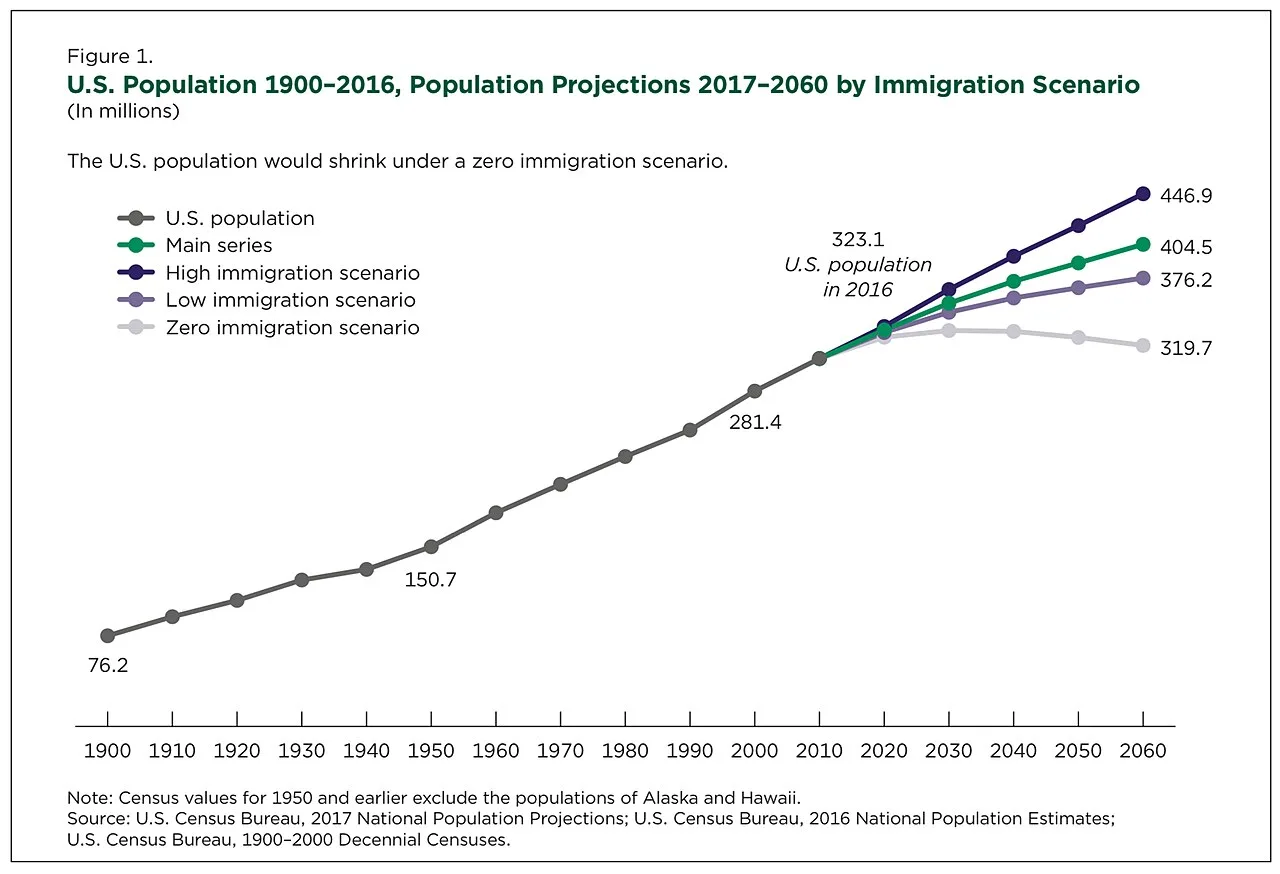
The UN's 2022 median projection expects global population to reach 9.7 billion in 2050 and peak at approximately 10.4 billion in the 2080s before beginning a very gradual decline.[3] But these median projections conceal wide uncertainty.
The high variant produces nearly 11 billion by 2100; the low variant produces about 8.9 billion and then continuing decline.
The entire difference between these scenarios is driven by assumptions about future fertility rates, which change one-quarter of a child per woman relative to the median.
Sub-Saharan Africa's Demographic Trajectory
The demographic story of the coming decades is, more than anything else, the demographic story of Sub-Saharan Africa. The region holds roughly 14 percent of the world's population today and is projected to account for more than half of all global population growth between now and 2050.
Several Sub-Saharan countries - Niger, Chad, Mali, Angola - have TFRs still well above 5, meaning the average woman has more than five children over her lifetime.
The reasons for Africa's continued high fertility include high child mortality (which increases the number of births needed to ensure adult children), lower rates of female education and contraception access, continued importance of children as agricultural labor and old-age support in rural economies, and cultural preferences for larger families.
Development economists broadly agree that the most powerful intervention to accelerate fertility decline is girls' education: every additional year of schooling a girl receives is associated with a meaningful reduction in subsequent fertility.
Investments in female education, healthcare, and contraception access are therefore simultaneously development investments and demographic ones.
The Fertility Collapse in High-Income Countries
At the other end of the spectrum, many high-income countries now have fertility rates that would, if sustained, produce rapid population decline. South Korea's TFR fell to 0.72 in 2023 - a number so low it is nearly without historical precedent for a major nation.[5]
Japan's TFR hovers around 1.2. Italy, Spain, and much of Eastern Europe are in the range of 1.2 to 1.5.
The drivers of this fertility collapse are discussed in depth in the context of population aging. But it is worth noting the limits of policy responses. Hungary has spent a higher share of its GDP on pro-natalist policies than almost any other country and has produced only modest increases in fertility.
France - which has invested heavily in childcare, parental leave, and child benefits for decades - has maintained fertility closer to 1.8, higher than most of Europe but still below replacement.
South Korea has spent billions with essentially no effect. The conclusion that most demographers draw is that pro-natalist policies can make a modest difference at the margin but cannot reverse a fundamental shift in how people value and organize family life.
Population Aging: The Dominant Demographic Challenge
The most consequential demographic trend in high-income countries is not population growth but population aging.
As fertility has fallen and longevity has increased, the age structure of populations is shifting dramatically - fewer young people relative to elderly, a declining working-age population relative to retirees, and rapidly growing healthcare and pension obligations.
Japan is both the world's most aged society and the most instructive case study. Its TFR has been below replacement since the early 1970s. Its life expectancy is among the world's highest at approximately 84 years. By 2023, nearly 30 percent of Japan's population was over 65 - a share that will continue growing.
The fiscal consequences are chronic: Japan's government debt exceeds 250 percent of GDP, driven partly by healthcare and pension expenditures for an aging population.
Japan has also been reluctant to use immigration as a demographic corrective, reflecting cultural preferences for ethnic homogeneity that are slowly yielding to economic necessity.
The dependency ratio - the ratio of working-age people to retirees - is the core fiscal metric. Japan's ratio has fallen from roughly 7 workers per retiree in the 1970s to under 2 today.[9]
This means dramatically higher per-worker contributions are required to fund the same level of retirement benefits, or that benefits must be cut, or retirement ages must be raised.[8] All three are happening, slowly and contentiously.
Germany, Italy, and most of Eastern Europe face similar trajectories. China, whose fertility was suppressed below natural levels by the one-child policy from 1980 to 2015, faces particularly rapid aging: a relatively young working-age population will contract sharply within the next two decades while the elderly cohort expands.
Population, Environment, and the Carrying Capacity Debate
The relationship between population size and environmental impact is frequently misunderstood in public debate, and the misunderstanding has significant political consequences. The intuitive assumption - more people means more environmental damage - is correct as a first approximation but misleading as a guide to policy.
The key insight, encapsulated in the IPAT identity developed by Paul Ehrlich and John Holdren in the 1970s, is that environmental impact equals Population times Affluence (per capita consumption) times Technology (the environmental impact of each unit of consumption).
Population matters, but so do affluence and technology - and in the current global situation, affluence is far more important than population in determining the total environmental footprint.
A child born in the United States generates, on average, many times the lifetime carbon emissions of a child born in Niger or Chad. Sub-Saharan Africa, the region with the highest birth rates in the world, is also the region with the lowest per capita energy consumption and carbon emissions.
The countries with the lowest fertility rates - the United States, Canada, Australia, Germany, Japan - are among the highest per capita emitters of greenhouse gases.
If the goal is reducing greenhouse gas emissions, the most effective interventions target the consumption patterns of wealthy countries, not the birth rates of poor ones.
This does not mean population is irrelevant to environmental pressure. As incomes rise in high-fertility developing countries - as they should, through economic development - per capita consumption and emissions will rise as well.
The combination of rising population and rising incomes in the developing world creates significant pressure on global resources.
But focusing primarily on population numbers, rather than on the development trajectories that determine consumption patterns, is both analytically confused and carries uncomfortable political implications: it directs attention toward controlling births in poor countries while deflecting attention from the consumption of wealthy ones.
The biodiversity and land-use dimensions of population growth are more direct. Expanding agricultural and pastoral land to feed growing populations - particularly in Sub-Saharan Africa and parts of South and Southeast Asia - is a primary driver of tropical deforestation, habitat loss, and biodiversity decline.
The relationship here is more direct than in climate: more people in agricultural societies means more land under cultivation, and land conversion is among the most significant immediate drivers of species extinction.
Ester Boserup's counter-Malthusian insight, developed in 'The Conditions of Agricultural Growth' (1965), provides a more dynamic perspective. Boserup argued that population pressure is not simply a threat to agricultural systems; it is a spur to agricultural intensification and innovation.[10]
When populations grow, farmers intensify cultivation, develop new techniques, and innovate to maintain or improve yields. Population pressure drives the development of more productive agricultural systems rather than simply straining existing ones.
This insight, like the Green Revolution it in some ways anticipated, challenges the static Malthusian picture.
Immigration as Demographic Response
Immigration is the most direct policy tool for addressing the labor force and fiscal consequences of population aging. Countries with robust immigration programs - Canada, Australia, New Zealand - have been more successful in maintaining workforce growth and fiscal sustainability than those that rely primarily on domestic fertility.
The United States' relatively higher fertility rate (around 1.6-1.7 in recent years, compared to under 1.5 for most of Western Europe) reflects in part the effect of immigration: immigrants and especially second-generation Americans tend to have higher fertility than native-born non-Hispanic white Americans, lifting the overall TFR.
The United States' continued population growth depends significantly on maintaining immigration levels.
Immigration does not fully solve the aging problem, because immigrants also age. A flow of immigrants in their twenties and thirties provides a demographic dividend for several decades but eventually adds to the elderly population.
The arithmetic requires continuous immigration to sustain the workforce ratio, which many countries find politically unsustainable.
The political backlash against immigration in Europe, the United States, and elsewhere reflects tensions between demographic necessity and nativist sentiment that are among the defining political conflicts of the early twenty-first century.
For the relationship between population dynamics and poverty traps in developing countries, see Economic Insights on How Poverty Traps Operate. For the connection between demographic change and climate, see Climate Change Fundamentals: The Science Explained.
For how inequality shapes health across different demographic groups, see How Inflation Functions: Causes and Central Bank Responses.
Sources & Further Reading
- Malthus, Thomas Robert. An Essay on the Principle of Population. J. Johnson, 1798.
- Ehrlich, Paul R. The Population Bomb. Ballantine Books, 1968.
- United Nations, Department of Economic and Social Affairs. World Population Prospects 2022: Summary of Results. UN DESA/POP/2022/TR/NO. 3, 2022. DOI: 10.18356/9789210014380
- Borlaug, Norman E. "The Green Revolution, Peace, and Humanity." Nobel Peace Prize Lecture, December 11, 1970. View source
- Demographic data, South Korea TFR 2023: Statistics Korea (KOSTAT). 2023 Birth Statistics. Published February 2024.
- Caldwell, John C. "Demographic Theory: A Long View." Population and Development Review 30, no. 2 (2004): 297-316. DOI: 10.1111/j.1728-4457.2004.00014.x
- Bongaarts, John. "Fertility Transition in the Developing World: Progress or Stagnation?" Studies in Family Planning 39, no. 2 (2008): 105-110. DOI: 10.1111/j.1728-4465.2008.00157.x
- Lee, Ronald, and Andrew Mason. "Population Aging and the Generational Economy: Key Findings." In Population Aging and the Generational Economy: A Global Perspective. Edward Elgar, 2011.
- Hsieh, Frank S., et al. "Japan's Aging Population: Challenges and Responses." IMF Working Paper. Washington, DC: International Monetary Fund, 2020.
- Boserup, Ester. The Conditions of Agricultural Growth: The Economics of Agrarian Change Under Population Pressure. Aldine Publishing, 1965.