
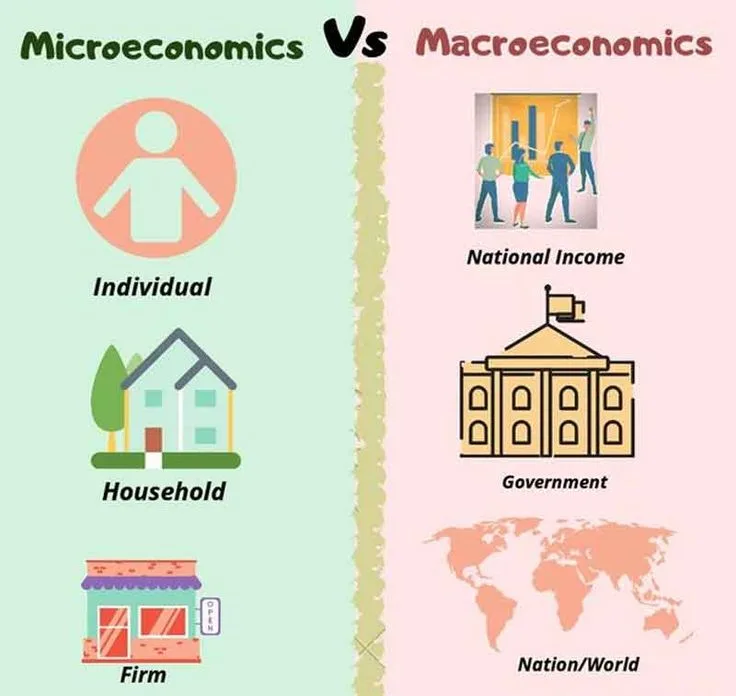
Microeconomics: Economics is the study of how people and organizations make decisions under conditions of scarcity - where resources are limited and choosing one thing means not choosing another.
The field divides into two broad branches that analyze economic behavior at different scales: microeconomics, which examines individual decisions and specific markets, and macroeconomics, which examines the economy as a whole.
The distinction matters because economic behavior at the individual level does not simply scale up to produce the same patterns at the aggregate level. What is rational for an individual household can be irrational for the economy as a whole when multiplied across millions of households simultaneously.
Understanding both levels of analysis - and where they connect and diverge - provides a far more complete framework for interpreting business decisions, government policy, and your own financial choices.
The terms themselves reflect the Greek roots mikros (small) and makros (large). While the analytical distinction has been implicit in economic thought since Adam Smith, the formalization of macroeconomics as a distinct field is largely credited to John Maynard Keynes, whose 1936 work The General Theory of Employment, Interest and Money argued that aggregate economic behavior required its own analytical framework - one that could not be derived by simply summing up individual decisions.[1]
The publication of that book is often cited as the founding moment of modern macroeconomics.
What Is Microeconomics?
Microeconomics is the branch of economics that studies the decisions made by individual agents - consumers, firms, households, and workers - and how those decisions interact in specific markets to determine prices, quantities, and the allocation of resources.
The central questions of microeconomics are:
- How do buyers and sellers interact to determine the price and quantity of a specific good or service?
- How do firms decide how much to produce and at what price?
- How do consumers allocate limited budgets across competing wants?
- What happens when markets fail to produce efficient outcomes?
Supply and Demand: The Foundation
The most fundamental tool in microeconomics is the model of supply and demand, which describes how prices emerge from the interaction between buyers and sellers in a market.
Demand represents buyers' relationship between price and quantity: the lower the price, the more units consumers typically want (the law of demand). A demand curve plots this relationship, sloping downward from left to right.
Supply represents sellers' relationship between price and quantity: at higher prices, producers are willing to supply more units because profitability increases (the law of supply). A supply curve slopes upward.
Market equilibrium occurs where supply equals demand - the price at which the quantity producers want to sell exactly matches the quantity consumers want to buy. Prices above equilibrium produce surpluses that push prices back down; prices below equilibrium produce shortages that push prices back up.
This framework predicts the direction of price changes from any shift in underlying conditions. If a drought destroys 30% of wheat production (supply falls), wheat prices rise. If a new diet trend reduces demand for red meat, beef prices fall. The model is simple but its predictive power across diverse situations is remarkable.
Alfred Marshall's Principles of Economics (1890) gave the supply-and-demand model its modern form, including the graphical representation and the concept of elasticity.[2] Marshall's student, A.C. Pigou, extended it to include externalities and welfare economics.[11]
The model they developed remains the starting point for every introductory economics course worldwide, not because it captures all complexity but because its core logic is robust and its predictions are directionally reliable.
Consumer Theory: How People Make Choices
Behind the demand curve lies a theory of consumer decision-making. The standard model assumes consumers have preferences over bundles of goods that can be represented by a utility function - a mathematical representation of how much satisfaction different combinations of goods provide.
Consumers maximize utility subject to a budget constraint - the combinations of goods they can actually afford at prevailing prices. The optimal choice occurs where the marginal rate of substitution (the rate at which a consumer is willing to trade one good for another) equals the price ratio between those goods.
This model predicts not just that demand curves slope downward, but how demand changes when prices change: an increase in price produces both a substitution effect (the good is now more expensive relative to alternatives, so substitute toward cheaper goods) and an income effect (the price increase makes the consumer effectively poorer, reducing demand for normal goods).
For most goods, both effects push in the same direction - price increase reduces demand.
For Giffen goods - a theoretical exception where the income effect is so large and negative that demand rises when price rises - the law of demand can be violated, though empirically confirmed examples are rare.
Elasticity: How Sensitive Are Quantities to Price?
Elasticity measures how sensitive quantity demanded or supplied is to changes in price or income.
Price elasticity of demand answers: if price rises by 10%, by what percentage does quantity demanded fall? If the percentage fall in quantity exceeds the percentage rise in price, demand is elastic (sensitive to price). If the percentage fall is less, demand is inelastic.
| Good Type | Elasticity | Reasoning | Example |
|---|---|---|---|
| Luxury goods | Elastic | Easily foregone if expensive | Designer handbags |
| Necessities | Inelastic | Purchased regardless of price | Insulin, gasoline |
| Goods with close substitutes | Elastic | Consumers switch to alternatives | One cola brand |
| Goods with no substitutes | Inelastic | No alternatives available | Life-saving medication |
| Goods representing small budget share | Inelastic | Not worth careful scrutiny | Table salt, shoelaces |
| Goods representing large budget share | Elastic | Large enough to pay attention to | Housing, cars |
Elasticity matters for pricing strategy, taxation policy, and predicting market responses.
A government that wants to reduce smoking with a cigarette tax benefits from knowing that cigarette demand is relatively inelastic - smokers will pay higher prices rather than quit easily - meaning the tax raises revenue without much behavior change, but the revenue can fund cessation programs.
Meta-analyses of tobacco price elasticity by Chaloupka & Warner (2000) found elasticity of approximately -0.3 to -0.5 in high-income countries, with somewhat higher sensitivity among younger smokers.[6]
Market Structures
Not all markets work the same way. Microeconomics categorizes markets by their competitive structure:
Perfect competition: Many small sellers of identical products, no single seller can influence price, easy entry and exit. Agricultural commodity markets approximate this. Firms earn only normal profits in the long run, and prices reflect marginal costs of production.
Monopoly: A single seller controls the entire market supply. The monopolist can set prices above competitive levels by restricting output. Examples include some utility services in areas without competition.
Monopoly is the market structure most studied in antitrust law because its welfare costs - reduced output, higher prices, deadweight loss - are well-characterized theoretically and measurable empirically.
Oligopoly: A small number of large firms dominate the market, each aware of and responding to the others' decisions. Technology, airlines, and automobiles are oligopolistic in most markets.
Strategic interaction between firms produces complex dynamics best modeled using game theory - the mathematical study of strategic decision-making developed by John von Neumann and Oskar Morgenstern in 1944 and extended by John Nash (whose Nash equilibrium concept earned him the Nobel Prize in 1994).[15]
Monopolistic competition: Many sellers of differentiated products, each with some pricing power from product differentiation. Restaurants, clothing, and most retail sectors fit this model. Like perfect competition, there are many competitors; like monopoly, each firm has some price-setting ability due to differentiation.
Monopsony: A single buyer dominates the market for a good or input. The monopsony model is particularly important for labor economics - a single large employer in a town (a classic company town) can pay wages below competitive levels because workers have no alternative employers.
Monopsony power is increasingly invoked to explain why minimum wage increases sometimes do not reduce employment as classical theory predicts (Dube et al., 2020).[9]
Externalities: When Markets Fail
Externalities are costs or benefits imposed on parties outside a market transaction. When a factory produces steel and emits pollution that harms nearby residents, those residents bear costs they did not agree to - a negative externality.
When a beekeeper's hives pollinate nearby farms, farmers receive benefits they did not pay for - a positive externality.
Markets with externalities allocate resources inefficiently: negative externalities result in overproduction of the harmful good (pollution is "free" to the producer so they produce too much), while positive externalities result in underproduction of the beneficial activity (innovators cannot capture all the social value their innovations create).
The microeconomic prescriptions are: tax negative externalities to force producers to bear the full social cost (a Pigouvian tax, named for A.C. Pigou who developed the framework in 1920), and subsidize positive externalities to encourage more of the beneficial activity (public research funding, education subsidies).
Carbon pricing is the largest-scale application of Pigouvian taxation in history. The European Union's Emissions Trading System (ETS), launched in 2005, is the world's largest carbon market, covering over 10,000 power stations and industrial plants across Europe.
By pricing CO2 emissions at market rates, the ETS forces emitters to internalize the social cost of carbon that markets would otherwise treat as free. Similar systems operate in California, British Columbia, and other jurisdictions.
A second approach to externalities, articulated by Ronald Coase in his 1960 paper "The Problem of Social Cost," argues that if property rights are well-defined and transaction costs are low, private bargaining between the affected parties can internalize externalities without government intervention - the Coase theorem.[8]
The practical limitations of zero-transaction-cost bargaining are obvious in cases involving millions of affected parties (as with air pollution), but the theorem remains important as a benchmark for understanding when private solutions versus government intervention are likely to be more efficient.
Information Asymmetry
Information asymmetry occurs when one party in a transaction has significantly more information than the other, distorting market outcomes.
Adverse selection - a pre-transaction problem - occurs when one side of the market cannot verify quality.
George Akerlof's seminal 1970 paper "The Market for Lemons" showed that in a used car market where buyers cannot distinguish good cars from lemons, the fear of buying a lemon drives down the maximum buyers will pay, which drives quality sellers out of the market (since they cannot credibly signal quality), which further reduces buyer willingness to pay - potentially collapsing the market.[3]
Akerlof won the Nobel Prize in 2001 for this insight and its extensions to insurance markets (where unhealthy people are more likely to seek coverage) and credit markets (where riskier borrowers are more willing to accept high-interest loans).
Moral hazard - a post-transaction problem - occurs when one party changes behavior in a risky direction after a risk has been transferred to another party. Insurance creates moral hazard: someone with comprehensive car insurance may drive less carefully than someone who bears the full cost of any accident.
Health insurance creates moral hazard: insured patients may use more medical services than they would if paying out of pocket.
These concepts are foundational to understanding insurance design, contract theory, and regulatory economics - and they explain why free markets without information institutions (ratings agencies, certification systems, disclosure requirements, warranties) tend to function poorly in markets for complex goods.
What Is Macroeconomics?
Macroeconomics is the branch of economics that examines the aggregate economy - the behavior and performance of the entire economic system of a country or region.
It studies phenomena that emerge from the interactions of all the individual micro-level decisions but cannot be fully understood by analyzing any individual decision in isolation.
The central questions of macroeconomics are:
- What determines the total output (GDP) of an economy?
- What causes unemployment, and how is the labor market clearing at the national level?
- What causes inflation, and how does it affect economic well-being?
- How do government fiscal policy and central bank monetary policy affect growth and stability?
- What drives business cycles - the alternation between expansion and recession?
GDP: Measuring Economic Output
Gross Domestic Product (GDP) is the total market value of all final goods and services produced within a country's borders during a specific time period. It is the primary measure of economic size and growth.
GDP is measured three equivalent ways:
- Expenditure approach: GDP = Consumption + Investment + Government spending + Net exports (C + I + G + NX)
- Income approach: Sum of all incomes earned in production (wages, profits, rent, interest)
- Production approach: Sum of value added at each stage of production
Real GDP adjusts for inflation to measure actual changes in productive output. A country whose nominal GDP rose 5% but whose prices rose 5% saw no real economic growth. Real GDP growth is the standard measure of economic expansion.
Per capita GDP (GDP divided by population) is a rough measure of average living standards, though it obscures distribution: a country where all output goes to 1% of the population has the same per capita GDP as one where output is evenly distributed, despite dramatically different typical welfare.
GDP also excludes non-market production (household labor, volunteer work, natural capital depletion) and measures activity rather than well-being - producing substantial criticism from economists including Joseph Stiglitz, Amartya Sen, and Jean-Paul Fitoussi, whose 2009 Commission on the Measurement of Economic Performance and Social Progress argued for supplementing GDP with broader well-being metrics (Stiglitz, Sen & Fitoussi, 2009).[13]
| Country | Nominal GDP 2023 (USD trillion) | GDP per capita (USD) | Real GDP Growth 2023 |
|---|---|---|---|
| United States | 27.4 | 80,030 | 2.5% |
| China | 17.7 | 12,540 | 5.2% |
| Germany | 4.4 | 52,820 | -0.3% |
| India | 3.7 | 2,600 | 7.2% |
| United Kingdom | 3.1 | 45,850 | 0.1% |
| Japan | 4.2 | 33,950 | 1.9% |
Source: World Bank, IMF World Economic Outlook (2024 estimates)[14]
Inflation: The Rising Price Level
Inflation is the sustained increase in the general level of prices across an economy. It is measured by price indices: the Consumer Price Index (CPI) tracks a basket of goods and services typical households purchase; the Personal Consumption Expenditures (PCE) index is preferred by the US Federal Reserve.
Moderate inflation (around 2%, the Fed's target) is considered healthy in modern macroeconomic consensus. Very low inflation or deflation (falling prices) is dangerous because it incentivizes delay of spending (if prices will be lower tomorrow, why buy today?) and increases the real burden of debt.
High inflation erodes purchasing power, distorts economic decision-making, and disproportionately harms fixed-income earners and savers.
"Inflation is always and everywhere a monetary phenomenon in the sense that it is and can be produced only by a more rapid increase in the quantity of money than in output." - Milton Friedman, The Counter-Revolution in Monetary Theory (1970)[10]
The causes of inflation are debated, but major sources include: demand-pull inflation (too much money chasing too few goods, often from fiscal stimulus), cost-push inflation (supply shocks that raise production costs, like oil price spikes), and built-in inflation (wage-price spirals where wage increases lead to price increases lead to wage demands).
The 2021-2023 global inflation episode combined all three: supply chain disruptions (cost-push), massive fiscal stimulus (demand-pull), and some wage growth in tight labor markets, producing inflation rates in developed economies not seen since the early 1980s.
Unemployment and the Labor Market
Unemployment is the proportion of the labor force that is actively seeking work but not employed. Macroeconomists distinguish several types:
Frictional unemployment arises from the normal time it takes workers to match with jobs - even in a healthy economy, people are always transitioning between jobs, and this transition takes time. Some frictional unemployment is inevitable and healthy.
Structural unemployment arises from mismatches between workers' skills and the skills employers need - as when an industry declines (manufacturing job loss to automation or offshoring) and displaced workers lack skills for available jobs in growing sectors.
Cyclical unemployment arises from insufficient aggregate demand during recessions. When economic output falls below potential, firms reduce employment; cyclical unemployment rises and falls with the business cycle. This is the type of unemployment Keynesian policies are designed to address.
The natural rate of unemployment (or NAIRU - Non-Accelerating Inflation Rate of Unemployment) is the rate consistent with stable inflation - the unemployment rate below which wage and price pressures begin to accelerate.
Estimates for the US natural rate in recent years have ranged from approximately 4-5%, though the pandemic period revealed that the true natural rate may be lower than economists had assumed, as unemployment fell below 4% in 2022-2023 without triggering the wage-price spiral many feared.
Monetary Policy: The Central Bank's Toolkit
Monetary policy refers to central bank actions designed to influence the money supply, interest rates, and ultimately economic growth and inflation.
The Federal Reserve (US), European Central Bank (EU), Bank of England (UK), and equivalent institutions in each country have mandates to maintain price stability and, in the case of the Fed, also to promote maximum employment.
The primary monetary policy tool is the policy interest rate - in the US, the federal funds rate, which is the interest rate at which banks lend to each other overnight. When the Fed raises this rate:
- Borrowing costs rise throughout the economy (mortgages, business loans, auto loans)
- Investment and consumption decline
- Economic growth slows
- Inflationary pressure eases
When the Fed cuts rates, borrowing becomes cheaper, stimulating investment and consumption, supporting employment and growth.
Following the 2008 financial crisis, with interest rates at zero, central banks deployed quantitative easing (QE) - purchasing government bonds and mortgage-backed securities to inject money into the financial system and reduce long-term interest rates beyond what the policy rate alone could achieve.
The Fed's balance sheet expanded from approximately $900 billion in 2008 to over $4.5 trillion by 2015, and to nearly $9 trillion at the peak of pandemic-era QE in 2022.
Fiscal Policy: Government Taxing and Spending
Fiscal policy refers to government decisions about taxation and spending, used to influence aggregate demand. It is implemented by elected legislatures and executives, making it more politically constrained than monetary policy.
Expansionary fiscal policy - increased government spending and/or tax cuts - adds to aggregate demand.
The Keynesian multiplier suggests that government spending creates ripple effects: a $1 government expenditure increases GDP by more than $1 because the initial recipients spend their income, creating income for others who also spend, and so on.
The magnitude of the fiscal multiplier is empirically contested. During normal economic conditions, estimates cluster around 0.8-1.5 for government spending (Blanchard & Leigh, 2013).[5]
During recessions, when monetary policy is constrained by the zero lower bound, multipliers may be larger - estimates during the 2009 recession suggested multipliers of 1.5-2.0 (Christiano, Eichenbaum & Rebelo, 2011).[7]
During periods of full employment, multipliers may be smaller because government spending crowds out private investment.
Contractionary fiscal policy - reduced spending and/or tax increases - removes demand from the economy and is typically used to reduce deficits or cool an overheating economy.
The persistent debate between Keynesian economists (who favor active fiscal policy to smooth business cycles) and classical/neoclassical economists (who argue markets self-correct and fiscal policy mostly crowds out private investment) has shaped policy debates for nearly a century.
The 2008-2009 financial crisis renewed interest in Keynesian fiscal policy after decades of relative neglect; the subsequent austerity debates in Europe and the stimulus debates in the US reflected both economic disagreements and political value conflicts about the appropriate role of government.
How Microeconomics and Macroeconomics Connect
The relationship between micro and macro is not simply "micro is small and macro is big." It is a relationship of emergence: macroeconomic phenomena emerge from millions of microeconomic decisions but cannot be understood by simply aggregating them.
The Fallacy of Composition
The fallacy of composition is the error of assuming that what is true for individuals must be true for the aggregate. Macroeconomics is full of examples where individual rationality produces collective irrationality.
The paradox of thrift (Keynes): During a recession, it is individually rational for each household to save more and spend less to protect finances. But if all households do this simultaneously, total spending falls, aggregate demand collapses, output falls, incomes fall, and people become poorer - the opposite of their individual goal.
This paradox is the core justification for countercyclical fiscal policy: the government can increase spending precisely when households are collectively reducing it, sustaining aggregate demand.
The coordination failure in bank runs: It is individually rational for each depositor to withdraw money from a bank that might fail. But if all depositors act on this rational fear simultaneously, they cause the bank failure they feared, regardless of whether the bank was initially solvent.
This is why deposit insurance exists - to eliminate the incentive for individual depositors to run, preventing the coordination failure that causes the systemic problem.
Labor market adjustment: A single firm can profitably lower wages during a recession. But if all firms lower wages simultaneously, consumer income falls, demand for products falls, and the recession deepens rather than resolves.
This is why Keynes argued that wage cuts are not self-correcting during a general demand shortfall - unlike in the microeconomic model of a single market.
Micro Foundations of Macro
Modern macroeconomics attempts to ground aggregate models in explicit microeconomic behavior - asking what rational, optimizing individual decisions would produce the observed aggregate patterns.
This approach, called microfoundations, has been influential but also criticized for relying on unrealistic assumptions about individual rationality that behavioral economics has repeatedly challenged.
Dynamic Stochastic General Equilibrium (DSGE) models - the dominant framework in academic macroeconomics - build aggregate behavior from microeconomic first principles, including optimization by households and firms, market clearing, and rational expectations.
These models were criticized for failing to predict or explain the 2008 financial crisis, leading to significant internal debate about their limitations (Romer, 2016).[12] Former Bank of England Chief Economist Andy Haldane famously described DSGE models as "spectacularly ill-suited" to analyzing financial crises.
Behavioral macroeconomics incorporates insights from behavioral economics - bounded rationality, loss aversion, reference-dependent preferences - to build more realistic models.
George Akerlof and Robert Shiller's work on animal spirits (Akerlof & Shiller, 2009) argues that confidence, fairness norms, and narrative-driven expectations are essential to understanding macroeconomic fluctuations that pure rational-expectations models cannot explain.[4]
Key Differences at a Glance
| Dimension | Microeconomics | Macroeconomics |
|---|---|---|
| Scale | Individual agents, specific markets | Entire economies, national aggregates |
| Key variables | Price, quantity, market structure | GDP, inflation, unemployment, interest rates |
| Policy tools | Competition law, taxes, regulation | Monetary policy, fiscal policy |
| Core models | Supply and demand, utility maximization | IS-LM, AD-AS, DSGE models |
| Founding figures | Marshall, Pigou, Coase, Arrow | Keynes, Friedman, Samuelson, Lucas |
| Typical errors | Missing aggregate feedback effects | Missing distributional consequences |
| Level of analysis | Positive (what is) and normative (what should be) | Primarily positive, with major policy implications |
Why Both Matter for Individuals
Understanding microeconomics helps you:
- Negotiate wages: Supply and demand in labor markets determine wages; understanding when you have leverage (scarce skills, tight labor market) versus when you do not improves negotiation outcomes
- Make consumer decisions: Understanding elasticity and substitute goods helps identify when brand loyalty is economically irrational
- Evaluate business decisions: Marginal analysis - comparing marginal costs and marginal revenues - is the foundation of most optimal business decisions
- Assess policy arguments: Proposals to raise the minimum wage, regulate monopolies, or tax pollution all rest on microeconomic logic that can be evaluated with basic supply and demand tools
Understanding macroeconomics helps you:
- Interpret Federal Reserve decisions: Knowing that rate increases are designed to slow inflation and employment growth allows you to anticipate their effects on mortgage rates, job markets, and investments
- Time major financial decisions: Understanding the relationship between interest rates and housing prices, or between recession and equity valuations, does not enable perfect timing but provides context for major decisions
- Evaluate government budget claims: Understanding the difference between deficit spending during a recession (which Keynesian theory supports) and structural deficit spending during full employment helps evaluate fiscal policy claims
- Understand your own labor market position: Macroeconomic conditions determine how competitive the job market is, what wage growth to expect, and how much negotiating leverage workers have versus employers
Economics is not a set of answers to follow. It is a set of analytical tools for thinking clearly about how incentives, constraints, and decisions produce outcomes. Both microeconomics and macroeconomics contribute essential parts of that toolkit.
Sources & Further Reading
- Keynes, J. M. (1936). The General Theory of Employment, Interest and Money. Macmillan.
- Marshall, A. (1890). Principles of Economics. Macmillan.
- Akerlof, G. A. (1970). The market for "lemons": Quality uncertainty and the market mechanism. Quarterly Journal of Economics, 84(3), 488-500. DOI: 10.2307/1879431
- Akerlof, G. A., & Shiller, R. J. (2009). Animal Spirits: How Human Psychology Drives the Economy, and Why It Matters for Global Capitalism. Princeton University Press.
- Blanchard, O., & Leigh, D. (2013). Growth forecast errors and fiscal multipliers. American Economic Review, 103(3), 117-120. DOI: 10.1257/aer.103.3.117
- Chaloupka, F. J., & Warner, K. E. (2000). The economics of smoking. In Handbook of Health Economics. Elsevier.
- Christiano, L., Eichenbaum, M., & Rebelo, S. (2011). When is the government spending multiplier large? Journal of Political Economy, 119(1), 78-121. DOI: 10.1086/659312
- Coase, R. H. (1960). The problem of social cost. Journal of Law and Economics, 3, 1-44. DOI: 10.1086/466560
- Dube, A., et al. (2020). Monopsony in online labor markets. American Economic Review: Insights, 2(1), 33-46. DOI: 10.1257/aeri.20180150
- Friedman, M., & Schwartz, A. J. (1963). A Monetary History of the United States, 1867-1960. Princeton University Press.
- Pigou, A. C. (1920). The Economics of Welfare. Macmillan.
- Romer, P. (2016). The trouble with macroeconomics. American Economist, 20(10), 1-20.
- Stiglitz, J. E., Sen, A., & Fitoussi, J. P. (2009). Report by the Commission on the Measurement of Economic Performance and Social Progress. Commission on the Measurement of Economic Performance and Social Progress.
- World Bank. (2024). World Development Indicators. World Bank. View source
- von Neumann, J., & Morgenstern, O. (1944). Theory of Games and Economic Behavior. Princeton University Press.