
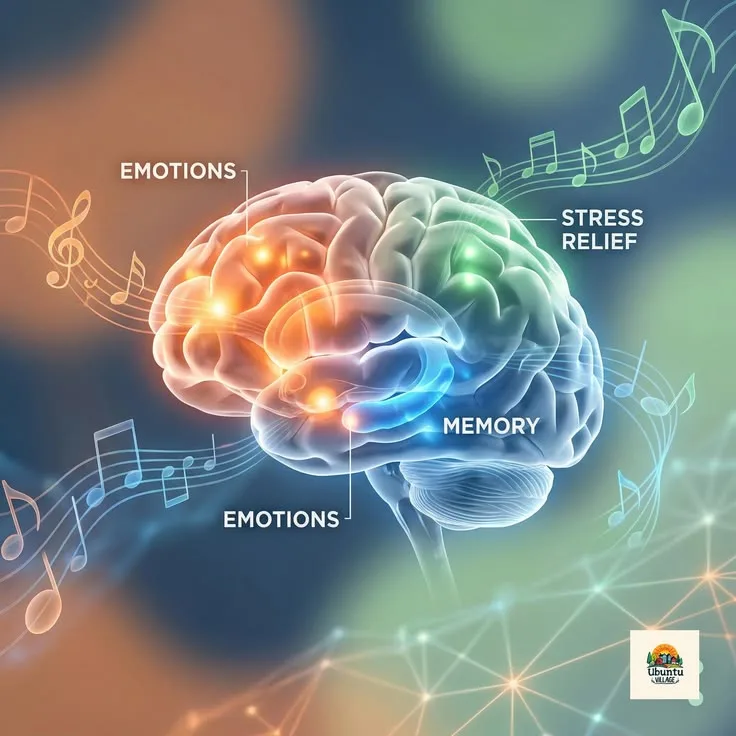
Why music evokes emotion involves the brain's prediction, reward, memory, and motor systems. Listeners form expectations about rhythm, harmony, and melody, so fulfillment, delay, and surprise can create dopamine-linked anticipation and frisson. Music also entrains neural activity and movement, activates autobiographical memory, and can produce chills, tears, joy, or tension through both acoustic features and learned musical patterns.
In 1995, neuroscientist Jaak Panksepp published an unusual survey.[4] He asked respondents whether music had ever made them feel chills - a shiver or tingling sensation running up the spine or across the scalp. Almost all said yes. He then asked which types of music produced this response most reliably.
The answers were strikingly consistent: slow tempos, unexpected harmonic shifts, swelling dynamics, a soprano voice sustaining a high note, the moment a new instrument enters a passage already dense with tension. These were not arbitrary preferences.
They pointed toward something structured - a set of musical features that reliably triggered a specific physiological response across diverse listeners.
Panksepp was fascinated by this because it was so biologically anomalous. The chill response - piloerection, the same mechanism as goosebumps in cold - is an ancient mammalian reflex. In other mammals, it serves a purpose: fur bristling makes animals appear larger to predators, or responds to sudden cold.
In humans responding to music, it appears to serve no purpose at all. It is the body reacting to sound with a response evolution built for physical survival.
What is happening? And why should vibrations in air produce tears, joy, chills, or the almost unbearable feeling of being understood?
The answers, emerging from neuroscience over the last thirty years, turn out to involve fundamental questions about prediction, reward, memory, and what it means to be a brain that makes sense of the world by anticipating it.
"Music is the shorthand of emotion." - Leo Tolstoy
Key Definitions
Frisson - The "aesthetic chill" or "musical shiver" response: piloerection, tingling, brief acceleration of heart rate, sometimes tears, in response to particularly moving musical moments. Reported by approximately 50-70% of people. Associated with dopamine release in the nucleus accumbens.
Dopamine prediction error - The neural signal generated when an outcome differs from what was predicted. Positive prediction error (better than expected) produces reward learning; negative prediction error (worse than expected) produces aversion.
Huron's theory proposes musical emotion is largely driven by prediction errors in musical expectation.
Musical expectation - The brain's implicit predictions about where a piece of music is going - the next note, the harmonic resolution, the rhythmic continuation - based on learned musical patterns. Emotion arises from the fulfillment, violation, or delay of these expectations.
SEEKING system - Jaak Panksepp's term for the mammalian motivational system that produces anticipatory arousal, curiosity, and the drive toward rewarding experience. Mediated by dopamine; proposed as the neural substrate through which music activates intense emotional states.
Entrainment - The synchronization of neural oscillations (and body movement) with an external rhythmic stimulus. The brain literally oscillates in time with music, and bodies naturally move to synchronize with rhythmic beats.
Consonance and dissonance - Perceptual qualities of pitch combinations: consonance is the pleasing quality of simple frequency ratios (perfect fifth: 3:2; octave: 2:1); dissonance is the tense, rough quality of complex frequency ratios. Involves both acoustic physics and culturally learned expectations.
Musical absolute pitch (perfect pitch) - The ability to identify or produce a musical note without a reference pitch. Present in approximately 1 in 10,000 of the general population; much higher among those with early musical training; associated with specific structural differences in auditory cortex.
How Music Activates the Brain: Key Neural Systems
| Brain system | Role in music response | Key evidence | Clinical relevance |
|---|---|---|---|
| Nucleus accumbens | Dopamine release at peak emotional moments (frisson) | Blood & Zatorre 2001 PET; Salimpoor 2011 raclopride study | Suggests music activates same reward circuits as food, sex, drugs |
| Ventral tegmental area (VTA) | Source of dopamine projecting to accumbens; active during anticipation | Salimpoor 2011: anticipatory dopamine in caudate before peak | "Wanting" phase of musical anticipation |
| Caudate | Anticipatory dopamine during build-up before emotional peak | Salimpoor 2011 | Maps to "wanting" vs. "getting" distinction |
| Amygdala | Emotional valence processing; fear/sadness in minor-mode music | Koelsch meta-analysis | Emotional induction; relevant to music therapy |
| Hippocampus | Autobiographical memory encoding/retrieval linked to music | Janata 2009 mPFC study | Preserved in Alzheimer's; basis for music therapy |
| Medial prefrontal cortex | Personal familiarity and self-referential processing of music | Janata 2009 | More active for personally meaningful music |
| Motor cortex and cerebellum | Entrainment to rhythm; urge to move | Basal ganglia lesion studies; Parkinson's gait improvement | Rhythmic auditory stimulation for Parkinson's |
| Auditory cortex | Enhanced frequency mapping in musicians; brainstem encoding | Kraus lab Northwestern | Music training changes auditory processing at brainstem level |
The Prediction Machine Listens to Music
The modern neuroscience of music is inseparable from the modern theory of the predictive brain.
Karl Friston, Andy Clark, and others have developed the view that the brain is fundamentally a prediction machine - continuously generating models of what will happen next, comparing those predictions to actual sensory input, and updating the model based on prediction errors.
Perception is not passive reception of the world; it is active hypothesis-testing.
Music activates this prediction machinery intensively. After even brief exposure to a musical tradition, the brain has internalized its patterns: the scales, the chord progressions, the rhythmic conventions, the melodic contours that characterize the style.
When you listen to a melody, your brain is simultaneously perceiving the notes and predicting what will come next - generating anticipation.
David Huron's Sweet Anticipation (2006) is the most comprehensive theory of how this prediction system generates musical emotion.[3] Huron identifies several distinct emotional systems activated by musical expectations:
Imagination: Simply imagining a musical continuation - before the music plays - activates reward circuits. The anticipation of a coming resolution creates pleasurable arousal.
Tension: Sustained uncertainty about resolution - the drawn-out dominant seventh chord that hasn't resolved yet, the silence before the final chord - creates physiological arousal and subjective tension.
Prediction: The moment-by-moment accuracy (or inaccuracy) of musical prediction generates continuous reward-and-surprise signals.
Reaction: The immediate physiological and emotional response when an expected event occurs (or fails to occur). Frisson occurs here - at the moment of surprise, the unexpected beauty, the particularly perfect resolution.
Appraisal: The post-hoc cognitive evaluation of what just happened - "that was beautiful," "that was unexpected," "that moved me."
The Neuroscience of Frisson: Dopamine and Expectation
Anne Blood and Robert Zatorre at McGill University conducted the first neuroimaging study of musical frisson in 2001.[1] Participants brought music that reliably gave them chills; the researchers scanned their brains while they listened.
The results were striking. Moments rated as producing chills activated the nucleus accumbens, ventral tegmental area (VTA), amygdala, insula, and orbitofrontal cortex - the core reward circuit that responds to food, sex, addictive drugs, and other biological rewards.
This meant music was triggering genuine dopamine release in the brain's reward system through purely abstract, auditory stimulation. Nothing was being ingested; no biological need was being met; no survival-relevant event had occurred.
Sound patterns were activating one of evolution's most ancient and fundamental motivational systems.
Valorie Salimpoor and colleagues (2011) extended this work with a more direct measure.[2]
Using radiolabeled raclopride (which binds to dopamine receptors - less binding means more dopamine release, since endogenous dopamine and the tracer compete for the same receptor), they found that chills-producing music released dopamine not just at the peak moment but in the anticipation period leading up to it - consistent with the prediction error model (anticipatory dopamine for expected reward; confirmation dopamine at delivery).
The anatomy was telling: dopamine released in the caudate during anticipation; dopamine released in the nucleus accumbens at the chills moment itself.
The caudate-nucleus accumbens distinction maps onto the wanting-vs-getting distinction in reward neuroscience - the brain responds differently to anticipating a reward and actually receiving it.
Why Not Everyone Gets Musical Chills
Roughly 30-50% of people report never experiencing frisson from music. This is not a failure of sensitivity or taste.
Matthew Sachs and colleagues found a structural brain difference: people who experience frisson have a denser connection between the auditory cortex and the regions involved in emotional processing, including the anterior insula and the medial prefrontal cortex.[5]
This suggests that frisson proneness partly reflects the richness of the structural pathway through which auditory information reaches emotional processing systems. More axons, faster communication, richer emotional resonance.
Individual differences in openness to experience - the Big Five personality trait - also predict frisson proneness. Open individuals seek novelty, aesthetic experience, and variety; they are more likely to be deeply engaged by musical surprises and to experience their emotional impact fully.
Music and Memory: Why Songs Take You Back
Music is the most powerful autobiographical memory cue known to psychology.
David Rubin's research on memory for music found that musical memories - compared to memories for other stimuli - show unusual vividness, emotional intensity, and involuntary recall.
When a piece of music associated with a specific autobiographical period is heard, it can retrieve not just the memory but the full emotional context: the feeling of being 17, the specific quality of a relationship, the emotional tenor of an entire season of life.
The neural basis involves the hippocampus, which encodes autobiographical memories, and the limbic system, which stores the emotional context.
The temporal lobe's role in music processing overlaps substantially with autobiographical memory networks; hearing a piece of music activates both the acoustic representation and the contextual memory network in which it was encoded.
This explains why music heard repeatedly during formative emotional experiences becomes permanently associated with those experiences - and why hearing it later retrieves the original emotional state with unusual fidelity.
The Reminiscence Bump
The well-documented reminiscence bump in autobiographical memory - the tendency for adults to recall disproportionately many memories from ages 15-25 - is particularly pronounced for music. Music that was popular during that period retains unusual emotional salience throughout life.
Petr Janata at UC Davis has shown that the medial prefrontal cortex, active during self-referential processing and autobiographical memory retrieval, shows greater activation to personally familiar music than to unfamiliar music - and this personal familiarity effect is stronger the more emotionally significant the association.[8]
This is clinically relevant: music therapy for Alzheimer's disease can reactivate memories and emotional states in patients with severe semantic memory loss, because the emotional memory system is partially preserved even when other memory systems are damaged.
Patients who no longer recognize family members may still respond emotionally to music from their youth.
The Social Dimension: Why Music Is Always Cultural
Music is a universal human feature - no known culture lacks it. But music is also always cultural: every human musical tradition creates its own distinctive system of expectation, its own vocabulary of tension and release, its own grammar.
The emotional power of music is partly universal and partly constructed by cultural learning.
What Appears Universal
Patrick Savage's cross-cultural comparative musicology and Samuel Mehr's large-scale study across 60 societies find consistent cross-cultural features:[6]
- Rhythm and beat: Rhythmic entrainment - synchronizing body movement to a beat - appears universal; no culture has been found without rhythmic music
- Arousal recognition: Fast tempo = high energy; slow tempo = low energy - recognized across cultures
- Functional categories: Lullabies (soothing, simple, descending), dance music (rhythmic, energetic), and healing/ritual music (often involving repetition and drone) are distinguishable across cultures
- Sad music universals: Slow tempo, minor mode (in traditions using it), low pitch, soft dynamics - these features cluster in "sad" music across independent traditions
What Varies
- The specific scales, intervals, and harmonic progressions that feel "resolved" vs. "unresolved"
- The emotional valence of specific timbres and modes
- The boundary between music and speech/chant
- Whether specific emotional categories (nostalgia, triumph, yearning) are musically encoded and recognized
The Moving Body: Why We Can't Stop
One of music's most universal effects is involuntary movement. The urge to tap a foot, nod a head, or dance is nearly impossible to fully suppress.
This reflects the deep integration of music processing with the motor system.
Neural entrainment: When the brain processes rhythmic music, neural oscillations in auditory cortex synchronize with the musical beat - the auditory system literally oscillates in time with the music. These oscillations propagate to motor regions, producing the motor preparation that becomes movement.
The basal ganglia and cerebellum: Both structures are involved in both rhythm processing and motor control. Basal ganglia lesions (as in Parkinson's disease) disrupt both voluntary movement initiation and rhythmic entrainment.
Notably, rhythmic auditory stimulation (heard rhythmic music) can temporarily improve gait in Parkinson's patients - a documented clinical application of musical rhythm's grip on motor systems.
The universality of dance - moving the body in rhythmic synchrony with music or other people - appears to reflect this deep motor-auditory integration, and has been proposed as serving social cohesion functions: synchronized movement between individuals produces feelings of affiliation, cooperation, and trust.
Why Music Can Hurt As Much As It Helps
The same properties that make music emotionally powerful make it difficult to control.
Earworms (involuntary musical imagery, or INMI) - the experience of a fragment of music playing repetitively in one's mind - affects nearly all people, typically for minutes at a time, occasionally for hours or days.
James Kellaris has studied INMI extensively; it is most common for music with simple, repetitive patterns, unexpected intervals, or strong associations with recent contexts.
The brain's prediction system, having set up strong musical expectations, continues generating the anticipated continuation even in the absence of the music.
Emotional induction: Music can induce emotional states that persist after the music ends - including sad emotional states. Listening to genuinely sad music (slow, minor, descending) can produce sad affect that lingers.
In people already in sad states, sad music may deepen rather than relieve the sadness - consistent with mood-congruent processing.
Research on music in clinical depression is mixed: some studies find music therapy beneficial; others find that melancholic music preferred by depressed individuals may maintain rumination.
The autonomic signature: Music-induced emotion produces genuine autonomic arousal - changes in heart rate, skin conductance, respiration rate, and body temperature - that can be measured objectively.
Stefan Koelsch's meta-analysis documented these autonomic signatures across studies, confirming that musical emotion is not simply a cognitive report but a full-body physiological response.
Music and the Developing Brain
Musical training beginning before age 7 produces the most extensive brain plasticity effects. The auditory system during this window is in a sensitive period - maximally responsive to acoustic experience.
Compared to non-musicians, musically trained individuals show:
- Enlarged primary auditory cortex with more refined frequency mapping
- Enhanced brainstem encoding of acoustic features (the auditory brainstem response is faster and more precise)
- Enlarged corpus callosum (particularly the anterior portion, connecting frontal and temporal areas involved in music)
- Enhanced verbal memory and phonological awareness
- More efficient attentional control
Nina Kraus's lab at Northwestern has documented the brainstem effects extensively, showing that musicians' nervous systems encode acoustic features more faithfully even outside the cortex - suggesting music training's effects are not superficial but reach the deepest levels of auditory processing.[7]
The reason music moves us turns out to be neither mysterious nor accidental. It engages the prediction systems that make the brain work; it activates reward circuits that evolution built for survival; it retrieves memories with unusual fidelity; it synchronizes bodies through motor-auditory integration that is millions of years old.
What is remarkable is not that music affects us so deeply. What is remarkable is that we ever thought it was merely entertainment.
For related articles, see why we cry, how learning happens in the brain, what causes anxiety, and why exercise feels good.
Sources & Further Reading
- Blood, A. J., & Zatorre, R. J. (2001). Intensely Pleasurable Responses to Music Correlate with Activity in Brain Regions Implicated in Reward and Emotion. PNAS, 98(20), 11818-11823. DOI: 10.1073/pnas.191355898
- Salimpoor, V. N., et al. (2011). Anatomically Distinct Dopamine Release During Anticipation and Experience of Peak Emotion to Music. Nature Neuroscience, 14(2), 257-262. DOI: 10.1038/nn.2726
- Huron, D. (2006). Sweet Anticipation: Music and the Psychology of Expectation. MIT Press.
- Panksepp, J. (1995). The Emotional Sources of 'Chills' Induced by Music. Music Perception, 13(2), 171-207. DOI: 10.2307/40285693
- Sachs, M. E., et al. (2016). Brain Connectivity Reflects Human Aesthetic Responses to Music. Social Cognitive and Affective Neuroscience, 11(6), 884-891. DOI: 10.1093/scan/nsw009
- Mehr, S. A., et al. (2019). Universality and Diversity in Human Song. Science, 366(6468). DOI: 10.1126/science.aax0868
- Kraus, N., & Chandrasekaran, B. (2010). Music Training for the Development of Auditory Skills. Nature Reviews Neuroscience, 11(8), 599-605. DOI: 10.1038/nrn2882
- Janata, P. (2009). The Neural Architecture of Music-Evoked Autobiographical Memories. Cerebral Cortex, 19(11), 2579-2594. DOI: 10.1093/cercor/bhp008