
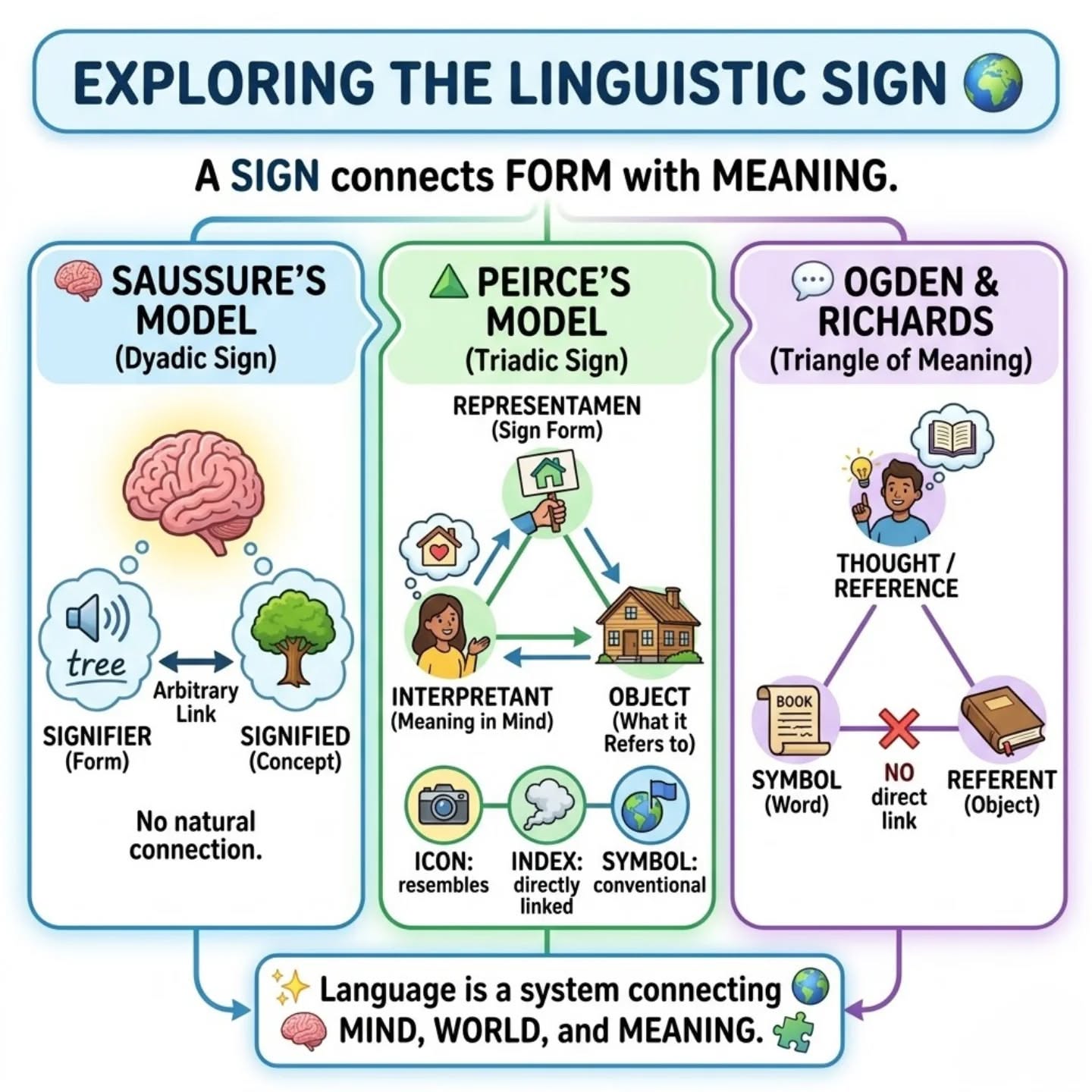
Philosophy of language asks how words mean, refer, represent, and act, and what linguistic analysis reveals about thought and reality. Key theories address Frege's sense and reference, Russell's descriptions, Kripke's rigid designators, Wittgenstein's use theory, speech acts, and conversational implicature. The field connects logic and philosophy with linguistics, cognitive science, and pragmatic questions about what speakers communicate beyond literal wording.
Language is so pervasive, so intimate to human experience, that we rarely notice its strangeness. We use words to make promises, to tell lies, to ask questions, to insult, to comfort, to describe things we have never seen. We say 'the morning star' and 'the evening star' and mean the same planet, but not in the same way.
We say 'can you pass the salt?' and no one answers the literal question about our capacity; everyone understands we are making a request.
We say 'this statement is false' and generate a paradox with no resolution. These peculiarities are not the province of linguistics, which studies language as a natural object with empirically describable properties.[12]
They are problems for the philosophy of language: the branch of philosophy that investigates what words mean, how they refer to the world, what we do when we utter them, and what the study of language reveals about the structure of mind and reality.
The philosophy of language as a systematic discipline emerged in the late nineteenth and early twentieth centuries from the intersection of mathematical logic and philosophical analysis, primarily through the work of Gottlob Frege, Bertrand Russell, and the early Ludwig Wittgenstein.
Its questions - about reference, meaning, truth, and the relationship between language and thought - proved unexpectedly foundational. Nearly every philosophical problem is stated in language; understanding how language works became a precondition for clarity about almost anything else.
The logical positivists of the 1920s and 1930s went further, arguing that most traditional philosophical questions were not merely stated in language but were generated by its misuse - that metaphysics, theology, and much of ethics consisted of sentences that were grammatically well-formed but semantically empty.
That diagnosis has been largely rejected, but the method of careful linguistic analysis it promoted has shaped every subsequent tradition in Anglophone philosophy.
The late twentieth century added a pragmatic dimension - not merely what words mean, but what speakers do with them - and empirical dimensions connecting philosophy of language to cognitive science, linguistics, and experimental psychology.
The question of whether language shapes thought, ancient in philosophical discussion, has been given new empirical traction by researchers like Lera Boroditsky, whose cross-cultural experiments on spatial cognition, temporal reasoning, and the perception of color have produced fascinating and contested evidence that grammatical and lexical structures in different languages do leave distinct marks on non-linguistic cognition.
"The meaning of a word is its use in the language." - Ludwig Wittgenstein, Philosophical Investigations (1953), section 43
This piece traces the analytic canon in depth, from Frege's sense-reference distinction through Strawson's rebuttal of Russell, Searle's work on intentionality, and the empirical Sapir-Whorf research. For how these same ideas play out in communication and the exercise of power, including Orwell's political language, Lakoff's cognitive framing, and Foucault's discourse analysis, see How Philosophy of Language Explains Communication and Power.
Key Definitions
Reference (Bedeutung): In Frege's framework, the actual object or entity in the world that an expression picks out. The reference of 'the morning star' and 'the evening star' is the same: the planet Venus.
Sense (Sinn): In Frege's framework, the mode of presentation or the way in which an expression presents its reference. 'The morning star' and 'the evening star' have the same reference but different senses.
Definite description: An expression of the form 'the F,' purporting to pick out a unique individual satisfying description F. Russell's theory analyzes these as disguised quantificational claims rather than genuine referring expressions.
Rigid designator: Kripke's term for an expression that picks out the same individual in every possible world in which that individual exists. Proper names are rigid designators; definite descriptions are typically not.
Illocutionary act: In Austin's speech act theory, the act performed in making an utterance: asserting, promising, warning, commanding, questioning. To be distinguished from the locutionary act (making a meaningful utterance) and the perlocutionary act (the effect produced in the hearer).
Conversational implicature: Grice's term for meaning that is communicated but not literally said, derived by hearers who assume the speaker is observing the cooperative principle and its maxims.
Key Theories of Meaning Compared
| Theory | Central Claim | Key Proponent | Central Objection |
|---|---|---|---|
| Referentialism | Meaning is what an expression refers to | Mill | Cannot explain empty terms or informativeness of identities |
| Sense-reference theory | Meaning has two components: how an expression presents its referent, and what it refers to | Frege | What determines sense? |
| Description theory of names | Names abbreviate definite descriptions | Russell, early Frege | Fails for modal contexts; Kripke's counterexamples |
| Causal-historical theory | Names refer via causal chains back to initial baptism | Kripke, Putnam | Cannot explain reference change and error |
| Use theory | Meaning is constituted by patterns of use in the language | Wittgenstein | Underspecifies meaning; struggles with novel uses |
| Speech act theory | Language is action; meaning includes illocutionary force | Austin, Searle | Semantics and pragmatics remain separate |
| Gricean pragmatics | Communicated meaning extends beyond literal meaning via cooperative inference | Grice | Requires extensive background knowledge to work |
Frege and the Foundations of Semantic Theory
The Sense-Reference Distinction
Gottlob Frege (1848-1925) was primarily a mathematician and logician who invented modern predicate logic as a tool for a philosophical program - demonstrating that arithmetic is reducible to logic alone (the 'logicist' program) - but his contributions to the philosophy of language proved equally revolutionary.
His 1892 paper 'Uber Sinn und Bedeutung' introduced the distinction between Sinn (sense) and Bedeutung (reference) that has structured semantic theory ever since.
The puzzle Frege addressed was about identity. The planet Venus can be identified as 'the morning star' (the bright object seen in the eastern sky before sunrise) or as 'the evening star' (the bright object seen in the western sky after sunset).
These two expressions pick out the same thing - astronomical discovery established this in antiquity - but they seem to mean different things.
If a name simply attached to its referent like a label, then 'the morning star is the evening star' would say no more than 'the morning star is the morning star,' which is trivially and uninformatively true.
Yet discovering that the morning star and evening star are the same planet was a genuine empirical achievement, an informative discovery. The two expressions must contribute something beyond their shared referent to the meaning of sentences containing them.
Frege's solution separated the reference of an expression - what it picks out - from its sense - the way in which it presents or specifies what it picks out.[1] Two expressions can share a reference while having different senses, explaining how identity statements can be informative.
A thought (the propositional content of a sentence) is constituted by the senses of its parts, not their references; the reference of a sentence is, Frege argued, its truth value - True or False.
Sentences with different senses can share the same truth value, just as different expressions can share the same referent.
Frege's logic, developed in the Begriffsschrift (1879), introduced quantification theory - the formal apparatus for expressing claims like 'every prime number has a successor' or 'there is at least one even prime' - which Aristotle's syllogistic could not adequately represent.
This formal apparatus is the foundation of all subsequent work in mathematical logic, formal linguistics, and the theory of computation.
Russell's Challenge: Definite Descriptions
Bertrand Russell's 1905 paper 'On Denoting' proposed a radically different approach to definite descriptions that challenged Frege's framework. Russell was troubled by expressions lacking a referent: 'the present king of France' (France being a republic) seems to express something but picks out nothing.
Frege's solution - that such expressions have a sense but no reference, and sentences containing them lack a truth value - struck Russell as unsatisfying.
Russell's theory of descriptions analyzed 'the F is G' not as a predication about a thing picked out by 'the F,' but as a conjunction of three quantificational claims: something is F, nothing else is F, and that thing is G.[2]
'The present king of France is bald' thus claims: there exists exactly one present king of France, and he is bald. When France has no king, the existential claim is false and the whole conjunction is false - no problematic truth-value gaps.
Russell dissolved the puzzle of empty descriptions by showing they were not genuine referring expressions at all.
Russell also solved the puzzle of negative existential statements. 'The golden mountain does not exist' is not paradoxical on Russell's analysis: it simply denies that there is exactly one thing that is both golden and a mountain. No mysterious reference to a non-existent entity is required.
P.F. Strawson's 1950 response, 'On Referring,' argued that Russell was confusing the semantic content of an expression with a speech act performed on a particular occasion.[9]
The sentence 'The present king of France is bald' is not false when France has no king; it fails to express a proposition at all, because the presupposition required for the use of a definite description has not been met.
This debate between Russell's semantic account and Strawson's pragmatic account of presupposition remains live.
Wittgenstein: From Picture Theory to Language Games
The Tractatus
The early Wittgenstein, in the Tractatus Logico-Philosophicus (1921), developed a picture theory of meaning that can be seen as a generalization of Frege's semantic insights.[3]
The central claim is that language is capable of meaning because elementary propositions picture or represent facts about the world: they share a logical form with the configurations of objects they represent.
'The cat is on the mat' is meaningful because there is a possible state of affairs - a cat being on a mat - whose structure mirrors the proposition's structure.
If the proposition accurately represents the actual configuration of objects in the world, it is true; if not, it is false.
From this picture theory, Wittgenstein drew a stark limiting conclusion. The limits of significant language are the limits of what can be pictured: the possible facts about the world.
Propositions of logic are special - they are tautologies or contradictions, showing the logical scaffolding of language without saying anything about the world.
But ethical, aesthetic, and metaphysical propositions - claims about value, meaning, God, the nature of the soul - cannot picture facts, because there are no such facts.
They are not false; they are attempts to say something that can only be shown. The Tractatus ends: 'Whereof one cannot speak, thereof one must be silent.'
The Philosophical Investigations
Wittgenstein repudiated the Tractatus almost entirely in the Philosophical Investigations (written in the 1940s, published posthumously in 1953).
The later work is not a systematic treatise but a series of interconnected observations, questions, and thought experiments proceeding by dialogue with an imaginary interlocutor whose philosophical confusions the text diagnoses and dissolves.
The Investigations begins by attacking a simple picture of language that Wittgenstein associates with Augustine's description of how he learned to talk: adults point at objects and say their names; the child associates the name with the object.[4]
This ostensive teaching model captures one function of language - naming - but not the range of things language does. Language is not primarily a naming system.
It is a collection of enormously diverse activities - 'language games' - in the broadest sense: telling stories, singing songs, playing chess, reporting events, making up stories, acting in plays, asking and answering questions, cursing, praying.
Each language game is embedded in a form of life, a set of practices and activities that give it its character.
Meaning, for the later Wittgenstein, is use: the meaning of a word is not an object it refers to or an image it conjures but the pattern of its correct application in the practices that constitute a language game.
There is no Platonic essence that all games share, no single property that all red objects have in common beyond the tendency to elicit the word 'red' in the relevant circumstances.
Wittgenstein's concept of family resemblances - the idea that members of a category may share overlapping and criss-crossing features without any single feature being common to all - has been highly influential in cognitive psychology and philosophy of concepts.
The later Wittgenstein's most important contribution may be his account of how philosophical problems arise.
They arise when language 'goes on holiday' - when words are used outside the language games that give them meaning, producing the illusion of profound questions about consciousness, knowledge, meaning, or other abstractions.
The philosopher's task is not to answer these questions but to dissolve them - to show that they are artifacts of linguistic confusion rather than genuine problems about the world.
This therapeutic conception of philosophy has been enormously influential, generating both enthusiastic disciples and vehement critics who believe genuine philosophical problems survive Wittgenstein's dissolution attempts.
Austin, Searle, and Speech Act Theory
Doing Things with Words
J.L. Austin (1911-1960), the Oxford philosopher, redirected attention from what sentences mean to what speakers do with them.
His William James Lectures at Harvard in 1955, published posthumously as How to Do Things with Words (1962), began with an observation about a class of utterances that semantic theory had systematically ignored: performatives.
When a registrar says 'I now pronounce you married,' the utterance does not describe a fact - it constitutes one.
Similarly with promises, bets, apologies, verdicts, and declarations. These utterances are not true or false but successful or unsuccessful, 'felicitous' or 'infelicitous,' depending on whether the appropriate conditions are met.
Austin eventually found the simple performative-constative distinction too crude and replaced it with a more general analysis.[5]
Every utterance involves three distinguishable acts: the locutionary act (making a meaningful utterance with a given sense and reference), the illocutionary act (the act performed in making the utterance: asserting, warning, promising, commanding), and the perlocutionary act (the effect produced on the hearer: convincing, alarming, amusing, consoling).
The same locution ('The engine is overheating') can be used to warn, to inform, to threaten, or to invite, depending on context. The illocutionary force of an utterance is the primary object of speech act theory.
Searle's Extensions
John Searle's Speech Acts (1969) systematized Austin's insights. Searle introduced the concept of 'illocutionary force indicators' (the grammatical and prosodic features that signal what kind of act is being performed).
He also formulated the 'conditions of satisfaction' for different speech act types: the preparatory conditions that must hold, the sincerity conditions that reflect the speaker's mental state, and the essential condition that defines what kind of act is being performed.
Searle's distinction between direct and indirect speech acts has been particularly influential.[8] 'Can you pass the salt?' is, literally, a question about ability; but it is conventionally understood as a polite request. The hearer recognizes the indirect illocutionary force through inference about communicative intent.
Searle's subsequent work on intentionality (Intentionality, 1983) argued that the conditions of satisfaction of speech acts are continuous with the conditions of satisfaction of mental states, connecting speech act theory to the philosophy of mind.
Speech act theory has found applications in law (the jurisprudential analysis of contracts, promises, and authoritative declarations), linguistics (the analysis of discourse structure and pragmatic phenomena), and debates about artificial intelligence (what would it mean for a machine to genuinely assert or promise something, and does this require intentionality?).
Grice and Conversational Implicature
Paul Grice's 1967 William James Lectures, published as Studies in the Way of Words (1989), explained how speakers communicate more than they literally say.
Grice proposed that communication is governed by a Cooperative Principle - contribute what is required by the purpose of the conversation - articulated through four maxims of Quantity, Quality, Relation, and Manner.[6]
The theoretical payoff comes when a speaker appears to violate one of the maxims but is clearly still trying to cooperate. A rational hearer, assuming cooperation, will look for an interpretation that makes the apparent violation intelligible - a conversational implicature.
The letter of recommendation that says only 'Ms Smith's attendance was excellent, and she was always on time' implicates, by deliberate understatement (violation of the Quantity maxim), that the writer cannot say anything positive about the candidate's intellectual abilities.
The implicature is communicated without being stated.
Grice's framework distinguishes implicatures from semantic entailments (which cannot be cancelled) and from conventional implicatures (the contrastive force of 'but,' the inferential force of 'therefore,' which are encoded in word meaning rather than derived from context).
Conversational implicatures are cancellable ('He didn't fail - actually he did quite well') and calculable (the reasoning that generates them can in principle be made explicit).
This framework has shaped research programs in formal pragmatics and has been refined and challenged by relevance theory (Sperber and Wilson) and neo-Gricean theories (Levinson, Horn).[10]
Kripke, Rigid Designation, and the Necessary A Posteriori
Saul Kripke's Naming and Necessity (1980) challenged the description theory of names that had dominated philosophy of language since Frege and Russell.
Kripke argued that proper names are not disguised descriptions - 'Aristotle' does not mean 'the teacher of Alexander the Great.' Names are rigid designators: they pick out the same individual in every possible world in which that individual exists, regardless of which descriptions happen to be true of them.[7]
The argument from possible worlds: we can coherently ask 'Could Aristotle have been someone other than the teacher of Alexander?' and mean by this - could things have been so different that the man we actually call Aristotle never taught Alexander?
The answer seems to be yes: Aristotle might have died young, or refused the tutoring commission.
But if 'Aristotle' meant 'the teacher of Alexander,' the question would be equivalent to 'Could the teacher of Alexander have been someone other than the teacher of Alexander?' - which is either trivially false or semantically confused.
We intend to ask about the man, not about whoever satisfies a description.
The philosophical implications were far-reaching. Kripke showed that the statement 'Hesperus is Phosphorus' - both names being rigid designators for Venus - is necessarily true: in every possible world, the thing called 'Hesperus' is the same as the thing called 'Phosphorus,' since both are Venus.
Yet this necessary truth can only be known empirically, through astronomical observation. Kant had assumed that all necessary truths were knowable a priori (without empirical investigation); Kripke's necessary a posteriori truths demonstrated that this was wrong.
Language and Thought: The Sapir-Whorf Revisited
The Sapir-Whorf hypothesis - associated with the linguists Edward Sapir and his student Benjamin Lee Whorf in the 1930s-1940s - proposed that the language one speaks influences the way one thinks and perceives the world.
Whorf's comparison of Hopi temporal concepts with European temporal concepts was criticized by subsequent linguists as methodologically flawed, and strong Whorfianism (the view that language determines thought, making certain thoughts impossible in certain languages) is now almost universally rejected.
The weak version of the hypothesis - that language influences certain aspects of cognition and perception - has attracted renewed empirical attention through the experimental work of Lera Boroditsky at Stanford.[11]
Her research has shown that speakers of languages with different spatial vocabulary (absolute versus relative directions) show different patterns in non-linguistic spatial tasks; that speakers of languages with grammatical gender show systematic associations between objects and gender-typical properties; and that speakers of languages with richer color vocabulary show faster discrimination of colors in the relevant range.
These effects are typically modest and context-dependent, and the mechanisms remain contested: it is unclear whether language is causing differences in non-linguistic cognition or whether both language patterns and cognitive patterns are downstream from other cultural or perceptual factors.
The philosophical significance of this research is not that strong Whorfianism is vindicated - it is not - but that it underscores the intimate relationship between linguistic and non-linguistic cognition and challenges any sharp separation between language as a labeling system applied to pre-formed thoughts and language as itself partly constitutive of the ways we categorize experience.
For related discussions of meaning in cognitive science, see /explainers/how-it-works/how-language-acquisition-works and /explainers/how-it-works/how-the-brain-processes-language. For the logical apparatus underlying modern formal semantics, see the companion article at /concepts/philosophy-ethics/what-is-logic.
Sources & Further Reading
- Frege, G. (1892). Uber Sinn und Bedeutung. Zeitschrift fur Philosophie und philosophische Kritik, 100, 25-50. Translated as "On Sense and Reference."
- Russell, B. (1905). On denoting. Mind, 14(56), 479-493. doi:10.1093/mind/XIV.4.479
- Wittgenstein, L. (1921). Tractatus Logico-Philosophicus. Kegan Paul, Trench, Trubner. (C.K. Ogden, Trans.)
- Wittgenstein, L. (1953). Philosophical Investigations. Blackwell. (G.E.M. Anscombe, Trans.)
- Austin, J. L. (1962). How to Do Things with Words. Oxford University Press.
- Grice, H. P. (1989). Studies in the Way of Words. Harvard University Press.
- Kripke, S. A. (1980). Naming and Necessity. Harvard University Press.
- Searle, J. R. (1969). Speech Acts: An Essay in the Philosophy of Language. Cambridge University Press.
- Strawson, P. F. (1950). On referring. Mind, 59(235), 320-344. doi:10.1093/mind/LIX.235.320
- Sperber, D., & Wilson, D. (1986). Relevance: Communication and Cognition. Harvard University Press.
- Boroditsky, L. (2001). Does language shape thought? Mandarin and English speakers' conceptions of time. Cognitive Psychology, 43(1), 1-22. doi:10.1006/cogp.2001.0748
- Chomsky, N. (2000). The Architecture of Language. Oxford University Press India.