
Persuasion: In 1963, Martin Luther King Jr. stood before 250,000 people on the National Mall and delivered a speech that changed the trajectory of American history. He did not present new facts. He did not introduce new policy proposals. He did not reveal information that his audience did not already know.
What he did was arrange words in a way that made people feel differently about facts they already possessed-that activated emotions, values, and aspirations so powerfully that the speech became one of the most consequential acts of persuasion in modern history.
"I have a dream" was not a logical argument. It was a rhetorical act-a demonstration of the extraordinary power of words to move people from passive awareness to active commitment, from intellectual agreement to emotional conviction, from understanding to action.
Persuasion through words is the use of language-word choice, structure, rhythm, metaphor, narrative, and emotional appeal-to influence how people think, feel, and act.
It is one of the oldest and most studied human capabilities, as relevant to a marketing email as to a presidential address, as operative in a text message between friends as in a courtroom summation.
Understanding how words persuade is essential both for communicating more effectively and for defending yourself against manipulation.
"The art of persuasion is not about forcing others to agree with you. It is about creating the conditions under which agreement becomes natural."
How Do Words Persuade? The Core Mechanisms
Linguistic persuasion operates through several distinct psychological mechanisms, each targeting a different aspect of the listener's cognitive and emotional system. The classical study of rhetoric identified three primary modes of appeal-ethos, pathos, and logos-that remain the foundation for understanding how words move people.
1. Emotional Appeals (Pathos)
The most direct route to persuasion is through emotion. Words that activate strong emotional responses-fear, hope, anger, compassion, pride, guilt, joy-bypass analytical processing and influence attitudes and behavior through the faster, more automatic emotional system.
How emotional language works:
- Emotional words activate the amygdala and other limbic structures faster than analytical words activate the prefrontal cortex
- Once an emotional response is activated, it colors subsequent reasoning-people who feel afraid interpret ambiguous information as threatening; people who feel hopeful interpret it as promising
- Emotional arousal narrows attention to the emotional stimulus, reducing the cognitive resources available for critical evaluation of the persuasive message
Examples of emotional persuasion:
- Fear appeals: "If we don't act now, our children will inherit a devastated planet" activates parental fear and urgency
- Hope appeals: "Imagine a world where every child has access to quality education" activates aspirational emotion
- Anger appeals: "They took your jobs, and they're laughing about it" activates indignation and desire for redress
- Compassion appeals: "Right now, a child is going hungry just three miles from where you sit" activates empathic distress and desire to help
Emotional language is not inherently manipulative. Honest emotional expression is a legitimate and often necessary component of effective communication.
The ethical boundary is crossed when emotional appeals are used to circumvent rational evaluation rather than to complement it-when the emotion is manufactured to distract from weakness in the argument rather than to amplify its genuine force.
"People will forget what you said, people will forget what you did, but people will never forget how you made them feel." - Maya Angelou
2. Credibility and Authority (Ethos)
Words persuade partly through the perceived credibility of the speaker, and language choices can enhance or undermine that credibility:
Language markers of credibility:
- Precision: Specific details signal knowledge and reliability ("37% of respondents" is more credible than "most people")
- Qualification: Acknowledging limitations ("This evidence is preliminary, but it suggests...") signals intellectual honesty
- Domain-appropriate vocabulary: Using the right technical terms signals expertise
- Confidence without overconfidence: Measured certainty is more persuasive than absolute certainty, which signals either knowledge or delusion
Language that undermines credibility:
- Hedging excessively ("sort of," "kind of," "maybe," "I think possibly")
- Using filler words ("um," "you know," "like") to excess
- Making absolute claims that are easily falsified
- Using language that is too formal or too informal for the context
3. Logical Structure (Logos)
The logical structure of an argument-how premises connect to conclusions-is itself a persuasive tool:
- Clear causal chains: "X causes Y because Z" is more persuasive than vague causal assertions
- Parallel structure: Presenting arguments in parallel form creates a sense of logical inevitability
- Problem-solution framing: Establishing a problem before presenting a solution makes the solution feel necessary
- Enumeration: "There are three reasons..." creates an expectation of systematic reasoning
4. Framing and Word Choice
As explored in the study of framing through language, the specific words chosen to describe the same reality can dramatically shift perception. The framing effects at work here are among the most well-documented phenomena in communication research. Persuaders select words that:
- Activate desired emotional associations ("freedom" vs. "deregulation")
- Emphasize favorable aspects and minimize unfavorable ones
- Create metaphorical frameworks that support the desired conclusion
- Normalize the persuader's position ("common sense" implies that disagreement is senseless)
What Makes Language Persuasive? The Key Qualities
Persuasive language consistently shares four qualities: clarity, so the message cannot be misread against the persuader's purpose; vivid imagery, which makes abstract claims concrete and experiential rather than analytical; rhythm and sound, including repetition, parallelism, alliteration, and tricolon, which make phrasing memorable independent of content; and memorability itself, favoring language that is brief, surprising, emotional, and rhythmic.
Clarity
Persuasive language is clear. Ambiguity weakens persuasion because it allows listeners to interpret the message in ways that do not serve the persuader's purpose. The most effective persuaders express complex ideas in simple language:
- Churchill: "We shall fight on the beaches, we shall fight on the landing grounds, we shall fight in the fields and in the streets"
- Lincoln: "Government of the people, by the people, for the people"
- Steve Jobs: "One thousand songs in your pocket"
Clarity is not the same as simplicity. A clear message can convey sophisticated ideas-but it does so without unnecessary complexity, jargon, or abstraction.
Vivid Imagery
Words that create sensory images in the listener's mind are more persuasive than abstract descriptions:
- "Poverty" is abstract. "A child eating ketchup packets for dinner because the food ran out" is vivid.
- "Environmental destruction" is abstract. "The river your grandfather fished in is now too toxic to touch" is vivid.
- "Market growth" is abstract. "Your investment grew from $1,000 to $4,700 in five years" is vivid.
Vivid language persuades because it makes abstract claims concrete and experiential. When people can picture, feel, or imagine what you are describing, they process it through experiential cognition rather than analytical cognition-and experiential processing has a more direct path to emotional response and behavioral motivation.
This is closely related to the phenomenon of narrative transportation, where vivid language draws the audience into a story so completely that critical resistance is lowered.
Rhythm and Sound
The musicality of language affects its persuasive power independently of its content:
- Repetition creates emphasis and memorability: "I have a dream" (repeated eight times in King's speech)
- Parallelism creates a sense of balance and inevitability: "Ask not what your country can do for you; ask what you can do for your country"
- Alliteration creates sonic cohesion: "nattering nabobs of negativism" (Spiro Agnew's speechwriter William Safire)
- Tricolon (groups of three) creates a sense of completeness: "Life, liberty, and the pursuit of happiness"
- Antithesis creates dramatic contrast: "That's one small step for a man, one giant leap for mankind"
These sonic devices work because the brain processes language partly through its sound patterns, and patterns that are rhythmically satisfying feel more true, more important, and more memorable than patterns that are arrhythmic.
This is the "processing fluency" effect: messages that are easy to process are judged as more truthful.
Memorability
Persuasion fails if the audience forgets the message. Memorable language is:
- Brief: Short phrases stick better than long ones
- Surprising: Unexpected word combinations or ideas capture attention
- Emotional: Emotionally charged content is remembered better than neutral content
- Rhythmic: Rhymes and rhythmic patterns are remembered better than prose
- Concrete: Specific, vivid details are remembered better than abstractions
What Are Power Words?
Power words are words with strong emotional or psychological impact that trigger immediate attention and response. They work by activating deep psychological motivations rather than analytical thought, drawing on categories such as fear, desire, trust, and identity to provoke a fast reaction. A single well-chosen power word can shift how a sentence feels, even when the underlying claim stays the same, which is why marketers, speechwriters, and headline writers rely on them so heavily.
Fear-based power words: "Warning," "danger," "crisis," "shocking," "alarming," "devastating"
- Activate the threat-detection system
- Create urgency and demand for immediate attention
Desire-based power words: "Exclusive," "secret," "proven," "guaranteed," "revolutionary," "breakthrough"
- Activate reward-seeking motivation
- Create anticipation and desire
Trust-based power words: "Authentic," "evidence-based," "transparent," "verified," "tested"
- Activate the credibility-assessment system
- Reduce skepticism and resistance
Identity-based power words: "Patriotic," "innovative," "compassionate," "smart," "elite"
- Activate self-concept maintenance motivation
- Align the message with the listener's desired identity
Power words work through rapid emotional activation rather than analytical processing. They are effective precisely because they bypass the deliberative system and trigger automatic responses-exploiting the same cognitive biases that shape so much of human judgment.
This makes them useful tools for legitimate persuasion and dangerous tools for manipulation.
"Words are, of course, the most powerful drug used by mankind." - Rudyard Kipling
How Does Repetition Persuade?
Repetition is one of the most consistently effective persuasive techniques, operating through several reinforcing mechanisms: it increases familiarity through repeated exposure, builds emphasis by signaling that an idea matters to the speaker, and creates rhythmic patterns that intensify emotional impact. Each of these mechanisms works independently of whether the repeated claim is true, which is what makes repetition so reliable and so easily misused.
The Illusory Truth Effect
Research consistently demonstrates that statements that have been encountered before are judged as more true than novel statements, regardless of their actual accuracy. This "illusory truth effect" means that simply repeating a claim increases its perceived truthfulness.
The effect operates because:
- Repeated exposure creates processing fluency (the statement feels easier to process)
- Fluent processing is unconsciously interpreted as familiarity
- Familiarity is unconsciously interpreted as truthfulness
This is why advertising slogans are repeated relentlessly, why political talking points are hammered on with metronomic consistency, and why propaganda relies on repetition as a core technique.
The mechanism is not that repetition convinces people through logical argument-it is that repetition makes statements feel true through cognitive fluency.
Emphasis and Importance
Repetition signals that an idea is important to the speaker. When a leader repeats a phrase-"Build back better," "Make America great again," "Yes we can"-the repetition communicates conviction, emphasis, and centrality. The repeated phrase becomes the distilled essence of the message.
Rhythmic and Emotional Amplification
Repetition creates rhythmic patterns that build emotional intensity. Each repetition adds emotional weight to the phrase, creating a crescendo effect:
"Free at last! Free at last! Thank God Almighty, we are free at last!"
The emotional impact of this closing is inseparable from the repetition. A single statement of freedom would be intellectually equivalent but emotionally flat by comparison.
What Role Does Specificity Play in Persuasion?
Specific details increase persuasion through several mechanisms: they signal that the speaker has done real research, they create vivid mental images that abstract language cannot, and they exploit a mental shortcut where precise claims are automatically judged more truthful than vague ones. A number like 37 percent reads as measured and credible in a way that a phrase like significantly never can.
Credibility Through Precision
"Increased by 37%" is more persuasive than "increased significantly" because precision signals measurement, which signals knowledge. A speaker who knows the precise figure has (apparently) done the research, counted the numbers, and verified the result.
Vividness Through Detail
Specific details create vivid mental images that abstract claims cannot:
- "A lot of people are hungry" vs. "23 million Americans are food insecure-that's one in seven people in the richest country on earth"
- "Our product is popular" vs. "12,000 customers switched to our product in the last quarter alone"
- "Crime is bad in this neighborhood" vs. "There were three armed robberies on this block in the past month"
The Specificity-Truthfulness Heuristic
People use specificity as a heuristic for truthfulness: the more specific a claim, the more likely it seems to be true. This heuristic is generally useful (specific claims are harder to fabricate than vague ones) but can be exploited (fabricated specific details are more convincing than fabricated vague ones).
| Strategy | Mechanism | Example |
|---|---|---|
| Emotional appeal | Activates feeling before thinking | "Your family deserves better than this" |
| Repetition | Illusory truth + emphasis | "We will not stop. We will not rest. We will not quit." |
| Specificity | Credibility + vividness | "In the last 18 months, 47,000 jobs were lost" |
| Vivid imagery | Experiential processing | "Picture yourself walking into your dream home" |
| Rhythm/parallelism | Processing fluency | "Stronger communities, safer streets, brighter futures" |
| Power words | Automatic emotional trigger | "This exclusive, proven method..." |
| Rhetorical questions | Active engagement | "Aren't you tired of being ignored?" |
How Do Questions Persuade?
Rhetorical questions, questions asked for persuasive effect rather than to elicit information, are one of the most versatile persuasive tools. They work because the listener is prompted to generate an answer internally, and self-generated conclusions carry more persuasive weight than facts simply handed to them. This is why speeches, advertisements, and opinion pieces so often open or close on a pointed question rather than a flat statement.
How Rhetorical Questions Work
- They engage active processing: Questions prompt the listener to generate their own answer, and self-generated conclusions are more persuasive than externally provided ones
- They presuppose assumptions: "Don't you want the best for your children?" presupposes that the listener has children, that the listener wants the best for them, and that the speaker's proposal serves this goal
- They create a sense of agreement: Questions with obvious answers create a "yes momentum" that carries forward into less obvious claims
- They reduce counterarguing: Questions shift the listener's cognitive activity from evaluating the speaker's claims to generating their own responses, reducing the resources available for critical evaluation
Persuasive Question Techniques
- Leading questions: "Isn't it true that..." guides the listener toward a specific conclusion
- The "yes" ladder: A series of questions with obvious "yes" answers creates psychological momentum
- Challenge questions: "Are you going to let them get away with this?" activates agency and resistance
- Imagination questions: "What would your life look like if..." activates the visualization that makes a scenario feel real and desirable
Can You Be Persuasive and Ethical?
Yes. The ethical dimension of persuasion is determined not by the use of persuasive techniques but by the intent, transparency, and truthfulness with which they are used. The same emotional appeal, repetition, or vivid image can inform an audience honestly or manipulate it, depending on whether the underlying claims are accurate and whether the audience retains the freedom to disagree.
Ethical Persuasion
- Transparent about purpose: The audience knows that persuasion is being attempted
- Truthful in content: The claims made are accurate and verifiable
- Respectful of autonomy: The audience is given the information and freedom to make their own decision
- Proportionate in technique: The persuasive intensity matches the importance and urgency of the topic
- Open to challenge: The persuader welcomes questions, counterarguments, and scrutiny
Manipulative Persuasion
- Hidden purpose: The audience does not realize they are being persuaded
- Deceptive in content: Claims are false, misleading, or selectively presented to distort
- Exploitative of vulnerability: Techniques target cognitive biases, social influence pressures, emotional weaknesses, or limited knowledge
- Disproportionate in technique: Extreme emotional manipulation is used for trivial or selfish purposes
- Resistant to challenge: The persuader avoids scrutiny, deflects questions, and punishes dissent
The Gray Area
Much persuasion falls between these poles. Advertising uses emotional appeals and psychological techniques to sell products that people may or may not need. Political rhetoric simplifies complex issues into emotionally resonant frames that may or may not accurately represent reality.
Self-help content uses motivational language that may or may not correspond to evidence-based strategies.
The most productive approach is not to divide persuasion into "ethical" and "unethical" categories but to develop the critical awareness to evaluate persuasive communication on multiple dimensions: Is it truthful? Is it transparent? Does it respect my autonomy? Am I being informed or manipulated?
"Nearly all men can stand adversity, but if you want to test a man's character, give him power." - Abraham Lincoln
The same principle applies to the power of persuasive language: the true measure of a communicator lies not in their ability to persuade, but in whether they use that ability honestly whether in a public address, a negotiation, or handling objections in a professional setting.
How Can You Resist Linguistic Persuasion?
You can resist linguistic persuasion by treating your own strong reactions as a signal to slow down rather than a reason to act. Notice when emotional triggers, loaded framing, or familiar rhetorical techniques are shaping your response, question what alternative wording or evidence was left out, seek perspectives that compete with the one being offered, and delay judgment until any manufactured urgency has passed.
1. Notice Emotional Triggers
When communication makes you feel strongly-afraid, excited, angry, hopeful-pause and ask: "Is this feeling a response to the substance of the message, or to the language it's wrapped in?" Strong emotions are not inherently suspicious, but they should prompt heightened critical attention.
2. Question the Framing
Ask: "What words were chosen, and what alternatives were available? What does this framing emphasize, and what does it hide? Whose interests does this frame serve?" Reframing a message in different terms often reveals assumptions that were invisible in the original presentation.
3. Identify Rhetorical Techniques
When you can name the technique being used-repetition, emotional appeal, rhetorical question, power words, vivid imagery-you reduce its unconscious influence. Awareness does not make you immune, but it activates the analytical system that can evaluate what the emotional system is already accepting.
4. Seek Alternative Perspectives
Persuasion is most effective when it encounters no competition. Deliberately seeking alternative views on any issue you are being persuaded about reduces the power of any single persuasive frame by placing it in the context of competing frames.
5. Delay Judgment
Many persuasive techniques exploit urgency to prevent deliberation. "Act now," "limited time," "this won't last"-these phrases are designed to prevent the cooling-off period during which analytical processing can catch up with emotional processing.
Whenever you feel pressure to decide immediately, that pressure is itself a reason to pause.
"The pen is mightier than the sword, but only if the hand that wields it has the clarity to write the truth." - Edward Bulwer-Lytton
Words are the most powerful tools humans have ever developed-more consequential than any weapon, more transformative than any technology, more enduring than any empire. They build the conceptual world we inhabit, shape the emotions we experience, and determine the actions we take.
Understanding how they persuade is not merely an intellectual exercise. It is a fundamental life skill-the ability to wield language intentionally and to recognize when language is being wielded against you.
What Research Shows About Linguistic Persuasion
The scientific study of how words persuade has expanded dramatically since the 1960s, incorporating cognitive psychology, neuroscience, and computational linguistics.
Robert Cialdini (Arizona State University), whose Influence: The Psychology of Persuasion (1984, revised 2006) is the best-selling scientific book on persuasion, spent three years going undercover in sales, fundraising, and advertising organizations to document persuasion techniques as they are actually used.
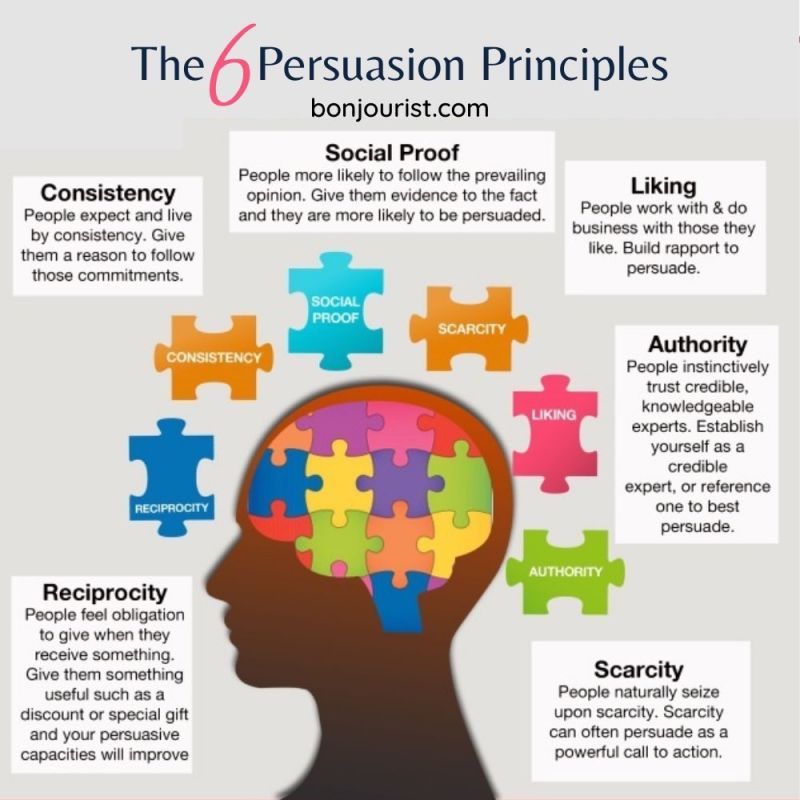
He identified six core principles - reciprocity, commitment/consistency, social proof, authority, liking, and scarcity - each of which has been independently validated in controlled experiments.
His most cited experiment involved a hotel in Tempe, Arizona, where different messages on bathroom cards asking guests to reuse towels were tested. The standard environmental appeal ("save the environment") produced 35.1% reuse. The social norm appeal ("the majority of guests reuse their towels") produced 44.1% reuse.
And a highly specific social norm ("the majority of guests who stayed in this room reused their towels") produced 49.3% reuse.
The research demonstrates that social proof operates on increasingly specific reference groups - the closer the described "others" are to the audience, the stronger the influence.
George Lakoff (UC Berkeley), in Metaphors We Live By (1980, with Mark Johnson) and Don't Think of an Elephant! (2004), established that conceptual metaphors - the underlying frames through which abstract concepts are understood - powerfully determine which verbal messages are persuasive.
His research demonstrated that crime being framed as a "beast" (wild, invasive, external) leads people to prefer enforcement solutions, while crime framed as a "virus" (systemic, contextual, spreading from underlying conditions) leads people to prefer social reform solutions - even when presented with identical crime statistics.
The metaphor determines which solutions seem natural. Lakoff argued that much political persuasion operates at the level of activating frames rather than presenting arguments: the choice of word ("estate tax" vs. "death tax," "pro-life" vs. "anti-abortion") activates different cognitive frames that determine how subsequent information is processed.
Steven Pinker's The Sense of Style (2014) brought cognitive science to the study of effective writing, drawing on research in sentence processing to explain why certain prose structures are more persuasive than others.
His most important contribution to persuasion research was the analysis of "the curse of knowledge" - the finding that experts are systematically worse at communicating to non-experts than non-experts are at communicating to each other, because expertise makes it impossible to imagine not knowing what you know.
Pinker synthesized research on sentence processing showing that active voice, concrete nouns, and chronological narrative organization are consistently more persuasive than passive voice, abstract nouns, and logical-sequential organization - not because the latter are less accurate, but because they impose greater cognitive load and trigger less vivid mental simulation.
Richard Petty and John Cacioppo's Elaboration Likelihood Model (ELM), developed in their 1986 book Communication and Persuasion, established the most influential dual-route model of persuasion.
The "central route" involves careful, systematic evaluation of message quality and evidence; the "peripheral route" involves responding to surface cues (speaker attractiveness, message length, emotional tone) without engaging with content.
The key insight: the route taken depends on the audience's motivation and ability to process the message. When audiences are highly motivated and capable, strong arguments persuade and weak arguments boomerang.
When audiences are low in motivation or processing capacity, peripheral cues (credibility signals, emotional appeals, social proof) dominate.
This model has direct implications for language choice: technical language persuades expert, motivated audiences but alienates and fails to persuade general audiences, who respond better to vivid narrative and credibility signals.
Real-World Case Studies in Linguistic Persuasion
Barack Obama's 2008 campaign language: Linguist George Lakoff and communication scholar Drew Westen both analyzed the linguistic strategies of the 2008 Obama presidential campaign.
The campaign systematically avoided Republican-established frames ("war on terror," "death tax," "pro-life") and introduced new frames: "hope," "change we can believe in," and crucially, the narrative frame of America's story as ongoing and unfinished.
The repeated use of "Yes we can" worked rhetorically through multiple mechanisms simultaneously: anaphora (rhythmic repetition), collective identity formation ("we"), active agency ("can"), and the compressed expression of possibility rather than promise.
Communication scholars have analyzed the emotional and narrative language of Obama's 2008 campaign speeches.
Dove's "Real Beauty" campaign (2004-present): When Unilever's Dove brand launched its "Real Beauty" campaign in 2004, it was a deliberate experiment in reframing.
Rather than using the standard beauty advertising language (aspirational, perfection-oriented, comparative), Dove used language of celebration, normalcy, and self-acceptance.
Words like "real," "natural," and "beautiful" were applied to models who did not conform to conventional beauty advertising standards.
Market research firm Millward Brown tracked the campaign's persuasion effectiveness and found it dramatically outperformed standard beauty advertising on both brand identification and purchase intent - not because it abandoned persuasion but because it used a different persuasion frame.
The campaign generated substantial earned media coverage, demonstrating that linguistic reframing can create persuasive power that paid media cannot buy.
The anti-smoking campaign and language de-normalization: Public health researcher Stan Glantz (UC San Francisco) documented the linguistic strategies used to de-normalize smoking in the United States from the 1970s through the 2000s.
The campaign's most effective linguistic move was shifting the frame from "personal choice" (which implied that non-smokers had no stake in the behavior) to "secondhand smoke" (which implicated smoking in harm to non-consenting others).
The word "addiction" replaced "habit" in public discourse, changing the causal attribution of smoking from character weakness to physiological compulsion.
These linguistic shifts preceded and enabled policy changes: once smoking was framed as harming others and as addictive rather than chosen, restrictions and liability became politically viable.
Glantz analyzed media coverage and found that the period of greatest linguistic shift (1985-1995) correlated with the steepest decline in smoking prevalence, though causation could not be cleanly established.
Winston Churchill's wartime rhetoric: Historian David Reynolds (In Command of History, 2004) analyzed Churchill's writing and wartime memoirs in detail.
Churchill's most famous phrases ("fight them on the beaches," "their finest hour") were crafted and revised through multiple drafts, with Churchill testing phrasing aloud to optimize rhythm and emotional impact.
Reynolds documented that Churchill was explicitly aware of the difference between the propositional content of a message (what is stated) and its rhetorical force (what is communicated emotionally and motivationally).
His decision to broadcast "We shall fight on the beaches" rather than the more accurate description of the Dunkirk evacuation as a defeat was a deliberate choice to use language to shape morale rather than to report facts - a case that raises important ethical questions about persuasion in crisis contexts.
The Science Behind Persuasive Language Effects
Neuroscientist Uri Hasson (Princeton University) has used fMRI to study what happens in listeners' brains when they hear narratives.
His 2010 paper (Stephens, Silbert & Hasson) in Proceedings of the National Academy of Sciences introduced the concept of "neural coupling" - the finding that successful communication produces synchronized brain activity patterns between speakers and listeners.
Hasson's most striking finding: the strength of neural coupling predicted comprehension and attitude change.
Listeners whose brain activity most closely matched the speaker's brain activity during a story showed the greatest persuasion effect.
The research provides neural evidence for the "transportation" model of narrative persuasion: stories that draw listeners into the narrative space of the speaker literally synchronize their neural processing, reducing the distinction between observer and participant.
Psycholinguist Rolf Zwaan (Erasmus University Rotterdam) has demonstrated through multiple experiments that language comprehension activates sensorimotor simulations - mental representations of the actions, perceptions, and emotions described in language.
Reading "the pitcher threw the ball" activates motor regions associated with throwing; reading "she bit into the apple" activates gustatory processing regions.
This "simulation" model of language comprehension explains why vivid, sensory language is more persuasive than abstract language: it produces richer mental simulation, which creates stronger feelings of reality and personal relevance.
Zwaan's research suggests that the most persuasive language is not the most logically compelling but the most sensorially and emotionally rich - language that creates an experience rather than conveying information.
James Pennebaker (University of Texas at Austin) has studied the psychology of language use through analysis of millions of naturally occurring texts, summarized in The Secret Life of Pronouns (2011).
His counterintuitive finding: function words (pronouns, prepositions, articles) - which people rarely consciously choose - are more predictive of psychological states, social relationships, and persuasive outcomes than content words.
Specifically, high first-person singular pronoun use ("I," "me," "my") correlates with depression, lower social status, and less persuasive writing; high first-person plural pronoun use ("we," "us," "our") correlates with social cohesion and group solidarity.
Leaders who use "we" more than "I" in public communication are rated as more trustworthy and more persuasive by audiences. Pennebaker's research has been applied to analyzing political speech, detecting deception, and predicting the persuasive effectiveness of marketing copy.
Sources & Further Reading
Cialdini, R.B. (2006). Influence: The Psychology of Persuasion. Revised ed. Harper Business. View source
Lakoff, G. (2004). Don't Think of an Elephant! Know Your Values and Frame the Debate. Chelsea Green Publishing. View source!
Aristotle. Rhetoric. Multiple editions. View source
Kahneman, D. (2011). Thinking, Fast and Slow. Farrar, Straus and Giroux. View source
Petty, R.E. & Cacioppo, J.T. (1986). Communication and Persuasion: Central and Peripheral Routes to Attitude Change. Springer-Verlag. View source
Hasher, L., Goldstein, D., & Toppino, T. (1977). "Frequency and the Conference of Referential Validity." Journal of Verbal Learning and Verbal Behavior, 16(1), 107-112. DOI: 10.1016/S0022-5371(77)80012-1
Pinker, S. (2014). The Sense of Style: The Thinking Person's Guide to Writing in the 21st Century. Viking. View source
Leith, S. (2011). Words Like Loaded Pistols: Rhetoric from Aristotle to Obama. Basic Books. View source
Pratkanis, A.R. & Aronson, E. (2001). Age of Propaganda: The Everyday Use and Abuse of Persuasion. Revised ed. W.H. Freeman.
Heath, C. & Heath, D. (2007). Made to Stick: Why Some Ideas Survive and Others Die. Random House. View source