
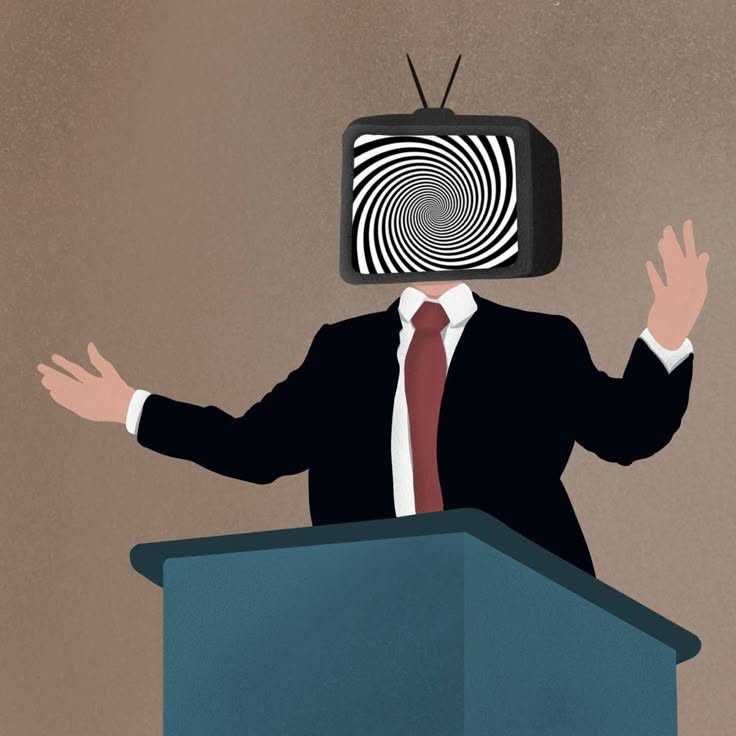
Power can operate through the categories and terms that determine what people are able to say, think, and treat as legitimate. Discourse and power examines this relationship between language, knowledge, and social practice rather than reducing discourse to ordinary conversation.
What Is Discourse and Power?
Discourse, in the tradition of Michel Foucault and critical linguistics, refers to systems of language, knowledge, and practice that determine what can be said, thought, and done within a given domain of social life - not merely conversation, but the entire framework of meaning that shapes which ideas are thinkable and which are excluded.
Power, in this context, operates not primarily through force but through discourse: whoever controls the categories, terms, and narratives through which a subject is understood controls what questions can be asked and what alternatives can be imagined.
The study of discourse and power examines how language constructs authority, legitimizes institutions, and makes certain social arrangements appear natural and inevitable rather than chosen.
In 2003, the United States government did not invade Iraq. It launched Operation Iraqi Freedom. The military did not kill civilians; there was collateral damage. Prisoners were not tortured; they underwent enhanced interrogation techniques.
The war was not fought for oil or geopolitical dominance; it was part of a global war on terror aimed at eliminating weapons of mass destruction and bringing democracy to the Middle East.
Every one of these linguistic choices was deliberate. Every one shaped how the public understood what was happening. The language did not merely describe reality-it constructed the reality that people perceived.
By controlling the words used to describe the invasion, its methods, and its purposes, the government controlled what questions could be asked, what criticisms could be made, and what alternatives could be imagined. This is discourse and power in action.
"Political language is designed to make lies sound truthful and murder respectable, and to give an appearance of solidity to pure wind." - George Orwell
Discourse-systems of language, knowledge, and practice that shape understanding and action-is one of the most powerful mechanisms through which authority is established, legitimacy is constructed, and social control is exercised.
It operates not through force but through meaning-through determining how issues are understood, what counts as knowledge, who has the right to speak, and what can and cannot be said.
Understanding the relationship between discourse and power is essential for anyone who wants to think critically about the world they live in, because the most effective power is the power that does not need to be exercised through coercion. It is the power that shapes what people think and want before any conflict arises.
What Is Discourse?
In everyday usage, "discourse" simply means conversation or written communication.
In the academic tradition that examines the relationship between language and power-drawing primarily on the work of Michel Foucault, Pierre Bourdieu, and critical discourse analysts like Norman Fairclough and Teun van Dijk-"discourse" means something far more specific and consequential.
Discourse, in this sense, refers to systems of meaning-making that determine what can be said, thought, and done within a particular domain of social life. It encompasses:
- Language: The words, phrases, metaphors, and narrative structures used to discuss a topic
- Knowledge: The frameworks, theories, and categories through which a topic is understood
- Practices: The institutions, procedures, and behaviors that are legitimized by the discourse
- Subject positions: The roles that individuals can occupy within the discourse (expert, patient, criminal, citizen)
A discourse is not just a collection of statements about a topic. It is the entire system of rules that determines which statements are possible, which are taken seriously, and which are excluded from consideration.
Examples of Discourse Systems
Medical discourse determines:
- What counts as illness vs. health
- Who has authority to diagnose and treat (credentialed professionals)
- What treatments are legitimate (evidence-based medicine) vs. illegitimate (folk remedies, alternative medicine)
- How patients should relate to doctors (deference to expertise, compliance with instructions)
Economic discourse determines:
- What counts as economic health (GDP growth, low unemployment, rising stock markets)
- Which economic frameworks are taken seriously (mainstream economics) vs. dismissed (heterodox approaches)
- What solutions are considered possible (market-based solutions, fiscal and monetary policy) vs. unthinkable (radical redistribution, degrowth)
Legal discourse determines:
- What counts as a crime vs. acceptable behavior
- Who has authority to judge (judges, juries, credentialed lawyers)
- What evidence is admissible and how it should be interpreted
- How justice is conceptualized (punishment vs. rehabilitation, individual rights vs. social order)
Each of these discourse systems exercises enormous power-not through coercion but through defining the boundaries of the thinkable. When medical discourse defines obesity as a disease, it transforms a bodily characteristic into a medical condition requiring treatment.
When economic discourse treats GDP growth as the primary measure of national success, it marginalizes alternative measures of wellbeing. When legal discourse criminalizes drug use, it transforms a health issue into a criminal justice issue.
How Does Discourse Relate to Power?
The core insight of discourse theory is that language does not merely reflect power relations-it constitutes them. Power is not something that exists independently of language and then uses language as a tool. Power is partly created, sustained, challenged, and transformed through language.
Foucault's Power/Knowledge
Michel Foucault, the philosopher most closely associated with the analysis of discourse and power, argued that power and knowledge are inseparable (he often wrote "power/knowledge" as a single concept).
Those who control the production of knowledge control what counts as truth, and what counts as truth determines who has authority.
"Where there is power, there is resistance." - Michel Foucault
Foucault's key insights include:
Power produces, not just represses: Traditional views see power as primarily repressive-it says "no," it prohibits, it constrains. Foucault argued that power is primarily productive-it creates categories, identities, truths, and behaviors.
The power of medical discourse does not merely prohibit certain behaviors; it creates the entire framework through which bodily experience is understood.
Power is everywhere, not just at the top: Power does not flow only from rulers to ruled. It operates in every interaction, every institution, every classification system.
A teacher exercising authority over students, a psychiatrist diagnosing a patient, a social media algorithm determining what content is visible-all are exercises of discursive power.
Truth is produced, not discovered: What counts as "true" in any era is determined by the discursive systems that produce and validate knowledge.
This is not a claim that reality does not exist but that our access to reality is always mediated by discursive frameworks that shape what we can perceive, articulate, and accept as true.
Subjects are constituted by discourse: People do not have fixed identities that exist prior to discourse. The categories through which we understand ourselves (our gender, our sanity, our sexuality, our health, our normality) are produced by discursive systems that define and classify human beings.
Bourdieu's Symbolic Power
Pierre Bourdieu complemented Foucault's analysis with the concept of symbolic power-the power to impose categories of perception and appreciation on others, to define what is legitimate, valuable, and worthy of recognition.
"Every linguistic exchange contains the potentiality of an act of power." - Pierre Bourdieu
Bourdieu argued that:
Linguistic capital: Mastery of the dominant language variety (standard English, received pronunciation, formal register) functions as a form of capital that grants social advantages. People who speak "correctly" (by the standards of the dominant class) are perceived as more intelligent, more competent, and more trustworthy.
Symbolic violence: The imposition of dominant categories and standards on subordinate groups, experienced not as violence but as natural, inevitable, or deserved.
When working-class children are taught in school that their home dialect is "incorrect," they internalize a devaluation of their own linguistic heritage that serves the interests of the dominant class.
The illusion of naturalness: The most effective symbolic power is that which is perceived not as power but as the natural order of things.
When people accept that certain ways of speaking, certain types of knowledge, and certain social arrangements are simply "how things are," they accept the power relations embedded in those arrangements without resistance. This is social influence at its most invisible.
Mechanisms of Discursive Power
Discourse exercises power through several identifiable mechanisms.
1. Agenda Setting
The power to determine what is discussed is more fundamental than the power to win arguments about those topics. If an issue is never placed on the agenda-if it is never framed as a problem requiring attention-then no amount of argumentation can change the outcome, because there is no debate to win.
Media organizations, political leaders, and institutional actors exercise agenda-setting power by:
- Choosing which stories to cover and which to ignore
- Framing some issues as urgent and others as unimportant
- Defining what counts as newsworthy
- Determining which experts are invited to comment
2. Naming and Classification
The power to name things is the power to define how they are understood:
- Calling armed groups "freedom fighters" vs. "terrorists" determines whether they are heroic or criminal
- Calling immigrants "expats" vs. "migrants" vs. "aliens" determines whether they are welcomed or feared
- Calling a military action "peacekeeping" vs. "occupation" vs. "intervention" determines whether it is legitimate
- Calling economic inequality a "natural outcome of the market" vs. "structural injustice" determines whether it requires action
Naming is not neutral description. It is an act of power that establishes the framework within which subsequent discussion occurs. Once a name is established, it becomes the default lens through which an issue is perceived, and changing the name requires overcoming the inertia of established understanding.
3. Defining the Terms of Debate
Related to naming, the power to define the terms in which a debate occurs-central to all rhetoric-often determines its outcome:
| How the Issue Is Framed | What Follows |
|---|---|
| Healthcare is a market | Solutions involve market mechanisms: competition, consumer choice, deregulation |
| Healthcare is a right | Solutions involve government provision: universal coverage, public funding, regulation |
| Crime is a moral failure | Solutions involve punishment: longer sentences, more prisons, stricter law enforcement |
| Crime is a social problem | Solutions involve prevention: education, poverty reduction, mental health services |
| Immigration is a security threat | Solutions involve enforcement: walls, deportation, border patrol |
| Immigration is an economic necessity | Solutions involve management: legal pathways, work permits, integration programs |
In each case, the framing effects determine not just the preferred solution but which solutions are even imaginable. If healthcare is a market, single-payer healthcare is not just wrong-it is conceptually incoherent within the framework. If crime is a moral failure, poverty reduction is not just inefficient-it is irrelevant.
4. Controlling Access to Discourse
Not everyone has equal access to public discourse. The ability to speak and be heard in public forums, media, and institutions is unequally distributed:
- Media ownership determines whose voices are amplified and whose are marginalized
- Credentialing systems determine who is recognized as an expert with authority to speak on a topic
- Platform algorithms determine whose content is visible and whose is suppressed
- Institutional gatekeeping determines who is invited to speak, publish, testify, and advise
- Language barriers exclude people who do not speak the dominant language from participation
This unequal access means that the discourse that shapes public understanding is produced disproportionately by those who already hold power-educated, wealthy, socially connected individuals and institutions that have the resources, credentials, and access to shape public conversation.
5. Normalization
Perhaps the most powerful function of discourse is normalization-the process by which certain arrangements, behaviors, and beliefs are made to appear natural, inevitable, and unquestionable.
When a particular state of affairs is successfully normalized, it ceases to be perceived as a choice or a power arrangement and becomes simply "the way things are." Examples include:
- The normalization of market-based solutions to social problems ("there is no alternative")
- The normalization of certain body types as healthy and others as pathological
- The normalization of certain family structures as standard and others as deviant
- The normalization of endless economic growth as both possible and necessary
Normalization is the most effective form of power because it eliminates resistance by eliminating the perception that there is anything to resist. You cannot fight what you cannot see, and normalized power is invisible.
"The most potent weapon of the oppressor is the mind of the oppressed." - Steve Biko
Can Changing Language Change Power Relations?
This question is central to contemporary debates about political correctness, inclusive language, and linguistic activism. The answer is: partially, and with significant limitations.
What Language Change Can Do
- Shift perceptions: When "handicapped" becomes "disabled" becomes "person with a disability," the evolving language reflects and reinforces a shift in how disability is understood-from a deficiency in the person to a condition of the environment
- Open discursive space: New terms can create space for ideas that were previously inexpressible. The concept of "microaggressions" gave a name to experiences that were previously difficult to articulate, making them discussable and therefore addressable
- Challenge normalization: Language change can denaturalize arrangements that were previously taken for granted. Using "enslaved people" instead of "slaves" emphasizes that slavery was something done to people, not an inherent characteristic
- Signal social change: Language change both reflects and accelerates social change. As terminology evolves, it signals to both speakers and listeners that norms are shifting
What Language Change Cannot Do
- Replace structural change: Renaming a problem does not solve it. Using inclusive language in a workplace that still discriminates in hiring and promotion changes the surface while leaving the structure intact
- Overcome material power: Discursive power is real, but it operates alongside and intertwined with material power (money, weapons, institutional control). Language change without corresponding changes in material conditions produces what critics call "symbolic politics"-the appearance of change without its substance
- Force adoption: Language change that is perceived as imposed from above rather than emerging organically often generates backlash. When terminology changes are experienced as mandates rather than as reflections of genuine cultural evolution, they can provoke resistance that hardens the very attitudes they intend to change
The Dialectical Relationship
The most accurate view is that language and material power exist in a dialectical relationship-each shapes the other, and lasting change typically requires movement in both domains.
The civil rights movement changed both the language used to discuss race (discursive change) and the laws and institutions that enforced racial hierarchy (structural change). Neither change alone would have been sufficient; together, they transformed American society.
How Do Dominant Groups Control Discourse?
Dominant groups maintain discursive control through several reinforcing mechanisms:
Media Ownership and Control
Those who own and control media outlets-news organizations, publishing houses, social media platforms, entertainment studios-have disproportionate influence over public discourse.
Concentration of media ownership means that a relatively small number of individuals and corporations determine what information reaches the public and how it is framed.
Institutional Authority
Universities, think tanks, government agencies, professional associations, and other institutions produce the "official" knowledge that shapes public discourse.
These institutions are not neutral knowledge factories-they are embedded in power structures that influence what research is funded, what expertise is valued, and what conclusions are considered legitimate.
Expert Discourse
The authority of expertise-the ability of credentialed professionals to define reality within their domains-is a powerful form of discursive control.
When a doctor defines a condition as a disease, when an economist declares a recession, when a psychologist diagnoses a disorder, they exercise the power to classify reality in ways that have material consequences for people's lives.
Repetition and Saturation
The sheer repetition of dominant framings through media, education, and everyday conversation normalizes them until they become invisible.
When every news outlet uses the term "national security" rather than "state power," when every economics textbook treats GDP growth as the goal of economic policy, when every courtroom follows the same procedural norms, the discursive frameworks become the unquestioned backdrop of social life.
Can Individuals Resist Dominant Discourse?
Despite the power of dominant discourse, resistance is both possible and continuously occurring.
Counter-Narratives
Marginalized groups create counter-narratives that challenge dominant framings:
- The labor movement's counter-narrative to the discourse of "free markets" and "job creators"
- Feminist counter-narratives to patriarchal discourse about gender roles
- Anticolonial counter-narratives to imperial discourse about "civilization" and "development"
- Environmental counter-narratives to the discourse of unlimited economic growth
Counter-narratives do not merely disagree with dominant discourse; they offer alternative frameworks for understanding reality. They redefine terms, challenge classifications, name experiences that were previously invisible, and propose different criteria for evaluating truth and value.
Critical Discourse Analysis
Developed by Norman Fairclough, Teun van Dijk, and others, critical discourse analysis (CDA) is a methodology for systematically examining how language serves power. CDA asks:
- Whose perspective is centered in this text?
- What assumptions are taken for granted?
- What alternatives are excluded or marginalized?
- Who benefits from this framing?
- What power relations are naturalized?
By making the power dynamics of discourse visible, CDA enables individuals to recognize and resist discursive manipulation that would otherwise operate below conscious awareness.
Digital Counter-Discourse
The internet has created unprecedented opportunities for counter-discourse:
- Social media enables marginalized voices to reach audiences without passing through institutional gatekeepers
- Hashtag activism (#MeToo, #BlackLivesMatter) creates new discursive frameworks that challenge dominant narratives, though it can also fuel digital tribalism
- Alternative media outlets provide platforms for perspectives excluded from mainstream discourse
- Citizen journalism challenges the monopoly of professional media on news production
However, the internet also creates new forms of discursive power-algorithmic control of visibility, platform censorship, information overload that drowns out counter-narratives-meaning that digital discourse is a contested terrain rather than a simple liberation from traditional power structures.
Discourse and Power in Everyday Life
The relationship between discourse and power is not confined to politics and institutions. It operates in everyday interactions:
- Workplace discourse: The language of "team players," "going above and beyond," and "corporate culture" naturalizes employer expectations that serve organizational interests over worker wellbeing
- Educational discourse: The language of "achievement," "potential," and "intelligence" creates categories that sort students into tracks with vastly different life outcomes
- Family discourse: The language of "good" children, "normal" families, and "proper" behavior enforces conformity to norms that reflect particular cultural values rather than universal truths
- Self-discourse: The language people use to describe themselves ("I'm just not a math person," "I'm not creative," "I'm too emotional") can constrain their own possibilities by internalizing limiting categories-a clear illustration of how language shapes thought
Recognizing discourse and power in everyday life is not about becoming paralyzed by the realization that language is never neutral.
It is about developing the critical awareness to notice when language is doing more than it appears when it is not just describing reality but constructing it, not just communicating ideas but establishing authority, not just expressing views but constraining what views are expressible.
This awareness is the foundation of critical thinking and the prerequisite for meaningful participation in the democratic governance of shared social life.
What Research Shows About Discourse and Power in Digital Environments
Contemporary research has extended discourse and power analysis to digital platforms, producing empirical findings that both confirm and complicate the theoretical frameworks developed by Foucault, Bourdieu, and the critical discourse analysts.
Zeynep Tufekci at the University of North Carolina has produced the most empirically grounded account of how digital platform architectures function as discourse-shaping mechanisms.
Her research, including analysis of how Twitter, Facebook, and YouTube shape political discourse, documents that platform algorithms exercise a form of discursive power that has no precise historical precedent: they determine what speech is effectively heard (receives amplification and distribution) without explicitly prohibiting any speech.
This "soft censorship through amplification" is more effective than traditional censorship because it shapes discourse without triggering the resistance that explicit prohibition provokes.
Tufekci's analysis in Twitter and Tear Gas (2017) shows that movements that succeed in gaining visibility within algorithmically governed discourse may do so precisely by adapting their communication to algorithmic requirements - emotional intensity, conflict framing, in-group signaling - which shapes their politics as much as their reach.
Researcher Safiya Umoja Noble at UCLA, in Algorithms of Oppression (2018), documented how search engine algorithms encode and reproduce existing power relations in their organization of information.
Noble's analysis of Google search results for racially charged queries found that the algorithm systematically surfaced content reflecting and reinforcing racial stereotypes, not because of deliberate choice but because the algorithm was trained on human-generated content that reflected existing racial hierarchies.
Noble's work represents a critical discourse analysis of algorithmic systems, showing that Foucault's insight - that power produces rather than merely represses, and that it operates through the categories of knowledge rather than through explicit prohibition - applies directly to the technical architectures of digital information systems.
Marshall McLuhan's concept of the "global village" - his prediction that electronic media would create a new form of tribal consciousness by collapsing time and space - anticipated dynamics in digital discourse that discourse theorists are only now systematically analyzing.
McLuhan argued in Understanding Media (1964) that different media technologies produce different relationships to knowledge, authority, and community: oral cultures produce different knowledge relationships than literate cultures, which produce different relationships than electronic cultures.
The specific discourse structures of social media - rapid, ephemeral, emotionally intense, identity-focused - are, on McLuhan's framework, products of the medium rather than of the content, and they are reshaping what kinds of knowledge claims are credible, what kinds of speakers have authority, and what kinds of communities can form around shared discourse.
Neil Postman's critical extension of McLuhan's analysis in Technopoly (1992) argued that every technology carries embedded assumptions about what is worth knowing, who has knowledge worth listening to, and what counts as a valid argument.
Postman coined the term "technopoly" to describe a social order in which technology has achieved cultural authority - where questions about value, meaning, and truth are routinely deferred to technological systems.
Applied to digital discourse, Postman's framework predicts that the authority of algorithmic curation, engagement metrics, and viral spread will progressively displace the authority of expertise, deliberation, and evidence in determining what claims and what speakers are taken seriously.
Research on the decline of expert authority in online discourse, documented by researchers including Tom Nichols (The Death of Expertise, 2017), provides empirical support for Postman's prediction.
Real-World Case Studies in Discourse and Power
The Iraq War and Language of Power (2003-2011). The linguistic analysis of the Iraq War provides perhaps the most carefully studied modern case of political language exercising discursive power at scale.
Cognitive linguist George Lakoff at UC Berkeley documented how the framing of the conflict as a "war on terror" rather than a "military campaign against specific groups" shaped public understanding in ways that made the invasion semantically coherent - wars are fought against enemies, enemies must be defeated, therefore the war must be pursued until victory.
Lakoff's analysis showed that this framing was not merely rhetorical decoration but had causal power: surveys showed that support for the invasion was significantly predicted by whether respondents used the "war on terror" frame or alternative frames, and that the frame was robustly adopted by mainstream media despite its tendentiousness.
The case is cited in media studies curricula as a demonstration that Foucault's theoretical claim - that language constitutes rather than merely describes political reality - has measurable empirical consequences.
The "Welfare Queen" Narrative and Policy Outcomes (1976-2000s). Ronald Reagan's repeated invocation of the "welfare queen" - a composite figure of a Black woman allegedly defrauding the welfare system - in his 1976 presidential campaign and subsequently has been studied extensively as a case of racialized discourse shaping policy.
Historian Michael Brown documented that the "welfare queen" narrative constructed a discourse about public assistance in which fraud, dependency, and racial characteristics were bundled into a single recognizable figure, making any discussion of welfare reform semantically connected to that bundle.
Opinion surveys documented that this discursive frame shifted public attitudes toward welfare policy in measurable ways that persisted for decades: longitudinal research by Martin Gilens at Princeton showed that negative stereotypes about Black welfare recipients, heavily shaped by media framing, were among the strongest predictors of opposition to welfare policy more generally.
This case illustrates Bourdieu's concept of symbolic violence: the "welfare queen" discourse imposed a stigmatizing category on the poor that they internalized and that shaped the policy environment constraining their lives.
Wikipedia's Neutrality Wars (2001-present). Wikipedia's talk pages - the discussion spaces where editors negotiate what content will appear in articles - have been studied by discourse analysts as cases of power negotiation through discourse.
Research by Aaron Halfaker and colleagues documented systematic patterns in how different categories of editors exercise discursive power on Wikipedia: experienced editors with high reputation scores can invoke policy language and Wikipedia norms as discourse-closing moves, while new editors - even those with accurate information - are often unable to overcome these discursive authority moves.
The research found measurable declines in new editor retention that tracked with changes in the discourse norms of Wikipedia's editing community, suggesting that discursive power exercised by experienced editors was effectively shaping the composition of the knowledge-producing community.
Hashtag Activism and Counter-Discourse (2012-present). The emergence of hashtag-based political movements - #BlackLivesMatter (2013), #MeToo (2017), #FridaysForFuture (2018) - has been analyzed by communications researchers as exercises in counter-discursive power that exploit digital platform architecture to bypass traditional gatekeepers.
Karine Nahon and Jeff Hemsley at the University of Washington documented in Going Viral (2013) how hashtag campaigns achieve rapid norm-change by creating visible evidence of widespread participation, which functions as social proof that the counter-discourse is not marginal.
Researcher Sarah Jackson at Northeastern University, in #HashtagActivism (2020), co-authored with Moya Bailey and Brooke Foucault Welles, analyzed years of Black political hashtag campaigns and found that they consistently achieved three things simultaneously: naming experiences that dominant discourse left unnamed, building community among those who shared the experiences, and forcing mainstream media to cover realities they had previously ignored.
This represents a documented mechanism by which digital tools can shift discourse power at scale in ways that were impossible before social media.
The Science Behind Discourse and Power: Psychological and Linguistic Research
Several streams of empirical research from psychology and linguistics support and specify the theoretical claims of discourse and power analysis.
Robert Cialdini's research on social influence, documented most comprehensively in Influence: The Psychology of Persuasion (1984), demonstrates empirically that authority is a powerful determinant of compliance independent of the content of authoritative claims.
Cialdini's experiments showed that markers of authority - titles, uniforms, credentials, confident tone - increase compliance with requests even when those markers are fabricated or irrelevant to the domain of the request.
This finding supports Bourdieu's analysis of linguistic capital: the markers of dominant discourse (formal register, credentialed vocabulary, institutional affiliation) exercise genuine persuasive power independent of the epistemic merit of what is being said.
Cialdini's work implies that discursive power is not merely ideological but operates through well-documented psychological mechanisms.
Psychologist George Miller's foundational research on cognitive limits - his 1956 paper "The Magical Number Seven, Plus or Minus Two" establishing that working memory can hold only a small number of items - has been invoked in discussions of discourse and power.
If human cognition can only hold a small number of categories in working memory at once, then the power to define which categories are "in play" in any given discussion is the power to define what can be thought in that discussion.
Foucault's "episteme" - the set of concepts and categories that define what can be thought in an era - maps directly onto the cognitive limits Miller documented: power over discourse is partly power over the limited cognitive space available for political thought.
Linguist George Lakoff at UC Berkeley's empirical research on political framing demonstrated through experimental methods that the linguistic frames used to discuss political issues shape evaluation of policy options in ways that are resistant to correction by contrary information.
In experiments documented in Don't Think of an Elephant (2004) and subsequent academic publications, Lakoff and colleagues showed that describing the same tax policy as a "tax relief" rather than a "tax cut" or "reduced public funding" changed evaluations of the policy in predictable directions - and that providing additional information about policy effects did not fully counteract the framing effect.
This empirical finding gives precise content to the theoretical claim that language does not merely describe political reality but constitutes it: the frame chosen to describe a policy is not neutral and cannot be neutralized by adding more information, because the frame shapes how additional information is processed.
Sources & Further Reading
Foucault, M. (1972). The Archaeology of Knowledge. Trans. A.M. Sheridan Smith. Pantheon Books. View source
Foucault, M. (1980). Power/Knowledge: Selected Interviews and Other Writings, 1972-1977. Ed. Colin Gordon. Pantheon Books. View source
Fairclough, N. (2001). Language and Power. 2nd ed. Longman. View source
Bourdieu, P. (1991). Language and Symbolic Power. Ed. John B. Thompson. Trans. Gino Raymond & Matthew Adamson. Harvard University Press. View source
van Dijk, T.A. (2008). Discourse and Power. Palgrave Macmillan. View source
Lakoff, G. (2004). Don't Think of an Elephant! Know Your Values and Frame the Debate. Chelsea Green Publishing. View source!
Chomsky, N. & Herman, E.S. (1988). Manufacturing Consent: The Political Economy of the Mass Media. Pantheon Books. View source
Gramsci, A. (1971). Selections from the Prison Notebooks. Ed. & trans. Quintin Hoare & Geoffrey Nowell Smith. International Publishers. View source
Said, E.W. (1978). Orientalism. Vintage Books. View source
Orwell, G. (1946). "Politics and the English Language." Horizon. View source