
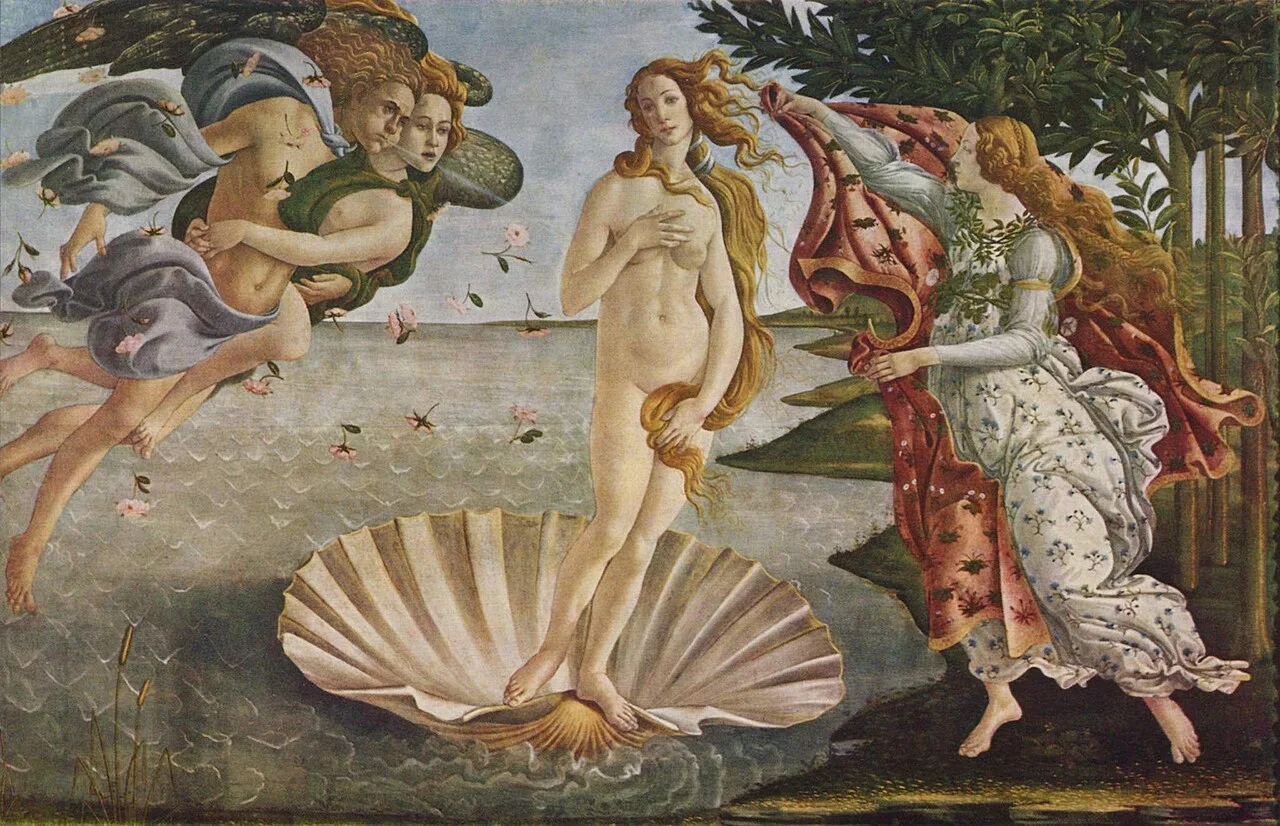
Renaissance: In 1439, Cosimo de' Medici - the wealthiest banker in Europe, the unofficial ruler of Florence, and a man who understood that culture was power - hosted the Council of Florence in his city. The Council had been convened to reunite the Eastern and Western Christian churches, a diplomatic initiative that ultimately failed.
But Cosimo saw another opportunity in the Byzantine delegation: Greek scholars from Constantinople, some of them carrying manuscripts of Plato, Aristotle, and the ancient Greek mathematicians and scientists that Western Europe had lost for centuries, arrived in Florence speaking a language and bearing a culture that was both ancient and alive.
When Constantinople fell to the Ottoman Turks in 1453, many more Greek scholars fled West, bringing their libraries with them. Cosimo funded the translation of Plato's complete works by Marsilio Ficino - a project completed in 1469 that would not have been possible without the Greek manuscripts the Byzantine refugees carried.
This confluence - Florentine wealth, competitive civic patronage, the influx of Byzantine learning, and the momentum of a century of humanist textual scholarship - was not the origin of the Renaissance but its acceleration.
The movement had roots in Petrarch's fourteenth-century recovery of Latin texts, in Boccaccio's championing of Italian vernacular literature, and in the civic pride of Italian city-states that competed through art as much as arms.
But the mid-fifteenth century was when the Renaissance became self-aware: when scholars, artists, and patrons understood that they were engaged in a rebirth of something that had been buried - the intellectual and artistic achievement of classical antiquity - and that this rebirth was transforming what it meant to be human.
The word "Renaissance" - French for rebirth - was not applied to the period until the nineteenth century, when the Swiss historian Jacob Burckhardt fixed it in his 1860 "The Civilization of the Renaissance in Italy." But the people living through it had a version of the same perception: they called themselves moderni, the moderns, recovering the ancient world against what Petrarch had memorably called the dark middle ages separating them from Rome.
They were wrong about the middle ages in ways that matter, but the self-understanding shaped what they created.
"We have made you neither of heavenly nor of earthly stuff, neither mortal nor immortal, so that with free choice and dignity, you may mold and carve yourself into the shape you prefer." - Pico della Mirandola, Oration on the Dignity of Man (1486)
| Domain | Renaissance Development | Key Figures |
|---|---|---|
| Visual arts | Perspective; naturalism; human anatomy | Leonardo da Vinci, Michelangelo, Raphael |
| Literature | Vernacular writing; humanism; classical themes | Petrarch, Dante, Boccaccio, Shakespeare |
| Architecture | Classical proportion; domes; civic buildings | Brunelleschi, Alberti, Palladio |
| Philosophy | Humanism; dignity of man; civic virtue | Pico della Mirandola, Erasmus, Machiavelli |
| Science | Observation and experiment; anatomy | Vesalius, Copernicus, Galileo |
| Music | Polyphony; secular music; madrigals | Josquin des Prez, Palestrina |
Key Definitions
Renaissance - A European cultural, intellectual, and artistic movement lasting approximately 1300-1600, originating in the Italian city-states and spreading north, characterized by the recovery of classical Greco-Roman learning, the development of humanism, and new approaches to art, literature, science, and philosophy.
Humanism - The Renaissance intellectual program centered on the studia humanitatis (grammar, rhetoric, poetry, history, and moral philosophy), focused on classical texts, and characterized by a new emphasis on human dignity, achievement, and self-fashioning in this world.
Not anti-religious but reorienting intellectual life toward human excellence.
Studia humanitatis - The five classical disciplines that defined the Renaissance humanist curriculum: grammar (Latin and Greek), rhetoric, poetry, history, and moral philosophy, studied through primary classical texts rather than medieval commentaries.[2]
Linear perspective - A system of representing three-dimensional space on a two-dimensional surface as it appears to a single stationary observer, with parallel lines converging to vanishing points.
Developed by Filippo Brunelleschi around 1413-1420 and codified by Leon Battista Alberti in "On Painting" (1435). Both a technical achievement and a philosophical statement: the human eye as the center of pictorial space.
Patronage system - The mechanism by which Renaissance art and scholarship was funded: wealthy individuals, families, guilds, and the Church commissioned specific works from artists, architects, and scholars in exchange for prestige, political influence, religious merit, or commemorative immortality.
The Medici, papacy, Este, and Sforza families were the most important patrons.
Printing press - Johannes Gutenberg's development of movable-type printing in Mainz around 1440-1450, which enabled mass reproduction of texts and transformed the circulation of ideas.
The enabling technology that turned the Renaissance from an elite scholarly movement into a continent-wide intellectual revolution, and then turned the Reformation from a theological dispute into a continental crisis.
The Renaissance man (uomo universale) - The humanist ideal of the complete person of universal competence: mastery of arts, letters, arms, learning, and social graces simultaneously. Leonardo da Vinci is the archetype; Castiglione's "Book of the Courtier" (1528) is the theoretical formulation.
The Northern Renaissance - The reception and transformation of Italian Renaissance ideas in France, Germany, the Low Countries, England, and Spain from the late fifteenth through the sixteenth century, producing Erasmus, Montaigne, Thomas More, Albrecht Durer, and the Elizabethan literary culture.
Preconditions: Why Italy, Why the Fourteenth Century
The Black Death as Paradoxical Catalyst
The Black Death of 1347-1351, which killed perhaps one-third of Europe's population, seems an unlikely foundation for cultural flowering. Yet historians have repeatedly noted the paradoxical connections.
The massive labor scarcity created by demographic collapse drove up wages for surviving workers and artisans, creating a degree of social mobility - and a degree of questioning of inherited hierarchy - that had been impossible in the more rigid structures of peak medieval population.
Survivors who had watched established authorities (the Church, the medical profession, the feudal order) fail catastrophically to explain or contain the plague were perhaps more open to questioning tradition and seeking new frameworks.
The redistribution of wealth in a collapsed market - with fewer heirs competing for a fixed stock of land and assets - concentrated capital in ways that fed into the patronage systems that Renaissance art required.
The intellectual precondition was already developing. Petrarch (1304-1374) had been recovering and editing classical Latin texts throughout his life, writing in elegant Ciceronian Latin and Italian vernacular simultaneously, and articulating a vision of classical antiquity as a living resource for the present rather than a museum piece.
His discovery of Cicero's letters to Atticus in the cathedral library at Verona in 1345 was a paradigm: real ancient voices, not filtered through medieval commentary, speaking directly across the centuries.
Boccaccio, his friend and disciple, wrote the Decameron (1353) in vernacular Italian, legitimizing the vernacular as a literary medium equal to Latin.
Italian City-States and the Patronage Economy
The institutional context was the competitive world of the Italian city-states. Florence, Venice, Milan, Rome, and smaller centers like Ferrara, Mantua, and Urbino were sovereign polities competing for prestige, trade, and territory.[6]
Unlike the centralized monarchies of France, England, and the Iberian kingdoms, the city-states had developed mercantile economies that concentrated wealth in merchant families rather than in a landed aristocracy.
The Medici banking network, with branches across Europe, financed the Florentine state and generated the surplus that Cosimo and then Lorenzo deployed on art, scholarship, and architecture.
Patronage was not philanthropy - it was investment in prestige, commemoration, and political legitimacy. When the Florentine wool guild commissioned Ghiberti's bronze doors for the Baptistery (1401-1424) and again Ghiberti's "Gates of Paradise" (1425-1452), it was asserting Florence's civic superiority.
When Nicholas V rebuilt Rome as a humanist capital - the Papal Renaissance of the 1440s-1450s - he was creating a visible claim to Rome's imperial inheritance for the papacy.
When the Sforzas of Milan employed Leonardo da Vinci for seventeen years, they were buying not just paintings and equestrian statues but the cultural authority that Leonardo's universal genius represented.
Renaissance Humanism: The New Vision of the Human
Petrarch and the Recovery of Antiquity
Petrarch's contribution to the Renaissance was partly practical - his meticulous scholarly recovery of ancient texts, his insistence on reading primary sources rather than medieval commentaries, and his creation of an influential model of classical Latin style - but more fundamentally philosophical.
He articulated the conviction that the ancient world represented a height of human achievement from which the intervening centuries had descended, and that recovering the ancient world would be morally and intellectually transformative.[3]
He also modeled a new form of subjectivity. His "Secretum" is a dialogue between himself and an imagined Augustine about his spiritual condition - an introspective, self-examining mode of writing that was novel in its sustained attention to the individual interior.
His collection of Italian love poems, the Canzoniere, devoted to Laura, gave the lyric self a central place in literary culture that it has never since lost.
Pico della Mirandola and Human Dignity
Pico della Mirandola's "Oration on the Dignity of Man" (1486), written as a preface to the nine hundred philosophical theses he planned to defend publicly in Rome (the papacy eventually prohibited the debate), made the most ambitious humanist statement of human nature.
God, in Pico's account, has created humans last, when all fixed natures and places have been assigned.[10]
To Adam God says: "We have given you no fixed seat, no form of your very own, no gift peculiarly your own, so that whatever place, form, or gift you choose, you may have and keep through your own will and endeavor." Humans are the only creatures without a fixed nature: they can descend to the brute or ascend to the divine through their choices.
This was not Christian orthodoxy - it elevated human freedom and self-determination in ways that orthodox anthropology, which emphasized creaturely limitation and dependence on grace, did not endorse.
But it captured something characteristic of the Renaissance cultural mood: the individual as self-fashioning agent, not a fixed type defined by birth, class, and divine assignment.
Art: The Visual Revolution
Linear Perspective and the Human Eye
Filippo Brunelleschi's demonstration of linear perspective, traditionally dated to around 1413-1420, was both a technical and philosophical event.
By constructing a painted panel of the Florence Baptistery using the perspective geometry he had worked out, and having viewers compare the painting to the building through a hole while holding up a mirror, Brunelleschi demonstrated that the visible world could be rendered mathematically from a single viewpoint.
Leon Battista Alberti codified the procedure in "On Painting" (1435), providing the geometrical rules that Renaissance painters then applied.
What perspective meant philosophically was that the human eye - the specific, positioned, embodied viewer - became the organizing principle of pictorial space.
Medieval painting had organized space theologically, with important figures larger than minor ones regardless of position, with multiple moments in a narrative shown simultaneously.
Perspective organized space from a single human viewpoint. The viewer became, as historians of science have noted, the measure of the pictured world. This was a humanist statement in paint.
Leonardo, Michelangelo, and Raphael
Leonardo da Vinci (1452-1519) was trained in the Florentine workshop of Verrocchio, which was simultaneously a training ground for painters, sculptors, and engineers.[5]
His best-known completed masterpieces - "The Last Supper" (1495-1498, Milan) and "Mona Lisa" (1503-1519, Florence) - are widely regarded as among the greatest paintings ever made.
"The Last Supper" solved the compositional challenge of depicting thirteen figures at a single moment of dramatic revelation (Christ's announcement that one of them will betray him) with psychological nuance in each apostle's response.
The "Mona Lisa" achieved an atmospheric depth (sfumato - the gradual blending of tones without hard edges) and an ambiguity of expression that have made it the most examined and analyzed painting in history.
But Leonardo's notebooks - some 5,000 pages survive from an estimated 13,000 - reveal a mind for which painting was one activity among many.
The notebooks contain designs for flying machines, hydraulic systems, military engineering, anatomical studies from direct human dissection (he dissected approximately thirty corpses, producing drawings of musculature, bone, and organ that were not surpassed for a century), geological observations, botanical studies, and theoretical reflections on art, science, and nature.
The Renaissance man ideal was, in Leonardo's case, not a cultural affectation but a lived reality.
Michelangelo Buonarroti (1475-1564) spent four years painting the Sistine Chapel ceiling (1508-1512) lying on his back on scaffolding sixty feet above the floor, executing what remains the most ambitious visual theological program in Western art: nine scenes from Genesis, surrounded by prophets, sibyls, and the ancestors of Christ, across five thousand square feet of ceiling.
The physical and intellectual scale of the project was unprecedented. His "David" (1504), carved from a single block of marble, defined the classical nude figure for the Western tradition.
His late career design for the dome of St. Peter's Basilica in Rome remained the template for domed civic architecture for centuries.
Raphael Sanzio (1483-1520), working in Rome for Pope Julius II and Leo X, created the Vatican Stanze frescoes that set the standard for the grand decorative program.
"The School of Athens" (1511), showing Plato and Aristotle at the center of a comprehensive assembly of ancient philosophers and scientists, is the visual manifesto of humanist learning: antiquity as living presence, philosophy as ongoing conversation.
The Printing Press: The Renaissance's Amplifier
Gutenberg's movable-type press, developed in the 1440s in Mainz, did not cause the Renaissance - that had begun a century earlier. But it transformed the movement's reach and speed. Before printing, reproducing a text required weeks or months of a trained scribe's labor and produced a single expensive manuscript.
By 1500, printing presses in over two hundred European cities had produced approximately twenty million books - more than European scribes had produced in the preceding thousand years combined.
For the Renaissance, printing did several things simultaneously. It standardized texts: humanist scholars like Erasmus, who worked closely with the Aldine Press in Venice, could now publish definitive critical editions of classical texts - authoritative, consistent, correcting manuscript errors - that circulated identically across Europe.[9]
The Aldine Press's affordable octavo-format editions of Greek and Latin classics made books accessible to merchants, lawyers, and minor clergy, not just bishops and princes.
Printing also created the conditions for rapid intellectual exchange that the humanist "Republic of Letters" - the network of scholars corresponding across Europe - required. Erasmus could write a book in Rotterdam that was read in Florence within months.
Ideas competed in a market, not just in the patronage economy of a single court.
The Northern Renaissance
Erasmus and Textual Criticism
Desiderius Erasmus (1466-1536), the Dutch scholar who became the most celebrated intellectual in Europe, brought humanist textual methods to the New Testament itself.
His 1516 critical edition of the Greek New Testament - the first printed edition, comparing manuscripts and identifying errors in Jerome's fourth-century Latin Vulgate - was a landmark in both scholarship and religious controversy.
The Vulgate's rendering of Matthew 4:17 as "do penance" (act sacramentally) was shown to correspond to a Greek that actually meant "be repentant" (change your mind) - an example of translation error that undermined the textual basis of the Church's sacramental authority.
Erasmus's "In Praise of Folly" (1511), written in a week at Thomas More's house in England, used satirical irony to critique Church corruption, scholastic pedantry, and human self-delusion.
He remained a Catholic, refusing Luther's invitation to break with Rome - but his editions and satirical critiques had prepared the intellectual ground for the Reformation.
Montaigne and the Essay Form
Michel de Montaigne (1533-1592) invented the personal essay in the "Essais" he began writing in 1572 after withdrawing from public life to his chateau in Bordeaux.
The Essais are distinctive in their method: Montaigne uses himself - his body, his habits, his changing opinions, his fears and pleasures - as the subject of philosophical reflection.
"What do I know?" (Que sais-je?) was his motto. The sceptical, introspective, digressive mode he created became a foundational literary form for the subsequent four centuries.
The essay as a form embodies the humanist conviction that self-examination and personal experience are legitimate philosophical data.
Science and the Renaissance: Observing Nature
The Renaissance's relationship to the Scientific Revolution is mediated through the humanist program's emphasis on primary sources - including Archimedes, Hero of Alexandria, and the Greek mathematicians - and on careful observation modeled by artistic practice.
Leonardo's anatomical studies were the product of the same observational discipline that made him a great painter; the artist's attention to the visible world required understanding its structure.
Andreas Vesalius's "De Humani Corporis Fabrica" (1543) applied direct human dissection to correct Galen's fourteen-century-old anatomical errors, reorienting medicine from textual authority to empirical observation.
In the same year, Nicolaus Copernicus published "On the Revolutions of the Celestial Spheres," proposing the heliocentric model.
Copernicus was educated at the University of Cracow and the University of Bologna - both humanist-influenced institutions - and drew on Aristarchus's ancient heliocentric proposal, recovered through humanist manuscript work.
The mathematical tools of perspective - Brunelleschi's and Alberti's geometry of visual space - contributed to a more general habit of applying mathematics to the physical world that flowered in Galileo's work at the University of Padua in the early seventeenth century.[7]
Critiques: The Renaissance's Exclusions
Burckhardt's nineteenth-century celebration of the Renaissance as the origin of modern individualism obscures several of its most important features.[1]
The vast majority of Renaissance cultural life was conducted by men, for men, under institutional structures - guilds, workshops, academies, courts, the Church - that largely excluded women.
A handful of remarkable women - Sofonisba Anguissola, Gaspara Stampa, Vittoria Colonna - achieved recognition, but they did so against the grain of structures that systematically denied women education, workshop access, and patronage.[8]
The Renaissance also built on foundations that its humanist narrative obscured: the Islamic preservation and translation of Greek texts, conducted in Baghdad's "House of Wisdom" and in Andalusia between the eighth and twelfth centuries, transmitted Aristotle, Galen, and the Greek mathematicians to Europe.
The Arabic numerals and algebraic notation that Renaissance mathematicians used were Islamic contributions. The Renaissance debt to Islamic scholarship was real and was generally denied by the humanists, who preferred the narrative of direct European inheritance from Greece and Rome.[4]
For related topics, see what is the Enlightenment, what made the Industrial Revolution happen, and what is colonialism.
Sources & Further Reading
- Burckhardt, J. (1860/1990). "The Civilization of the Renaissance in Italy" (trans. S. G. C. Middlemore). Penguin.
- Kristeller, P. O. (1961). Renaissance Thought: The Classic, Scholastic, and Humanistic Strains. Harper Torchbooks.
- Grafton, A., & Jardine, L. (1986). From Humanism to the Humanities: Education and the Liberal Arts in Fifteenth and Sixteenth-Century Europe. Harvard University Press.
- Brotton, J. (2002). The Renaissance Bazaar: From the Silk Road to Michelangelo. Oxford University Press.
- Vasari, G. (1550/1998). "The Lives of the Artists" (trans. J. C. Bondanella & P. Bondanella). Oxford World's Classics.
- Hale, J. R. (1994). The Civilization of Europe in the Renaissance. Atheneum.
- Westfall, R. S. (1977). The Construction of Modern Science: Mechanisms and Mechanics. Cambridge University Press.
- King, M. L. (1991). Women of the Renaissance. University of Chicago Press.
- Eisenstein, E. L. (1979). The Printing Press as an Agent of Change. Cambridge University Press.
- Pico della Mirandola, G. (1486/1965). Oration on the Dignity of Man (trans. A. R. Caponigri). Regnery Publishing.