
Buddhism begins with a question that no other tradition has posed with quite the same precision: what is the nature of suffering, and is liberation from it possible? This is not primarily a question about God, or creation, or the afterlife, though Buddhist traditions have developed elaborate positions on all three.
It is, at root, a question about the structure of human experience and whether the unsatisfactoriness that permeates ordinary conscious life can be addressed, or whether it is simply the inescapable condition of being alive.
The historical Buddha, Siddhartha Gautama, is said to have posed this question in a particular way.
He did not begin with metaphysical abstractions but with observation: aging, sickness, and death are certain; the things we cling to change and are lost; the self that does the clinging turns out, on close inspection, to be less solid than we assumed.
His teaching - the Dharma - was a diagnosis and a path, not a creed to be accepted on authority. The word he reportedly used for his teaching was "come and see," an invitation to investigate rather than believe.
Whether Buddhism is a religion or a philosophy has been debated extensively, and the question is partly an artifact of Western categorical habits. Buddhism has cosmologies, rituals, monastic institutions, devotional practices, prayer, and concepts of rebirth and liberation that look very much like what we mean by religion.
It also has sustained analytical traditions in metaphysics, epistemology, philosophy of mind, and ethics that rival anything in the Western canon.
In 2,500 years it has spread from northeast India across the entirety of Asia, generated several distinct schools with significantly different philosophical frameworks, and in the last two centuries has arrived in the West in forms ranging from the highly traditional to the entirely secular.
Understanding what Buddhism is requires engaging with all of these dimensions.
"Do not believe in anything simply because you have heard it. Do not believe in anything simply because it is spoken and rumored by many. Do not believe in anything simply because it is found written in your religious books.
But after observation and analysis, when you find that anything agrees with reason and is conducive to the good and benefit of one and all, then accept it and live up to it." - Attributed to the Kalama Sutta, Anguttara Nikaya
| Buddhist Tradition | Geographic Center | Key Emphasis |
|---|---|---|
| Theravada | Sri Lanka, Thailand, Myanmar, Cambodia | Pali canon; monastic discipline; individual liberation |
| Mahayana | China, Japan, Korea, Vietnam | Bodhisattva ideal; compassion; many scriptures |
| Vajrayana (Tibetan) | Tibet, Mongolia, Bhutan | Tantric practices; guru lineage; rapid liberation |
| Zen (Chan) | Japan, China, Korea | Meditation; direct experience; koans |
| Pure Land | China, Japan | Devotion to Amitabha Buddha; rebirth in Pure Land |
Key Definitions
Dharma: In Buddhist usage, both the Buddha's teaching and the nature of things as they truly are - the way reality functions. The capitalized term refers specifically to the Buddha's doctrine.
Sangha: The community of Buddhist practitioners - originally the community of monks and nuns, now often including lay practitioners. Together with the Buddha and the Dharma, the Sangha constitutes the Three Jewels, in which Buddhists take refuge.
Nirvana: Literally "blowing out" (as of a flame), referring to the extinguishing of craving, aversion, and delusion, and to the liberation from the cycle of conditioned existence (samsara) that results. Its positive nature has been extensively debated.
Bodhisattva: In Mahayana Buddhism, an enlightened being who postpones final nirvana to help liberate all sentient beings. Bodhisattvas such as Avalokitesvara (the bodhisattva of compassion) are central objects of devotion.
Karma: Literally "action," referring to the principle that intentional actions have consequences, both in this life and in future existences, shaping the conditions of rebirth. Buddhist karma is not a mechanical law of punishment but an understanding of how habitual patterns of action shape consciousness and circumstance.
The Life of Siddhartha Gautama
Origins and the Four Sights
Siddhartha Gautama was born in Lumbini, in present-day southern Nepal, to a family of the kshatriya caste.
The traditional biography places his birth circa 563 BCE, though a shorter chronology favored by many scholars in the Theravada tradition places it circa 480 BCE; the uncertainty reflects the fact that the earliest biographical texts were compiled centuries after his death.
His father, Suddhodana, was a chief of the Shakya clan; his mother, Mahamaya, died shortly after his birth, and he was raised by his aunt Mahapajapati.
A prophecy at his birth reportedly warned that Siddhartha would become either a universal monarch or a great renunciant, prompting his father to shelter him from the realities of suffering.
The traditional narrative describes a young man raised in luxury within a palace compound, shielded from aging, sickness, and death.
The transformative encounters came during chariot rides outside the palace: with an old man bent with age, a man ravaged by disease, a corpse being carried to cremation, and finally a wandering ascetic who appeared serene amid these realities.
These "four sights" precipitated what the tradition describes as the "great renunciation": at age 29, Siddhartha left his wife Yasodhara and his newborn son Rahula in the middle of the night to seek liberation from the suffering he had seen.
The Path to Enlightenment
For approximately six years, Siddhartha studied with established meditation teachers - Alara Kalama and Uddaka Ramaputta - reaching the highest states of meditative absorption taught in the existing tradition, and then practicing severe asceticism with a group of five companions.
Both paths, he concluded, were inadequate: meditative absorption, however refined, was not liberation from rebirth; extreme self-mortification simply weakened the body and mind without producing insight.
He accepted a meal of rice milk from a young woman named Sujata, to the disgust of his companions who saw this as abandonment of the ascetic path.
Sitting beneath a pipal tree - the Bodhi tree - at Bodh Gaya in present-day Bihar, Siddhartha entered deep meditation with the resolution not to rise until he had attained liberation.
The subsequent night, according to the traditional account, involved successive stages of insight: knowledge of his past lives, knowledge of the rebirth-determining consequences of actions, and finally the direct understanding of the Four Noble Truths and the dependent origination of all suffering.
At this point he became the Buddha - the "awakened one." The insight was described not as a supernatural revelation but as a seeing of things as they actually are.
Teaching and Community
The Buddha's initial response to his enlightenment was uncertainty about whether its content could be communicated. He was persuaded - the tradition depicts a divine persuasion, though interpretations vary - to teach, and delivered his first sermon to his five former companions at the Deer Park in Sarnath.
This discourse, called the "Dhammacakkappavattana Sutta" (Setting the Wheel of Dhamma in Motion), set out the Middle Way between extreme indulgence and extreme asceticism, and the Four Noble Truths.
His companions immediately recognized its significance and became the first members of the Sangha. Over the next 45 years, the Buddha traveled across the Gangetic plain, teaching a wide range of people - nobles, merchants, farmers, outcasts, kings, and wanderers - establishing communities of monks, nuns, and lay practitioners.
He died, or attained parinirvana (final nirvana), at Kushinagar around 483 BCE, reportedly of a meal that caused illness, his final instructions emphasizing that his followers should work out their own liberation diligently rather than depending on him.
The Four Noble Truths and the Eightfold Path
Dukkha, Tanha, and Nirodha
The First Noble Truth, dukkha, is frequently translated as "suffering," but this translation is inadequate.[8]
The Pali word encompasses a broad spectrum: obvious physical and mental pain; the suffering inherent in impermanence, because even pleasant experiences are tinged with the knowledge that they will end; and the pervasive, subtle unsatisfactoriness of conditioned existence as a whole - the fact of being subject to aging, sickness, death, change, and the gap between what we want and what we have.
The claim is not that life contains no pleasure, but that ordinary unexamined life is characterized by an underlying unsatisfactoriness arising from our relationship to impermanent things and our misconception of ourselves.
The Second Noble Truth identifies tanha - craving, thirst, or grasping - as the origin of dukkha.
More precisely, tanha arises from and is sustained by ignorance (avidya) of the Three Marks of Existence: the impermanence (anicca) of all conditioned phenomena, the unsatisfactoriness (dukkha) inherent in that impermanence, and the absence of a permanent self (anatta) in any phenomenon.
This analysis is developed through the doctrine of dependent origination (pratityasamutpada), which maps the 12-link chain through which ignorance gives rise to craving, clinging, becoming, and rebirth.
The Third Noble Truth asserts that nirodha - the cessation of craving, and thereby of dukkha - is possible. The Fourth prescribes the means: the Noble Eightfold Path.
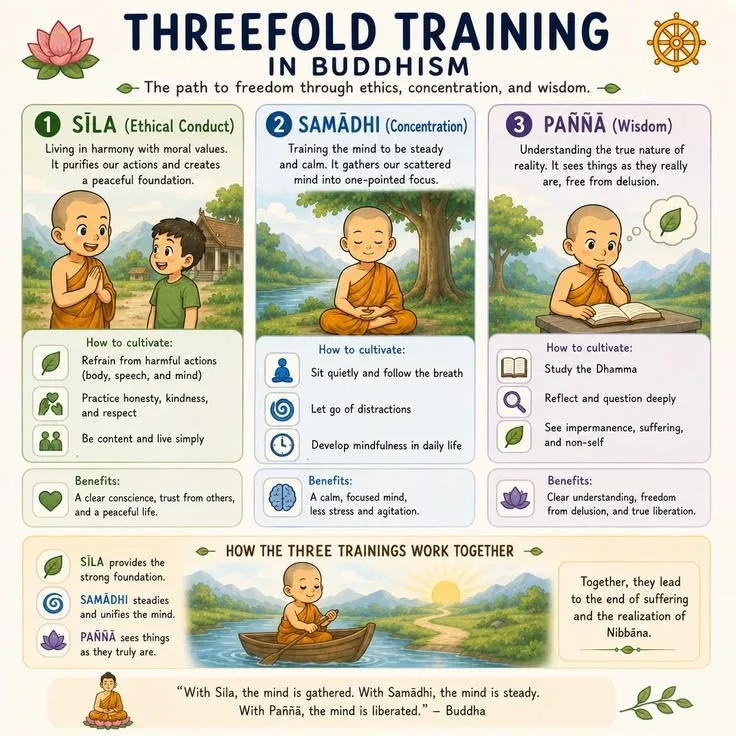
This path is divided into three groups: wisdom (right view, right intention), ethical conduct (right speech, right action, right livelihood), and mental cultivation (right effort, right mindfulness, right concentration).
The Path is not a linear sequence but a set of mutually supporting practices; progress in any one aspect supports the others.
Dependent Origination and No-Self
The doctrine of pratityasamutpada (dependent origination) is one of Buddhism's most philosophically distinctive contributions. It holds that all phenomena arise in dependence on conditions; nothing has independent, self-sufficient existence.[3]
The formula is: "When this is, that is. With the arising of this comes the arising of that. When this isn't, that isn't.
With the cessation of this comes the cessation of that." Applied to the chain of suffering, the doctrine traces how ignorance gives rise to karma-forming volitions, which give rise to consciousness, which gives rise to the five aggregates, and so on through craving, clinging, and the process of becoming and rebirth.
The anatta (no-self) doctrine is philosophically central: there is no permanent, unchanging self underlying personal experience.[1] What we ordinarily take to be the self is a constantly changing collection of five aggregates (skandhas): form, sensation, perception, mental formations, and consciousness.
None is permanent; none is the self; no combination of them constitutes a fixed self.
The doctrine does not deny the conventional existence of persons - Buddhist ethics and karma presuppose persons who act and experience consequences - but insists that persons exist conventionally (as designations) rather than ultimately (as metaphysical entities).[6]
The implications for suffering are direct: most dukkha arises from defending, satisfying, and aggrandizing a self that does not have the fixed existence we assume.
The Major Buddhist Schools
Theravada
Theravada Buddhism preserves what it regards as the earliest stratum of Buddhist teaching in the Pali Canon - a large collection of texts in the Pali language, organized into three baskets (Tipitaka): the Vinaya Pitaka (monastic rules), the Sutta Pitaka (discourses attributed to the Buddha), and the Abhidhamma Pitaka (systematic philosophical analysis).[2]
Theravada is the dominant tradition in Sri Lanka, Thailand, Myanmar, Cambodia, and Laos. Its soteriological ideal is the arhat - the individual who has completed the Eightfold Path and attained liberation through their own effort, ending the cycle of rebirth.
Monasticism is central: monks and nuns maintain the full vinaya rules, which provide the structure for intensive practice, while lay practitioners support the Sangha materially and accumulate merit through ethical conduct and generosity.
Vipassana (insight) meditation traditions, including those developed by figures such as Mahasi Sayadaw in Burma and later popularized in the West, derive primarily from Theravada.
Mahayana
Mahayana Buddhism emerged in India from approximately the first century BCE and developed an extensive literature of sutras - texts attributed to the Buddha but not included in the Pali Canon - including the Prajnaparamita (Perfection of Wisdom) sutras, the Vimalakirti Sutra, the Lotus Sutra, and the Avatamsaka Sutra.
The bodhisattva ideal - the aspiration to attain full Buddhahood for the benefit of all sentient beings rather than seeking individual liberation as an arhat - is central.[12]
The concept of shunyata (emptiness), elaborated by Nagarjuna in his 'Mulamadhyamakakarika' (Fundamental Verses on the Middle Way, approximately second century CE), argued that all phenomena, including emptiness itself, are empty of intrinsic existence - a position of extraordinary subtlety that has been compared to Western debates about substance, essence, and ontology.
Mahayana spread along the Silk Road to China, where it was adapted into Chinese forms; from China to Korea, Japan, and Vietnam. Chinese Buddhist schools include Chan (known as Zen in Japan), Pure Land, and Huayan.
Vajrayana and Tibetan Buddhism
Vajrayana (the Diamond Vehicle), also called Tantric Buddhism, developed in India from approximately the sixth century CE and incorporated esoteric practices - visualizations of deities, mandalas, mantras, mudras, and yogic practices - into Mahayana philosophical frameworks.
Transmitted to Tibet from the eighth century onward, Vajrayana was developed by figures including Padmasambhava, who is said to have tamed the indigenous Tibetan spirits, and later systematized by Tsongkhapa (1357-1419), founder of the Gelug school and of the Dalai Lama institution.
The Dalai Lama is understood to be a reincarnation of the bodhisattva Avalokitesvara; the current (fourteenth) Dalai Lama, Tenzin Gyatso, born in 1935, has been the most internationally prominent Buddhist figure of the modern era.
Tibetan Buddhism includes elaborate practices for working with the states of consciousness during dying and the period between death and rebirth described in texts such as the Bardo Thodol (Tibetan Book of the Dead).[10]
Buddhist Philosophy
Madhyamaka and Two Truths
Nagarjuna's Madhyamaka (Middle Way) philosophy, developed in the second century CE, is arguably the most sophisticated philosophical tradition within Buddhism.[5] Its central thesis is the emptiness (shunyata) of all phenomena: nothing exists with inherent, independent selfhood (svabhava).
Nagarjuna's method is dialectical - he takes each possible position about the nature of things and demonstrates that it leads to incoherence - rather than constructive, and has been interpreted both as a form of nihilism (wrongly, by most Madhyamaka scholars) and as a form of pragmatism.
The two truths doctrine distinguishes conventional truth, at which level ordinary discourse, causation, and ethical distinctions operate, from ultimate truth, at which level nothing has independent existence. Both are real; neither can be reduced to the other.
This framework has been compared to the distinction between folk-psychological and physical-level descriptions of behavior in Western philosophy of mind.
Buddhist Logic and Epistemology
The Buddhist logical tradition, founded by Dignaga in the fifth century CE and developed by Dharmakirti in the seventh century, produced sophisticated accounts of valid knowledge, inference, and the reliability of perception.
Dharmakirti's 'Pramanavarttika' (Commentary on Valid Cognition) argued for two valid sources of knowledge - direct perception and inference - and developed a philosophy of momentariness (all phenomena exist for only an instant) and representation (cognition directly perceives only mental images, not external objects).
The tradition engaged extensively with Hindu philosophical schools, especially Nyaya epistemology, and with Mahayana Buddhist philosophy.
Contemporary philosophers including Jay Garfield, Graham Priest, and Evan Thompson have engaged seriously with Madhyamaka and Buddhist philosophy of mind in dialogue with analytic philosophy, phenomenology, and cognitive science.
Buddhism in the Modern World
Mindfulness and the Secular Turn
The most consequential transformation of Buddhism in Western modernity has been the development of secular mindfulness.
Jon Kabat-Zinn, a molecular biologist at the University of Massachusetts Medical Center who had trained in Zen meditation with Korean teacher Seungsahn, developed Mindfulness-Based Stress Reduction (MBSR) in 1979 as a secular, clinically applicable practice.
MBSR extracts mindfulness meditation - systematic non-judgmental attention to present-moment experience - from its Buddhist doctrinal and institutional context, presenting it as a health intervention compatible with any belief system.
A 2010 meta-analysis by Stefan Hofmann, Alice Sawyer, Angela Witt, and Diana Oh, covering 39 studies, found MBSR and Mindfulness-Based Cognitive Therapy (MBCT) effective for reducing anxiety and depression symptoms across a range of clinical populations.[9]
MBCT has been endorsed by the UK's National Institute for Health and Care Excellence (NICE) as a treatment for recurrent depression.
The scholar David McMahan, in 'The Making of Buddhist Modernism' (2008), analyzed how Buddhist modernism - the reinterpretation of Buddhism as compatible with science, psychology, and secular liberal values - represents a selective reconstruction rather than a simple preservation of traditional Buddhist teaching.[4]
Elements typically downplayed include rebirth, multiple cosmological realms, devotional practices, and institutional monasticism; elements highlighted include ethical principles, meditative techniques, and a philosophy of mind that resonates with Western scientific psychology.
Engaged Buddhism
Thich Nhat Hanh, a Vietnamese Zen monk and poet who was exiled from Vietnam for his opposition to the Vietnam War, developed the concept of "engaged Buddhism" - the application of Buddhist principles to social and political action.[11]
His 'Order of Interbeing' and his concept of "interbeing" (the radical interdependence of all phenomena) have been influential in environmental ethics and social justice movements.
Sulak Sivaraksa, a Thai activist and intellectual, has similarly advocated for a Buddhism engaged with structural injustice, poverty, and militarism.
These movements explicitly challenge interpretations of Buddhism as counseling withdrawal from social concern in favor of individual liberation.
Controversy and Political Buddhism
The relationship between institutional Buddhism and political power has been complex throughout Buddhist history.
In ancient India, the Emperor Ashoka (third century BCE), after a brutal military campaign, converted to Buddhism and attempted to govern according to Buddhist ethical principles, disseminating the Dharma across his empire through inscriptions that survive today.
Ashoka's reign is often cited as a model of Buddhist statecraft. But Buddhist institutions have also been deeply entangled with state power in ways that have authorized or supported violence.
The historian Brian Daizen Victoria's 'Zen at War' (1997) documented how Zen Buddhist institutions and teachers provided ideological support for Japanese militarism and imperialism in the early twentieth century - framing self-sacrifice, discipline, and combat in Buddhist terms - in ways that challenged any simple equation of Zen with pacifism.[7]
In Myanmar, Buddhist nationalism has been implicated in severe violence against the Rohingya Muslim minority.
The Ma Ba Tha organization and figures such as Ashin Wirathu have framed Buddhist identity as under existential threat from Muslim expansion, providing a vocabulary of civilizational defense that accompanied or encouraged ethnic cleansing.
The UN Fact-Finding Mission on Myanmar concluded in 2018 that military operations bore the hallmarks of genocide, while documenting Buddhist nationalist rhetoric as a contributing factor.
These developments have prompted serious scholarly re-examination of the relationship between Buddhist doctrines and political violence, and of the historical conditions under which Buddhist institutions have supported rather than opposed state violence.
The Tibetan case raises different issues of political Buddhism. The Dalai Lama's government-in-exile in Dharamsala, India, has since 1959 maintained that Chinese rule over Tibet is illegitimate and has sought genuine autonomy - the "Middle Way" approach that rejects both full independence and complete assimilation.
The People's Republic of China insists on state control over Buddhist institutions, including the recognition of reincarnated lamas.
The 1995 dispute over the recognition of the Panchen Lama - the Dalai Lama recognized Gedhun Choekyi Nyima, who disappeared into Chinese custody; China installed its own candidate - illustrated the depth of the conflict between Tibetan Buddhist institutional authority and Chinese political authority.
The question of who will recognize the next Dalai Lama after Tenzin Gyatso's death remains unresolved and is likely to be one of the significant religious-political flashpoints of the mid-twenty-first century.
Sources & Further Reading
- Collins, S. (1982). Selfless Persons: Imagery and Thought in Theravada Buddhism. Cambridge University Press.
- Harvey, P. (2013). An Introduction to Buddhism: Teachings, History and Practices (2nd ed.). Cambridge University Press.
- Kalupahana, D.J. (1975). Causality: The Central Philosophy of Buddhism. University of Hawaii Press.
- McMahan, D.L. (2008). The Making of Buddhist Modernism. Oxford University Press.
- Nagarjuna. (c. 2nd century CE). Mulamadhyamakakarika. (J. Garfield, Trans., 1995). Oxford University Press.
- Parfit, D. (1984). "Reasons and Persons". Oxford University Press.
- Victoria, B.D. (1997). "Zen at War". Weatherhill.
- Gethin, R. (1998). The Foundations of Buddhism. Oxford University Press.
- Hofmann, S.G., Sawyer, A.T., Witt, A.A., & Oh, D. (2010). The effect of mindfulness-based therapy on anxiety and depression: A meta-analytic review. Journal of Consulting and Clinical Psychology, 78(2), 169-183.
- Lopez, D.S. (1998). Religions of Tibet in Practice. Princeton University Press.
- Thich Nhat Hanh. (1988). The Heart of the Buddha's Teaching. Parallax Press.
- Williams, P. (2009). Mahayana Buddhism: The Doctrinal Foundations (2nd ed.). Routledge.