
Causes: On the morning of June 28, 1914, Gavrilo Princip had already failed. His comrades had failed first: the grenade thrown at Franz Ferdinand's open car had bounced off the folded-back convertible roof, rolled under the following vehicle, and exploded too late, wounding some of the Archduke's staff but leaving him unharmed.
Princip, having watched the motorcade speed away, walked to a delicatessen on Franz Josef Street to compose himself. He was nineteen years old.
He had no particular plan. Then, by a sequence of accidents - the Archduke's decision to visit the bomb victims in hospital, the wrong turn taken by his driver on a street he did not know, the car stalling directly in front of the deli where Princip stood - history pivoted.
Princip stepped forward, drew his FN Model 1910 pistol, and fired twice. Within six weeks, Europe was at war. Within four years, ten to twenty million people were dead.
The question of what caused the First World War has been argued for more than a century, and it is still argued now. This is unusual for historical events of comparable antiquity. We have settled, more or less, on explanations for the fall of Rome, the rise of capitalism, the emergence of democracy.
But World War One remains alive as a historical problem because its causes touch live nerves: national guilt, the nature of democracy, the rationality of states, the role of contingency versus structure in history.
The question "was Germany responsible?" was not merely a scholarly debate but a question on which reparations were assessed, on which German politics pivoted, and on which, indirectly, the conditions for a second world war were created. Historiography and history are unusually entangled here.
The answer - as in most serious historical questions - involves multiple levels simultaneously. There was the immediate trigger: an assassination. There was the immediate escalation: 37 days of diplomacy collapsing into mobilization.
There were medium-term structural conditions: alliance systems, arms races, military doctrines, imperial rivalries. And there was the deepest level: the values, fears, ideologies, and misperceptions of the men who made the decisions.
None of these levels alone is sufficient. Together they explain not merely why the war began but why it began so rapidly, spread so widely, and lasted so long.
"The nations slithered over the brink into the boiling cauldron of war without any of them wanting war, excepting Austria-Hungary and even she did not want the sort of war she got." - David Lloyd George, War Memoirs (1933)
Key Definitions
The July Crisis: The 37-day sequence of diplomatic events and military mobilizations between the assassination of Franz Ferdinand (June 28, 1914) and the outbreak of general European war (early August 1914).
The blank check: Germany's July 5-6, 1914 assurance to Austria-Hungary of unconditional support for whatever action it took against Serbia, issued by Kaiser Wilhelm II and Chancellor Bethmann Hollmann.
The Schlieffen Plan: Germany's prewar military strategy for a two-front war - a rapid offensive to knock France out of the war within six weeks before turning to face Russia in the east; required an attack through neutral Belgium.
The cult of the offensive: The dominant military doctrine across European general staffs before 1914 - the belief that attacking was decisive, that wars would be short and decided by initial offensives, and that mobilizing first was critically advantageous.
Article 231 (war guilt clause): The clause in the Versailles Treaty (1919) that assigned sole responsibility for the war to Germany and its allies, forming the legal basis for reparations.
The Fischer Controversy: The historiographical debate ignited by Fritz Fischer's 1961 argument that Germany deliberately engineered the war as part of a hegemonic program; the most important controversy in modern German historiography.
The sleepwalkers: Christopher Clark's metaphor (2012) for European leaders in 1914 - suggesting they stumbled into war not through deliberate design but through shared misperception, miscalculation, and failure of statecraft.
Weltpolitik: Kaiser Wilhelm II's policy of asserting Germany as a global power through naval expansion, colonial acquisition, and assertive diplomacy - a central driver of Anglo-German antagonism in the decade before 1914.
Pan-Slavism: The ideological movement promoting solidarity among Slavic peoples, which Russia championed and which gave it strategic interest in protecting Serbia from Austrian pressure - a key mechanism of escalation in 1914.
The Scale of the Catastrophe
Before examining causes, the scale of the First World War deserves emphasis. It reshaped every dimension of the world it touched.
Combat deaths: estimates range from 9 to 11 million military personnel killed in action or from wounds.[9]
Civilian deaths directly attributable to the war: 7 to 13 million, including famine, displacement, and atrocities.
The 1918 influenza pandemic, accelerated by mass troop movements and the physical degradation of populations under wartime conditions: 50 to 100 million deaths globally - the most lethal pandemic since the Black Death.
Four empires collapsed: the Russian, Ottoman, Austro-Hungarian, and German empires all ceased to exist as a direct result of the war. The political map of Europe and the Middle East was redrawn entirely.
Economic consequences: the war cost participating nations an estimated $186 billion in direct costs (1918 dollars) and $151 billion in indirect costs, according to Carnegie Endowment estimates published in 1920.
Britain emerged from the war as the world's largest debtor; the United States emerged as its largest creditor. The economic and financial disruption contributed directly to the Great Depression.
| Nation | Military Deaths | Wounded | Prisoners/Missing |
|---|---|---|---|
| Russia | ~1,800,000 | ~5,000,000 | ~2,500,000 |
| France | ~1,400,000 | ~4,300,000 | ~537,000 |
| Britain & Empire | ~908,000 | ~2,090,000 | ~191,000 |
| Germany | ~2,000,000 | ~4,200,000 | ~1,150,000 |
| Austria-Hungary | ~1,200,000 | ~3,600,000 | ~2,200,000 |
| Ottoman Empire | ~771,000 | ~400,000 | ~500,000 |
(Source: Keegan, 1998; Clodfelter, 2017)
The Assassination and the July Crisis
The immediate history is extraordinary in its compression. Gavrilo Princip and his co-conspirators were Bosnian Serb nationalists with connections to the Black Hand, a secret society within Serbian military intelligence that sought the unification of South Slavic peoples under Serbian leadership.
Their target, Franz Ferdinand, was the heir to the Austro-Hungarian throne and a man whose program of reform - federalizing the empire to give South Slavs greater autonomy - actually threatened the Serbian nationalist vision of a unified South Slav state outside Austrian control.
The assassins' planning was amateurish. The Austrian security arrangements were poor. The car stopped in front of Princip because the driver, unfamiliar with the route change, had to be told by a bystander that he had turned the wrong way.
What followed was 37 days in which the future of the 20th century was determined. Austria-Hungary saw the assassination as an opportunity to crush Serbian nationalism permanently and to reassert its authority in the Balkans, which had been shaken by two Balkan Wars in 1912-13 that had enlarged Serbia substantially.
But Austrian decision-makers feared Russian intervention and sought German backing before acting. The blank check - Germany's unconditional assurance of support issued on July 5-6 - gave Austria-Hungary what it needed. The deliberate nature of that assurance, and its enabling effect, is at the center of the Fischer controversy.
Austria-Hungary's July 23 ultimatum to Serbia was designed to be humiliating and unacceptable: among its ten demands was the right of Austrian officials to participate directly in Serbia's investigation of the assassination on Serbian soil, a flagrant violation of sovereignty.
Serbia's response on July 25 was remarkable for its concessions - it accepted nine and a half of the ten demands, conditional on arbitration for the contested point. Austria-Hungary declared the response unsatisfactory and severed diplomatic relations. War was declared on Serbia on July 28.
The subsequent cascade had its own logic. Russia had humiliated itself in the 1908 Bosnian crisis by backing down when Austria-Hungary annexed Bosnia; Tsar Nicholas II reversed his mobilization order twice before allowing it to proceed, torn between the advice of his foreign minister and his generals.
German ultimatums to Russia to halt mobilization went unanswered. Germany declared war on Russia on August 1. France, bound by treaty with Russia, was issued an impossible ultimatum.
Germany declared war on France on August 3 and began the implementation of the Schlieffen Plan, which required attacking through neutral Belgium. Britain, bound by the 1839 Treaty of London to guarantee Belgian neutrality, declared war on Germany on August 4.
The Role of Individual Decisions
The compression of the July Crisis - 37 days from assassination to world war - makes visible the role of individual decision-making in a way that longer historical processes obscure. Historians have identified several moments where different choices by specific individuals might have altered the outcome:
- Kaiser Wilhelm II's initial bellicose response to the assassination was followed by cold feet when war actually arrived, but by then the military timetables could not be stopped.
- Austrian Foreign Minister Berchtold's decision to declare the Serbian reply unsatisfactory, despite its extraordinary concessions, foreclosed the last diplomatic route before mobilizations began.
- German Chancellor Bethmann Hollweg, who appears to have calculated that the crisis could be kept local if he acted quickly enough, but also acknowledged in private correspondence that a wider war was possible - and decided to risk it.
- Russian Foreign Minister Sazonov, who persuaded the Tsar that partial mobilization against Austria-Hungary alone was technically impossible and that full mobilization was required - a claim that historians have since disputed.
The decisions were not inevitable. But neither were they random. They reflected the specific political pressures, fear of prestige loss, alliance commitments, and military logic that the structural conditions had created.[12]
Structural Conditions: Why Europe Was Ready to Burn
The July Crisis was the spark; the structural conditions were the accumulated fuel.[6] Five long-term factors created the preconditions that made a regional crisis capable of becoming a world war.[3]
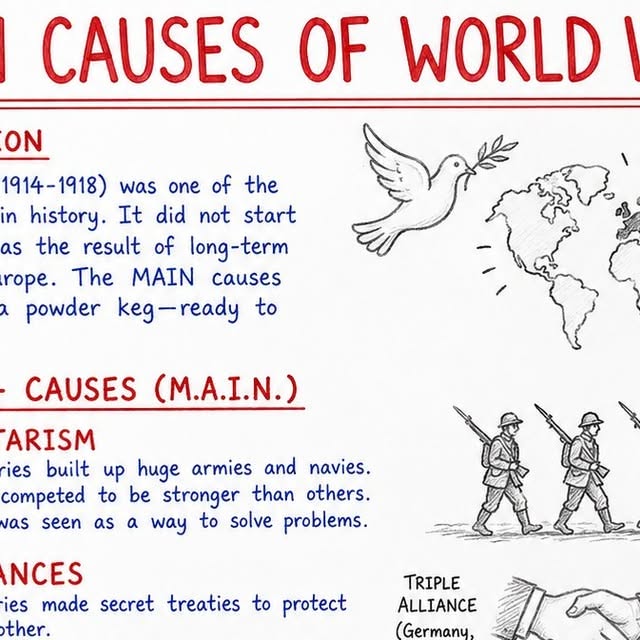
The alliance system was the most directly operative structural cause of escalation. Europe had divided itself, through a series of agreements from 1879 onward, into two armed blocs: the Triple Alliance (Germany, Austria-Hungary, and nominally Italy) and the Triple Entente (France, Russia, and Britain).
The system was designed for deterrence - each side was supposed to be too strong to attack.
But deterrence logic can fail in precisely the way it failed in 1914: by making backing down from any confrontation politically and militarily intolerable, it ensured that a crisis that began with two parties (Austria-Hungary and Serbia) rapidly drew in all of Europe.
The arms race had made European military establishments the largest, most technologically advanced, and most politically influential in history.
The Anglo-German naval race - Germany's decision under Kaiser Wilhelm II to build a high-seas fleet capable of challenging British naval dominance - was a direct source of British alarm and a primary driver of the Anglo-French-Russian entente alignment.
Continental powers had raced to build larger armies since the Franco-Prussian War of 1870-71.
By 1914, military planning had become the driver of political options in ways that civilian leaders struggled to override.
Between 1870 and 1914, European military spending grew dramatically: Germany's military budget increased by approximately 300 percent in real terms; Britain's by 200 percent; Russia's by over 250 percent.
The arms race made war more thinkable - enormous military establishments require justification and deployment - and made European foreign ministries progressively more dependent on military timetables that assumed offensive action.
The Schlieffen Plan deserves separate treatment because it was the mechanism by which German military timetables overcame political decision-making.
General Alfred von Schlieffen, German Chief of Staff until 1906, designed a two-front war strategy: a rapid western offensive through Belgium and France to achieve victory in six weeks, then transfer of forces east to face Russia.
The plan required immediate action against France the moment war with Russia became likely, because Russia's mobilization would take weeks while France's was immediate.
When Russia began mobilizing, the German military establishment told civilian leaders that partial mobilization against Russia alone was technically impossible given railway logistics - full implementation of the plan was required.
This was, as Barbara Tuchman memorably argued in The Guns of August, a case of political decisions being driven by military timetables rather than the reverse.[4]
The cult of the offensive pervaded all European general staffs. Military doctrine held that attacking was decisive, that offensive operations would achieve breakthroughs, and that wars would be short - measured in weeks, not years.
This doctrine had lessons from the Franco-Prussian War and from colonial campaigns but ignored the evidence of the American Civil War and the Russo-Japanese War, both of which had shown that modern weapons made the defense far stronger than the offense.
The cult of the offensive meant that leaders who started mobilizing felt they were gaining decisive advantages, and leaders who had not yet started feared irrecoverable disadvantage if they waited. It contributed to the mobilization race of late July 1914.
Balkan instability provided both the specific flashpoint and a decade of increasing tension. The decline of the Ottoman Empire - the "sick man of Europe" - had created a vacuum of power in southeastern Europe that Austria-Hungary, Russia, and the new Balkan states competed to fill.
The 1908 Bosnian crisis, when Austria-Hungary annexed Bosnia-Herzegovina with German backing, forced Russia to back down humiliatingly. The Balkan Wars of 1912-13 enlarged Serbia and alarmed Austria-Hungary.
By 1914, Austrian decision-makers had concluded that Serbian power must be crushed before it became great enough to pull apart the multinational empire from within.
Nationalism and Its Discontents
Underlying all of these structural factors was the force of nationalism - the ideological claim that peoples defined by ethnicity, language, and culture should govern themselves in their own states.
Nationalism was the most powerful political idea of the nineteenth century, and by 1914 it had produced a fundamental tension in European politics: the major powers were multinational empires ruling over subject nationalities, while the ideology of the age demanded national self-determination.
The Austro-Hungarian Empire contained Germans, Hungarians, Czechs, Poles, Slovaks, Slovenes, Croats, Serbs, Romanians, and dozens of other groups. The Russian Empire contained Russians, Poles, Ukrainians, Finns, Armenians, Jews, and many others.
The Ottoman Empire contained Turks, Arabs, Kurds, Armenians, Greeks, and Bulgarians. All were structurally vulnerable to nationalist claims, and all responded with varying degrees of repression that generated grievances fueling the nationalist movements they feared.
Pan-Slavism - the idea of solidarity among Slavic peoples - gave Russia a rationale for intervention in Balkan affairs whenever Slavic peoples (particularly Serbs) were threatened by Austria-Hungary. Pan-Germanism gave segments of German political culture an aggressive claim on Eastern Europe.
Serbian nationalism challenged the survival of Austria-Hungary. The assassination that triggered the war was a nationalist act; the alliance system that escalated it was partly built on nationalist alignments; and the peace settlement that followed was organized around nationalist principles - with consequences that produced further instability.
The Historiography: Who Is Responsible?
The question of war guilt was not merely academic. The Versailles Treaty (1919) imposed in Article 231 the assignment of sole responsibility to Germany and its allies - which became the legal basis for reparations of 132 billion gold marks, the military restrictions of the treaty, and the territorial settlements.
German politicians across the political spectrum rejected the war guilt clause, and its perceived injustice became a central grievance exploited by nationalist and Nazi politics throughout the Weimar period. Hitler explicitly campaigned on reversing Versailles.
The dominant postwar historiographical view in the West tended toward a collective responsibility thesis: all great powers had contributed through the alliance system, imperialism, and nationalism, and none had designed the catastrophe. This consensus was shattered by Fritz Fischer's 1961 Griff nach der Weltmacht.
Fischer, working from German archives, argued that German political and military leadership had deliberately used the July Crisis to launch a war aimed at European hegemony and colonial expansion.[2]
His key evidence was the September Program of 1914 - a war aims document prepared barely a month into the war - which specified extensive annexations in Europe and Africa. Fischer argued this document reflected prewar planning, not wartime opportunism.
The Fischer Controversy divided German historiography for decades. Critics argued that Fischer overread the September Program as evidence of prewar design, that he ignored Germany's genuine defensive anxieties about Russian growth and French revanchism, and that he drew illegitimate continuities between Wilhelmine and Nazi imperialism.
Defenders produced more archival evidence for German aggressiveness. The debate was never fully resolved, but it permanently shifted the terms: the comfortable "everyone shares blame equally" position became very difficult to maintain.
Christopher Clark's The Sleepwalkers (2012) offered the most significant recent revision.
Clark's exhaustive account of the July Crisis argued that responsibility was genuinely shared: Serbia's government had tacit knowledge of the assassination plot; Russia's mobilization decision was a critical escalation that Germany could point to; France's unconditional backing of Russia removed a potential brake; Britain's ambiguous signals misled some German decision-makers.
Leaders across Europe, Clark argued, were in the grip of misperception and miscalculation - they stumbled into a war none of them had designed.[1] Clark's book was enormously influential and generated substantial pushback from historians who felt it excessively rehabilitated Germany and Austrian responsibility.
| Historiographical Position | Key Argument | Main Scholars |
|---|---|---|
| German war guilt | Germany deliberately engineered the war for hegemony | Fischer (1961), Geiss |
| Shared responsibility | All great powers contributed through structural conditions | Joll, pre-Fischer consensus |
| Sleepwalker thesis | Leaders miscalculated and stumbled into war | Clark (2012) |
| Austrian agency | Austria-Hungary was the primary aggressor | MacMillan, Hamilton & Herwig |
| Systemic explanation | Structural conditions made war nearly inevitable | Albertini, Kennedy |
| Revisionist (German innocence) | Germany was a defensive power encircled by enemies | German inter-war scholarship |
Most contemporary historians occupy a middle position: Germany bore significant and perhaps primary responsibility - the blank check was an enabling act of recklessness at minimum - while the Austrian decision to escalate and the Russian decision to mobilize were also consequential choices by agents who could have chosen otherwise.
The war was neither fully designed nor purely accidental.
The Economics of Unthinkable War
One of the most remarkable features of the July Crisis is that it occurred despite overwhelming economic disincentives to war.
Norman Angell's 1910 The Great Illusion had argued, on rigorous economic grounds, that the financial and commercial integration of Europe made war irrational: a victorious power could not profitably annex the industrial economy of a defeated one, because that economy depended on the same international financial and trade networks as the victor's.[7]
Angell's argument was empirically correct - the economic costs of WWI were catastrophic for all participants, including the nominal victors - but it was wrong in its implication that rational economic calculation would prevent war.
Before the war, bilateral trade between Britain and Germany had reached 50 million annually. The two nations were among each other's largest trading partners. French banks had invested heavily in Russian railways - the same railways that would carry Russian armies westward.
Austro-Hungarian banks were deeply integrated with Serbian commercial networks. Economic interdependence had, if anything, created more flashpoints for conflict as well as shared interests.
The lesson is both specific and general. Specific: European decision-makers in 1914 were not primarily calculating economic costs. They were calculating prestige, alliance credibility, security threats, and domestic political pressures.
General: the liberal peace theory - that economic interdependence prevents war - cannot rest on the assumption that states always act as rational economic maximizers.
States act on many calculations simultaneously, and non-economic factors can override economic interests when prestige, security, and ideology are at stake.
John Maynard Keynes identified this dynamic precisely in The Economic Consequences of the Peace (1919), arguing that the economic disruption of war would be so severe that rational actors should have avoided it. But rationality is conditional on what actors are trying to maximize.
The statesmen of 1914 were often maximizing national prestige and survival in a competitive interstate system - calculations in which economic welfare was only one variable.
The Western Front: What the War Became
The war that everyone's war plans assumed would be short - resolved in weeks by decisive offensive operations - became instead a four-year war of industrial attrition that defied every military expectation.[5]
The Schlieffen Plan's western offensive stalled at the Marne in September 1914, failing to knock France out of the war within the prescribed six weeks.
Both sides then engaged in the "Race to the Sea" - extending their flanks northward to the English Channel - and by November 1914 a continuous line of trenches stretched from the Swiss border to the Belgian coast: the Western Front.
The military technology of 1914 - machine guns, magazine rifles, artillery, and barbed wire - had made offensive operations suicidally expensive. The defensive was overwhelmingly stronger than the offensive, exactly as the American Civil War and Russo-Japanese War had suggested and the cult of the offensive had ignored.
A defending force in prepared positions with machine guns could repel attackers at ratios of four or five to one. Attacking across No Man's Land meant crossing open ground swept by automatic fire.
The result was the war of attrition that killed millions:
- Battle of the Somme (1916): Britain suffered approximately 57,470 casualties on the first day of the offensive alone - July 1, 1916 - the bloodiest single day in British military history. Total Somme casualties: approximately 1.2 million across all participating armies.
- Battle of Verdun (1916): France and Germany fought from February to December 1916 in a battle designed by German Chief of Staff Falkenhayn to "bleed France white." Total casualties: approximately 700,000.
- Passchendaele (Third Battle of Ypres, 1917): British and Empire forces advanced approximately 8 kilometers over three months of fighting in mud conditions that made movement nearly impossible. Casualties: approximately 500,000 across both sides.
"We were now in that flattened, featureless landscape where the whole surface of the earth had been churned and rechurned, and there was nothing natural left." - Siegfried Sassoon, Memoirs of an Infantry Officer (1930)[10]
The mass slaughter of the Western Front permanently shaped how liberal societies understood war.[13] The expectation that wars would be short, decisive, and somewhat glorious - the cultural assumption that had made the initial mobilizations of August 1914 possible - was destroyed.
Poetry, fiction, memoir, and art from the war produced the modern understanding of warfare as organized mechanical mass death.
The Consequences That Made the 20th Century
World War One's consequences were so vast that they defined the shape of the 20th century.[11] Approximately 17-20 million died in combat and directly war-related causes; the 1918 influenza pandemic - accelerated by the mass movement of troops and the physical degradation of populations - killed another 50-100 million globally.
The Versailles settlement, by imposing the war guilt clause and demanding reparations, created the economic and political conditions that made Weimar Germany's democratic failure and Hitler's rise possible.
The redrawing of the Ottoman Empire's territories through the Sykes-Picot agreement and related settlements created the borders of the modern Middle East - borders drawn with little regard for ethnic, religious, or political realities, with consequences still unfolding.
The Russian Empire's collapse under military strain led to the Bolshevik Revolution of 1917, which created the Soviet Union and a geopolitical fault line that organized world politics until 1991.
John Maynard Keynes, writing in The Economic Consequences of the Peace (1919), predicted with remarkable accuracy that the Versailles reparations would produce German resentment, economic instability, and political extremism.[8] The war that was supposed to end war instead created the conditions for a worse one.
The Middle East Redrawn
Among the most enduring of the war's consequences was the post-Ottoman settlement of the Middle East.
The Sykes-Picot Agreement of 1916 - a secret arrangement between Britain and France dividing Ottoman Arab territories into spheres of influence - created the basic territorial framework for the modern Middle East.
The agreement drew borders with limited consideration of ethnic, tribal, or religious divisions on the ground.
The Balfour Declaration of 1917, in which the British government expressed support for a Jewish homeland in Palestine, established the framework for the Zionist project and the conflict over Palestine that continues to the present.
The promises made to Arab leaders during the war - particularly to Sharif Hussein of Mecca, who led the Arab Revolt against Ottoman rule - were subsequently contradicted by Sykes-Picot and Balfour, generating the sense of betrayal that shaped Arab nationalist politics for decades.
The End of Empires and the Birth of New States
The collapse of the Austro-Hungarian Empire produced a collection of successor states - Poland, Czechoslovakia, Yugoslavia, Hungary, Austria - whose borders were drawn by the peacemakers at Paris with reference to ethnic nationalism but produced new minorities everywhere.
The Wilson's Fourteen Points had promised national self-determination, but in practice, the application of the principle was selective, geographically incoherent, and often contradictory. Every new state contained minorities from other nations; every border left co-nationals on the wrong side.
These minority populations and unresolved territorial claims became fuel for the fascist and nationalist movements of the 1930s - particularly in Germany, where the "stab in the back" myth, the war guilt clause, and the loss of territories containing German-speaking populations combined to create the grievance culture that National Socialism exploited.
For the patterns of how wars begin see why-wars-start. For how the postwar settlement shaped subsequent decades see why-the-cold-war-shaped-the-modern-world.
Sources & Further Reading
- Clark, C. (2012). The Sleepwalkers: How Europe Went to War in 1914. HarperCollins.
- Fischer, F. (1967). Germany's Aims in the First World War. W. W. Norton.
- MacMillan, M. (2013). The War That Ended Peace: The Road to 1914. Random House.
- Tuchman, B. W. (1962). The Guns of August. Macmillan.
- Keegan, J. (1998). The First World War. Hutchinson.
- Joll, J., & Martel, G. (2007). The Origins of the First World War (3rd ed.). Longman.
- Angell, N. (1910). The Great Illusion. Heinemann.
- Keynes, J. M. (1919). The Economic Consequences of the Peace. Macmillan.
- Clodfelter, M. (2017). Warfare and Armed Conflicts: A Statistical Encyclopedia of Casualty and Other Figures, 1492-2015 (4th ed.). McFarland.
- Sassoon, S. (1930). Memoirs of an Infantry Officer. Faber & Faber.
- Stevenson, D. (2004). Cataclysm: The First World War as Political Tragedy. Basic Books.
- Hamilton, R. F., & Herwig, H. H. (2003). The Origins of World War I. Cambridge University Press.
- Fussell, P. (1975). The Great War and Modern Memory. Oxford University Press.