
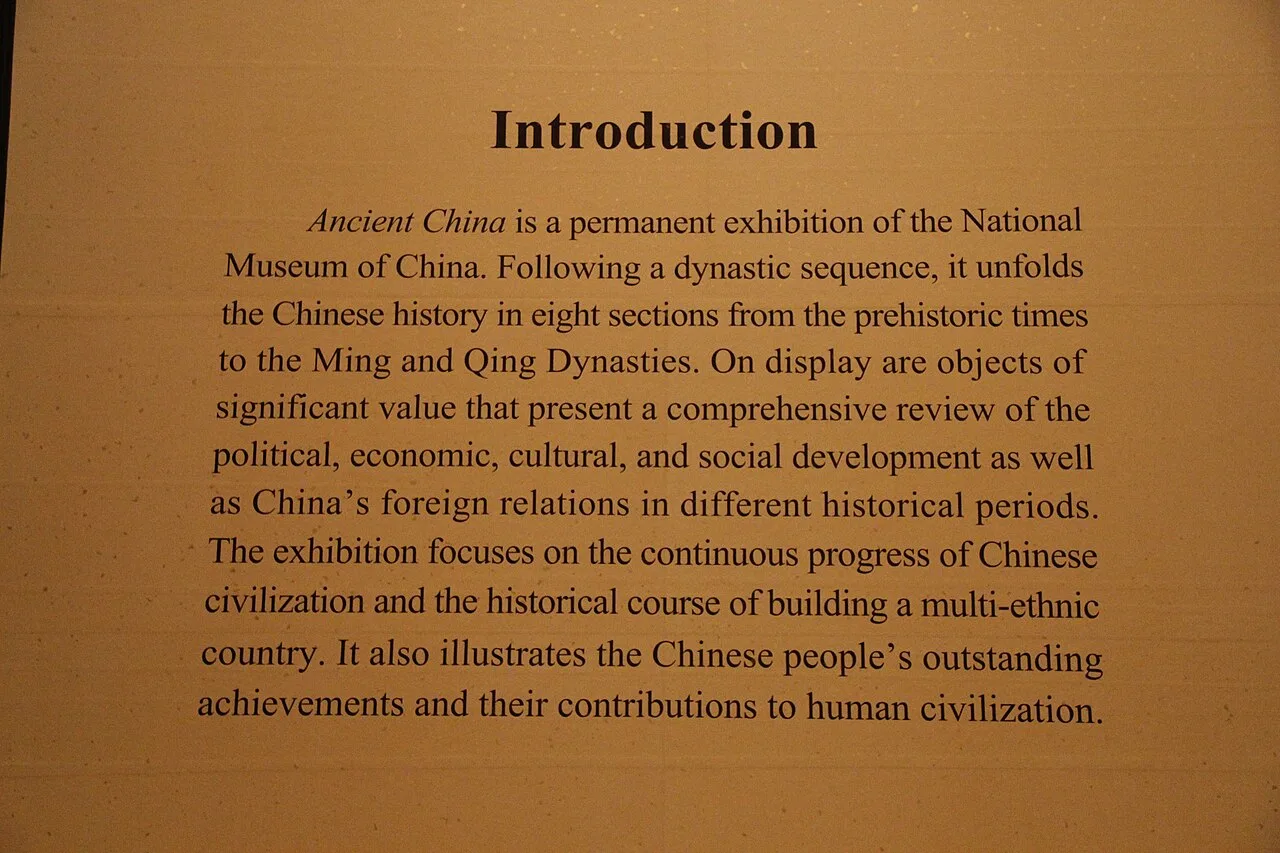
An introduction to ancient China spans a long written tradition, durable state institutions, major dynasties, technological achievement, and influential philosophical schools. Oracle-bone writing, the Qin and Han empires, and Tang, Song, and Ming developments mark its long historical arc. The Mandate of Heaven, Confucian bureaucracy, Legalism, trade, printing, and the Needham Question frame a civilization whose legacy remains central to historical debate.
When the Polish astronomer Copernicus published his heliocentric theory in 1543, China already had eight centuries of woodblock printing behind it.
When Columbus crossed the Atlantic in 1492 with three small ships and ninety men, a Chinese fleet commanded by Zheng He had been sailing the Indian Ocean with sixty-two ships and nearly thirty thousand sailors seven decades earlier.
When Europe's medieval peasants scratched the earth with wooden plows, Chinese engineers were drilling to depths of hundreds of meters for natural gas and cast iron was commonplace in workshops across the Yellow River valley.
Ancient China is, by almost any measure, one of the most consequential civilizations in human history.
From the oracle-bone inscriptions of the Shang dynasty to the voyages of Zheng He, it produced a continuous written tradition of three and a half thousand years, state institutions of extraordinary durability, technological innovations that the rest of the world would not match for centuries, and a literary and philosophical culture of immense richness.
Yet for most of Western history this civilization has been either unknown or misrepresented, and even now the serious study of Chinese history remains marginal in most Western educational systems.
The story that follows is necessarily selective. Three and a half millennia of history for a civilization that has at various points comprised a third of humanity cannot be told in a single article.
What can be offered is the architecture - the major dynasties, the foundational ideas, the key turning points, and the questions that historians still argue about, above all the question of why a civilization so intellectually and technologically advanced did not industrialize first.
"Confucius said: When you know a thing, to recognize that you know it; and when you do not know a thing, to recognize that you do not know it - this is knowledge." - Analects 2.17, translated by Arthur Waley[9]
| Dynasty | Period | Key Achievement |
|---|---|---|
| Shang | c.1600-1046 BCE | Bronze casting; oracle bone script; city-states |
| Zhou | 1046-256 BCE | Mandate of Heaven; Confucianism; Iron Age |
| Qin | 221-206 BCE | First unified empire; Great Wall begun; Legalism |
| Han | 206 BCE-220 CE | Silk Road; civil service; Confucian state |
| Tang | 618-907 CE | Golden age of arts; Buddhism; trade expansion |
| Song | 960-1279 CE | Printing; gunpowder; compass; urbanization |
| Ming | 1368-1644 CE | Zheng He voyages; Forbidden City; isolationism |
Key Definitions
Oracle bones: The shoulder bones of oxen and the plastrons of tortoises used by Shang dynasty diviners to communicate with royal ancestors. Questions were inscribed, heat applied to create cracks, and the cracks interpreted as answers. The inscriptions are the earliest securely dated Chinese writing.
Mandate of Heaven (Tianming): The Zhou dynasty doctrine holding that Heaven grants the right to rule to virtuous rulers and withdraws it from corrupt ones, signaling the withdrawal through natural disasters and rebellion. The successful rebel thereby demonstrated receipt of the Mandate.
Hundred Schools of Thought: The Warring States period (475-221 BCE) intellectual efflorescence in which Confucians, Daoists, Mohists, Legalists, Logicians, and many other philosophical schools competed for patronage and debated governance, ethics, and the nature of reality.
Legalism: The political philosophy associated with Shang Yang, Han Feizi, and Li Si, which rejected Confucian moral governance in favor of strict law, harsh punishment, and bureaucratic centralization in the service of state power. The Qin dynasty's instrument of unification.
Civil service examinations: The meritocratic system of recruiting state officials through competitive examinations on the Confucian classics, developed under the Han and reaching maturity under the Tang and Song dynasties. The most sophisticated pre-modern bureaucratic meritocracy.
Needham Question: The puzzle posed by historian Joseph Needham: given China's extraordinary record of technological and scientific achievement, why did the Scientific Revolution and Industrial Revolution occur in Europe rather than China?[1]
The Shang Dynasty and the Beginnings of Chinese Writing
Oracle Bones and the Shang State
The Shang dynasty (c.1600-1046 BCE) is the first Chinese dynasty for which both archaeological and textual evidence exists in abundance.[6]
The Shang state, centered in the Yellow River basin in modern Henan province, was a theocratic monarchy in which the king served simultaneously as chief diviner, military commander, and intermediary between the living and the royal ancestors whose blessing was essential to the dynasty's success.
The oracle bone inscriptions - more than 150,000 fragments recovered mostly from the last Shang capital at Anyang - provide a remarkable window into Shang royal concerns.[3] The questions put to the ancestors range from the cosmic to the mundane: Will the harvest be good?
Should we wage war against the Fang people? Will the king's toothache recover? Is the ancestor Grandfather Jia causing this illness? The script used in these inscriptions is directly ancestral to modern Chinese characters - a continuous writing tradition of over three thousand years, unmatched in human history.
Shang bronze vessels, produced with technical skill that astonished modern metallurgists when they were first studied, served both ritual and symbolic functions. The 'taotie' mask motif - a stylized, symmetrical animal face of uncertain meaning - appears on these vessels with extraordinary consistency.
Whether it represents a protective deity, a sacrificial animal, or something else entirely has been debated for decades without resolution.
The Zhou Overthrow
Around 1046 BCE, the Zhou people of the Wei River valley in the northwest overthrew the last Shang king, traditionally depicted as a tyrant of spectacular cruelty. The Zhou founders needed to justify this overthrow ideologically - their answer was the Mandate of Heaven.
Heaven had withdrawn its mandate from the degenerate Shang and conferred it on the virtuous Zhou. The logic was circular in a productive way: virtue justifies rule, and successful rule is evidence of virtue. This doctrine shaped Chinese political thought for the next three thousand years.
The early Western Zhou (c.1046-771 BCE) was later idealized as a golden age of ritual order, the model to which Confucius would look back. The Zhou king enfeoffed relatives and allies with territories, creating a feudal structure loosely analogous to medieval European feudalism, though with important differences.
The system gradually weakened as the enfeoffed lords built up independent power, and in 771 BCE the Zhou capital was sacked by nomadic invaders, forcing the court to relocate east - initiating the Eastern Zhou period.
The Warring States and the Hundred Schools of Thought
Political Fragmentation and Intellectual Ferment
The Eastern Zhou period (770-256 BCE) divides into two phases: the Spring and Autumn period (722-476 BCE), characterized by competition among dozens of feudal states while nominal Zhou suzerainty was maintained, and the Warring States period (475-221 BCE), in which seven major powers engaged in total war aimed at elimination.
The scale of violence was staggering: mass armies of hundreds of thousands deployed iron weapons, sophisticated siege machinery, and disciplined infantry formations. By some estimates, the wars of the Warring States period killed tens of millions.
This political catastrophe was simultaneously an intellectual golden age. The competing rulers needed advisers, strategists, and ideologues, and they attracted them. Traveling scholars sold their ideas and administrative expertise at the courts of various lords.
The result was the 'Hundred Schools of Thought' - an expression of the extraordinary plurality of philosophical positions that flourished in this crisis period.
Confucius and the Ru School
Kong Qiu (551-479 BCE), known in the West as Confucius, spent his career attempting and largely failing to obtain a significant advisory post, while teaching a circle of disciples who spread his ideas after his death. His thought is preserved in the 'Analects,' a collection of conversations compiled by his students.
Confucius understood himself as a transmitter of ancient wisdom rather than an innovator. His central concern was the practical problem of restoring social order in a fractured world.
His answer was ethical: only rulers and officials of genuine moral cultivation - who embodied ren (benevolence, humaneness), practiced li (ritual propriety), and governed through the force of moral example rather than coercion - could create stable and humane governance.
Mencius (c.372-289 BCE) extended Confucian thought in a more explicitly political direction. Human nature is inherently good, he argued - the famous 'sprout' analogy: just as a sprout will grow into a tree if given the right conditions, moral goodness will develop given proper nurture.
The political implication was radical: a ruler who fails to provide for the people's welfare, who governs cruelly, has lost the Mandate of Heaven and may legitimately be overthrown.
Xunzi (c.310-235 BCE) took the opposite view of human nature - inherently selfish and requiring external discipline - but reached similar conclusions about the importance of ritual and education.
Daoism
The Daoist tradition, associated with two texts of uncertain date and authorship - the 'Dao De Jing' attributed to Laozi and the 'Zhuangzi' attributed to Zhuangzi (c.369-286 BCE) - offered a fundamental critique of Confucian activism.
The Dao (Way) is the ineffable principle underlying all things; attempts to impose human moral categories and political structures on the natural order distort and violate it. The ideal is wu wei - non-action or effortless action in harmony with the natural way.
The 'Zhuangzi' in particular is one of the masterpieces of world literature: witty, paradoxical, and philosophically profound in its explorations of the relativity of perspective and the limitations of language.
Legalism and the Qin Solution
Legalism, developed by Shang Yang (c.390-338 BCE) in his reforms of the Qin state and given systematic philosophical expression by Han Feizi (c.280-233 BCE), rejected both Confucian moral governance and Daoist quietism. The state's power - measured in military strength and agricultural output - was the supreme value.
Virtuous rulers were not necessary and could not be relied upon. What was needed was a clear, strictly enforced system of law in which rewards for productive and military service were generous and punishments for non-compliance were harsh and certain, regardless of the offender's status.
This was not merely theory. Under Shang Yang's administration, the Qin state was systematically reformed along Legalist lines, transforming it from a peripheral state into the most powerful military force in China.
Han Feizi himself died in Qin captivity, reportedly poisoned by a rival, having watched his ideas implemented with a thoroughness he might not have anticipated.
The Qin Unification
Qin Shihuang and the First Empire
King Zheng of Qin (259-210 BCE) conquered the other six major states between 230 and 221 BCE in a decade of relentless campaigning.
After unification he took the new title Qin Shihuang - First Sovereign Emperor - claiming a status above all previous rulers and declaring the beginning of a dynasty that would last ten thousand generations. It lasted fifteen years.
His administrative revolution was as significant as his military conquest. The feudal system was abolished; the empire was divided into thirty-six commanderies, each administered by appointed officials accountable to the center.
Weights, measures, currency, and the written script were standardized, creating the administrative and communicative infrastructure of a unified state.
The standardization of writing was particularly momentous: despite the enormous diversity of spoken Chinese dialects, a unified written language allowed communication across the entire empire and created the foundation for the literary and bureaucratic culture of subsequent dynasties.
He ordered the burning of books - specifically Confucian classics and historical records that might be used to criticize imperial policy by reference to ancient precedent. Scholars who continued to study and teach prohibited texts were reportedly executed.
This 'burning of books and burying of scholars' became the founding scandal of Confucian historiography, evidence of tyranny's inevitable hostility to learning.
His mausoleum near modern Xi'an, guarded by the terracotta army of approximately eight thousand life-size soldiers, horses, and chariots - each face individualized, the whole representing the emperor's military force in the afterlife - was excavated beginning in 1974 and is now one of the most visited archaeological sites in the world.
The inner burial chamber, buried under a large mound and apparently protected by elaborate traps, has not yet been excavated.
The Qin Collapse and the Rise of Han
The Qin dynasty collapsed within a decade of Qin Shihuang's death in 210 BCE, overwhelmed by the combination of forced labor, heavy taxation, harsh law, and the rebellions that followed.
The final victor in the civil wars that followed was Liu Bang, a commoner who became the first Han emperor (r.206-195 BCE) under the temple name Gaozu.
The Han dynasty endured, with one interruption (Wang Mang's interregnum, 9-23 CE), from 206 BCE to 220 CE - over four centuries.
The Han Dynasty
Confucian Synthesis and Civil Service
The Han's signal achievement was the synthesis of the Qin's centralized bureaucratic structure with Confucian ideological legitimation.[12] Emperor Wu (r.141-87 BCE) established Confucianism as the official state philosophy, founding a National Academy (Taixue) to train officials in the classics.
By the Eastern Han period, the civil service examination - selecting officials by competitive testing on Confucian texts - was well established in embryonic form.
This system had profound long-term consequences for Chinese society. It directed elite ambition toward scholarship and state service rather than commerce, military innovation, or independent intellectual inquiry.
The ideal of the junzi (gentleman-scholar) who studies the classics, passes the examinations, and serves the state became the dominant model of elite aspiration for two thousand years - a model with both enormous strengths (meritocracy, administrative competence, cultural continuity) and significant constraints on intellectual and economic innovation.[5]
The Silk Road
Emperor Wu's military campaigns into Central Asia, aimed at outflanking the Xiongnu nomadic confederation that threatened the northern frontier, had the unintended consequence of opening what became the Silk Road.
The diplomat Zhang Qian, sent on two missions to Central Asia (138-126 BCE), returned with information about the kingdoms of the region and established the diplomatic contacts that enabled trade.
Chinese silk - a fabric the rest of the world could not yet produce - was the primary export; horses, glassware, and luxury goods flowed east.
The Silk Road was not a single road but a network of routes crossing Central Asian deserts, mountain passes, and steppe grasslands, maintained by relay stations and caravanserais. It was as much a conduit for ideas, religions, and diseases as for trade goods.
Buddhism traveled along the Silk Road from India to China, arriving in the first century CE and reaching massive popularity by the Tang dynasty. Papermaking technology eventually traveled the reverse route, reaching the Islamic world via Central Asia in the eighth century and Europe by the twelfth.
Technology and Invention
The Han period saw important technological advances that would shape subsequent Chinese civilization. Paper - initially made from hemp and rags, later standardized using bark by the court official Cai Lun in 105 CE - transformed the economics of writing and administration.
Cast iron technology, already known in China centuries before its European development, enabled the production of iron tools on a mass scale that dramatically increased agricultural productivity.
The seismograph, invented by Zhang Heng in 132 CE, detected earthquakes at a distance. Water mills, chain pumps for irrigation, and the horse collar harness (which transferred pulling force from the throat to the shoulders, dramatically increasing efficiency) collectively supported a productive agricultural economy.
Tang and Song: The Technological Peak
The Tang Golden Age
The Tang dynasty (618-907 CE) is remembered as one of the great cultural efflorescences of Chinese history.[10]
The capital Chang'an (modern Xi'an), with a population of close to one million, was one of the largest cities in the world and among the most cosmopolitan - drawing merchants, monks, diplomats, and artists from across Eurasia.
Persian and Sogdian merchants dominated the Silk Road trade. Buddhist monasteries sponsored the translation of Indian texts on a massive scale, and Chinese pilgrims like Xuanzang (whose journey to India in 629-645 CE became the basis for the later novel 'Journey to the West') traveled to India to collect scriptures.
The Tang examination system was expanded and refined. The jinshi (presented scholar) degree, the highest examination qualification, became the gold standard for official recruitment.
But the Tang also saw the maturation of woodblock printing: the Diamond Sutra, produced in 868 CE and discovered sealed in a cave at Dunhuang in 1900 by the Daoist monk Wang Yuanlu (and acquired by the explorer Aurel Stein in 1907), is the oldest dated printed book in the world.
Printing transformed the economics of textual production, enabling wider distribution of Buddhist texts, official documents, and eventually commercial literature.
Tang poetry reached what subsequent generations regarded as an unsurpassed classical pinnacle.
Li Bai (701-762 CE), the 'Poet Immortal,' and Du Fu (712-770 CE), the 'Sage Poet,' are paired in Chinese literary tradition as the greatest Tang voices - Li Bai's ecstatic, wine-soaked Romanticism contrasting with Du Fu's compassionate observation of human suffering, particularly during the devastating An Lushan Rebellion (755-763 CE), which killed millions and permanently weakened Tang imperial authority.
Song Innovations and the Near-Industrial Revolution
The Song dynasty (960-1279 CE) - reduced to a 'Southern Song' (1127-1279 CE) state centered at Hangzhou after losing northern China to the Jurchen Jin - presided over what economic historians have identified as the most significant economic and technological transformation before the European Industrial Revolution.
The Song economy featured paper money, sophisticated credit instruments, the earliest stock companies, extensive domestic and maritime trade, commercialized agriculture, and prosperous cities.
Hangzhou, the Southern Song capital, was described by the Venetian traveler Marco Polo (who arrived after the Mongol conquest) as the greatest city in the world.
Three of the most consequential technologies in human history reached mature or militarily significant form under the Song.
Gunpowder, known since the Tang period in recipes for incendiary compounds, was developed into a sophisticated range of military weapons: fire arrows, bombs, flame projectors, and by the late Song, early firearms - hollow bamboo or metal tubes using gunpowder charges to propel projectiles.
The magnetic compass, already in use for geomancy, was refined for maritime navigation, enabling the expansion of seaborne trade that would eventually reach as far as East Africa.
Movable type printing was developed by the craftsman Bi Sheng around 1040 CE using baked ceramic type - a technology Johannes Gutenberg would independently invent in metal four centuries later with world-transforming consequences.
The historian Joel Mokyr noted in 'The Lever of Riches' (1990) that if historians in 1100 CE had been asked where the Industrial Revolution would occur, the answer would confidently have been China.[11]
The density of technological innovation, the sophistication of market institutions, and the productivity of the agricultural economy all pointed to China as the most likely candidate.
The Ming Dynasty and Zheng He's Voyages
The Great Wall
The Ming dynasty (1368-1644 CE), founded after the overthrow of the Mongol Yuan dynasty, undertook the construction of what became the iconic Great Wall as we know it today.
Earlier walls - including Qin Shihuang's northern frontier defenses - were earthen; the Ming Great Wall, built primarily between 1449 and 1644 CE in response to renewed nomadic threats, was largely brick and stone, extending approximately 8,850 kilometers with watchtowers, garrison stations, and signaling systems.
It was an extraordinary feat of mobilized labor - estimates run to hundreds of thousands of workers over more than a century - and a symbol of the Ming's defensive, inward-turning strategic posture.[7]
Zheng He and the Choice Not to Expand
Between 1405 and 1433 CE, the Yongle Emperor's court eunuch admiral Zheng He commanded seven massive naval expeditions across the Indian Ocean, reaching Arabia, the East African coast, and returning with exotic animals - giraffes, zebras, lions - that astonished the Chinese court.
The flagship 'treasure ships' reportedly measured approximately 120 meters in length, dwarfing any contemporary European vessel; the fleet comprised approximately 62 large ships and up to 255 smaller vessels carrying nearly 28,000 men.[8] Columbus's 1492 fleet of three ships and ninety sailors was, by comparison, an excursion.
The voyages were suspended in 1433 after Zheng He's death, and in 1436 the construction of ocean-going vessels was prohibited. The reasons have been extensively debated.
The voyages were expensive, the conservative Confucian bureaucracy at court regarded maritime trade as beneath state dignity and potentially destabilizing, the emperor's attention turned to the northern frontier threat, and there was no colonial or commercial logic compelling their continuation - China was not seeking new markets; it was demonstrating prestige.
Whatever the specific reasons, the decision was one of the great 'roads not taken' of history. Within seventy years of the voyages' end, Portuguese ships were rounding the Cape of Good Hope and establishing the maritime routes that would make Europe rather than China the center of the global economy.
The Needham Question
China's Technological Lead
Joseph Needham's monumental 'Science and Civilisation in China' documented in extraordinary detail the range of technologies developed in China before their independent development in Europe: paper, printing, gunpowder, the compass, cast iron, the mechanical clock, the seismograph, the crossbow, the decimal system, negative numbers, the concept of zero, deep well drilling, the segmental arch bridge.
For most of recorded history, China was more technologically advanced than any European society.
Why Not Industrialization?
The question of why, given this extraordinary record, the Scientific Revolution and Industrial Revolution occurred in Europe rather than China has generated extensive and unresolved debate. Several competing explanations have been advanced.
The 'high-level equilibrium trap' hypothesis, proposed by Mark Elvin, argues that China's large, productive population made labor so cheap that there was insufficient economic incentive to develop labor-saving machinery.[4]
Kenneth Pomeranz's 'The Great Divergence' (2000) argues that the divergence was largely accidental and relatively late - occurring after 1750 - driven by England's exceptional coal geography and access to Atlantic colonial resources rather than deep cultural factors.[2]
Justin Lin argues that the examination system channeled China's best minds toward classical literary learning rather than technical problem-solving.
Others have pointed to the political structure: a unified empire with a conservative bureaucracy was less favorable to competitive experimentation than Europe's fragmented state system, where political refugees, dissidents, and innovators could simply move across a border.
No single explanation has commanded consensus. What is not in doubt is that from approximately 1700 onward, European technological and military capacity surpassed China's, with consequences - the Opium Wars, the 'century of humiliation,' the violent twentieth-century struggle for modernity - that continue to shape China's national identity, its suspicion of foreign powers, and its determination never again to be technologically dependent on others.
Cross-References
- For the trade networks that connected China to the wider world, see The Silk Road
- For the Mongol dynasty that ruled China, see The Mongol Empire
- For the Industrial Revolution that China did not initiate, see What Made the Industrial Revolution Happen
- For the broader context of world religions including Buddhism's transmission to China, see What Is Buddhism
Sources & Further Reading
- Needham, J. (1954-2004). Science and Civilisation in China (27 vols). Cambridge University Press.
- Pomeranz, K. (2000). The Great Divergence: China, Europe, and the Making of the Modern World Economy. Princeton University Press.
- Keightley, D.N. (1978). Sources of Shang History: The Oracle-Bone Inscriptions of Bronze Age China. University of California Press.
- Elvin, M. (1973). The Pattern of the Chinese Past. Stanford University Press.
- Fairbank, J.K., & Goldman, M. (2006). China: A New History (2nd ed.). Harvard University Press.
- Loewe, M., & Shaughnessy, E.L. (Eds.). (1999). The Cambridge History of Ancient China. Cambridge University Press.
- Brook, T. (2010). The Troubled Empire: China in the Yuan and Ming Dynasties. Harvard University Press.
- Levathes, L. (1994). When China Ruled the Seas: The Treasure Fleet of the Dragon Throne, 1405-1433. Simon & Schuster.
- Waley, A. (1938). The Analects of Confucius. George Allen and Unwin.
- Ropp, P.S. (2010). China in World History. Oxford University Press.
- Mokyr, J. (1990). The Lever of Riches: Technological Creativity and Economic Progress. Oxford University Press.
- Lewis, M.E. (2007). The Early Chinese Empires: Qin and Han. Harvard University Press.