
Byzantine: On the morning of May 29, 1453, a Tuesday, a janissary soldier named Hasan from Ulubad climbed over the battlements of Constantinople through a breach opened by a hundred-and-fifty-pound cannonball.
He was cut down almost immediately, but in the moments before he fell, he had stood on the walls of a city that had not been taken by assault in over a thousand years.
Others followed. By noon, the last emperor of Rome was dead, the Hagia Sophia was being converted to a mosque, and the Ottoman sultan Mehmed II, twenty-one years old, was riding through the gates of a city he had spent his life dreaming of taking.
What had fallen was not, strictly speaking, the Byzantine Empire. The people inside those walls had never used that name. They called themselves Romaioi, Romans, and their state the Roman Empire. They traced their legitimacy to Augustus and Constantine, maintained the laws of Justinian, and prayed in the language of the New Testament.
For over a thousand years they had been the largest Christian power in the world, the preserver of classical Greek learning, the source of legal systems that would eventually govern half of Europe, and the evangelizer of peoples from Bulgaria to Russia who are Orthodox Christian to this day.
The word "Byzantine" was coined by a German scholar a century after the city fell. It was, from the beginning, the name of something seen from the outside and from a distance.
The distance, in time and cultural understanding, is part of why the Byzantine millennium remains underappreciated in Western historical education.
Sandwiched between the fall of Rome in the West and the rise of the Italian Renaissance, understood primarily through the lens of Latin Christendom as a schismatic and decadent eastern remnant, Byzantium is regularly treated as a historical footnote to the Roman story rather than as a civilization of the first rank.
That treatment is a serious distortion. The empire that continued from Constantine's refounding of Constantinople in 330 CE to the Ottoman conquest in 1453 preserved classical civilization through the European dark ages, developed sophisticated statecraft that would not be matched in Western Europe for centuries, produced some of the most significant art and architecture in human history, and shaped the religious and legal traditions of cultures from Serbia to Ethiopia.
"They call us Byzantines. But we are Romans. We have always been Romans." - Constantine XI Palaiologos, attributed in various sources, c. 1453
| Emperor | Period | Key Achievement |
|---|---|---|
| Constantine I | 306-337 CE | Founded Constantinople; Christianized empire |
| Justinian I | 527-565 CE | Legal code; reconquered Italy and North Africa |
| Heraclius | 610-641 CE | Defeated Persians; then lost to Arab expansion |
| Basil II | 976-1025 CE | Crushed Bulgaria; empire at medieval peak |
| Alexios I Komnenos | 1081-1118 CE | Requested First Crusade; reformed military |
| Constantine XI | 1449-1453 CE | Last emperor; killed defending Constantinople |
Key Definitions
Byzantine Empire: The modern scholarly term for the Eastern Roman Empire that survived the fall of the Western Roman Empire in 476 CE and continued until the Ottoman conquest of Constantinople in 1453.[1] The inhabitants called themselves Romans (Romaioi in Greek) and their state the Roman Empire.[6]
Constantinople: The capital of the empire, founded by Constantine I on the site of the ancient Greek city Byzantion in 330 CE. Located at the junction of Europe and Asia, controlling the straits between the Black Sea and the Mediterranean. Now Istanbul, Turkey.
Corpus Juris Civilis: The systematic codification of Roman law commissioned by Justinian I and completed 529-534 CE. Comprised the Codex, Digest, Institutes, and Novels. The foundation of civil law systems across continental Europe and Latin America.
Hagia Sophia: The cathedral of Constantinople, built by Justinian I and completed in 537 CE. The largest enclosed space in the world for nearly a thousand years. Converted to a mosque in 1453; a museum from 1934 to 2020; reconverted to a mosque by Turkish decree in 2020.
Greek fire: An incendiary naval weapon used by Byzantine forces, composition unknown, that burned on water and could not be extinguished by conventional means. Decisive in the naval defense of Constantinople against Arab sieges in the seventh and eighth centuries.
Filioque: The Latin term for "and from the Son," added by the Western church to the Nicene Creed to describe the procession of the Holy Spirit. The Eastern church rejected this addition as unauthorized and theologically erroneous; the dispute was one element of the Great Schism of 1054 between Rome and Constantinople.
The Great Schism (1054): The mutual excommunication of the Pope of Rome and the Patriarch of Constantinople that formally divided Western Catholic and Eastern Orthodox Christianity. The underlying disputes included filioque, papal authority, and liturgical differences.
Origins: The Continuity of Rome
The conventional dates for the Byzantine Empire are 330 CE (Constantine's refounding of Constantinople) or 395 CE (the permanent administrative division of the Roman Empire between East and West). Neither date marks a sharp break; they are retrospective landmarks on a gradual process of differentiation.
Constantine I chose the site of ancient Byzantion for his new capital in 324 CE for reasons that were primarily strategic and commercial. The city sat astride the Bosphorus, the narrow strait connecting the Black Sea to the Sea of Marmara and thus to the Mediterranean - the busiest commercial waterway in the ancient world.
It commanded land routes between Europe and Asia. It was defensible on three sides by water, requiring fortification only on the short western land front.
Constantine spent enormous resources on the new city, constructing palaces, forums, a hippodrome, churches, and a new senate house.[2] Constantinople was formally dedicated on May 11, 330 CE, and within a generation had become the effective center of the empire's administration, population, and wealth.
When the Western Roman Empire collapsed between the late fourth and fifth centuries - the conventional date of 476 CE marks the deposition of the last Western emperor Romulus Augustulus by the Germanic chieftain Odoacer - the Eastern Empire continued uninterrupted.
It continued to collect taxes, maintain a professional army, administer justice through Roman law, and govern in the name of Roman imperial tradition.
From the perspective of Constantinople, nothing had fundamentally changed; the West had experienced administrative difficulties, as it periodically did, and would presumably eventually be restored to proper Roman governance. Justinian I would attempt that restoration.
The term "Byzantine" entered scholarly usage through Hieronymus Wolf, a German humanist who in 1557 published a collection of Greek historical texts from the medieval Eastern empire under the title Corpus Historiae Byzantinae.
Wolf used "Byzantine" to distinguish the medieval Greek-speaking empire from both ancient Rome and the contemporary Holy Roman Empire, which competed for the Roman inheritance.
Subsequent Western historians adopted the term, partly because it aligned with a view of the medieval Eastern empire as a diminished, even degenerate survival of classical Rome rather than its legitimate continuation. That view has been substantially revised by modern scholarship, but the name has persisted.
Justinian I: Reconquest, Law, and Catastrophe
Justinian I, who ruled from 527 to 565 CE alongside his extraordinary wife and co-ruler Theodora, was the most ambitious emperor in Byzantine history. His program was nothing less than the complete restoration of Roman imperial rule across the Mediterranean world.[8]
The military reconquest was partially achieved by Justinian's brilliant general Belisarius. In 533-534, Belisarius defeated the Vandal kingdom in North Africa in a campaign of remarkable swiftness - the reconquest took less than two years.
In 535, he turned to Italy, then controlled by the Ostrogoths. The Italian campaign was far more protracted: the Gothic War lasted until 554, devastated the Italian peninsula, and left it significantly depopulated and impoverished.
Justinian also recovered southern Spain from the Visigoths. At his death in 565, the empire controlled the entire Mediterranean coastline, the closest approach to full Roman territorial extent since the third century.
The legal achievement was more durable and more consequential for world history. Justinian commissioned the jurist Tribonian to organize and rationalize the accumulated body of Roman law, which had grown over six centuries into a labyrinthine mass of statutes, senatorial decrees, imperial rescripts, and legal commentary.
The resulting Corpus Juris Civilis comprised four parts: the Codex Justinianus (a systematic compilation of imperial legislation), the Digest (a massive anthology of opinions from the great Roman jurists, organized by topic), the Institutes (an introductory textbook for law students), and the Novels (Justinian's own subsequent legislation).
The compilation was completed between 529 and 534 CE and represented the most comprehensive legal codification in history to that point.
The Corpus Juris Civilis was preserved in Byzantine libraries when Roman legal tradition elsewhere faded. Rediscovered in Bologna around 1070 CE - a manuscript of the Digest was found there, possibly brought from Constantinople - it became the foundation of the medieval legal university curriculum.
The civil law systems of France, Germany, Italy, Spain, Portugal, and their former colonies are all traceable to Justinian's code. When Napoleon's jurists systematized French law in the Code Civil of 1804, they were working from a tradition rooted in Tribonian's sixth-century compilation.
The common law of England is the principal exception to this lineage; most of the rest of the world's legal systems are not.
The Hagia Sophia, completed in 537 CE by the architects Anthemius of Tralles and Isidore of Miletus, was the physical embodiment of Justinian's ambitions.
Its central dome - 31.24 meters in diameter, floating above a ring of forty windows that flood the interior with light - solved engineering problems that had defeated every previous attempt at large-scale dome construction.
The visual effect was and remains extraordinary: the dome appears to hover, suspended in light, above the vast interior.
"Solomon, I have surpassed you," Justinian is reported to have said on entering the completed building, alluding to the Temple in Jerusalem. The building served as the patriarchal cathedral of Constantinople until 1453 and remained the largest enclosed space in the Christian world for nearly a thousand years.
Justinian's reign also encompassed catastrophe. The Nika riots of January 532 - a stadium uprising that united normally rival chariot-racing factions against the emperor - burned much of Constantinople and nearly drove Justinian from his throne.
The suppression, credited partly to Theodora's refusal to flee ("the purple is a good burial shroud," she reportedly said), killed approximately 30,000 people in the Hippodrome. More devastating in the long run was the Justinianic Plague, which struck in 541 CE.
Caused by Yersinia pestis - the same bacterium responsible for the Black Death of the fourteenth century - it spread from Egypt through the empire and beyond, killing perhaps a third of the population in its initial outbreak and returning in waves for two centuries.
Procopius recorded bodies stacked in churches and mass graves, grain rotting in fields for lack of harvesters, and a shortage of soldiers so acute that military operations had to be curtailed.[9]
Modern historians estimate the pandemic may have killed 25 to 50 million people across the Mediterranean world, significantly weakening the demographic and economic foundations of Justinianic reconquest.
Religion, Culture, and the Great Schism
Christianity was the organizing principle of Byzantine civilization in a way that had no Western parallel in the same period.
The emperor was not merely a secular ruler who happened to be Christian; he was the viceroy of God on Earth, the protector of orthodoxy, the convener of ecumenical councils that settled doctrinal disputes.
The boundary between religious and political authority was institutionally blurred from the beginning.
The theological tradition that Byzantine Christianity developed was rich, sophisticated, and contentious.
The great Christological controversies of the fourth through seventh centuries - Arianism (which denied the full divinity of Christ), Nestorianism (which divided Christ into two separate persons), Monophysitism (which denied the distinction of human and divine natures in Christ) - were not merely academic disputes but fault lines that divided provinces, peoples, and dynasties.
The Council of Chalcedon in 451 CE established the orthodox formulation - two natures, human and divine, in one person - that Eastern Orthodoxy and Roman Catholicism both accept.
Large Christian communities in Egypt (Coptic), Ethiopia (Ethiopian Orthodox), and Syria (Syrian Orthodox) rejected Chalcedon and remain distinct churches to this day, their separation from Constantinople partly a consequence of these Byzantine doctrinal disputes.
The Iconoclast controversy of the eighth and ninth centuries was the most dramatic internal religious conflict within Byzantine Christianity. Emperor Leo III in 726 CE ordered the destruction of religious images, arguing that the veneration of icons was idolatry forbidden by scripture.
The resulting controversy divided the church, the army, and the imperial court for over a century. Iconoclasm was twice promulgated as imperial policy (726-787 and 814-843) and twice reversed.
The "Triumph of Orthodoxy" in 843, marking the final restoration of icons, is celebrated annually in Eastern Orthodox churches on the first Sunday of Lent. The iconoclast controversy also deepened the theological and political division between Constantinople and Rome, where the papacy consistently opposed iconoclasm.
The formal Great Schism of 1054 was in some respects the culmination of centuries of divergence rather than a sudden rupture. The proximate trigger was a dispute over ecclesiastical jurisdiction in southern Italy, combined with the filioque dispute and questions of papal primacy.
In July 1054, papal legates placed a bull of excommunication on the altar of the Hagia Sophia; the Patriarch of Constantinople responded with a synodal letter anathematizing the legates.
The mutual excommunications were not revoked until 1964, when Pope Paul VI and Patriarch Athenagoras I met in Jerusalem and issued a joint declaration regretting the 1054 events.
Byzantine cultural production was extraordinary and often underestimated.[7] The mosaics of Ravenna (made during the brief Byzantine reconquest of Italy), the Hagia Sophia, and countless churches throughout the former Byzantine world represent a visual tradition of extraordinary refinement.
Byzantine manuscript illumination preserved not only Christian texts but the bulk of classical Greek literature that survives.[5]
Scholars including Anna Komnene, whose twelfth-century Alexiad is both a military history and a literary masterpiece, Michael Psellus, and countless anonymous compilers maintained a continuous tradition of Greek learning from antiquity through the Byzantine millennium and into the Italian Renaissance.
Military Sophistication and the Theme System
Byzantium's survival for a thousand years after Rome's western collapse was not accidental.[13]
It reflected genuine military, diplomatic, and institutional sophistication that allowed a shrinking empire to defend itself against successive waves of attackers - Persians, Arabs, Bulgars, Rus, Normans, Crusaders, Seljuks, and ultimately Ottomans.
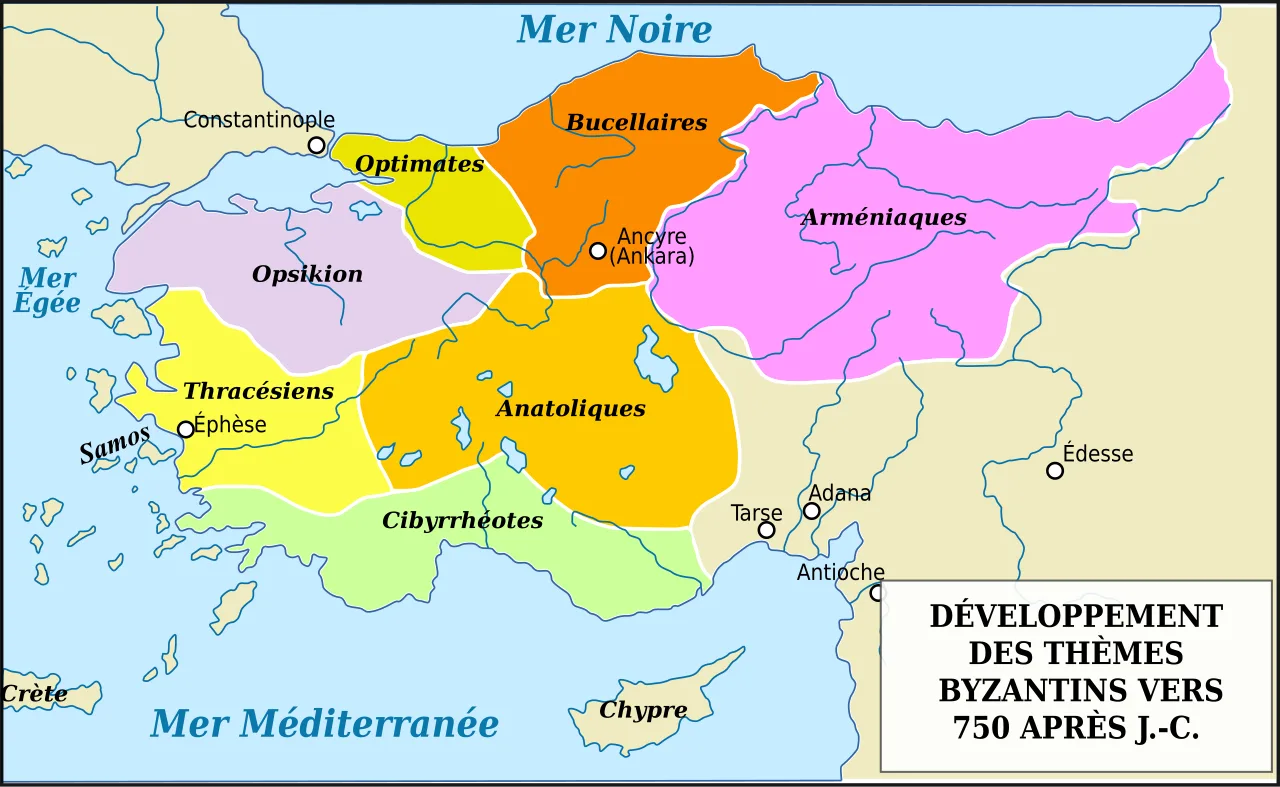
The theme system, developed in the seventh century in response to the Arab conquests, was the key military reorganization.[3] Themes (themata) were large administrative districts combining military and civilian governance under a single officer, the strategos.
Soldiers in the theme system received land grants in exchange for hereditary military service, creating a self-sufficient provincial military that was less dependent on central fiscal resources than the late Roman professional army had been.
The system provided resilience: even when Constantinople was under siege or central authority was disrupted, themes could defend their territory independently.
Greek fire - the Byzantine secret incendiary weapon - was decisive in several naval engagements that might otherwise have ended the empire.
Arab fleets besieging Constantinople in 674-678 and 717-718 were destroyed partly through the use of Greek fire, a substance that burned on water and could be projected through siphons onto enemy ships.
The precise composition of Greek fire remains unknown; its secret was closely guarded and apparently lost when the empire fell.
Modern chemists have proposed various formulations involving naphtha, quicklime, and other substances, but no reconstruction fully matches the historical descriptions.
Byzantine diplomacy was at least as important as military force. The empire's practice of what modern theorists would call "soft power" - the use of prestige, alliance-building, marriage diplomacy, subsidized conversion, and the calculated distribution of honorary titles - was systematic and sophisticated.
The emperor maintained a hierarchy of honorary titles that foreign rulers could be given, creating ties of nominal loyalty and obligation.
Missionary activity in Bulgaria, Moravia, Serbia, and Rus was coordinated with diplomatic strategy, creating Christian states that were politically, liturgically, and culturally linked to Constantinople.
The conversion of Vladimir I of Kiev around 988 CE brought Russia into the Byzantine cultural sphere, with consequences that persist in Russian Orthodoxy to the present day.
Decline, the Fourth Crusade, and the End
Byzantine decline was not a single event but a long contraction punctuated by catastrophic shocks.
The Battle of Manzikert in 1071 was the first decisive turning point. The Seljuk Turk sultan Alp Arslan defeated and captured the Byzantine emperor Romanos IV Diogenes, opening Anatolia - the heartland of Byzantine military and agricultural power - to Turkish settlement.
Over the following decades, the Byzantines lost most of Asia Minor, reducing the empire's population and tax base severely.
Emperor Alexios I Komnenos's appeal to Pope Urban II for military assistance in reconquering Anatolia contributed to the First Crusade in 1095, though the crusading armies proved less controllable than Alexios had hoped.
The Fourth Crusade of 1204 was the most damaging blow the empire ever received from a nominally Christian power. The Crusade, organized to reconquer Jerusalem, was redirected to Constantinople through a sequence of events involving Crusader debts to the Venetians, a Byzantine succession dispute, and opportunism on all sides.
In April 1204, Crusader and Venetian forces stormed Constantinople, sacking the city over three days.[11] The Byzantine scholar Niketas Choniates described the horror: churches plundered, icons destroyed, relics seized, women assaulted, and the accumulated treasures of a thousand years of civilization looted.[10]
A Latin Empire was established at Constantinople (1204-1261), and Byzantine successor states fragmented the empire's territory.
The empire was restored in 1261 when Michael VIII Palaiologos recaptured Constantinople, but the restored Byzantine state was a shadow of its former self: its Anatolian heartland was gone, its treasury was depleted, and its political authority extended over a small fraction of its former territory.
The Palaeologan renaissance - a cultural and intellectual flourishing that made Constantinople a center of Greek scholarship in the fourteenth and early fifteenth centuries - co-existed with military and political irreversibility.
Each decade brought further Ottoman advance: Adrianople fell in 1369, Thessaloniki in 1430.[12] By the 1440s, Constantinople was an island of Byzantine territory surrounded by Ottoman lands, its population reduced from hundreds of thousands to perhaps 50,000.
The final siege began on April 6, 1453. Mehmed II brought an army of approximately 80,000 men and a siege train that included enormous cannon cast by the Hungarian engineer Urban. The Theodosian Walls, which had defeated every previous attacker for a thousand years, could not withstand sustained artillery bombardment.
On May 29, a breach was opened; the defenders, numbering perhaps 7,000, could not plug it.[4] Constantine XI died fighting somewhere on the walls.
Mehmed entered the city, went to the Hagia Sophia, and said a Muslim prayer there, formally claiming it as a mosque. He was given the title Kayser-i Rum - Caesar of Rome - and understood his conquest as the restoration of a unified empire from its eastern capital.
Legacy: Law, Religion, and Preserved Learning
The Byzantine legacy is distributed across four domains that shaped the subsequent world in ways that are often invisible precisely because they have been so thoroughly absorbed.
The legal legacy is the most concretely measurable. Justinian's Corpus Juris Civilis, transmitted through medieval Byzantine scholarship, became the basis of European civil law when it was rediscovered in Bologna in the eleventh century.
The Code Napoleon, the German Burgerliches Gesetzbuch, the Italian, Spanish, Portuguese, and Dutch civil codes - and through these the legal systems of Latin America, parts of Africa, and much of Asia - are descendants of Justinian's sixth-century compilation.
Scholars estimate that well over half the world's population lives under legal systems derived from Roman law as preserved by Byzantium.
The religious legacy operates primarily through Eastern Orthodox Christianity. Byzantine missionaries evangelized the Slavic peoples from the ninth century; Cyril and Methodius created the Glagolitic alphabet (the precursor to Cyrillic) to write Slavic languages and translate scripture.
Russia, Ukraine, Serbia, Bulgaria, Romania, and Greece are predominantly Orthodox Christian countries whose religious institutions, liturgy, and theology descend from Byzantine Christianity.
The Russian Orthodox Church's claim of Moscow as the "Third Rome" - the successor to Rome and Constantinople - is a direct assertion of Byzantine religious inheritance.
The transmission of classical Greek learning was perhaps the most significant Byzantine contribution to the Renaissance and subsequent intellectual history. Constantinople's libraries held manuscripts of Plato, Aristotle, Thucydides, Ptolemy, Galen, and virtually every major Greek author whose works survive.
When Byzantine scholars fled west before and after 1453 - bringing manuscripts with them - they contributed directly to the Italian Renaissance recovery of Greek learning.
The scholar Gemistus Pletho's visit to the Council of Florence in 1439 sparked a Platonic revival in Florence that influenced Ficino, Pico della Mirandola, and the Medici academy. The manuscripts brought by George of Trebizond, Bessarion, and others became the foundation of Greek studies in Western Europe.
The empire's administrative vocabulary and institutional practices were directly inherited by the Ottoman Empire, which employed many Byzantine officials and adopted Byzantine court ceremonial, fiscal practices, and administrative terminology.
The word "sultan" aside, the bureaucratic machinery of the early Ottoman state owed much to Byzantine precedent.
The Hagia Sophia itself, now a mosque, remains the most eloquent monument to what Byzantium built and what was lost in its fall. Its architect Anthemius of Tralles solved dome engineering problems that no one before him had solved; his solution was not fully replicated in Western Europe for nearly a thousand years.
Every visitor who enters it today, under the floating dome and the ancient mosaics that survived centuries of plastering, encounters something made in Constantinople fourteen hundred years ago - a tangible remainder of a civilization that called itself Roman until its last emperor died on its walls.
For related reading, see what was the Ottoman Empire, why the Roman Empire fell, and what was the Reformation.
Sources & Further Reading
- Treadgold, W. (1997). A History of the Byzantine State and Society. Stanford University Press.
- Norwich, J. J. (1988). Byzantium: The Early Centuries. Knopf.
- Ostrogorsky, G. (1969). History of the Byzantine State (J. Hussey, Trans.). Rutgers University Press.
- Runciman, S. (1965). The Fall of Constantinople 1453. Cambridge University Press.
- Kaldellis, A. (2007). Hellenism in Byzantium: The Transformations of Greek Identity and the Reception of the Classical Tradition. Cambridge University Press.
- Kaldellis, A. (2019). Romanland: Ethnicity and Empire in Byzantium. Harvard University Press.
- Herrin, J. (2007). Byzantium: The Surprising Life of a Medieval Empire. Princeton University Press.
- Evans, J. A. S. (1996). The Age of Justinian: The Circumstances of Imperial Power. Routledge.
- Procopius. (c. 550 CE). History of the Wars (H. B. Dewing, Trans.). Loeb Classical Library.
- Choniates, N. (c. 1207 CE). O City of Byzantium (H. J. Magoulias, Trans.). Wayne State University Press.
- Whitby, M. (Ed.). (2007). Byzantines and Crusaders in Non-Greek Sources, 1025-1204. British Academy.
- Harris, J. (2010). The End of Byzantium. Yale University Press.
- Haldon, J. (2016). The Empire That Would Not Die: The Paradox of Eastern Roman Survival, 640-740. Harvard University Press.