
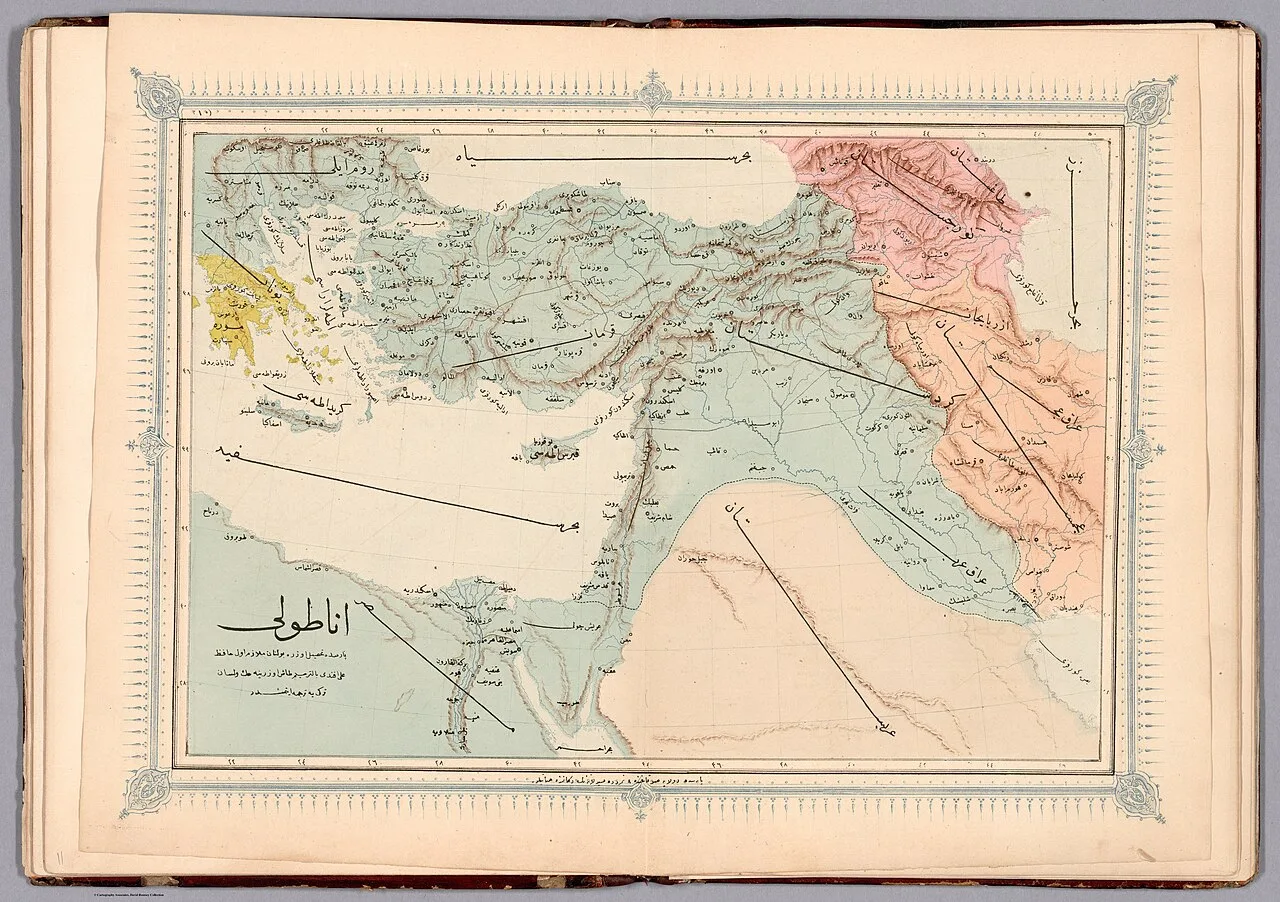
The Ottoman Empire was a Sunni Muslim dynastic state founded in northwestern Anatolia that became a diverse continental empire before its dissolution in 1922. Its sultans combined military power, fiscal administration, trade-route control, and a hierarchy of recognized religious communities. The millet system gave religious communities legal and administrative roles in personal matters while preserving unequal political and legal status for non-Muslim subjects.
On the morning of May 29, 1453, the walls of Constantinople finally gave way after a fifty-three-day siege.[4] The Eastern Roman Empire - the last direct institutional heir of Rome, which had governed continuously from Constantinople since 330 CE - ceased to exist.
Sultan Mehmed II, twenty-one years old, rode through the Theodosian Walls and made his way to the Hagia Sophia, the great sixth-century cathedral that had been the symbolic center of Orthodox Christianity for nearly a millennium.
He converted it to a mosque before the day was out. Then he did something deliberate and historically significant: he declared himself "Kayser-i Rum" - Caesar of Rome. He was not announcing the empire's destruction. He was announcing its succession.
The Ottoman Empire that Mehmed II expanded through that gate would go on to rule three continents for the next four and a half centuries. At its height under his great-great-grandson Suleiman the Magnificent (r.
1520-1566), it stretched from the gates of Vienna in the west to the Persian border in the east, from the Crimea and Hungary in the north to Yemen and the Somali coast in the south.
It encompassed the Arabian Peninsula and the holy cities of Mecca and Medina, the Anatolian heartland, the entire Fertile Crescent, the Nile valley, and the Maghreb.
This was not a European empire projecting power overseas. It was a continental empire of extraordinary diversity - dozens of ethnicities, three major religions, scores of languages - governing itself through institutions that were in many respects more sophisticated and tolerant than anything contemporary Europe could offer.
The Ottoman Empire was, for most of its existence, the most powerful state in the eastern Mediterranean and western Asia. It controlled the major overland trade routes between Europe and the East. Its armies twice reached the walls of Vienna (1529 and 1683).
Its navy dominated the eastern Mediterranean until the Battle of Lepanto (1571), and even that defeat did not dislodge Ottoman naval power for long.
And yet the empire is primarily remembered in Western historiography through the lens of its decline - the "sick man of Europe," the Armenian Genocide, the collapse that produced the modern Middle East.
Understanding what the Ottoman Empire actually was, at the height of its power and during the long complexity of its transformation, is essential to understanding the contemporary world.
"The Ottoman system was not based on the idea that all subjects were equal, but rather that all communities could find a recognized and protected place within the imperial order." - Halil Inalcik, The Ottoman Empire: The Classical Age 1300-1600 (1973)[5]
| Sultan | Period | Key Achievement |
|---|---|---|
| Osman I | 1299-1326 | Founded Ottoman dynasty in northwest Anatolia |
| Mehmed II | 1451-1481 | Conquered Constantinople (1453); expanded into Europe |
| Suleiman the Magnificent | 1520-1566 | Peak territorial extent; legal reforms; siege of Vienna |
| Selim I | 1512-1520 | Conquered Egypt, Syria; became Caliph |
| Mahmud II | 1808-1839 | Reformed army; destroyed Janissaries; early modernization |
| Abdul Hamid II | 1876-1909 | Autocratic rule; Armenian massacres; pan-Islamism |
Key Definitions
The Ottoman Empire (Osmanli Devleti) was a Sunni Muslim dynastic state founded around 1299 in northwestern Anatolia by Osman I, a Turkic tribal leader, and dissolved in 1922 following the defeat of the Central Powers in World War I and the Turkish War of Independence.
At its greatest extent it covered approximately 5.2 million square kilometers. The Ottoman state was a sultanate - ruled by successive sultans of the Osmanli dynasty - and from 1517 onward, its rulers also held the title of Caliph, claiming spiritual leadership over Sunni Muslims worldwide.
The millet system was the Ottoman framework for managing religious minority communities.
From the Greek word for "nation" (borrowed into Ottoman Turkish), millets were autonomous religious communities with their own legal and administrative structures for matters of personal status - marriage, inheritance, education, internal disputes.
The Greek Orthodox Patriarch in Constantinople, the Armenian Patriarch, and the Chief Rabbi each governed their respective communities in these domains.
This was not liberal tolerance in any modern sense: the system explicitly ranked Muslims above non-Muslims, imposed the jizya (a special tax on non-Muslim subjects), and excluded non-Muslims from the military and certain state offices.
But it preserved religious pluralism at a moment when Catholic Europe was burning heretics and expelling Jews.
Multi-Ethnic Governance: The Millet System and Fiscal Flexibility
The practical success of the Ottoman system lay in its pragmatic management of diversity. Istanbul - Constantinople refounded as the Ottoman capital - became one of the most cosmopolitan cities in the world.
After the Spanish expulsion of the Jews in 1492, Sultan Bayezid II actively invited Sephardic Jewish refugees to settle in Ottoman territories; by the sixteenth century, Salonica (modern Thessaloniki) had a Jewish majority and was a major center of Ottoman trade and textile production.
In Alexandria, Cairo, Aleppo, and Baghdad, Ottoman governance layered over existing urban hierarchies without necessarily destroying them.
The millet system's administrative genius was its devolution of the costs of governance to community leaders while preserving the sultans' fiscal and military claims.
The Greek Orthodox Patriarch administered a vast network of churches, schools, and courts for Orthodox Christians across Anatolia, the Balkans, and the Arab provinces.
Armenian merchants connected Ottoman trade networks to Persia and Central Asia. Jewish physicians, translators, and financiers staffed the upper levels of Ottoman administration.
The Chief Rabbi negotiated tax rates for Jewish communities across the empire. Each millet maintained its own courts, charities, and educational institutions, reducing the administrative burden on the central state while keeping communal hierarchies invested in Ottoman stability.
At the local level, Ottoman fiscal flexibility operated through the ayan - provincial notables, often large landowners or merchants, who served as intermediaries between the central state and local populations.
The ayan collected taxes, maintained order, and provided military contingents in exchange for a share of fiscal revenues and formal recognition of their status.
This arrangement was efficient but generated a structural tension: the most powerful ayan could use their local bases to extract concessions from the center or, in periods of Ottoman weakness, to operate with near-autonomous authority.
By the eighteenth century, figures like Ali Pasha of Janina and Muhammad Ali of Egypt had accumulated power that rivaled the sultan's in their own domains.
The 1808 Deed of Alliance (Sened-i Ittifak) between Sultan Mahmud II and the ayan was often compared by Ottoman historians to the English Magna Carta - an acknowledgment that central authority had limits.
The Devshirme System: Power Through Conversion
The Ottoman system solved a problem that plagued all pre-modern empires: how to staff a loyal central administration without becoming captive to hereditary aristocratic families whose interests diverged from the dynasty's. The devshirme, meaning "collection" in Turkish, was their solution.
Beginning in the late fourteenth century, Ottoman officials periodically collected boys - typically between 8 and 18 years old - from Christian villages in the Balkans and Anatolia.
These boys were taken from their families, converted to Islam, educated in palace schools, and formed into an elite corps of administrators and soldiers entirely dependent on the sultan for their status and lives.
The logic was elegant and brutal. A devshirme recruit had no family connections, no noble lineage, no inherited property, and no alternative source of power beyond royal favor.
He could be elevated to the highest offices in the empire - including grand vizier, the chief administrative officer - or executed at the sultan's whim, with no clan to avenge him and no property to dispute.
The Janissaries, the elite infantry corps that formed the backbone of Ottoman armies, were recruited entirely through the devshirme system until the seventeenth century.
By the sixteenth century, most grand viziers were devshirme recruits of Christian Balkan origin. Ibrahim Pasha, who served as grand vizier under Suleiman the Magnificent until his execution in 1536, was of Greek origin.
Sokollu Mehmed Pasha, who served three sultans as grand vizier from 1565 to 1579 and is widely considered one of the most capable Ottoman statesmen, was born into a Serbian family in Bosnia.
This system was, as the historian Leslie Peirce has observed, meritocratic within an extraordinarily violent logic.[9] The devshirme recruit who survived the palace schools and rose through military or administrative service could attain wealth, power, and prestige that would have been impossible in the village of his birth.
The Christian communities from which boys were taken developed complex and sometimes contradictory attitudes toward the system: it was a loss and a grief, but also a path to power, and some families reportedly bribed officials to have their sons selected.
The devshirme system contained the seeds of its own transformation. By the late sixteenth and seventeenth centuries, Janissaries had begun to marry, acquire property, and enroll their own sons in the corps - exactly the hereditary transmission the system had been designed to prevent.
The Janissaries became a conservative political force, resistant to military modernization and capable of deposing sultans who threatened their privileges. Sultan Mahmud II, who had spent years carefully building an alternative military force, moved against them in 1826.[1]
In what Ottoman chronicles called the "Auspicious Incident" (Vaka-i Hayriye), Mahmud ordered the new troops to fire on the Janissary barracks when the corps revolted against his reforms.
Thousands of Janissaries were killed, the survivors dispersed, and the corps abolished - clearing the way for the Tanzimat era of Ottoman modernization.[10]
The Conquest of Constantinople and Its Consequences
The fall of Constantinople in 1453 was one of the most consequential events of the fifteenth century, with ramifications extending far beyond the military defeat of a declining Byzantine state. For European Christendom, it was a civilizational shock.
The city that had been the symbolic guardian of Christianity's eastern frontier, the repository of classical Greek scholarship, and the greatest city in the European world had fallen to Muslim armies.
Pope Nicholas V called for a crusade; nothing came of it, but the event galvanized European consciousness and generated decades of apocalyptic literature.
For the overland trade routes connecting Europe to the lucrative markets of Asia - silk, spices, dyes, and luxury goods - the conquest created new realities.
The Ottoman control of Constantinople and, through the later sixteenth century, of the entire eastern Mediterranean coast, did not block trade entirely; the Ottomans were pragmatic about commerce and taxed it rather than prohibiting it.
But it increased costs, introduced new uncertainties, and powerfully motivated European maritime powers to seek oceanic alternatives.
The Portuguese had already begun their Atlantic and African coastal explorations before 1453, but the fall of Constantinople accelerated the urgency of the search for sea routes to Asia.
Vasco da Gama's 1498 voyage to India via the Cape of Good Hope was not solely caused by Ottoman control of overland routes, but the motivation is documented in Portuguese court records and contemporary chronicles.
Mehmed II's claim to the title of Caesar of Rome was more than rhetoric. He collected Greek and Latin manuscripts, commissioned a biography of Alexander the Great, employed Italian humanist scholars, and positioned the Ottoman sultanate as the legitimate continuation of Roman imperial authority in the East.
The Greek Orthodox Patriarch was reinstated in Constantinople - not as a concession to Christianity but as a demonstration of Ottoman capacity to govern diverse subjects.
This political theology, which presented the Ottoman sultan as the universal sovereign of a multi-religious empire, informed Ottoman diplomacy and self-presentation for centuries.
The Armenian Genocide
The Armenian Genocide of 1915-1923 is the most contested and consequential episode of the Ottoman Empire's final decades.
It represents one of the first systematic efforts by a modern state to eliminate an entire ethnic and religious community within its borders, and it prefigured the genocides of the twentieth century in both method and scale.[12]
The context was the catastrophic loss of territory in the Balkan Wars of 1912-1913, in which the Ottoman Empire lost virtually all its European possessions and experienced the violent displacement of hundreds of thousands of Muslims from formerly Ottoman territories.
The Committee of Union and Progress (CUP, known as the "Young Turks"), which had seized effective control of the Ottoman government in a 1913 coup, developed an ideology of ethnic Turkish nationalism that stood in sharp contrast to the multi-ethnic Ottomanism the empire had historically practiced.[6]
Armenian Christians, concentrated in eastern Anatolia and possessing cultural and commercial ties to Russia, were increasingly viewed by CUP ideologists as a fifth column in the context of war with Russia.
The trigger was the Ottoman defeat at the Battle of Sarikamish in January 1915, in which Russian forces inflicted a catastrophic defeat on Ottoman armies. The CUP leadership attributed the defeat in part to alleged Armenian collaboration with Russia.
In April 1915, beginning with the arrest and deportation of Armenian community leaders in Constantinople, the government launched a systematic program of deportation of Armenians from eastern Anatolia to the Syrian desert.[2]
The deportations were organized through the Special Organization (Teskilat-i Mahsusa), a paramilitary unit that coordinated killings along the deportation routes. Men were typically killed outright; women, children, and the elderly were forced on death marches through the Syrian desert without adequate food, water, or shelter.
Scholarly estimates of the death toll range from approximately 600,000 to 1.5 million people. The most widely cited figure among genocide scholars is approximately 1 to 1.2 million deaths.
Contemporary documentation comes from multiple independent sources: German diplomatic cables (Germany was an Ottoman ally and had military advisors with Ottoman forces), American consular reports, the accounts of relief workers, and survivor testimonies collected in subsequent decades.[3]
Ambassador Henry Morgenthau Sr.'s memoir, published in 1918, provides detailed contemporaneous accounts of conversations with CUP leaders that constitute some of the most direct documentary evidence.[8]
The question of whether the events meet the legal definition of genocide under the 1948 UN Convention has been answered affirmatively by the overwhelming consensus of genocide scholars and recognized by over thirty countries, including the United States (formally in 2021), France, Germany, Canada, and the European Parliament.
The Turkish state's official position - that the deaths resulted from wartime displacement, disease, and intercommunal violence rather than systematic extermination, and that the death toll is substantially overstated - is rejected by mainstream scholarship but remains politically significant.
Legacy in the Modern Middle East
The collapse of the Ottoman Empire produced the political geography of the modern Middle East in ways that continue to generate conflict.
The Sykes-Picot Agreement of 1916 - the secret Anglo-French partition of anticipated Ottoman territories - drew the lines that would eventually become the borders of Iraq, Syria, Lebanon, and Transjordan.
These borders had no relationship to the Ottoman provincial structure, to existing political communities, or to the distribution of ethnic and religious populations.
They were instruments of Anglo-French strategic convenience, and they created states with fatal internal contradictions.
Iraq, assembled from three Ottoman provinces (Mosul, Baghdad, and Basra) by British mandate administrators, grouped Kurds, Arab Sunnis, and Arab Shia into a single state with no prior political unity and a British-imposed Hashemite monarchy.
Syria and Lebanon were divided between French and British spheres in ways that separated populations with strong regional ties and created artificial entities requiring authoritarian management to hold together.
The Lebanese confessional system - the formal allocation of governmental positions among religious communities according to the 1932 census - was a French mandate creation that institutionalized sectarian identity as the basis of political participation and has generated recurrent crises ever since.[7]
The Ottoman Caliphate, which had provided a framework of Islamic legitimacy for Ottoman rule since 1517, was abolished by Mustafa Kemal Ataturk in March 1924, one year after the formal dissolution of the sultanate.
The abolition created what scholars have called a "legitimacy vacuum" in Sunni Islamic political thought: for the first time in the modern era, there was no universally recognized Caliph.
Various attempts to fill this vacuum - by the Saudi state, by pan-Arab nationalist movements, and most recently by the Islamic State's declaration of a caliphate in 2014 - can be read partly as responses to the institutional rupture of 1924.
The Ottoman legacy is also contested in contemporary Turkey, where the AKP government of Recep Tayyip Erdogan has pursued a foreign policy sometimes described by analysts as "neo-Ottoman" - seeking to project Turkish influence across former Ottoman territories in the Middle East, the Balkans, and North Africa.
The conversion of the Hagia Sophia from a museum back to a mosque in 2020 was a symbolic act that explicitly invoked the 1453 conquest. Whether this represents a coherent imperial project or a domestic political maneuver leveraging Ottoman nostalgia remains debated.
Conclusion
The Ottoman Empire endured for over six centuries by solving, repeatedly and pragmatically, the fundamental problem of how to govern enormous diversity. The millet system preserved communal autonomy. The devshirme created a meritocratic administrative corps loyal to the dynasty rather than to hereditary elites.
The carefully negotiated relationship between the central state and provincial notables maintained fiscal extraction without triggering permanent revolt.
These solutions had costs - the devshirme's violence, the millet's hierarchical ordering of religions, the periodic massacres of Janissary corps that had become obstacles to reform - but they sustained a multi-continental empire for longer than almost any comparable polity in history.[11]
The empire's collapse was neither inevitable nor rapid. It unfolded over a century of military defeats, territorial losses, financial dependency, and nationalist pressures from within, culminating in the catastrophic choices of World War I that destroyed what remained.
The borders, sectarian tensions, and unresolved questions of legitimacy left by that collapse remain among the most consequential inheritances of the imperial age.
Sources & Further Reading
- Aksan, V. H. (2007). Ottoman Wars, 1700-1870: An Empire Besieged. Longman/Pearson.
- Akcam, T. (2006). A Shameful Act: The Armenian Genocide and the Question of Turkish Responsibility. Metropolitan Books.
- Balakian, P. (2003). The Burning Tigris: The Armenian Genocide and America's Response. HarperCollins.
- Finkel, C. (2005). Osman's Dream: The Story of the Ottoman Empire, 1300-1923. John Murray.
- Inalcik, H. (1973). The Ottoman Empire: The Classical Age 1300-1600. Weidenfeld and Nicolson.
- Kayali, H. (1997). Arabs and Young Turks: Ottomanism, Arabism, and Islamism in the Ottoman Empire, 1908-1918. University of California Press.
- Makdisi, U. (2000). The Culture of Sectarianism: Community, History, and Violence in Nineteenth-Century Ottoman Lebanon. University of California Press.
- Morgenthau, H. (1918). Ambassador Morgenthau's Story. Doubleday.
- Peirce, L. P. (1993). The Imperial Harem: Women and Sovereignty in the Ottoman Empire. Oxford University Press.
- Quataert, D. (2000). The Ottoman Empire, 1700-1922. Cambridge University Press.
- Shaw, S. J., & Shaw, E. K. (1977). History of the Ottoman Empire and Modern Turkey (2 vols.). Cambridge University Press.
- Straus, S. (2015). Making and Unmaking Nations: War, Leadership, and Genocide in Modern Africa. Cornell University Press.