
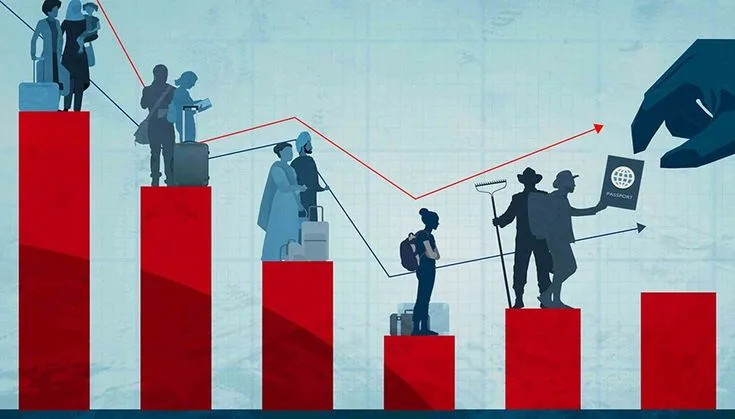
Economic: In 1980, Fidel Castro announced that any Cuban who wanted to leave could do so from the port of Mariel.
The announcement was partly a pressure-release valve - Cuba's prisons and psychiatric institutions were emptied and their inhabitants included in the departing boats - and partly a political maneuver designed to embarrass the United States.
In six months, 125,000 Cubans arrived in Miami. The city's labor supply increased by approximately 7% almost overnight.
For economists, the Mariel Boatlift was a natural experiment of the kind that rarely presents itself: a sudden, exogenous, large-scale shock to the labor supply of a specific city. What happened to wages? David Card, analyzing the data in 1990, found that wages in Miami did not fall relative to comparison cities.[2]
Employment levels were unaffected. The Boatlift had not hurt Miami workers. George Borjas, re-analyzing the same data in 2017 with a different comparison group, found that wages had fallen sharply among high school dropouts.
Card and his colleagues responded that Borjas had made methodological errors. Borjas maintained otherwise. The same 125,000 people, the same city, the same years - and two careful economists reached opposite conclusions about one of the most intensively studied episodes in immigration history.
The Mariel dispute is a microcosm of migration research more broadly. Human movement is the most human of behaviors - it is how our species colonized every habitable environment on earth, how empires were built and undermined, how families were assembled and scattered.
Yet our knowledge of why people move, where they go, what happens when they arrive, and what this means for those they leave and join is constructed from imperfect data, contested methods, and research programs that have not always been innocent of political motivation.
This article assembles what is known - and acknowledges what is genuinely contested - about migration from the perspectives of economics, demography, social psychology, and political science.
The stakes are not merely academic. Migration is among the most politically charged subjects in contemporary democracies.
The gap between economic research on immigration - which tends to find modest and often positive effects on receiving countries - and public perception of immigration as an economic threat is among the largest such gaps in political economy.
Understanding where that gap comes from, and what the research actually shows, is essential for anyone trying to think clearly about one of the defining political questions of the 21st century.
"The fundamental law of migration is that people move when they expect the benefits to exceed the costs and when they have the resources to make the move. Everything else is variations on this theme." - Douglas Massey, Worlds in Motion (1998)
| Migration Driver | Type | Examples |
|---|---|---|
| Economic opportunity | Labor migration | Mexican workers to USA; South Asians to Gulf |
| Conflict and persecution | Forced migration / refugee | Syrians to Europe; Rohingya to Bangladesh |
| Family reunification | Chain migration | Post-war European immigration to Americas |
| Education | Student migration | International students to USA, UK, Australia |
| Climate and environment | Environmental migration | Pacific Islanders; Sahel drought displacement |
| Colonial and historical ties | Post-colonial migration | Commonwealth to UK; Algerians to France |
Key Definitions
Push factors: Conditions in an origin country or region that motivate people to leave - poverty, conflict, persecution, environmental degradation, lack of economic opportunity.
Pull factors: Conditions in a destination that attract migrants - higher wages, safety, family networks, established diaspora communities, legal pathways.
Migrant: A general term for anyone who moves from one location to another. Carries no specific legal status.
Refugee: A person with a well-founded fear of persecution on specific grounds (race, religion, nationality, political opinion, group membership) who is outside their country of nationality, as defined by the 1951 UN Refugee Convention.
Asylum seeker: A person who has applied for refugee status and is awaiting a determination.
Chain migration: The self-reinforcing process by which pioneer migrants establish networks that reduce the cost and risk of migration for subsequent migrants from the same community.
Remittances: Money sent by migrants to family and community members in their origin country. Globally exceeds foreign aid in volume.
Brain drain: The emigration of highly skilled workers from developing to developed countries, raising concerns about losses of human capital in origin countries.
Acculturation: The process of psychological and cultural adaptation when individuals encounter a new cultural environment.
Scale and Historical Context
The International Organization for Migration estimated 281 million international migrants in 2020 - approximately 3.6% of the world's population. This figure sounds large, but it means that roughly 96% of people live in the country where they were born.
Human movement has been the norm across evolutionary history - Homo sapiens originated in Africa and colonized every inhabitable continent within 60,000 years - but the modern norm is that most people stay where they are born, constrained by legal borders that are themselves very recent historical constructions.
The concept of "illegal" migration, in the sense of moving across an international border without authorization, barely existed before the 20th century. The United States had essentially open borders until the Chinese Exclusion Act of 1882 and the comprehensive restriction acts of the 1920s.
The modern passport, as a required travel document, became standard only after World War I. The distinction between a legal migrant and an illegal one - which generates enormous political heat in contemporary debates - is historically recent and politically constructed rather than being a natural feature of human geography.
Internal migration dwarfs international migration in absolute numbers. The World Bank estimates that there are approximately 740 million internal migrants globally.
China's internal migration from rural areas to coastal manufacturing cities over the past four decades represents perhaps the largest voluntary movement of people in human history - roughly 300 million people - and has been the single largest driver of global poverty reduction over that period.
Why People Move: Theory and Evidence
The economic model of migration, in its simplest form, treats migration as an investment decision. People move when the expected benefits - higher wages, better opportunities, safety - exceed the costs - transportation, social disruption, foregone earnings during the transition, risk of failure.
This framework, formalized by Michael Todaro in 1969, captures the basic structure but misses important complexity.
Who Actually Migrates
One important prediction the basic push-pull model gets wrong is about who moves. If people move when conditions at home are bad, we would expect the poorest and most miserable to move first. In practice, the poorest people rarely migrate internationally.
International migration requires substantial resources - travel costs, legal fees, housing deposits in the destination, the ability to bear months of reduced income during transition. The very poor cannot afford it.
This creates what economists call the "migration hump": as poor countries develop and more households have enough resources to migrate, emigration initially increases even as conditions improve. Only when development produces sufficient opportunities at home does emigration begin to decline.
This pattern explains why rapid development in Mexico, for example, did not immediately reduce migration to the United States - development first generated the resources that made migration possible for more households before it eventually generated the conditions that made it less necessary.
The selectivity of migration also means that migrants are typically positively selected from their origin populations: they are more educated, more risk-tolerant, more entrepreneurial, and more motivated than the average person they leave behind.
This selection effect is important for interpreting both the success of migrant communities in destination countries and the losses to origin communities.
Social Networks and Chain Migration
The social network theory of migration, developed most fully by Douglas Massey and colleagues in their 1993 synthesis, explains migration not as a series of individual decisions but as a social process in which networks of information, assistance, and obligation accumulate over time to produce durable migration streams.[1]
The pioneer migrant faces maximum costs: everything is new and uncertain. If they succeed, they become an information hub and a resource for subsequent migrants from their community. They can provide accommodation, job leads, introductions, and practical knowledge that dramatically reduce the costs and risks for the next migrant.
As the network grows, it makes migration accessible to people who could not have undertaken the pioneer's journey. Over time, the migration stream takes on a self-sustaining quality independent of the original economic differentials that triggered it.
This explains the highly non-random geographic distribution of immigrant communities: Mexicans concentrated in Los Angeles, California's Central Valley, and Chicago; Somalis concentrated in the Twin Cities; Hmong concentrated in Minnesota and Wisconsin.
These concentrations are not accidents of geography or preference but products of network dynamics: early migrants established themselves, subsequent migrants followed the network, and the accumulating community made each subsequent migration cheaper and lower-risk.
Network theory also explains why migration streams persist even when the economic case for migration has weakened: the social capital embedded in the network has value independent of the wage differential, and as long as the network exists, it will continue channeling migrants toward established destinations.
The Economics of Immigration in Destination Countries
Wages: The Mariel Debate
The wage effects of immigration on native workers remain the most contested empirical question in immigration economics, as the Mariel Boatlift dispute illustrates. The theoretical predictions are ambiguous because they depend on whether immigrants and natives are substitutes or complements in production.
If they do the same jobs, immigration increases labor supply for those jobs and should reduce wages. If they do different jobs that are mutually productive, immigration can increase native wages by enabling more specialization.
Giovanni Peri and Chad Sparber's analysis suggested that immigrant and native workers tend to occupy different positions in "task space": immigrants, on average, concentrate in manual and physical tasks; native workers, particularly those who might seem most directly competitive with immigrants in terms of formal education, concentrate in communication-intensive tasks.[7]
This task specialization means that immigration reshapes how work is divided rather than simply competing with natives for identical positions.
The cross-national meta-analytic evidence finds that the average wage effect of immigration on native workers is close to zero or modestly positive, with some negative effects concentrated among the most directly substitutable workers - often prior immigrants rather than native-born workers - and positive effects for complementary workers.
The distributional effects matter more than the aggregate.
The Fiscal Balance
The National Academies of Sciences' comprehensive 2016 analysis of immigration's fiscal impacts in the United States found that the overall impact, taking a long time horizon, was positive - primarily driven by the strong economic performance of the second generation.[4]
The children of immigrants outperform comparably situated native-born Americans on educational attainment and earnings, generating more in taxes than they use in services.
The first generation's fiscal impact depends heavily on education level: immigrants with college degrees typically generate net positive fiscal contributions from early in their residence; immigrants with less education generate net negative contributions in the short to medium run.
The geography of fiscal impact also matters: state and local governments bear the costs of education and healthcare for immigrant families, while the federal government collects the income and payroll taxes that represent the long-run positive contribution.
On innovation, the data is unambiguous: immigrants are dramatically overrepresented among U.S. patent holders, Nobel laureates, and founders of high-growth companies. A substantial fraction of the technology companies that drove U.S. economic growth in recent decades were founded by immigrants or their children.
Refugees, Asylum, and the Limits of International Law
The international legal framework for refugee protection was designed in the aftermath of World War II and the Holocaust, with the specific experience of Jewish refugees who had been unable to find asylum in mind.
The 1951 Refugee Convention and its 1967 Protocol established the principle that people fleeing persecution based on race, religion, nationality, political opinion, or group membership cannot be returned to countries where they face persecution - the principle of non-refoulement.
The framework does not cover economic migrants, people displaced by natural disasters, or people fleeing generalized violence not specifically targeting them as a group. These categories are large and growing.
The UNHCR counted 26.6 million refugees globally in 2021 - people meeting the Convention definition - but many millions more were displaced by conditions the Convention does not cover.
Climate change is creating the most significant gap in the legal framework. Sea level rise, increased storm intensity, drought, and desertification are displacing millions of people.
Pacific island nations facing existential threat from sea level rise - Kiribati, Tuvalu, the Marshall Islands - may see their entire populations displaced within decades.
None of this displacement falls within the 1951 Convention's protection framework. Debates about whether to create a new "climate refugee" category, expand the Convention, or develop other protective frameworks have not yet produced consensus, while the scale of climate displacement continues to grow.
Brain Drain, Brain Gain, and Remittances
The "brain drain" concern - that emigration of skilled workers depletes developing countries of the human capital they need for development - captures a real phenomenon but overstates its costs in most contexts.
Michael Clemens's 2011 analysis identified "trillion-dollar bills on the sidewalk": the gains from reducing barriers to labor mobility across international wage differentials are so large that they dwarf the estimated costs of brain drain.
The global misallocation of labor is, on Clemens's estimates, among the largest sources of foregone economic output in the world economy.[3]
Remittances are the most tangible positive counterweight to brain drain. Migrants sent an estimated $540 billion to low and middle-income countries in 2020 - more than three times total official development assistance, and for many countries the largest source of foreign exchange.
Remittances reduce poverty in origin communities, fund household investment in education and health, and smooth consumption during economic shocks. They are also more responsive to recipient need than most aid flows.
The "brain gain" hypothesis adds a further complication: the prospect of emigration raises the returns to education in origin countries, potentially increasing educational investment even among people who ultimately do not emigrate.
When sufficient numbers do not emigrate, the net effect can be an increase in the skilled labor force despite emigration. This mechanism appears to operate in some contexts, particularly for smaller educational elite groups.
The Psychology of Migration and Acculturation
John Berry's acculturation framework identifies four psychological strategies that migrants employ in navigating between their heritage culture and the culture of their new environment.[6]
Integration - maintaining elements of the heritage culture while also adapting to and participating in the host culture - is the "bicultural" approach and is associated with the best psychological outcomes across multiple studies.
Assimilation - abandoning heritage culture to adopt the host culture fully - produces decent outcomes but at the cost of cultural identity.
Separation - maintaining heritage culture while avoiding engagement with the host culture - tends to produce isolation. Marginalization - losing connection to both cultures - is associated with the worst outcomes.
Acculturative stress - the psychological disruption of navigating between cultures - is a normal feature of migration that varies enormously with individual circumstances, social support, and the receptiveness of the host society.
Migrants who arrive with social networks in place (through chain migration) experience significantly less acculturative stress than pioneers. Hostile policy environments and social climates increase stress and can impair acculturation outcomes.
The political backlash against immigration in receiving countries has been extensively studied by political scientists. Dennison and Geddes's cross-national analysis found a striking dissociation: anti-immigrant attitudes predict vote share for right-populist parties, but they do not track actual immigration levels.
Countries with relatively low immigration but high anti-immigrant sentiment vote for anti-immigration parties; countries with high actual immigration may show less political backlash.
This suggests that immigration politics is driven more by identity anxiety, cultural threat perception, and symbolic politics than by direct economic experience of immigration.
Climate Migration: The Emerging Challenge
Climate change is already displacing people through multiple pathways, and the scale is expected to increase substantially over the coming decades. Agricultural disruption - reduced yields from heat stress, drought, and changing precipitation - reduces rural incomes and pushes people toward cities and across borders.
Flooding and coastal erosion directly destroy homes and infrastructure. Water scarcity in already-stressed regions creates conflict over resources that drives displacement.
The World Bank's 2018 Groundswell report, modeling slow-onset climate stressors - rather than sudden disasters - in sub-Saharan Africa, South Asia, and Latin America, projected between 31 million and 143 million internal climate migrants by 2050, with the range depending heavily on emissions trajectories and development investments in the affected regions.
Aggressive emissions reduction and targeted development investment could reduce the high-end projection by roughly 80%.[5]
The distinction between "internal" and "international" climate migration matters enormously for policy: international migration generates legal and political complexity, while internal migration may be more practically manageable but can create regional crises within countries.
Bangladesh's coastal zone, for example, is losing territory to sea level rise while the country's cities are already under significant population pressure.
Managing the transition of millions of coastal residents to other parts of Bangladesh - an internal migration - represents an enormous governance challenge even without the international dimensions.
What the Research Adds Up To
Migration is a normal and persistent feature of human existence, driven by the universal logic of seeking better outcomes and shaped by networks, costs, and policy environments.
Its economic effects on destination countries are generally modest in aggregate, with significant distributional variation - most workers are slightly affected in either direction, with the most direct substitutes for immigrants bearing the largest costs and the most complementary workers gaining the most.
The political salience of immigration vastly exceeds its economic effects on most people, driven by identity, cultural change, and the concentrated visibility of newcomers rather than by labor market calculation.
The legal frameworks designed after World War II are struggling to accommodate the scale and character of 21st-century displacement. Climate change will stress these frameworks further.
The most valuable contribution of migration research may be to substitute evidence for anxiety - to replace the stories about immigration that circulate in political debate with the careful analysis of what actually happens when people move, and when they are prevented from doing so.
Sources & Further Reading
- Massey, D. S., et al. (1993). Theories of international migration: A review and appraisal. Population and Development Review, 19(3), 431-466. DOI: 10.2307/2938462
- Card, D. (1990). The impact of the Mariel Boatlift on the Miami labor market. Industrial and Labor Relations Review, 43(2), 245-257. DOI: 10.1177/001979399004300205
- Clemens, M. A. (2011). Economics and emigration: Trillion-dollar bills on the sidewalk? Journal of Economic Perspectives, 25(3), 83-106. DOI: 10.1257/jep.25.3.83
- National Academies of Sciences. (2016). The Economic and Fiscal Consequences of Immigration. National Academies Press.
- Rigaud, K. K., et al. (2018). Groundswell: Preparing for Internal Climate Migration. World Bank.
- Berry, J. W. (1997). Immigration, acculturation, and adaptation. Applied Psychology, 46(1), 5-34. DOI: 10.1111/j.1464-0597.1997.tb01087.x
- Peri, G., & Sparber, C. (2009). Task specialization, immigration, and wages. American Economic Journal: Applied Economics, 1(3), 135-169. DOI: 10.1257/app.1.3.135
Further Reading
- Hauer, M. E. (2017). Migration induced by sea-level rise could reshape the US population landscape. Nature Climate Change, 7(5), 321-325. DOI: 10.1038/nclimate3271
See also:What Is Nationalism | What Is Populism | What Is Capitalism