
Sikhism: In 1499, a young man named Nanak disappeared into a river in the Punjab and emerged three days later with a sentence that has echoed across five centuries: "There is no Hindu, there is no Muslim." He did not mean that religion was unimportant.
He meant that the labels human beings attach to themselves as spiritual identities had, in the communities he observed, become instruments of hierarchy, exclusion, and empty ritual rather than genuine pathways to the divine.
What he proposed instead was a path grounded in direct experience of God, ethical labor, and radical equality - and that path became one of the world's major religions.[1]
Sikhism emerged in the Punjab region of South Asia in the late 15th century, at the intersection of Hindu devotional traditions and the Islamic culture of the Mughal period.
It was shaped by a succession of ten human Gurus over approximately 200 years, culminating in the proclamation that the scripture itself - the Guru Granth Sahib - would serve as the eternal living Guru.
Today, with 25-30 million adherents worldwide, Sikhism is the world's fifth-largest religion, defined by theological monotheism, ethical rigor, martial courage, and a distinctive social institution - the community kitchen - that makes the Golden Temple in Amritsar one of the world's largest free feeding operations.
Understanding Sikhism means encountering a tradition that is neither a synthesis of Hinduism and Islam nor a sect of either, but a distinct spiritual path with its own scripture, its own sacred language, its own theology, and a history written in martyrdom, migration, and diaspora.
"God is one. Truth is his name. He is the creator, without fear, without hatred, immortal, unborn, self-existent, known by the grace of the Guru." - Mool Mantar, the opening verse of the Guru Granth Sahib, composed by Guru Nanak
| Core Principle | Punjabi / Sanskrit | Meaning |
|---|---|---|
| One God | Ik Onkar | Ultimate reality is one, formless, eternal |
| Selfless service | Seva | Voluntary service to community and humanity |
| Congregation and worship | Sangat / Kirtan | Community prayer with hymn-singing |
| Shared communal meal | Langar | Free kitchen open to all, regardless of background |
| The Guru's scripture | Guru Granth Sahib | Living eternal Guru; final and perpetual authority |
| Five K's (for Khalsa) | Panj Kakars | Uncut hair, comb, steel bracelet, sword, shorts |
Key Definitions
Gurdwara: A Sikh place of worship, literally "door to the Guru," where the Guru Granth Sahib is installed as the living presence of divine wisdom. Every gurdwara operates a langar.
Langar: The community kitchen maintained in every gurdwara, serving free vegetarian meals to all visitors regardless of caste, religion, gender, or social status. A central institution of Sikh egalitarianism.
Khalsa: The community of initiated Sikhs, founded by Guru Gobind Singh in 1699. Khalsa members are identified by the panj kakars (Five Ks) and are committed to the sant-sipahi (saint-soldier) ideal.
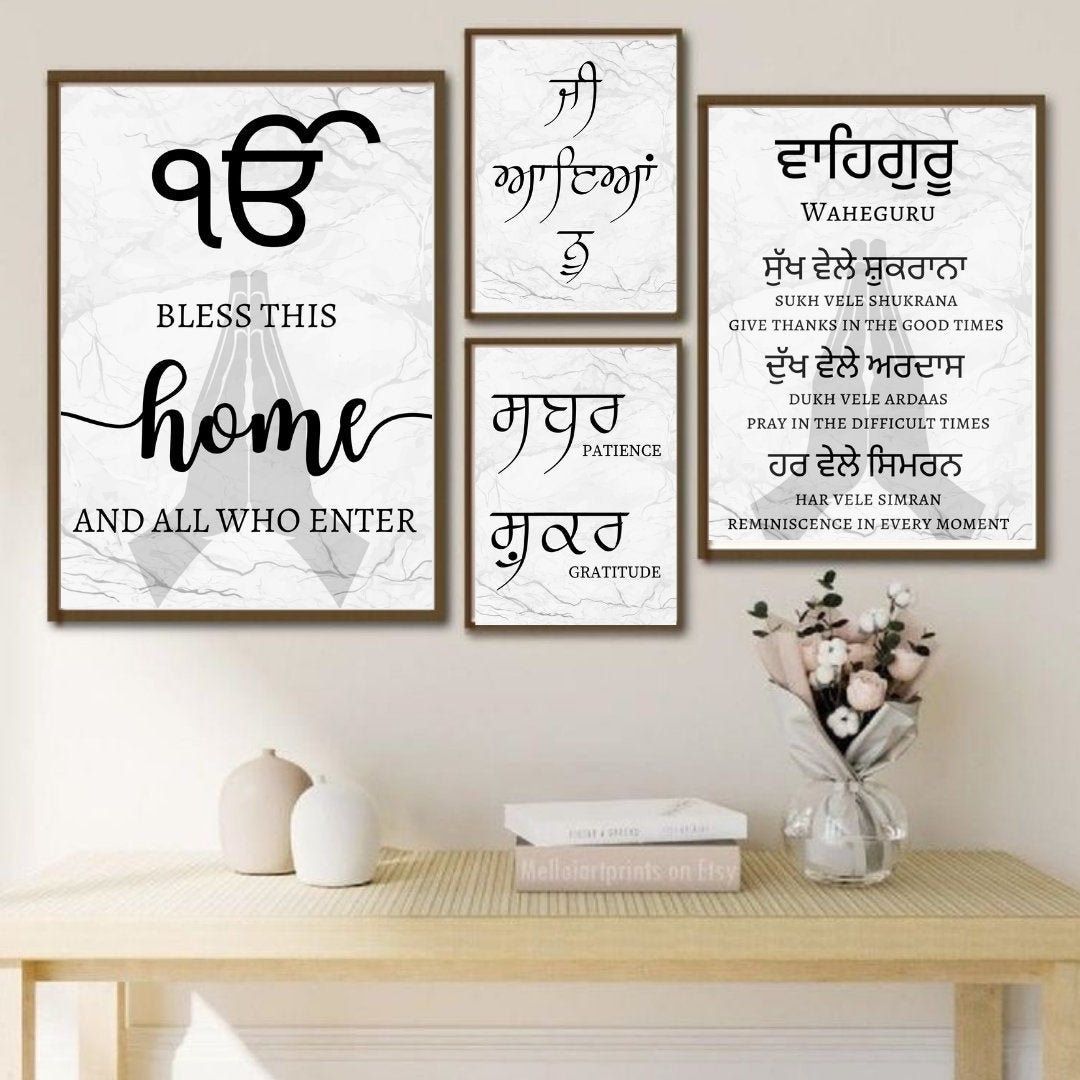
Waheguru: The most common Sikh name for God, often translated as "Wonderful Lord" or "Wondrous Enlightener."
Seva: Selfless service to others, understood as an act of worship. Preparing langar, cleaning the gurdwara, and serving the community are all forms of seva.
Naam simran: Meditation on the names and qualities of God, typically through recitation or singing of shabads (hymns from the Guru Granth Sahib).
Haumai: The ego-self, regarded in Sikh theology as the primary spiritual obstacle. Haumai produces pride, self-centeredness, and separation from God.
The Founding Vision: Guru Nanak and His Journey
Guru Nanak Dev Ji was born in 1469 in the village of Talwandi in the Punjab, now within the borders of Pakistan and renamed Nankana Sahib in his honor. His birth is celebrated as Guru Nanak Gurpurab, typically in November.
From childhood, the accounts preserved in the Janamsakhis (hagiographies) portray him as a child who asked uncomfortable questions of religious authorities and refused conventional social scripts.
His foundational spiritual experience at the River Bein around 1499 marks the traditional beginning of Sikhism. He disappeared into the river while bathing and was absent for three days. When he emerged, he distributed his possessions to the poor and began preaching.
His first public statement was the declaration that there is no Hindu, there is no Muslim - a claim that the categories by which people identified their spiritual allegiances were less important than the direct relationship with God that Nanak had experienced.
He then undertook four major journeys, called udasis, that took him across the Indian subcontinent and beyond. He traveled east to the Hindu pilgrimage sites at Hardwar, Benares, and beyond, engaging Brahmin priests in debates about the function of ritual.
He traveled south through the Deccan and reportedly to Sri Lanka. He traveled north into the Himalayas and toward Tibet, engaging yogic communities. He traveled west to Mecca (wearing a robe combining both Hindu and Muslim elements) and to Baghdad.
These journeys were not tourism but systematic theological dialogue. At Hardwar, he poured water in the opposite direction from the pilgrims who were flinging water toward the east to feed their dead ancestors.
When asked why, he said he was watering his fields in Punjab - if water thrown in one direction could reach the dead in another world, surely it could reach his crops. The argument was about the logical coherence of magical ritual, conducted with characteristic dry humor.
Guru Nanak settled at Kartarpur in his final years, founding a community (sangat) that gathered for prayer and communal eating. He appointed his disciple Lahina as his successor, renaming him Guru Angad.
His death in 1539 was marked, the Janamsakhis say, by a debate between Hindu and Muslim followers about whether he should be cremated or buried.
When they lifted the sheet covering his body, they found only flowers - which the Hindus cremated and the Muslims buried.
This story, whether historical or symbolic, perfectly encapsulates the tradition's claim that Nanak transcended the boundaries between traditions.
The Ten Gurus: A Living Chain of Light
The Sikh tradition maintains that there is one Guru whose light passed through ten successive human forms, each responding to the historical circumstances of their time. The metaphor of the lamp lighting another lamp captures the theological claim: each Guru was fully the Guru, not a lesser or partial version.
The Early Gurus
Guru Angad (1504-1552), the second Guru, standardized the Gurmukhi script used to write Punjabi, enabling the Guru's teachings to be recorded in a consistent written form. He also systematized and expanded the institution of langar.
Guru Amar Das (1479-1574), the third Guru, was 73 years old when appointed Guru - itself a statement against age-based hierarchy. He established a system of 22 teaching centers (manjis) spreading the faith's reach across the Punjab.
He opposed the practice of purdah (the seclusion of women) and sati (the immolation of widows), and required the Mughal Emperor Akbar to eat in the langar before meeting him.
Guru Ram Das (1534-1581), the fourth Guru, founded the city of Ramdaspur, which became Amritsar ("pool of nectar"). He composed the Lavan, the four verses chanted during the Sikh wedding ceremony (Anand Karaj), establishing a distinct Sikh marriage rite.
Guru Arjan Dev Ji (1563-1606), the fifth Guru, accomplished two foundational acts. He compiled the Adi Granth - the first authorized collection of Sikh scripture - between 1601 and 1604, including compositions by Gurus and by Hindu and Muslim saints.[9]
He also constructed the Harmandir Sahib (Golden Temple) at Amritsar, built with four doors open in all four directions to symbolize its welcome to all peoples.
His martyrdom in 1606, when the Mughal Emperor Jahangir had him tortured and executed for refusing to alter the scripture to include Islamic verses, transformed Sikh identity. His death was not resistance to Islam as such but resistance to the corruption of truth.
The Turn to the Sword
Guru Hargobind (1595-1644), the sixth Guru, responded to his father Arjan's martyrdom by taking up two swords - one representing miri (temporal authority) and one representing piri (spiritual authority). He trained soldiers, maintained a court, and engaged Mughal forces militarily.
He wore a royal turban and sat on a throne. This was not an abandonment of spirituality but an elaboration of it: the Sikh tradition would now combine contemplative depth with the duty to defend justice.
Guru Tegh Bahadur (1621-1675), the ninth Guru, was executed in Delhi in 1675 by the Mughal Emperor Aurangzeb. Historical accounts record that he had intervened on behalf of Kashmiri Hindu Brahmins who were being pressured to convert to Islam - an act of interfaith solidarity that cost him his life.
He is remembered in the tradition as "Hind di Chadar" (Shield of India). His martyrdom set the context for his son's radical founding of the Khalsa.
Guru Gobind Singh and the Khalsa
Guru Gobind Singh (1666-1708), the tenth and final human Guru, is one of the most extraordinary figures in world religious history. Brilliant poet, warrior, philosopher, and administrator, he presided over the Sikh community during its most intense period of Mughal persecution.
His response was to institutionalize Sikh identity in a form that would be recognizable, uncompromising, and capable of self-defense.
At Vaisakhi in April 1699, he assembled a large gathering at Anandpur Sahib and created the Khalsa through a ceremony that transformed Sikh communal identity.
The founding of the Khalsa - with its amrit (initiation) ceremony, its panj kakars, and its adoption of Singh (lion) for men and Kaur (princess) for women as shared surnames - created a community that abolished caste through the common surname.
The five founding members of the Khalsa, the Panj Pyare, came from different castes and regions.
Before his death in 1708, Guru Gobind Singh declared that the lineage of human Gurus was complete. The eternal Guru would henceforth be the Guru Granth Sahib itself - the scripture.
This was not merely a succession arrangement but a theological statement that divine wisdom was fully accessible in the text, without need for human intermediary.
The Guru Granth Sahib: A Scripture Unlike Any Other
The Guru Granth Sahib is 1430 pages (ang, literally "limbs") in its standardized printed form. It contains the compositions of six of the ten Sikh Gurus, along with devotional poetry by 15 bhakti saints and Sufi mystics from Hindu and Muslim traditions.
The saints include Sheikh Farid (a 12th-century Sufi), Kabir (a 15th-century weaver-poet whose caste was Muslim but whose theology defies categorization), Ravidas (a leatherworker considered untouchable), Namdev (a tailor), Jaidev, Surdas, and others.
The inclusion of voices from across the social spectrum - high-caste scholars alongside untouchable artisans, Hindu devotees alongside Muslim mystics - is not ecumenical gesture but theological claim: divine wisdom is accessible to all human beings regardless of their social position or religious label.
The Guru Granth Sahib is organized by raga (classical musical mode) rather than by author or subject, reflecting the tradition that these compositions are meant to be sung. There are 31 ragas, and the compositions within each section vary according to the emotional character of the raga.
The Guru Granth Sahib is treated as a living presence in Sikh worship. It is installed on a throne (palki), covered with embroidered cloths (romalas), and fanned with a ceremonial whisk (chaur sahib). It is carried above the heads of worshippers in processions.
Gurdwaras maintain a continuous reading (akhand path) on significant occasions. The text is opened ceremonially each day and the first verse encountered (vak or hukamnama) is taken as divine guidance for the community.
Core Sikh Theology
Ik Onkar: The One God
The Guru Granth Sahib opens with the Mool Mantar, the foundational statement of Sikh theology. It begins with the symbol "1 Onkar" - the numeral one followed by the word for God - expressing the absolute unity of the divine.
God is one, without gender, without form, beyond description, yet experienced and encountered in creation and in the depths of human consciousness.
Sikhism is unequivocally monotheistic, and the oneness of God is the foundation from which all other theological claims follow.[2]
This God is not a distant creator but a living presence encountered through nam simran - the practice of keeping the divine name alive in consciousness. The Sikh tradition speaks of God's light (jot) present within all human beings, and liberation (mukti) consists in realizing and living in accordance with this inner light.
Haumai and the Spiritual Obstacle
Haumai, the ego-self, is the primary spiritual obstacle in Sikh theology.[5] It is the tendency to see oneself as separate from God and from other human beings, to prioritize personal gain, status, and pride over service and truth.
Haumai generates the five vices (panj chor) that keep human beings trapped in samsara (the cycle of rebirth): lust (kaam), anger (krodh), greed (lobh), attachment (moh), and pride (ahankar).
The antidote to haumai is not self-mortification or withdrawal from the world but seva (selfless service) and naam simran within the context of the sangat (community). Sikh spirituality is fundamentally world-affirming and communal rather than ascetic and individualistic.
Samsara and Mukti
Sikhism accepts the framework of samsara - the cycle of birth, death, and rebirth - from the Hindu and Buddhist traditions within which it emerged. But it departs from these traditions in its understanding of liberation (mukti).
Rather than emphasizing renunciation of worldly life, Sikhism calls for the householder's life (grihasthi) as the preferred spiritual path. Married life, honest work, and community service within the world are the contexts for spiritual development.
Mukti in the Sikh tradition is not an escape from embodied existence but a transformation of the quality of consciousness: living in sahaj (equanimity), experiencing anand (bliss), and ultimately merging with God like a drop of water returning to the ocean - a metaphor used repeatedly in the Guru Granth Sahib.
The Khalsa: Saints and Soldiers
The founding of the Khalsa in 1699 introduced the concept of the sant-sipahi: the saint-soldier.[6] This is not a compromise between spirituality and violence but an integration of them. The Sikh understanding is that justice requires the capacity and willingness to defend it.
A person who has genuine compassion and recognizes the dignity of all human beings will, when that dignity is violated, act to protect it.
The Five Ks (panj kakars) are the physical markers of Khalsa identity.[4] Kesh (uncut hair) is maintained as a sign of accepting God's creation. Kara (steel bangle) represents the infinity of God and the bounds of ethical conduct. Kanga (wooden comb) in the hair symbolizes cleanliness and discipline.
Kachera (a specific undergarment) represents sexual restraint and readiness for action. Kirpan (a steel blade) represents the duty to defend justice and protect the weak.
The turban worn over the kesh is not one of the Five Ks but is inseparable from them in practice and is the most publicly visible marker of Sikh identity. It has been a source of discrimination and legal dispute in Western contexts, where Sikhs have often had to argue for the right to wear it in schools, workplaces, and military service.
Langar: The Theology of the Kitchen
Every gurdwara in the world operates a langar, a free community kitchen open to all. The meal - always vegetarian to be maximally inclusive - is prepared and served by volunteers performing seva. Everyone sits together on the floor (pangat) and eats the same food, regardless of their social position outside the kitchen.
The Golden Temple complex in Amritsar operates the world's largest langar, serving between 50,000 and 100,000 meals per day, rising to several hundred thousand on festival days.
It operates 24 hours a day, seven days a week, sustained entirely by volunteer labor and community donations (daswandh, the traditional Sikh practice of giving one-tenth of one's income).
The langar is theology made edible. In a social world where who you ate with was a precise index of caste hierarchy, requiring everyone - including Mughal emperors - to sit on the floor and eat together before any other business was a radical act.
Guru Amar Das reportedly instituted this requirement specifically to break down caste barriers at a time when such barriers were legally and socially enforced.
Sikh History: Martyrdom, Partition, and 1984
Mughal Persecution and the Making of Martyrs
The relationship between the Sikh Gurus and Mughal authority was complex and evolved over time.[3] The early Mughal emperors, particularly Akbar (who reportedly visited Guru Amar Das and ate in the langar), showed relatively tolerant attitudes toward the Sikhs.
This changed under Jahangir, who had Guru Arjan Dev Ji tortured and executed in 1606, and dramatically worsened under Aurangzeb, whose policy of forced conversion and temple destruction brought the Sikh community into sustained conflict with the empire.
The martyrdoms of Guru Arjan and Guru Tegh Bahadur are not remembered in Sikhism primarily as traumatic events but as acts of radical courage and principled witness. The martyrs chose death rather than compromise truth. This tradition of martyrdom - shaheedi - is central to Sikh identity and is commemorated in annual ceremonies.
The Partition of 1947
The partition of British India in August 1947 was a catastrophe for the Punjab, and for the Sikh community in particular. The boundary drawn by the Radcliffe Commission divided the Punjab into Indian and Pakistani halves, cutting through the heart of the Sikh homeland.
Sikh holy sites in Nankana Sahib (Guru Nanak's birthplace), Kartarpur, and other locations in western Punjab fell within the new Pakistani state.
Millions of Sikhs fled westward Pakistan and into Indian Punjab within weeks. The violence that accompanied this displacement was among the worst of the entire partition catastrophe. Estimates of Sikh deaths range widely but number in the hundreds of thousands.
Entire communities that had farmed the same land for generations were dispossessed within days.
The memory of partition continues to shape Sikh diaspora communities and informs contemporary debates about Sikh self-determination (the Khalistan movement sought an independent Sikh state in Punjab).
Access to pilgrimage sites in Pakistani Punjab has required visa arrangements between India and Pakistan that are subject to diplomatic relations.
Operation Blue Star and 1984
Operation Blue Star, the Indian Army's assault on the Golden Temple complex in June 1984, ordered by Prime Minister Indira Gandhi, is the defining trauma of contemporary Sikh history.
Jarnail Singh Bhindranwale, a Sikh preacher who had come to advocate for a separate Sikh state, had occupied the Harmandir Sahib complex along with armed followers.[7]
The army's operation used tanks and heavy artillery in the complex, killing hundreds and causing severe damage to the Akal Takht - the seat of Sikh temporal authority and the most symbolically significant site in Sikh life after the Harmandir Sahib itself.
Two months later, Indira Gandhi was assassinated by two of her Sikh bodyguards. The assassination triggered organized anti-Sikh pogroms in Delhi and other cities over the following three days, in which approximately 3,000 Sikhs were killed.
The pogroms were not spontaneous outbursts but showed evidence of coordination, with voter rolls used to identify Sikh households. Several decades of legal and political process have resulted in convictions of a small number of figures.
The events of 1984 remain unresolved in Sikh political memory and continue to shape the posture of Sikh diaspora communities, particularly in Canada, toward the Indian government.
Global Sikhism: Diaspora and Identity
Approximately 75-80 percent of the world's 25-30 million Sikhs live in the Indian state of Punjab.
The diaspora, built primarily through labor migration in the postwar period, is concentrated in the United Kingdom (700,000-800,000), Canada (500,000-700,000), and the United States (250,000-500,000), with smaller communities in Australia, New Zealand, Malaysia, East Africa, and across the Gulf states.
Sikh diaspora communities have established gurdwaras, Punjabi-language schools, and cultural organizations that maintain connections to the Punjab. They have also achieved remarkable political representation in their adopted countries.
Canadian Sikhs have served as cabinet ministers at the federal level; British Sikhs have been elected to Parliament and served at senior levels of government; American Sikhs have served in state legislatures and city governments.
The diaspora also maintains a complex and sometimes contentious relationship with developments in Punjab.[8] The Khalistan movement retains support in diaspora communities, particularly among Sikhs old enough to remember 1984 or to have heard family accounts of partition.
The governments of India and Canada have experienced significant diplomatic friction over this issue in recent years.
Sikhism and the Modern World
Sikhism engages the modern world through several characteristic commitments. The tradition's egalitarianism regarding caste, gender, and social status continues to be tested and re-examined in practice - caste discrimination has not disappeared in Sikh communities despite the tradition's explicit opposition to it.[10]
The role of women in Sikh religious leadership remains a live question, with debates about women's right to serve as granthis (scripture readers) and on the Akal Takht.
The Sikh environmental tradition - rooted in the understanding that creation is God's handiwork and deserves reverence - has generated eco-Sikh movements addressing climate change and water depletion in Punjab, which faces severe agricultural sustainability challenges from decades of intensive water extraction.
The turban and kesh remain focal points of religious freedom debates in Western countries. Sikh communities have successfully argued for exemptions from motorcycle helmet laws, military uniform regulations, and workplace dress codes in various jurisdictions, establishing legal precedents for religious accommodation.
Sources & Further Reading
- Singh, Nikky-Guninder Kaur. Sikhism: An Introduction. London: I.B. Tauris, 2011.
- McLeod, W.H. Sikhism. London: Penguin Books, 1997.
- Singh, Patwant. The Sikhs. New York: Doubleday, 2000.
- Fenech, Louis E., and W.H. McLeod. Historical Dictionary of Sikhism. 3rd ed. Lanham: Rowman and Littlefield, 2014.
- Mandair, Arvind-Pal Singh. Sikhism: A Guide for the Perplexed. London: Bloomsbury, 2013.
- Dhavan, Purnima. When Sparrows Became Hawks: The Making of the Sikh Warrior Tradition, 1699-1799. New York: Oxford University Press, 2011.
- Singh, Gurharpal, and Giorgio Shani. Sikh Nationalism: From a Dominant Minority to an Ethno-Religious Diaspora. Cambridge: Cambridge University Press, 2020.
- Tatla, Darshan Singh. The Sikh Diaspora: The Search for Statehood. London: UCL Press, 1999.
- Mann, Gurinder Singh. The Making of Sikh Scripture. New York: Oxford University Press, 2001.
- Oberoi, Harjot. The Construction of Religious Boundaries: Culture, Identity, and Diversity in the Sikh Tradition. Chicago: University of Chicago Press, 1994.
Related reading: What Is Hinduism? | What Is Islam? | What Is the Caste System? | What Was the Partition of India?