
The French Revolution replaced the Ancien Regime with claims of popular sovereignty, equality before the law, and universal rights, while also unleashing radical repression, war, and eventually military rule. Its progression from fiscal crisis through constitutional reform, republic, Terror, reaction, and Napoleon's coup became an enduring model for revolutionary history. It also supplied much of modern politics' vocabulary of nationalism, ideology, left, and right.
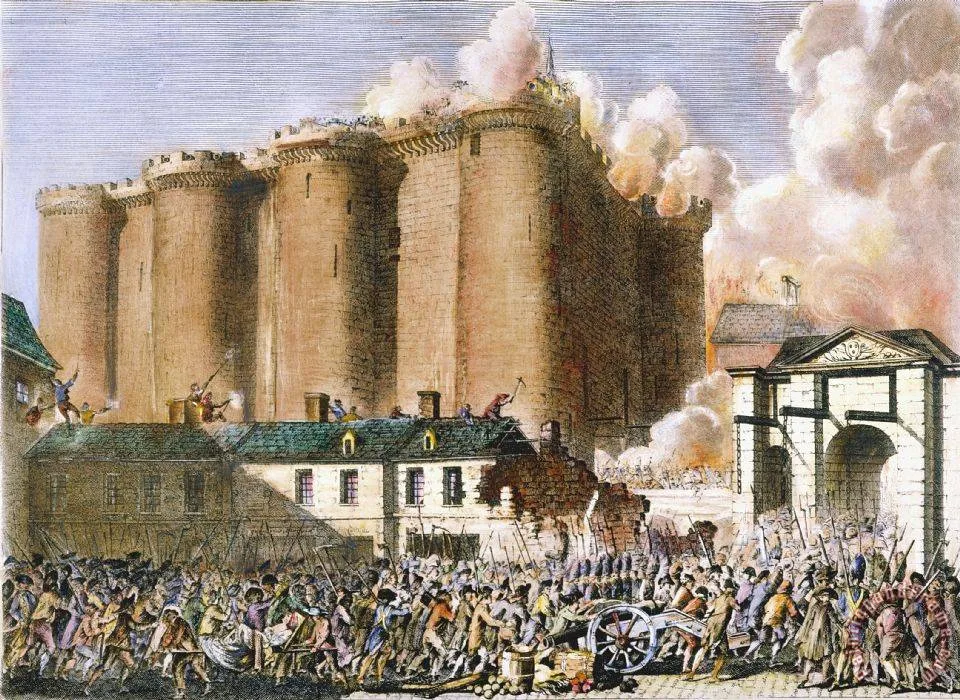
On the morning of July 14, 1789, an armed mob in Paris stormed the Bastille - a medieval fortress used as a royal prison. They found only seven prisoners. The Bastille was not an important prison and had almost no strategic value. But as a symbol of royal tyranny, its fall reverberated across Europe and, eventually, the world.
Within a few years, a king would be executed, the Catholic Church disestablished, a new calendar invented, and hundreds of thousands killed in what became the world's first modern revolution - and the template for every revolution that followed.
The French Revolution lasted a decade, from 1789 to 1799, and passed through distinct phases of accelerating radicalism before collapsing into military dictatorship. It abolished feudalism in a single night, declared the rights of man as universal principles, and put sovereignty in the people rather than the crown.
It also executed 17,000 people by guillotine, imprisoned half a million more, and triggered wars that killed millions across Europe. Both of these things are true, and understanding how they happened together is the central challenge of revolutionary history.
The Revolution did not merely change France. It invented the political vocabulary of modernity - left and right (literally, from the seating in the National Assembly), nationalism, ideology, revolution itself as a concept of fundamental transformation rather than mere cyclical change.
Crane Brinton, in "The Anatomy of Revolution" (1938), used France as the template for all subsequent revolutions: the old regime's fiscal crisis, the moderate phase, the radical phase, the Terror, the Thermidorian reaction, and the military strongman.[4]
The pattern repeated in Russia, China, Iran, and Cuba because the underlying dynamic - revolution as a process that devours its own children - seems to recur wherever radical politics meets the problem of power.
"The Revolution devours its own children." - Georg Buchner, Danton's Death (1835)
| Phase | Period | Key Events |
|---|---|---|
| Estates-General and National Assembly | 1789 | Third Estate forms National Assembly; Tennis Court Oath |
| Constitutional monarchy | 1789-1792 | Declaration of Rights; new constitution; Louis XVI accepts limits |
| First Republic / Legislative Assembly | 1792-1793 | War with Austria/Prussia; monarchy abolished |
| Reign of Terror | 1793-1794 | Committee of Public Safety; 17,000+ executions |
| Thermidorian Reaction | 1794-1795 | Robespierre executed; moderate republic restored |
| Directory | 1795-1799 | Unstable five-man executive rule |
| Napoleon's coup | 1799 | Bonaparte seizes power; Republic ends |
Key Definitions
Ancien Regime: The old order of pre-revolutionary France, characterized by absolute monarchy, the three-estates social structure, and the privileges of clergy and nobility. The term was coined retroactively to describe what the Revolution had overthrown.
The Three Estates: The formal division of French society. The First Estate was the clergy (approximately 0.5% of the population); the Second Estate was the nobility (about 1.5%); the Third Estate was everyone else - roughly 27 million people, from wealthy merchants to landless peasants.
The clergy and nobility were largely exempt from direct taxation; the Third Estate paid almost all of it.
Enlightenment: The 18th-century intellectual movement emphasizing reason, individual rights, and skepticism toward traditional authority. Key figures relevant to the Revolution include Rousseau (social contract, popular sovereignty), Voltaire (anticlericalism, freedom of expression), and Montesquieu (separation of powers).
Social Contract: The theory, developed by Rousseau in "Du Contrat Social" (1762), that legitimate government derives its authority from an agreement among free and equal citizens. Government that fails to represent the general will loses its legitimacy and may be overthrown.
Declaration of the Rights of Man and Citizen (1789): The foundational document of the Revolution, adopted August 26, 1789. Its seventeen articles declared natural rights, popular sovereignty, equality before the law, and freedom of religion and speech - articulating Enlightenment principles as law.
Jacobins vs. Girondins: The two main republican factions of the radical phase. The Girondins (so called because several leaders came from the Gironde region) favored a more moderate, federalist republic.
The Jacobins, based in Paris, favored centralized power, economic controls, and more radical egalitarianism. The Jacobins defeated and arrested the Girondins in June 1793.
Reign of Terror: The period from September 1793 to July 1794 when the Committee of Public Safety, dominated by Robespierre, used the guillotine and imprisonment to suppress internal opposition. Approximately 17,000 were executed officially; tens of thousands more died in prison or in extrajudicial killings.
Guillotine: A beheading device adopted in 1792 as a humane method of execution that applied equally to all condemned regardless of social rank. Named after Dr. Joseph-Ignace Guillotin, who proposed standardized execution. It became the symbol of revolutionary terror.
Napoleon Bonaparte: Corsican-born military general who rose to prominence during the Revolutionary Wars and seized power via the coup of 18 Brumaire (November 9, 1799), establishing the Consulate and eventually the Empire (1804).
Levee en Masse: The universal military conscription decreed in August 1793, mobilizing the entire French nation for war. It raised an army of approximately 750,000 - larger than any European force previously assembled - and established the modern concept of the nation in arms.
Thermidorian Reaction: The political reaction following Robespierre's fall on 9 Thermidor Year II (July 27, 1794), which dismantled the Terror apparatus and moved France toward a more conservative republic under the Directory (1795-1799).
Revolutionary Calendar: A new calendar adopted in 1793, replacing the Gregorian calendar (which was associated with the Church). Year I began with the founding of the Republic (September 22, 1792).
The calendar had twelve months of thirty days each, named after natural phenomena, with ten-day weeks replacing the seven-day Christian week. Napoleon abolished it in 1806.
The Causes: Fiscal Crisis, Social Inequality, and Enlightenment Ideas
The French Revolution did not have a single cause. It emerged from the intersection of a fiscal emergency, a structural social inequality, an intellectual revolution, and a model of successful revolt - all converging in a moment of royal weakness.
The fiscal crisis was the immediate precipitant. France had spent lavishly on the American Revolutionary War, and the national debt had grown to the point where interest payments consumed roughly half of state revenue. The French monarchy was effectively bankrupt.
King Louis XVI and his finance ministers attempted a series of reforms, but each effort was blocked by the parlements - regional courts dominated by nobles who refused to accept taxation of their estates. When Louis proposed taxing the nobility in 1787, the nobility invoked tradition and the king was forced to back down.
In desperation, Louis called the Estates-General for the first time since 1614 - a gathering of representatives from all three estates to address the financial crisis. This was a crucial miscalculation.
Convening the Estates-General handed the Third Estate a political platform it had never possessed, and the representatives arrived with accumulated grievances and Enlightenment-influenced expectations.
The social structure made those grievances explosive. The First and Second Estates comprised about 2% of France's population but owned roughly 35-40% of its land and paid almost no direct taxes. The Third Estate - the other 98% - bore the tax burden for a state that provided them little in return.
In rural France, peasants owed feudal dues to their lords even where they owned their land outright. In urban France, artisans and merchants faced guild restrictions, internal customs barriers, and arbitrary royal regulation.
The cahiers de doleances (lists of grievances) submitted before the Estates-General fill thousands of pages and reveal a population not seeking revolution but reform: fiscal equity, legal equality, and an end to aristocratic privilege.
The intellectual context transformed grievances into revolutionary demands. Rousseau's concept of popular sovereignty - that legitimate government rests on the will of the people, not the will of kings - had been widely read for decades.
Montesquieu's "The Spirit of the Laws" (1748) had established separation of powers as an institutional ideal. Voltaire's satires had eroded deference to both crown and Church.
The American Declaration of Independence (1776) and the Constitution (1787) demonstrated that Enlightenment principles could be translated into functioning institutions.
Thousands of French officers had served in America, and many returned with firsthand experience of a republic that worked.
The 1788 harvest failure added material desperation to political radicalism. Bread prices in Paris rose to perhaps 80-90% of a laborer's daily wage by the summer of 1789. Hungry people in a city with a recent tradition of bread riots were ready to act.
1789: The Revolutionary Year
The Estates-General convened at Versailles on May 5, 1789. Almost immediately, procedural disputes revealed the depth of political conflict.
The Third Estate demanded voting by head (each delegate one vote - giving them parity with the other two estates combined) rather than by order (each estate one vote - which gave the clergy and nobility a permanent majority).
The king refused. The Third Estate, joined by sympathetic clergy and nobles, declared itself a National Assembly on June 17.
On June 20, royal officials locked the Third Estate out of their meeting hall. The delegates reconvened at a nearby indoor tennis court and swore not to disperse until they had given France a constitution - the Tennis Court Oath.
This was the revolutionary moment: the representatives of the people asserting their authority against the crown, with no legal basis except the logic of popular sovereignty.
Louis XVI appeared to capitulate, ordering all three estates to meet together. But he simultaneously concentrated royal troops near Paris, alarming Parisians who feared a royalist crackdown. On July 11, Louis dismissed Jacques Necker, the popular finance minister. On July 14, Parisians stormed the Bastille.
The political revolution in Versailles was echoed by a social revolution in the countryside.
The Great Fear swept rural France from mid-July into August: peasants, terrified by rumors of noble armies and bands of brigands, attacked chateaux, burned records of feudal obligations, and asserted their freedom.
The rural uprising created a crisis of order that forced the hand of the National Assembly.
On the night of August 4, 1789, in one of the most remarkable spontaneous moments in political history, noble after noble rose in the National Assembly to renounce feudal privileges.
Hunting rights, seigneurial courts, tithes, and noble exemptions from taxation were abolished in a single night of competitive generosity.[6] The feudal order of France collapsed in hours. When dawn came, delegates wondered what they had done.
The Declaration of the Rights of Man and Citizen, adopted on August 26, gave the moment its philosophical foundation. Women were not included in its provisions, a gap that Olympe de Gouges addressed directly in her 1791 Declaration of the Rights of Woman and the Female Citizen - for which she was guillotined in 1793.
The Women's March on Versailles on October 5 brought the king physically to Paris. Thousands of market women, furious at bread prices, marched twelve miles in the rain to the palace and demanded that the king return to his capital. Louis XVI was essentially a prisoner of Paris from that day forward.
The Constitutional Monarchy Phase, 1789-1792
For two years, the National (then Constituent) Assembly worked to create a constitutional monarchy - preserving the king but subordinating royal power to a constitution grounded in Enlightenment principles. The work was transformative.
The old provincial map of France was replaced with eighty-three departments of roughly equal size, breaking the power of regional aristocracies.
The Church's vast landholdings were nationalized and sold, partly to finance the debt and partly to create a new class of property owners with a stake in the revolutionary settlement.
Monastic orders were dissolved. Feudal dues were abolished. A new uniform legal code replaced the bewildering patchwork of Roman law (south) and customary law (north).
France was, on paper, becoming a constitutional state. But two things destroyed the constitutional phase. First, Louis XVI did not believe in it. He accepted each change as a forced concession while secretly seeking foreign intervention to restore his authority.
On June 21, 1791, the royal family disguised themselves and fled Paris in a carriage bound for the Austrian border - the Flight to Varennes. They were recognized and stopped at Varennes, sixty miles short of safety, and returned to Paris under humiliating guard. The king's credibility as a constitutional monarch never recovered.
Second, war. In April 1792, France declared war on Austria. Prussia joined the Austrian side. The war, initially welcomed by radicals (who thought it would expose traitors) and by the king (who expected foreign powers to restore his authority), rapidly became a catastrophe.
Prussian and Austrian forces invaded, and on August 10, 1792, a radical Parisian crowd stormed the Tuileries palace, massacring the Swiss guards and suspending the king. The constitutional monarchy was over.
The Radical Phase and the Terror, 1792-1794
The First French Republic was declared on September 21, 1792. The day after, the armies of the young Republic - inspired by revolutionary fervor and the levee en masse that would eventually conscript 750,000 men - halted the Prussian advance at the Battle of Valmy.
"From this place and from this day forth," Goethe reportedly wrote, "commences a new era in the world's history."
Louis XVI was tried by the National Convention in December 1792. The charges included treason: evidence had been found of his secret correspondence with foreign enemies. He was convicted and executed by guillotine on January 21, 1793, before a crowd of perhaps 20,000.
His wife Marie Antoinette followed in October. The republic had crossed an irreversible threshold.
Through 1793, the revolutionary government faced simultaneous crises: invasion by six European powers, counterrevolution in the Vendee (a region of western France where Catholic, royalist peasants rose against the Republic in March 1793), economic crisis, food shortages, and federalist revolts in Lyon, Bordeaux, and Toulon.
The Committee of Public Safety - twelve men who became the effective executive of France - responded with emergency measures.
The Law of Suspects (September 17, 1793) allowed arrest of anyone suspected of disloyalty by the most expansive definition. Revolutionary tribunals delivered verdicts in minutes. The guillotine worked continuously.
The Vendee counterrevolution was suppressed with exceptional violence. Historian Donald Sutherland's estimates suggest 200,000-250,000 deaths on both sides; more extreme estimates reach 400,000.[7]
Historians such as Reynald Secher and Jean-Clement Martin have documented systematic republican atrocities including the noyades (mass drownings) in the Loire River ordered by Jean-Baptiste Carrier, who drowned perhaps 2,000-4,000 priests, nobles, and prisoners in barges deliberately sunk mid-river.
In Paris, the Terror peaked in the summer of 1794. Between June 10 and July 27, 1,376 people were guillotined in Paris - an average of about twenty-eight per day. The victims were no longer predominantly aristocrats or clergy; by 1794, they were overwhelmingly commoners and even former revolutionaries.
Georges Danton, who had been one of the Revolution's most powerful figures, was executed in April. When Robespierre appeared to target the Committee of General Security itself, fear crystallized into action.
On 9 Thermidor Year II (July 27, 1794), delegates in the National Convention shouted him down, had him arrested, and sent him to the guillotine the following day with twenty-one associates. The Terror ended not because it had achieved its aims, but because its own practitioners became afraid of it.
Why the Terror Happened: Historiographical Debate
Few questions in modern historiography are more contested. The debate divides roughly into two camps.
The circumstantial interpretation holds that the Terror was not inherent in the Revolution but was a response to concrete military and political emergency.
Timothy Tackett, in "The Coming of the Terror in the French Revolution" (2015), traces how ordinary men became killers through a process of fear, threat, and radicalization - the same process observable in later political violence.[5]
On this view, without the war, the Vendee, and the food crisis, the Terror might never have happened.
The ideological interpretation, associated with Francois Furet in "Interpreting the French Revolution" (1981), argues that the Terror was embedded in the Revolution's political logic.[2]
Rousseau's concept of the General Will - the true interest of the community, which must prevail over individual interests - provided the philosophical license for the revolutionary vanguard to destroy anyone who opposed the popular will as they defined it.
The Terror was not an aberration from Enlightenment principles but a possible conclusion of them.
Simon Schama, in "Citizens" (1989), pushed further, arguing that the Revolution was catastrophically violent from its very beginning - that the Festival of the Federation and the September Massacres were products of the same revolutionary culture.[1]
Albert Soboul, writing from a Marxist tradition, saw the Terror as the necessary violence of a bourgeois revolution under siege by feudal Europe.[3]
The debate matters beyond France. Hannah Arendt, in "On Revolution" (1963), contrasted the French and American Revolutions: the Americans succeeded in founding a durable republic partly because they did not try to solve the social question (poverty, inequality) through politics; the French attempted the social question through political means and fell into terror.[8]
Whether this analysis holds, and what it implies for subsequent revolutions, remains a live question in political theory.
Napoleon and the Revolutionary Legacy
The Directory (1795-1799) that replaced the Terror was corrupt, unstable, and despised. France was still at war. Inflation had wiped out the middle classes. Political life lurched between royalist and Jacobin extremes. When Napoleon Bonaparte staged his coup on 18-19 Brumaire (November 9-10, 1799), few mourned the Directory's passing.
Napoleon presented himself as the Revolution's heir - the man who would preserve its gains against both royalist reaction and Jacobin chaos. The Napoleonic Code of 1804 was his institutional legacy and arguably the Revolution's most durable monument.
It codified equality before the law, freedom of religion, the right to work, civil marriage, and the abolition of feudalism. Crucially, it protected the land sales that had transferred church and noble property to bourgeois and peasant buyers, giving millions of new property owners a material stake in the revolutionary settlement.
The Code spread across Europe with Napoleon's armies - to Italy, Spain, Poland, the Low Countries, the German states - and persisted long after Napoleon's defeat in 1815.
But Napoleon also terminated the Revolution in important respects. He restored slavery in French colonies in 1802 - directly triggering the final phase of the Haitian Revolution and the defeat of his Caribbean expedition.
He established an hereditary empire, created a new nobility (the noblesse d'Empire), and reconciled with the Catholic Church in the Concordat of 1801.
The mass democratic participation that had characterized 1789-1794 was replaced by plebiscites ratifying decisions already made.
The Revolutionary Wars (1792-1802) and the Napoleonic Wars (1803-1815) spread revolutionary principles across Europe while simultaneously generating nationalist reactions against French conquest.
The irony was complete: revolutionary France, which had declared the rights of man as universal, spread those ideas partly through military occupation that violated the national self-determination those very ideas implied.
The Revolution's Global Impact
The French Revolution was not merely a French event. It was the inaugural moment of modern politics and exported its consequences across the world.
The Haitian Revolution (1791-1804) was the most direct consequence. Enslaved people in Saint-Domingue invoked the Declaration of the Rights of Man literally and rose against their enslavers in the largest and most successful slave revolt in history.
Their victory against France, Britain, and Spain created the first Black republic and the first Western Hemisphere nation to permanently abolish slavery.
The fear Haiti generated in slaveholding societies across the Americas shaped hemispheric politics for a century and drove the United States to delay recognizing Haitian independence until 1862.
In Latin America, the French Revolution provided the intellectual framework for independence movements. Simeon Bolivar and other creole elites, educated in Enlightenment thought, drew on French revolutionary principles to challenge Spanish colonial rule.
The same ideological toolkit crossed the Atlantic repeatedly, from the 1820s independence movements to the liberal revolutions of 1830 and 1848.
In Europe, the Revolution redrew the political map. The concept of the nation as a sovereign people replaced the dynastic state as the primary unit of political legitimacy. The left-right political spectrum was born in the National Assembly's seating arrangements.
Modern conservatism was arguably invented by Edmund Burke's "Reflections on the Revolution in France" (1790) as a direct response to the Revolution. Modern liberalism and modern socialism were both shaped by engagement with revolutionary ideas.
The 1848 revolutions that swept Europe from Paris to Vienna to Budapest were explicitly self-conscious repetitions of 1789 - attempts to fulfill the Revolution's democratic promise.
The revolutions of the twentieth century, from Russia in 1917 to China in 1949 to Cuba in 1959, all recapitulated Brinton's revolutionary anatomy: the moderate phase, the radical phase, the terror, the strongman. The French Revolution had not merely changed France. It had provided the script.
Sources & Further Reading
- Schama, Simon. Citizens: A Chronicle of the French Revolution. Knopf, 1989.
- Furet, Francois. Interpreting the French Revolution. Cambridge University Press, 1981.
- Soboul, Albert. The French Revolution, 1787-1799. NLB, 1975.
- Brinton, Crane. The Anatomy of Revolution. Norton, 1938.
- Tackett, Timothy. The Coming of the Terror in the French Revolution. Harvard University Press, 2015. doi: 10.4159/harvard.9780674495524
- Hunt, Lynn. Politics, Culture, and Class in the French Revolution. University of California Press, 1984.
- Sutherland, Donald. The French Revolution and Empire: The Quest for a Civic Order. Blackwell, 2003.
- Arendt, Hannah. On Revolution. Viking, 1963.
See also: What Caused World War One, What Is Nationalism, What Is Liberalism