
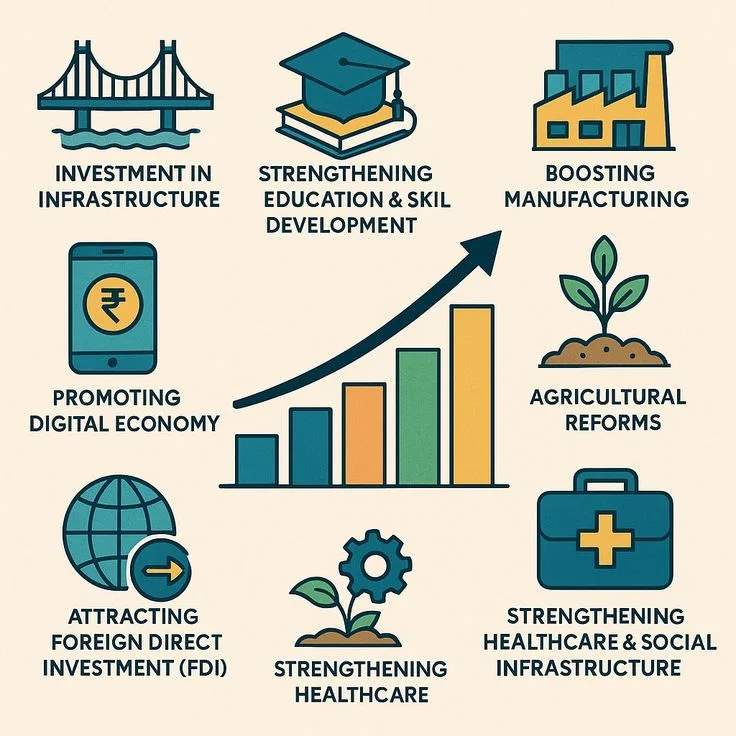
Economic development is a sustained rise in income, living standards, and human capabilities, not simply an increase in GDP. Development economics studies why countries remain poor or grow prosperous and tests policies ranging from modernization, institutional reform, and structural adjustment to targeted experiments. The field has moved from universal development blueprints toward a more contested, evidence-focused account of poverty, institutions, health, education, and opportunity.
In 1960, an MIT economist named Walt Rostow published a short book with a subtitle that announced its ambition: "A Non-Communist Manifesto." "The Stages of Economic Growth" proposed that all societies pass through five predictable phases on the way to prosperity, and that Western aid and investment could accelerate poor countries through the early stages.
It was optimistic, schematic, and enormously influential. It was also, by most assessments, substantially wrong.
Yet the questions Rostow was trying to answer have not become any less urgent: why do some countries grow rich and others remain poor? What policies help? What makes the difference between South Korea in 1960 - a country with lower per capita income than Ghana - and South Korea today, one of the world's most prosperous democracies?
Development economics is the subdiscipline of economics devoted to these questions. It is a field marked by fierce intellectual disagreements, dramatic shifts in orthodoxy, and uncomfortable encounters between abstract theory and the lives of very poor people.
Over seven decades, the field has moved from grand modernization theories to institutional analysis, from Washington Consensus prescriptions to randomized controlled trials, from debating foreign aid blueprints to measuring the effects of specific cash transfer programs.
What has been learned is substantial - and so is what remains uncertain.
The stakes are not abstract. In 2022, the World Bank updated its international poverty line to $2.15 per person per day in 2017 purchasing power parity terms, a revision reflecting updated price data. By that measure, approximately 700 million people remained in extreme poverty.
Understanding why, and what can be done about it, is among the most consequential questions in economics and public policy.
"The test of our progress is not whether we add more to the abundance of those who have much; it is whether we provide enough for those who have too little." - Franklin D. Roosevelt
| Approach | Core Argument | Key Scholars |
|---|---|---|
| Modernization theory | Development follows a linear path; industrialize | Rostow (1960) |
| Dependency theory | Rich nations structurally exploit poor nations | Frank, Cardoso (1960s-70s) |
| Washington Consensus | Liberalization, privatization, fiscal discipline | IMF/World Bank (1980s-90s) |
| Capabilities approach | Development means expanding human capabilities | Sen (1999) |
| Institutional economics | Good institutions drive long-run growth | Acemoglu & Robinson (2012) |
| Randomized evaluation | Field experiments to test what actually works | Banerjee & Duflo (2000s-) |
Key Definitions
Development: In economic terms, a sustained process of increasing per capita income, improving living standards, and expanding human capabilities - including health, education, and freedom from want - in lower-income countries.
Distinguished from mere growth (an increase in GDP) by its broader conception of human welfare, following Amartya Sen's capabilities framework.
Poverty trap: A self-reinforcing mechanism by which poverty perpetuates itself across generations.
A household too poor to afford adequate nutrition cannot maintain the productivity needed to escape poverty; a country too poor to invest in health and education cannot generate the human capital needed for growth.
The concept motivates much of the argument for foreign aid as an initial capital injection.
Structural adjustment: The package of economic reforms - typically including fiscal austerity, currency devaluation, trade liberalization, and privatization - required by the IMF and World Bank as conditions for emergency loans to developing countries in financial distress, particularly during the 1980s and 1990s.
Randomized controlled trial (RCT): An experimental design in which participants are randomly assigned to receive a policy intervention or not, allowing researchers to measure the causal effect of the intervention by comparing outcomes between groups.
Borrowed from medicine, it became the methodological signature of a generation of development economists.
Inclusive institutions: A concept developed by Daron Acemoglu and James Robinson to describe economic and political institutions that distribute power broadly, secure property rights and rule of law for all citizens, and thereby create incentives for productive investment throughout society.
Contrasted with extractive institutions, which concentrate power and resources in elite hands.
Origins: Modernization Theory and Its Critics
Rostow's Stages of Growth
Development economics emerged as a distinct field after World War II, driven by two historical forces: the Cold War competition for influence in newly decolonized nations, and the genuine humanitarian urgency of global poverty. Rostow's "Stages of Economic Growth" (1960) provided the canonical early framework.[1]
All economies pass through five stages: traditional society, preconditions for takeoff, takeoff (a decisive period of rapid industrialization), drive to maturity, and the age of high mass consumption.
Western countries had completed this journey; developing countries were at earlier stages; aid and investment could accelerate the process.
The theory had political convenience: it framed Western capitalism as the destination toward which all societies were naturally moving, and it framed foreign aid as technical assistance rather than as redistribution of global resources. Its empirical foundations were thin.
Subsequent research showed that development paths were far more varied than the five-stage sequence suggested, that countries could stall indefinitely, and that the specific mechanisms driving growth in successful cases bore little resemblance to the model.
The framework is discussed further in the context of modernization theory at What Is International Law? Norms and Global Relations.
Arthur Lewis and Structural Transformation
Arthur Lewis's dual-sector model (1954) was more analytically sophisticated.[2]
Lewis, who would share the Nobel Prize in Economics in 1979, described a traditional agricultural sector with surplus labor - workers whose marginal product was so low that removing them would not reduce total agricultural output - alongside a modern industrial sector.
As industrialization expanded, it could draw on this surplus labor at subsistence wages, generating profits that could be reinvested, expanding the modern sector further.
Economic development was, fundamentally, structural transformation of a predominantly agricultural economy into an industrial one.
Lewis's model described the early phase of industrialization reasonably well - it echoed the historical experience of Britain, Germany, and Japan - but had less to say about economies that remained agricultural or service-based, or about the political conditions under which industrial expansion would occur.
Dependency Theory: Development of Underdevelopment
A radical critique came from Latin American structuralists. Raul Prebisch, the Argentine economist who headed the UN Economic Commission for Latin America from 1950, argued that the international trading system systematically disadvantaged developing countries: the terms of trade for primary commodities deteriorated relative to manufactured goods over time, draining resources from poor to rich countries.
The appropriate policy response was import substitution industrialization: developing countries should protect domestic industries behind tariff walls while building domestic manufacturing capacity.
Andre Gunder Frank's "Development of Underdevelopment" (1966) radicalized this analysis.[3]
Frank argued that the poverty of the "periphery" was not a pre-capitalist condition to be overcome by integration into the world economy but was actively produced by that integration: the "metropole" (wealthy countries and their local allies) extracted surplus from the periphery, preventing the capital accumulation necessary for autonomous development.
Underdevelopment was not an absence of development but a specific form of it - development in the interests of external powers. The connections between dependency theory and the broader history of colonialism are explored at Defining Colonialism and Its Impact.
Dependency theory was influential through the 1970s but declined as some countries - particularly in East Asia - achieved rapid development through export-oriented integration into the world economy, precisely the strategy dependency theory condemned.
The Washington Consensus: Rise and Fall
Ten Prescriptions
The term "Washington Consensus" was coined by economist John Williamson in a 1989 paper as a descriptive category: what economic policies did Washington-based institutions - the IMF, World Bank, and US Treasury - actually agree on?[4]
His list of ten prescriptions included fiscal discipline, reordering spending priorities toward education and health, tax reform, interest rate liberalization, competitive exchange rates, trade liberalization, liberalization of foreign direct investment, privatization of state enterprises, deregulation, and secure property rights.
These were implemented throughout the developing world in the 1980s and 1990s, primarily as conditions attached to IMF and World Bank loans - structural adjustment programs.
The timing was not coincidental: the Latin American debt crisis of the early 1980s, in which countries that had borrowed heavily during the 1970s found themselves unable to service their debts after the Volcker disinflation raised global interest rates, gave Washington-based institutions enormous leverage over debtor governments.
The Lost Decade and Stiglitz's Critique
Latin America's "lost decade" of the 1980s - a period of declining per capita incomes, rising unemployment, and worsening poverty in the region most systematically subjected to structural adjustment - was the first major indictment of the Washington Consensus in practice.
Per capita income in Latin America in 1990 was no higher than it had been in 1980. The 1994-95 Mexican peso crisis and the 2001-02 Argentine collapse, both in countries that had pursued Washington Consensus policies relatively faithfully, added to the evidence against.
Joseph Stiglitz, the World Bank's chief economist from 1997 to 2000 before resigning in protest, provided the most prominent insider critique in "Globalization and Its Discontents" (2002).
Stiglitz argued that the IMF applied ideological prescriptions with insufficient attention to country-specific conditions, pushed capital account liberalization before countries had the institutional capacity to manage it, imposed pro-cyclical austerity during downturns that deepened recessions rather than resolving them, and operated with a democratic deficit that insulated it from the populations most affected by its decisions.[12]
The intellectual retreat from the Washington Consensus produced what became known as a "post-Washington Consensus" in the 2000s, restoring emphasis on institutions, governance, sequencing of reforms, social safety nets, and the need for country-specific rather than universal prescriptions.
Institutions and Growth: Why Rules Matter
Douglass North and the New Institutional Economics
If the Washington Consensus failed partly because it focused on policy prescriptions while neglecting the institutional context in which policies operate, the "new institutional economics" associated with Douglass North provided the theoretical foundation for understanding why.
North's "Institutions, Institutional Change and Economic Performance" (1990), which contributed to his Nobel Prize in 1993, defined institutions as "the rules of the game in a society" - the formal rules (constitutions, laws, property rights), informal norms (customs, traditions, codes of conduct), and their enforcement mechanisms that structure human interaction.
The central argument was that secure property rights and enforceable contracts were necessary (though not sufficient) conditions for sustained economic growth.[5] Without confidence that their investments would not be expropriated, entrepreneurs would not invest productively.
Without trust that contracts would be enforced, markets could not function efficiently. Rich countries had developed these institutional foundations over centuries; the question was how they could be built in countries that lacked them.
Colonial Origins of Comparative Development
The most influential empirical paper in the institutional tradition was Daron Acemoglu, Simon Johnson, and James Robinson's "The Colonial Origins of Comparative Development," published in the American Economic Review in 2001.[6]
The authors faced a fundamental methodological challenge: the relationship between institutions and prosperity might run in either direction.
Their solution was to use the mortality rates of European settlers in different colonies as an instrument for the quality of institutions those colonizers established.
Where European settlers faced high mortality from tropical diseases - malaria, yellow fever - as in much of sub-Saharan Africa and tropical Asia, they established extractive institutions designed to transfer resources to Europe and settled in small numbers.
Where Europeans could settle permanently, as in North America, Australia, and New Zealand, they built more inclusive institutions modeled on their home countries. Those institutional differences, persisting through independence, explain a substantial fraction of income differences between countries today.
The historical depth of institutional effects - the "long shadow of colonialism" - underscores that development outcomes cannot be separated from colonial history. See also The History of Science: Key Discoveries Through Time.
Their popular synthesis "Why Nations Fail" (2012, co-authored by Robinson) distinguished between inclusive economic institutions - which distribute opportunities broadly, enforce property rights for all citizens, and create incentives for productive investment - and extractive institutions, which concentrate power and extract resources for elite benefit.[7]
The key insight was the interaction between political and economic institutions: political elites with extractive institutions have incentives to block economic reforms that might redistribute power, explaining the persistence of inequality-generating institutions even when their costs are obvious.
Randomized Evaluations: Measuring What Works
The RCT Revolution
The introduction of randomized controlled trials into development economics transformed the field. Esther Duflo and Abhijit Banerjee of MIT's Abdul Latif Jameel Poverty Action Lab (J-PAL) were the central figures.
Working with communities in India, Kenya, Indonesia, and elsewhere, they and their colleagues measured the effects of specific interventions: improved teaching methods, deworming programs, bed net distribution, microfinance access, immunization incentives, and many others.
Michael Kremer of Harvard worked independently on similar questions, particularly on education in Kenya.
Their collaborative synthesis "Poor Economics" (2011) argued that understanding poverty required studying how poor people actually made decisions under severe constraints.[8]
Poor people, they found, often made sophisticated decisions under severe uncertainty and resource constraints - but those decisions were sometimes shaped by cognitive biases, limited information, and coordination failures that systematic interventions could address.
The analysis challenged both the paternalistic assumption that the poor needed experts to solve their problems and the neoliberal assumption that removing market distortions would automatically generate welfare improvements for the poorest.
In 2019, Duflo, Banerjee, and Kremer were awarded the Nobel Prize in Economics for their experimental approach to alleviating global poverty.
The Limits of RCTs
The RCT approach generated important findings but also significant controversies. The deworming debate became the field's most acrimonious: Kremer and Edward Miguel's 2004 study found that deworming primary school students in Kenya produced large increases in school attendance at very low cost.
A 2015 reanalysis challenged the statistical methods and found much smaller effects. The debate continued for years, with economists disagreeing about both methods and the proper interpretation of ambiguous evidence.
Angus Deaton, who won the Nobel Prize in 2015 partly for his work on measuring poverty and welfare, provided the most influential critique of the RCT approach.
Deaton argued that RCTs were well-suited to answering specific questions about local interventions but could not address the fundamental questions about why whole countries were poor.
Understanding why Bangladesh is poorer than South Korea requires historical, institutional, and structural analysis that no experiment can provide.
Treating development as a collection of micro-interventions risked losing sight of the systemic transformations - industrialization, institutional change, social protection - that had actually ended poverty in the countries where it had been ended.
The Foreign Aid Debate
Sachs, Easterly, and Moyo
Few questions in development economics generate more heat than whether foreign aid works. Jeffrey Sachs's "The End of Poverty" (2005) represented the optimistic pole: extreme poverty was essentially an engineering problem.[9]
Countries trapped in poverty could not invest in the health, education, and infrastructure needed for growth, but targeted aid could provide the initial capital to escape the trap.
Sachs cited the Marshall Plan - which transferred roughly $13 billion to rebuild Western Europe after 1948 - as proof that large-scale, coordinated aid could work.
William Easterly's "The White Man's Burden" (2006) offered a rebuttal grounded in the record. Rich countries had transferred over $2.3 trillion to developing countries over the preceding fifty years, and the results were deeply disappointing.
Easterly attributed this to the nature of top-down planning: aid agencies set grand goals but had no feedback mechanisms to identify and correct failures, because the poor people who were supposed to benefit had no way to hold planners accountable.[10]
He contrasted "planners" who designed comprehensive development strategies from above with "searchers" who worked locally, learned from feedback, and found specific solutions that actually worked.
Dambisa Moyo's "Dead Aid" (2009), written from an African perspective, went further: aid perpetuated African poverty by enabling corrupt governments, crowding out domestic entrepreneurship and tax systems, creating dependency, and removing the incentives for political reforms that could generate sustainable growth.[11]
She argued that African countries should follow the East Asian model of export-led growth financed by foreign direct investment rather than aid flows.
The debate between these three positions - aid as investment, aid as dysfunctional planning, aid as actively harmful - remains unresolved, and empirical evidence has been marshaled for each position depending on the type of aid, the institutional context, and the outcome measure.
China and the Beijing Consensus
China's transformation since Deng Xiaoping's 1978 economic reforms represents the most consequential poverty reduction episode in human history. More than 800 million people were lifted from extreme poverty by most estimates - more than the entire remaining extreme poor population of the world today.
China achieved this through an approach that defied the Washington Consensus in nearly every respect: maintaining state ownership of key industries, protecting domestic sectors during their development phase, retaining capital controls, sequencing reforms gradually from agriculture to industry to services, and deploying industrial policy actively through state-directed credit and strategic sector targeting.
The "Beijing Consensus," a term associated with journalist Joshua Cooper Ramo's 2004 paper, described a development model built on pragmatic experimentation, national sovereignty, and state-led growth as an alternative to Washington Consensus orthodoxy.
Whether China's success derived from its heterodox approach or succeeded despite it - whether the lessons are transferable or specific to China's scale, historical conditions, and state capacity - is deeply contested among development economists.
What is clear is that China demolished the Washington Consensus claim that there was only one path to development, and that industrial policy, which the Consensus had consigned to the dustbin of history, could work when implemented with sufficient state capacity.
The political economy of China's development - and the question of whether authoritarian state capacity is a necessary or merely a contingent feature of its success - connects to broader debates about governance and development explored at Understanding Authoritarianism.
Measuring Poverty: Progress and Its Limits
The World Bank Line and the Multidimensional Index
Angus Deaton's "The Great Escape" (2013) documented the extraordinary improvements in human health and living standards that economic growth had produced over the past two centuries, cautioning against a pessimism that ignored genuine progress.[13]
The World Bank's international poverty line - updated to $2.15 per person per day in 2017 purchasing power parity terms in 2022 - showed extreme poverty falling from roughly 36% of the global population in 1990 to approximately 9% by 2019, before COVID-19 and subsequent crises reversed some of that progress.
Yet the optimistic reading requires qualification. Much of the measured progress reflects China's transformation; sub-Saharan Africa's progress has been much slower, and some countries have seen poverty increase in absolute terms.
The $2.15 line is austere: life above it can still involve severe malnutrition, poor health, and lack of access to education.
The United Nations Development Programme's Multidimensional Poverty Index, developed by Sabina Alkire and James Foster and drawing on Sen's capabilities framework, combines indicators across health, education, and living standards - access to cooking fuel, sanitation, drinking water, electricity, housing quality, and assets - alongside income.
The MPI consistently shows higher poverty rates than the income measure alone, because people can be above the income line while lacking access to basic services.
While global extreme poverty has fallen, inequality within countries has generally risen.
Thomas Piketty's documentation of rising income concentration at the top of rich-country distributions, and Branko Milanovic's "elephant graph" - showing the global middle class gaining substantially while rich-country working classes were largely stagnant and the global top 1% gained dramatically - complicate any straightforward narrative of shared progress.
The lesson of development economics, accumulated through seven decades of theoretical debate, policy experimentation, and measurement improvement, is that development is hard, context-dependent, and resistant to universal prescriptions.
What is also clear is that it is possible: the poverty afflicting hundreds of millions of people is not a permanent condition but a soluble problem, if approached with analytical rigor, institutional imagination, and political will.
Sources & Further Reading
- Rostow, W. W. (1960). "The Stages of Economic Growth: A Non-Communist Manifesto". Cambridge University Press.
- Lewis, W. A. (1954). Economic development with unlimited supplies of labour. Manchester School, 22(2), 139-191.
- Frank, A. G. (1966). Development of Underdevelopment. Monthly Review Press.
- Williamson, J. (1989). What Washington means by policy reform. In Williamson, J. (ed.), Latin American Adjustment: How Much Has Happened? Institute for International Economics.
- North, D. C. (1990). Institutions, Institutional Change and Economic Performance. Cambridge University Press.
- Acemoglu, D., Johnson, S., and Robinson, J. A. (2001). "The colonial origins of comparative development: An empirical investigation". American Economic Review, 91(5), 1369-1401.
- Acemoglu, D., and Robinson, J. A. (2012). "Why Nations Fail: The Origins of Power, Prosperity, and Poverty". Crown Publishers.
- Banerjee, A., and Duflo, E. (2011). "Poor Economics: A Radical Rethinking of the Way to Fight Global Poverty". PublicAffairs.
- Sachs, J. D. (2005). "The End of Poverty: Economic Possibilities for Our Time". Penguin Press.
- Easterly, W. (2006). The White Man's Burden: Why the West's Efforts to Aid the Rest Have Done So Much Ill and So Little Good. Penguin Press.
- Moyo, D. (2009). Dead Aid: Why Aid Is Not Working and How There Is a Better Way for Africa. Farrar, Straus and Giroux.
- Stiglitz, J. E. (2002). "Globalization and Its Discontents". W. W. Norton.
- Deaton, A. (2013). The Great Escape: Health, Wealth, and the Origins of Inequality. Princeton University Press.