
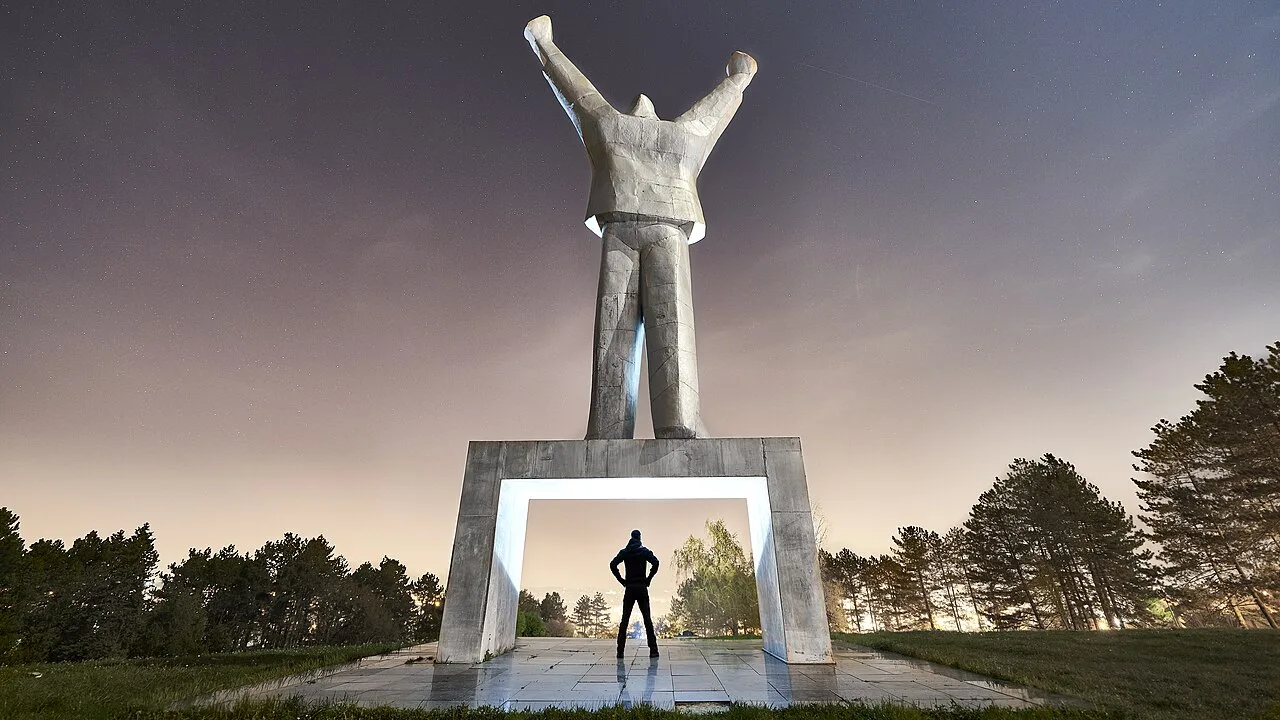
Fascism defined as a regime type combines ultranationalism, charismatic leadership, mass mobilization, violence, single-party rule, and the subordination of individual rights to a mythic national community. It commonly rises amid crisis and gains power through both organized intimidation and elite accommodation. Its central promise is national rebirth, while opposition, pluralism, and legal restraints are dismantled.
On the night of October 27, 1922, approximately 30,000 men in black shirts began converging on Rome from four assembly points across central and northern Italy.
They were Benito Mussolini's squadristi - the Blackshirts of the National Fascist Party, veterans of post-war political violence who had been terrorizing socialists, labor organizers, and rural cooperatives for three years.
Their march on the capital was designed to intimidate the Italian state into surrendering power.
The army was mobilized; the king's advisors assured Victor Emmanuel III that the regular forces could hold. The march would be crushed within hours, they said, if the king only declared martial law.
Victor Emmanuel III did not declare martial law. On October 28, he summoned Mussolini - who was in Milan, not Rome, having prudently remained close to the Swiss border in case the gamble failed - and invited him to form a government. Mussolini arrived in Rome by overnight train to accept the appointment as prime minister.
Fascism had come to power not through a successful military coup or an overwhelming electoral mandate, but through a combination of organized street violence, the credible threat of more violence, and the capitulation of conservative elites who believed they could use Mussolini to stabilize Italy against the communist threat while maintaining their own positions.
The pattern would repeat eleven years later in Germany, where Adolf Hitler came to power through a similar combination: the organizational violence of the SA, the electoral breakthrough of the Nazi Party during the Depression, and the fatal miscalculation of conservative establishment figures - Hindenburg, Papen, the industrialists and landowners who thought they could control and contain the new chancellor.
They were wrong in both cases. Within months of taking power, each fascist movement had dismantled the political frameworks through which the elites had imagined they would remain in control. The lesson was not absorbed fast enough.
"Fascism is not defined by the number of its victims, but by the way it kills them." - Jean-Paul Sartre, What Is Literature? (1948)[14]
| Feature | Liberal Democracy | Fascism |
|---|---|---|
| Source of authority | Popular consent, elections | National will embodied in leader |
| Role of individual | Rights-bearing individual | Subordinate to nation and state |
| Opposition | Protected, legal | Suppressed, illegal |
| Economy | Market or mixed | State-directed; private property under state control |
| Violence | Monopoly restrained by law | Celebrated as regenerative force |
| Ideology | Pluralist | Ultranationalist; often racial or ethnic |
| View of history | Progressive or cyclical | Decline followed by national rebirth |
| Role of women | Expanding equality | Restricted to domestic and reproductive roles |
Key Definitions
Fascism: A political movement and regime type characterized by ultranationalism, mass mobilization, cult of violence and regeneration, charismatic leadership, single-party rule, and the subordination of individual and class interests to the national community, typically arising in conditions of post-war trauma, economic crisis, and communist threat.
Squadrismo: The organized paramilitary violence conducted by Italian fascist squads (squadristi) against socialist, communist, and labor organizations between 1919 and 1922 - the foundation of fascism's path to power.
Totalitarianism: Hannah Arendt's term for regimes that aspire to transform human nature itself through total social reorganization and ideological logic pursued without limit - applied by Arendt strictly to Nazi Germany and Stalinist Russia.
Corporatism: The fascist economic model, particularly associated with Italian Fascism, in which production is organized through state-supervised corporations representing employers and workers, eliminating class conflict through enforced coordination.
Ur-Fascism: Umberto Eco's term for the deep structure common to all fascist movements - the underlying pattern of fourteen features that recurs across different historical expressions of fascism.[2]
Palingenetic ultranationalism: Roger Griffin's academic definition of fascism's ideological core - the vision of national rebirth or regeneration from a period of crisis, decadence, or humiliation, through a new community of national unity.
Ethnic nationalism: Nationalism defined by ancestry, blood, and ethnic community - the organizing principle of German National Socialism as distinct from Italian Fascism's civic nationalism.
Enabling Act: The legislation passed by the German Reichstag on March 23, 1933 that gave Hitler's cabinet the power to enact laws without parliamentary approval, effectively ending parliamentary government in Germany.
The Problem of Definition
Fascism has the distinction of being among the most frequently invoked and least precisely defined political concepts in modern political discourse.
This is partly a product of the concept's political history: "fascism" became a term of abuse so early that its analytical content was compromised before scholars had a chance to define it carefully. But the difficulty is also intrinsic to fascism itself.
Unlike Marxism, which produced Das Kapital, or liberalism, which produced Locke, Rawls, and a tradition of systematic political philosophy, fascism was constitutively anti-theoretical. Mussolini famously said that fascism had no fixed program when it was founded - it was defined by action, not doctrine.
"The fascist negation of socialism, democracy, liberalism should not make one think that fascism wants to push the world backward," he wrote in 1932.
The doctrine of fascism, to the extent it existed, was assembled after the fact from the experiences of the movement. This anti-doctrinal character makes fascism resistant to definition by its ideas, and has led the best scholars to define it instead by its behavior, its emotional structure, and its political sociology.
Robert Paxton's The Anatomy of Fascism (2004) is the most rigorous modern treatment.
Paxton's behavioral definition describes fascism as "a form of political behavior marked by obsessive preoccupation with community decline, humiliation, or victimhood and by compensatory cults of unity, energy, and purity, in which a mass-based party of committed nationalist militants, working in uneasy but effective collaboration with traditional elites, abandons democratic liberties and pursues with redemptive violence and without ethical or legal restraints goals
of internal cleansing and external expansion." This definition has the advantage of describing what fascist movements do rather than what they claim to believe.
It applies equally well to Italian Fascism and German National Socialism despite their significant ideological differences.[1]
Roger Griffin's The Nature of Fascism (1991) offers a more ideologically focused account, defining fascism's core as palingenetic ultranationalism - the mythic vision of national rebirth after a period of decadence.[5]
Griffin's definition captures something Paxton's behavioral approach tends to underemphasize: the genuine idealism and even utopian energy that fascist movements generated among their followers.
Fascism was not merely a cynical power grab; it mobilized millions through a vision - however distorted and destructive - of national renewal and communal purpose.
Umberto Eco's Fourteen Features
Umberto Eco's 1995 essay "Ur-Fascism," written as both personal testimony and political analysis by a man who had grown up in Fascist Italy, approaches the definition problem differently.
Rather than seeking a single essential definition, Eco identifies fourteen features - a "fuzzy set" in which the presence of enough features creates a recognizable pattern even when not all fourteen are present simultaneously.
The features include: the cult of tradition (the belief that ancient wisdom is superior to modern learning); the rejection of modernism (despite fascism's enthusiastic use of modern technology, it is ideologically anti-modern in its commitment to hierarchy and tradition); action for action's sake (thought is emasculation; the leader must act, and intellectualism is suspect); disagreement is treason (criticism of the movement is equivalent to betrayal of the
community); and fear of difference (fascism is inherently xenophobic).
Additional features are the appeal to a frustrated middle class (fascism recruits from those who feel squeezed between established elites and organized labor), obsession with a plot (the nation is always surrounded by enemies working in secret), and the idea that the enemy is both strong and weak (the enemy is terrifyingly powerful but also decadent and ultimately defeatable).
The remaining features are life as permanent warfare, contempt for the weak, everyone educated to become a hero, machismo and weaponry worship, selective populism (the leader speaks for the real people against parliamentary corruption), and Newspeak (the impoverishment of language to limit complex thinking).
"The first feature of Ur-Fascism is the cult of tradition... As a consequence, there can be no advancement of learning. Truth has been already spelled out once and for all, and we can only keep interpreting its obscure message." - Umberto Eco, "Ur-Fascism," New York Review of Books, 1995
Eco's list has been criticized for being too broad - many items could describe non-fascist movements - but its heuristic value lies precisely in the pattern it identifies. No single item defines fascism; the cluster does.
Italian Fascism: The Original
Italian Fascism was born in March 1919 when Mussolini founded the Fasci di Combattimento in Milan. The founding meeting assembled an eclectic group: veterans of the Arditi shock troops, futurist intellectuals, revolutionary syndicalists, and nationalists.[12]
What united them was not a program but a mood: disgust with liberal parliamentary politics, exhilaration with violence and direct action, and the conviction that Italy had been betrayed.
The fasces - a bundle of rods with an axe, the Roman symbol of authority - expressed the movement's core metaphor: individual rods (people) are weak alone but unbreakable when bound together.
The individual had no meaning outside the collective; the collective was the nation; the nation required absolute unity under a leader who embodied its will.
"Everything within the state, nothing outside the state, nothing against the state" was Mussolini's formulation, and it expressed a totalitarian aspiration, even if Italian Fascism never fully realized it.
Italian Fascism's path to power was built on squadrismo - the organized violence of blackshirt squads who attacked socialist party offices, labor union halls, and agricultural cooperatives across northern and central Italy from 1920 to 1922.
Denis Mack Smith, in Mussolini (1982), estimates that this violence killed hundreds of labor organizers and leftists while destroying the organizational infrastructure of the Italian left.[7] Local landowners, industrialists, and police often facilitated or ignored it.
By the time of the March on Rome, the Italian left had been effectively smashed in the north.
Once in power, Mussolini consolidated authority gradually rather than through a single revolutionary act. The murder of socialist deputy Giacomo Matteotti in June 1924 - by fascist agents, almost certainly on Mussolini's orders - produced a political crisis that Mussolini resolved by assuming dictatorial powers in January 1925.
From that point, Italy became a single-party state: opposition parties were banned, independent newspapers were shut down, local governments were replaced by appointed officials, and the Fascist Party became co-extensive with the state.
The regime's economic model - corporatism - was presented as a third way between capitalism and socialism. In practice it meant state direction of a nominally private economy, with business owners maintaining formal ownership but subject to state guidance on wages, prices, and investment.
The system functioned mainly to suppress labor costs and direct resources toward Mussolini's prestige projects: public works, agricultural reclamation, and eventually rearmament.
For all its totalitarian rhetoric, Italian Fascism remained a regime in which the monarchy, the Catholic Church, and established aristocratic families retained real power alongside the party - an "imperfect totalitarianism," as historians have described it.
German National Socialism: Race as the Organizing Principle
German National Socialism shared fascism's basic architecture - mass mobilization, violence, charismatic leadership, single-party state - but differed from Italian Fascism in its organizing principle. Where Mussolini organized around the nation, Hitler organized around race.
The Nordic Aryan race, in Nazi ideology, was both the highest creation of nature and the perpetual target of Jewish conspiracy.
The central purpose of the Nazi state was to protect, purify, and extend the Aryan race - by removing Jews from German society, by expanding German living space (Lebensraum) to the east, and by eliminating those the regime deemed "life unworthy of life" through the euthanasia program.
This racial obsession is what makes Nazism the most extreme and historically consequential form of fascism. The Holocaust - the systematic murder of six million Jews and millions of others - was not an accident of the Nazi regime or a wartime excess; it was the logical implementation of the ideology's core premise.
Once the racial enemy was identified as the source of all national decline and the conspiratorial power against which the nation struggled, the logic of the racial state led to annihilation.
Hannah Arendt's argument in The Origins of Totalitarianism (1951) was that the totalitarian element of Nazism - its aspiration to transform human nature, to create a world of racial purity through the elimination of everything that contradicted it - was what distinguished it from ordinary authoritarianism.[3]
Hitler had observed Mussolini's March on Rome with admiration and attempted to replicate it in the Munich Beer Hall Putsch of November 1923. That attempt failed and landed Hitler in prison, where he wrote Mein Kampf.
The lesson he drew was that power must be achieved through legal means as well as force - the combination that ultimately succeeded in January 1933, when Hindenburg appointed him chancellor.
The Enabling Act of March 1933, passed by the Reichstag after Nazi intimidation of the chamber, ended parliamentary government.[10]
Within months, all other political parties were banned, labor unions were dissolved, the press was subordinated, and the process of Gleichschaltung (coordination) had brought virtually all social institutions into alignment with the Nazi state.[15]
Ian Kershaw, in Hitler 1889-1936: Hubris (1998), documents how the speed and comprehensiveness of this coordination exceeded anything Italian Fascism had achieved, partly because German state institutions were more centralized and efficient, and partly because the Nazis were more radical in their willingness to destroy rather than merely capture existing institutions.[8]
Why Fascism in the 1920s and 1930s?
Fascism was not an accident. Its emergence across Europe in the interwar period reflected the convergence of specific structural conditions that created both the demand for fascist politics and the opportunities for fascist movements to succeed.
The trauma of World War I was foundational. The war had killed approximately 17 million people, demolished the old European order, humiliated defeated powers (Germany, Austria-Hungary, Ottoman Empire), and left millions of veterans who had experienced the extraordinary intensity of industrial warfare and found peacetime civilian life pale and meaningless by comparison.
In Italy, the "mutilated victory" - the sense that Italy had sacrificed 600,000 dead for the Entente only to be denied promised territorial gains at Versailles - created a specific national humiliation narrative that Mussolini exploited with skill.
The veterans' experience of the trenches, with their intense male comradeship, their subordination of individual will to collective purpose, and their normalization of violence as a political tool, provided both the personnel and the psychological template for fascist politics.
The economic crisis of the early 1930s was equally important for timing. The Great Depression produced mass unemployment across Europe - six million unemployed in Germany by 1932, representing approximately 30 percent of the workforce.
The Nazi electoral breakthrough from 2.6% in 1928 to 37.4% in July 1932 tracks almost perfectly with the unemployment curve.
The middle classes, twice devastated - first by the hyperinflation of 1923 that wiped out savings, then by the Depression that destroyed employment - proved especially susceptible to fascist mobilization.
The fear of communism was the third essential ingredient. The Russian Revolution of 1917 had demonstrated that socialist revolution was not a theoretical possibility but a real event, and the waves of labor unrest, communist organizing, and revolutionary attempts that swept Europe from 1917 to 1923 terrified established elites.
Fascist movements positioned themselves explicitly as the only force capable of defeating communism, and this positioning was the key to the elite collaborations that brought them to power.
In Italy, it was landowners and industrialists who funded and protected the squadristi. In Germany, it was the conservative establishment around Hindenburg that brought Hitler into government.
Zeev Sternhell's intellectual history traces fascism's conceptual roots further back, to a pre-WWI "revolutionary right" in France and Italy that synthesized nationalist and syndicalist currents into a new anti-liberal, anti-Marxist politics.[4]
Sternhell's work challenges the view that fascism was a pure product of the post-war crisis; the intellectual materials were assembled beforehand. But it was the structural conditions of the interwar period that gave those materials explosive political force.
Michael Mann's Fascists (2004) adds a sociological dimension, analyzing the social composition of fascist movements across five countries and finding that fascists were predominantly young men from middling social positions - not the lumpenproletariat of Marxist analysis, but clerks, students, junior officers, and small businessmen who felt economically threatened and culturally displaced.[11]
Mann's comparative data challenge both the Marxist reading (fascism as the last resort of capitalism) and the liberal reading (fascism as simply irrational mass psychology), pointing instead to fascism's roots in specific structural tensions within interwar European societies.
Fascism vs. Conservative Authoritarianism
The distinction between fascism and conservative authoritarianism matters for historical and contemporary analysis.
Conservative authoritarian regimes - military dictatorships, reactionary monarchies, clerical-authoritarian states - suppress political competition and maintain hierarchical social order without the fascist elements of mass mobilization, cult of violence and regeneration, and totalitarian aspiration.
Francisco Franco's Spain is a revealing case. Franco used fascist organizational support (the Spanish Falange) in the Civil War and adopted fascist-style rhetoric, but the Francoist regime was essentially a conservative military-clerical dictatorship rather than a genuinely fascist state.
It did not mobilize the masses behind a project of national regeneration; it demobilized them. The Church was not subordinated to the party but served as a pillar of the regime.
The regime's violence was reactionary - a restoration of the old order - rather than revolutionary and forward-looking.
Stanley Payne's work on Spanish Fascism documents how the Falangists were progressively marginalized by Franco's regime, precisely because genuine fascism's dynamism threatened conservative order as well as the left.[9]
The distinction matters because it helps explain why fascist movements required not just right-wing politics but specific psychological conditions - the experience of national humiliation, the cult of violence, the aspiration to a new national community beyond class division - that conservative authoritarianism did not need and often found destabilizing.
Fascism's Economic Record
The economic policies of fascist regimes have often been misrepresented in both directions - either credited with genuine recovery or dismissed as pure propaganda. A more careful assessment is warranted.
In Germany, Nazi economic policy in the 1930s did produce a rapid reduction in unemployment, from approximately six million in 1932 to under one million by 1938.
However, this recovery was driven primarily by massive military rearmament spending - by 1938, roughly 20 percent of German GDP went to the military - and by coercive labor market policies that suppressed wages and abolished independent trade unions.
The apparent prosperity masked structural imbalances: Germany was effectively financing rearmament through deficit spending and the expropriation of Jewish property and businesses, paths that were sustainable only through continued territorial expansion and plunder.
Adam Tooze's The Wages of Destruction: The Making and Breaking of the Nazi Economy (2006) demonstrated conclusively that the Nazi economy was heading toward crisis well before the war, making war not merely an ideological goal but an economic necessity.[13]
In Italy, Mussolini's economic record was more mixed. The regime pursued prestige projects - land reclamation, public works, the construction of new cities - while suppressing organized labor and maintaining close collaboration with established industrial and financial interests.
Real wages for Italian workers fell under Fascism, particularly after the Depression. The much-vaunted "battle for grain" - a campaign for agricultural self-sufficiency - succeeded in increasing grain production while reducing efficiency in the agricultural sector overall.
The Fascism Question Today
The question of whether fascism as a concept applies to contemporary politics is genuinely contested among serious scholars. The word has been used so promiscuously as a political insult that its analytical value has been substantially eroded.
And yet scholars who have spent careers studying fascism have found themselves drawn to the question by the political events of the 2010s.
Jason Stanley's How Fascism Works (2018) argues that a recognizable fascist politics exists: mythologizing the past, deploying propaganda, attacking intellectual life, asserting unreality, building hierarchies, exploiting victimhood, using law and order selectively, mobilizing sexual anxiety, appealing to a "real" people against cosmopolitan elites, and dismantling public goods.
Stanley argues this politics is visible in the politics of Viktor Orban, Jair Bolsonaro, Narendra Modi, and Donald Trump.[6]
Stanley is careful not to argue that these figures are identical to Mussolini or Hitler; his claim is that the underlying political structure - the emotional and rhetorical architecture - is recognizably fascist.
Paxton was more cautious. For most of his career after publishing The Anatomy of Fascism, he resisted applying the label to American right-wing politics, noting the absence of organized paramilitary violence, the maintenance of electoral frameworks, and the lack of the specific historical conditions - mass trauma, communist threat, weak liberal institutions - that enabled fascism's original rise.
After January 6, 2021, he revised his assessment, writing that Trump's behavior during and after the 2020 election resembled fascism's emotional and political logic more closely than anything he had previously seen in American politics.
The most defensible position is that contemporary right-wing movements share significant features with historical fascism - the emotional structure Paxton identifies, the cult of the leader, the glorification of violence, the scapegoating of minorities, the assault on democratic institutions - while differing from it in important ways.
Whether those similarities are strong enough to warrant the fascism label depends on the purpose of the analysis: for historical precision, the differences matter enormously; for political warning, the similarities may be what counts.
See also: What Caused World War Two, What Caused the Holocaust, What Is Democratic Backsliding
Sources & Further Reading
- Paxton, R. O. (2004). The Anatomy of Fascism. Knopf.
- Eco, U. (1995). Ur-Fascism. New York Review of Books, June 22, 1995.
- Arendt, H. (1951). The Origins of Totalitarianism. Harcourt.
- Sternhell, Z., Sznajder, M., & Asheri, M. (1994). The Birth of Fascist Ideology. Princeton University Press.
- Griffin, R. (1991). The Nature of Fascism. Pinter.
- Stanley, J. (2018). How Fascism Works: The Politics of Us and Them. Random House.
- Mack Smith, D. (1982). Mussolini. Knopf.
- Kershaw, I. (1998). Hitler 1889-1936: Hubris. Norton.
- Payne, S. G. (1995). A History of Fascism, 1914-1945. University of Wisconsin Press.
- Bracher, K. D. (1970). The German Dictatorship. Praeger.
- Mann, M. (2004). Fascists. Cambridge University Press. DOI: 10.1017/CBO9780511806568
- Gentile, E. (2002). The Struggle for Modernity: Nationalism, Futurism, and Fascism. Praeger.
- Tooze, A. (2006). The Wages of Destruction: The Making and Breaking of the Nazi Economy. Allen Lane.
- Sartre, J.-P. (1948). What Is Literature? Philosophical Library.
- Mosse, G. L. (1966). Nazi Culture: Intellectual, Cultural, and Social Life in the Third Reich. Grosset and Dunlap.