
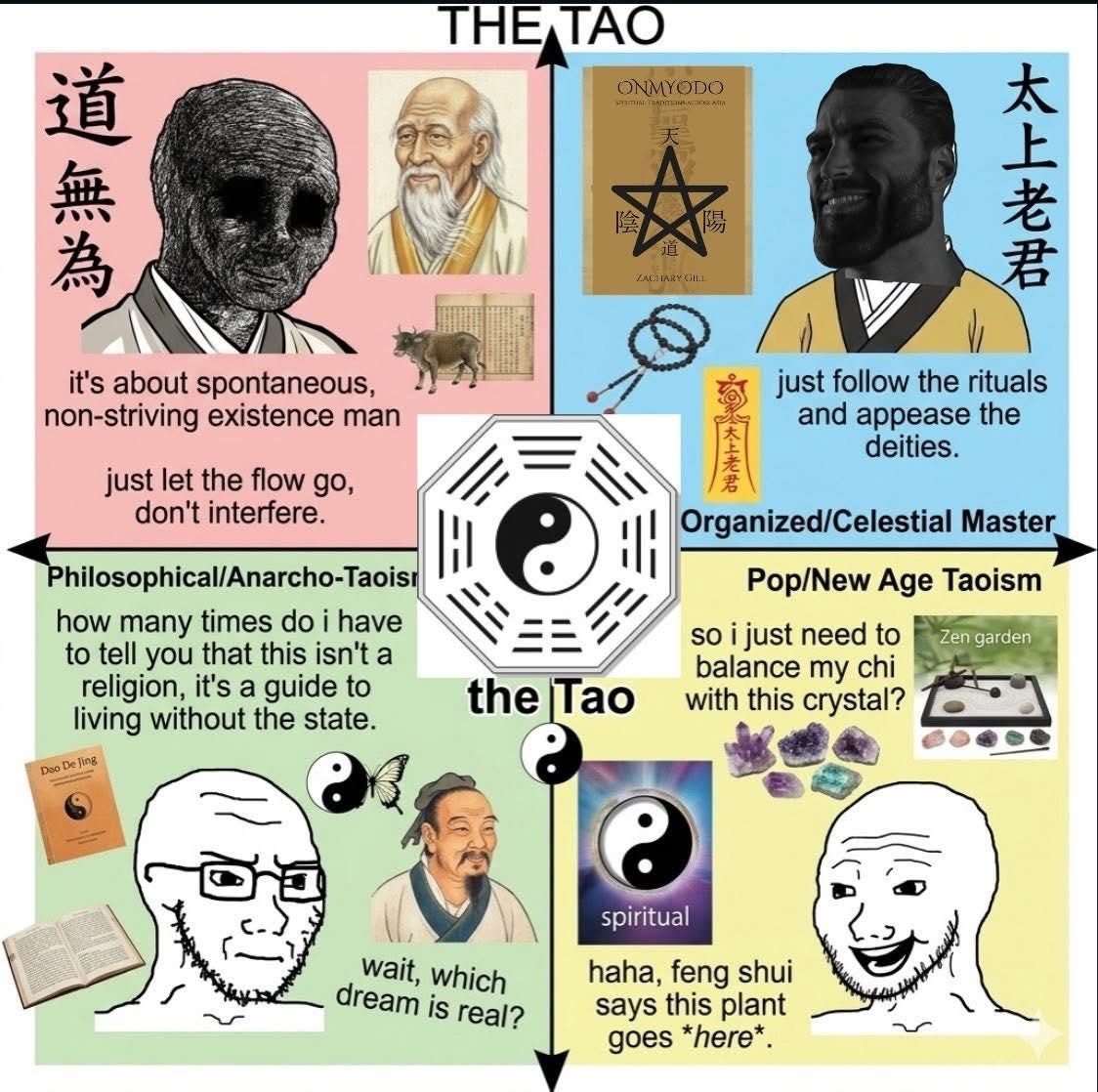
Daoism centers on the Dao, an underlying natural order that cannot be fully captured in language and that guides a receptive, unforced way of living. Understanding daoism includes its philosophical texts, especially the Daodejing and Zhuangzi, as well as religious institutions and practices. Its emphasis on paradox, non-contention, and harmony has shaped Chinese thought and life for centuries.
Daoism - spelled Taoism in the older Wade-Giles romanization system - is one of China's two major indigenous philosophical and religious traditions, alongside Confucianism, and one of the most influential systems of thought in human history.
It centers on the concept of the Dao (the Way): the underlying principle of all reality, the natural order that pervades and sustains all things, and the guide for human life rightly lived.
Over more than two and a half thousand years, Daoism has shaped Chinese philosophy, religion, art, medicine, martial arts, governance, and ecological sensibility.
Its influence has spread far beyond China, reaching global audiences through translations of its foundational texts and its influence on Zen Buddhism, New Age spirituality, and Western philosophy.
The tradition encompasses what scholars distinguish as philosophical Daoism (daojia, the school of the Dao), represented by the classical texts attributed to Laozi and Zhuangzi, and religious Daoism (daojiao, the teaching of the Dao), which developed organized communities, clergy, ritual systems, and a rich pantheon from the second century CE onward.
These strands have always been intertwined, drawing on the same foundational texts while expressing different practical and institutional forms.
Understanding Daoism requires engaging with a tradition that is, at its core, deliberately resistant to systematic formulation. This is not an accident or a weakness.
It is the tradition's central claim about the nature of reality itself: that what is most fundamental cannot be captured in the categories and distinctions of language, and that wisdom consists not in multiplying propositions but in cultivating a quality of receptive attention that allows the Dao to move through you without obstruction.
Laozi and the Daodejing
The Question of Laozi
Laozi (also romanized as Lao Tzu or Lao Zi, meaning roughly "Old Master") is the legendary figure to whom the foundational text of Daoism is attributed. The biographical tradition holds that he was a royal archivist at the Zhou dynasty court who, growing disillusioned with society's decline, decided to leave China.
At the western pass, he was persuaded by the gatekeeper Yin Xi to write down his wisdom before departing. The result was the Daodejing - the Classic of the Way and Virtue.
Scholarship has largely concluded that Laozi as an individual historical figure is uncertain at best.
The Daodejing is more plausibly understood as a composite text compiled over time, reaching something close to its present form around the fourth or third century BCE during the turbulent Warring States period, when multiple philosophical schools competed for court patronage.
Two manuscript versions discovered at Mawangdui in 1973, dating to around 168 BCE, differ in organization from the received text but confirm the text's antiquity and provide evidence for its complex textual history.
A third set of manuscript fragments, recovered from the Guodian tombs in 1993 and dating to approximately 300 BCE, represents the oldest known portions of the text and differs enough from later versions to suggest an evolving literary tradition rather than a fixed original (Boltz, 1993).[4]
The Laozi legend itself has philosophical significance. By attributing the Daodejing to an anonymous "Old Master" who promptly disappeared, the tradition resists the authority-by-biography that governs most philosophical canons.
The text does not ask to be believed because of its author's credentials. It asks to be tested against experience.
The Text and Its Paradoxes
The Daodejing is an astonishingly compact book: 81 short chapters, approximately 5,000 Chinese characters in total. It has been translated into more languages and more versions than any Chinese text, and may have more English translations than any other foreign-language book - over 250 at last count.
This proliferation of translations reflects the text's deliberate obscurity and paradox: it resists definitive interpretation.
Scholar Michael LaFargue (1992), in Tao and Method, surveyed the translation landscape and argued that many Western translators bring prior philosophical commitments that systematically shape their renderings, producing a family of "Laozis" that tell us as much about modern intellectual preoccupations as about the original text.[11]
Characteristic lines include:
- "The Dao that can be spoken is not the eternal Dao" (the opening line)
- "Acting without acting, everything gets done" (wu wei er wu bu wei)
- "The highest good is like water, which benefits all things without contending"
- "To know others is wisdom; to know oneself is enlightenment"
Each of these has generated centuries of commentary and debate. Wang Bi (226-249 CE), the brilliant third-century commentator who wrote the most influential traditional interpretation of the Daodejing, characterized the Dao as non-being (wu) - not as nothingness but as the undifferentiated ground from which all differentiated beings emerge.
His Neo-Daoist reading was enormously influential on later Daoist and Buddhist thought.
The text's literary form is itself philosophically significant. The Daodejing is written in verse-like parallel structures that resist the sequential, argument-from-premise-to-conclusion format of Western philosophical prose. Philosopher and Sinologist A.C.
Graham (1989) argued in Disputers of the Tao that early Chinese philosophical texts, including the Daodejing, presuppose a different conception of what philosophical discourse is for: not to establish propositions but to cultivate a disposition, a way of attending to experience.[8]
This is why the text seems to "say the same thing in many different ways" - the repetition and approach from multiple angles is the method, not mere redundancy.
The Dao: Ineffability and Immanence
The Dao (literally "way," "path," or "road") is the central concept of Daoist thought, distinguished by its fundamental resistance to definition. The Daodejing opens with the claim that the Dao that can be named is not the eternal Dao.
This is not rhetorical modesty but a substantive philosophical claim: the Dao is prior to all distinctions, categories, and language. Any description of it will necessarily name it as one thing rather than another, and thereby miss what it essentially is.
The Dao is described in the text as:
- The origin of heaven and earth, the mother of all things
- Something existing before the cosmos, silent and formless
- A source that is inexhaustibly generative without being a personal creator
- Not a deity who acts intentionally or intervenes in human affairs
The text uses multiple analogies to approach what it cannot directly state. The Dao is like an empty vessel that is inexhaustibly useful; like the hub of a wheel whose empty center makes the wheel functional; like the space inside a room that makes the room habitable.
The productive power of the Dao lies in what it is not, not in what it is - a doctrine of creative emptiness that has profoundly influenced Chinese aesthetics.
"The Tao is like the emptiness of a vessel; and in our employment of it we must be on our guard against all fullness." - Laozi, Daodejing, Chapter 4 (James Legge translation, 1891)
For practical life, the Dao manifests as the natural patterns and rhythms of the world: the alternation of seasons, the flow of rivers to the sea, the behavior of animals according to their natures. A person aligned with the Dao moves through the world harmoniously, without forcing or straining.
A ruler who governs according to the Dao leads through example and minimal interference rather than coercion and law.
Philosopher Roger Ames (1998), in Wandering at Ease in the Zhuangzi, argues that the Dao should not be understood as a transcendent metaphysical absolute - a "thing" beyond the world that explains it - but as the immanent aesthetic ordering of events as they unfold.[1]
The Dao is not behind or beneath experience but is the quality of coherence that experience has when it proceeds well. This reading draws a sharp contrast with Western theological conceptions of a creator God and emphasizes the this-worldly character of Daoist spirituality.
Wu Wei: The Art of Effortless Action
Wu wei is often translated as "non-action" or "non-doing," but these translations are misleading because they suggest passivity. More accurately, wu wei means acting without artificial forcing, contention, or striving against the natural grain of things.
It is action that flows effortlessly from alignment with the Dao, like water finding the lowest place, like a skilled craftsperson whose movements are so practiced they require no conscious deliberation.
The water metaphor is central to the Daodejing's presentation of wu wei. Water is soft and yielding; it does not fight obstacles but flows around them. Yet over time water wears away rock. Water benefits all things without competing; it seeks the lowest places that people disdain.
The sage, like water, is not passive but moves through the world without the friction of ego-driven striving.
Politically, wu wei implies a governing style of minimal interference. The Daodejing famously states that the best ruler is the one whose subjects barely know he exists. He does not burden people with laws and regulations but maintains conditions in which people can follow their natural inclinations.
This is not libertarianism in the modern sense but something closer to an ecological model of governance: the health of the whole depends on the health and spontaneity of the parts.
In personal life, wu wei points toward working with rather than against circumstances - not refusing to act in the face of injustice, but not wasting energy in resistance, resentment, and forced effort.
This principle appears in Chinese martial arts: the ideal is to redirect the opponent's force rather than meet it head on. The concept has also shaped Chinese aesthetics, where the ideal brushstroke is spontaneous and unstrained.
Psychologist Mihaly Csikszentmihalyi's influential concept of flow - the state of effortless, fully absorbed optimal performance documented in his 1990 research with athletes, musicians, surgeons, and chess players - has been noted by numerous scholars as a close functional analog to wu wei (Combs, 1996).[7]
In flow, deliberate self-monitoring falls away and action proceeds with a sense of effortlessness and intrinsic rightness. This convergence suggests that wu wei names a real psychological state, not merely a philosophical aspiration, and may help explain the tradition's practical appeal across cultures.
Zhuangzi: Playfulness, Paradox, and the Limits of Language
Zhuangzi (c. 369-286 BCE) was a philosopher of the Warring States period and the author, at least in part, of the text bearing his name. Where the Daodejing is terse and aphoristic, the Zhuangzi is expansive, playful, and full of vivid stories, metaphors, and philosophical arguments.
It is widely regarded as one of the masterpieces of Chinese literary prose. Scholar Harold Roth (1999), in Original Tao, identifies an inner chapters/outer chapters distinction in the text, arguing that the inner seven chapters represent an earlier, unified literary work by Zhuangzi himself, while the outer and miscellaneous chapters represent later additions by disciples and commentators.[13]
The Butterfly Dream
The most famous passage is the butterfly dream:
"Once upon a time, I, Chuang Tzu, dreamt I was a butterfly, fluttering hither and thither, to all intents and purposes a butterfly. I was conscious only of my happiness as a butterfly, unaware that I was Chuang Tzu. Soon I awakened, and there I lay, myself again.
Now I do not know whether I was then a man dreaming I was a butterfly, or whether I am now a butterfly dreaming I am a man." - Zhuangzi, Chapter 2 (Giles translation)
The question is not merely playful. It challenges the certainty with which we identify ourselves with any fixed perspective or identity, pointing toward the fundamental relativity of all points of view. There is no Archimedean standpoint from which to judge which state is the real one.
Western philosophers including Rene Descartes and more recently Thomas Nagel have posed structurally similar questions about the reliability of waking consciousness, but Zhuangzi's response differs sharply: rather than seeking a higher certainty that would resolve the doubt, he suggests we should live lightly with the uncertainty, accepting the fluidity of perspective as a feature of existence rather than an obstacle to be overcome.
Cook Ding and Effortless Mastery
The Cook Ding story is another touchstone. A skilled cook butchers an ox with such perfect technique that his cleaver never wears down, because he finds the natural spaces between bones and joints rather than hacking through them.
He no longer consciously thinks about what he is doing; he follows the natural structure of the animal with perfect attunement.
This story illustrates both wu wei and what Zhuangzi calls zhi - intuitive, pre-reflective skill that surpasses conscious deliberation. True mastery is invisible because it has merged with the nature of the task.
Modern cognitive science has developed concepts remarkably parallel to zhi. Research by surgeon and writer Atul Gawande (2002) on expert surgical performance, and by chemist-turned-philosopher Michael Polanyi on tacit knowledge - the kind of knowing that cannot be fully articulated in explicit rules - suggest that the highest levels of practical skill do involve a transition from deliberate rule-following to a more fluid, intuitive engagement with the task.
Zhuangzi's philosophical story and contemporary empirical research are pointing at the same phenomenon from different directions.
Zhuangzi was radically skeptical of Confucian moral categories - benevolence (ren) and righteousness (yi) - arguing that imposing these categories on human life does violence to the natural diversity of individuals. He was equally skeptical of fixed distinctions in language and logic.
His philosophical method is frequently ironic and self-undermining; he seems to delight in catching the reader in the act of taking any position too seriously. Later Chan (Zen) Buddhist thinkers found in Zhuangzi a philosophical sensibility very close to their own.
Perspectives and Transformation
A central theme in the Zhuangzi is the relativity of perspective - what he calls the equality of things (qi wu lun). A morning mushroom does not know the alternation of day and night; a chrysalis does not know spring and autumn. All perspectives are limited by the horizon of the perspective itself.
This does not lead to nihilism - Zhuangzi is not claiming that all views are equally wrong - but to a kind of perspectival humility, an awareness that any given viewpoint is one limited take on an inexhaustibly richer reality.
This philosophical insight has practical implications. The person who is attached to a single perspective will suffer when circumstances shift beyond it.
The person who can move fluidly between perspectives - who, as Zhuangzi puts it, "illuminates things" from the perspective of heaven rather than from any fixed human vantage point - is less vulnerable to the disorientation that change brings.
Religious Daoism: History and Practice
The Celestial Masters
The founding figure of organized religious Daoism is conventionally identified as Zhang Daoling, who is said to have received a revelation from the deified Laozi in 142 CE, establishing the Celestial Masters movement (Tianshi Dao) in what is now Sichuan province.
Zhang Daoling established a community governed by Daoist priests with ritual healing, confession of sins, and communal organization.
His grandson Zhang Lu led a theocratic state in the mountains of Sichuan and Shaanxi during the collapse of the Han dynasty - one of the few instances in Chinese history of a religious community exercising direct political sovereignty.
Historian Stephen Bokenkamp (1997), in Early Daoist Scriptures, provides a detailed scholarly analysis of the Celestial Masters' ritual texts, demonstrating that the movement was not simply a popularization of philosophical Daoism but drew on earlier traditions of local religious practice and incorporated them into a new institutional framework.[3]
Key Movements in Religious Daoism
| Period | Movement | Key Features |
|---|---|---|
| 142 CE | Celestial Masters | Revelation, community organization, ritual healing |
| 4th-5th c. CE | Shangqing (Highest Clarity) | Meditation, visualization of inner deities |
| 4th-5th c. CE | Lingbao (Numinous Treasure) | Ritual texts, universal salvation |
| 8th-13th c. CE | Tang-Song synthesis | Imperial patronage, Daoist canon compiled |
| 12th-13th c. CE | Quanzhen (Complete Perfection) | Celibate monastic communities, inner alchemy |
| 20th c. to present | Contemporary Daoism | Revival after Cultural Revolution, global diaspora |
Religious Daoism developed an elaborate pantheon of deities, including a deified Laozi as the supreme divine figure, and pursued goals including healing, longevity, and ultimately physical immortality through ritual, meditation, dietary practices, and alchemy.
The laboratory alchemical tradition (waidan) sought to produce a pill of immortality through processes involving cinnabar and other substances. Later, inner alchemy (neidan) transposed these practices inward, interpreting alchemical vocabulary metaphorically to describe internal meditative and energetic cultivation.
Historian of religion Livia Kohn (2001), in Daoism and Chinese Culture, estimates that at its medieval peak during the Tang dynasty (618-907 CE), Daoist institutions included several thousand monasteries and tens of thousands of ordained clergy.[10]
The Tang imperial family, the Li clan, claimed descent from the deified Laozi (whose family name was also Li) and actively patronized Daoist institutions, sponsoring the compilation of the first Daoist canon and granting tax exemptions to Daoist establishments.
This period of imperial patronage produced some of the tradition's most sophisticated theological and practical texts.
Today, religious Daoism maintains temple networks across China and diaspora communities in Southeast Asia, Taiwan, and globally. Daoist priests perform rituals for community welfare, funerals, and festivals. The White Cloud Monastery in Beijing, founded in the Tang dynasty, remains a center of Daoist learning and practice.
By one estimate, approximately 30,000 Daoist clergy are registered with the Daoist Association of China (Kohn, 2001), though this figure almost certainly undercounts practitioners in rural areas and the diaspora.
Daoist Cosmology and Cosmogony
Religious Daoism developed detailed cosmological frameworks that drew on the philosophical texts but elaborated them in distinctive directions.
The Three Pure Ones (Sanqing) are the highest triad of deities in the Daoist pantheon: Yuanshi Tianzun (the Celestial Worthy of Original Beginning), Lingbao Tianzun (the Celestial Worthy of Numinous Treasure), and Daode Tianzun (the Celestial Worthy of the Dao and its Power, identified with the deified Laozi).
These three represent successive emanations of the Dao as it generates the cosmos from primordial unity through increasingly differentiated forms.
The cosmogonic scheme of the Daodejing - "The Dao gives birth to One; One gives birth to Two; Two gives birth to Three; Three gives birth to all things" - was interpreted in religious Daoism as describing not just a logical or metaphysical process but a literal temporal emanation of cosmic energies (qi) from the primordial Dao.
The alternation of yin and yang - the complementary poles of receptive and active, dark and light, female and male - generates the five elemental phases (wuxing: wood, fire, earth, metal, water) whose interactions produce the entire diversity of phenomena.
This cosmological framework underlies Chinese medicine, geomancy (fengshui), and the system of correlations that pervades traditional Chinese intellectual culture.
Daoism's Influence on Chinese Art and Culture
Landscape Painting
Daoism's influence on Chinese aesthetic culture is so pervasive that it is difficult to identify where it begins and ends. In Chinese landscape painting, the dominant tradition from the Song dynasty (960-1279) onward reflected deeply Daoist sensibilities.
The conventions of the genre - placing human figures small within vast natural settings, using ink wash to suggest mountains and mist rather than depict them precisely, leaving significant portions of the silk or paper blank - express a vision of nature as active presence rather than backdrop for human activity.
Art historian James Cahill (1960), in Chinese Painting, documents how the theoretical literature of Song-dynasty painters drew explicitly on Daoist concepts: the painter's goal was not to reproduce the surface appearance of things but to grasp and express their inherent vital energy (qi yun sheng dong, "spirit resonance and lifelike movement"), a concept elaborated by the sixth-century critic Xie He that remained definitive for the tradition.[6]
The blank areas of a landscape painting are not absences but active presences - the Dao's own showing through the negative space that gives the composition its life.
Prominent painters including Su Shi (Su Dongpo) and Mi Fu in the Song period, and the individualist painters of the Ming and Qing dynasties, spoke explicitly of Daoist cultivation as integral to artistic practice.
The painter does not impose a design on the blank surface but finds the natural movement of the brush and lets the composition emerge.
Poetry and Withdrawal
The pastoral tradition associated with Tao Yuanming (365-427 CE) is perhaps the purest literary expression of Daoist values. His poems about farming, drinking wine, watching geese fly, and choosing poverty with integrity over advancement without it became touchstones of the Chinese literary tradition.
The willingness to withdraw from official life rather than compromise one's nature became a defining model of intellectual integrity in Chinese culture.
Scholar Robert Ashmore (2010), in The Transport of Reading, analyzes how Tao Yuanming's poetry constructs what he calls "the Daoist refusal" - a principled disengagement from the social world of ambition and performance in favor of immediate, sensory engagement with the natural world.[2]
The Tang dynasty poet Wang Wei combined Buddhist and Daoist sensibilities in landscape poetry of extraordinary economy and stillness. His quatrains describe scenes in which human presence is barely felt amid mountains, pines, and moonlight - the natural world apprehended not as scenery but as the Dao's own showing.
Martial Arts
Tai chi chuan (taijiquan) is the martial art most explicitly associated with Daoist principles. Its theory is based on the interaction of yin and yang, the cultivation of qi (vital energy) through relaxed movement, and the principle of yielding to redirect an opponent's force rather than meeting it directly.
The slow, flowing forms of tai chi are understood as both health cultivation and martial training, grounded in the Daoist understanding of how the soft overcomes the hard.
Research into the health benefits of tai chi has produced a substantial evidence base. A meta-analysis by Wayne and Kaptchuk (2004) reviewing 47 randomized controlled trials found significant positive effects of regular tai chi practice on balance, fall prevention in older adults, blood pressure reduction, and psychological well-being.[15]
A study published in the New England Journal of Medicine (2012) found tai chi superior to conventional physical therapy for fibromyalgia symptom management.
Whether these benefits derive from the Daoist cosmological framework or from the general properties of slow, mindful movement remains an open question, but the convergence of traditional theory and modern evidence has given tai chi a remarkable cross-cultural credibility.
Daoism and Environmental Philosophy
Daoism has attracted significant interest from environmental philosophers since the 1970s, when ecological crisis began to be understood as requiring new frameworks of human-nature relationship.
The most basic Daoist contribution is its cosmological framework in which humans are not the center or purpose of creation but one participant among many in a web of natural processes. The Dao pervades and sustains all things equally.
Zhuangzi is particularly clear: from the perspective of the Dao, distinctions between large and small, valued and unvalued, dissolve.
Ziran - the concept of naturalness or spontaneity - implies that things have their own inherent patterns and processes that should not be overridden by human design.
Industrial agriculture that depletes soil organisms, development that channels rivers into concrete courses, forests cleared for monoculture: all violate the principle of following the grain of nature rather than cutting against it.
Scholars including David Hall and Roger Ames, in Thinking Through Confucius (1987) and related works, have argued that classical Chinese thought offers a process-oriented and relational understanding of nature that contrasts productively with the substance-dualism that underlies Western anthropocentrism.[9]
Whether Daoist concepts can be applied to contemporary environmental problems without creative reinterpretation remains debated; the tradition was not primarily concerned with industrial-scale ecological destruction.
But the core Daoist sensibility - of humans as participants in rather than masters of natural systems - is precisely the corrective most urgently needed.
Environmental philosopher J. Baird Callicott (2013), in Thinking Like a Planet, compares Western and East Asian environmental ethics and argues that the Daoist framework of correlative cosmology - in which all things exist in responsive, mutually constitutive relationships rather than as isolated substances with fixed properties - provides more robust philosophical foundations for environmental ethics than either Western utilitarian or rights-based approaches.[5]
The key move is treating ecological systems as networks of relationship rather than aggregates of individuals, which is more consistent with what ecology has actually found.
Daoist-inspired environmental activism has been most visible in Taiwan, where Daoist religious organizations have undertaken significant conservation and recycling initiatives.
The Tzu Chi Foundation, while technically Buddhist, reflects a broadly Daoist-Buddhist sensibility about human responsibility within the natural order that has made it one of East Asia's most effective humanitarian and environmental organizations.
Daoism and Western Philosophy: Points of Contact
Since the first serious engagement of Western philosophers with Daoist texts in the nineteenth century, a recurring theme has been the resonances between Daoist thought and specific strands of Western philosophy.
These convergences are illuminating, though scholars rightly caution against the temptation to reduce one tradition to a precursor of the other.
Process philosophy in the tradition of A.N. Whitehead shares with Daoism a metaphysics of process rather than substance: reality is constituted by events and their relations, not by fixed objects with enduring properties.
The Dao as the ongoing, inexhaustible source of processes resonates with Whitehead's primordial nature of God as the ground of possibility from which actual occasions arise.
Heidegger's critique of Western metaphysics has been compared to the Daodejing's skepticism about language and conceptual thinking.
Heidegger's concept of Gelassenheit (releasement, letting-be) is functionally close to wu wei: a disposition of receptive openness in which things are allowed to show themselves rather than being forced into pre-given conceptual schemas.
Philosopher Graham Parkes (1987) edited an influential volume, Heidegger and Asian Thought, in which multiple contributors explore these parallels in detail.[12]
Wittgenstein's mysticism - his claim at the end of the Tractatus that whereof one cannot speak, thereof one must be silent - echoes the Daodejing's opening insistence that the eternal Dao exceeds the reach of speech.
Both thinkers locate the most important dimension of reality at the boundary of language, but draw different practical conclusions: Wittgenstein moves toward silence, while Daoism generates a vast literature that perpetually points beyond itself.
These convergences do not imply that Daoism and Western philosophy are saying the same things in different vocabularies. The differences are as significant as the similarities.
But they do suggest that Daoism addresses perennial philosophical concerns with resources that the Western tradition has not independently developed, making serious cross-cultural philosophical engagement genuinely productive rather than merely comparative.
Daoism in the Modern World
Daoism's global presence today takes several forms. Religious Daoist communities maintain temple traditions across the Chinese diaspora.
Philosophical Daoist texts, particularly the Daodejing, have become global cultural property: the text's influence on Western alternative medicine, self-help literature, management philosophy, and environmental ethics is substantial if sometimes superficial.
The Daoist tradition's encounter with modernity has produced both creative adaptations and significant losses. Attempts by the Chinese Communist state to suppress religious practice after 1949 damaged organizational structures that are only partially restored.
The Cultural Revolution (1966-1976) destroyed temples, scattered clergy, and burned texts. The partial religious liberalization of the 1980s allowed a degree of recovery, and the Daoist Association of China now provides an institutional framework, though under state supervision.
Beyond China, Western practitioners of tai chi, qigong, and Chinese medicine absorb elements of Daoist cosmology and practice without necessarily engaging with the tradition's philosophical depth.
This decontextualization is a loss but also, in a sense, a continuation of Daoism's historical adaptability: a tradition that has always emphasized alignment with circumstances over rigid adherence to form.
A growing body of scholarship by Chinese Daoist philosophers and practitioners - including figures associated with Wuhan University's Center for Daoist Studies, and the international journal Dao: A Journal of Comparative Philosophy, founded in 2001 - is working to articulate Daoism's resources for contemporary philosophy and life without either domesticating it to Western categories or treating it as a museum piece.
This ongoing conversation between Daoist tradition and contemporary thought is, in the spirit of the tradition itself, a work in progress that resists definitive conclusions.
"The Taoism that can be neatly organized and trotted out in a lecture is not really Taoism at all." - Alan Watts, Tao: The Watercourse Way (1975)[14]
Comparative Summary: Philosophical vs. Religious Daoism
| Feature | Philosophical Daoism (daojia) | Religious Daoism (daojiao) |
|---|---|---|
| Central texts | Daodejing, Zhuangzi | Revelation texts, ritual manuals |
| Primary concern | Cosmology, ethics, governance | Salvation, immortality, healing |
| Institutional form | None; philosophical school | Temples, clergy, communities |
| Key figures | Laozi, Zhuangzi, Wang Bi | Zhang Daoling, Lu Xiujing |
| Deity concept | Impersonal Dao | Pantheon headed by deified Laozi |
| Practices | Self-cultivation, meditation | Ritual, alchemy, qigong |
| Historical origin | 4th-3rd c. BCE | 2nd c. CE |
Frequently Asked Questions
Who was Laozi and what is the Daodejing?
Laozi ("Old Master") is the legendary figure to whom the Daodejing is attributed. Scholars regard the historical Laozi as uncertain; the Daodejing is more plausibly a composite text reaching its current form around the 4th-3rd century BCE.
Manuscript evidence from the Mawangdui tombs (168 BCE) and Guodian tombs (c. 300 BCE) confirms the text's antiquity and complex literary history.
At approximately 5,000 characters in 81 chapters, it is one of the world's most translated texts, with over 250 English versions reflecting its deliberate paradox and resistance to definitive interpretation (LaFargue, 1992).
What is wu wei and how does it apply to daily life?
Wu wei means effortless action aligned with the natural order - not passivity but the absence of forced, ego-driven striving. The Daodejing's water metaphor captures it: water yields to obstacles and finds the lowest path, yet wears away stone.
In practice, wu wei implies working with circumstances rather than against them, waiting for the right moment, and accomplishing through skillful indirection.
Psychologist Mihaly Csikszentmihalyi's concept of "flow" - effortless absorption in optimal performance - has been identified as a functional modern parallel (Combs, 1996). It appears in Chinese martial arts, painting, and political philosophy.
How does religious Daoism differ from philosophical Daoism?
Philosophical Daoism (daojia) refers to the classical texts of Laozi and Zhuangzi and their intellectual tradition. Religious Daoism (daojiao) refers to organized communities with clergy, ritual systems, temples, and a pantheon of deities, beginning with Zhang Daoling's Celestial Masters movement in 142 CE.
The two strands are intertwined: religious Daoism draws on the same foundational texts while expressing them through institutional and ritual forms.
Historian Livia Kohn (2001) estimates that religious Daoist institutions reached their peak during the Tang dynasty, when several thousand monasteries and tens of thousands of ordained clergy served the tradition.
How has Daoism influenced environmental philosophy?
Daoism's cosmology places humans as participants rather than masters in a natural order the Dao pervades equally. The concept of ziran (naturalness) implies that things have inherent patterns that human intervention should follow rather than override.
Environmental philosopher J. Baird Callicott (2013) argues that Daoist correlative cosmology provides more robust philosophical foundations for environmental ethics than Western utilitarian or rights-based approaches.
Daoist-inspired environmental activism has been most active in Taiwan, and the framework has gained increasing attention in global environmental ethics scholarship.
What is the relationship between Daoism and Zen Buddhism?
The relationship is historically deep and philosophically significant. When Mahayana Buddhism spread from India to China in the first centuries CE, Chinese translators and thinkers drew on Daoist vocabulary to render Buddhist concepts - a process scholars call "concept-matching" or "matching concepts" (geyi).
The Chan (Zen) school that emerged in China during the Tang dynasty was shaped profoundly by Zhuangzi's paradoxical methods, his use of irreverent humor and sudden reversal to jolt the student out of habitual thinking, and his emphasis on direct, embodied experience over doctrinal study.
The Zen tradition of enigmatic questions (koans) and the value it places on mind-to-mind transmission outside scriptures bear the unmistakable imprint of Zhuangzi's philosophical style.
Sources & Further Reading
- Ames, R. T. (1998). Wandering at Ease in the Zhuangzi. State University of New York Press.
- Ashmore, R. (2010). The Transport of Reading: Text and Understanding in the World of Tao Yuanming. Harvard University Asia Center.
- Bokenkamp, S. (1997). Early Daoist Scriptures. University of California Press.
- Boltz, W. G. (1993). Lao tzu Tao te ching. In M. Loewe (Ed.), Early Chinese Texts: A Bibliographical Guide. Society for the Study of Early China.
- Callicott, J. B. (2013). Thinking Like a Planet: The Land Ethic and the Earth Ethic. Oxford University Press.
- Cahill, J. (1960). Chinese Painting. Skira.
- Csikszentmihalyi, M. (1990). Flow: The Psychology of Optimal Experience. Harper & Row.
- Graham, A. C. (1989). Disputers of the Tao: Philosophical Argument in Ancient China. Open Court.
- Hall, D. L., & Ames, R. T. (1987). Thinking Through Confucius. State University of New York Press.
- Kohn, L. (2001). Daoism and Chinese Culture. Three Pines Press.
- LaFargue, M. (1992). Tao and Method: A Reasoned Approach to the Tao Te Ching. State University of New York Press.
- Parkes, G. (Ed.). (1987). Heidegger and Asian Thought. University of Hawaii Press.
- Roth, H. D. (1999). Original Tao: Inward Training and the Foundations of Taoist Mysticism. Columbia University Press.
- Watts, A. (1975). Tao: The Watercourse Way. Pantheon Books.
- Wayne, P. M., & Kaptchuk, T. J. (2004). Challenges inherent to t'ai chi research. Journal of Alternative and Complementary Medicine, 14(6), 751-760.