
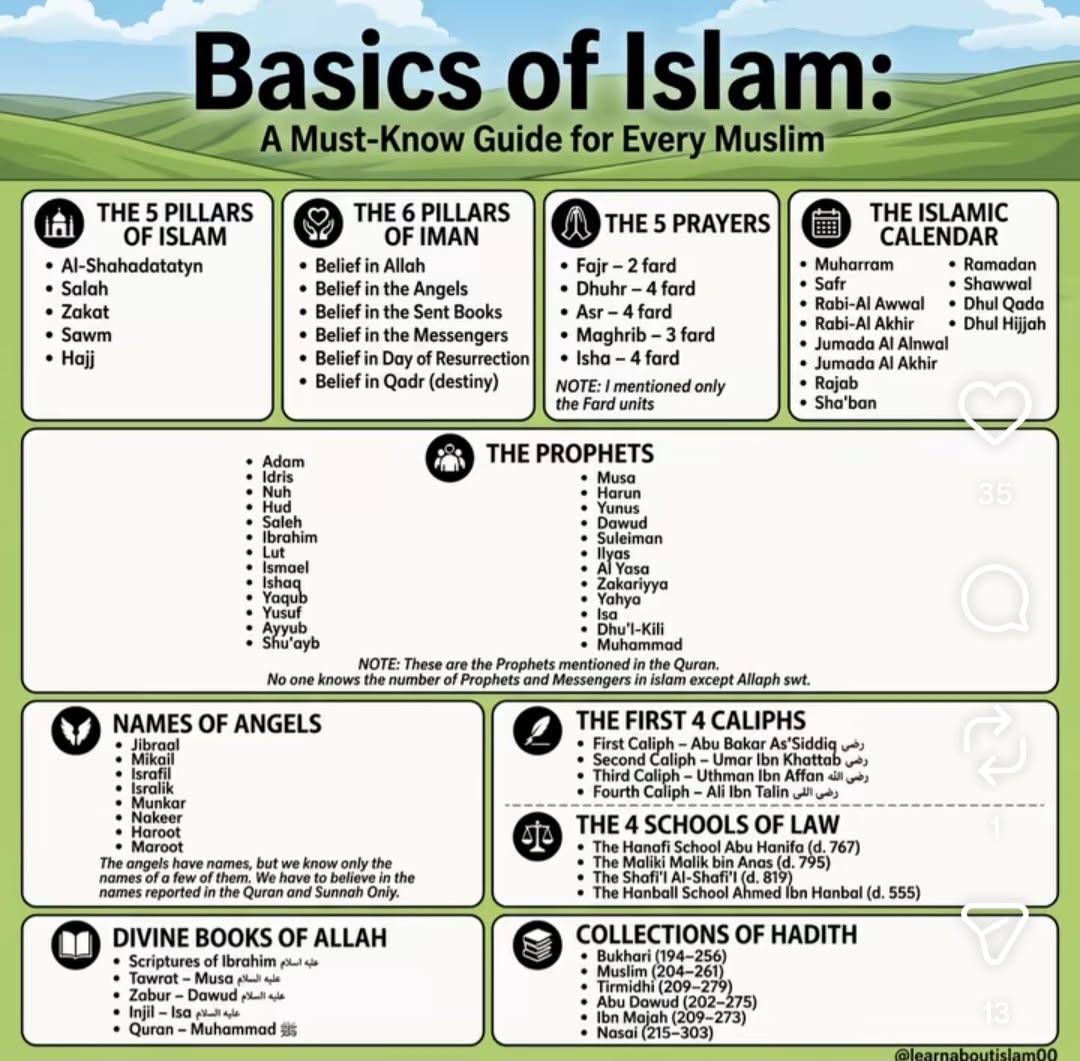
An islam overview begins with a diverse global religious tradition united by the Quran, Muhammad as the final prophet, and the practical obligations of the Five Pillars. Sunni, Shia, Sufi, and legal traditions differ in important ways, while Muslims have developed rich intellectual, legal, scientific, literary, and political cultures. Islam's history runs from seventh-century Arabia through a transregional civilization and varied modern communities.
Islam is the second-largest religion on Earth, with approximately 1.8 billion adherents constituting around 24 percent of the global population.
It is also, by the reckoning of historians, one of the most consequential forces in world history - a faith that within a century of its founding had produced an empire stretching from the Iberian Peninsula to the borders of China, and that within three centuries had given birth to one of the most sophisticated intellectual cultures the world had ever seen.
To understand Islam is therefore not simply to understand a set of religious beliefs and practices; it is to engage with a civilization that shaped mathematics, medicine, philosophy, law, and literature across Eurasia for a thousand years and that today encompasses populations from Indonesia to Nigeria, from Morocco to the United States.
The challenge for any introduction is the sheer diversity of what Islam contains. There is no single Islam.
There are Sunni and Shia traditions, themselves internally fragmented; there is Sufi mysticism and legalist literalism; there is the Islam of Moroccan Berbers, of Indonesian rice farmers, of Senegalese Sufi brotherhoods, of Pakistani urban professionals, of American converts.
What unites these communities is a shared orientation toward the Quran as the word of God, toward Muhammad as the final prophet, and toward the practical obligations of the Five Pillars. Beyond these anchors, variation is vast and historically deep.
This article traces Islam from its founding in seventh-century Arabia through its classical civilization and internal diversity, examines its legal and theological traditions, surveys the range of modern Muslim political thought from reformism to Islamism, and considers the debates - some productive, some distorting - that have characterized Western scholarly engagement with this tradition.
"There is no god but God, and Muhammad is the messenger of God." - The Shahada, the foundational declaration of Islamic faith, recited by approximately 1.8 billion people worldwide.
| Pillar | Arabic Term | Obligation |
|---|---|---|
| Declaration of faith | Shahada | "There is no god but God, and Muhammad is His messenger" |
| Prayer | Salah | Five daily prayers facing Mecca |
| Almsgiving | Zakat | Annual charity, typically 2.5% of savings |
| Fasting | Sawm | Abstaining from food and drink during Ramadan |
| Pilgrimage | Hajj | Once-in-a-lifetime journey to Mecca if able |
Key Definitions
Quran: The sacred text of Islam, understood by Muslims as the direct, literal word of God (Allah) revealed to the Prophet Muhammad through the angel Jibril (Gabriel) over approximately twenty-three years (~610-632 CE). It consists of 114 chapters (suras) arranged roughly by length.
Hadith: Reports of the sayings and actions of the Prophet Muhammad, transmitted through chains of narrators (isnad). The most authoritative Sunni collections are the Sihah Sitta (Six Sound Books), including the compilations of al-Bukhari and Muslim ibn al-Hajjaj.
Sunnah: The body of the Prophet's normative practice, derived primarily from the Hadith and regarded as the second source of Islamic guidance after the Quran.
Sharia: Literally "the path" or "the way to water," sharia denotes the divinely ordained moral and legal framework for Muslim life as derived from the Quran and Sunnah through the discipline of fiqh (Islamic jurisprudence).
Ummah: The worldwide community of Muslim believers, conceived as a trans-ethnic, transnational unity bound by shared faith rather than tribal or national identity.
The Founding of Islam
Muhammad ibn Abdullah
Muhammad ibn Abdullah was born around 570 CE in Mecca, a commercial and religious center on the Arabian Peninsula. Orphaned early and raised by his uncle Abu Talib, he worked as a merchant and developed a reputation for integrity - the epithet al-Amin, "the trustworthy," is attributed to him.
Around 610 CE, at approximately forty years of age, he began receiving what he and his followers understood as divine revelations in the Cave of Hira, transmitted through the angel Jibril.
The experience was initially so overwhelming that Muhammad was uncertain of its nature, and the tradition records that his wife Khadijah and her cousin Waraqah ibn Nawfal played crucial roles in affirming the revelations' divine origin.
The core message was straightforward but radical in its context: there is one God (Allah), all other gods are false, and human beings will be held accountable before this God on a Day of Judgment. The social implications were equally radical.
Muhammad preached against the hoarding of wealth, demanded care for orphans and the poor, and insisted on the spiritual equality of all human beings regardless of tribal origin.
These teachings attracted followers among the marginalized but generated fierce opposition from the Quraysh aristocracy, whose wealth, status, and control of Mecca's religious shrines (including the Kaaba, already an ancient pilgrimage site) were threatened.
The Hijra and the Formation of the Muslim Community
In 622 CE, facing intensifying persecution, Muhammad and his followers undertook the Hijra - the migration from Mecca to the city of Yathrib (renamed Medina, "the city of the Prophet"). This event is so fundamental to Islamic self-understanding that the Islamic lunar calendar (the Hijri calendar) begins from this year.
In Medina, Muhammad assumed roles that combined prophetic, judicial, and political authority, and the first Islamic community (ummah) was institutionalized through the Constitution of Medina, a document that regulated relations between Muslim and non-Muslim communities in the city.
The following decade saw a series of military conflicts with Mecca, including the battles of Badr (624 CE), Uhud (625 CE), and the Trench (627 CE), as well as the expulsion of Jewish tribal confederates from Medina. In 630 CE Muhammad's forces entered Mecca largely without resistance.
Muhammad cleared the Kaaba of its idols and rededicated it to monotheistic worship. When he died in 632 CE, most of the Arabian Peninsula had accepted Islam.
The Quran and Hadith
The Quran (from the Arabic qara'a, "to recite") was not compiled into a single written text during Muhammad's lifetime but was memorized by companions and written on various materials. The third caliph Uthman ibn Affan (r.
644-656 CE) oversaw the production of a standardized written text around 650 CE, which became the definitive version.[2] Muslims universally regard the Quran as the direct word of God - not Muhammad's own composition or interpretation, but divine speech in Arabic.
Its 114 suras vary enormously in character, from the short devotional suras of its final section to the long legislative and narrative passages of suras such as al-Baqara and al-Nisa.
Alongside the Quran, the Hadith literature - collections of reports about Muhammad's sayings and actions - provides the second major source of Islamic guidance. The science of Hadith criticism (ilm al-hadith) developed elaborate methods for evaluating the reliability of transmission chains (isnad).
The Sihah Sitta, the Six Sound Books compiled in the ninth century CE, are considered the most authoritative Sunni collections; the most prestigious single collection is that of Muhammad al-Bukhari (~810-870 CE), who reportedly examined 600,000 reports and accepted fewer than 7,300 as sound.
The Sunnah - the normative practice of the Prophet derived from the Hadith - together with the Quran forms the foundational bedrock of Islamic law and ethics.
The Five Pillars and Six Articles of Faith
The Five Pillars
The Five Pillars (arkan al-Islam) are the practical obligations that structure Muslim life. The Shahada ("testimony") is the declaration: "La ilaha illa Allah, Muhammad rasul Allah" - there is no god but God, and Muhammad is the messenger of God.
Sincere utterance of this formula, with understanding and conviction, constitutes entry into the Muslim community. The Salat (ritual prayer) is performed five times daily at prescribed times, preceded by ritual purification (wudu), and oriented toward the Masjid al-Haram in Mecca.
Friday midday prayer (Jumu'a) carries particular communal significance. Zakat (almsgiving) is obligatory for Muslims above a minimum wealth threshold, typically calculated at 2.5 percent of accumulated savings annually, distributed to the poor and other specified recipients.
Sawm (fasting) during the month of Ramadan requires abstention from food, drink, and other specified acts from dawn to sunset - a month of intensified devotion that culminates in Eid al-Fitr.
Hajj (pilgrimage) to Mecca is required once in a lifetime for those physically and financially able, comprising a series of rituals including circumambulation of the Kaaba, standing on the plain of Arafat, and the symbolic stoning of the devil at Mina, culminating in Eid al-Adha.
The Six Articles of Faith
The six articles of faith (arkan al-iman) constitute the theological core: belief in God (Allah) as one and unique; belief in the angels (mala'ika); belief in the revealed scriptures (kutub), which include the Torah, Psalms, Gospels, and Quran; and belief in the prophets and messengers (anbiya' wa rusul), from Adam through Abraham, Moses, Jesus, and culminating with Muhammad as the "Seal of the Prophets."
The remaining two articles are belief in the Day of Judgment (yawm al-qiyama) and divine accountability, and belief in divine decree (qadar), that all events occur within God's knowledge and will. The precise relationship between divine foreordination and human free will has been debated by theologians for centuries.
The Sunni-Shia Split and the Diversity of Muslim Traditions
The Succession Crisis
Muhammad died in 632 CE without having designated a successor in writing. What followed shaped the subsequent fourteen centuries of Muslim history.
The majority of Muhammad's companions chose Abu Bakr, the Prophet's close friend and father-in-law, as the first caliph (khalifa, "successor"), through a process of consultation and acclamation.
This became the Sunni model of legitimate succession - based on community consensus and the qualities of the candidate rather than blood relation to the Prophet.
A minority, centered around Ali ibn Abi Talib - Muhammad's cousin, son-in-law (married to his daughter Fatima), and one of the earliest converts - held that Muhammad had designated Ali as his successor, most explicitly at the Pond of Khumm, where he reportedly said: "Whoever considers me their master (mawla), Ali is their master."
Ali became the fourth caliph in 656 CE but faced civil conflict and was assassinated in 661 CE. His son Hasan ibn Ali renounced the caliphate.
The defining rupture came at Karbala in 680 CE, when Ali's son Hussein ibn Ali, traveling with a small group of family and companions to lead a revolt against the Umayyad Caliph Yazid ibn Muawiya, was surrounded and slaughtered by a vastly larger Umayyad force.
Hussein's martyrdom became the founding trauma of Shia Islam, annually commemorated on the tenth of Muharram (Ashura) with mourning rituals, passion plays (ta'ziya), and in some communities, self-flagellation, though many Shia scholars have discouraged the last practice.
Sunni and Shia Today
Sunni Muslims constitute approximately 85-90 percent of the world's 1.8 billion Muslims. Shia majorities exist in Iran (where the Safavid Dynasty made Twelver Shia Islam the state religion in the sixteenth century), Iraq, Bahrain, and Azerbaijan.
Lebanon's Hezbollah is a Shia political-military organization drawing on Khomeini's doctrine of wilayat al-faqih (guardianship of the jurist). Significant Shia communities exist in Pakistan, India, Kuwait, and Saudi Arabia's Eastern Province.
Beyond the historical and political differences, Sunni and Shia traditions have developed distinct jurisprudential schools, Hadith canons, and devotional practices.
The Shia veneration of Imams (the twelve successors to Muhammad in the Twelver tradition) and the intercessory role attributed to them represents a significant theological divergence from Sunni doctrine.
Sufism
Sufism (tasawwuf) is the mystical dimension of Islam, encompassing a vast range of spiritual practices, orders (turuq/tariqa), and theologies that emphasize direct experiential knowledge of God (ma'rifa) over juridical compliance.
The theologian and mystic Abu Hamid al-Ghazali (1058-1111 CE), often described as the most influential Muslim after the Prophet, reconciled Sufi spirituality with Sunni orthodoxy in his masterwork 'Ihya Ulum al-Din' (The Revival of the Religious Sciences), integrating inner moral and spiritual cultivation with legal observance.[6]
The Persian poet Jalal al-Din Rumi (1207-1273 CE), founder of the Mevlevi order (the "whirling dervishes"), produced the Masnavi and the Divan-e Shams - among the most widely read poetry in the world.
Sufi orders spread Islam across Sub-Saharan Africa, Central Asia, and South Asia through networks of saints, shrines, and spiritual lineages.
Wahhabism and Salafism have been hostile to many Sufi practices, considering shrine veneration and saint intercession as forms of associationism (shirk) that compromise monotheism.
The Islamic Golden Age
The Abbasid Caliphate (750-1258 CE), having displaced the Umayyads in a revolution that drew heavily on Persian and Mawali (non-Arab Muslim) support, established Baghdad as the capital of a civilization of extraordinary intellectual vitality.[7]
Under Caliphs such as Harun al-Rashid (r. 786-809 CE) and al-Ma'mun (r. 813-833 CE), the Bayt al-Hikmah (House of Wisdom) became the center of a systematic translation movement: Greek philosophy (Aristotle, Plato, Galen, Euclid, Ptolemy), Persian administrative and literary texts, Indian mathematics, and Syriac Christian scholarship were all translated into Arabic.
This was not mere transmission; it was transformation. Islamic scholars corrected, extended, critiqued, and synthesized what they inherited.
Muhammad ibn Musa al-Khwarizmi (~780-850 CE) produced 'Al-Kitab al-mukhtasar fi hisab al-jabr wal-muqabala' (The Compendious Book on Calculation by Completion and Balancing), giving algebra its name and laying foundational methods.
His treatise on Hindu-Arabic numerals introduced the positional decimal system to the Islamic world and, through Latin translations, to Europe.
Ibn Sina (Avicenna, 980-1037 CE), the philosopher-physician, produced an encyclopedic body of work spanning medicine, logic, metaphysics, and natural philosophy.
His 'Al-Qanun fi al-Tibb' (Canon of Medicine) systematized Greek and Islamic medical knowledge and served as a standard text in European universities from the twelfth to the seventeenth centuries.
Ibn Rushd (Averroes, 1126-1198 CE) in Andalusia wrote exhaustive commentaries on Aristotle - commentaries so authoritative that Dante called him simply "the Commentator" - and argued for the compatibility of Aristotelian reason with religious truth, an argument that shaped both Jewish philosophy (Maimonides) and Christian scholasticism (Thomas Aquinas).
Al-Biruni (~973-1048 CE) visited India, learned Sanskrit, and wrote a comparative cultural study of Indian civilization ('Kitab al-Hind') that stands as a landmark in comparative ethnography; he also calculated the Earth's circumference with an error of less than one percent.
The catastrophe of 1258, when Hulagu Khan's Mongol forces sacked Baghdad and destroyed the House of Wisdom, killed hundreds of thousands and ended an era.
The intellectual legacy migrated westward through Andalusia (itself lost gradually from 1085 onward) and eastward to Cairo and Persia, but the centralized efflorescence of Abbasid Baghdad was never reconstructed.[8]
Islamic Law and Theology
Jurisprudence: The Four Schools
Islamic jurisprudence (fiqh) emerged during the eighth and ninth centuries through intensive scholarly effort to derive legal norms from the foundational sources.
The methodology (usul al-fiqh) identified four sources: the Quran; the Sunnah (as recorded in the Hadith); ijma (scholarly consensus, particularly of the early Muslim community); and qiyas (analogical reasoning).
Four Sunni schools (madhabs) crystallized around leading scholars: the Hanafi school (traced to Abu Hanifa, ~699-767 CE), which spread across Central and South Asia, Turkey, and the former Ottoman territories, and the Maliki school (traced to Malik ibn Anas, ~711-795 CE), dominant in North and West Africa.
The other two are the Shafi'i school (traced to Muhammad al-Shafi'i, 767-820 CE), influential in East Africa and Southeast Asia, and the Hanbali school (traced to Ahmad ibn Hanbal, 780-855 CE), which dominates in Saudi Arabia and Qatar and provides the jurisprudential foundation for Wahhabi and Salafi movements.
These schools agree on essentials but differ on numerous specifics. Their co-existence has generally been recognized as legitimate within mainstream Sunni practice, a principle of intra-Muslim pluralism (ikhtilaf) that has sometimes been invoked against contemporary sectarianism.
Theology: Mutazilites, Asharites, and Beyond
Islamic theology (kalam) was partly generated by the encounter with Greek philosophy.
The Mutazilite school, influential at the Abbasid court in the ninth century, emphasized divine rationality and human free will, arguing that God's justice requires that human beings have genuine freedom of choice and that the Quran was created (not co-eternal with God).
Their opponents, the Asharites - founded by Abu al-Hasan al-Ashari (873-935 CE), himself a former Mutazilite - defended the eternity of the Quran, a more voluntarist conception of divine power, and a more cautious approach to rationalist theology that eventually became the dominant Sunni theological school.
The fourteenth-century scholar Ibn Taymiyya argued strenuously against what he saw as innovations (bida') in Islamic practice, advocating a return to Quran and Hadith and rejecting the interpretive authority of the classical schools; his writings became deeply influential on Muhammad ibn Abd al-Wahhab and, subsequently, on Salafi and Wahhabi movements.
Islam in the Modern World
Islamic Modernism and Reform
The encounter with European colonial power in the nineteenth century generated a crisis of Islamic thought.
Intellectuals such as Muhammad Abduh (1849-1905 CE) in Egypt and his student Rashid Rida argued that Islam was fully compatible with reason, science, and constitutional government, and that Muslims needed to reopen the gates of ijtihad (independent reasoning) to address modern questions.
Abduh's reformism was institutionalized partly through his influence at al-Azhar University in Cairo, one of the oldest universities in the world and the most prestigious institution of Sunni Islamic learning.
Political Islam
Hassan al-Banna founded the Muslim Brotherhood (al-Ikhwan al-Muslimun) in Egypt in 1928 as a social and political movement seeking to re-Islamize society from the ground up through education, welfare provision, and political participation.
Sayyid Qutb, who had lived in the United States (1948-1950) and found it morally repugnant, developed a far more radical ideology in prison, arguing in 'Milestones' (1964) that contemporary societies - including Muslim-majority ones governed by secular nationalist regimes - existed in a state of jahiliyya (pre-Islamic ignorance) and that a vanguard of true Muslims was obligated to confront this through any means necessary.
Qutb was executed in 1966, but his ideas permeated jihadist movements globally. The Saudi-Wahhabi partnership, formalized between Muhammad ibn Abd al-Wahhab and Muhammad ibn Sa'ud in 1744, found global reach after 1973 oil revenues funded the worldwide export of Salafi-oriented Islam.
Islamic Feminism
Islamic feminist scholarship has produced some of the most creative theological work of the late twentieth and early twenty-first centuries.
Fatima Mernissi (1940-2015), in works such as 'The Veil and the Male Elite' (1987), examined the Hadith literature to argue that many misogynist reports were of dubious authenticity and reflected the preferences of patriarchal transmitters rather than prophetic guidance.[9]
Amina Wadud's 'Quran and Woman' (1992) offered a systematic gender-inclusive rereading of the Quran's foundational passages, arguing that the text's egalitarian principles had been consistently distorted by male-dominated interpretation.[11]
Both scholars worked within Islamic frameworks, contesting the claim that patriarchy is intrinsic to Islamic teaching rather than a historical imposition on it.
Western Scholarship on Islam: Orientalism and Its Aftermath
The study of Islam in Western universities was shaped for two centuries by Orientalist frameworks that Edward Said, in his foundational critique 'Orientalism' (1978), argued systematically distorted representations of the Islamic world by projecting a monolithic, static, and inferior Orient onto diverse realities.[10]
Said's critique - which drew on Foucault's analysis of the relationship between knowledge and power - transformed the field and continues to structure its debates.
Subsequent generations of scholars have worked to develop historically rigorous accounts that neither romanticize nor demonize the traditions under study.
W. Montgomery Watt's two-volume biography of Muhammad (Muhammad at Mecca, 1953; Muhammad at Medina, 1956) remains important despite its datedness.[12] Karen Armstrong's popular 'Muhammad: A Biography of the Prophet' (1991) offered sympathetic rehabilitation for general audiences.[1]
John Esposito's 'Islam: The Straight Path' (1988; multiple editions) has served as a widely used academic introduction presenting Islam from an emic (insider-respectful) perspective.[5]
Fred Donner's historical scholarship, including 'Muhammad and the Believers' (2010), applies rigorous source criticism to reconstruct early Islamic history.[4]
Most controversially, Patricia Crone and Michael Cook's 'Hagarism: The Making of the Islamic World' (1977) applied skeptical external-source analysis to argue that the Islamic historical tradition's account of its own origins is unreliable - a position that generated intense scholarly controversy and response but forced engagement with the methodological challenges of early Islamic historiography.[3]
Sources & Further Reading
- Armstrong, Karen. Muhammad: A Biography of the Prophet. HarperCollins, 1991.
- Cook, Michael. The Koran: A Very Short Introduction. Oxford University Press, 2000.
- Crone, Patricia, and Michael Cook. "Hagarism: The Making of the Islamic World". Cambridge University Press, 1977.
- Donner, Fred M. Muhammad and the Believers: At the Origins of Islam. Harvard University Press, 2010.
- Esposito, John L. Islam: The Straight Path. 4th ed. Oxford University Press, 2011.
- al-Ghazali, Abu Hamid. Ihya Ulum al-Din (The Revival of the Religious Sciences). ~1095 CE. Various modern editions.
- Hodgson, Marshall G. S. "The Venture of Islam", 3 vols. University of Chicago Press, 1974.
- Lapidus, Ira M. A History of Islamic Societies. 3rd ed. Cambridge University Press, 2014.
- Mernissi, Fatima. The Veil and the Male Elite: A Feminist Interpretation of Women's Rights in Islam. Addison-Wesley, 1991.
- Said, Edward W. "Orientalism". Pantheon Books, 1978.
- Wadud, Amina. Qur'an and Woman: Rereading the Sacred Text from a Woman's Perspective. Oxford University Press, 1999.
- Watt, W. Montgomery. Muhammad: Prophet and Statesman. Oxford University Press, 1961.