
Cultural: A few years ago, a team of American software engineers flew to Tokyo to present a new product roadmap to their Japanese partners. The presentation was polished, direct, and efficient-exactly the kind of pitch that would earn enthusiastic nods in a San Francisco boardroom.
The lead engineer outlined the vision, listed the milestones, and asked for feedback. The Japanese team listened attentively. At the end, they were quiet. A few members nodded slowly. One said, "We understand your proposal. We will consider it carefully."
The Americans left the meeting energized. "They loved it," the lead engineer told his boss back in California. "They were totally on board."
Two weeks later, the Japanese partner sent a detailed counter-proposal that redirected the entire roadmap. The Americans were blindsided. What happened? They agreed with us in the meeting.
What happened was cultural bias-specifically, the American team's culturally conditioned assumption that silence means agreement, that nodding means approval, and that the absence of explicit objection equals endorsement. In the Japanese communication context, silence meant the team was being respectful.
Nodding meant they were listening, not agreeing. And the phrase "we will consider it carefully" was a polite way of signaling that significant concerns existed but would be communicated through proper channels-not in a face-to-face meeting where direct criticism would cause embarrassment.
The American team was not stupid, racist, or culturally insensitive. They were simply doing what every human being does by default: interpreting the world through the lens of their own cultural assumptions without realizing that a lens was in place at all.
This is cultural bias in its most fundamental form-not deliberate prejudice but the invisible framework through which we perceive, interpret, and evaluate everything around us.
"The real voyage of discovery consists not in seeking new landscapes, but in having new eyes." - Marcel Proust
What Cultural Bias Actually Is
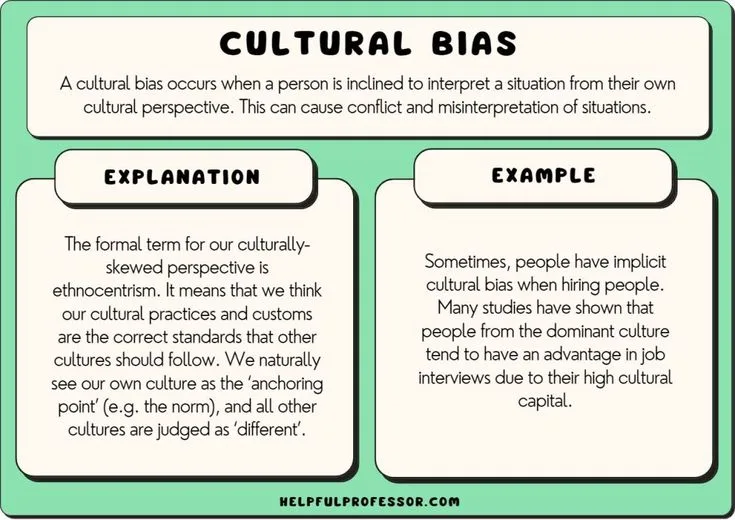
Cultural bias is the tendency to interpret and judge situations, behaviors, and ideas using the standards, values, and assumptions of one's own culture as the baseline for what is "normal," "correct," or "natural." It operates largely below conscious awareness, which is both what makes it universal and what makes it so difficult to counteract.
Like other cognitive biases, it shapes perception automatically-but its content is learned from the specific cultural environment in which a person is raised.
Cultural bias is distinct from related concepts, though it overlaps with all of them:
- Ethnocentrism - the belief that one's own culture is superior to others. Cultural bias is broader; you can be biased without believing your culture is better, simply by treating it as the default standard.
- Stereotyping - fixed, oversimplified beliefs about specific groups. Cultural bias is the underlying lens that can produce stereotypes, but it operates more fundamentally than any specific belief about any specific group.
- Prejudice - negative attitudes toward a group based on their membership. Cultural bias can exist without negative attitudes; you can genuinely respect another culture while still misinterpreting it through your own cultural lens.
- Discrimination - differential treatment based on group membership. Cultural bias can lead to discrimination but often manifests as misunderstanding rather than intentional unfair treatment.
How Cultural Bias Differs from Individual Bias
Individual biases-confirmation bias, anchoring bias, availability bias-are universal cognitive tendencies shared across cultures. Cultural bias is different because its specific content varies by culture. All humans have cognitive biases.
But which behaviors you perceive as "rude," which communication style you consider "clear," which decision-making process you regard as "efficient"-these depend on which culture shaped your perceptions.
A useful analogy: individual cognitive biases are like the hardware of a computer-shared architecture that works the same way regardless of what software is installed.
Cultural biases are like the operating system-a framework that shapes how information is processed, displayed, and interpreted, and that varies depending on which system you were raised within.
Understanding why awareness alone does not remove bias helps explain why even well-traveled, culturally literate people still fall into these patterns.
The Mechanisms: How Cultural Bias Operates
Cultural bias is not a single phenomenon but a set of interrelated perceptual and interpretive processes.
1. Selective Attention
Culture shapes what you notice in any situation. Research in cross-cultural psychology has demonstrated that people from different cultures literally see different things when looking at the same scene.
Richard Nisbett and Takahiko Masuda's landmark studies showed participants animated scenes of underwater environments. When asked to describe what they saw:
- American participants focused on the largest, most prominent fish-the focal objects
- Japanese participants described the background context first-the water, plants, rocks-before mentioning individual fish, and noticed more about the relationships between objects
This perceptual difference reflects a broader cultural pattern:
- Individualist cultures tend toward analytic attention-focusing on distinct objects, categorizing them by attributes, and explaining their behavior through internal properties
- Collectivist cultures tend toward holistic attention-focusing on context, relationships between objects, and situational factors
"We don't see things as they are, we see things as we are." - Anais Nin
These perceptual differences are one reason why cultures think differently about the same events and arrive at genuinely different conclusions.
In practical terms, this means that people from different cultures may attend to entirely different features of the same situation-different aspects of a business negotiation, different elements of a conflict, different signals in a conversation-and reach different conclusions not because they are reasoning differently but because they are working with different perceptual data.
2. Interpretive Frameworks
Beyond what you notice, culture shapes how you interpret what you see. The same behavior can carry entirely different meanings depending on the cultural framework applied to it.
Consider these common behaviors and how they are interpreted across cultures:
Direct eye contact:
- In many Western cultures: confidence, honesty, engagement
- In many East Asian cultures: potential aggression, disrespect (especially to elders)
- In some Indigenous Australian cultures: confrontational, inappropriate
Arriving 30 minutes late to a meeting:
- In Germany or Japan: deeply disrespectful, unreliable
- In Brazil or Nigeria: normal, expected, not noteworthy
- In Saudi Arabia: depends entirely on the relationship and context
Disagreeing openly with your boss in a meeting:
- In the Netherlands or Israel: expected, healthy, shows engagement
- In Thailand or South Korea: shocking, disrespectful, career-damaging
- In the United States: acceptable but depends on how it is done
Asking about someone's salary or age:
- In China: normal social conversation, shows interest
- In the United States or UK: intrusive, rude, potentially illegal in professional settings
- In Scandinavian countries: salary information may be publicly available and discussing it is unremarkable
In each case, the behavior itself is neutral. The meaning is supplied entirely by the cultural framework of the interpreter-a phenomenon closely related to how framing effects shape perception in communication more broadly.
Cultural bias is what causes people to treat their own interpretation as the obvious, natural, correct reading of the behavior rather than as one culturally specific reading among many.
3. Evaluation and Judgment
The deepest layer of cultural bias involves moral and evaluative judgment-not just seeing and interpreting behavior differently but judging it as good or bad, competent or incompetent, trustworthy or suspicious.
When an American manager interprets a Japanese colleague's indirect communication style as "evasive" or "dishonest," the bias has moved from perception to moral judgment.
When a Japanese manager interprets an American colleague's blunt feedback as "aggressive" or "disrespectful," the same escalation has occurred.
In both cases, the moral evaluation is unwarranted-the behavior is culturally normal and morally neutral in its original context.
The moral judgment is a product of cultural bias, not a response to genuine moral failure. This raises fundamental questions about moral relativism versus universalism-whether moral standards can ever be applied across cultural boundaries, or whether all moral evaluation is inherently culture-bound.
"It is not our differences that divide us. It is our inability to recognize, accept, and celebrate those differences." - Audre Lorde
Common Cultural Blind Spots
Certain areas of cultural difference are especially prone to bias because the norms involved feel so natural that people rarely recognize them as cultural at all.
Communication Style: Direct vs. Indirect
Perhaps the most consequential cultural blind spot involves the spectrum from direct to indirect communication.
Direct communication cultures (Germany, Netherlands, Israel, Scandinavia, much of the United States) value:
- Explicit verbal messages that say exactly what is meant
- Clear, unambiguous feedback
- "Honest" as a high compliment
- Getting to the point quickly
Indirect communication cultures (Japan, China, Korea, much of Southeast Asia, many Middle Eastern and African cultures) value:
- Implicit communication where meaning is conveyed through context, tone, and what is not said
- Face-saving feedback that avoids embarrassment
- "Tactful" and "sensitive" as high compliments
- Building context before reaching the point
Neither style is more "honest" or "clear" than the other. Direct communication is clear to people who share the direct communication code. Indirect communication is equally clear to people who share the indirect communication code.
The bias lies in assuming that one style represents genuine clarity while the other represents evasion or confusion.
Time Orientation
The experience of time feels so fundamental that it is almost impossible to recognize as culturally constructed. Yet cultures differ dramatically in how they conceptualize and manage time:
Linear time cultures (Northern Europe, United States, East Asia) treat time as:
- A finite, valuable resource that can be "spent," "wasted," or "saved"
- Sequential-one thing at a time, in order
- Structured by schedules, deadlines, and punctuality norms
Fluid time cultures (Middle East, Latin America, Mediterranean, much of Africa) treat time as:
- A flexible context shaped by relationships and circumstances
- Simultaneous-multiple things happening at once, with priorities shifting
- Structured by relationships and events rather than clocks
A person from a linear time culture who waits 45 minutes for a meeting that was scheduled for 2:00 PM is likely to interpret the delay as disrespectful, disorganized, or unprofessional. A person from a fluid time culture may have been engaged in an important conversation that took precedence because the relationship demanded attention.
Neither interpretation is wrong within its own framework. The bias lies in applying one framework's standards to judge another framework's behavior.
Conflict and Disagreement
Cultures differ profoundly in how they handle conflict, and these differences generate enormous cross-cultural friction:
| Dimension | Confrontational Cultures | Harmony-Oriented Cultures |
|---|---|---|
| View of conflict | Natural, potentially productive | Dangerous, potentially destructive |
| Expression | Direct, explicit, public | Indirect, implicit, private |
| Goal | Resolution through open debate | Preservation of relationship and face |
| Emotions | Expressing strong feelings is authentic | Expressing strong feelings is disruptive |
| Outcome | Winner/compromise through argument | Face-saving solution through mediation |
| Examples | Israel, France, Germany, Netherlands | Japan, Thailand, Indonesia, many African cultures |
A French team member who passionately argues against a proposal is demonstrating engagement and intellectual rigor-in French professional culture, not arguing suggests you do not care enough to have an opinion.
A Thai team member who smiles and avoids explicit disagreement is demonstrating respect and social competence-in Thai professional culture, open confrontation damages relationships in ways that may be irreparable.
When these two styles meet, the French team member may perceive the Thai colleague as passive, disengaged, or lacking conviction. The Thai team member may perceive the French colleague as aggressive, disrespectful, and emotionally uncontrolled.
Both perceptions are products of cultural bias, not accurate readings of the other person's character or competence.
The Psychology Behind Cultural Bias
Cultural bias is not a personality flaw or a failure of intelligence. It is a predictable consequence of how human cognition works.
The Naive Realism Problem
Psychologists use the term naive realism to describe the deeply human tendency to believe that we see the world as it objectively is-that our perceptions, interpretations, and evaluations are direct, unmediated responses to reality rather than culturally constructed interpretations of reality.
Naive realism operates through three assumptions:
- "I see the world as it is." My perceptions are objective and accurate.
- "Reasonable people will see it my way." If others have access to the same information, they will reach the same conclusions.
- "Those who disagree are either uninformed, irrational, or biased." Disagreement reflects a deficiency in the other person, not a difference in framework.
When applied cross-culturally, naive realism produces a predictable sequence:
- I interpret behavior through my cultural framework
- My interpretation feels natural and obvious
- When others interpret the same behavior differently, I assume they are wrong
- I explain their "error" through negative attributions (they are rude, dishonest, incompetent, or biased)
Breaking this cycle requires recognizing that your own framework is a framework, not the framework-a difficult cognitive move because the framework is precisely what makes everything else visible. You see through your cultural lens, which makes it nearly impossible to see the lens itself.
The Fundamental Attribution Error Across Cultures
The fundamental attribution error-the tendency to explain others' behavior through their character rather than their circumstances-interacts with cultural bias in particularly damaging ways.
When someone from your own culture behaves in a way you find strange, you are more likely to consider situational explanations: "She must be having a bad day," "He's probably under pressure." When someone from a different culture behaves in a way you find strange, you are more likely to reach for character explanations: "That's just how they are," "Their culture doesn't value honesty/punctuality/directness."
This asymmetry means that cross-cultural interactions are systematically biased toward negative character judgments of the other group-not because of ill will but because the interpretive frameworks that would provide charitable situational explanations are missing.
Cultural Bias in Institutions
Cultural bias operates not only in individual perception but in institutional structures, policies, and norms that encode one culture's assumptions as universal standards.
Education Systems
Educational assessment reflects deep cultural biases about what constitutes intelligence and learning:
Western educational systems tend to value:
- Individual achievement and competition
- Verbal articulation and debate
- Analytical and critical thinking
- Independent work and original ideas
- Speed of response
Many East Asian educational systems tend to value:
- Group harmony and collaborative learning
- Careful listening and reflection before speaking
- Memorization as foundation for understanding
- Respect for established knowledge
- Thoroughness over speed
A student from a culture that values reflective listening may be assessed as "lacking participation" in a Western classroom. A student from a culture that values verbal assertion may be assessed as "disruptive" in an East Asian classroom.
Both assessments reflect cultural bias embedded in institutional evaluation criteria.
Hiring and Performance Evaluation
Workplace systems are permeated with cultural assumptions:
- Interview styles that reward self-promotion disadvantage candidates from cultures where self-promotion is considered arrogant
- Performance reviews that prize "initiative" and "speaking up" disadvantage employees from high power distance cultures
- Leadership assessments that value "decisiveness" and "vision" reflect Western individualist leadership ideals that do not match leadership norms in collectivist cultures
- Communication norms that treat direct, assertive communication as "professional" encode one cultural style as the standard while implicitly pathologizing others
Research and Knowledge Production
Academic research itself is subject to cultural bias. The overwhelming majority of psychological research has been conducted on participants from Western, Educated, Industrialized, Rich, Democratic (WEIRD) societies.
Joseph Henrich and colleagues demonstrated in a landmark 2010 paper that WEIRD populations are actually outliers on many psychological dimensions-yet findings from these populations have been treated as universal features of human cognition.
This means that much of what is presented as "human psychology" is actually "Western psychology"-findings that may or may not generalize to the majority of humanity.
Cultural bias in research design, participant selection, and theoretical framing has produced a body of knowledge that systematically overgeneralizes from one cultural context.
The problem of measurement bias in research instruments compounds this issue, as tests and surveys designed in one cultural context often fail to measure the same constructs validly in another.
"No culture can live if it attempts to be exclusive." - Mahatma Gandhi
Reducing Cultural Bias: What Actually Works
Cultural bias cannot be eliminated-culture shapes perception too fundamentally for that. But it can be recognized, managed, and reduced through sustained effort.
What Works
Sustained cross-cultural exposure. Brief diversity trainings have limited lasting impact. Long-term immersion in other cultures-living abroad, working in diverse teams over extended periods, forming deep relationships across cultural boundaries-produces genuine perspective shift.
Cultural knowledge acquisition. Learning the specific norms, values, and communication styles of cultures you interact with provides the interpretive frameworks needed to generate accurate readings of behavior.
Reading about Japanese communication norms does not make you Japanese, but it gives you tools to interpret silence, indirectness, and formality through a more appropriate lens.
Perspective-taking practice. Actively imagining how a situation looks from another cultural standpoint-not as an abstract exercise but as a genuine attempt to understand the logic of another framework-builds cognitive flexibility over time.
Assumption surfacing. Before interpreting cross-cultural behavior, explicitly identify the cultural assumptions you are bringing to the interpretation. "I am interpreting her silence as agreement. Is that interpretation based on her cultural framework or mine?"
Feedback seeking. Asking cross-cultural counterparts directly about their experiences, communication preferences, and interpretive frameworks-and listening without defensiveness-provides calibrating information that no amount of reading can substitute for.
What Does Not Work
- One-time diversity training - produces temporary awareness that fades quickly without reinforcement
- Color-blindness or culture-blindness - pretending cultural differences do not exist does not eliminate bias; it prevents you from recognizing and managing it
- Assuming good intentions are sufficient - you can have excellent intentions and still cause significant harm through culturally biased behavior
- Overcorrection through stereotyping - learning that "Japanese people are indirect" and then treating every Japanese person as indirect is replacing one form of bias with another
The Paradox of Cultural Awareness
There is an inherent paradox in the effort to reduce cultural bias. The very frameworks we use to understand cultural difference-Hofstede's cultural dimensions, Hall's high-context/low-context model, Trompenaars's cultural dilemmas-are themselves products of particular cultural perspectives (primarily Western academic culture) and carry their own biases.
Categorizing cultures along dimensions like "individualism vs. collectivism" risks:
- Essentializing - treating cultures as monolithic and static rather than internally diverse and constantly changing
- Binary thinking - reducing complex cultural realities to simple oppositions
- Ignoring power dynamics - presenting cultural differences as neutral variations when they exist within historical relationships of colonialism, economic inequality, and political domination
- Stereotyping by another name - replacing individual stereotypes with cultural generalizations that may be equally inaccurate for any specific person
The response to this paradox is not to abandon cultural frameworks but to hold them lightly-as useful starting points for understanding that must be refined through actual engagement with actual people. Every individual exists at the intersection of multiple cultural influences, personal experiences, and individual characteristics.
Cultural knowledge provides a starting hypothesis; genuine understanding requires testing that hypothesis against the specific person in front of you.
Cultural bias will never be fully eliminated because culture is not a layer that can be peeled away to reveal a culture-free perceiver underneath. We are constituted by our cultural frameworks, not merely influenced by them.
But recognizing this-genuinely internalizing that your perception of "normal," "polite," "professional," "honest," and "clear" is culturally specific rather than universally valid-is itself a profound cognitive shift that changes how you engage with the world and the people in it.
The practical work of navigating cultural differences begins with that recognition.
"The highest form of knowledge is empathy, for it requires us to suspend our egos and live in another's world." - Plato
What Research Shows About Cultural Bias
The scientific study of cultural bias has produced findings that challenge commonsense assumptions about perception, cognition, and the universality of psychological research.
Richard Nisbett (University of Michigan), in his landmark research program culminating in The Geography of Thought (2003), conducted dozens of controlled experiments comparing East Asian and Western European/American participants on fundamental cognitive tasks.
His most famous finding: when shown an animated underwater scene and asked to describe it, American participants focused on the largest, most prominent fish (focal object), while Japanese participants began by describing the background - the water color, plants, and rocks - and noted more about the relationships between objects.
The perceptual difference was not a matter of attention capacity; it reflected a genuine difference in what each cultural group had been trained to notice as relevant.
Nisbett and his colleague Takahiko Masuda (University of Alberta) replicated this finding across multiple studies and populations, establishing that cultural background shapes perceptual attention at a basic level, not merely interpretation of what is seen.
The WEIRD problem, identified by Joseph Henrich, Steven Heine, and Ara Norenzayan in a 2010 paper in Behavioral and Brain Sciences ("The Weirdest People in the World?"), is arguably the most consequential finding in 21st-century psychology.
Reviewing decades of research, they found that approximately 96% of psychological study participants come from Western, Educated, Industrialized, Rich, Democratic (WEIRD) societies - but WEIRD populations represent only about 12% of humanity and are statistical outliers on many psychological dimensions including visual perception, fairness intuitions, cooperation patterns, and self-concept.
Findings presented as universal features of human psychology were frequently findings about a highly specific cultural population. The paper has generated over 5,000 citations and triggered a substantial replication and cross-cultural expansion effort in psychology.
Hazel Markus (Stanford) and Shinobu Kitayama's (University of Michigan) 1991 paper "Culture and the Self" in Psychological Review established the distinction between independent self-construal (predominant in Western cultures, where the self is defined as separate from social context) and interdependent self-construal (predominant in East Asian cultures, where the self is fundamentally relational).
This distinction predicts a wide range of differences in cognition, emotion, and motivation: independently-construed individuals experience more pride in personal achievements, attend more to internal attributes when explaining behavior, and show larger fundamental attribution errors.
Interdependently-construed individuals show stronger contextual sensitivity, attribute behavior more to situation than character, and experience stronger shame responses to social failure. This research reveals that what Western psychology labeled "fundamental" attribution processes are actually culturally specific.
Geert Hofstede's cultural dimensions research (1967-1973) demonstrated that national cultures systematically differ on measurable value dimensions, and these differences predict concrete behavioral differences in organizational settings.
His Power Distance Index alone - measuring how much less powerful members of institutions accept and expect unequal power distribution - predicts differences in how subordinates communicate with superiors, how feedback is given and received, and what types of leadership are considered legitimate.
A manager who does not understand that their own behavior as a "low power distance" person will be interpreted through a "high power distance" cultural lens by their colleagues is operating with a significant blind spot.
Real-World Case Studies in Cultural Bias
The NUMMI factory experiment (1984): When General Motors and Toyota established the joint NUMMI plant in Fremont, California, they rehired the workforce that GM had previously dismissed for poor productivity and labor relations - widely regarded as one of the worst workforces in the American auto industry.
Under Toyota's management system, which included different assumptions about worker authority, quality responsibility, and problem-reporting, the same workers became one of the most productive in the GM system within two years.
The GM managers who visited NUMMI to study the system largely failed to implement it elsewhere because they attributed Toyota's success to cultural factors specific to Japan ("Japanese workers are more disciplined") rather than recognizing that the management system itself embodied different assumptions about human motivation and organizational hierarchy.
This is cultural bias operating at the institutional level: attributing behavioral outcomes to fixed cultural traits rather than to changeable organizational structures.
Medical diagnosis and cultural bias: Research by Joan Weiss and colleagues (2006, published in Journal of General Internal Medicine) found that Black patients in the United States received less aggressive pain management than White patients with equivalent conditions - a pattern replicated across multiple subsequent studies.
A portion of this gap was attributed to physicians' implicit cultural assumptions: pain expressions that are culturally normative for some patient populations (stoicism, indirect expression of distress) were being misread as indicating lower pain levels.
Separately, research on psychiatric diagnosis has documented that schizophrenia was systematically over-diagnosed in Black patients in the United States throughout the 20th century - a pattern later attributed partly to cultural bias in interpreting confrontational or assertive behavior as symptoms rather than culturally appropriate self-protective responses.
These cases illustrate that cultural bias in professional contexts can have life-altering consequences.
The 2010 Haiti earthquake response: After the January 2010 earthquake that killed over 200,000 people, international aid organizations encountered significant difficulties distributing aid effectively.
Anthropologist Timothy Schwartz, who had worked in Haiti for two decades, documented in Travesty in Haiti (2008) how aid organizations systematically bypassed existing Haitian social networks, community leaders, and distribution systems - assuming these were inadequate - and imposed Western organizational models that proved far less effective.
The assumption that Western aid delivery methods were universally superior, and that local systems were problems to work around rather than assets to leverage, is a direct expression of cultural bias with measurable humanitarian costs.
Standardized testing and cultural context: The long controversy over cultural bias in standardized intelligence testing was crystallized by Claude Steele and Joshua Aronson's 1995 research on "stereotype threat" (Journal of Personality and Social Psychology).
They demonstrated that reminding Black students of their racial identity before a standardized test - a manipulation as simple as asking them to indicate their race on a demographic form - significantly reduced their test performance compared to conditions where race was not made salient.
The effect was explained by the psychological burden of performing under conditions where a negative cultural stereotype could be confirmed. This research revealed that standardized tests do not measure stable cognitive capacity; they measure performance under specific social conditions that are not culturally neutral.
The Science Behind Cultural Bias Mechanisms
Implicit Association Test (IAT) research by Anthony Greenwald (University of Washington) and Mahzarin Banaji (Harvard), launched in 1998, provided the first large-scale evidence that culturally learned associations operate below conscious awareness.
The IAT measures response latencies to pairings of concepts (e.g., Black faces with negative words vs. positive words) and has been administered to over 17 million people worldwide through Project Implicit.
Results consistently show implicit associations that diverge from explicit beliefs: people who consciously endorse racial equality often show implicit preferences for their own racial group. This dissociation between explicit and implicit bias is now one of the most replicated findings in social psychology.
Neuroscientist Lasana Harris (Duke University, now University College London) extended bias research to the neural level.
His research on "dehumanization" found that certain cultural out-groups fail to activate the medial prefrontal cortex - the brain region associated with social cognition and attributing mental states to others - when participants view their photographs.
The same brain region that processes the mental states of in-group members is relatively inactive for extreme out-groups.
This finding suggests that cultural bias can operate at a neurological level, affecting not just interpretation of behavior but the fundamental processing of whether another person is perceived as a full social agent.
Psychologist Patricia Devine (University of Wisconsin-Madison) developed the "prejudice habit-breaking" framework, demonstrating in a series of studies (most notably Devine et al., 2012, Journal of Experimental Social Psychology) that explicit training in recognizing bias cues, combined with implementation intentions (specific plans for when and how to respond differently), can produce lasting reductions in implicit bias measured by the IAT.
This research is significant because it demonstrates that cultural bias, while automatic and deeply learned, is not fixed - it can be modified through sustained, structured intervention. The training program Devine developed has been implemented in medical schools, police departments, and corporate settings.
Sources & Further Reading
Nisbett, R.E. (2003). The Geography of Thought: How Asians and Westerners Think Differently...and Why. Free Press. View source
Henrich, J., Heine, S.J., & Norenzayan, A. (2010). "The Weirdest People in the World?" Behavioral and Brain Sciences, 33(2-3), 61-83.
Hofstede, G. (2001). Culture's Consequences: Comparing Values, Behaviors, Institutions and Organizations Across Nations. 2nd ed. Sage Publications. View source
Hall, E.T. (1976). Beyond Culture. Anchor Books. View source
Meyer, E. (2014). The Culture Map: Breaking Through the Invisible Boundaries of Global Business. PublicAffairs. View source
Ross, L. & Ward, A. (1996). "Naive Realism in Everyday Life: Implications for Social Conflict and Misunderstanding." In Values and Knowledge, pp. 103-135. Lawrence Erlbaum. View source
Nisbett, R.E. & Masuda, T. (2003). "Culture and Point of View." Proceedings of the National Academy of Sciences, 100(19), 11163-11170. View source
Trompenaars, F. & Hampden-Turner, C. (1997). Riding the Waves of Culture: Understanding Diversity in Global Business. 2nd ed. McGraw-Hill. View source
Markus, H.R. & Kitayama, S. (1991). "Culture and the Self: Implications for Cognition, Emotion, and Motivation." Psychological Review, 98(2), 224-253. View source
Matsumoto, D. & Hwang, H.S. (2011). "Culture and Emotion: The Integration of Biological and Cultural Contributions." Journal of Cross-Cultural Psychology, 43(1), 91-118. View source