
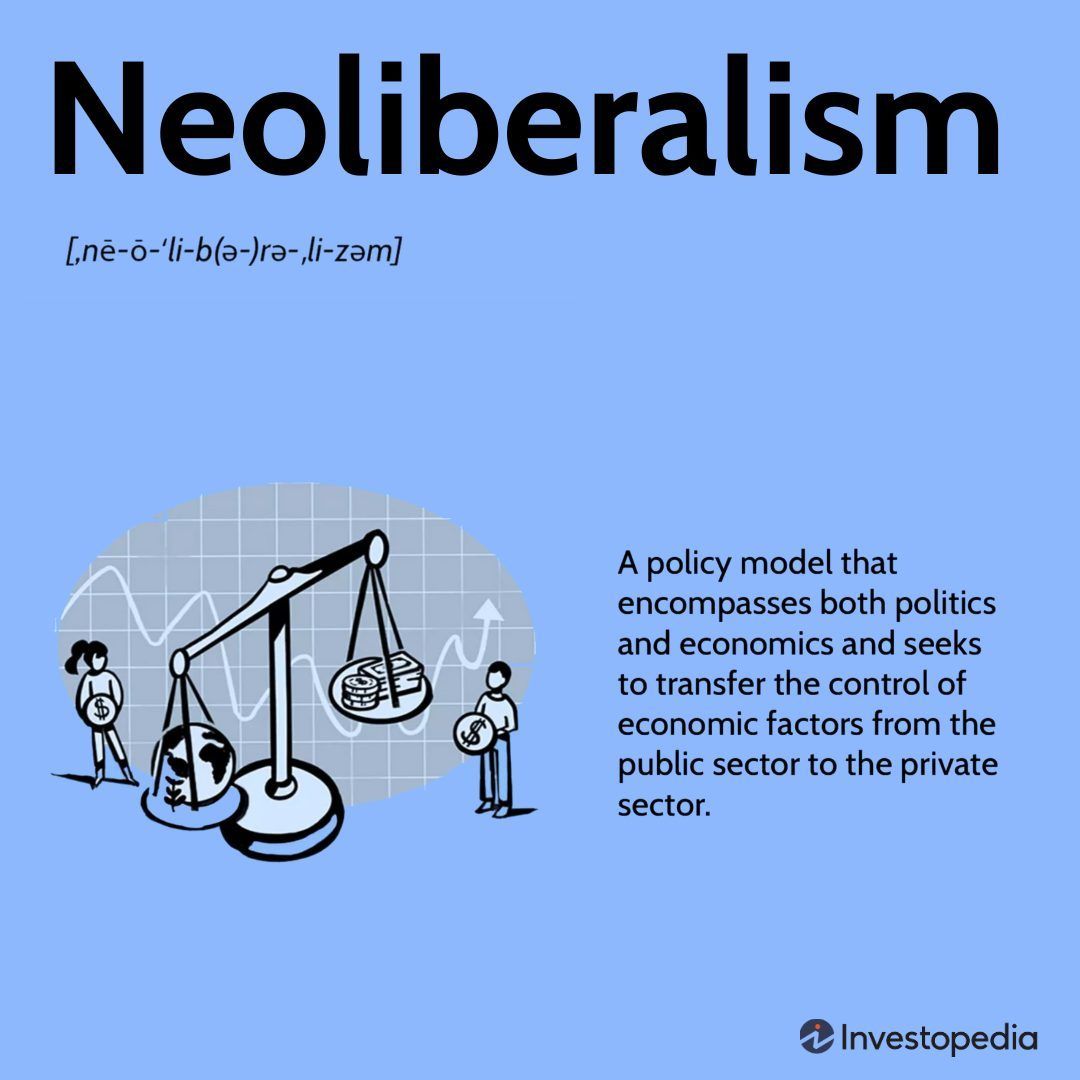
Few words in contemporary political and economic debate generate more heat and less clarity than "neoliberalism." Its critics use it to describe the source of almost every major social pathology of the past four decades: rising inequality, precarious work, financialized capitalism, the erosion of public services, the weakening of democratic accountability.
Its proponents - to the extent anyone embraces the label, which is rare - prefer terms like "economic liberalism," "market reform," or simply "sound economics." The terminological disagreement reflects a genuine dispute about substance: what is neoliberalism, what did it actually do to the world, and are we still living in it?
The most useful answer begins not with a definition but with a moment: the winter of 1947, when Friedrich Hayek gathered a group of economists, philosophers, and historians at the Mont Pelerin resort in the Swiss Alps.
The world had just emerged from a global depression and a catastrophic war; governments everywhere were expanding their roles in economic life; Keynesian economics dominated professional opinion; and socialism of various kinds held enormous intellectual prestige.
Hayek's group believed, passionately, that this was a catastrophic mistake - that market freedom and political freedom were inextricably linked, and that the road to serfdom was paved with good Keynesian intentions.
Over the next three decades, working largely outside mainstream policy influence, they developed the ideas that would eventually reshape the global economy.
"There is no alternative." - Margaret Thatcher, 1980, on her economic program
| Policy Area | Neoliberal Prescription | Criticism |
|---|---|---|
| Trade | Free trade; reduce tariffs and quotas | Deindustrialization in wealthy countries |
| Finance | Deregulate financial markets | Increased systemic risk; 2008 crisis |
| State services | Privatize state-owned enterprises | Reduced access; rent extraction |
| Labor | Reduce union power; increase flexibility | Wage stagnation; precarious work |
| Fiscal policy | Reduce deficits; cut public spending | Austerity depresses growth and welfare |
| Monetary policy | Independent central banks; target inflation | Prioritizes stability over employment |
Key Definitions
Neoliberalism: A contested family of ideas and policies that prioritize market mechanisms over state direction in allocating resources, emphasize individual freedom and private property rights, advocate reducing state intervention in economic life, and treat competition as the organizing principle of both economic and social affairs.
The term is used primarily by critics; proponents tend to use different labels.
Monetarism: Milton Friedman's macroeconomic doctrine that the money supply is the primary determinant of nominal economic output and that inflation is "always and everywhere a monetary phenomenon." Central banks should maintain a steady, predictable growth rate of the money supply rather than using discretionary policy to manage the business cycle.
Financialization: The growing role of financial markets, financial institutions, and financial motives in the operation of the economy. A characteristic feature of neoliberal-era economies: the financial sector's share of total corporate profits in the United States rose from roughly 10% in the 1950s to over 40% by the early 2000s.
TINA: "There Is No Alternative" - the rhetorical formulation associated with Margaret Thatcher, conveying the claim that market discipline was not a policy choice among alternatives but an economic necessity, making opposition to it not merely wrong but irrational.
Capital account liberalization: The removal of restrictions on cross-border capital flows, allowing investors to move money freely between countries. A central prescription of the Washington Consensus and a policy whose distributional and stability effects became deeply controversial.[12]
Intellectual Origins: Hayek, Friedman, and the Mont Pelerin Society
The Road to Serfdom
Friedrich Hayek's "The Road to Serfdom," published in 1944 while the war was still being fought, was a direct intervention in the political debate about postwar reconstruction.[1] Its central argument was philosophical as much as economic: economic freedom and political freedom were inextricably linked.
When governments took control of economic decisions - directing investment, allocating labor, setting prices - they necessarily concentrated power in ways that led toward authoritarian control.
This was not merely a theoretical possibility; Hayek traced the rise of National Socialism in Germany and fascism in Italy partly to the prior tradition of state economic intervention that had accustomed those societies to centralized direction.
The book became a surprise bestseller, condensed in Reader's Digest and distributed widely in the United States and United Kingdom.
It established Hayek as a public intellectual and gave him the platform for his deeper theoretical contribution: the "knowledge problem." The information required to coordinate a complex economy - the specific preferences, capabilities, technologies, and local conditions of millions of individuals - is dispersed throughout society in forms that are mostly tacit, inarticulate, and impossible to transmit to any central authority.
The price system in competitive markets performs an extraordinary function: it aggregates this dispersed information automatically, signaling relative scarcities and opportunities without any need for central coordination. No planning apparatus, however sophisticated, can replicate this function.
Hayek's later "The Constitution of Liberty" (1960) elaborated a positive political philosophy: a free society under the rule of law, in which general rules applied equally to all citizens (including governments) rather than particular directives aimed at specific individuals or groups.[2]
Milton Friedman and Capitalism as Freedom
Milton Friedman made the free-market case with greater accessibility and polemical directness than Hayek.[3]
"Capitalism and Freedom" (1962) argued that competitive capitalism was not merely economically efficient but a necessary condition for political freedom: concentration of economic power in the state's hands inevitably threatened political liberty.
The book's specific policy proposals were radical at the time - floating exchange rates, abolition of occupational licensing, education vouchers, a negative income tax to replace the welfare bureaucracy, elimination of the draft - and several have since entered mainstream policy debate.
His 1963 work with Anna Schwartz, "A Monetary History of the United States," made a transformative empirical argument: the Great Depression had not been a failure of capitalism but a failure of Federal Reserve policy.
The Fed had allowed the money supply to contract catastrophically between 1929 and 1933, turning a recession into a depression.[4]
The implication was that properly managed monetary policy could prevent depressions, and that the Keynesian diagnosis - that capitalism was inherently unstable and required fiscal management - was wrong.
The Long March Through the Institutions
The Mont Pelerin Society, founded by Hayek in 1947, served as the organizational network through which these ideas developed over three decades.
When Hayek won the Nobel Prize in Economics in 1974, and Friedman in 1976, the intellectual tide was already turning: the stagflation of the 1970s - simultaneous high inflation and high unemployment that Keynesian models said was impossible - created a crisis of mainstream macroeconomics that the monetarist and supply-side alternatives were positioned to fill.
Think tanks including the Heritage Foundation (founded 1973), the Cato Institute (1977), and the Adam Smith Institute (1977) translated these academic ideas into policy proposals for practitioners.
The Chicago School and the Chile Laboratory
Monetarism in Practice
The University of Chicago economics department, where Friedman spent most of his career, became the intellectual center of neoliberal economics.
The "Chicago Boys" - a group of Chilean economists trained at Chicago in the 1950s and 1960s under a US government-funded exchange program - provided the first large-scale test of the ideas in practice.
When General Augusto Pinochet seized power in Chile in the coup of September 11, 1973, overthrowing the democratically elected socialist government of Salvador Allende, he invited the Chicago-trained economists to design his economic program.
The Chilean experiment implemented nearly every element of the neoliberal program simultaneously: trade liberalization, financial deregulation, privatization of state enterprises, radical reduction of the public sector, reform of the pension system into a system of private individual accounts, and abandonment of active industrial policy.
The results were mixed: after a severe recession in 1974-75 and another crisis in 1982-83 (partly caused by the very financial deregulation the reforms had implemented), Chile eventually achieved sustained growth that continued through the democratic period after 1990.
Supporters cited Chile as proof that the program worked; critics noted that it required military dictatorship and killed or tortured tens of thousands of people to implement, raising the question of whether the economic outcomes were worth the political costs - and whether those outcomes could be attributed primarily to the market reforms or to other factors.
Thatcher and Reagan: Neoliberalism in Power
"There Is No Alternative"
Margaret Thatcher became Britain's Prime Minister in May 1979, Ronald Reagan became US President in January 1981.
Both came to power in countries experiencing serious economic difficulties - high inflation, slow growth, industrial unrest - and both implemented broadly similar programs drawing on the neoliberal intellectual framework, though with country-specific adaptations.
Thatcher's program had several distinct elements. She used high interest rates to squeeze inflation, producing a severe recession in 1980-81 with unemployment exceeding three million - the highest since the 1930s.
She confronted and defeated the trade union movement in a series of industrial confrontations, most famously the 1984-85 miners' strike, in which she refused to negotiate with the National Union of Mineworkers' leader Arthur Scargill for a full year, eventually breaking the strike and accelerating the closure of the British coal industry.
She privatized the nationalized industries: British Telecom, British Gas, British Airways, British Steel, British Petroleum, the water companies, the electricity generators.
The "Big Bang" financial deregulation of 1986 transformed the City of London, abolishing fixed commissions, removing the separation between brokers and market-makers, and opening the market to foreign banks, creating the globally integrated financial center it remains today.
Reagan cut the top marginal income tax rate from 70% to 50% in 1981 and to 28% by 1988, deregulated industries from airlines to savings and loans, and fought the air traffic controllers' union PATCO with particular symbolic force: when 11,345 controllers went on strike in August 1981, Reagan fired them all, decertified their union, and banned them from future federal employment.
The signal to organized labor was unambiguous. US union membership, which had stood at approximately 35% of the private sector workforce in the mid-1950s, has declined relatively continuously since, falling to approximately 6% of private sector workers by the early 2020s.
Globalization, Financialization, and the Washington Consensus
Building the Global Market
The international dimension of neoliberalism was as consequential as its domestic dimension.
Capital account liberalization - removing restrictions on cross-border capital flows - was pushed by the IMF as a prescription for developing countries throughout the 1980s and 1990s, despite limited evidence that it promoted growth and growing evidence that it increased financial instability.[6]
The World Trade Organization, founded in 1995, institutionalized trade liberalization and provided enforcement mechanisms for intellectual property rights and investment protections that significantly constrained national economic policy space.
The combination created the conditions for the offshoring of manufacturing from high-wage to low-wage countries that transformed the economic geography of rich countries.
Dani Rodrik's "The Globalization Paradox" (2011) formalized the fundamental tension: countries cannot simultaneously maintain deep economic integration, national policy sovereignty, and democratic governance.[9]
The neoliberal era prioritized the first at the expense of the other two, insulating market outcomes from democratic challenge through international legal commitments.
Quinn Slobodian's "Globalists: The End of Empire and the Birth of Neoliberalism" (2018) offered a revisionist reading of the neoliberal project that challenged the conventional narrative.
The Mont Pelerin neoliberals, Slobodian argued, were not primarily trying to liberate markets from states but to encase markets in international institutions - the IMF, GATT/WTO, the European Community - that would protect market outcomes from democratic redistribution by national governments.[7]
The project was not about shrinking the state but about using international institutional architecture to inoculate economic decisions against political challenge.
The Evidence on Outcomes
Growth, Inequality, and the Record
What did the neoliberal era actually deliver? The picture is more complex than either enthusiasts or critics allow.
On growth, the comparison between the postwar "Keynesian" era (roughly 1945-1973) and the neoliberal era (roughly 1980-2008) does not favor the latter in most rich countries: per capita growth rates were higher in the earlier period in the United States, United Kingdom, continental Europe, and most developing regions.
The exceptions are the economies of East and Southeast Asia, which achieved rapid growth through export-oriented industrialization during this period - though those economies typically used heterodox policies quite different from the Washington Consensus.
On inflation control, the neoliberal era scored genuine successes: the Volcker disinflation of the early 1980s, achieved at severe short-term cost, produced a long period of low and stable inflation that persisted through the 1990s and 2000s.
On trade, liberalization contributed to lower consumer goods prices and, as part of a larger process, the extraordinary growth of manufacturing in China, Vietnam, Bangladesh, and elsewhere that raised living standards for hundreds of millions of people.
On inequality, the evidence is unambiguous. Thomas Piketty's "Capital in the Twenty-First Century" (2013) assembled the most comprehensive historical dataset on income and wealth distribution, documenting a U-shaped curve: high concentration in the early 20th century, compression during the social democratic mid-20th century, and a return toward higher concentration from the 1980s onward.[10]
In the United States, the share of national income going to the top 1% roughly doubled between 1980 and 2010, from approximately 10% to over 20%, according to data assembled by Piketty and Emmanuel Saez.
Labor's share of national income declined by 5-10 percentage points across most OECD countries. The CEO-to-median-worker pay ratio at large American corporations rose from approximately 20:1 in 1965 to over 350:1 by 2020.
Crises and Critiques
2008 and the Flaw in the Model
The 2008 global financial crisis was the most direct challenge the neoliberal program had faced.
The crisis originated in the collapse of a US subprime mortgage market that had been built on financial innovations - collateralized debt obligations, credit default swaps, mortgage-backed securities - that the deregulatory philosophy had permitted to develop without adequate oversight.
When housing prices fell, the interconnections between these instruments meant that losses cascaded through the entire financial system, threatening institutions that had seemed stable.
The response required the very state intervention that neoliberalism had disparaged: government bailouts of financial institutions, central bank interventions at extraordinary scale, and fiscal stimulus.
The moral hazard was stark: financial institutions that had prospered by privatizing returns during the boom required socialized rescue during the bust.
David Harvey's framing - that neoliberalism was a political project to restore elite class power rather than a coherent economic program - seemed vindicated by the bailout dynamics.[5]
Alan Greenspan, whose tenure at the Federal Reserve had been associated with deregulatory philosophy, acknowledged in Congressional testimony in October 2008 that he had found a "flaw" in his ideology - the assumption that financial institutions' self-interest would lead them to protect their shareholders and the broader system.
Wolfgang Streeck's "Buying Time" (2013) offered a structural interpretation: neoliberal capitalism had serially managed its fundamental tension between capital accumulation and democratic redistribution through inflation (1970s), public debt (1980s-1990s), and financial innovation (2000s), each solution generating the next crisis.[8]
The 2016 IMF paper "Neoliberalism: Oversold?" - remarkable for its source - acknowledged that capital account liberalization had increased volatility and financial crises without clear growth benefits, and that fiscal consolidation had increased inequality and damaged economic performance under many conditions.
It was a significant, if diplomatically phrased, admission.
Post-Neoliberal Possibilities
The political consequences of the neoliberal era materialized on a significant scale in the 2010s.
The combination of stagnant wages, rising inequality, austerity policies after the 2008 crisis, bank bailouts that protected the wealthy while communities declined, and the perceived capture of mainstream politics by technocratic elites generated populist insurgencies across the ideological spectrum: Brexit, Trump, the Sanders and Corbyn movements, the rise of nationalist parties across Europe.
These movements, however incoherent their positive programs, shared a rejection of the globalist consensus.
The COVID-19 pandemic from 2020 produced a further rupture: governments intervened in economies at wartime scale, providing massive income support, directing industrial capacity toward public health objectives, and discovering that the state could act more decisively than the neoliberal playbook had allowed.
The Biden administration's industrial policy agenda - the CHIPS and Science Act, the Inflation Reduction Act of 2022, substantial infrastructure investment - explicitly embraced active state industrial strategy in the country where neoliberal ideas had been most dominant.
Mariana Mazzucato's "The Entrepreneurial State" (2013) provided intellectual scaffolding, documenting the central historical role of public investment in the technologies underlying smartphones, the internet, and pharmaceutical innovation.[11]
Whether this represents a genuine paradigm shift - a post-neoliberal era in the making - or a temporary deviation within a fundamentally neoliberal framework is genuinely uncertain.
The underlying institutional architecture - trade agreements, central bank mandates, labor market deregulation, corporate governance norms - that embeds neoliberal policy remains largely in place.
Slobodian's encasement framework suggests that even significant domestic policy changes may not fundamentally alter the international economic architecture.
But the ideological self-confidence of the Washington Consensus era has clearly passed, and both the policy space and the intellectual mood of the 2020s look substantially different from those of the 1990s.
Sources & Further Reading
- Hayek, Friedrich A. The Road to Serfdom. University of Chicago Press, 1944.
- Hayek, Friedrich A. "The Constitution of Liberty". University of Chicago Press, 1960.
- Friedman, Milton. Capitalism and Freedom. University of Chicago Press, 1962.
- Friedman, Milton, and Anna Jacobson Schwartz. "A Monetary History of the United States, 1867-1960". Princeton University Press, 1963.
- Harvey, David. A Brief History of Neoliberalism. Oxford University Press, 2005.
- Stiglitz, Joseph E. Globalization and Its Discontents. W.W. Norton, 2002.
- Slobodian, Quinn. Globalists: The End of Empire and the Birth of Neoliberalism. Harvard University Press, 2018.
- Streeck, Wolfgang. Buying Time: The Delayed Crisis of Democratic Capitalism. Verso, 2013.
- Rodrik, Dani. The Globalization Paradox: Democracy and the Future of the World Economy. W.W. Norton, 2011.
- Piketty, Thomas. Capital in the Twenty-First Century. Belknap Press of Harvard University Press, 2014.
- Mazzucato, Mariana. The Entrepreneurial State: Debunking Public vs. Private Sector Myths. Anthem Press, 2013.
- Quinn, Dennis P., and A. Maria Toyoda. "Does Capital Account Liberalization Lead to Growth?" Review of Financial Studies, 2008.
The term itself is contested: most of those whose ideas and policies are labeled neoliberal do not use the word to describe themselves. Margaret Thatcher did not call her program neoliberal; she called it common sense. Ronald Reagan spoke of freedom and opportunity.
The IMF called its prescriptions sound economic management. The label comes primarily from critics, which has generated accusations that it is a polemical rather than analytical concept.
This article aims to explain what the term refers to, where the ideas came from, how they were implemented, what the evidence says about their effects, and what has happened to the ideology after the shocks of 2008 and 2020.
"The market is not an invention of capitalism. It has existed for centuries. It is an invention of civilization." - Mikhail Gorbachev, in an interview often cited by neoliberal proponents to indicate even their ideological opponents accepted market logic by the 1990s
Key Definitions
Neoliberalism: Broadly, an ideological and policy orientation favoring market mechanisms over state direction, including deregulation, privatization, trade liberalization, fiscal restraint, and skepticism toward state intervention in economic life.
The term is used almost exclusively by critics; proponents describe the same orientation as free-market economics, economic liberalism, or simply sound policy.
Classical liberalism: The 19th-century tradition emphasizing individual liberty, limited government, free trade, and constitutional constraints on state power, associated with thinkers including Adam Smith, John Stuart Mill, and Herbert Spencer.
Neoliberalism descends from but modifies this tradition, particularly by accepting a larger role for international institutions and rules.
Washington Consensus: The set of ten economic policy prescriptions identified by John Williamson in 1989 as the conventional wisdom of Washington-based institutions (IMF, World Bank, US Treasury) for developing country reform: fiscal discipline, tax base broadening, trade liberalization, privatization, deregulation, and protection of property rights, among others.
Structural adjustment program: Conditions attached to IMF and World Bank loans requiring recipient countries to implement neoliberal economic reforms, particularly fiscal austerity, privatization, and trade and capital account liberalization.
Financialization: The increasing dominance of financial markets, institutions, and motives in economic life, associated with the neoliberal period particularly from the 1980s onward.
Intellectual Origins: Hayek, Friedman, and the Mont Pelerin Society
The intellectual foundations of neoliberalism were laid in the 1940s, at a moment when market economics seemed discredited by the Great Depression and threatened by the advance of state planning, fascism, and communism. Friedrich August Hayek's "The Road to Serfdom" (1944) was the galvanizing text.
Writing in wartime Britain, where economic planning had broad political support as part of the war effort and as a model for postwar reconstruction, Hayek argued that economic planning and political freedom were incompatible.
Not because planners were malicious but because they would inevitably need to coerce: a planned economy requires enforcing priorities that not everyone accepts, and the logic of planning would inevitably expand the state's reach into political and personal life.
Hayek's deeper argument was epistemological. In a celebrated 1945 paper, "The Use of Knowledge in Society," he argued that the information needed to coordinate a complex economy is irreducibly dispersed - distributed in fragments across millions of individual minds, most of it tacit and incommunicable.
Prices in competitive markets aggregate and transmit this distributed information through the impersonal mechanism of the price system, enabling coordination without central direction.
No planning apparatus, however sophisticated, could replicate this information-processing function because the necessary information does not exist in any form that could be gathered and used by a central planner.
Milton Friedman's "Capitalism and Freedom" (1962) translated Hayekian principles into a policy program with characteristic polemical directness.
Friedman called for floating exchange rates (against the Bretton Woods fixed-rate system), competitive deregulation of industries from airlines to banking, education vouchers, abolition of the draft, drug legalization, and replacement of the welfare system with a negative income tax.
His 1963 work with Anna Schwartz reinterpreted the Great Depression as a Federal Reserve policy failure rather than a market failure, challenging the Keynesian consensus that had dominated postwar macroeconomics and providing intellectual foundations for monetarism.
The Mont Pelerin Society, founded in April 1947 at a resort near Vevey, Switzerland, assembled Hayek, Friedman, Karl Popper, George Stigler, Ludwig von Mises, Wilhelm Ropke, and a small group of like-minded economists, philosophers, and historians for a week of discussions.
The society became the organizational backbone of the neoliberal intellectual network - a forum where economists from Chicago, Vienna, Geneva, and London could meet, debate, coordinate, and develop their ideas across decades during which Keynesianism dominated mainstream economics.
By the time political conditions shifted in the late 1970s, the ideas were ready.
From Ideas to Policy: Pinochet, Thatcher, Reagan
The route from intellectual network to government policy required political opportunity as well as intellectual preparation. Three political moments in the 1970s and 1980s proved decisive.
Chile's post-1973 experiment was the first full-scale implementation of Chicago-school economics in a national context.
The Chicago Boys, several of whom had been trained under Friedman and Harberger through a partnership between the University of Chicago and the Catholic University of Chile funded by USAID, implemented their program with radical speed: price controls abolished, state enterprises privatized, tariffs slashed, the pension system replaced with individual accounts managed by private fund companies (the AFP system, later influential as a model globally).
GDP contracted sharply in the mid-1970s, recovered with a debt-fueled boom in the late 1970s, collapsed again in 1982-83, and then grew strongly in the late 1980s.
Whether Chile's subsequent development vindicates the neoliberal experiment is contested: critics note that growth required significant state intervention (nationalized copper mines provided much of the revenue) and that inequality remained among the highest in Latin America.
Margaret Thatcher's arrival in Downing Street in May 1979 brought neoliberal ideas to a G7 government.
Influenced by Keith Joseph and the Institute of Economic Affairs, which had been promoting Hayekian ideas in British conservative circles since the 1950s, Thatcher pursued a program combining monetarist inflation control (under Chancellor Geoffrey Howe), privatization of nationalized industries (British Telecom, British Gas, British Steel, British Airways, water utilities), and deregulation of financial markets (the 1986 "Big Bang" removed controls on London's financial sector).
The program also included systematic reduction of trade union power, culminating in the 1984-85 miners' strike, which Thatcher won after a year-long confrontation.
Unemployment rose sharply in the early 1980s before falling; manufacturing contracted; financial services expanded. The distributional effects were clear: real wages for the highest earners rose substantially while wages for the lowest earners stagnated, and Gini coefficients increased markedly.
Ronald Reagan's administration from 1981 pursued similar policies in the United States: the Kemp-Roth tax cuts reduced the top federal income tax rate from 70 to 50 percent (and later to 28 percent under the 1986 Tax Reform Act), regulatory agencies were restructured to reduce their activity, financial deregulation proceeded, and the decisive confrontation with organized labor came in August 1981 when Reagan fired 11,000 striking air traffic controllers and decertified their union (PATCO).
The Laffer curve - the theoretical proposition that tax cuts could pay for themselves by stimulating growth and broadening the tax base - provided intellectual justification for fiscal policy that produced large deficits despite claimed supply-side effects.
The Washington Consensus and the Developing World
John Williamson's 1989 paper "What Washington Means by Policy Reform," written for a conference on Latin American economic reform, identified ten propositions he believed commanded consensus among Washington-based economic institutions: fiscal discipline, reordering public expenditure toward health, education, and infrastructure, and tax reform.
The remaining propositions were interest rate liberalization, competitive exchange rates, trade liberalization, liberalization of inward foreign direct investment, privatization of state enterprises, deregulation, and secure property rights.
Williamson intended the paper as a descriptive codification of existing consensus, not a normative prescription, and he later regretted that the term became a polemical shorthand for aggressive market fundamentalism.
But in practice, the Washington Consensus became operationalized through IMF and World Bank structural adjustment programs, which attached detailed conditionality requirements to emergency financing for countries in balance-of-payments crises.
Countries with no alternative source of emergency credit - which in the 1980s meant most of Latin America, sub-Saharan Africa, and Eastern Europe - had little choice but to accept.
Joseph Stiglitz, who served as Chief Economist at the World Bank from 1997 to 2000, provided the most influential insider critique in "Globalization and Its Discontents" (2002).
Stiglitz argued that the IMF applied ideological prescriptions with inadequate attention to specific country circumstances, imposed contractionary austerity during downturns that deepened recessions, pushed capital account liberalization before countries had the institutional capacity to regulate capital flows, and prioritized the interests of international creditors over domestic workers.
He contrasted this with East Asian development models: South Korea, Taiwan, and later China had achieved rapid growth with activist industrial policy, managed trade, and selective capital controls that contradicted Washington Consensus prescriptions but worked.
Argentina's crisis of 2001-2002 became the emblematic failure. After a decade of currency board convertibility, privatization, and fiscal adjustment, Argentina suffered a catastrophic debt crisis, currency collapse, and social emergency.
The peso devalued by 70 percent, unemployment exceeded 20 percent, and the middle class queued at soup kitchens.
The crisis was widely attributed to the rigidity of the convertibility regime and the accumulation of fiscal imbalances under structural adjustment, though economists debate the relative weight of external shocks versus policy failures.
Evidence on Inequality and Labor
The distributional effects of neoliberal policies have been extensively studied, and several findings are robust across methodologies and countries.
Within-country income inequality increased in most advanced economies during the period of neoliberal policy adoption.
Thomas Piketty's "Capital in the Twenty-First Century" (2014), drawing on historical tax records across France, the United States, United Kingdom, Germany, and Sweden, documented a U-shaped pattern: high inequality in the early 20th century, compression during the postwar social democratic era, and a return to rising inequality from the 1980s.
Piketty's theoretical argument that the rate of return on capital (r) systematically exceeds the economic growth rate (g) under normal conditions provides a mechanism: capital owners accumulate wealth faster than the economy grows, concentrating income and wealth at the top.
The labor share of national income - the fraction of GDP going to workers as wages rather than to capital as profits - declined by approximately 5 to 10 percentage points in most OECD countries from the early 1980s through the 2010s, depending on the measure used.
Karabarbounis and Neiman (2014) attribute much of this to falling capital goods prices (making capital relatively cheaper, inducing substitution).
Daron Acemoglu and colleagues point to labor market deregulation, declining union density, and changes in corporate governance norms toward shareholder value maximization as additional contributors.
The CEO-to-worker pay ratio in the United States moved from roughly 20:1 in 1965 to approximately 350:1 by 2020 (Economic Policy Institute estimates), reflecting both rising executive compensation and stagnant wages for typical workers.
This divergence is partly explained by changes in corporate governance norms - the shift from stakeholder capitalism (associated with postwar corporate practice) to shareholder value maximization (associated with Jensen and Meckling's 1976 principal-agent theory and popularized by Friedman's argument that firms' only responsibility is to their shareholders) - and partly by deregulation of executive compensation markets.
The counterargument is that global inequality between countries declined significantly during the same period, primarily due to rapid growth in China, India, and other developing countries that integrated into the global trading system.
This creates an irreducible tension: if neoliberal globalization contributed to within-country polarization in rich countries while enabling the largest reduction in global poverty in human history, how should the overall assessment be made?
The answer depends on both empirical questions (was the poverty reduction caused by neoliberal policies or would it have happened anyway with different policies?) and normative questions (how should we weigh distributional changes within and between countries?).
Critiques from Multiple Traditions
The critique of neoliberalism spans the political and intellectual spectrum, with different critics emphasizing different failures.
David Harvey's "A Brief History of Neoliberalism" (2005) offers a Marxian interpretation: neoliberalism is a political project for restoring the class power of capital following the compression of the postwar period, using free-market ideology as legitimation.
The evidence Harvey marshals - the sharp increase in the income share of the top 1 percent, the legislative and regulatory changes that facilitated it - is difficult to explain purely as unintended consequences of technical economic policy.
Quinn Slobodian's "Globalists: The End of Empire and the Birth of Neoliberalism" (2018) offers a revisionist account of the intellectual history.
Rather than neoliberals seeking to liberate markets from states, Slobodian argues, the Geneva school of neoliberalism sought to encase markets in international institutions - GATT, the IMF, the European economic institutions - specifically to insulate economic decisions from democratic politics at the national level.
The project was not anti-statist but meta-statist: building institutions above and beyond democratic reach.
The communitarian critique, associated with thinkers including Robert Nisbet, Robert Bellah, and Michael Sandel, argues that market expansion corrodes the social bonds, communal institutions, and non-market values - family, religious community, civic association, professional ethics - that make market society itself possible.
Sandel's "What Money Can't Buy: The Moral Limits of Markets" (2012) argues that marketizing domains previously governed by non-market norms does not merely allocate them more efficiently; it changes their character in ways that may destroy the values at stake.
The ecological critique observes that neoliberal market frameworks systematically fail to incorporate environmental externalities - costs imposed on third parties and future generations.
Climate change is the most consequential example: the carbon price needed to align private incentives with social costs has been resisted by neoliberal-aligned political coalitions for decades, with consequences that will compound for centuries.
Ha-Joon Chang's "Kicking Away the Ladder" (2002) adds the development critique: rich countries achieved development through activist industrial policy that neoliberal prescriptions deny to developing countries.
After Neoliberalism
The 2008 global financial crisis punctured neoliberal intellectual confidence more than it changed actual policy. The immediate response - massive government intervention, bailouts of financial institutions, fiscal stimulus - contradicted neoliberal precepts.
But the medium-term response, particularly in Europe, took the form of austerity, driven by a return to fiscal orthodoxy.
Research by Alberto Alesina and Silvia Ardagna (2009) claiming that "expansionary fiscal consolidation" was possible - that austerity could actually stimulate growth - provided cover for deficit reduction during recession, with results that the IMF's own subsequent research found had significantly underestimated the harm of fiscal multipliers.
The COVID-19 pandemic and its aftermath accelerated pre-existing trends toward what some economists call the "New Washington Consensus" or post-neoliberal industrial policy.
In the United States, the Biden administration's Inflation Reduction Act (2022), CHIPS and Science Act (2022), and Infrastructure Investment and Jobs Act (2021) represented the largest program of active industrial policy since the New Deal, explicitly rejecting the Washington Consensus objection to picking winners.
Mariana Mazzucato's "The Entrepreneurial State" (2013), documenting the central role of public investment in creating the technologies underlying smartphones and the internet, provided intellectual legitimacy for this shift.
Whether the current moment represents a genuine paradigm shift or a temporary deviation remains genuinely uncertain. The international economic architecture built over decades - trade agreements that constrain industrial policy, capital account mobility, central bank mandates focused on price stability - remains largely in place.
Slobodian's encasement framework suggests that neoliberal institutional arrangements may prove more durable than the ideological confidence that created them.
But the policy consensus of the 2020s is unambiguously different from that of the 1990s, and the question of what should replace the Washington Consensus is an open one.
Sources \& Further Reading
- Acemoglu, D., & Restrepo, P. (2019). Automation and new tasks: How technology displaces and reinstates labor. Journal of Economic Perspectives, 33(2), 3-30.
- Chang, H-J. (2002). Kicking Away the Ladder: Development Strategy in Historical Perspective. Anthem Press.
- Friedman, M. (1962). Capitalism and Freedom. University of Chicago Press.
- Harvey, D. (2005). A Brief History of Neoliberalism. Oxford University Press.
- Hayek, F.A. (1944). The Road to Serfdom. University of Chicago Press.
- Hayek, F.A. (1945). The use of knowledge in society. American Economic Review, 35(4), 519-530.
- Karabarbounis, L., & Neiman, B. (2014). The global decline of the labor share. Quarterly Journal of Economics, 129(1), 61-103.
- Mazzucato, M. (2013). The Entrepreneurial State: Debunking Public vs. Private Sector Myths. Anthem Press.
- Piketty, T. (2014). Capital in the Twenty-First Century. Harvard University Press.
- Sandel, M. (2012). What Money Can't Buy: The Moral Limits of Markets. Farrar, Straus and Giroux.
- Slobodian, Q. (2018). Globalists: The End of Empire and the Birth of Neoliberalism. Harvard University Press.
- Stiglitz, J. (2002). Globalization and Its Discontents. W.W. Norton.
- Williamson, J. (1989). What Washington means by policy reform. In J. Williamson (Ed.), Latin American Adjustment: How Much Has Happened? (pp. 7-20). Peterson Institute for International Economics.