
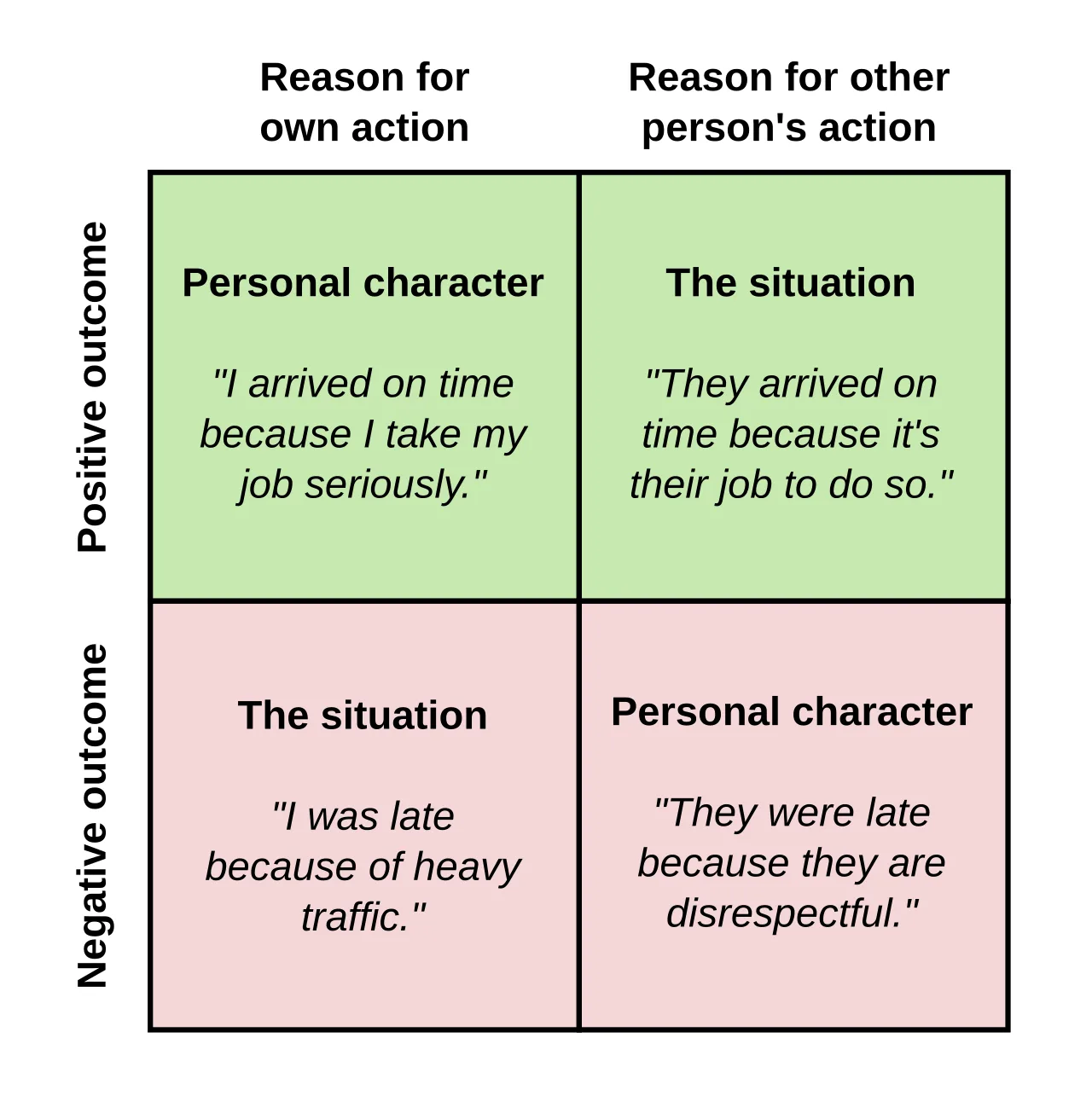
The fundamental attribution error is the tendency to explain other people's behavior too readily through character while underweighting situational pressures. It persists even when context is explicit, though its strength varies with culture, cognitive load, threat, and whether the actor is part of one's own group. The bias helps explain why observers grant themselves complexity and constraint while treating others' actions as evidence of stable traits.
"The tendency to overattribute behavior to internal dispositions while underweighting situational factors is one of the most robust findings in social psychology." - Lee Ross, 1977
Why We Locate Cause in People When Circumstance Is the Culprit
In the spring of 1967, social psychologists Edward E. Jones and Victor Harris ran an experiment at Yale that should have produced an obvious result.[1] They gave participants essays either supporting or opposing Fidel Castro's government in Cuba.
For some participants, the experimenters clearly stated that the essay writers had freely chosen their positions. For others, the critical variable was added: the writers had been assigned their position by the experimenter.
This latter condition was the crux of the design. If you are told that someone wrote a pro-Castro essay because an authority figure instructed them to, you have no rational basis for concluding that they personally hold pro-Castro views. The situational cause of the behavior is explicit, visible, and complete.
Yet the participants did conclude exactly that. They consistently rated assigned-position essay writers as holding the attitudes their essays expressed, even when they knew assignment was forced.
The finding, published in the Journal of Experimental Social Psychology, appeared to reveal something structurally wrong with how ordinary social reasoning works - not a mistake arising from bad information or limited thinking, but a systematic pull toward the person as cause, regardless of what the evidence actually warranted.
The experiment held up across replications, modifications, and decades. Researchers tried weakening the situational cue. They tried strengthening it. They told participants explicitly that the writer had been given a list of arguments to use, that they had no choice, that the essay was produced under time pressure.
None of it fully neutralized the effect. Some dispositional attribution always leaked through. Jones and Harris had found what appeared to be a default setting of social perception: observe behavior, infer character.
The inference proceeds automatically, and situational context, even when explicitly supplied, fails to fully interrupt it.
A decade later, in 1977, the social psychologist Lee Ross gave this phenomenon a name.[2]
Writing in Leonard Berkowitz's Advances in Experimental Social Psychology, Ross called it the Fundamental Attribution Error - the tendency to underestimate the impact of situational factors and to overestimate the role of dispositional factors in controlling behavior.
The word "fundamental" carried weight. Ross was not merely describing one bias among many.
He was identifying a structural feature of ordinary social cognition - one that generates a whole family of more specific errors and that lies near the root of how human beings make sense of one another.
Attribution Patterns: A Comparison
The Fundamental Attribution Error does not operate identically in all conditions. Its strength varies across perspectives, cultures, domains, and threat levels. The table below maps how the attributional tendency shifts across key dimensions.
| Dimension | Situational Attribution | Dispositional Attribution | Key Finding |
|---|---|---|---|
| Actor-Observer Effect | Actors explain their own behavior by citing context, constraints, and circumstance | Observers explain the same behavior by citing the actor's stable traits | Jones and Nisbett (1972): we grant ourselves situational complexity we deny to others |
| Cultural Context | East Asian participants (Korean, Japanese, Chinese) show greater situational sensitivity | Western (especially American) participants show stronger dispositional pull | Choi, Nisbett, and Norenzayan (1999): correspondence bias substantially weaker in collectivist cultures; Miller (1984): Indian respondents give more situational explanations than Americans |
| Domain of Behavior | Neutral or ambiguous behaviors receive more situational consideration | Negative or morally laden behaviors trigger swift dispositional inference | Malle (2006) meta-analysis: dispositional attribution dominates especially for negative acts and out-group members |
| Cognitive Load | When cognitively unencumbered, observers more likely to complete the situational correction step | When cognitively busy, observers remain anchored to the automatic dispositional inference | Gilbert, Pelham, and Krull (1988): dual-task participants failed to revise dispositional impressions even when situational cause was explicit |
| Threat Conditions | Low-threat conditions allow deliberate, nuanced attribution | High-threat or high-stakes conditions amplify dispositional attribution and suppress correction | Tetlock (1985): accountability to audiences prompts more complex attribution, but default under low accountability is dispositional |
| In-Group vs. Out-Group | In-group members' negative behaviors receive more situational explanation | Out-group members' negative behaviors receive more dispositional explanation | Malle (2006); consistent with broader inter-group attribution asymmetry literature |
Intellectual Lineage: Who Influenced Whom
The Fundamental Attribution Error did not arrive without ancestry. Its intellectual genealogy runs through several decades of social and cognitive psychology, each generation sharpening the problem.
Fritz Heider is the origin point. His 1944 paper "Social Perception and Phenomenal Causality," published in Psychological Review, introduced the concept of naive psychology - the commonsense causal reasoning that underlies everyday social perception.
Heider argued that the perceptual field is organized around persons as causes: we see people as originating their behavior in a way we do not see the situation as originating it.[13]
His 1958 book The Psychology of Interpersonal Relations (Wiley) formalized this into the distinction between personal causality - behavior originating from intentions - and impersonal causality.
Heider observed that unit formation favors person-level attribution: behavior "belongs to" the person who performs it in a way that situational forces do not easily displace.
Edward Jones and Keith Davis extended this in 1965 with their theory of correspondent inferences, proposing that observers infer that behavior corresponds to an underlying intention and trait.
Conditions such as the noncommon effects of a choice - the distinctive outcomes that only that choice produces - were supposed to license stronger dispositional inferences.
Jones spent the next decade discovering empirically how far observers will extend the inference beyond what this framework licenses.
Jones himself, in a 1979 paper published in American Psychologist, introduced the term "correspondence bias" as an alternative label for the phenomenon - emphasizing its logical structure (the unwarranted assumption that behavior corresponds to disposition) rather than its frequency or fundamentality.
Jones was more cautious than Ross about universality: he saw the bias as a robust regularity rather than an iron law.
Harold Kelley (1967) contributed the covariation model, offering a normatively rational account of attribution via consistency, distinctiveness, and consensus information. The model described how a careful, information-rich reasoner ought to assign causality.
Subsequent work by Nisbett, Ross, and others demonstrated that actual reasoners depart from the Kelley model predictably and systematically - and that the departure is overwhelmingly in the direction of the person.[14]
Richard Nisbett and Lee Ross consolidated the field in their 1980 book Human Inference: Strategies and Shortcomings of Social Judgment (Prentice-Hall), which situated the attribution literature within the broader heuristics-and-biases framework being developed by Tversky and Kahneman.
They introduced the concept of the "person-as-causal-agent" bias - the tendency to use the person as the primary explanatory anchor - and argued that it was continuous with the general anchoring processes that distort judgment in non-social domains as well.
The book became a standard reference, framing attribution bias not as an isolated curiosity but as one manifestation of a general architecture of judgment.
Cognitive Science: Mechanisms and Models
Understanding why the error occurs required moving below the behavioral level into the cognitive processes that generate attribution.
The most influential mechanistic account is Gilbert and Malone's two-step model, developed across a series of studies and synthesized in their 1995 paper "The Correspondence Bias" in Psychological Bulletin (117[1], 21-38).[3]
Step one is automatic and irresistible: upon observing behavior, the perceiver immediately and involuntarily characterizes it in dispositional terms. Someone stumbles; the mental register reads "clumsy." Someone raises their voice; the register reads "aggressive." This inference does not require deliberate reasoning.
It precedes it. Using a neural and cognitive architecture organized around person-level social perception, the observer produces a dispositional attribution as the default output.
Step two is conditional and effortful: the observer may attempt to correct the initial inference by incorporating situational information. Is the stumble explained by a broken paving stone? Is the raised voice explained by someone's hearing impairment across the room?
This correction draws on working memory, attentional resources, and motivation. It can be crowded out.
The empirical support for this architecture came primarily from Daniel Gilbert, Brett Pelham, and Douglas Krull, whose 1988 experiment in Journal of Personality and Social Psychology (54[5], 733-740) had participants watch a videotape of an anxious woman discussing personal problems.[4]
All participants received information indicating that the topics she was discussing were inherently anxiety-provoking for anyone. Participants who watched without distraction partially corrected their dispositional inference - they rated her as less dispositionally anxious than her behavior alone would suggest.
Participants who simultaneously performed a memory task did not correct; they remained anchored to the automatic dispositional judgment. The situational information was available to all; only those with cognitive resources managed to use it.
Gilbert extended this line of research across several studies in the late 1980s and early 1990s, showing that the correction step is selectively impaired by cognitive load, time pressure, and distraction.
The implication is stark: the social conditions that most often produce dispositional errors - rushed meetings, emotionally charged interactions, high-stakes judgment under pressure - are precisely the conditions that deplete the cognitive resources needed for situational correction.
Philip Tetlock's 1985 paper "Accountability: A Social Check on the Fundamental Attribution Error" in Social Psychology Quarterly (48[3], 227-236) demonstrated that the error is modulated by social pressure.
When participants expected to justify their judgments to a knowledgeable audience, they engaged in more effortful, situationally sensitive reasoning. Accountability activated the correction step even when internal motivation might not have.
This does not eliminate the error; it merely shows that social structures can trigger the effortful override that cognitive architecture does not deliver automatically.
Glenn Reeder's 2009 work on the attribution of mental states, published in Social Cognition, added a further layer of complexity.
Reeder proposed that what looks like a uniform dispositional attribution tendency actually masks selective inference patterns: observers are particularly sensitive to behaviors that reveal the presence of a negative trait (one brutal act implies cruelty) and less sensitive to behaviors that could only follow from a positive trait.[15]
The error is not symmetric across valence, and the underlying mechanism involves reasoning about moral character specifically, not just causal agency in general.
Four Named Case Studies
Case Study 1: The Castro Essay Experiment (Jones and Harris, 1967)
The original experiment remains the paradigm case. Jones and Harris's design stripped the situation of ambiguity: participants were told, explicitly, that essay writers had been assigned their positions. No information about the writer's true views was available beyond the essay content.
The rational inference was zero: a forced essay licenses no conclusion about the writer's actual beliefs.
What participants produced instead was a significant positive correlation between essay content and attributed attitude, even in the assigned condition.
The effect size was smaller than in the free-choice condition, indicating that participants were not entirely ignoring situational information, but the attribution persisted well above zero.
Writers of pro-Castro essays were rated as more pro-Castro than writers of anti-Castro essays, regardless of whether choice had been free or constrained.
The study has been replicated with speech topics, legal arguments, debate positions, and advertising copy. The robustness of the effect across four decades of replication - with modifications to context, nationality, and experimental framing - established it as one of the most reliable findings in social psychology.
Case Study 2: The Actor-Observer Asymmetry (Jones and Nisbett, 1972)
Edward Jones and Richard Nisbett's 1972 theoretical paper "The Actor and the Observer: Divergent Perceptions of the Causes of Behavior" (published in Attribution: Perceiving the Causes of Behavior, edited by Jones et al., General Learning Press) proposed and synthesized evidence for a systematic asymmetry: actors attribute their own behavior to situational causes; observers attribute the same behavior to dispositional causes.
The explanation they offered was attentional: actors, facing outward into a situation that fills their phenomenal field, see their behavior as a response to a dense array of environmental demands.[5]
Observers, viewing the actor as a figure against a relatively undifferentiated background, naturally assign causality to the most salient entity in their perceptual field - the person.
Nisbett, Caputo, Legant, and Marecek tested this in 1973 (Journal of Personality and Social Psychology, 27[2], 154-164) by asking participants to explain their own behavior and the behavior of a close friend across a range of situations.
Participants wrote more trait-language for friends than for themselves, and more situational language for themselves than for friends.
The asymmetry was specific and systematic. Later work showed it was reduced - though not eliminated - when participants were asked to imagine themselves in the actor's position, confirming that it is primarily a product of attentional and informational asymmetry rather than motivated self-protection.
Case Study 3: Cultural Variation (Choi, Nisbett, and Norenzayan, 1999; Miller, 1984)
The cross-cultural challenge to the "fundamental" in Fundamental Attribution Error came from two streams of research.
Joan Miller's 1984 study, published in Journal of Personality and Social Psychology (46[5], 961-978), compared American and Indian children and adults across age groups in explaining social transgressions and prosocial behaviors.[7]
American respondents showed increasing use of dispositional explanation with age - a developmental trajectory that paralleled enculturation into Western individualist norms.
Indian respondents showed the opposite pattern: adult Indians gave more situational explanations than Indian children did, reflecting increasing enculturation into a more contextual framework. The finding was striking: the developmental direction of attribution was reversed across cultures.
Incheol Choi, Richard Nisbett, and Ara Norenzayan's 1999 paper "Causal Attribution Across Cultures: Variation and Universality" in Personality and Social Psychology Review (3[1], 47-61) presented Korean and American participants with Jones-and-Harris-style forced-essay paradigms and other attribution tasks.[6]
American participants replicated the classic correspondence bias. Korean participants showed significantly reduced correspondence bias and showed more situational sensitivity even when situational information was made increasingly salient.
The authors argued that the difference reflects a deeper divergence in implicit theories of self: Western individualist cultures construct a self that is bounded, internally caused, and the locus of agency; East Asian collectivist cultures construct a self that is embedded in social relations and constitutively responsive to context.
Attribution follows ontology.
Case Study 4: Milgram's Obedience Studies (Milgram, 1963) and the Attribution Error in Prediction
Stanley Milgram's 1963 studies in Journal of Abnormal and Social Psychology (67[4], 371-378) are most often discussed as demonstrations of obedience to authority.[8] They are equally instructive as demonstrations of the Fundamental Attribution Error in the realm of prediction.
Before conducting the studies, Milgram asked psychiatrists, graduate students, and ordinary adults to predict how many participants would administer the maximum 450-volt shock.
The consensus was that fewer than 2 percent would do so - and that those who did would be pathological or sadistic types. The actual result was 65 percent.
The predictors committed the error in advance: they assumed that behavioral variance would be explained by dispositional variance among participants.
They did not adequately weight the situational variables that Milgram's design deliberately maximized - the legitimizing presence of a scientific authority, the incremental escalation of voltage, the physical separation of action from consequence, the binding effect of prior commitment.
The gap between predicted and actual behavior is a direct measure of how much situational force was discounted.
Ross and Nisbett's 1991 book The Person and the Situation (McGraw-Hill) used the Milgram results as a centerpiece illustration of situational power and of the general failure of dispositional prediction.
Empirical Research: Findings and Evidence
The empirical literature on the Fundamental Attribution Error is large enough to resist easy summary, but several findings are especially load-bearing.
The Jones and Harris (1967) effect has been replicated across cultures, ages, and experimental variations, consistently showing that situational constraint information - even when explicitly stated - fails to fully neutralize dispositional attribution.
The effect size is typically modest, meaning the bias is real and reliable but not total: participants do use situational information to some degree, they simply under-correct.
Bertram Malle's 2006 meta-analysis in Psychological Bulletin (132[6], 895-919) synthesized the actor-observer asymmetry literature and reached surprising conclusions: the asymmetry for explanations of behavior is smaller and more conditional than the original Jones-Nisbett paper suggested, varying substantially across positive versus negative events, intentional versus unintentional behaviors, and the type of explanation requested.
When participants explain intentional behavior, the actor-observer asymmetry is weaker and sometimes reverses.
When they explain unintentional or negative behavior, the asymmetry is robust. Malle's meta-analysis did not debunk the FAE but significantly refined the conditions of its occurrence.[12]
Cross-cultural work by Nisbett and collaborators, summarized in Nisbett's 2003 book The Geography of Thought (Free Press), established that the East-West difference in situational versus dispositional attribution is among the most replicable cross-cultural findings in social psychology.
The difference appears in perceptual tasks - holistic versus analytic attention to visual scenes - not only in verbal attribution tasks, suggesting that the attribution asymmetry reflects a deep difference in how social environments configure attention and cognition, not merely a linguistic or evaluative difference.
Limits, Critiques, and Nuances
The Fundamental Attribution Error has not escaped serious challenge. Several lines of critique have accumulated since the 1990s that complicate the textbook version of the story.
John Sabini, Michael Siepmann, and Julia Stein published a direct critique in 2001 in Psychological Inquiry (12[1], 1-10) titled "The Really Fundamental Attribution Error in Social Psychological Research." Their argument was pointed: the error is frequently described in textbooks and popular accounts as if it were universal, robust across all conditions, and far stronger than the evidence warrants.[10]
They examined the actual effect sizes in the Jones and Harris paradigm and in related studies and found them to be moderate at best.
More importantly, they questioned whether the error is properly called "fundamental" when it varies so substantially with cognitive load, culture, motivation, and behavioral domain.
The "fundamental" in the name, they argued, licenses a stronger claim than the data support, and the field has over-relied on the label at the expense of a nuanced account of when and why the bias occurs.
Bertram Gawronski's 2004 paper "Theory and Evidence on the Correspondence Bias in Social Cognition: Basic Processes, Boundary Conditions, and Constraints on the Validity of the Attitude Attribution Paradigm" in European Review of Social Psychology (15[1], 183-217) raised a methodological concern that strikes close to the paradigm's core.[11]
The Jones-Harris paradigm infers the attribution process from an attribution product - the rated attitude of the essay writer.
Gawronski argued that the paradigm does not cleanly distinguish between the inference process and participants' uncertainty about what the correct inference is.
Some of what looks like FAE may reflect rational inference under incomplete information: if participants have background beliefs that most people who write pro-Castro essays actually hold pro-Castro views (because assignment to write against one's views is unusual), the paradigm confounds naive Bayesian reasoning with the error.
The critique does not dissolve the effect but complicates the interpretation.
George Quattrone's 1982 work also contained an important limit on the generality of overattribution.[9] He found that the tendency to see behavior as highly indicative of stable underlying traits is stronger when the observer has no prior relationship with the actor and no expectation of future interaction.
With increased acquaintance, people integrate more situational information and show less automatic correspondence bias.
The error is particularly likely in the conditions of first impressions and stranger perception that pervade experimental social psychology, conditions that may not fully represent the attribution processes governing ongoing social relationships.
Finally, more recent replication efforts across the behavioral sciences have introduced general caution about the robustness of classic social psychology effects.
While the basic Jones and Harris result has been replicated, the magnitude and boundary conditions of the FAE more broadly have proven more sensitive to methodological variation than the classical literature suggested.
This does not overturn the phenomenon, but it argues against treating it as a uniform, context-independent feature of social cognition.
None of these critiques eliminates the Fundamental Attribution Error as a real and consequential phenomenon. The Castro essay result is genuine. The cultural variation is real. The cognitive load dependency is mechanistically understood.
What the critiques collectively establish is that the error is more conditional, more variable across persons and contexts, and more modest in magnitude than its canonical label implies.
The practical lesson is not that situational factors usually dominate - they do - but that the degree to which observers fail to appreciate this varies with who is judging, what they are judging, and under what conditions the judgment is made.
The error remains among the most important findings in social psychology not because it is universal but because it is default.
In the conditions of ordinary social life - rushing past strangers, forming rapid impressions under time pressure, rendering verdicts about unfamiliar people based on limited behavioral evidence - the pull toward dispositional explanation is real, systematic, and consequential.
Understanding it does not eliminate it. But it provides at least the conceptual vocabulary needed to ask the question that the error otherwise forecloses: What was pressing on that person when they did what they did?
Sources & Further Reading
Jones, E. E., & Harris, V. A. (1967). The attribution of attitudes. Journal of Experimental Social Psychology, 3(1), 1-24.
Ross, L. (1977). The intuitive psychologist and his shortcomings: Distortions in the attribution process. In L. Berkowitz (Ed.), Advances in Experimental Social Psychology (Vol. 10, pp. 173-220). Academic Press.
Gilbert, D. T., & Malone, P. S. (1995). The correspondence bias. Psychological Bulletin, 117(1), 21-38.
Gilbert, D. T., Pelham, B. W., & Krull, D. S. (1988). On cognitive busyness: When person perceivers meet persons perceived. Journal of Personality and Social Psychology, 54(5), 733-740.
Jones, E. E., & Nisbett, R. E. (1972). The actor and the observer: Divergent perceptions of the causes of behavior. In E. E. Jones et al. (Eds.), Attribution: Perceiving the Causes of Behavior. General Learning Press.
Choi, I., Nisbett, R. E., & Norenzayan, A. (1999). Causal attribution across cultures: Variation and universality. Personality and Social Psychology Review, 3(1), 47-61.
Miller, J. G. (1984). Culture and the development of everyday social explanation. Journal of Personality and Social Psychology, 46(5), 961-978.
Milgram, S. (1963). Behavioral study of obedience. Journal of Abnormal and Social Psychology, 67(4), 371-378.
Quattrone, G. A. (1982). Overattribution and unit formation: When behavior engulfs the person. Journal of Personality and Social Psychology, 42(4), 593-607.
Sabini, J., Siepmann, M., & Stein, J. (2001). The really fundamental attribution error in social psychological research. Psychological Inquiry, 12(1), 1-10.
Gawronski, B. (2004). Theory and evidence on the correspondence bias in social cognition: Basic processes, boundary conditions, and constraints on the validity of the attitude attribution paradigm. European Review of Social Psychology, 15(1), 183-217.
Malle, B. F. (2006). The actor-observer asymmetry in attribution: A (surprising) meta-analysis. Psychological Bulletin, 132(6), 895-919.
Heider, F. (1958). The Psychology of Interpersonal Relations. Wiley.
Nisbett, R. E., & Ross, L. (1980). Human Inference: Strategies and Shortcomings of Social Judgment. Prentice-Hall.
Reeder, G. D. (2009). Mindreading: Judgments about intentionality and motives in dispositional inference. Psychological Inquiry, 20(1), 1-18.