
Leo Kanner published the first clinical description of autism in 1943, describing 11 children with what he called "autistic aloneness" - a profound withdrawal from human contact - and "an obsessive insistence on sameness" that made any deviation from established routines intolerable.
A year later, Hans Asperger in Vienna, working independently and unaware of Kanner's paper, described a group of children he called "little professors": highly verbal, with unusual specialist knowledge and striking intellectual gifts, but also with rigid patterns of interest, significant difficulties with peer relationships, and a social naivety that set them apart from other children.
Kanner's and Asperger's descriptions were of different points on what we now call a spectrum.
In the eight decades since those initial descriptions, autism has gone from an extremely rare and poorly understood condition affecting perhaps 4 in 10,000 children to a diagnosis given to approximately 1 in 36 American children, according to the Centers for Disease Control's 2023 surveillance data.
The intervening decades brought profound shifts: the decoupling of autism from psychoanalytic theories of "refrigerator mothers," the discovery of strong genetic contributions, the identification of autism across the intellectual spectrum rather than only in children with intellectual disability, the recognition that girls were being systematically missed, and the emergence of a powerful autistic self-advocacy movement that challenged expert assumptions about what
autistic people need and want.
Understanding what autism actually is - what changed in those eight decades and what remains unresolved - requires separating genuine biological facts from diagnostic history, social change, and the still-contested science of a condition that may be less a single entity than a family of related conditions sharing a diagnostic address.
The question of what caused the prevalence increase is live and consequential. So is the question of what autism means for the people who have it, and what kind of help and accommodation genuinely serves them.
"The spectrum is not a line from 'a little bit autistic' to 'very autistic.' It is more like a colour wheel, with many different dimensions that vary independently." - Steve Silberman, NeuroTribes (2015)
Key Definitions
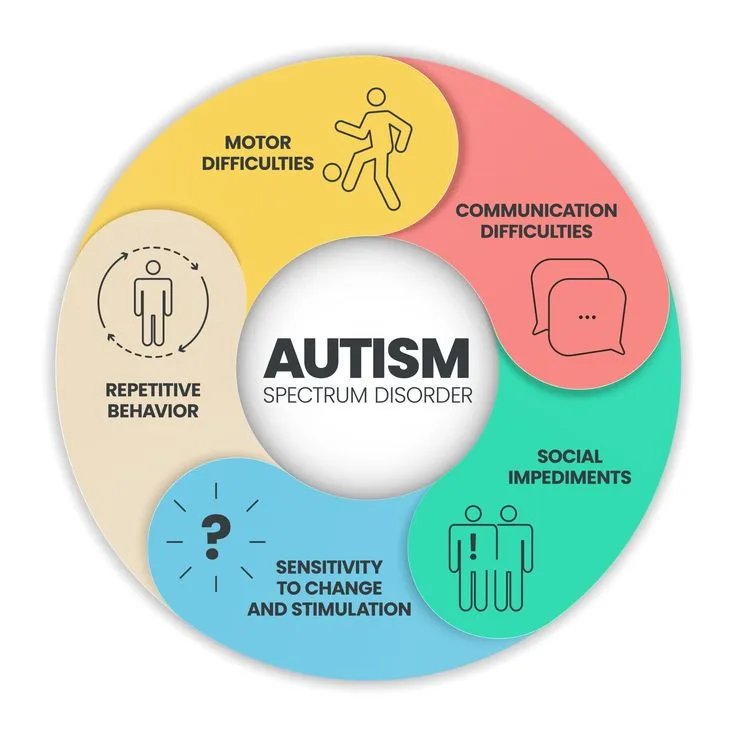
Autism spectrum disorder (ASD): A neurodevelopmental condition defined by persistent differences in social communication and interaction, combined with restricted, repetitive patterns of behavior, interests, or activities, present from early development.
DSM-5 two-domain model: The diagnostic framework requiring deficits in both social communication/interaction AND restricted/repetitive behaviors - replacing the DSM-IV three-domain model that separated social, communicative, and behavioral features.
| Domain | Common Differences in Autism | Range of Expression |
|---|---|---|
| Social communication | Difficulty with implicit social cues, eye contact variability | Subtle differences to significant challenges |
| Repetitive behavior | Routines, special interests, stimming | From mild preferences to rigid requirements |
| Sensory processing | Hyper- or hypo-sensitivity to sensory input | Can be disabling or minor |
| Language and communication | Delayed onset, literal interpretation, pragmatics | Non-speaking to highly verbal |
| Executive function | Planning, flexibility, transitions | Ranges from mildly affected to significantly impairing |
Asperger's syndrome: A former diagnostic category, now subsumed into ASD Level 1, characterized by autistic features without intellectual disability or significant language delay.
Theory of mind (ToM): The ability to attribute mental states - beliefs, desires, intentions, knowledge - to oneself and others, and to use those attributions to predict behavior. Deficits in ToM are associated with autism.
Double empathy problem: Damian Milton's 2012 reframing that social difficulties between autistic and non-autistic people are bidirectional; neurotypical people are equally poor at understanding autistic communication, suggesting the problem is cross-neurotype interaction rather than autistic deficit alone.[4]
Executive function in autism: Difficulties with planning, cognitive flexibility, and inhibitory control are common in autism, overlapping substantially with ADHD co-occurrence and contributing independently to daily functioning challenges.
Sensory processing differences: Hyper- or hypo-sensitivity to sensory input (sound, light, touch, smell, taste, proprioception) is a formal DSM-5 criterion for autism and a major contributor to daily functioning.
Masking/camouflaging: Conscious and unconscious strategies autistic people use to appear neurotypical in social situations, associated with exhaustion, anxiety, and delayed diagnosis.
Applied behavior analysis (ABA): A behavioral intervention approach with the largest published evidence base for autism, and also the most contested, with debates about which ABA-based approaches are therapeutic versus harmful.
Neurodiversity: The framework, popularized by Judy Singer in 1998, holding that neurological differences are natural human variation rather than defects requiring correction.
What Autism Is
The DSM-5 reorganized the previous landscape of autism diagnoses - autistic disorder, Asperger's disorder, pervasive developmental disorder not otherwise specified, and childhood disintegrative disorder - into a single spectrum diagnosis.
The consolidation was scientifically motivated: research showed poor reliability in distinguishing between these subtypes, and genetic and neurobiological evidence suggested they reflected dimensions of the same underlying condition rather than discrete categories.
Under DSM-5, a diagnosis requires deficits in both core domains. Social communication and interaction deficits must include problems with social-emotional reciprocity, nonverbal communicative behaviors, and relationships.
Restricted, repetitive behaviors must include at least two of four symptom types: stereotyped motor movements or speech (echolalia, idiosyncratic phrases), insistence on sameness and routines, highly restricted fixated interests unusual in intensity or focus, and sensory hyper- or hypo-reactivity.
The sensory criterion's inclusion in DSM-5 was significant: sensory differences had been recognized by autistic people and their families for decades but were absent from DSM-IV.
The history of prevalence estimates is instructive. Victor Lotter's 1966 epidemiological survey of a British county estimated a prevalence of approximately 4.5 per 10,000 children - 0.045%. By 1990, estimates had risen to around 1 in 1,000.
By 2007, the CDC estimated 1 in 150. By 2023, the CDC's Autism and Developmental Disabilities Monitoring Network estimated 1 in 36 - roughly 2.8%.
This increase is often cited as evidence of an epidemic, but the majority of researchers attribute most of the increase to diagnostic expansion, increased awareness, and service-driven diagnosis rather than a genuine biological increase.
The broadening of criteria from Kanner's narrow "classic autism" to a full spectrum capturing Asperger's presentations alone accounts for a substantial portion of the increase.
Whether a small residual biological increase exists - perhaps related to rising paternal age and corresponding de novo mutations - remains an open empirical question.
The Neuroscience
The neuroscience of autism does not point to a single lesion or deficit. Decades of neuroimaging, neurochemical, and neuropathological research have produced a complex picture of distributed network differences that vary considerably across individuals on the spectrum.
One of the most replicated early findings was early brain overgrowth. A 2003 study by Eric Courchesne and colleagues at the University of California San Diego, published in JAMA, analyzed head circumference growth curves in 48 children with autism and 113 typically developing controls.[5]
They found that autistic children had smaller than average head circumferences at birth but underwent accelerated brain growth in the first year of life, such that by 12-14 months they had significantly larger brains than controls.
This abnormal early overgrowth, followed by deceleration, suggested disrupted early developmental mechanisms before any environmental trigger in the first year of life could be implicated - a finding with significant implications for the vaccine debate.
Marcel Just and colleagues published a landmark 2004 fMRI study examining brain connectivity during a sentence comprehension task in high-functioning autistic adults versus neurotypical controls.
The autistic group showed reduced synchronization between frontal and posterior brain regions - long-range underconnectivity - accompanied by evidence of local cortical overconnectivity.
This profile of local overconnectivity and long-range underconnectivity has been replicated in multiple studies and may reflect an early developmental process in which neural pruning and connection-formation go awry, producing a brain with dense local processing but reduced integration across networks.
The default mode network (DMN), implicated in social cognition, self-referential processing, and mentalizing, shows altered function and connectivity in autism. The DMN includes medial prefrontal cortex and the temporoparietal junction - regions central to thinking about other people's minds.
Reduced connectivity within and between DMN nodes in autism is consistent with the theory of mind difficulties documented by Baron-Cohen and colleagues, though the causal direction of this relationship remains debated.
The "broken mirror neuron" hypothesis proposed by Vilayanur Ramachandran, which attributed autism's social difficulties to dysfunction of mirror neurons involved in imitation and empathy, generated considerable popular interest but has been largely discredited as an oversimplification: mirror neuron-mediated imitation is relatively preserved in autism, and the theory fails to account for the full spectrum of autistic features.
Theory of Mind and Social Cognition
The most influential psychological theory of autism is Simon Baron-Cohen, Alan Leslie, and Uta Frith's theory of mind hypothesis, published in 1985 in the journal Cognition (doi: 10.1007/BF01531659).[1] Their study used the Sally-Anne false belief task: a child watches a puppet named Sally place a marble in a basket, then leave the room.
While Sally is away, another puppet moves the marble to a box. The child is asked where Sally will look for her marble when she returns.
Correctly answering requires the child to represent Sally's false belief - her ignorance of the marble's new location.
The results were striking. Among neurotypical children with a mental age of four or above, 85% passed the task. Among children with Down syndrome matched for mental age, 86% passed. Among children with autism, 80% failed - the inverse pattern.
Baron-Cohen and colleagues argued this demonstrated a specific deficit in the ability to attribute mental states to others: not a general intellectual impairment, but a selective difficulty with the inferential machinery that underlies social understanding.
Baron-Cohen developed this into the concept of "mindblindness," elaborated in his 1995 book of the same name.
The theory of mind hypothesis has been enormously productive but has also been progressively refined and challenged.
Many autistic adults explicitly pass laboratory theory of mind tasks but continue to struggle in real-world social situations, suggesting the problem is not a complete absence of mentalizing but rather a slower, more effortful process that fails under the time pressures of real interaction.
Critically, researchers have distinguished cognitive empathy - the capacity to represent and infer another's mental state - from affective empathy - emotional resonance with another's feeling.
Evidence suggests that many autistic people have intact or elevated affective empathy while struggling with the cognitive-inferential process. They feel others' distress acutely but have difficulty reading the behavioral cues that signal what that distress is.
Damian Milton's double empathy problem, articulated in a 2012 paper in Disability and Society, has been especially influential in reshaping how researchers and clinicians understand autistic social difficulties.
Milton noted that studies of theory of mind typically measure autistic people's ability to understand non-autistic minds, then interpret failure as an autistic deficit.
But neurotypical people show comparable difficulty understanding autistic communication, emotional expression, and social cues - they are simply not tested on this.
When autistic people interact primarily with other autistic people, Milton and subsequent researchers have found, mutual understanding and rapport improve. The empathy problem, from this perspective, is a problem of different cognitive styles failing to translate for each other, not a unidirectional deficit.
Genetics
Autism has among the highest heritability of any psychiatric condition. Twin studies have consistently estimated heritability in the range of 64-91%.
A large population-based study by Sandin and colleagues, published in JAMA in 2017 (doi: 10.1001/jama.2017.4187), used Swedish national registry data covering over 2 million children and estimated heritability at approximately 83%, with the remainder of variance accounted for by non-shared environmental factors and measurement error.[3]
If one identical twin has autism, the probability of the co-twin also having autism is approximately 70-90%.
Despite this high heritability, the genetic architecture of autism is exceptionally heterogeneous. Unlike single-gene conditions, autism has no single causative gene. The genetic contributions come from two broad categories.
Rare, large-effect variants - copy number variants and de novo point mutations in genes such as SHANK3, NRXN1, CHD8, and others - account for approximately 10-15% of cases, typically associated with more severe presentations and often not inherited from parents (de novo mutations arising fresh in the child).
Common polygenic variation - hundreds of small-effect variants summing across the genome - accounts for the majority of heritability in the general autism population.
Advanced paternal age is one of the most clearly established environmental risk factors for autism. Sperm accumulate de novo mutations throughout a man's life, and studies have consistently found that children of older fathers have elevated autism risk, proportional to the age effect.
This is a biological risk factor unrelated to parenting behavior or social dynamics.
Genetic overlap between autism and other neurodevelopmental and psychiatric conditions is substantial. Autism shares significant genetic risk architecture with ADHD, schizophrenia, bipolar disorder, intellectual disability, and major depression.
This genetic correlation explains the high rates of co-occurrence: ADHD is the most common co-occurring condition, present in approximately 30-50% of autistic children.
The implication for genetic research is that these conditions do not have separate etiologies so much as overlapping ones, with specific genetic profiles tipping individuals toward different diagnostic presentations.
The Vaccine Controversy
The claim that childhood vaccination causes autism originated in a 1998 paper by Andrew Wakefield and 12 co-authors in The Lancet, presenting a case series of 12 children who reportedly developed autism or autism-like symptoms shortly after receiving the MMR vaccine.[6]
The paper generated enormous media attention and a lasting cultural panic.
The scientific community's response was thorough and methodologically decisive.
Taylor and colleagues published a 1999 study examining autism rates in 498 autistic children in the North Thames region of England, finding no change in the age of autism diagnosis before and after MMR introduction and no difference in autism rates between vaccinated and unvaccinated children.
The definitive epidemiological test came in a 2002 study by Madsen and colleagues in the New England Journal of Medicine (doi: 10.1056/NEJMoa021134), which examined the entire cohort of Danish children born between 1991 and 1998 - 537,303 children - and compared autism rates in those who received MMR with those who did not.[2]
The relative risk of autism in vaccinated children was 0.92 (essentially identical to unvaccinated), with narrow confidence intervals. The study was followed by similar large-scale null results from Japan, the United Kingdom, the United States, and Finland, covering collectively tens of millions of children.
The Lancet retracted the Wakefield paper in February 2010 following an investigation by the UK General Medical Council, which found that Wakefield had manipulated data, subjected children to unnecessary invasive procedures without ethical approval, and failed to disclose that he had been paid by a personal injury law firm representing families in vaccine-related litigation.
Wakefield was struck off the medical register. No subsequent researcher has replicated his findings.
The persistence of the vaccine-autism belief is a case study in motivated cognition and the difficulty of undoing misinformation once it has attached to parental anxiety.
The timing coincidence is genuine: MMR is administered at 12-15 months, and the social symptoms of autism typically become apparent in the same developmental window as infants begin to engage in more complex reciprocal social behavior.
This temporal proximity creates a compelling spurious association that is immune to the statistical argument that at any given age, some children will receive vaccinations and some children will receive autism diagnoses, and that the coincidence tells us nothing about causation.
Neurodiversity and Identity
The neurodiversity movement emerged in the late 1990s, with the term coined by Judy Singer in her 1998 honors thesis and popularized in a Harvey Blume article in The Atlantic the same year.
The core argument is that neurological differences - autism, ADHD, dyslexia, and others - represent natural variation in human cognitive styles rather than inherently pathological conditions requiring elimination.
From this perspective, the distress and impairment associated with autism derives substantially from the mismatch between autistic ways of thinking, communicating, and being and a social world designed exclusively around neurotypical norms.
The Autistic Self Advocacy Network, founded in 2006 by Ari Ne'eman, has been the most prominent organizational expression of this framework.
ASAN's motto - "nothing about us without us" - demanded that autistic people be included in research and policy decisions affecting them, challenging a research and advocacy ecosystem dominated by parents and clinicians.
The impact has been real: autistic researchers now participate in the design of autism studies, patient-reported outcomes are taken more seriously, and the previous focus of advocacy organizations on finding a "cure" has been substantially challenged.
Applied Behavior Analysis has been the most contested territory in the neurodiversity debate. ABA-based interventions developed from the work of Ivar Lovaas in the 1960s and 1970s, which used intensive behavioral conditioning to reduce autistic behaviors and increase neurotypical ones.
Some autistic adults who received intensive early ABA therapy have described the experience as traumatic, particularly approaches that used punishment-based techniques or focused on eliminating stimming behaviors that serve genuine self-regulatory functions.
Professional ABA has evolved considerably since Lovaas, with most contemporary approaches using positive reinforcement exclusively and focusing on functional communication and child-led goals. But the underlying question of whose definition of "better outcomes" should govern intervention remains live and important.
Outcomes and Support
The range of outcomes across the autism spectrum is enormous, reflecting the spectrum's fundamental heterogeneity. Some autistic people live independently, sustain careers, and maintain relationships, managing their autistic traits as one dimension of a full life.
Others require intensive daily support for all activities of living throughout their lives.
The factors that predict outcome are complex: intellectual ability and language development in early childhood are the strongest predictors of later independence, but early intensive support significantly modifies trajectories, and autistic adults consistently report that the presence or absence of appropriate support - in school, in employment, in housing - is the most powerful determinant of their quality of life.
Employment remains a severe challenge. Studies consistently find that only 15-20% of autistic adults in the United States are in any form of paid employment, including part-time, despite the majority of autistic adults surveying as wanting to work.
The gap between capability and employment reflects a combination of communication barriers, sensory environments hostile to autistic workers, and employer misunderstanding rather than an inherent inability to contribute.
Communication interventions, particularly AAC for non-speaking or minimally speaking autistic people, have transformed outcomes and challenged the long-standing conflation of being non-speaking with having nothing to say.
Sensory accommodations in educational and workplace environments - reduced fluorescent lighting, quieter spaces, permission to use headphones - are low-cost and high-impact.
Treating co-occurring conditions, particularly anxiety (present in 40-50% of autistic people), ADHD, depression, and sleep disorders, addresses a large proportion of what makes daily life most difficult for many autistic individuals.
Cross-References
Sources & Further Reading
- Baron-Cohen, S., Leslie, A. M., & Frith, U. (1985). Does the autistic child have a "theory of mind"? Cognition, 21(1), 37-46. DOI: 10.1007/BF01531659
- Madsen, K. M., Hviid, A., Vestergaard, M., Schendel, D., Wohlfahrt, J., Thorsen, P., ... & Melbye, M. (2002). A population-based study of measles, mumps, and rubella vaccination and autism. New England Journal of Medicine, 347(19), 1477-1482. DOI: 10.1056/NEJMoa021134
- Sandin, S., Lichtenstein, P., Kuja-Halkola, R., Hultman, C., Larsson, H., & Reichenberg, A. (2017). The heritability of autism spectrum disorder. JAMA, 318(12), 1182-1184. DOI: 10.1001/jama.2017.4187
- Milton, D. E. M. (2012). On the ontological status of autism: The "double empathy problem." Disability and Society, 27(6), 883-887.
- Courchesne, E., Carper, R., & Akshoomoff, N. (2003). Evidence of brain overgrowth in the first year of life in autism. JAMA, 290(3), 337-344.
- Wakefield, A. J., et al. (1998). Ileal-lymphoid-nodular hyperplasia, non-specific colitis, and pervasive developmental disorder in children. The Lancet, 351(9103), 637-641. [RETRACTED 2010]