
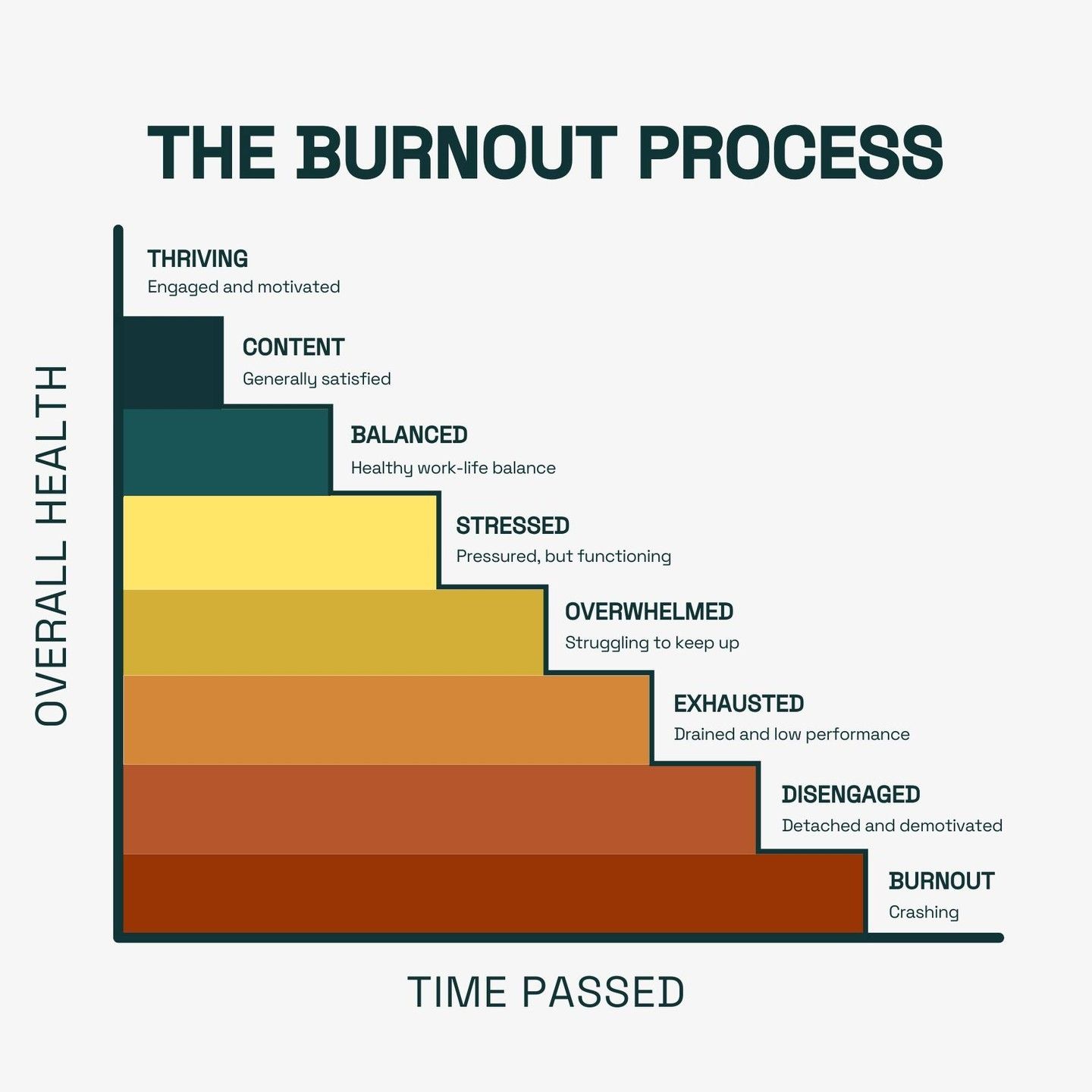
What Is Burnout?
Burnout is a state of chronic work-related depletion characterized by three dimensions: exhaustion (severe depletion of emotional and physical resources), depersonalization or cynicism (detachment and negative attitudes toward work and people), and reduced professional efficacy (a declining sense of competence and effectiveness).
First clinically described by Herbert Freudenberger in 1974 and systematically researched by Christina Maslach at Berkeley, burnout arises from sustained mismatch between job demands and available resources and is distinct from ordinary tiredness or stress.[4]
It has measurable physiological markers, including dysregulation of the HPA axis, and represents a structural outcome of working conditions rather than an individual failing.
In 1974, Herbert Freudenberger arrived at work one morning and found something that troubled him.[1]
A volunteer at the free clinic he ran in New York - someone who had come in months earlier burning with idealism, ready to give everything they had to the patients who had nowhere else to go - was sitting hollow-eyed, mechanically completing tasks, indifferent to outcomes that had once mattered intensely.
Freudenberger recognized the pattern. He had seen it before, in himself and in others.
The fire had not simply gone out; something more systemic had happened, a kind of progressive depletion that idealism and good intentions could not prevent. He borrowed a term from drug culture - where it described the state of being used up by hard narcotics - and applied it to the human beings in front of him. He called it burnout.
Freudenberger's 1974 paper in the Journal of Social Issues was the first clinical description of the phenomenon, written from the inside by a practitioner who had lived it as much as observed it. It planted a seed.
Over the following decades, psychologists - most significantly Christina Maslach at Berkeley - would develop burnout into one of the most extensively researched constructs in occupational health psychology, generating a measurement instrument used in hundreds of studies across dozens of countries.
That research produced a theoretical framework that has repeatedly challenged the individualistic assumptions of how we think about work and its costs, and a body of physiological research showing that what happens to burned-out workers is not simply a matter of bad attitude or insufficient resilience.
The word "burnout" has since traveled far from its clinical origins. It now appears in articles about students, parents, caregivers, athletes, and activists. Some of this expansion reflects genuine continuity with Maslach's construct; some of it is conceptual drift.
Understanding what burnout actually is - in precise, scientific terms - requires returning to the research from which the concept emerged.
"Burnout is a state of chronic stress that leads to physical and emotional exhaustion, cynicism and detachment, and feelings of ineffectiveness and lack of accomplishment." - Christina Maslach, Burnout: The Cost of Caring (1982)
Key Definitions
Burnout: A state of chronic work-related depletion characterized by three dimensions - exhaustion, depersonalization/cynicism, and reduced professional efficacy - arising from sustained mismatch between job demands and available resources.
Maslach Burnout Inventory (MBI): The most widely used measure of burnout, developed by Maslach and Jackson in 1981, assessing the three dimensions across separate subscales.[2]
Exhaustion: The core dimension of burnout - the depletion of emotional and physical resources to the point of feeling chronically drained and unable to recover.
Depersonalization/Cynicism: The development of detached, callous, or negative attitudes toward work, colleagues, clients, or the organization; a psychological distancing mechanism.
Reduced professional efficacy: A declining sense of competence and effectiveness at work; the feeling that one's efforts no longer produce results.
Job Demands-Resources (JD-R) model: Bakker and Demerouti's (2007) framework proposing that burnout occurs when job demands chronically exceed job resources, and that engagement is the positive outcome when resources are high.
Emotional labor: Hochschild's concept (1983) describing the work of managing one's expressed emotions to fulfill occupational display rules, including surface acting (suppression) and deep acting (genuine modulation).
HPA axis: The hypothalamic-pituitary-adrenal axis - the central neuroendocrine stress response system whose dysregulation is a key physiological marker of chronic burnout.
Freudenberger and the Origins of the Concept
Herbert Freudenberger was a psychoanalyst who worked in both a private practice serving high-achieving New York professionals and the alternative health clinic where he first identified burnout. The contrast was instructive.
His private patients were burning out in a different way than the idealistic volunteers - through relentless ambition, overwork, and the compulsive pursuit of achievement.
His clinic volunteers were burning out through the chronic emotional demands of care work and the gradual exhaustion of empathy under conditions of institutional inadequacy.
Freudenberger's original description emphasized certain personality types as particularly vulnerable: the dedicated, the committed, those who bring their whole selves to work.
This framing - burnout as the price paid by the most devoted - had a certain poignancy, but it carried a problematic implication that subsequent research would challenge: that burnout is fundamentally a problem of the individual, a consequence of personal qualities rather than organizational conditions.
Christina Maslach would systematically reframe that assumption. Beginning in the mid-1970s with her observations of human services workers and developing through the construction and validation of the MBI in 1981, Maslach's research emphasized the social and organizational context in which burnout occurs.
The individuals burning out were not failing - the environments they worked in were failing them.
The Three Dimensions: Maslach's Framework
The Maslach Burnout Inventory conceptualizes burnout through three empirically distinguishable dimensions measured on separate subscales, each capturing a different aspect of the syndrome.
Exhaustion is the primary dimension - the one most closely tied to the folk understanding of burnout and the one that tends to develop first. It refers to the depletion of emotional and physical resources: the experience of having nothing left to give, of being unable to engage meaningfully with work demands regardless of effort.
This is not tiredness that sleep resolves; it is a more fundamental depletion that persists across nights and weekends, returning with the person to work on Monday morning unchanged. Maslach describes exhaustion as the stress component of burnout - the direct consequence of overwhelming demands.
Depersonalization (or cynicism, in the adapted versions of the MBI used outside human services contexts) is the relational or attitude component. It describes the progressive development of detachment, negativity, and callousness toward work and the people involved in it.
The nurse who starts treating patients as cases rather than people; the teacher who privately dismisses students as incapable; the social worker who loses faith in the meaning of their work.
Depersonalization begins as a coping mechanism - emotional distancing as protection against further depletion - but becomes a problem in its own right as it erodes the quality of work and relationships.
Reduced professional efficacy is the self-evaluation component: the declining sense that one is effective, competent, and making a meaningful contribution. Where exhaustion is about depletion and depersonalization is about detachment, efficacy loss is about futility.
The belief that one's efforts make no difference, that the situation is too broken to be fixed, that whatever skills one once had are now insufficient.
The three dimensions are related - exhaustion tends to precede and drive the other two - but they are empirically distinct and respond differently to different interventions.
This has clinical significance: a person in the exhaustion phase, before cynicism has become entrenched, is substantially more amenable to change than one in whom all three dimensions have reached clinical levels.
Burnout vs. Depression: A Contested Boundary
The relationship between burnout and clinical depression is one of the most debated questions in occupational health psychology, and the answer has significant implications for how each is treated and who bears responsibility for each.
Renzo Bianchi, Irvin Schonfeld, and Eric Laurent's 2015 review in Clinical Psychology Review examined the empirical literature on burnout-depression overlap and found substantial symptom convergence - in some study samples, the overlap approached 86%.[6]
Both conditions involve depletion of energy, cognitive impairment, withdrawal, and negative affect. Both predict physical health consequences. Both are associated with reduced engagement in previously valued activities.
The proposed distinctions are real but require qualification. Burnout is supposed to be occupationally specific - its symptoms should dissipate outside the work context - while depression pervades all life domains.
Burnout involves the specific triad of exhaustion, cynicism, and efficacy loss; depression involves the classic triad of depressed mood, anhedonia, and hopelessness, along with neurovegetative symptoms (sleep disturbance, appetite change, psychomotor retardation).
In practice, researchers have found that separating the two is difficult, that many people who meet criteria for burnout also meet criteria for major depressive episode, and that the causal direction is unclear: does burnout cause depression, or does depression manifest occupationally as burnout, or are they different expressions of the same underlying vulnerability?
The WHO's 2019 ICD-11 classification explicitly declines to call burnout a medical condition. It is classified as an "occupational phenomenon" - something that happens at the intersection of a person and a work environment, rather than a disorder residing within the person.
This is not merely a taxonomic nicety; it has policy implications. If burnout is a disease, treatment falls to healthcare. If it is an occupational phenomenon, prevention and accountability fall to employers and organizations.
The Job Demands-Resources Model
Arnold Bakker and Evangelia Demerouti's Job Demands-Resources model, published in 2007, provides the most empirically supported theoretical framework for understanding the organizational determinants of burnout.[3]
The model proposes two parallel processes. In the health-impairment process, excessive job demands (workload, emotional demands, role ambiguity, interpersonal conflict, physical demands) deplete workers' psychological and physiological resources, ultimately leading to burnout and health problems.
In the motivational process, job resources (autonomy, social support, feedback, skill variety, developmental opportunities) foster engagement and buffer the impact of demands on burnout.
| Job Demands (Drive Burnout) | Job Resources (Drive Engagement) |
|---|---|
| Excessive workload | Autonomy over work processes |
| Emotional demands (e.g., dealing with distressed clients) | Supervisor and peer social support |
| Role ambiguity or conflict | Performance feedback |
| Interpersonal conflict | Skill utilization and development |
| Physical demands | Job security |
| Time pressure | Participation in decision-making |
The model's practical implication is that burnout prevention cannot be achieved solely by reducing demands - organizations must also actively invest in building and maintaining resources. A high-demand job with rich resources can sustain engagement; a low-demand job with depleted resources produces boredom and eventual disengagement.
The model also treats engagement as the genuine positive opposite of burnout, not merely its absence - a state characterized by vigor, dedication, and absorption - which shifts the prevention conversation from avoiding harm to actively cultivating conditions for thriving.
Maslach's Six Mismatches
Maslach and Leiter extended the original three-dimension model to identify six areas of organizational life whose misalignment with worker needs drives burnout. This framework moves beyond simple demand-overload to capture more subtle organizational pathologies.
The six areas are workload, control, reward, community, fairness, and values. Workload and control are the most studied. But the values dimension deserves particular attention because it is the least visible and often the most psychologically toxic.
Values mismatch occurs when workers are required to do work that conflicts with their core ethical principles or personal values: the clinician asked to provide inadequate care due to staffing constraints; the teacher required to use methods they believe harm students; the journalist asked to produce content they believe is dishonest.
The person in this situation is not simply exhausted - they are being systematically asked to violate who they are in order to continue being paid.
Fairness mismatch - the experience of decisions made through inequitable or opaque processes, or of differential treatment based on favoritism - activates a different psychological system: the moral injury response that comes from witnessing or participating in perceived injustice.
Organizational injustice has been specifically linked to the cynicism dimension of burnout, suggesting that depersonalization is not merely a coping response to exhaustion but can also be a response to moral disillusionment.
Emotional Labor
Arlie Hochschild's concept of emotional labor, introduced in her 1983 book "The Managed Heart," adds another dimension to the burnout etiology that the Maslach and JD-R frameworks do not fully capture.
Hochschild studied flight attendants and bill collectors - occupations with radically different emotional display rules - and documented the work that goes into managing one's expressed emotions to meet occupational requirements.[7]
She distinguished two forms. Surface acting involves suppressing or masking one's actual emotional state in order to display the required one: the call center worker who feels frustrated but must sound patient and warm; the nurse who feels detachment but must project care.
Surface acting requires the sustained effort of managing a gap between inner state and outer expression, and depletes emotional resources in proportion to the gap's size and duration.
Deep acting involves genuinely modulating one's emotional state to match what the job requires - using cognitive reframing, perspective-taking, or method acting techniques to actually feel the required emotion. Deep acting is more sustainable because the inner and outer states align, but it requires skill and is not always possible.
Research consistently finds that surface acting is a strong predictor of burnout, particularly the exhaustion dimension, while deep acting has a weaker or negligible relationship with burnout.
The practical implications for job design are significant: roles that require sustained emotional labor with rigid display rules, little autonomy, and high contact with distressed or demanding clients create the conditions in which surface acting is most likely and most depleting.
The Body Under Burnout
Burnout is not merely a psychological state. Its physiological consequences are documented across multiple systems and extend well beyond subjective fatigue.
The HPA axis dysregulation pattern is among the most studied. In early or moderate burnout, the stress response is in chronic activation, producing elevated cortisol levels (hypercortisolism).
In severe or chronic burnout, the HPA axis shows signs of depletion: the cortisol awakening response - the normal sharp rise in cortisol in the first 30-45 minutes after waking, which prepares the organism for the demands of the day - becomes blunted.
Jens Pruessner and colleagues documented this reduced morning cortisol in burnout populations in 1999; subsequent research has replicated the finding and extended it to document flattened diurnal cortisol profiles.[10]
This depletion pattern has structural parallels with HPA dysfunction in PTSD, suggesting that severe burnout may involve mechanisms similar to those underlying chronic trauma responses.
The cardiovascular evidence is both robust and alarming. Samuel Melamed and colleagues' 2006 prospective study followed 8,838 employed individuals over 3.4 years.[5]
After adjusting for traditional cardiovascular risk factors (hypertension, smoking, sedentary behavior, BMI), the researchers found that burnout more than doubled the risk of cardiovascular events including heart attack and coronary artery disease.
The proposed mechanisms include chronic sympathetic activation, HPA-mediated inflammatory processes, and the health behaviors (poor sleep, physical inactivity, substance use as coping) that tend to accompany burnout.
The cognitive evidence from Panagiotis Deligkaris and colleagues' 2014 meta-analysis documents impairment in attention, executive function, and memory in burned-out populations - consistent with the hypothesis that chronic stress-related HPA dysregulation compromises prefrontal cortical function over time.[8]
Recovery: What Actually Works
The honest answer from the research is that most commonly prescribed recovery strategies work only temporarily, and most fail because they leave the organizational conditions of burnout unchanged.
Charlotte Fritz and Sabine Sonnentag's 2006 research on vacation effects documented what practitioners observing burned-out workers have long noticed: subjective wellbeing and energy improve markedly during vacations, and the improvement has almost entirely dissipated within the first one to four weeks of return to the same work environment.[9]
If the organizational mismatches that produced the burnout are still present, the person who returns from a vacation is simply re-exposed to the same conditions.
Maaike Sianoja and colleagues' 2018 research found that leisure recovery activities - particularly nature exposure - produced meaningful recovery from work-related stress and improved detachment. But again, the effects were primarily sustained only when combined with changes to the work context.
The most effective interventions in Maslach and Leiter's organizational research target the six mismatch areas directly: reducing workloads to sustainable levels, increasing workers' autonomy over their processes, ensuring reward is commensurate with contribution, investing in collegial community, demonstrating organizational fairness, and aligning organizational practices with workers' values.
These interventions are organizationally demanding and require sustained commitment from leadership, which is precisely why they are less common than wellness programs and resilience training.
Individual psychological recovery, in cases of severe burnout, typically requires extended leave from work, treatment of comorbid depression or anxiety, and gradual reintroduction to work with structural changes in place.
The timeline is highly variable: mild burnout in a changing environment may resolve in weeks; severe, chronic burnout with established HPA dysregulation may require months to years of active recovery.
See also: What Causes Anxiety, How Stress Damages the Body
Sources & Further Reading
- Freudenberger, H. J. (1974). Staff burn-out. Journal of Social Issues, 30(1), 159-165. DOI: 10.1111/j.1540-4560.1974.tb00706.x
- Maslach, C., & Jackson, S. E. (1981). The measurement of experienced burnout. Journal of Organizational Behavior, 2(2), 99-113. DOI: 10.1002/job.4030020205
- Bakker, A. B., & Demerouti, E. (2007). The job demands-resources model: State of the art. Journal of Managerial Psychology, 22(3), 309-328. DOI: 10.1108/02683940710733115
- Maslach, C., & Leiter, M. P. (2016). Burnout. In G. Fink (Ed.), Stress: Concepts, Cognition, Emotion, and Behavior (pp. 351-357). Academic Press.
- Melamed, S., Shirom, A., Toker, S., Berliner, S., & Shapira, I. (2006). Burnout and risk of cardiovascular disease: Evidence, possible causal paths, and promising research directions. Psychological Bulletin, 132(3), 327-353. DOI: 10.1037/0033-2909.132.3.327
- Bianchi, R., Schonfeld, I. S., & Laurent, E. (2015). Burnout-depression overlap: A review. Clinical Psychology Review, 36, 28-41. DOI: 10.1016/j.cpr.2015.01.004
- Hochschild, A. R. (1983). The Managed Heart: Commercialization of Human Feeling. University of California Press.
- Deligkaris, P., Panagopoulou, E., Montgomery, A. J., & Masoura, E. (2014). Job burnout and cognitive functioning: A systematic review. Work and Stress, 28(2), 107-123. DOI: 10.1080/02678373.2014.909545
- Fritz, C., & Sonnentag, S. (2006). Recovery, well-being, and performance-related outcomes: The role of workload and vacation experiences. Journal of Applied Psychology, 91(4), 936-945. DOI: 10.1037/0021-9010.91.4.936
- Pruessner, J. C., Hellhammer, D. H., & Kirschbaum, C. (1999). Burnout, perceived stress, and cortisol responses to awakening. Psychosomatic Medicine, 61(2), 197-204. DOI: 10.1097/00006842-199903000-00012
Health note: This article is general educational information about how a topic works, not medical, psychological, or mental-health advice, diagnosis, or treatment. Everyone's situation is different, and research findings describe groups, not individuals.
If you are struggling or have concerns about your health, please talk to a qualified professional such as a doctor or licensed therapist.
If you are in crisis or thinking about harming yourself, contact your local emergency services or a crisis line right away, in the US you can call or text 988 (Suicide & Crisis Lifeline); elsewhere, find local lines at findahelpline.com.