
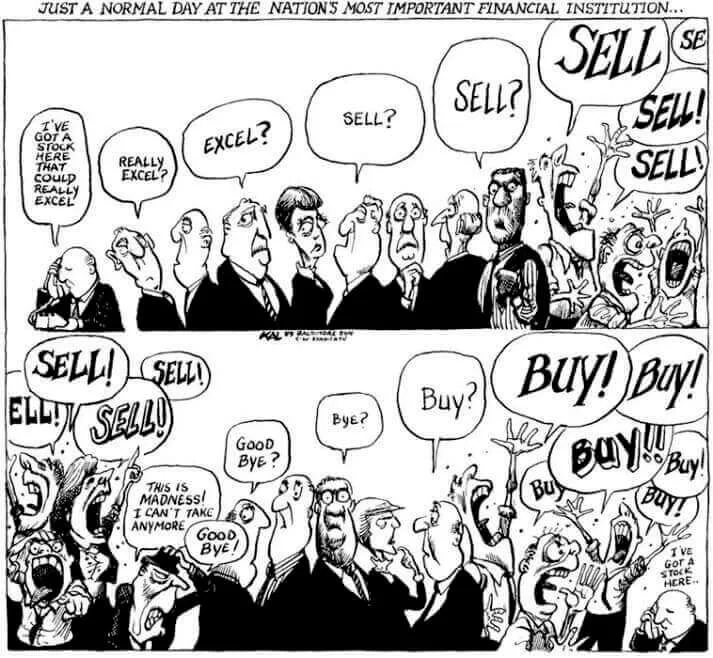
Mentality: Few forces shape human behavior as quietly and consistently as the pull of the crowd. People quit jobs because colleagues are quitting. They sell investments when markets fall, and buy when markets peak. They pile onto social media condemnations of strangers they know nothing about.
The pattern is so common that economists, psychologists, and evolutionary biologists all have competing names for it: herd mentality, conformity, social proof, cascade behavior.
Understanding why humans follow the crowd - and when following is actually the right call - is one of the most practically useful things you can learn about your own thinking.
What Is Herd Mentality
Herd mentality refers to the tendency for individuals to align their beliefs, attitudes, or behaviors with those of the group, often at the expense of independent judgment. It does not require stupidity or weakness. It can happen to careful, intelligent people, especially under conditions of uncertainty, time pressure, or social scrutiny.
The concept draws on research across several disciplines. Social psychologists study conformity. Behavioral economists study information cascades. Evolutionary psychologists explain the deep adaptive roots of the behavior. Each frame captures a different part of the same phenomenon.
The Core Mechanism
The process typically runs as follows. An individual faces a decision with uncertain outcomes. They observe what other people around them are doing or believing. They weight that observation as evidence - sometimes as very strong evidence - about what the correct choice is.
They then act in line with the group rather than their private information.
The crucial question is whether the weight given to social observation is appropriate. Sometimes it is. Often it is not, because people follow cascades without knowing whether the first movers in the cascade had good reasons at all.
Robert Cialdini, in his foundational work Influence (1984), identified social proof as one of the six primary principles of persuasion. His framework described how people look to the behavior of others - especially similar others - to determine correct behavior in ambiguous situations.
His research showed that the social proof principle was exploited systematically in marketing, sales, and persuasion, precisely because it was such a reliable feature of human cognition.
The "most popular" label on a menu item, the crowd of people looking up at a building, the laugh track on a television show: all are engineered applications of the same mechanism that drives herd behavior.
The Asch Conformity Experiments
The most famous demonstration of herd behavior in a laboratory setting comes from Solomon Asch's line experiments, conducted in the early 1950s at Swarthmore College.
Asch presented groups of participants with a simple perceptual task: identify which of three lines on a card matched a reference line in length. The correct answer was always obvious.
The twist was that most people in the room were confederates - actors following Asch's instructions. On designated trials, the confederates would unanimously give a clearly wrong answer. The real participant, seated to go last or near-last, then had to give their own response publicly.
The results were striking. Under normal conditions, participants answered incorrectly less than one percent of the time. When facing unanimous wrong answers from confederates, roughly 75 percent of participants conformed at least once across the twelve critical trials.
Across all critical trials, about one-third of answers were incorrect - matching the wrong confederate consensus.
After the experiments, participants gave varied explanations. Some said they genuinely thought the group must be right and they must be misreading the lines. Others admitted they knew the group was wrong but did not want to stand out. This maps directly onto the two fundamental types of conformity.
The Importance of Unanimity
Asch went further, testing what conditions modified conformity rates. One finding was particularly consequential: the presence of a single dissenter dramatically reduced conformity.
When just one confederate gave the correct answer (breaking the unanimous consensus), conformity rates dropped from roughly 32% of trials to approximately 5-10%.
It did not matter that the dissenter was still a minority; the mere existence of a non-conforming voice gave the real participant permission to trust their own perception.
This finding has significant practical implications. The social pressure that produces conformity is not simply majority pressure - it is the appearance of unanimous agreement.
A single dissenter or devil's advocate, even one who does not provide new information, can substantially reduce herd behavior by breaking the psychological illusion of consensus.
Asch also found that size of the majority beyond three people did not substantially increase conformity. A group of three wrong confederates produced nearly as much conformity as a group of eight or more. The critical factor was unanimity, not size.
Informational vs. Normative Conformity
Psychologists distinguish between two distinct mechanisms that produce conformity, and understanding them matters for knowing how to resist each.
| Type | Driver | Attitude Change | Example |
|---|---|---|---|
| Informational conformity | Belief that others know more | Private belief shifts | Deferring to doctors on diagnosis |
| Normative conformity | Fear of rejection or desire to belong | Public compliance only | Laughing at a joke you don't find funny |
Informational conformity is not inherently irrational. If you are new to a city and every local avoids a particular restaurant, their behavior is useful data. Their collective experience likely exceeds yours.
The problem arises when people treat the crowd as an expert even in situations where the crowd has no special information - where everyone is simply copying the person ahead of them.
Normative conformity does not change private beliefs at all. People go along publicly while privately disagreeing. Asch found evidence of both types among his participants, sometimes in the same person across different trials.
Morton Deutsch and Harold Gerard (1955) established this distinction formally, demonstrating through experimental design that informational influence (using others as a source of knowledge) and normative influence (using others as a source of social approval) were separable and produced different patterns of private versus public attitude change.
Their framework remains foundational to the social psychology of conformity.
Pluralistic Ignorance
A related phenomenon - pluralistic ignorance - occurs when most members of a group privately reject a norm while each assumes that others privately accept it. The result is a norm maintained by no one but enforced by everyone, because each person believes they are the private dissenter in a sea of genuine believers.
Prentice and Miller (1993) demonstrated pluralistic ignorance in their research on college drinking norms. Students at Princeton consistently overestimated how comfortable their peers felt with the campus drinking culture.
Most students privately felt uncomfortable but conformed publicly, each assuming the others were genuine participants in the culture rather than similarly uncomfortable conformers.
The practical implication is that publicly stated group norms can massively overstate actual private sentiment.
Challenging a norm that seems deeply entrenched can release the pressure holding it in place more easily than the apparent solidity of the norm would suggest - because the solidity is itself partly a product of everyone else's conformity to apparent consensus.
Information Cascades and Market Bubbles
The economist Sushil Bikhchandani and colleagues formalized a model of informational cascades in a 1992 paper that has since become central to behavioral economics.
Their insight was that a rational individual will sometimes be correct to ignore their private signal and follow the crowd - but that this rational individual behavior can produce collectively irrational outcomes.
Here is the basic logic. Suppose individuals make decisions sequentially, each observing what all prior individuals chose. If the first two people both chose Option A, a third person who privately signals Option B might rationally conclude that A must be better, given the two prior independent observations pointing that way.
They choose A. Now the fourth person sees three prior choices for A, and their private signal for B seems even weaker against that evidence. They also choose A. A cascade has formed.
The cascade is fragile. It is built on the private information of the first two people, who may simply have been unlucky draws. If a credible dissenter breaks the cascade, it can reverse entirely and rapidly.
This mechanism appears to drive financial market bubbles. Investors observe rising prices and interpret them as evidence that other investors have positive information about value. They buy in, driving prices higher, which attracts more buyers.
The cascade continues until something - earnings disappointment, a credit shock, a regulatory announcement - cracks the consensus. The reversal is often faster than the run-up.
"A stock market bubble is, at its core, a social phenomenon: an amplifying feedback loop between rising prices and investor enthusiasm, in which the crowd's behavior is simultaneously the evidence for and the cause of the belief." - Robert Shiller, Irrational Exuberance
The dot-com bubble of the late 1990s and the US housing bubble of the mid-2000s both display this signature: rising asset values attracting more buyers who treat rising prices as proof of rising value, until the underlying reality can no longer be ignored.
The GameStop Episode
A more recent and unusually well-documented example of herd dynamics in financial markets was the GameStop short squeeze of January 2021. Retail investors, organized primarily through the Reddit forum WallStreetBets, coordinated purchases of heavily shorted stocks, most prominently GameStop (GME).
The stock rose from approximately $20 in early January 2021 to a peak of $483 on January 28 - a gain of over 2,000% in three weeks.
The episode was widely analyzed as a case study in social media-amplified herding.
Participants in the WallStreetBets forum explicitly modeled herd dynamics as a mechanism - a sufficient number of small buyers coordinating could force short sellers to cover their positions, driving the price higher and attracting yet more buyers.
The cascade mechanism was not just present but consciously engineered.
When the peak came and institutional brokers restricted trading in GME, the cascade reversed rapidly. The stock fell from an intraday high of about $483 to roughly $40 by mid-February 2021. Retail investors who entered during the peak - drawn by the same social momentum that produced the peak - suffered substantial losses. The cascade had consumed its own energy.
Studies of the episode (e.g., SEC staff report, October 2021) found that late entrants (who entered after the peak publicity had generated maximum social proof) lost significantly more than early entrants, consistent with the cascade model: the most powerful social proof signal coincided with the highest price and the worst subsequent returns.
Social Media Pile-Ons
Digital platforms have created a new environment for herd behavior that operates at unprecedented speed and scale. Social media pile-ons - rapid mass condemnations directed at an individual - illustrate herd dynamics with particular clarity.
The structure is typically as follows. A post is flagged as objectionable. A handful of influential accounts amplify criticism. Each subsequent condemnation both signals group membership and adds apparent social proof that condemnation is warranted.
Participants often have not read the original post carefully and are responding primarily to the visible pile-on itself - not to independent assessments of the original content.
Research by Molly Crockett at Yale on moral outrage in digital environments found that social media platforms reward outrage expression with social currency (likes, shares, follower growth), which distorts the expression of moral concerns away from actual harm and toward performative condemnation aligned with tribal signals.
This is normative conformity amplified by algorithmic reinforcement. People express outrage not only because others are expressing it but because the platform rewards doing so.
Platform Architecture and Cascade Design
A crucial but underappreciated aspect of social media herd behavior is that it is not an accidental emergent property - it is a designed feature. Platform architecture deliberately amplifies social proof signals.
Visible like counts, share counts, trending indicators, and algorithm-driven amplification of high-engagement content all function to make currently popular views more available and more compelling.
Brady et al. (2017) in a study published in the Proceedings of the National Academy of Sciences analyzed 563,312 tweets on polarizing political topics and found that each moral-emotional word in a tweet increased the probability of retweet by about 20%.
The implication is that the social visibility of moral outrage expression has been systematically amplified by platform incentives - and that what users experience as spontaneous collective moral judgment is partly an artifact of the platform's engagement optimization.
The information cascade model applies directly: each visible retweet or like provides social proof that the condemnation is warranted, updating the private probability assessments of subsequent observers in the direction of condemnation, regardless of whether the initial social proof was grounded in independent evaluation.
Jon Ronson's So You've Been Publicly Shamed (2015) documented the real-world consequences of social media pile-ons in dozens of case studies, finding that targets faced career destruction, social ostracism, and in several cases long-term psychological harm - outcomes wildly disproportionate to the original transgression in many cases, and driven almost entirely by cascade dynamics rather than proportional moral assessment.
When Following Is Rational
Herd behavior does not always represent a cognitive failure. Humans are genuinely social and genuinely limited in what any one person can know. Under the right conditions, deferring to the crowd is a sensible epistemic strategy.
The conditions under which following is rational include:
- The domain is one where experience accumulates reliably. If local residents consistently avoid a particular road, their aggregate experience may encode real information about accident risk or delays.
- The first movers in the cascade had independent reasons for their choices. If expert consensus in a scientific field converges on a view through independent research streams, the consensus carries evidential weight very different from a social media trend where everyone is copying the last person.
- You are genuinely uncertain and have no relevant private information. Cascade-following is most defensible when you have nothing to add to the signal pool.
The problem is that people often follow crowds in conditions where none of these apply - markets where first movers were as uninformed as followers, social controversies where everyone is relying on a single viral post, political debates where the crowd's view is tribal rather than evidence-based.
The Wisdom of Crowds
Francis Galton's famous observation from a 1907 Nature article is the foundation of the "wisdom of crowds" literature. At a country fair, 800 visitors submitted estimates of an ox's weight. The median of their estimates was 1,207 pounds; the ox weighed 1,198 pounds. No individual came closer than the collective average.
James Surowiecki's 2004 book The Wisdom of Crowds systematized this insight: under the right conditions - diversity of opinion, independence of judgment, decentralization, and aggregation - crowds make better estimates than any single expert.
The crucial qualifier is independence. The crowd's wisdom relies on the diversity of private information being preserved in individual judgments before aggregation.
Once people observe each other's choices before making their own, the independence condition is violated: correlated errors replace independent ones, and the crowd's wisdom collapses into a cascade.
This is why prediction markets and carefully designed polling methods go to considerable lengths to prevent participants from observing each other's responses before committing to their own.
Herd Mentality in Organizations
Workplaces generate powerful conditions for conformity. Hierarchies signal whose views should count most. Teams value cohesion. Careers can be damaged by persistent dissent.
Groupthink, Irving Janis's concept derived from analysis of major US foreign policy failures including the Bay of Pigs invasion, describes a pattern where group cohesion and pressure for unanimity overrides realistic appraisal of alternatives.
Key symptoms include the illusion of invulnerability, collective rationalization of warning signs, and the emergence of "mindguards" - members who suppress dissenting information.
The 2003 US intelligence assessment of Iraqi weapons of mass destruction later became a case study in institutional groupthink: analysts who expressed skepticism about weapons programs were isolated, while analysts who found evidence for programs were rewarded with visibility and career advancement.
Janis's analysis identified eight symptoms of groupthink, including illusion of unanimity - the assumption that silence implies agreement - and self-censorship - individuals choosing not to raise concerns because they assume they alone hold them.
Both symptoms are direct manifestations of normative conformity in organizational settings, and both are amenable to structural interventions rather than individual attitude change.
Organizational research by Amy Edmondson at Harvard Business School on psychological safety - the belief that one can speak up without punishment - finds that teams with higher psychological safety make better decisions precisely because dissenting information reaches decision-makers before choices are locked in.
Edmondson's research, published in Administrative Science Quarterly (1999; medication-error study in 1996 in the Journal of Applied Behavioral Science) and developed across two decades of subsequent work, found that medical teams with higher psychological safety caught significantly more medication errors than teams with lower psychological safety - not because they made fewer errors, but because members felt safe reporting errors they observed.
The teams that appeared to perform most reliably were often the ones with the most actively reported problems, because in high-safety teams, problems became visible and fixable rather than being suppressed.
The NASA Challenger Case
The 1986 Space Shuttle Challenger disaster has become a canonical organizational case study in the costs of conformity pressure overriding dissent. Engineers at Morton Thiokol, the manufacturer of the solid rocket boosters, had data showing that O-ring performance degraded at low temperatures.
The night before the launch, they recommended a delay. NASA management pushed back. After an offline caucus, Thiokol management reversed the engineers' recommendation and approved the launch.
The decision met all the classic criteria of normative conformity under organizational pressure: engineers who had dissented publicly in the first teleconference were placed in the position of having to "prove it was not safe" rather than "prove it was safe" - a reversal of the default burden of proof that effectively required them to overcome their own stated concerns.
The launch proceeded; the shuttle broke apart 73 seconds after launch due to O-ring failure in cold temperatures.
Diane Vaughan's sociological analysis of the disaster, The Challenger Launch Decision (1996), found that the conformity was not driven by bad intent or overt pressure but by the normalization of deviance - repeated launches with O-ring anomalies that were not catastrophic had created an implicit organizational heuristic that the risks were manageable.
Each safe launch made the available evidence point toward safety, regardless of the underlying engineering reality.
How to Think Independently
Resisting herd behavior is genuinely difficult because the relevant pressures often feel like good reasons rather than social pressure. The following practices are supported by the research literature:
Pre-commit to decision criteria. Before you know what the crowd is doing, establish what evidence would justify each choice. This makes it harder for social observation to retroactively reframe your criteria.
Seek information before seeking opinions. When you read what others think first, you anchor on their view and then seek confirming evidence. Gathering raw information before social opinion reduces this anchoring.
Find a trusted dissenter. Organizations benefit from institutionalizing dissent through roles like devil's advocate or red team. Individuals benefit from finding one trusted person who will reliably push back on their thinking.
Check the first movers. Before concluding that a cascade contains real information, ask: why did the first people in this cascade act as they did? Did they have actual knowledge, or were they themselves following someone else?
Use base rates. Ask how often the crowd has been right in this domain historically. Markets have been right more often than they have produced bubbles - but bubbles happen.
Social media condemnations are sometimes warranted - but the base rate of pile-on subjects being guilty of what they are accused of is genuinely lower than the intensity of the condemnations implies.
Delay consumption of social proof. In domains where you have private information - your own health symptoms, your expertise in a professional area, your direct observation of a situation - consume social proof only after you have fully processed your private information.
Reversing the sequence (private information first, social proof second) changes the anchoring structure of your judgment.
Philip Tetlock's research on superforecasters identifies a relevant trait: the most accurate predictors of future events consistently reported updating their views based on new information (including information that conflicted with their initial beliefs) while being relatively resistant to updating based purely on the views of others in the absence of new substantive evidence.
They followed consensus when consensus tracked evidence, and ignored consensus when it did not. The distinguishing skill was the ability to assess whether consensus was evidential or merely social.
The Evolutionary Foundation
Herd behavior is not a malfunction. It is an adaptation. For most of human evolutionary history, social information was the best available information about dangerous environments, edible plants, reliable water sources, and hostile groups.
An individual who ignored what everyone else was doing in favor of private experimentation was at elevated risk of fatal error.
Boyd and Richerson, in their work on cultural evolution (1985, 2005), modeled the conditions under which copying others versus relying on private information is adaptive.
Their models showed that social learning (copying) should dominate when the environment is stable and others have had more time to accumulate experience; private learning should dominate when the environment is changing rapidly or when others' experience may be unrepresentative of current conditions.
The modern environment violates these conditions in specific ways. Social proof signals now arrive at high velocity and enormous scale through digital media, far exceeding what the social learning faculty evolved to process. The cascade-triggering threshold is reached almost instantaneously.
The "others" being copied are often strangers with no relevant experience of your specific situation. And the environment changes faster than social learning can calibrate to.
This evolutionary logic means herd behavior is most strongly triggered in situations that feel high-stakes, ambiguous, and irreversible - which is exactly the wrong profile for independent thinking. Fear, uncertainty, and time pressure are the psychological conditions that most reliably shunt decision-making toward social proof.
Understanding this does not make the pull disappear. But recognizing when you are in a high-conformity emotional state - scared, rushed, surrounded by social consensus - gives you the opportunity to deliberately slow down and check whether the crowd's behavior actually reflects relevant information.
Summary
Herd mentality is one of the oldest and most well-documented patterns in human psychology. It operates through two distinct mechanisms - informational and normative conformity - and it produces both rational and irrational outcomes depending on whether the first movers in a social cascade had genuine information.
The Asch experiments demonstrated its power even in unambiguous situations. Financial bubbles, social media pile-ons, and organizational groupthink all reflect the same core dynamic at different scales.
The cascade model from Bikhchandani and colleagues shows how rational individual behavior can produce collectively irrational outcomes: each person correctly updates based on observed social behavior, but because everyone does so simultaneously, private information is overwhelmed and the crowd amplifies noise as efficiently as it amplifies signal.
The structures that resist herd behavior work by preserving private information long enough to enter the decision before social proof can displace it: pre-commitment to decision criteria, independent information gathering, institutionalized dissent, and checks on the quality of first-mover reasoning.
The goal is not to never follow the crowd. Crowds sometimes know things you do not. The goal is to follow deliberately - after checking whether the social signal actually reflects real information - rather than by default.
That distinction, between conscious deference to informed consensus and reflexive cascade-following, is the entire distance between the wisdom of crowds and herd mentality.