
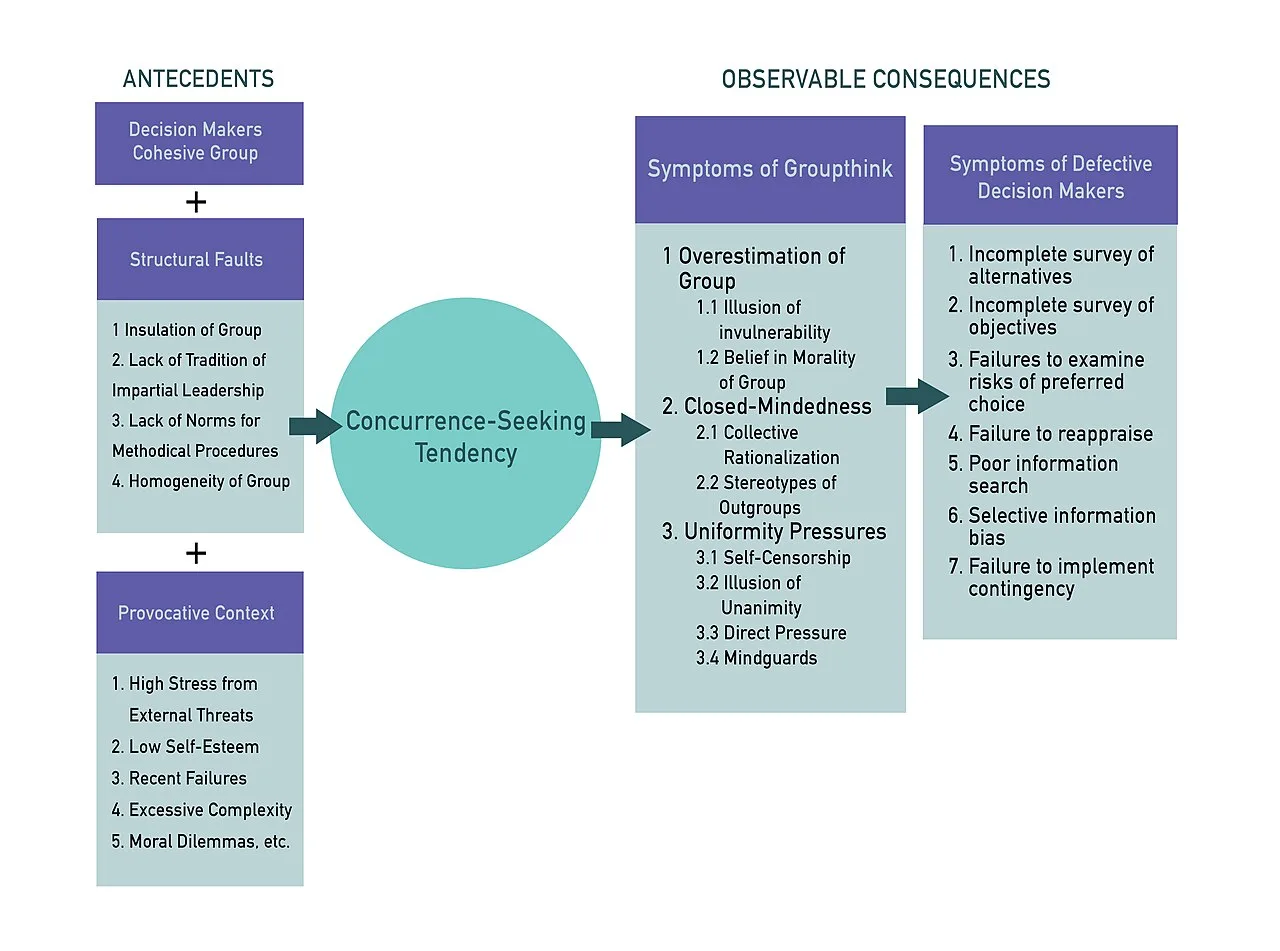
Groupthink: On the morning of April 17, 1961, approximately 1,400 CIA-trained Cuban exiles waded ashore at a remote inlet called the Bay of Pigs, expecting a popular uprising that would sweep Fidel Castro from power. No uprising came. Within seventy-two hours, the entire brigade had been captured or killed.
The invasion was a strategic catastrophe so complete that it shocked even the operation's architects.
President Kennedy, who had inherited the plan from the Eisenhower administration and approved it with apparent confidence after a series of briefings, later asked an aide, "How could I have been so stupid to let them go ahead?" His question was not rhetorical.
He genuinely did not understand what had gone wrong in the deliberations - why no one had said, loudly and clearly, that the plan was riddled with errors.
That question would eventually reach a Yale psychology professor named Irving Janis. Working through the declassified record of the Kennedy administration's Bay of Pigs planning sessions, Janis noticed something that went beyond the ordinary failures of intelligence or strategic planning.
The men in those rooms were not stupid. They included some of the most credentialed foreign policy minds in the country. And yet the planning record showed an almost systematic suppression of doubt, a curious absence of devil's advocacy, and a pattern of mutual reassurance that had insulated the group from the most basic scrutiny.
Kennedy's inner circle had not been deceived by bad information. They had deceived themselves, collectively and in concert, through a social process that Janis would name - borrowing a term from William H.[1] Whyte's 1952 Fortune essay - groupthink.
Janis published his analysis in Victims of Groupthink in 1972, expanded into a revised edition titled Groupthink: Psychological Studies of Policy Decisions and Fiascoes in 1982.[2] The framework he constructed has since become one of the most cited concepts in social and organizational psychology - and one of the most contested.
Understanding what groupthink actually is, what it explains, and where it fails requires working through both the elegance of Janis's original theory and the decades of empirical friction that followed.
"The more amiability and esprit de corps among members of a policy-making group, the greater the danger that independent critical thinking will be replaced by groupthink." - Irving Janis, 1972
The Eight Symptoms: A Diagnostic Framework
Janis did not define groupthink as mere conformity or poor decision-making. He defined it as a specific mode of thinking that develops in highly cohesive groups under particular conditions, characterized by a cluster of eight identifiable symptoms.
These symptoms are not independent pathologies - they are mutually reinforcing features of a single deteriorating epistemic environment.
| Symptom | Description | How It Manifests in Practice |
|---|---|---|
| Illusion of invulnerability | Excessive optimism; willingness to take extreme risks | Group assumes its plan cannot fail; dismisses warning signs as manageable |
| Collective rationalization | Discounting warnings that challenge assumptions | Members invent reasons to ignore inconvenient information without examining it |
| Belief in the group's inherent morality | Assuming the group's cause is just, so ethical questions need not be raised | Moral costs of decisions are not discussed; ethics are treated as settled |
| Stereotyped out-groups | Viewing opponents as too weak, evil, or stupid to pose a real threat | Adversary capabilities are underestimated; their rationality is denied |
| Pressure on dissenters | Direct pressure applied to members who express doubts | Dissenters are told they are being disloyal, naive, or obstructive |
| Self-censorship | Members withhold doubts to preserve apparent harmony | Individuals privately skeptical say nothing; the silence reads as consent |
| Illusion of unanimity | Silence is misread as agreement | Group believes consensus exists when it does not; dissent is invisible |
| Self-appointed mindguards | Some members actively protect the group from disturbing information | Mindguards filter out contrary evidence before it reaches the group |
Janis was careful to argue that no single symptom constitutes groupthink. It is the syndrome - the clustering and mutual reinforcement of these eight features - that produces the failure of deliberation. A group under time pressure might rationalize.
A group under charismatic leadership might self-censor. Neither condition alone constitutes groupthink. The full syndrome requires antecedent conditions that set the stage.
Antecedent Conditions: What Creates the Vulnerability
Janis identified several structural preconditions that make a group susceptible to groupthink. The most important is group cohesiveness - a strong sense of in-group identity and interpersonal loyalty.
Cohesion is normally considered a virtue in teams, but Janis argued that when it becomes the dominant value, it begins to suppress the honest expression of disagreement. Members hesitate to challenge ideas not because the ideas are sound, but because challenge feels like a social threat.
Cohesion alone is insufficient. Janis identified additional antecedents: insulation of the group from outside expertise; directive leadership that signals preferred conclusions before deliberation begins; and the absence of methodological procedures for systematic appraisal (no formal devil's advocate, no structured review process).
Also contributing: homogeneity of ideological background and social identity among members, and high stress combined with low hope of finding a better solution than the one the leader favors.
When these conditions converge, the social pressure to maintain harmony overwhelms the epistemic pressure to find the truth.
Intellectual Lineage: From Asch to Janis
Groupthink did not emerge in a theoretical vacuum. Its most important precursor is Solomon Asch's conformity research, conducted at Swarthmore College in the early 1950s.
Asch placed naive participants in a group where confederates unanimously gave obviously wrong answers to simple perceptual questions - which of three lines matches a reference line?
Under normal circumstances, error rates were below one percent. When surrounded by unanimous false consensus, participants gave the wrong answer roughly a third of the time.
Many who yielded later reported that they had privately known the correct answer but had not wanted to appear deviant or cause embarrassment.
Asch's 1951 and 1956 papers demonstrated that social unanimity exerts pressure powerful enough to override direct perceptual evidence.[3] What Janis did was transpose this dynamic from the laboratory to the highest levels of government and organizational decision-making.
He argued that the same mechanism - the aversiveness of appearing deviant before a cohesive in-group - operated in the Kennedy White House, the Johnson administration's Vietnam deliberations, and the Nixon White House during Watergate.
Janis was also influenced by Kurt Lewin's field theory and Leon Festinger's work on cognitive dissonance. Festinger had shown that people in close groups go to extraordinary lengths to maintain cognitive consistency and interpersonal harmony.
The dissonance of recognizing that one's group might be badly wrong is itself aversive; groupthink is partly a collective dissonance-reduction strategy.
This intellectual genealogy - from Lewin through Festinger through Asch to Janis - runs directly through the mid-century tradition of social psychology that understood individuals as inseparable from their social context.
Case Studies: When the Syndrome Takes Hold
The Bay of Pigs, 1961
The original case study remains the most thoroughly documented. Janis examined transcripts, memoirs, and declassified records of the planning sessions that preceded the April 1961 invasion. He found all eight symptoms present.
Kennedy had inherited a CIA plan from the Eisenhower administration and had surrounded himself with advisers who were reluctant to be seen as obstructionist in the new administration's early weeks.
Arthur Schlesinger Jr., who later wrote a Pulitzer Prize-winning memoir of the Kennedy years, admitted he had harbored serious doubts about the invasion plan but had suppressed them in meetings.
Chester Bowles, Undersecretary of State, expressed opposition to Secretary of State Dean Rusk - but Rusk never forwarded the objections to Kennedy. Both men acted as self-censors; Rusk acted additionally as a mindguard.
The illusion of unanimity was near-total. Kennedy, reading the silence as consent, took the absence of dissent as confirmation of the plan's soundness.
The group had convinced itself that Castro's forces would crumble and that an internal uprising would follow the landing - conclusions that required stereotyping the Cuban military as disorganized and dismissing CIA estimates that contradicted the preferred scenario.
Space Shuttle Challenger, 1986
On the night of January 27, 1986, engineers at Morton Thiokol - the manufacturer of the solid rocket boosters - presented data to NASA managers arguing that the O-ring seals on the boosters would fail in the cold temperatures forecast for the next morning's launch.
The engineers were told, in so many words, to take off their engineering hats and put on their management hats. The launch proceeded. Seventy-three seconds after liftoff, the Challenger disintegrated, killing all seven crew members.
James Esser and Joanne Lindoerfer published a 1989 analysis in the Journal of Behavioral Decision Making examining the Challenger decision in detail through Janis's framework.[4]
They found that NASA's decision-making culture had developed institutional symptoms of groupthink: a launch schedule culture that treated schedule pressure as morally equivalent to safety; a pattern of dismissing engineering dissent as overly conservative; and an illusion of invulnerability built up through twenty-four previous successful launches.
The Thiokol engineers who argued for a delay were subjected to direct pressure - a textbook symptom - and ultimately self-censored their remaining objections rather than continue to be seen as obstructionists.
Gregory Moorhead, Richard Ference, and Christopher Neck published a further analysis in the Journal of Applied Behavioral Science in 1991 that extended the Janis framework to the Challenger disaster.[5]
Their paper argued that directive leadership - NASA management signaling strongly that delay was unacceptable - was the pivotal antecedent condition in both cases.
The Columbia Shuttle Disaster, 2003
The Columbia Space Shuttle disintegrated on re-entry on February 1, 2003, after foam from the external tank struck the left wing during launch, damaging its heat shield. During the sixteen days Columbia was in orbit, engineers at NASA raised concerns about the foam strike and requested satellite imagery to assess the damage.
The request was declined by managers who had already rationalized the foam strike as a maintenance issue rather than a safety threat.
The Columbia Accident Investigation Board's 2003 report - a document that engaged directly with organizational behavior research - described NASA's organizational culture as having "broken safety culture" and documented a decision-making environment that bore clear hallmarks of groupthink: collective rationalization of the foam strike risk, pressure on engineers who raised concerns, and a mindguard function exercised by managers who chose not to elevate concerns to leadership.
The Columbia case is important partly because it occurred seventeen years after Challenger, demonstrating that an organization can be told it is vulnerable to groupthink and still succumb to it.
The Abilene Paradox: A Related but Distinct Failure
In 1974, management professor Jerry Harvey published a paper in Organizational Dynamics describing what he called the Abilene Paradox: a situation in which a group collectively agrees to a course of action that no individual member actually wants.[11]
Harvey's illustrative anecdote was a family in Coleman, Texas, that drove fifty-three miles to Abilene for dinner on a hot day, despite the fact that each member privately preferred to stay home.
No one wanted to go; everyone assumed everyone else wanted to go; and so the family spent an afternoon doing something none of them wanted to do.
Harvey distinguished the Abilene Paradox from groupthink on a critical dimension: groupthink involves the suppression of dissent in favor of a preferred position; the Abilene Paradox involves the suppression of dissent when no one has a preferred position.
In the Abilene case, the group doesn't follow a leader's vision - it follows a phantom consensus that no one actually holds. Both phenomena involve self-censorship and misread silence, but their structural causes differ, and their remedies differ accordingly.
Cognitive Science: What Research Has Found
The most significant empirical challenge to Janis's framework came not from dismissing groupthink but from trying to test it rigorously. James Esser's 1998 meta-analysis, published in Organizational Behavior and Human Decision Processes, reviewed the experimental literature and found mixed support.[10]
Laboratory studies that attempted to induce groupthink by manipulating cohesion and directive leadership produced inconsistent results. Some symptoms appeared reliably; others did not; and the syndrome as a whole proved difficult to replicate under controlled conditions.
Robert Baron's 2005 paper in Personality and Social Psychology Review, titled "So Right It's Wrong: Groupthink and the Ubiquitous Nature of Polarized Group Decision Making," took a different approach.
Baron argued that Janis had treated groupthink as exceptional - a pathological deviation from normal group functioning - when in fact many of its features are simply extreme expressions of ordinary group dynamics.
Baron proposed that conformity pressure, in-group preference, and self-silencing are not aberrations but baseline features of human social cognition, and that the conditions Janis identified as antecedents of groupthink are actually conditions that intensify normal processes rather than trigger a qualitatively different mode of decision-making.[9]
Baron called this "the forgotten variable in conformity research" - the social identity investment that makes groups inherently susceptible to what Janis described.
Charlan Nemeth and Julianne Rogers published research in 1996 in the European Journal of Social Psychology showing that minority influence and structured dissent - specifically the devil's advocate technique - could improve group decision quality.[8]
Their experimental work showed that groups exposed to a consistent minority position generated more creative and more accurate decisions than groups without one, even when the minority position was incorrect.
The value of dissent was not in the dissent being right; it was in the dissent forcing the majority to think more carefully. This finding has direct implications for groupthink countermeasures: if the problem is silenced dissent, the solution is institutionalized dissent.
Philip Tetlock and his collaborators published a 1992 paper in the Journal of Personality and Social Psychology - "Assessing Political Group Dynamics: A Test of the Groupthink Model" - that applied systematic coding schemes to records of governmental decision-making.[7]
Tetlock et al. found limited consistent support for the groupthink model as Janis specified it, and noted that the same historical decisions Janis analyzed as groupthink fiascoes could often be reanalyzed as failures of individual leadership, intelligence errors, or structural incentive problems that had nothing specifically to do with group cohesion.
Limits, Critiques, and Enduring Nuances
The most comprehensive critique of Janis came from Ramon Aldag and Sally Fuller, whose 1993 paper in Psychological Bulletin, "Beyond Fiasco: A Reappraisal of the Groupthink Phenomenon and a New Model of Group Decision Process," systematically dismantled the theoretical architecture.
Aldag and Fuller identified three fundamental problems.[6]
First, post-hoc reasoning: Janis selected his case studies based on outcomes - he analyzed decisions that were known to have failed and found groupthink symptoms in them. This is methodologically fraught. Decisions made under identical group conditions that happened to succeed were not selected for analysis.
The model was constructed to explain failures it had already identified, which makes it immune to disconfirmation by successful decisions. This is not a minor methodological quibble; it is a challenge to the theory's basic validity.
Second, lack of falsifiability: Janis's eight symptoms are defined broadly enough that they can be retrospectively identified in virtually any high-stakes group decision.
"Collective rationalization" and "illusion of unanimity" are features of many deliberative processes, not necessarily pathological ones. Without clear operational definitions and threshold criteria, the model explains too much and predicts too little.
Third, causal ambiguity: Even if groupthink symptoms are present in a failed decision, the model does not specify the causal mechanism by which cohesion and directive leadership produce suppressed dissent, or by which suppressed dissent produces decision failure.
The historical case studies are consistent with groupthink, but they are also consistent with other explanations - including, in the Bay of Pigs case, that the CIA provided genuinely faulty intelligence that would have misled any deliberative group, however well-structured.
These criticisms do not eliminate the concept's utility. Janis himself acknowledged that groupthink was a "quick and dirty" label for a cluster of phenomena that required more rigorous operationalization.
What survives the critique is not the full eight-symptom syndrome as a discrete psychological mode but something more modest and more durable: the recognition that cohesive groups under directive leadership and time pressure routinely underperform what their individual members could achieve, and that self-censorship and the misreading of silence are pervasive in organizational settings.
Structured procedures for eliciting dissent - devil's advocacy, red teams, pre-mortems - reliably improve decision quality.
The case studies Janis chose did something more important than prove a theory: they gave organizational decision-makers a vocabulary for recognizing a pattern they had experienced but could not name.
That vocabulary - groupthink, mindguard, illusion of unanimity - has entered the working language of institutional design in a way that few psychological concepts achieve. Its imprecision is a limitation; its resonance is a fact.
Empirical Research: What the Evidence Actually Shows
The experimental literature on groupthink has produced a more nuanced picture than either Janis's original enthusiasts or his critics have acknowledged.
Courtney Lam and colleagues (2003) found that directive leadership reliably suppressed information sharing in group decisions even when cohesion was low - suggesting that directive leadership may be the more potent antecedent condition, with cohesion playing a secondary role.
Marlene Turner and Anthony Pratkanis (1998), in a review published in Organizational Behavior and Human Decision Processes, proposed a "social identity maintenance" model of groupthink that grounded the phenomenon in self-categorization theory: when group members' social identity is threatened, they engage in identity-protective cognition that prioritizes the appearance of consensus over epistemic accuracy.[12]
This reframing connects groupthink to a broader literature on motivated reasoning and social identity, and it gives the model more precise cognitive machinery than Janis originally provided.
The structural interventions that research consistently supports include: formal devil's advocate roles (Nemeth and Rogers, 1996); anonymous pre-decision polling to surface private doubts before discussion begins; leader withholding of stated preferences during early deliberation stages; and structured analytic techniques such as the pre-mortem, in which groups are asked to imagine the decision has failed and to work backward to identify the causes.
These interventions work not by eliminating cohesion or trust - which are genuine assets in group performance - but by creating legitimate channels for dissent that short-circuit the social pressure to self-censor.
Sources & Further Reading
Janis, I. L. (1972). Victims of groupthink: A psychological study of foreign-policy decisions and fiascoes. Houghton Mifflin.
Janis, I. L. (1982). Groupthink: Psychological studies of policy decisions and fiascoes (2nd ed.). Houghton Mifflin.
Asch, S. E. (1951). Effects of group pressure upon the modification and distortion of judgments. In H. Guetzkow (Ed.), Groups, Leadership, and Men (pp. 177-190). Carnegie Press.
Esser, J. K., & Lindoerfer, J. S. (1989). Groupthink and the Space Shuttle Challenger accident: Toward a quantitative case analysis. Journal of Behavioral Decision Making, 2(3), 167-177.
Moorhead, G., Ference, R., & Neck, C. P. (1991). Group decision fiascoes continue: Space Shuttle Challenger and a revised groupthink framework. Journal of Applied Behavioral Science, 27(4), 539-550.
Aldag, R. J., & Fuller, S. R. (1993). Beyond fiasco: A reappraisal of the groupthink phenomenon and a new model of group decision process. Psychological Bulletin, 113(3), 533-552.
Tetlock, P. E., Peterson, R. S., McGuire, C., Chang, S., & Feld, P. (1992). Assessing political group dynamics: A test of the groupthink model. Journal of Personality and Social Psychology, 63(3), 403-425.
Nemeth, C., & Rogers, J. (1996). Dissent and the search for information. British Journal of Social Psychology, 35(1), 67-76.
Baron, R. S. (2005). So right it's wrong: Groupthink and the ubiquitous nature of polarized group decision making. Advances in Experimental Social Psychology, 37, 219-253.
Esser, J. K. (1998). Alive and well after 25 years: A review of groupthink research. Organizational Behavior and Human Decision Processes, 73(2-3), 116-141.
Harvey, J. B. (1974). The Abilene Paradox: The management of agreement. Organizational Dynamics, 3(1), 63-80.
Turner, M. E., & Pratkanis, A. R. (1998). Twenty-five years of groupthink theory and research: Lessons from the evaluation of a theory. Organizational Behavior and Human Decision Processes, 73(2-3), 105-115.