
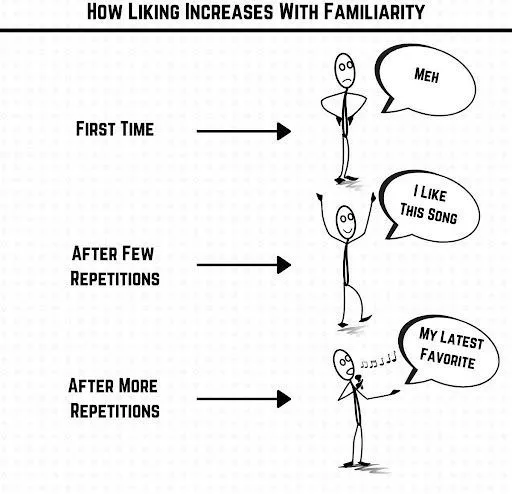
Repeated encounters can increase liking even when a person has no conscious memory of seeing the stimulus before. The mere exposure effect is attributed to perceptual fluency, where familiar material is processed more easily and that ease is experienced positively. It differs from using conscious familiarity as a shortcut for truth or quality, although both can influence preference.
Why do songs, faces, and even logos grow on us the more we encounter them? This guide explains the mere exposure effect - the psychology behind familiarity and liking - including the classic experiments, what's really happening in your brain, and where it quietly shapes your everyday choices.
In 1967, Robert Zajonc, a Polish-born social psychologist working at the University of Michigan, was puzzling over a question that most researchers of his era would have considered settled: why do people come to like things?
The standard answer, inherited from classical conditioning and reinforcement learning theory, was that positive affect follows positive outcomes.
You like things that reward you, things that signal safety, things associated with pleasure. Zajonc suspected there was a simpler engine running underneath all of that.
He designed a series of deceptively plain experiments. In one condition, participants were shown nonsense words - invented letter strings like "IKTITAF" or "CIVADRA" - at varying frequencies. Some words appeared once. Others appeared ten or twenty-five times.
Afterward, subjects were asked to rate how pleasant or unpleasant they suspected the words were, as though they were real words in an unfamiliar foreign language. In other conditions, Zajonc used photographs of Chinese characters and photographs of strangers' faces. The stimuli were arbitrary.
They carried no inherent meaning, no learned associations, no reward history.
The results were consistent and striking. Across all three stimulus types, the more frequently a stimulus had been shown, the more positively subjects rated it. Words that appeared twenty-five times were rated as more pleasant than words that appeared once.
Faces seen more frequently were judged as more likable. Chinese characters with higher exposure frequencies were rated as having more positive meanings.
The effect held even when subjects could not consciously recognize that they had seen the stimuli before - when they could not distinguish, at above-chance levels, previously shown items from new ones.
Zajonc published these findings in 1968 in the Journal of Personality and Social Psychology, in a paper titled "Attitudinal Effects of Mere Exposure." The title contained his thesis precisely: the mere act of exposure, stripped of any reinforcement, any conscious processing, any evaluative judgment, was sufficient to produce a measurable increase in positive affect.[1]
The paper became one of the most cited in the history of social psychology.
"Mere repeated exposure of the individual to a stimulus is a sufficient condition for the enhancement of his attitude toward it." - Robert Zajonc, 1968
What the Mere Exposure Effect Is
The Mere Exposure Effect is the empirically demonstrated tendency for people to develop greater positive affect toward stimuli simply as a result of repeated encounters with them, independent of any conscious memory of those encounters or any reward associated with them.
Mere Exposure Effect vs. Familiarity Heuristic
The Mere Exposure Effect is often conflated with the familiarity heuristic - the cognitive shortcut by which people treat recognition as a proxy for value or truth. They are related but mechanistically and empirically distinct phenomena.
| Dimension | Mere Exposure Effect | Familiarity Heuristic |
|---|---|---|
| Core mechanism | Repeated exposure increases positive affect via perceptual fluency; operates implicitly | Conscious recognition of a stimulus is used as a judgment shortcut (if I know it, it must be good/true) |
| Role of consciousness | Does not require conscious recognition; preference increases even without awareness of prior exposure | Requires conscious recognition; if you cannot consciously identify something as familiar, the heuristic does not activate |
| Domain | Affect and preference (liking, pleasantness ratings) | Judgment and inference (quality assessments, truth judgments, memory-based decisions) |
| Direction of effect | Always increases liking up to a point | Can increase or decrease evaluation depending on the judgment domain (e.g., fluency can inflate perceived truth or quality) |
| Underlying model | Zajonc's affective primacy; fluency as a signal of safety | Cognitive heuristics framework (Kahneman, Tversky, Gigerenzer); recognition heuristic |
| Dissociability | Can occur without familiarity judgment (subjects prefer stimuli they cannot consciously recognize as seen before) | Requires explicit or implicit familiarity signal; cannot operate in its absence |
| Empirical signature | Preference ratings increase monotonically with exposure frequency even at chance recognition | Judgment accuracy correlates with ability to consciously identify previously seen items |
The distinction matters practically. A person who has been subliminally exposed to a brand name may rate that brand more favorably without knowing why - this is the Mere Exposure Effect. A person who consciously thinks "I've heard of that brand, it must be legitimate" is deploying the familiarity heuristic.
Both effects can operate simultaneously, and both increase preference, but through different routes and with different modulating conditions.
Cognitive Science: Mechanisms and Neural Substrates
Perceptual Fluency and Affective Misattribution
The most developed mechanistic account of the Mere Exposure Effect centers on perceptual fluency - the subjective ease with which a stimulus is processed.
When a stimulus has been encountered before, its representation in memory is primed: neural pathways associated with its recognition are strengthened, and subsequent encounters engage those pathways with less processing effort.
This reduction in processing effort generates a signal of subjective ease.
Zajonc himself articulated this account in a 2001 review published in Current Directions in Psychological Science titled "Mere Exposure: A Gateway to the Subliminal." He argued that perceptual fluency - the feeling that a stimulus processes easily - is experienced as affectively positive.[5]
The organism interprets fluency as a signal of safety, benignity, or reliability. Evolution would have calibrated this: stimuli encountered repeatedly without harm are statistically safer than novel stimuli.
Fluency becomes a low-level alarm system that, in its absence (unfamiliarity, disfluency), triggers caution and mild negative affect, and in its presence, triggers comfort.
The critical and counterintuitive point is that this fluency-to-affect pathway operates without awareness. People do not consciously think: "This processes easily, therefore I like it." They simply notice that they like it, and if pressed for an explanation, generate post-hoc rationalizations unrelated to fluency.
Affective Primacy: Zajonc's Central Thesis
Zajonc's deeper theoretical claim, elaborated across several papers between 1968 and 2001, was what he called affective primacy: affect is not a product of cognition but precedes and operates independently of it.
The standard cognitive appraisal model of emotion (Arnold, 1960; Lazarus, 1966) held that emotions follow cognitive evaluations - you appraise a situation as threatening, then feel fear. Zajonc argued this was wrong, or at minimum incomplete.
Affect could precede cognition, could be triggered without any identifiable cognitive evaluation, and could influence behavior without conscious mediation.
This was a provocative thesis. It generated sustained debate with Richard Lazarus, who maintained that some form of cognitive appraisal, however primitive, was necessary for affect.
The exchange, published across multiple issues of American Psychologist in the early 1980s, remains one of the most substantive theoretical debates in twentieth-century emotion research.
The empirical record, particularly the subliminal exposure findings, has tended to favor Zajonc's position on the independence question.
Subliminal Exposure and the Dissociation of Preference and Recognition
The clearest evidence that the Mere Exposure Effect is not simply a product of conscious familiarity came from a landmark 1980 study by William Kunst-Wilson and Robert Zajonc, published in Science under the title "Affective Discrimination of Stimuli That Cannot Be Recognized."
Kunst-Wilson and Zajonc exposed subjects to irregular geometric shapes using exposure durations of one millisecond - far below the threshold for conscious recognition. When subsequently shown pairs of stimuli (one previously seen, one novel), subjects could not identify which they had seen before at better than chance levels.
They were, in the operationally meaningful sense, unaware of the prior exposures. But when asked which of the two shapes they preferred, they chose the previously exposed shape at significantly above-chance rates. Preference and recognition were dissociated: subjects liked the old stimuli better without knowing they had seen them.
This finding was theoretically decisive. If the Mere Exposure Effect operated through conscious familiarity - through the person noticing "I recognize this" and inferring positive value - then subliminal exposure should not produce it.
The fact that it did, and that it did so even when recognition was no better than guessing, meant the effect could not be fully explained by familiarity judgment. Something else - Zajonc's fluency signal - was doing the work.
Neural Evidence
Neuroimaging and psychophysiological research has since located some of the neural substrates of this effect.
Studies using functional MRI have found that stimuli processed under suboptimal conditions (brief exposure, degraded image quality) produce less activity in perceptual processing regions, and that this reduced effort is tagged affectively.
Research by Norbert Schwarz and colleagues at the University of Michigan, and separately by Piotr Winkielman at UC San Diego, has demonstrated that stimuli that process more fluently produce measurable differences in skin conductance, facial muscle activity (measured via electromyography), and self-reported affect.
This holds even when subjects cannot report any difference in recognition or familiarity.
Meta-Analytic Evidence: The Scale of the Effect
In 1989, Robert Bornstein of Gettysburg College published a comprehensive meta-analysis in Psychological Bulletin titled "Exposure and Affect: Overview and Meta-Analysis of Research, 1968-1987." Bornstein examined 134 studies and more than 230 experimental conditions testing the Mere Exposure Effect across a wide range of stimulus types, subject populations, and methodologies.
His findings established the effect as one of the most robust in social psychology:
- The average effect size across all studies was r = 0.26, which is considered a small-to-medium effect in psychological research but is exceptionally consistent across very different paradigms.
- The effect was found with stimuli including nonsense words, Chinese ideographs, photographs of faces, abstract geometric shapes, auditory tones, real words, and photographs of consumer products.
- Critically, the effect was stronger when stimuli were presented subliminally (below conscious awareness) than when they were presented supraliminally (consciously visible). Effect sizes for subliminal exposure conditions averaged r = 0.39, compared to r = 0.23 for supraliminal conditions. This counterintuitive finding - that you like something more when you are less consciously aware of being exposed to it - became one of the defining features of the effect and its strongest support for the perceptual fluency mechanism.
- The effect was found across cultures and age groups, though Bornstein noted that some stimulus types and some populations showed stronger effects than others.
Bornstein's 1989 meta-analysis is frequently cited as establishing the Mere Exposure Effect's status as a genuine, replicable psychological phenomenon rather than an artifact of particular experimental designs.
Four Case Studies Across Domains
Case Study 1: The Classroom Experiment (Social Psychology, 1992)
The most socially immediate demonstration of the Mere Exposure Effect in naturalistic conditions was conducted by Richard Moreland and Scott Beach at the University of Pittsburgh and published in the Journal of Experimental Social Psychology in 1992.[4]
Moreland and Beach arranged for female confederates to enroll in a large university lecture course at the beginning of a semester. The confederates attended class a specified number of times across the semester - either 0, 5, 10, or 15 sessions - and never interacted with other students.
They simply attended class and sat in the audience. At the end of the semester, students who had genuinely enrolled in the course were shown photographs of the confederates and asked to rate them on dimensions including attractiveness, liking, familiarity, and similarity.
The results conformed precisely to the Mere Exposure Effect's predictions. Confederates who had attended 15 sessions were rated significantly more positively than those who had attended 5, who were rated more positively than those who had attended 0 sessions (who had never appeared at all).
The dose-response relationship was linear. Students who had been passively exposed to the confederates more often liked them more - despite having never spoken to them.
Importantly, familiarity ratings also increased with exposure frequency, but the liking increase was not entirely explained by familiarity. The effect on liking was partially independent.
This is consistent with the dual-route interpretation: some of the liking increase comes from conscious familiarity, and some from the nonconscious fluency signal.
The study's ecological validity made it particularly influential. This was not a laboratory with millisecond-duration stimuli - it was a real university course, real students, real social context. The effect was present and measurable in conditions far removed from tightly controlled experimental chambers.
Case Study 2: Advertising Wear-In and Wear-Out (Marketing Science)
The advertising industry has spent decades grappling empirically with the Mere Exposure Effect under the practical labels of "wear-in" and "wear-out." These terms describe the trajectory of an advertisement's effectiveness across repeated exposures.
Research by Herbert Krugman, beginning with a 1972 paper in the Journal of Advertising Research and extending through subsequent decades of industry work, established that consumer attitudes toward advertised products generally improve across the first several exposures - the wear-in phase.
With sufficient repetition, attitudes then plateau and begin to decline through tedium, irritation, or reactance - the wear-out phase.
The Mere Exposure Effect maps cleanly onto the wear-in phenomenon. Early exposures to an advertisement, even if minimally attended to, increase processing fluency for the brand name, logo, visual identity, and product association. This fluency enhancement increases positive affect toward the brand.
The effect is particularly strong when the advertisement is encountered incidentally - on a billboard during a commute, as a background in a television program - precisely because low conscious attention maximizes the fluency-based mechanism while minimizing the counterargument and reactance that high conscious attention can generate.
The advertising research firm Research Systems Corporation, in work by Alvin Achenbaum published in the 1970s and subsequently updated, estimated that the typical consumer product required a minimum of three exposures for meaningful attitude change.
This "rule of three" entered advertising practice as a rough heuristic, though subsequent research by Krugman and others identified the threshold as context-dependent and varied substantially with creative quality, product category, and prior brand familiarity.
More recently, digital advertising research has revisited wear-out dynamics in the context of retargeting - the practice of repeatedly serving display advertisements to users who have previously visited a website.
Studies by professors Avi Goldfarb and Catherine Tucker, published in Management Science in 2011, found that retargeted advertisements showed strong positive effects at low frequencies but that effectiveness diminished sharply at higher frequencies, consistent with the wear-out curve.[11]
The optimal window in their data was typically between three and eight exposures within a short time window.
Case Study 3: Musical Preference and Earworm Dynamics (Cognitive Psychology)
Music provides an unusually clean domain for studying the Mere Exposure Effect because stimuli can be precisely controlled, repeated, and evaluated on explicit preference scales, and because people have strong intuitions about their own musical tastes that the data often contradict.
Research by Daniel Berlyne at the University of Toronto in the 1970s, extended by work from James Kellaris at the University of Cincinnati and others, established that listener ratings of unfamiliar musical pieces follow a reliable pattern.
They increase across initial exposures, peak at moderate familiarity, and then decline with very high exposure - the inverted-U curve that characterizes what Berlyne called the "optimal arousal" model.
However, the peak of this curve is strongly modulated by the complexity of the stimulus. For simple, repetitive musical structures, the inverted U is sharp: liking peaks quickly and declines quickly, which is consistent with the advertising wear-out finding.
For structurally complex compositions - those with more melodic, harmonic, or rhythmic information - the curve is much shallower and peaks at higher exposure levels, because more exposures are required before processing fluency for the piece reaches its maximum.
This has been exploited deliberately in the popular music industry.
Research by Elizabeth Hellmuth Margulis at the University of Arkansas, summarized in her 2014 book On Repeat, documents how pop music producers deliberately engineer repetition into song structures - using repeated hooks, recycled chord progressions, and short lyrical phrases - to accelerate the onset of fluency-based liking and to minimize the complexity that would slow the effect.[12]
The result is the phenomenon of the "earworm": a song that rapidly becomes familiar and therefore pleasant, even if the listener cannot initially articulate why they like it.
Case Study 4: Consumer Product Preference and Logo Recognition (Behavioral Marketing)
A controlled demonstration of the effect in consumer product contexts was conducted by Janiszewski (1988), published in the Journal of Consumer Research.[7] Janiszewski embedded brand logos in a series of advertisements in a way that directed attention either toward or away from the logo.
In conditions where attention was directed away from the logo - analogous to peripheral or incidental exposure - subsequent preference ratings for the brand were higher than in conditions where attention was directed toward the logo, despite equivalent exposure duration.
This finding directly parallels Bornstein's 1989 meta-analytic result that subliminal exposure produces stronger Mere Exposure Effects than conscious exposure.[6]
It suggests a practical implication: brand impressions formed under low-attention conditions may be more durable and more positive than those formed under high scrutiny, because high attention enables the kind of critical evaluation that can undercut simple fluency-based liking.
Subsequent work by Shapiro (1999) in the Journal of Consumer Research extended this to "incidental ad processing" - what happens when consumers encounter advertisements without deliberately reading them, as when flipping past pages in a magazine or scrolling past ads in a digital feed.
Shapiro demonstrated that brand evaluations improved even after incidental processing that left no conscious memory trace, using a process he termed "implicit memory for advertising."[8]
Intellectual Lineage: Where the Idea Came From
The Mere Exposure Effect did not emerge in a vacuum. Zajonc's 1968 paper was the empirical crystallization of ideas with a longer history.
Fechner (1876) may be the first to have noted, in passing, in his foundational work on experimental aesthetics, that familiarity with aesthetic stimuli tends to increase their perceived pleasantness. He offered no systematic data, but the observation was recorded.
Wundt (1874), working in Leipzig, developed the concept of the "Wundt curve" - the idea that stimuli of moderate intensity or moderate novelty are preferred over stimuli that are either extremely familiar or extremely novel.
This is the early formulation of what Berlyne would later call optimal arousal and what serves as the theoretical foundation for understanding why the Mere Exposure Effect eventually levels off and reverses at very high repetition.
William James (1890), in The Principles of Psychology, observed that objects encountered frequently feel comfortable and that novelty is intrinsically associated with a slight sense of unease - what he called "the feeling of a strange." This is not a controlled observation but an early statement of the phenomenology that the Mere Exposure Effect would later quantify.
Harrison (1968), in a contemporaneous but independently conducted set of studies, replicated Zajonc's basic paradigm and found consistent results, lending the original findings immediate cross-validation.
Bornstein and D'Agostino (1992) contributed the most detailed analysis of the fluency misattribution process, arguing in a paper in the Journal of Personality and Social Psychology that the Mere Exposure Effect is best understood as a special case of affect misattribution.
Fluency generated by prior exposure is real, but subjects do not correctly identify its source and instead attribute the positive feeling to the intrinsic pleasantness of the stimulus.
Norbert Schwarz at the University of Michigan, working broadly on fluency effects across the 1990s and 2000s, extended the theoretical framework from the Mere Exposure Effect to truth judgments, confidence assessments, and aesthetic evaluations, demonstrating that processing fluency is a general-purpose signal that the cognitive system applies across many different judgment domains.
Empirical Research: Key Findings and Parameters
Effect Size and Consistency
Bornstein's (1989) meta-analysis established a mean effect size of r = 0.26 across 134 studies.[3] This is a consistent but not enormous effect. For context, the correlation between height and weight in adults is approximately r = 0.44; the effect of aspirin on heart attack prevention is approximately r = 0.03.
The Mere Exposure Effect falls comfortably in the range of psychologically meaningful and practically relevant effect sizes.
Importantly, the effect is among the most replicated in social psychology. Unlike many findings from the 1960s and 1970s that failed replication attempts during the reproducibility crisis of the 2010s, the Mere Exposure Effect has consistently survived replication across different laboratories, countries, and stimulus types.
Optimal Exposure Frequencies
The relationship between exposure frequency and liking is not linear across all ranges. Research by Bornstein (1989) and subsequent work by Szpunar, Schellenberg, and Pliner (2004) in Cognitive, Affective, and Behavioral Neuroscience found that:[9]
- Liking increases with exposure up to approximately 10-20 exposures for most stimulus types.
- Beyond 20-30 exposures, liking tends to plateau and may decline - particularly for simple stimuli.
- The decline at very high exposure frequencies is more pronounced when stimuli are complex in terms of meaning or emotional valence than when they are neutral.
Spacing Effects
Massed versus distributed exposure produces measurably different preference trajectories. Zajonc and colleagues found that distributed exposures - stimuli encountered across multiple sessions with time intervals between them - produce stronger Mere Exposure Effects than the same number of exposures compressed into a single session.
This is consistent with the perceptual fluency account: distributed practice produces more durable fluency enhancements than massed practice, because spaced retrieval strengthens memory traces more effectively than continuous repetition.
Individual Differences
Research by Wilson and Zajonc (1980) and later work by Letizia Caso and colleagues found that individuals high in need for cognition - the trait-level tendency to engage in effortful thinking - show somewhat attenuated Mere Exposure Effects in supraliminal conditions, possibly because they engage in more deliberate evaluation of stimuli that counteracts the fluency-based affect.
Individuals low in need for cognition show stronger effects. This moderation is consistent with the dual-process interpretation: the Mere Exposure Effect is primarily a System 1 (automatic, affective) phenomenon, and individuals who heavily engage System 2 (deliberate, analytical) processing attenuate it.
Limits and Nuances
The Inverted-U Trajectory
As noted in the music and advertising discussions, the Mere Exposure Effect does not produce unlimited liking increases. At very high exposure frequencies, the curve flattens and reverses.
This reversal is sometimes explained in terms of reactance (Brehm, 1966) - the psychological resistance generated by perceived loss of autonomy or control - and sometimes in terms of tedium or satiation, a simple hedonic adaptation in which repeated stimulation of any sensory pathway produces diminishing returns.
The inflection point varies. For simple, meaningless stimuli like nonsense syllables or geometric shapes, it may occur after as few as 10-15 exposures.
For complex, emotionally meaningful stimuli - a beloved piece of music, a cherished photograph - it may occur only after thousands of exposures, or may not occur within a practical range at all.
The implication is that the Mere Exposure Effect is most powerful in its early and middle range, and that its benefits cannot be harvested indefinitely by simply increasing repetition.
Initial Affect Matters
The Mere Exposure Effect does not operate uniformly across all valence conditions.
Research by Perlman and Oskamp (1971) and more systematically by Grush (1976), both published in journals of social psychology, found that repeated exposure to stimuli that are initially negative - already disliked before repetition begins - tends to deepen dislike rather than convert it to liking.
This is sometimes called the "mere exposure effect reversal" or "polarization effect."
Zajonc's original studies used neutral stimuli, and the effect's robustness depends on starting from a neutral or weakly positive baseline.
The mechanism is consistent with the fluency account: fluency signals that a stimulus is safe and familiar, but if the stimulus has established negative meaning, increased fluency may amplify the ease with which negative associations are retrieved rather than producing positive affect.
Familiarity Does Not Always Mean Preference
The effect is specifically on affect and preference ratings - it does not necessarily produce higher quality assessments, greater credence, or greater behavioral endorsement across all domains.
Research in the truth literature (Hasher, Goldstein, and Toppino, 1977, in the Journal of Verbal Learning and Verbal Behavior) showed that repeated exposure increases rated truth of statements - the "illusory truth effect" - but this is a related, distinct phenomenon with its own moderators.[10]
The Mere Exposure Effect proper concerns hedonic valence, not epistemic confidence, though both draw on fluency as a mechanism.
Cross-Cultural Replication
The effect has been replicated across Western and East Asian samples, and with stimuli from both familiar and unfamiliar cultural contexts.
However, Bornstein (1989) found modest evidence that effect sizes differ across cultures, with some studies from East Asian populations showing more pronounced effects, possibly reflecting cultural differences in the salience of relational and familiarity-based cues.
This is an area where the evidence base remains thinner than it is for the core effect.
The Recognition Paradox
One of the most practically important nuances of the Mere Exposure Effect is its dissociation from recognition memory. Kunst-Wilson and Zajonc (1980) established that preference can increase even when recognition is at chance.[2]
Bornstein's (1989) meta-analysis confirmed that subliminal exposures produce stronger effects than supraliminal ones.
This means that conscious awareness of prior exposure is not only unnecessary for the effect - it may partially undercut it.
The implication is that the Mere Exposure Effect is strongest when people do not know they have been exposed.
This raises genuine ethical concerns in advertising and political communication: preference can be systematically shaped through repeated subliminal or incidental exposure without the target's knowledge or consent, and without any consciously accessible memory of the exposure that might prompt critical evaluation.
Sources & Further Reading
Zajonc, R. B. (1968). Attitudinal effects of mere exposure. Journal of Personality and Social Psychology Monograph Supplement, 9(2, Pt. 2), 1-27.
Kunst-Wilson, W. R., & Zajonc, R. B. (1980). Affective discrimination of stimuli that cannot be recognized. Science, 207(4430), 557-558.
Bornstein, R. F. (1989). Exposure and affect: Overview and meta-analysis of research, 1968-1987. Psychological Bulletin, 106(2), 265-289.
Moreland, R. L., & Beach, S. R. (1992). Exposure effects in the classroom: The development of affinity among students. Journal of Experimental Social Psychology, 28(3), 255-276.
Zajonc, R. B. (2001). Mere exposure: A gateway to the subliminal. Current Directions in Psychological Science, 10(6), 224-228.
Bornstein, R. F., & D'Agostino, P. R. (1992). Stimulus recognition and the mere exposure effect. Journal of Personality and Social Psychology, 63(4), 545-552.
Janiszewski, C. (1988). Preconscious processing effects: The independence of attitude formation and conscious thought. Journal of Consumer Research, 15(2), 199-209.
Shapiro, S. (1999). When an ad's influence is beyond our conscious control: Perceptual and conceptual fluency effects caused by incidental ad exposure. Journal of Consumer Research, 26(1), 16-36.
Szpunar, K. K., Schellenberg, E. G., & Pliner, P. (2004). Liking and memory for musical stimuli as a function of exposure. Cognitive, Affective, and Behavioral Neuroscience, 4(4), 517-525.
Hasher, L., Goldstein, D., & Toppino, T. (1977). Frequency and the conference of referential validity. Journal of Verbal Learning and Verbal Behavior, 16(1), 107-112.
Goldfarb, A., & Tucker, C. (2011). Online display advertising: Targeting and obtrusiveness. Marketing Science, 30(3), 389-404.
Margulis, E. H. (2014). On Repeat: How Music Plays the Mind. Oxford University Press.