
Moods can spread through a group without deliberate persuasion, changing how people feel after contact with anxiety, laughter, or irritation. Emotional contagion is this automatic social process, showing that another person's visible emotion can shape a team's energy and response.
Walk into a room full of anxious people and you may leave feeling vaguely uneasy, even if nothing bad happened to you. Spend an afternoon with someone who laughs easily and you may find yourself feeling lighter. Attend a meeting led by a visibly irritable manager and watch the team's energy flatten within minutes.
These are not merely metaphorical descriptions of social influence. They describe a real, measurable, and largely automatic psychological process: emotional contagion - the transmission of emotional states between people through mechanisms that operate mostly below the level of conscious awareness.
Understanding emotional contagion matters for anyone who works in groups, leads teams, maintains close relationships, or simply wants to understand why they feel the way they do after spending time with particular people.
What Emotional Contagion Is
The formal concept was developed and named by psychologists Elaine Hatfield, John Cacioppo, and Richard Rapson in their 1993 book "Emotional Contagion." They defined it as "the tendency to automatically mimic and synchronize expressions, vocalizations, postures, and movements with those of another person and, consequently, to converge emotionally."
Their model identified a two-step process:
- We unconsciously mimic the facial expressions, vocal tone, body posture, and movements of people around us
- This physical mimicry produces or amplifies the corresponding emotional state in ourselves, through what psychologists call peripheral feedback - the body's physical expression of an emotion generating or reinforcing the feeling
Hatfield and colleagues distinguished primordial emotional contagion - this automatic, non-conscious process - from more deliberate processes like empathy (consciously imagining another's perspective) or social comparison (deliberately evaluating one's emotional state against another's).
Primordial emotional contagion happens faster than thought, and it happens whether we intend it or not.
The distinction between primordial contagion and deliberate empathy is more than academic. Empathy requires cognitive effort, theory of mind, and conscious attention. Primordial contagion bypasses all of these.
It operates at the level of the body's automatic systems - postural, facial, vocal - before the thinking mind has any involvement.
This is why emotional contagion can occur even in people who would not describe themselves as particularly empathic, and why it cannot be reliably prevented by conscious intention alone.
The Mechanics of Contagion
Facial Mimicry
Research using electromyography - sensors that measure tiny muscle activations invisible to the naked eye - has repeatedly demonstrated that people automatically activate facial muscles corresponding to the expressions they observe in others.
When you see someone smile, your zygomatic major muscle activates slightly. When you see a grimace, your corrugator supercilii (brow-furrowing muscle) responds.
This happens extremely fast - within milliseconds of observing an expression - and happens even when people are consciously trying to maintain a neutral face. It is not voluntary imitation. It appears to be a default operation of the social brain.
A landmark study by Dimberg, Thunberg, and Elmehed (2000), published in Psychological Science, demonstrated that people showed measurable facial muscle responses to emotional expressions even when those expressions were presented subliminally - too briefly (30 milliseconds, masked by a neutral face) to reach conscious awareness.[2]
The effect was identical in direction to responses to visible expressions: subliminal happy faces activated the zygomaticus, subliminal angry faces activated the corrugator.
This finding is particularly significant because it rules out conscious mimicry as the explanation. The system operates automatically, beneath awareness, in response to social-emotional signals too brief to be consciously processed.
Vocal Synchronization
Emotional states spread through voices as well as faces. People unconsciously adjust their speaking pace, pitch, volume, and rhythm to match conversation partners - a phenomenon called vocal entrainment.
Since vocal characteristics are tightly coupled to emotional states, this synchronization transmits emotional tone in ways that are difficult to resist.
Research has found that emotional content in speech affects listeners' own emotional states through both the semantic content (what is being said) and the paralinguistic cues (how it is being said), with paralinguistic cues sometimes having stronger effects on rapid emotional responses.
Neumann and Strack (2000) demonstrated this specifically for vocal emotion.[3] In their experiments, participants listening to speech passages delivered in slightly happy or slightly sad vocal tone showed corresponding shifts in their own emotional state - even when the semantic content was emotionally neutral.
The voice's emotional tone, not the words' meaning, was driving the contagion. This has practical implications for any context in which voice is the primary channel of communication: phone calls, voicemail, audio messages, radio, and increasingly, voice interfaces with AI systems.
Postural and Movement Mirroring
Beyond face and voice, people unconsciously adopt the postures and movement patterns of those they interact with. Someone who slouches in their chair when speaking to you will often find you gradually adopting a similar posture. The energy and engagement level conveyed through posture and gesture spreads through groups.
This is particularly observable in high-performing teams and groups with strong rapport, where postural synchronization - people leaning in together, shifting positions at the same moments - is markedly higher than in groups with poor cohesion or adversarial dynamics.
Chartrand and Bargh (1999) demonstrated the behavioral mimicry effect in their "chameleon effect" studies, showing that people who were mimicked by an experimenter (subtly copying their posture and gestures) reported greater liking for the experimenter and smoother interaction.[4]
Mimicry functions as both a consequence of rapport and a producer of it - a bidirectional relationship that shapes social interaction through physical synchronization.
Mirror Neurons
In the 1990s, neuroscientist Giacomo Rizzolatti and colleagues at the University of Parma discovered a class of neurons in macaque monkeys that fired both when the monkey performed an action and when it merely observed the same action performed by another. These became known as mirror neurons.
Subsequent research suggested that humans possess an analogous mirror neuron system, distributed across several brain regions, that activates in response to observed actions, emotional expressions, and pain in others.
The mirror neuron system has been proposed as a potential neural substrate for empathy, for imitation learning, and - most relevantly here - for the automatic emotional synchronization that underlies emotional contagion.
"We are exquisitely social creatures. Our survival depends on understanding the actions, intentions and emotions of others. Mirror neurons allow us to grasp the minds of others not through conceptual reasoning but through direct simulation." - Giacomo Rizzolatti
The mirror neuron hypothesis remains active in neuroscience research, with ongoing debate about the precise mechanisms and their scope.
What is less contested is the behavioral evidence: people reliably and automatically synchronize emotionally with those around them, and this synchronization has measurable downstream effects on their own emotional states.
The Peripheral Feedback Loop
A critical component of Hatfield and colleagues' model is the mechanism through which physical mimicry produces emotional change. This is not merely theoretical: substantial research on facial feedback demonstrates that adopting or suppressing facial expressions produces corresponding changes in felt emotion.
The original evidence came from studies by Fritz Strack and colleagues (1988), in which participants held a pen in their teeth (inducing a smile-like contraction of the zygomaticus) or between their lips (preventing smiling) and rated the funniness of cartoons.
Those in the pen-in-teeth condition found cartoons funnier. This result, and related findings, supported the facial feedback hypothesis: that proprioceptive feedback from facial muscles contributes to the generation of emotional experience.
The effect has been contested - a large-scale registered replication produced mixed results (Wagenmakers et al., 2016) - and its magnitude remains debated. However, the broader class of embodied emotion findings - that bodily states feed back into emotional experience - has received substantial support across multiple methodologies.
The body is not merely the output channel for emotion; it participates in generating and modulating emotional experience. This participation is what allows facial and postural mimicry to produce emotional contagion rather than mere behavioral synchronization.
The Facebook Experiment
The most controversial demonstration of large-scale emotional contagion came in 2014, when Facebook published a paper (Kramer, Guillory, and Hancock) in the Proceedings of the National Academy of Sciences.[7] The study had been conducted in 2012 on approximately 689,000 Facebook users without their explicit knowledge.
The researchers manipulated the emotional content of users' news feeds. For one group, posts containing positive emotional language were reduced in the feed. For another, posts containing negative emotional language were reduced.
The study found that users in each condition subtly shifted the emotional tone of their own posts in the corresponding direction - those exposed to more negative content posted somewhat more negatively, those exposed to more positive content posted more positively.
The effect sizes were small - fractions of a percent difference in emotional word use. But the implications were significant in two directions:
Scientifically, the study confirmed that emotional contagion operates through text and social media interaction, not only through face-to-face contact. Emotional tone spreads even in the absence of direct physical interaction or vocal cues.
Ethically, the study demonstrated that a social media platform could systematically alter the emotional states of hundreds of thousands of users without their knowledge, using only feed curation.
The public and scientific response was intense: the study's conduct was criticized as violating research ethics norms, and its implications for platform responsibility generated policy debates that continued for years.
The Facebook experiment is a case study in the power of emotional contagion at scale - and a reminder that the mechanisms driving it can be deliberately engineered by entities controlling information environments.
Emotional Contagion in the Workplace
The implications of emotional contagion for organizational life are substantial and well-documented.
Leadership Mood Contagion
Sigal Barsade at the Yale School of Management conducted a series of influential studies on emotional contagion in work groups.[5]
Her 2002 study, published in Administrative Science Quarterly, used confederates trained to display different emotional states (pleasant/high energy, pleasant/low energy, unpleasant/high energy, unpleasant/low energy) in small group tasks.
The contagion of the confederate's emotional state to other group members was clearly measurable, and groups that caught positive emotions showed improved cooperation, reduced interpersonal conflict, and higher task performance ratings.
Subsequent research has consistently found that leader emotional displays are especially contagious.
The phenomenon occurs because followers pay heightened attention to high-status individuals: leaders are monitored more closely, their expressions are interpreted as signals about the group's situation, and their emotional state is treated as informative about whether conditions are safe or threatening.
This amplifies the transmission of leader emotions to the group.
The practical implication is significant: a leader's mood is not merely their private psychological state - it is an environmental variable that systematically affects the people around them. Leaders who are visibly anxious, irritable, or disengaged do not simply perform less well themselves; they degrade the emotional climate and performance of everyone they interact with.
A 2006 study by Bono and Ilies in Leadership Quarterly measured the relationship between transformational leadership, leader emotional displays, and follower mood and performance.[6]
They found that leaders who displayed more positive emotional expressions were rated as more charismatic and had followers with more positive moods, and that those followers in turn reported higher performance.
The contagion pathway - from leader expression to follower mood to follower behavior - was partially mediated through emotional contagion processes.
The study contributed to a growing understanding that leadership effectiveness is partly a function of the emotional environments leaders create, not merely their strategic decisions or task competencies.
Team Emotional Climate
Repeated emotional contagion events aggregate into what researchers call group affective tone - the consistent, characteristic emotional tenor of a team or work group.
Groups with positive affective tone show higher cooperation, greater information sharing, more creative problem-solving, and lower turnover intention. Groups with negative affective tone show the inverse.
Group affective tone is not simply the average of individual dispositions. It is substantially shaped by the contagion process itself: if one member (particularly a high-status or socially central one) consistently displays negative emotions, that negativity spreads and becomes part of the group's ambient experience.
| Emotional Display Source | Approximate Contagion Impact | Key Factor |
|---|---|---|
| Direct supervisor | High | Monitoring salience; power dynamics |
| Socially central team member | Moderate-high | Network centrality; social influence |
| Peripheral team member | Low-moderate | Less monitored; lower social impact |
| Written communication | Low-moderate | Text-based cues are weaker but still measurable |
| Video call interaction | Moderate | More cues than text; fewer than in-person |
| In-person interaction | High | Full range of face, voice, posture cues |
Customer-Facing Roles
Research on service workers and customer interactions has found bidirectional emotional contagion: service workers catch customers' emotional states, and customers catch service workers'. This creates both challenges and opportunities.
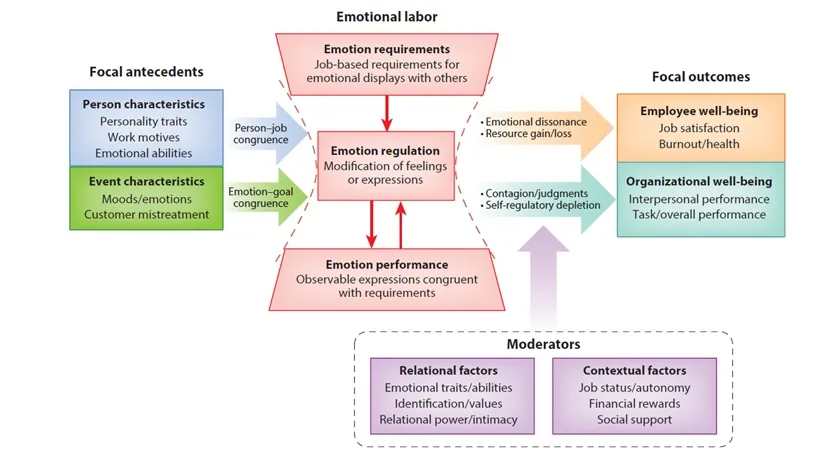
Workers in roles with high emotional labor - displaying positive emotions as part of the job - are vulnerable to burnout partly through this mechanism.
They must suppress the contagion of customer frustration or distress and simultaneously generate and transmit positive emotional states, a sustained process with documented psychological costs.
Grandey (2003) examined the distinction between surface acting (managing visible emotional expression without internal change) and deep acting (actually inducing the desired internal emotional state through cognitive and imaginative effort).[9]
Surface acting was associated with higher emotional exhaustion; deep acting with better customer satisfaction outcomes and less burnout.
The implication is that organizations asking employees to perform positive emotions without supporting the emotional management skills that make this sustainable are increasing burnout risk while potentially reducing service quality.
Managing Emotional Contagion
Understanding the process raises the practical question: what can individuals and organizations do with this knowledge?
Individual Awareness
Awareness of emotional contagion is a meaningful first step. Research suggests that people who understand the process are somewhat better at distinguishing their own emotional states from adopted ones.
Practices that support interoceptive awareness - checking in with one's own physical and emotional state, brief periods of solitude and quiet, mindfulness practices that develop attention to internal experience - create a buffer against automatic contagion by building the capacity to notice when one's emotional state has shifted and to evaluate its source.
Mindfulness-based practices, specifically, have been shown to reduce automatic emotional reactivity while maintaining sensitivity to others' emotional states.
Chambers, Lo, and Allen (2008) found that brief mindfulness training reduced rumination and improved emotional regulation - capacities directly relevant to managing the downstream effects of emotional contagion.
Deliberate Emotional Modeling
For leaders and anyone with social influence, the knowledge that emotional states are contagious carries a responsibility.
The question is not merely "how do I feel?" but "what emotional environment am I creating for the people I interact with?" This does not mean performing false positivity - emotional fakery is typically detected and creates its own problems.
It means recognizing the difference between processing difficult emotions in appropriate private contexts versus unmanaged emotional broadcasting in group settings.
Research distinguishes between authentic positive emotion and performed positive emotion.
The former produces genuine contagion and rapport; the latter may produce short-term compliance but is frequently detected as inauthentic, reducing trust and potentially triggering negative contagion as team members respond to the perceived inauthenticity.
Genuine emotional self-regulation - developing the capacity to access and express appropriate positive states authentically - is more effective than performance.
Environmental Design
Organizations can design for better emotional contagion dynamics. Teams with high-quality interpersonal relationships catch positive emotions more readily. Psychological safety reduces fear-based emotional contagion.
Structuring high-stakes meetings to begin with clear, calm framing shapes the emotional starting point of the group. These are not trivial interventions - they shape the emotional substrate in which all other work occurs.
Physical environment also plays a role. Research on ambient sound, lighting, and spatial arrangement shows these affect emotional baselines, which in turn affect what gets transmitted through contagion processes.
Open-plan offices, which increase the acoustic and visual presence of others' emotional states, are particularly high-contagion environments - which means they amplify both positive and negative emotional transmission.
Recognizing Contagion's Limits
Managing emotional contagion is not the same as suppressing it. The capacity to catch others' emotions is not a flaw - it is a fundamental feature of social cognition that enables empathy, coordination, and social bonding.
The goal is not emotional imperviousness but emotional awareness: the ability to notice what is happening, to choose a response rather than simply reacting, and to understand that mood is not purely generated from within but is substantially shaped by the social environment we inhabit.
Hatfield, Cacioppo, and Rapson closed their foundational book with an observation that still holds: we are not simply individual emotional islands.[1] We are, at the neurological and behavioral level, deeply connected emotional systems. The moods that move through us are rarely entirely our own.
Emotional Contagion Across Digital Media
A significant area of more recent research concerns emotional contagion in text-based and digital communication - environments where the traditional facial, vocal, and postural cues are absent or reduced.
The Facebook experiment (Kramer et al., 2014) demonstrated that emotional tone in written posts could spread to readers' own emotional expression.
Follow-up research has explored the mechanisms: text carries emotional content through word choice, punctuation patterns, sentence length, and even emoji use, each of which serves as a proxy cue for the emotional states that face-to-face interaction conveys through direct physical signals.
Research by Brady et al. (2017) in the Proceedings of the National Academy of Sciences found that moral-emotional language spread further on Twitter than non-emotional language, with each moral-emotional word in a tweet increasing its spread to new social networks by approximately 20%.[8]
Content that combined moral and emotional signals - outrage, righteousness, disgust - was particularly contagious. This finding aligned with the Facebook experiment's implications: platforms that measure success by engagement are, by design, optimized to maximize the spread of the highest-contagion emotional content.
The design of communication environments matters for emotional contagion in ways that were not possible to study before digital communication became ubiquitous.
Notification systems that prioritize emotional responses, recommendation algorithms that surface high-engagement content, and interface designs that make reactive responses (likes, reactions) one-touch - all of these are environmental structures that shape the emotional climate millions of people inhabit daily.
Algorithms as Emotional Contagion Amplifiers
The Facebook experiment revealed that a platform could shift the emotional states of hundreds of thousands of users through feed curation. What it did not fully address is the degree to which recommendation systems are structurally incentivized to do exactly this at scale.
Engagement-maximizing algorithms preferentially surface content that generates strong emotional responses - because emotional responses produce clicks, shares, comments, and dwell time.
The emotions that most reliably generate engagement are not, in general, positive: research consistently shows that negative arousing emotions (anger, fear, outrage, disgust) drive higher engagement than positive or low-arousal content.
An algorithm optimizing for engagement is therefore, implicitly, optimizing for the spread of negative emotional content - a machine-scale emotional contagion system whose direction is structurally biased toward the negative.
Kramer and colleagues (2014) showed the effect in the controlled direction. The uncontrolled real-world direction - what happens when engagement metrics determine feed content - has been analyzed in studies of political polarization, moral outrage dynamics, and adolescent mental health.
The effects are difficult to isolate cleanly, but the mechanism is not in theoretical doubt.
Susceptibility Differences
Not everyone is equally susceptible to emotional contagion. Research has identified several factors that moderate susceptibility:
Interpersonal sensitivity: Individuals who are more attentive to others' emotional states in general tend to catch emotions more readily. High interpersonal sensitivity is associated with stronger mimicry responses and greater downstream emotional impact.
Trait empathy: Higher trait empathy is associated with greater emotional contagion. This is consistent with the underlying mechanism - people who are more motivated and attuned to understanding others' emotional states pick up more of the emotional signal.
Attachment style: Research has found that anxiously attached individuals tend to be more susceptible to negative emotional contagion, potentially because their heightened vigilance to relationship-relevant social cues makes them more responsive to others' distress signals.
Exposure duration and relationship closeness: Longer exposure and closer relationships increase contagion. Brief, distant contact produces weak contagion; sustained contact with intimate others produces strong contagion.
This is one reason why marriage and other cohabiting relationships show the strongest evidence of emotional synchronization.
Gonzaga, Keltner, and Ward (2008) found that partners in long-term relationships showed significantly greater emotional synchrony than strangers - both in facial expression and in reported emotional experience - consistent with years of accumulated contagion exposure creating stable emotional attunement.
Professional context: Some professional roles require deliberate management of emotional expression and may develop greater resistance to contagion as an occupational adaptation.
Therapists, doctors, and other helping professionals often develop practices (supervision, deliberate compartmentalization) to manage the contagion risk in their work.
Power and status: Research suggests that lower-power individuals are more susceptible to emotional contagion from higher-power individuals than the reverse - a directional asymmetry that compounds the leadership contagion effect.
Employees attend more carefully to their managers than managers attend to employees, producing a structural bias in whose emotions spread most.
Emotional Contagion and Collective Wellbeing
The public health implications of emotional contagion extend beyond individual and organizational wellbeing. Large-scale emotional transmission events - moral panics, collective grief, shared celebration, national anxiety in response to threats - represent emotional contagion operating at societal scale.
Studies of community-level emotional contagion using social media data have found that emotional tones in one area of a social network spread to adjacent areas over time, even after controlling for shared exposure to the same events.
The emotional weather of a community is not simply the aggregated response to shared facts; it spreads through the network through contagion processes, meaning that the emotional state of communities remote from a triggering event can be altered by exposure to the emotional responses of those who were closer to it.
This has implications for how we understand media, news, and the emotional dynamics of public discourse. The news media have long been understood to shape public opinion and attention.
Research on emotional contagion adds another layer: news media also transmits emotional states to audiences, and the emotional states transmitted depend on editorial choices, framing, and increasingly on algorithmic curation - each of which shapes the emotional environment inhabited by millions of people daily.
The Collective Intelligence Implication
Emotional contagion has implications that extend beyond individual and team wellbeing into group cognition and decision-making.
Research on group emotions and decision quality has found that the emotional climate of a group affects not only how members feel but how they think. Positive emotional climates are associated with broader, more creative thinking (Fredrickson's broaden-and-build theory).[10]
Negative emotional climates, particularly those characterized by fear or anxiety, are associated with narrower, more defensive thinking.
Barbara Fredrickson's broaden-and-build theory (2001), published in the American Psychologist, proposes that positive emotions broaden the scope of attention and cognition - expanding the range of thoughts, actions, and associations available to the mind - while negative emotions narrow this scope toward survival-relevant responses.
If this is accurate, emotional contagion is not merely an interpersonal phenomenon but a group cognitive phenomenon: the emotional climate of a group determines the cognitive space available for the group's thinking.
A team experiencing shared anxiety thinks more narrowly than a team experiencing shared enthusiasm, regardless of individual differences.
This creates a collective intelligence dimension to emotional contagion management: a leader or team member who spreads fear or anxiety is not only affecting how people feel - they are shaping the cognitive space in which decisions are made.
Groups that approach strategic problems in a state of anxious threat-response think differently than groups that approach the same problems from a state of secure curiosity.
The practical implication is that managing the emotional climate of a group is not separate from managing the quality of its thinking and decision-making. It is a precondition for it. This reframes emotional leadership not as a soft skills concern but as a direct driver of organizational cognitive performance.
Sources & Further Reading
- Hatfield, E., Cacioppo, J. T., & Rapson, R. L. (1993). Emotional Contagion. Cambridge University Press.
- Dimberg, U., Thunberg, M., & Elmehed, K. (2000). Unconscious Facial Reactions to Emotional Facial Expressions. Psychological Science, 11(1), 86-89.
- Neumann, R., & Strack, F. (2000). "Mood Contagion": The Automatic Transfer of Mood Between Persons. Journal of Personality and Social Psychology, 79(2), 211-223.
- Chartrand, T. L., & Bargh, J. A. (1999). The Chameleon Effect: The Perception-Behavior Link and Social Interaction. Journal of Personality and Social Psychology, 76(6), 893-910.
- Barsade, S. G. (2002). The Ripple Effect: Emotional Contagion and Its Influence on Group Behavior. Administrative Science Quarterly, 47(4), 644-675.
- Bono, J. E., & Ilies, R. (2006). Charisma, Positive Emotions and Mood Contagion. Leadership Quarterly, 17(4), 317-334.
- Kramer, A. D. I., Guillory, J. E., & Hancock, J. T. (2014). Experimental Evidence of Massive-Scale Emotional Contagion Through Social Networks. Proceedings of the National Academy of Sciences, 111(24), 8788-8790.
- Brady, W. J., Wills, J. A., Jost, J. T., Tucker, J. A., & Van Bavel, J. J. (2017). Emotion Shapes the Diffusion of Moralized Content in Social Networks. Proceedings of the National Academy of Sciences, 114(28), 7313-7318.
- Grandey, A. A. (2003). When "The Show Must Go On": Surface Acting and Deep Acting as Determinants of Emotional Exhaustion and Peer-Rated Service Delivery. Academy of Management Journal, 46(1), 86-96.
- Fredrickson, B. L. (2001). The Role of Positive Emotions in Positive Psychology. American Psychologist, 56(3), 218-226.