
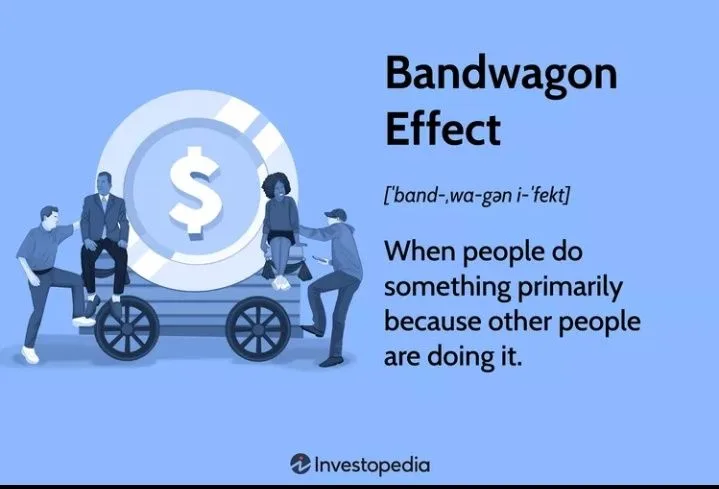
Social information can be useful, but it becomes a problem when the crowd replaces independent judgment. The bandwagon effect is the tendency to adopt a belief or behavior because others have already done so, shaping markets, elections, consumption, scientific discussion, and social movements.
In the spring of 2021, shares of GameStop, a struggling video game retailer, surged from roughly $20 to nearly $500 in a matter of days. Millions of retail investors who had never heard of the company a week earlier were suddenly buying in.
Many acknowledged they did not understand the fundamentals of the trade; they were buying because everyone else was buying.
This is the bandwagon effect in its starkest modern form: the tendency for people to adopt a belief, behavior, or position primarily because other people are doing so. It operates in financial markets, political elections, consumer choices, scientific discourse, and social movements.
Understanding it is not about dismissing social influence: social information is genuinely useful. It is about recognizing when following the crowd replaces rather than supplements your own judgment.
Origins of the Term
The phrase "jump on the bandwagon" comes from 19th-century American politics, when political candidates would hire a decorated wagon carrying a band to parade through towns. Joining the bandwagon, literally climbing aboard, signaled public support and attracted more followers.
The larger the crowd on the wagon, the more others wanted to join.
Elihu Katz and Paul Lazarsfeld studied bandwagon effects in voting in the 1940s and 1950s. Solomon Asch's famous conformity experiments in the 1950s demonstrated laboratory conditions under which people would deny the evidence of their own eyes to agree with a unanimous group.
Robert Cialdini, in Influence (1984), formalized social proof, the principle that people look to others' behavior as evidence of the correct action, especially under uncertainty.
The modern academic study of bandwagon effects draws heavily on cascade theory, developed by economists Sushil Bikhchandani, David Hirshleifer, and Ivo Welch in a landmark 1992 paper. Their model showed mathematically how individually rational agents can collectively produce irrational herd behavior.
The Asch Experiments in Detail
Solomon Asch's conformity studies of the early 1950s remain among the most vivid demonstrations of social pressure overriding independent judgment. In the original setup, a single test subject was placed in a room with several other participants who were secretly confederates of the experimenter.
The group was shown a line of a given length and asked to identify which of three comparison lines matched it. The correct answer was unambiguous: the difference in lengths was obvious to the naked eye.
When the confederates all gave the same wrong answer, roughly 75% of test subjects conformed to the incorrect group answer at least once during the experiment. Approximately 37% of all responses, across trials, matched the group's wrong answer.
When subjects were interviewed afterward, some reported that they had genuinely started to doubt their own perception. Others knew they were wrong but could not bring themselves to publicly deviate.
This is the bandwagon effect at its most fundamental: the crowd does not need to be right to compel agreement. It merely needs to appear unified.
Bikhchandani, Hirshleifer, and Welch (1992)
The 1992 paper "A Theory of Fads, Fashion, Custom, and Cultural Change as Informational Cascades" by Bikhchandani, Hirshleifer, and Welch provided the formal economic model of what happens when people update their beliefs based on observed behavior rather than independent signals.
Their key insight was that once enough people have made the same observable choice, the rational Bayesian response for a newcomer is to follow the crowd regardless of their own private information, because the crowd's aggregate signal outweighs the individual's private signal.
This rational mechanism explains why cascades start, propagate, and, critically, why they are extremely fragile. Because each person in the cascade has, in effect, discarded their own private information, the entire edifice rests on the behavior of the early movers.
If the early movers were wrong, the entire cascade is wrong, but it propagates as though it were right.
The Psychology Behind It
The bandwagon effect is not simply stupidity or laziness. It is the output of several cognitive mechanisms that are, in many contexts, adaptive.
Social Proof as Information
When you are uncertain, what others are doing provides genuine information. If you arrive in an unfamiliar city and one restaurant has a queue out the door while the one next to it is empty, choosing the busy restaurant is a reasonable heuristic. Other people may know something you do not.
The problem arises when the crowd is itself following a crowd, not independent information. If everyone in the queue joined because they saw a queue, the information value of the queue approaches zero, but it looks just like a queue formed by genuine independent assessors.
The Fear of Missing Out
FOMO (fear of missing out) amplifies the bandwagon effect in financial contexts. When asset prices rise and you see peers making money, not participating feels like a loss. The psychological pain of a missed gain is distinct from regret about a loss, but both motivate action.
Rising prices attract attention, attention attracts buyers, buyers push prices higher: a self-reinforcing loop that can continue far longer than any rational model predicts.
Social Identity and Belonging
Humans are deeply tribal. Holding the minority view within a social group carries social cost: the risk of ridicule, exclusion, or being labeled as out of touch. Conforming to group beliefs, even when they conflict with private assessment, can be a rational choice if social standing matters more than accuracy in a given context.
This is distinct from the informational explanation and helps explain why the bandwagon effect is stronger in public settings than private ones.
Availability and Salience
A rising market, a viral political movement, or a trending product is highly salient: it occupies mental space disproportionate to its actual frequency or importance. The availability heuristic leads people to overestimate the prevalence of things they can easily recall.
Seeing bandwagon behavior in the news makes it feel universal, which further reinforces joining.
Loss Aversion and Reference Points
Daniel Kahneman and Amos Tversky's prospect theory (1979) established that losses are psychologically roughly twice as painful as equivalent gains are pleasurable.
In a rising-market bandwagon, this asymmetry works perversely: as prices climb, the imagined future loss of continued non-participation grows larger while the imagined future loss from buying at the peak feels remote.
People anchor to recent prices, then feel increasingly behind, which accelerates late-stage buying pressure.
By the time a bubble is most obvious, the psychological pressure to join is at its strongest, and the actual risk of joining is at its highest.
Cascade Effects in Financial Markets
Financial markets are the domain where bandwagon effects have the most studied and most costly consequences.
Asset Bubbles
A speculative bubble forms when asset prices rise not because of improvements in underlying value but because rising prices attract more buyers who expect continued rises. This is pure bandwagon dynamics.
Each participant may understand intellectually that prices are disconnected from fundamentals, surveys conducted during the dot-com bubble found that many investors acknowledged prices were irrational, but they continued buying because they believed they could exit before the collapse.
"Markets can remain irrational longer than you can remain solvent." John Maynard Keynes
This observation captures the core problem: even if you correctly identify a bandwagon bubble, betting against it requires surviving the continued irrationality of the crowd, which can persist for years.
Historical examples span centuries:
| Bubble | Period | Asset | Peak Overvaluation |
|---|---|---|---|
| Dutch Tulip Mania | 1634-1637 | Tulip bulbs | Single bulb worth 10x a craftsman's annual wage |
| South Sea Bubble | 1720 | South Sea Company stock | Share price rose roughly 700-800% in months |
| Dot-com bubble | 1995-2000 | Internet stocks | NASDAQ fell 78% from peak |
| US Housing Bubble | 2003-2008 | Residential real estate | National price index fell ~33% |
| Crypto 2021 | 2020-2022 | Bitcoin, altcoins | Bitcoin fell ~75% from peak |
The Dot-Com Bubble as Case Study
The late 1990s technology bubble deserves extended examination because it is one of the most thoroughly documented bandwagon events in financial history. Between 1995 and March 2000, the NASDAQ Composite index rose from approximately 750 points to over 5,000, a gain of roughly 570%.
Valuations for internet-linked companies routinely reached hundreds or thousands of times earnings, when those companies had earnings at all.
What made this a textbook bandwagon was the structure of participation. In the early phases, a relatively small number of technology-sector investors were buying on genuine conviction about long-run potential.
As prices rose through the mid-to-late 1990s, a new class of buyers entered: people who had no particular view on technology but were responding to rising prices and visible peer gains. By 1999, retail investor accounts at online brokerage firms had grown by tens of millions.
Day trading became a cultural phenomenon, with CNBC providing real-time price feeds that functioned as a bandwagon-visibility engine.
The cascade collapsed between March and December 2000. The NASDAQ lost nearly 40% of its value in nine months. By October 2002, it had fallen 78% from its peak. Companies with no revenue, no path to profitability, and no compelling reason to exist had simply ceased to exist.
Investors who had entered in 1999 and 2000, those who had joined most purely on bandwagon momentum, lost the most.
Bank Runs
The classic bank run is an informational cascade with catastrophic consequences. If depositors believe other depositors are withdrawing their funds, the rational response is to withdraw first, even if the bank is fundamentally solvent.
A solvent bank cannot survive if everyone withdraws simultaneously, since banks operate on fractional reserves. The belief that a bank is failing causes it to fail.
This is why deposit insurance exists. By guaranteeing deposits up to a threshold, it removes the rational incentive to join the withdrawal cascade.
The 2023 collapse of Silicon Valley Bank (SVB) demonstrated that bank runs in the social media era can unfold in hours rather than days.
On March 9, 2023, following announcements of bond portfolio losses, prominent venture capitalists began advising their portfolio companies via private group chats and social media to withdraw deposits immediately.
SVB experienced approximately $42 billion in withdrawal requests in a single day, the fastest bank run in US history to that point.
The cascade was not driven by rational analysis by each depositor independently; it was driven by a small number of influential voices, whose behavior was then rapidly imitated.
Herding Among Institutional Investors
Professional fund managers exhibit herding behavior for reasons unrelated to irrationality. If a manager holds positions similar to peers and performs poorly, the relative underperformance is career-damaging. If the manager holds unconventional positions and performs poorly, they face career-ending accusations of recklessness.
This asymmetry creates a rational incentive to stay close to the herd, which amplifies market momentum and reduces the price discovery function of markets.
Research by Lakonishok, Shleifer, and Vishny (1992) found statistically significant herding among US pension fund managers, particularly in small-cap stocks where a relatively small number of funds moving together could have material price impact.
A 2000 study by Wermers found that mutual fund herding contributed to short-run momentum in stock prices and increased long-run return reversals, consistent with prices being temporarily pushed away from fundamental value by coordinated institutional behavior.
The Bandwagon Effect in Politics
Political scientists have studied whether knowing that a candidate is leading in polls causes more voters to support that candidate: a bandwagon voting effect.
The evidence is mixed but directionally consistent: bandwagon effects in elections are real, modest in size, and more pronounced among voters with weak prior preferences or low political knowledge.
Research from the 2012 and 2016 US presidential elections found that voters who believed momentum was behind a candidate were measurably more likely to report voting intentions for that candidate, independent of their policy positions. The effect was stronger for candidates perceived as surging rather than stably leading.
The Spiral of Silence
Elisabeth Noelle-Neumann's spiral of silence theory (1974) describes a related dynamic: when people perceive their opinion to be in the minority, they become less willing to voice it publicly.
This creates a feedback loop where minority views are increasingly underrepresented in public discourse, which makes the minority view appear even smaller than it is, which further silences holders of that view.
The spiral of silence helps explain why pre-election polls can undercount support for stigmatized candidates or positions, respondents conform to perceived social norms when answering questions, not just when voting.
Primary Cascades
In multi-candidate primary elections, the bandwagon effect is particularly powerful. When a candidate wins early contests in Iowa or New Hampshire, media coverage surges, donor enthusiasm rises, and rival candidates drop out, all of which makes the frontrunner appear inevitable.
Research on the 1976-2000 US presidential primaries found that early primary results had effects on subsequent voting substantially larger than the actual number of delegates at stake would justify.
Endorsements and Momentum Signaling
In the 2020 Democratic presidential primary, the speed of consolidation around Joe Biden after his South Carolina win demonstrated how powerfully endorsements can trigger bandwagon cascades.
Between February 29 and March 3, 2020, a period of roughly 96 hours, Pete Buttigieg and Amy Klobuchar withdrew from the race and endorsed Biden, while Beto O'Rourke (who had ended his own campaign months earlier, in November 2019) also endorsed Biden.
Tom Steyer dropped out on the same day as the South Carolina result.
The public signal was overwhelming: the party was consolidating. Biden won 10 of 14 Super Tuesday contests just three days later.
This is a cascade in the structural sense: each endorsement triggered more endorsements because the social signal of party consensus was interpreted as evidence that Biden was the strongest candidate, regardless of whether primary voters had independently reached that conclusion.
The bandwagon formed rapidly enough to determine the outcome before most voters had cast a primary ballot.
Conditions That Amplify the Effect
Not all situations produce equally strong bandwagon effects. The following conditions reliably amplify it:
High uncertainty. When people lack confidence in their own judgment, they weight social information more heavily. This is why bubbles tend to occur in new asset classes or industries where there are no reliable valuation frameworks.
Visible social cues. The more publicly visible the majority behavior, the stronger the pull. Online metrics, view counts, likes, follower numbers, are engineering specifically the conditions for maximizing bandwagon effects.
Speed and time pressure. When decisions must be made quickly, there is less time for independent analysis. Flash crashes, sudden viral trends, and emergency market conditions all concentrate bandwagon pressure.
Homogeneous networks. When everyone in your information network is making the same move, there are no dissenting signals. Homophily, the tendency to associate with similar others, means that social networks often fail to provide the independent information diversity that would check cascade behavior.
Prestige of early adopters. Bandwagons accelerate when the initial adopters are high-status. If Warren Buffett buys a stock, it influences far more followers than if an unknown investor does. Celebrity endorsements of cryptocurrencies or investment schemes are a direct exploitation of this mechanism.
The Bandwagon Effect in Consumer Markets
Consumer product adoption follows bandwagon dynamics with remarkable regularity. The adoption S-curve, slow early uptake, rapid acceleration through early majority, deceleration into saturation, partially reflects genuine product improvement and network effects, but is also substantially driven by bandwagon dynamics.
Network Effects and True Bandwagons
It is important to distinguish between true bandwagon effects (joining because others are joining) and network effects (a product becoming more valuable because more people use it).
A telephone network, a social media platform, and a payment system all become genuinely more useful as adoption grows, because the value comes from being connected to other users.
True bandwagon effects, by contrast, involve no actual value change from increased adoption. Buying a fashion item because it is popular does not make the item functionally better. Buying a stock because others are buying it does not improve the company's earnings.
In practice, the two effects coexist and are difficult to separate in real adoption cycles, which is one reason why it is genuinely hard to identify whether a rising market reflects improving fundamentals, a real network-effects dynamic, or a pure bandwagon.
Social Media and Algorithmic Amplification
The algorithmic structure of social media platforms is, in effect, a bandwagon amplifier. Content that is already receiving engagement is shown to more people, which generates more engagement, which qualifies it for still-wider distribution.
This creates systematic momentum toward whatever is already popular, regardless of its quality, accuracy, or genuine public interest.
A 2018 MIT study published in Science analyzed the spread of verified true and false news stories on Twitter from 2006 to 2017. False stories spread faster, reached more people, and penetrated deeper into the network than true stories.
The authors attributed this partly to the novelty of false information, which generates attention and sharing, but the structure of algorithmic amplification of existing engagement was a critical enabler. Viral bandwagon dynamics do not care about truth.
How to Resist the Bandwagon Effect
Resisting the bandwagon effect does not mean reflexively doing the opposite of what the crowd does, the crowd is often right. It means ensuring your decision process includes genuine independent evaluation before incorporating social information.
Pre-commitment
Before checking what others think, write down your own assessment. This forces you to articulate independent reasons and makes it harder to quietly abandon your judgment in favor of the crowd.
Seek dissenting views deliberately
Actively find the best argument against the popular position. If you cannot articulate why the crowd might be wrong, you have not thought carefully enough.
Examine the independence of the crowd
Ask: are the people following this trend doing so based on independent analysis, or are they themselves following others? A hundred people all reading the same viral article is not one hundred independent data points.
Weight base rates over narratives
Exciting stories travel faster than boring statistics. Before accepting the narrative that this time is different, check what the historical base rate is for the type of event being described.
Separate process from outcome
Bandwagon behavior often appears to be justified ex post by good outcomes. If you joined a bubble and sold at the right moment, you made money, but following the crowd was still a methodologically flawed process. Separating good processes from good outcomes prevents one lucky bandwagon ride from becoming a generalizable strategy.
Institutional Countermeasures
Organizations can design processes that structurally resist bandwagon dynamics. Investment committees that require written investment theses before group discussion, anonymous voting procedures before deliberation, and explicit pre-mortem exercises (imagining the decision has failed and working backward) all reduce the social transmission of enthusiasm that creates internal bandwagons.
Warren Buffett's investment approach at Berkshire Hathaway is often cited as a structural resistance to bandwagon effects.
Berkshire is deliberately isolated from market-mood signals: Buffett has described reading financial statements as his primary source of investment ideas rather than market trends or peer behavior. The organizational design minimizes the channels through which bandwagon signals typically flow.
The Line Between Bandwagon and Wisdom of Crowds
It is important not to overcorrect. Social information is not worthless; under the right conditions, aggregating the judgments of many independent individuals produces extremely accurate estimates, the famous wisdom of crowds effect described by James Surowiecki.
The key word is independent. When crowd members make independent assessments without knowledge of each other's views, aggregation improves accuracy. When they form a cascade, each one influenced by the last, the crowd amplifies errors rather than canceling them out.
The distinction matters for how you use social information:
- Prediction markets, where participants bet real money on independent assessments, are generally reliable.
- Social media trending topics, where visibility itself drives engagement, are systematically biased toward bandwagon distortion.
- Expert consensus built through independent peer review is more reliable than expert consensus built through public prominence.
Francis Galton's Ox and Its Limits
James Surowiecki popularized the wisdom-of-crowds idea through the story of Francis Galton's 1907 experiment at a country fair. Galton collected 800 estimates from fairgoers about the weight of an ox. The median estimate of 1,207 pounds was within one pound of the actual weight of 1,198 pounds.
This remarkable accuracy arose because each estimator made an independent judgment, errors were random, and the crowd included people with genuine knowledge.
The conditions that made Galton's crowd wise are exactly the conditions that are absent from financial bubbles, viral social media, and political cascades. In each of those domains, people are not making independent estimates, they are watching each other and updating in the same direction.
The wisdom-of-crowds effect requires diversity, independence, decentralization, and aggregation. Bandwagon effects exist precisely when those conditions fail.
Summary
The bandwagon effect is one of the most consequential cognitive biases in collective human behavior.
It emerges from individually rational responses to social information, using others' behavior as evidence, managing social risk, and responding to the availability of vivid trends, but produces collectively irrational outcomes when the independence of social signals breaks down.
In financial markets, it drives bubbles, panics, and institutional herding. In politics, it shapes primary contests and can silence minority views. In consumer markets, it creates network effects that can entrench mediocre standards.
In social media, algorithmic amplification has created a technological infrastructure that maximizes bandwagon dynamics at unprecedented scale and speed.
The intellectual history, from Asch's conformity experiments to Bikhchandani's cascade models to MIT's research on viral misinformation, converges on a consistent picture: humans are social animals whose rational information-processing capabilities are systematically shaped by what they observe others doing.
This is not a design flaw. It is an adaptation that works well in most conditions and fails in specific, identifiable circumstances. Recognizing those circumstances is the beginning of resistance.
Resisting the bandwagon effect requires neither contrarianism nor cynicism about social information. It requires a disciplined process: form your own view first, check its foundations, and only then weight what the crowd is doing, asking always whether the crowd itself is following a crowd.