
Dunning: On the afternoon of January 6, 1995, a heavyset man named McArthur Wheeler walked into two Pittsburgh banks in broad daylight, handed tellers robbery notes, took the cash, and walked out - all without wearing any kind of disguise. He was caught that same evening after surveillance footage was broadcast on the local news.
When police showed Wheeler the camera images, he stared at them in disbelief and reportedly said, "But I wore the juice."
Wheeler had rubbed lemon juice on his face before the robberies. He genuinely believed that lemon juice, which can be used as invisible ink when applied to paper and heated, would render his face invisible to security cameras. No one had told him this would work.
No one had tested it with him. He had apparently squeezed lemon juice on his face, taken a Polaroid of himself, and when the image came out dark and blurry - likely because he had pointed the camera incorrectly - he concluded the theory was confirmed.
He then walked into two banks, in broad daylight, on a busy afternoon, completely confident.
When Cornell University psychologist David Dunning read about the Wheeler case in a 1996 news item reprinted in the World Almanac, he was struck not by the brazenness but by the sincerity. Wheeler wasn't performing confidence - he genuinely had it.
Dunning mentioned the case to his graduate student Justin Kruger, and together they began asking a question that would become one of the most cited findings in modern psychology: Can incompetence, by its very nature, prevent a person from knowing they are incompetent?
The answer, as they published in the Journal of Personality and Social Psychology in 1999, was yes. And the mechanism behind that answer has consequences that reach far beyond bank robberies.
What the Dunning-Kruger Effect Actually Is (And What It Isn't)
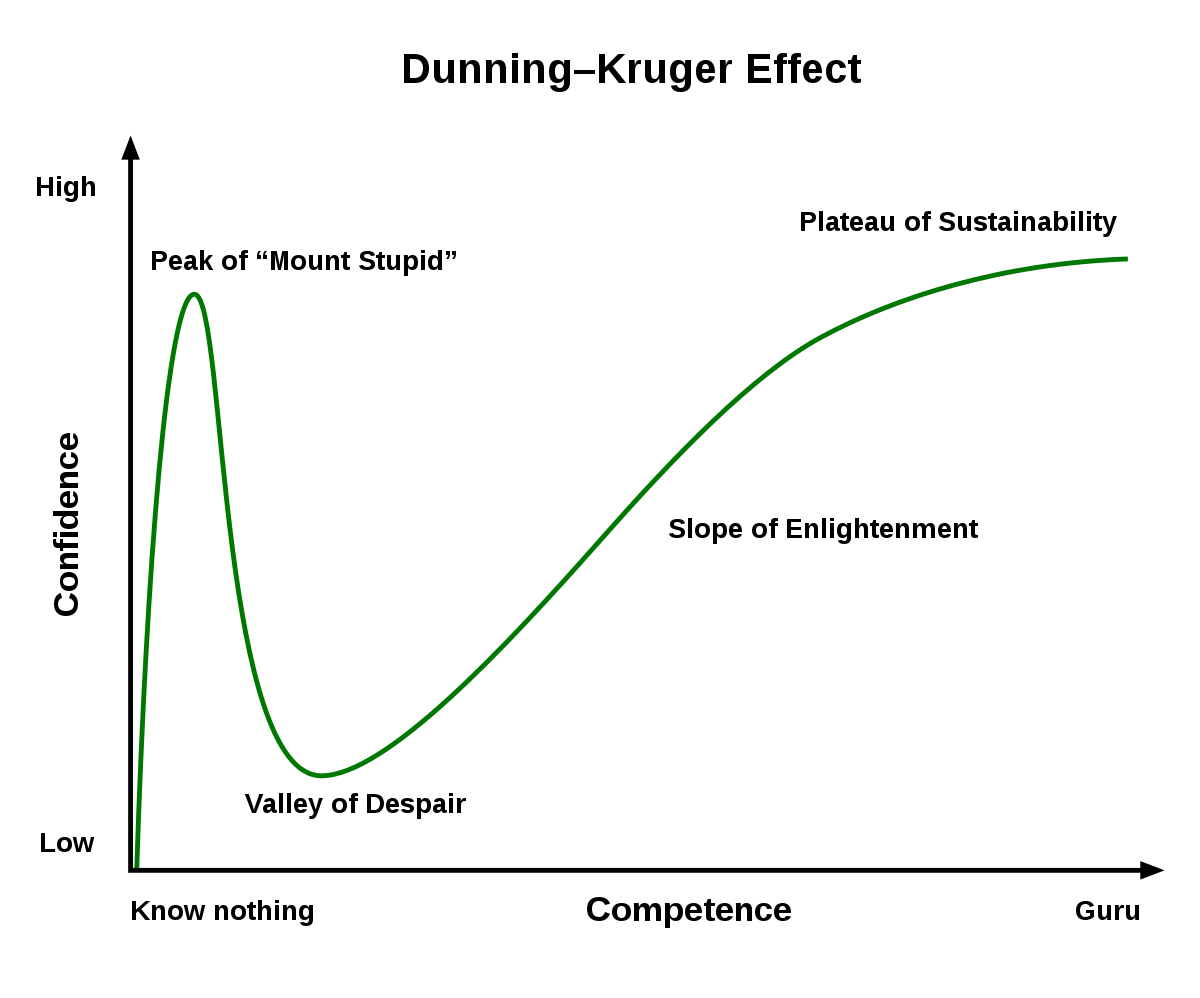
The popular version of the Dunning-Kruger effect, as it circulates in think-pieces, Twitter arguments, and corporate training decks, goes something like this: stupid people think they're smart, and smart people think they're stupid.
It is usually illustrated with a single-humped curve - confidence peaks at low competence, then crashes, then slowly recovers.
This version is wrong, or at least severely distorted.
Here is what Kruger and Dunning actually found in their 1999 paper, "Unskilled and Unaware of It: How Difficulties in Recognizing One's Own Incompetence Lead to Inflated Self-Assessments":
They gave undergraduate students at Cornell a series of tests measuring logical reasoning, English grammar, and humor detection. They then asked participants to estimate how they had performed relative to other participants. When they divided participants into quartiles by actual performance, they found:
- Bottom-quartile performers estimated they had performed in the 62nd percentile. In reality, they averaged the 12th percentile. They were overconfident by approximately 50 percentile points.
- Top-quartile performers estimated they had performed in the 68th percentile. In reality, they averaged the 86th percentile. They underestimated their performance by roughly 18 percentile points.
- Middle performers were comparatively well-calibrated.
The dramatic finding wasn't a universal human tendency to overestimate competence. It was a specific, asymmetric effect at the tails of the distribution, with a unique cognitive explanation for why low performers were so poorly calibrated.
Crucially, Dunning and Kruger's proposed mechanism was not about arrogance or ego.[1] It was about the structure of competence itself: the same skills that allow you to perform a task well are the skills that allow you to evaluate performance - your own and others'.
Someone who doesn't know how to construct a logical argument cannot recognize whether their argument is flawed. Someone who doesn't understand grammar cannot identify their own grammatical errors.
The knowledge required to perform is the same knowledge required to judge performance. This is the double burden of incompetence: you lack the skill, and you lack the ability to perceive that you lack the skill.
"The skills needed to produce logically sound arguments, for instance, are the same skills that are needed to recognize when a logically sound argument has been made.
If you lack the former, you are, by definition, without the tools to assess the quality of your own reasoning." - David Dunning and Justin Kruger, Journal of Personality and Social Psychology, 1999
The "smart people think they're stupid" half of the popular myth comes from the top-quartile underestimation finding, but Dunning and Kruger explained this differently: high performers tended to underestimate their relative standing not because they doubted their abilities, but because they assumed the tasks were easy for everyone.
This is not the same as being paralyzed by self-doubt. It is a calibration error in the opposite direction, rooted in a failure to recognize how much harder the tasks are for others.
A Map of Self-Knowledge by Skill Level
The following comparison illustrates how self-assessment typically shifts across the competence spectrum, based on findings from Kruger and Dunning (1999), Ehrlinger et al. (2008), and subsequent calibration research:
| Skill Level | Actual Performance | Estimated Performance | Error Direction | Primary Cause |
|---|---|---|---|---|
| Novice (bottom quartile) | ~12th percentile | ~62nd percentile | Overconfident by ~50 pts | Cannot recognize own errors; lacks evaluative framework |
| Low-intermediate | ~35th percentile | ~45th percentile | Slightly overconfident | Partial knowledge creates false coherence |
| Mid-level (median) | ~50th percentile | ~50th percentile | Roughly calibrated | Sufficient feedback loops; recognizes both limits and competencies |
| High-intermediate | ~70th percentile | ~65th percentile | Slightly underconfident | Increasing awareness of complexity; recognizes unknown unknowns |
| Expert (top quartile) | ~86th percentile | ~68th percentile | Underconfident by ~18 pts | Assumes task difficulty is universally visible; suffers "curse of knowledge" |
The pattern is not a simple U-curve of overconfidence. It is an asymmetric miscalibration that is most severe - and most consequential - at the low end.
Why This Happens: The Cognitive Science
Metacognition and Its Failures
Metacognition - thinking about your own thinking - is not a free-floating general capacity. It is domain-specific. A chess grandmaster has highly calibrated metacognition about chess and may have no better self-knowledge about their driving ability or interpersonal skills than anyone else.
Metacognition requires domain knowledge to operate, because you need a mental model of what good performance looks like before you can measure your own performance against it.
This is why the Dunning-Kruger effect is not about intelligence in any global sense. A highly intelligent person who is a novice in a new domain will show the same miscalibration as anyone else.
The research of cognitive scientist Stellan Ohlsson on error recognition points to the same principle: people cannot recognize errors that fall outside their current conceptual framework. The framework itself determines what counts as an error.
Calibration Research
Researchers studying calibration - the match between a person's confidence and their actual accuracy - have documented the overconfidence effect across hundreds of studies.
The seminal work by Sarah Lichtenstein and Baruch Fischhoff in the 1970s and 1980s at the Oregon Research Institute found systematic overconfidence in probability judgments: when people said they were "99% sure" of an answer, they were correct only about 80% of the time.[7]
The effect was most pronounced when questions were difficult and when participants had limited domain knowledge.
Philip Tetlock's 20-year study of expert prediction, published in his 2005 book Expert Political Judgment, found that domain experts - economists, political scientists, military analysts - were on average no better at predicting outcomes in their domain than educated laypeople, and that the confident "hedgehog" forecasters (who knew one big thing and applied it everywhere) were systematically less accurate than "fox" forecasters (who knew many things and hedged accordingly) - yet the hedgehogs were far more sought-after by media and policymakers because they projected certainty.[5]
The Double Burden: Knowing You Don't Know
The specific mechanism Dunning and Kruger proposed - and which subsequent research has largely supported - is that performance and evaluation share cognitive substrate. Joyce Ehrlinger and colleagues tested this directly in a 2008 study published in Organizational Behavior and Human Decision Processes.[2]
They found that when bottom-quartile performers were given training in how to recognize quality performance in the relevant domain, their self-assessments became dramatically more accurate - even though the training didn't improve their actual performance.
Learning to recognize good work taught them to recognize that their own work wasn't it.
This has a profound implication: the antidote to Dunning-Kruger miscalibration is not simply more practice. It is evaluative exposure - learning what good performance looks like before, or alongside, developing the skill itself.
Historical Case Studies: When Dunning-Kruger Dynamics Operate at Scale
1. The Charge of the Light Brigade (1854)
On October 25, 1854, during the Battle of Balaclava in the Crimean War, the British Light Brigade charged directly into a fortified valley defended by Russian artillery on three sides.
Lord Cardigan, who led the charge himself, was a man of extraordinary self-certainty and extraordinarily limited tactical intelligence. He had purchased his commission and risen through social rank rather than battlefield competence.
Cardigan led 670 men into direct artillery fire. 278 were killed or wounded in minutes. What makes this a Dunning-Kruger case study is the self-perception involved: Cardigan believed until his death that the charge had been a great success and that he had performed admirably.
He returned to Britain a hero, which reinforced rather than corrected the miscalibration. He never developed the evaluative framework to recognize the catastrophe he had participated in.
2. Kodak's Digital Blindspot
In 1975, Kodak engineer Steven Sasson built the world's first digital camera. Kodak's management reviewed the prototype, recognized it as a threat to their film business, and shelved the project.
For the next two decades, Kodak executives - highly competent in chemical film processing, distribution, and retail relationships - repeatedly underestimated the threat of digital imaging.
The Dunning-Kruger dynamic here is subtler than the popular understanding allows. These were not incompetent people. They were highly competent in one domain who applied that domain's logic to a different domain where their expertise did not transfer.
Their very success had given them a framework that was wrong for the new context - and their success made it hard to recognize that the framework was wrong. By the time Kodak filed for bankruptcy in 2012, the company had lost roughly $30 billion in market capitalization.
3. Long-Term Capital Management (1998)
LTCM, a hedge fund staffed by two Nobel Prize-winning economists (Myron Scholes and Robert Merton) and some of the most technically brilliant financial minds on Wall Street, came within hours of triggering a global financial collapse in 1998.
The fund lost $4.6 billion in less than four months and required a $3.6 billion bailout coordinated by the Federal Reserve Bank of New York.
LTCM's models were, within their assumptions, technically correct. The failure was a metacognitive one: the team was so expert in the mathematics of their models that they could not adequately perceive the limits of those models - specifically, the assumption that historical volatility patterns would hold under extreme market stress.
Their expertise in financial mathematics created a blind spot about the conditions under which financial mathematics breaks down.
*Example*: The very precision of LTCM's models - leverage ratios, spread calculations, volatility estimates - generated enormous confidence in a picture of the world that turned out to be incomplete. The confidence was technically earned but contextually misplaced.
4. The Wakefield MMR Study and Anti-Vaccination Confidence
In 1998, gastroenterologist Andrew Wakefield published a study in The Lancet claiming to find a link between the MMR vaccine and autism. The study involved 12 children, later found to involve ethical violations, undisclosed financial conflicts of interest, and data fabrication. The Lancet retracted the paper in 2010.
The Dunning-Kruger angle here is not primarily about Wakefield - it is about the anti-vaccination movement that formed around his claim. Thousands of parents, many of them educated and intelligent, became deeply certain about a causal mechanism on the basis of a single retracted study, personal experience, and web research.
They were novices in immunology, epidemiology, and study design who had acquired enough vocabulary to feel confident they understood the field - but who lacked the evaluative framework to assess the quality of the evidence they were citing.
The consequences were measurable: measles outbreaks in the United Kingdom, the United States, and Western Europe in populations that had previously achieved herd immunity.
Applications
Learning and Skill Development
The Dunning-Kruger effect has direct implications for how people experience the learning process. K.
Anders Ericsson, whose work on deliberate practice was published in Psychological Review in 1993, found that learners in early stages of skill acquisition frequently overestimate their competence because they have not yet encountered enough of the domain to know what they don't know.[8]
The transition from novice to intermediate is often experienced as a sudden, disorienting drop in confidence, as the learner gains enough knowledge to recognize their errors but not yet enough to reliably correct them.
This valley - sometimes called the "valley of despair" in skill-acquisition literature - is not evidence of regression. It is evidence of metacognitive improvement. You have learned enough to know what you're getting wrong.
For educators and trainers, this means that early-stage learners benefit from structured exposure to examples of expert performance. Not to demoralize them, but to give them an evaluative framework before their confidence outruns their ability.
Medical schools have long used case-based learning for this reason. Aviation uses simulation. The goal is to make the learner's mental model of "what good looks like" more accurate before self-assessment becomes consequential.
Organizational Hiring and Management
A 2011 meta-analysis found that self-assessments of job-relevant skills correlate poorly with actual performance assessments, with correlations typically in the 0.1-0.3 range - barely above chance. Candidates with the least skill in a domain are precisely the ones most likely to be overconfident in self-descriptions of that skill.
Structured interviews, work samples, and skills-based assessments consistently outperform unstructured interviews in predicting job performance - because they sidestep the miscalibration problem by measuring performance directly rather than relying on self-report.
A 2010 study by Ulrike Malmendier and Geoffrey Tate at the University of California Berkeley found that overconfident CEOs were significantly more likely to make value-destroying acquisitions than their less confident peers.[9]
The companies they acquired performed worse on average, and the overconfident CEOs were slower to recognize and correct this.
Public Discourse and Expertise
Tom Nichols, a professor at the U.S. Naval War College, documented this phenomenon extensively in his 2017 book The Death of Expertise.
Nichols argues that the internet, by democratizing access to information without democratizing the ability to evaluate information, has created conditions where large numbers of people have developed the vocabulary of expertise without its substance.[12]
A 2016 survey by the Pew Research Center found that 87% of scientists affiliated with the American Association for the Advancement of Science agreed that climate change is mostly due to human activity; only 50% of the general public agreed.
The gap was not primarily explained by lack of information access - it was explained by the structure of how people evaluate information they encounter.
The Intellectual Lineage
The Dunning-Kruger finding was new as a rigorously controlled experimental result. But the observation it formalized is very old.
"I know that I know nothing." - attributed to Socrates, via Plato's Apology, approximately 399 BCE
"Ignorance more frequently begets confidence than does knowledge." - Charles Darwin, Introduction to The Descent of Man, 1871[13]
"The trouble with the world is that the stupid are cocksure and the intelligent are full of doubt." - Bertrand Russell, The Triumph of Stupidity, 1933
Russell wrote this responding to the rise of fascism in Europe - the confidence with which demagogues claimed to understand problems that had stumped generations of economists, diplomats, and political scientists. His framing was polemical, but it anticipated the Dunning-Kruger findings by 66 years.
William Shakespeare placed a version of the observation in As You Like It (1599): "The fool doth think he is wise, but the wise man knows himself to be a fool." This is not merely a proverb - it encodes an accurate empirical claim about metacognition that would take another 400 years to measure rigorously.
The significance of Kruger and Dunning's 1999 paper was not that they discovered something humans had never noticed. It was that they designed controlled experiments to isolate and measure the mechanism, and proposed a falsifiable cognitive explanation for it.
The Research: What the Studies Show
The Original Study
Kruger and Dunning ran four experiments. The fourth was a follow-up: they tested whether improved competence would improve self-assessment, by training bottom-quartile performers in the logic tasks and retesting them.
After training, the bottom-quartile participants' self-assessments improved dramatically - not because their actual performance improved proportionally, but because they had gained the evaluative skills to recognize their previous errors.
This "training improves calibration" finding experimentally confirmed the proposed mechanism.
Replications and Extensions
The basic finding has been replicated across many domains. Ehrlinger et al. (2008) found similar patterns in studies of scientific reasoning and interpersonal skills. Schlösser et al. (2013) found the effect in negotiation skills assessments.
Cross-cultural replications have been conducted in the United States, Germany, Japan, and Sweden, with broadly consistent results.
A 2020 study by Gilles Gignac and Marcin Zajenkowski, published in Intelligence, found that people with lower cognitive ability showed greater overestimation of their intelligence, though the authors argued the classic Dunning-Kruger pattern is largely a statistical artifact - and that the relationship was non-linear, concentrated at the very low end of the ability distribution.[4]
The Methodological Critique
A significant challenge came from Edward Nuhfer and colleagues at California State University. In a series of papers beginning in 2016, published in Numeracy, Nuhfer et al.[3] argued that the Dunning-Kruger effect, as typically depicted, is at least partially a statistical artifact rooted in regression toward the mean.
Their argument: if you measure performance and ask people to predict their performance, the errors in those predictions will automatically produce the Dunning-Kruger pattern even if participants have no systematic bias at all.
Low scorers will tend to predict higher than their score because random prediction error regresses toward the mean.
David Dunning and colleagues responded that the training intervention study (Experiment 4) is not susceptible to this critique - because the training directly manipulated the proposed mechanism and produced the predicted change.
The debate remains active, with the most defensible position being that the Dunning-Kruger effect is real but its typical popular depiction exaggerates both its universality and its magnitude.
The Limits of the Effect
Immediate feedback domains: In activities where feedback is unambiguous and immediate - athletic performance measured by a stopwatch, weight lifted, points scored - self-assessment tends to be dramatically more accurate. The miscalibration is most severe in domains where feedback is delayed, ambiguous, or socially mediated.
High-stakes evaluation contexts: When people know their self-assessments will be compared against objective criteria, calibration improves. A 2003 study by Don Moore and Daylian Cain at Carnegie Mellon found that financial incentives for accuracy in self-assessment sharply reduced overconfidence.[11]
Professional domains with explicit self-evaluation training: Weather forecasters, who receive daily feedback on the accuracy of their probabilistic predictions, are among the best-calibrated professional groups ever studied - a finding documented by Philip Tetlock and Dan Gardner in Superforecasting (2015).
The expert blind spot: High performers in a domain frequently underestimate how hard the domain is for others. Colin Camerer, George Loewenstein, and Martin Weber named this the "curse of knowledge" in a 1989 paper in Journal of Political Economy.[10]
Where the novice cannot perceive their incompetence, the expert cannot perceive the difficulty of their expertise. Both are failures of calibration; they just point in opposite directions.
Toward Better Calibration
The evidence suggests three reliable approaches to mitigating Dunning-Kruger miscalibration:
Structured exposure to expert performance: Seeing what genuine expertise looks like - with errors visible alongside successes - builds the evaluative framework that novices lack. This is why apprenticeship models of learning (in medicine, law, skilled trades, and arts) have survived for centuries.
Calibrated feedback systems: In domains where feedback is typically delayed or ambiguous, introducing structured feedback mechanisms - pre-mortem analyses, structured peer review, outcome tracking - creates the informational environment that improves calibration.
Tetlock's Good Judgment Project trained thousands of non-expert forecasters in probabilistic reasoning and gave them systematic feedback on their predictions.[6] They outperformed professional intelligence analysts by an average of 30% on geopolitical prediction tasks.
Intellectual humility as a practiced skill: Psychologist Mark Leary at Duke University has documented that intellectual humility - the disposition to recognize the limits of one's knowledge - is a learnable trait.
Practices that cultivate it include actively seeking disconfirming evidence, assigning explicit probability estimates to beliefs rather than treating them as certainties, and deliberately engaging with the strongest versions of opposing views.
This connects to the broader territory of cognitive biases: the Dunning-Kruger effect is not an isolated quirk but one manifestation of a general pattern in which the evaluative machinery of the mind is systematically miscalibrated against the evidence available.
McArthur Wheeler, standing in a Pittsburgh police station, staring at his own face on a surveillance monitor, was not a uniquely foolish person.
He was a person who had made a catastrophic error in a specific domain - chemistry, optics, basic empiricism - and who had not had access to the information that would have told him he was wrong before it was too late.
This is the condition that Kruger and Dunning formalized. It is a structural feature of the relationship between knowledge and self-knowledge that each of us navigates every time we step into a domain where our evaluative framework may be lagging behind our confidence.
Sources & Further Reading
- Kruger, J., & Dunning, D. (1999). Unskilled and unaware of it: How difficulties in recognizing one's own incompetence lead to inflated self-assessments. Journal of Personality and Social Psychology, 77(6), 1121-1134. DOI: 10.1037/0022-3514.77.6.1121
- Ehrlinger, J., Johnson, K., Banner, M., Dunning, D., & Kruger, J. (2008). Why the unskilled are unaware. Organizational Behavior and Human Decision Processes, 105(1), 98-121. DOI: 10.1016/j.obhdp.2007.05.002
- Nuhfer, E., Fleisher, S., Cogan, C., Wirth, K., & Gaze, E. (2016). How random noise and a graphical convention subverted behavioral scientists' explanations of self-assessment data. Numeracy, 9(1). DOI: 10.5038/1936-4660.9.1.4
- Gignac, G. E., & Zajenkowski, M. (2020). The Dunning-Kruger effect is (mostly) a statistical artifact. Intelligence, 80, 101449. DOI: 10.1016/j.intell.2020.101449
- Tetlock, P. E. (2005). Expert Political Judgment. Princeton University Press.
- Tetlock, P. E., & Gardner, D. (2015). Superforecasting. Crown Publishers. View source
- Lichtenstein, S., & Fischhoff, B. (1977). Do those who know more also know more about how much they know? Organizational Behavior and Human Performance, 20(2), 159-183. DOI: 10.1016/0030-5073(77)90001-0
- Ericsson, K. A., Krampe, R. Th., & Tesch-Römer, C. (1993). The role of deliberate practice in the acquisition of expert performance. Psychological Review, 100(3), 363-406. DOI: 10.1037/0033-295X.100.3.363
- Malmendier, U., & Tate, G. (2008). Who makes acquisitions? CEO overconfidence and the market's reaction. Journal of Financial Economics, 89(1), 20-43. DOI: 10.1016/j.jfineco.2007.07.002
- Camerer, C., Loewenstein, G., & Weber, M. (1989). The curse of knowledge in economic settings. Journal of Political Economy, 97(5), 1232-1254. DOI: 10.1086/261651
- Moore, D. A., & Cain, D. M. (2007). Overconfidence and underconfidence: When and why people underestimate (and overestimate) the competition. Organizational Behavior and Human Decision Processes, 103(2), 197-213. DOI: 10.1016/j.obhdp.2006.09.002
- Nichols, T. (2017). The Death of Expertise. Oxford University Press. View source
- Darwin, C. (1871). The Descent of Man. John Murray. View source