
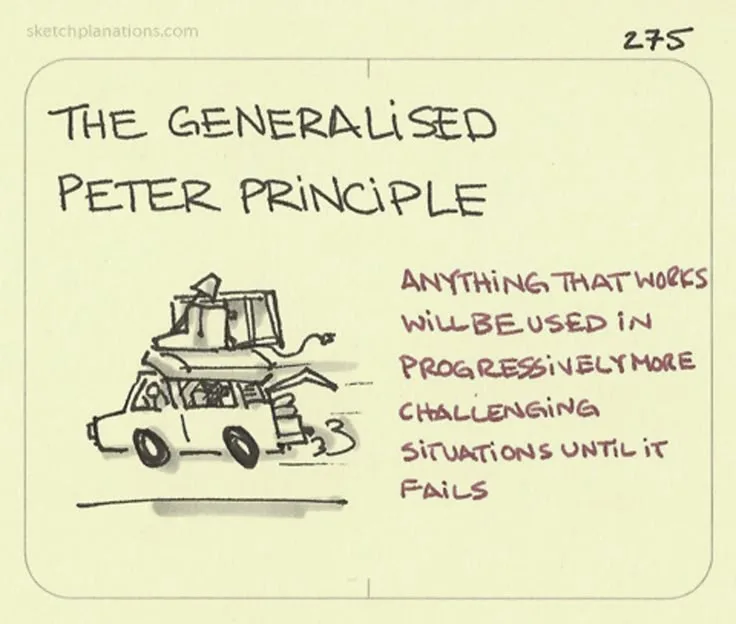
In 1969, a Canadian educator and management theorist named Laurence J. Peter, working with Raymond Hull, published a book with a satirical premise that turned out to be uncomfortably accurate: in any hierarchy, every employee tends to rise to their level of incompetence.
The book was called The Peter Principle, and it was initially read as comic social criticism: a sardonic observation about bureaucracy dressed up in pseudo-scientific language.
What its critics did not anticipate was that fifty years later, economists would run large-scale empirical tests of its central claim and find substantial evidence in its favor.
The Core Argument
The logic of the Peter Principle is simple enough to state in a few sentences.
In a hierarchical organization, people are promoted based on their performance in their current role. A good teacher is promoted to department head. A good salesperson is promoted to sales manager. A good engineer is promoted to engineering manager.
The assumption underlying each promotion is that skill in the current role indicates potential for the next.
The problem is that the next role typically requires different skills than the current one. A good teacher needs to understand a subject deeply and explain it clearly.
A good department head needs to manage other teachers, handle administrative tasks, mediate conflicts, and navigate organizational politics. These are not the same skills, and excellence in one set does not predict excellence in the other.
The Peter Principle's conclusion: each person in a hierarchy tends to get promoted until they reach a position where they are no longer competent, at which point they are no longer promoted. They stay there, at their level of incompetence, for the remainder of their career.
The satirical corollary Peter drew: over time, hierarchies fill up with people in roles they cannot adequately perform, with actual work done by employees who have not yet reached their level of incompetence.
"In a hierarchy, every employee tends to rise to their level of incompetence. The cream rises until it sours.", Laurence J. Peter, The Peter Principle (1969)
The Empirical Evidence
For decades, the Peter Principle was treated as a clever observation rather than an empirically testable claim. The joke was too good; the idea seemed too cynical to take seriously as organizational science.
In 2019, economists Alan Benson (University of Minnesota), Danielle Li (MIT), and Kelly Shue (Yale) published a rigorous empirical test. Their study analyzed promotion and performance data from 214 companies over six years, covering 53,035 sales workers and 1,531 managers.
It is among the most comprehensive tests of the Peter Principle ever conducted.
The Findings
The results were striking and closely matched the Peter Principle's predictions:
Top sales performers were significantly more likely to be promoted to manager. For every 10 percentile increase in pre-promotion sales performance, the probability of promotion increased by approximately 15%. Organizations were promoting their best salespeople.
However, higher pre-promotion sales performance was associated with significantly worse post-promotion managerial performance. Among promoted sales workers, those with the highest pre-promotion sales ranks had the worst performance ratings as managers, the worst subordinate sales performance under them, and the highest subordinate attrition rates.
The skills that made someone a top salesperson (individual drive, competitive instinct, personal relationship-building with clients) were not only different from the skills required for management; in some cases they were negatively correlated with them.
Great salespeople were being promoted specifically because they were great salespeople, which predicted that they would be poor managers.
Benson, Li, and Shue estimated that the companies they studied incurred meaningful costs in lost sales performance from mismatching high performers to managerial roles they were poorly suited for.
Why Organizations Keep Doing This
If the evidence is clear that promoting top individual contributors into management produces poor managers, why do organizations continue doing it? Several forces sustain the pattern.
Lack of Other Reward Mechanisms
In many organizations, promotion to management is the primary path to increased compensation, status, and organizational recognition. If you want to be recognized for excellent performance, the vehicle for recognition is a management title and the pay increase that comes with it.
This creates a problem: excellent individual contributors must either accept management positions they may be unsuited for and uninterested in, or accept a career ceiling. Many choose the management path not because they want to manage people but because they want the compensation and recognition that comes with it.
The Halo Effect
When an employee is excellent in their current role, their managers observe a pattern of success and develop confidence in them generally.
This confidence generalizes beyond the specific skills demonstrated: "She always delivers; I'm sure she'll figure out management." The halo effect, the tendency to assume that excellence in one domain indicates excellence generally, makes it seem intuitively right to promote high performers.
Signal Function of Promotion
Promotions serve a motivational function for the entire organization: they signal that strong performance is rewarded. Organizations that promote strong performers are communicating to everyone else that strong performance leads to advancement.
Failing to promote a top performer, even into a role for which they are suited, can undermine the motivational signal that promotions send.
The "Reward Them with Advancement" Norm
There is a deeply embedded norm in professional culture that advancement is the appropriate reward for excellence. "Where do you see yourself in five years?" is a culturally encoded question that presupposes a desire for progression up the hierarchy.
Organizations that want to retain high performers feel pressure to advance them, and advancement typically means management.
The Costs of Peter Principle Promotions
Direct Management Costs
Poor managers produce measurable harm: lower team performance, higher turnover among talented subordinates (who leave bad managers faster than they leave organizations), reduced innovation, impaired collaboration, and organizational culture erosion.
The Benson, Li, and Shue study quantified some of these costs; research on toxic leadership and abusive supervision documents others.
Lost Individual Contributor Performance
When a top individual contributor is promoted to management, the organization loses their direct contribution to output. If they were genuinely exceptional in their individual role, this is a significant loss.
Combined with poor managerial performance in their new role, the organization has paid a double cost: lost high performance plus gained poor management.
Career Damage to the Promoted Individual
Peter Principle victims, people placed in management roles they are not suited for, often suffer significant career damage.
They struggle in roles that do not play to their strengths, receive poor performance feedback, lose confidence, and may develop a professional record of mediocrity in management that obscures their genuine excellence as individual contributors.
Organizations have, in effect, promoted excellent performers out of the careers in which they could have thrived.
Alternatives: The Dual-Ladder System
The most widely implemented organizational response to the Peter Principle is the dual-ladder (or multi-ladder) career structure, which creates parallel advancement tracks that allow high performers to grow in compensation and status without moving into management.
A dual-ladder system typically has:
- A management track: Team lead, manager, senior manager, director, VP, and so on. Requires managing people, budgets, and organizational strategy.
- An individual contributor (IC) track: Senior engineer, staff engineer, principal engineer, distinguished engineer, fellow. Requires advancing technical depth, mentoring, architectural leadership, and domain expertise without direct people management.
| Track | Career Level | Primary Responsibility | Skills Required |
|---|---|---|---|
| Management | Manager | Lead a team of 5-10 | People development, communication, strategy |
| Management | Director | Lead multiple teams | Organizational strategy, cross-functional influence |
| IC | Senior | Lead technical work independently | Deep expertise, mentorship |
| IC | Staff | Set technical direction for teams | System thinking, technical judgment |
| IC | Principal | Shape technical strategy for org | Vision, influence without authority |
| IC | Fellow/Distinguished | Define industry-wide technical direction | Exceptional expertise, external leadership |
Major technology companies (Google, Microsoft, Amazon, Meta, Stripe, and many others) have developed sophisticated dual-ladder systems. At the senior levels of these IC tracks, compensation can match or exceed senior management compensation, removing the financial incentive to move into management against one's strengths.
Challenges of Dual-Ladder Systems
Dual-ladder systems are not easy to implement or sustain. Common failure modes include:
- Status asymmetry: Management roles continue to be perceived as more prestigious than IC roles at equivalent levels, creating social pressure to take management paths even when the IC track is the better fit
- Unclear criteria: IC advancement criteria that are less well-defined than management criteria make the IC path feel uncertain and harder to navigate
- Inconsistent compensation: IC senior levels that do not genuinely match management compensation make the financial case for the IC path weak
- Managerial bias: Managers who rose through traditional hierarchies sometimes undervalue IC career paths and subtly steer high performers toward management
What Better Promotion Processes Look Like
Beyond dual-ladder systems, organizations can reduce Peter Principle effects through better promotion design.
Competency-Based Promotion Criteria
Promotion into management should assess competencies required for management, not just excellence in the current role.
Organizations that assess management competencies before promotion, through structured simulations, 360-degree assessments, management development programs, or stretch assignments, produce better outcomes than those that promote on current performance alone.
Explicit Conversations About Fit
High performers should be explicitly asked whether they are interested in and suited for management. Many say yes because it seems like the expected answer. Normalized conversations that genuinely explore fit, treating the IC track as a serious and valued alternative, change the options people feel they have.
Trial Management Assignments
Some organizations use formal or informal trial periods in management roles before permanent promotion decisions, allowing both the organization and the individual to assess fit with reduced irreversibility.
If the trial reveals poor fit, the individual can return to their individual contributor role without the reputational damage that comes from a failed permanent promotion.
Reversibility
Organizations should be willing to move people back to individual contributor roles when management proves a poor fit, and should do so without stigma.
The cultural norm that movement from management back to individual contribution represents failure reinforces the Peter Principle by making it harder to correct mismatches once they are recognized.
The Peter Principle Beyond Management
The Peter Principle applies beyond the management promotion context wherever performance in one role is used as the primary criterion for selection into a different role.
- Academic promotion: Excellent researchers promoted to administrative positions (department chair, dean) on the strength of their research records, with limited evidence of administrative aptitude
- Sports coaching: Excellent athletes who become coaches, where the required skills overlap only partially
- Policy and regulation: Technical experts promoted to political or administrative leadership positions because of their technical credibility, regardless of whether they have the relevant political or managerial skills
The common thread is the assumption that excellence in one role predicts excellence in a different role requiring different competencies. Where that assumption is examined rather than taken for granted, the Peter Principle loses much of its grip.
The Peter Principle and Organizational Design
Beyond individual promotion decisions, the Peter Principle has implications for how organizations think about role design and career development.
The Problem with Universal Management Expectations
Many organizations are structured around an implicit assumption: that success means moving into management. Individual contributor roles are entry and mid-level positions; management is where careers "go." This assumption builds Peter Principle dynamics into the organizational structure itself.
When management is the only path to advancement, organizations lose high-performing individual contributors to management roles they are not suited for and the organization does not need them for.
A technology company with ten excellent engineers and no need for additional managers will create unnecessary management positions rather than develop IC tracks to retain talented engineers.
The organizational bloat that results, layer upon layer of management that exists primarily because management is the reward for performance, is itself a product of the Peter Principle applied at scale.
Measuring the Right Things for Promotion
A root cause of Peter Principle dynamics is using the wrong criteria for promotion decisions. Organizations that measure promotion candidates on their current role performance without assessing competencies required for the new role are systematically optimizing for the wrong thing.
What research and practice suggest should be measured instead:
- Evidence of the specific competencies the new role requires: For management, this might include structured interviews assessing interpersonal flexibility, comfort with ambiguity, ability to develop others, and organizational navigation
- Performance in stretch assignments: Trial responsibilities that approximate elements of the new role, allowing performance in role-relevant tasks to inform the decision
- Feedback from people who would be affected: For management roles, input from potential direct reports (where feasible) or peers in cross-functional roles that illuminate interpersonal dynamics
- Demonstrated learning agility: The ability to learn new skills quickly, which predicts adaptation to a new role better than mastery of the current one
Role Architecture Matters
Organizations can reduce Peter Principle effects through deliberate role architecture: designing roles so that the skills required at each level genuinely overlap with the skills that made someone excellent at the previous level.
Where skill discontinuities are unavoidable, as they are at the transition from individual contributor to management, designing robust support structures (manager training, coaching, peer support networks) for newly promoted individuals reduces the performance gap that the Peter Principle predicts.
What Individuals Can Do
For individuals navigating this dynamic, several considerations are worth holding:
Know your strengths. The Peter Principle hurts people who take management roles they are not suited for. Honest self-assessment of whether you genuinely enjoy and are suited for people management, as distinct from whether management would be recognized and rewarded, is valuable before accepting a promotion.
Understand what the role requires. Seek to understand what the next role actually involves before accepting it. If your organization does not offer a structured view of management competencies, find people currently in that role and ask them honestly what occupies most of their time.
Recognize the dual track as a real option. In organizations that have genuine IC tracks, the IC senior levels represent real careers with real ceiling and real compensation. Treating the management track as the only serious option, when a strong IC track exists, misapplies a traditional norm to a context where it no longer applies.
Advocate for reversibility. If you try management and discover it is not the right fit, advocate for the right to return to an individual contributor role without career damage. Normalizing this reduces the risk of trying management in the first place and reduces the entrenchment that makes Peter Principle effects persistent.
Summary
The Peter Principle, that in a hierarchy, each person tends to rise to their level of incompetence, was stated as satire in 1969 but has since received substantial empirical support.
The Benson, Li, and Shue 2019 study confirmed that top sales performers were promoted to management at higher rates, and that their pre-promotion sales excellence predicted worse post-promotion management performance.
The mechanism is straightforward: selection criteria for promotion (performance in current role) do not match the competencies required for the new role. Organizations promote their best current performers into positions that require different skills, producing poor managers and losing excellent individual contributors.
The best-documented organizational responses are dual-ladder career systems that allow advancement without requiring management, and competency-based promotion processes that assess fitness for the new role rather than performance in the old one.
For individuals, the primary protection is honest assessment of fit and recognition that excellent individual contributor work is a genuine career worth choosing.