
Parkinson: In virtually every organization, the same baffling dynamic plays out regularly: a meeting covers dozens of agenda items, but the serious, complex, high-stakes ones fly through in minutes, while a minor issue - the color of a button, the wording of an email subject line, the design of a logo - consumes half an hour of heated debate.
The important decisions get made quickly, almost carelessly. The trivial ones generate passionate disagreement.
This pattern is not random. It has a name, an explanation, and a structural cause. Understanding it is one of the most useful things anyone can learn about how organizations actually make decisions.
The Origin: Parkinson's Nuclear Plant
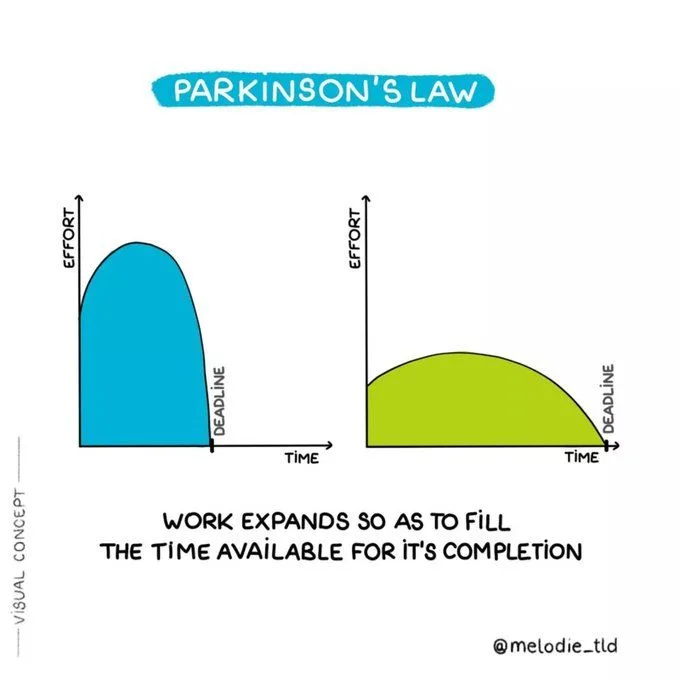
In 1957, the British historian and management theorist C. Northcote Parkinson - already known for Parkinson's Law ("work expands to fill the time available for its completion") - published a short essay introducing what he called the Law of Triviality.
Parkinson constructed a thought experiment. Imagine a finance committee reviewing the agenda for a meeting. Item One: a proposal to construct a nuclear reactor at a cost of 10 million. Item Two: a proposal to build a bicycle shed for employees at a cost of 350.
How long will the committee spend on each?
The nuclear reactor, Parkinson argued, will be approved in about two and a half minutes.[1] It is technical, complex, and expensive. Nobody on the committee fully understands nuclear engineering. Nobody wants to admit ignorance in front of colleagues.
Nobody feels they can meaningfully object. The finance director confirms the funding is available. The committee nods and moves on.
The bicycle shed will generate 45 minutes of debate.
Everyone has seen a bicycle shed. Everyone has a view on whether it should be built from aluminum, from wood, or from some other material. Some members have recently read about cost overruns on similar projects. Others have personal aesthetic preferences.
The accessibility of the topic is the problem: because everyone can engage, everyone does.
"The time spent on any item of the agenda will be in inverse proportion to the sum of money involved." - C. Northcote Parkinson, Parkinson's Law and Other Studies in Administration (1957)
The term bikeshedding was coined decades later by Poul-Henning Kamp, a computer scientist, in a 1999 email to a software mailing list.[2]
He invoked Parkinson's bicycle shed example to describe a recurring pattern he had observed in open-source software discussions: trivial technical choices attracted lengthy debate while structural decisions were handled quickly.
The word stuck and has since become standard vocabulary in software engineering and product development communities.
The Mechanism: Asymmetric Familiarity
Why does bikeshedding happen? The core cause is what we can call asymmetric familiarity: the gap between what different participants in a group feel qualified to engage with.
Complex decisions - enterprise architecture, strategic risk, major capital allocation, clinical protocols - require specialized knowledge. In a mixed-expertise group, most participants feel they cannot usefully contribute without revealing ignorance.
There is social cost to asking naive questions about complex topics when the topic is clearly within someone else's professional domain. The path of least resistance is to listen, not to speak.
Simple, concrete decisions - naming, colors, word choices, physical spaces - carry no such barrier. Everyone has relevant experience. Everyone has preferences. Everyone feels that their voice is legitimate. And because the stakes are low, there is no career risk in speaking up.
The result is that discussion concentrates at the accessible end of the complexity spectrum, regardless of importance. The group's aggregate attention is a limited resource, and it flows to the topics where participation feels safe, rather than the topics where it is most needed.
There is also a status dynamics component. On high-stakes, complex issues, challenging an established expert or a senior leader carries meaningful risk. On minor issues, disagreement is safe - it demonstrates engagement and critical thinking without threatening anyone's core interests.
Bikeshedding is, in part, the outlet for the critical energy that cannot be safely directed at things that matter.
The Psychology of Contribution
Behavioral psychology research on group dynamics helps explain why bikeshedding is so persistent. Studies on participation equity in group decision-making (Janis, 1982) show that group members experience discomfort when they feel unable to contribute - a form of social exclusion from the group's core activity.[5]
Bikeshedding on accessible topics is one resolution to this discomfort: it allows full participation in the meeting's social experience even when genuine expertise is absent.
Social psychologist Robert Cialdini's research on commitment and consistency adds another layer: once a person has expressed a view on a topic, they are motivated to defend and elaborate that view to remain consistent.
A group member who says "I think it should be red" in the first minute of a discussion is likely to spend the next ten minutes arguing for red - not because the color is important, but because consistency with prior statements is a psychological drive (Cialdini, 1984).[6]
Minor decisions invite rapid opinion formation, which then generates extensive defense.
The mere exposure effect, documented by social psychologist Robert Zajonc (1968), suggests that people develop preferences for things they encounter frequently.[8]
In meetings, this means that items presented with visual aids, prototypes, or mockups - the concrete, visible artifacts most common for minor design decisions - activate stronger opinions than abstract items discussed in the abstract.
A prototype of a button color generates stronger reactions than a description of an architecture decision, not because the button is more important but because it is more directly experienced.
Sayre's Law
Parkinson's Law of Triviality has a close cousin: Sayre's Law, attributed to Wallace Sayre, a Columbia University professor of political science, who reportedly coined the phrase in conversation in the early 1970s (it was published by Charles Philip Issawi in 1973):[3]
"In any dispute the intensity of feeling is inversely proportional to the value of the issues at stake."
Sayre's Law is often encountered in its extended form - "Academic politics is the most vicious and bitter form of politics, precisely because the stakes are so small" - though this extension is sometimes attributed to Henry Kissinger or other figures.
Whatever the attribution, the principle is the same: organizational energy concentrates on small things partly because there is nothing to lose by fighting hard. On genuinely important questions, the consequences of being wrong, or of creating enemies, are significant. On trivial ones, passionate advocacy is costless.
This also explains why academic faculty meetings are notorious for producing lengthy debate over minor matters: the participants are intelligent, opinionated, and deeply committed to a community where the genuinely consequential decisions (tenure, curriculum) are handled elsewhere, leaving meetings as the domain of the manageable and the minor.
Organizational theorist Herbert Simon's concept of bounded rationality (1955) provides the theoretical foundation: decision-makers with limited attention and cognitive resources will allocate those resources to problems they believe they can solve.[7]
Complex, uncertain, high-stakes problems are cognitively expensive to engage with, and the outcome of engagement is often unclear. Simple, certain, low-stakes problems are cognitively cheap to engage with, and the outcome of engagement is highly legible.
Bounded rationality predicts that group attention will flow toward legible problems regardless of their importance.
Bikeshedding in Software Development
The software industry has the most thoroughly documented experience with bikeshedding, partly because open-source projects conduct much of their decision-making in written, public, and searchable form.
Common manifestations in software contexts include:
Code review discussions that generate dozens of comments on variable naming conventions, whitespace choices, and minor style inconsistencies, while architectural problems - inefficient algorithms, poor abstraction choices, security considerations - receive little scrutiny or go unmentioned.
Product design meetings where button color, icon selection, microcopy, and animation timing dominate discussion while feature prioritization, accessibility requirements, and user research interpretation receive cursory treatment.
Pull request processes where trivial changes attract lengthy discussion while substantial refactors are merged with minimal review, because reviewers feel less qualified to comment on the complex code and more comfortable on the visible details.
Technology choice debates where the conversation focuses on syntax preferences and tooling aesthetics rather than performance characteristics, maintenance burden, or ecosystem stability.
Naming debates - what to call a class, a function, a product, a team - that can consume hours of engineering time.
Naming is universally accessible (everyone has an opinion on English words), immediately visible in the codebase, and touches professional identity (engineers often feel ownership over naming). This combination makes naming a bikeshedding attractor of exceptional power.
The open-source community has developed specific norms to address this. The Python Software Foundation's governance model, the Apache Software Foundation's voting systems, and various RFC (Request for Comments) processes in internet standards development all include structural mechanisms designed to channel discussion toward substantive issues and limit debate on settled or minor ones.
A particularly well-documented example from open-source history is the controversy around systemd in the Linux community.
While the substantive architectural debate - whether to adopt systemd as the init system - was legitimately complex and consequential, community discussion consistently allocated disproportionate energy to peripheral matters: coding style, documentation formatting, and the personalities of key contributors.
The structural debate about system design was repeatedly displaced by accessible personal and aesthetic debates.
Bikeshedding in Meetings
In organizational meetings, bikeshedding takes characteristic forms depending on the agenda structure:
| Agenda Position | Bikeshedding Risk | Reason |
|---|---|---|
| Items placed late in agenda | High | Decision fatigue increases reliance on familiar, simple topics |
| Items without clear decision authority | High | No one knows who can legitimately close the discussion |
| Items framed as open discussion | High | Invitation to participate signals all views are equally valid |
| Items with visual aids (mock-ups, prototypes) | High | Concrete visuals make superficial attributes extremely salient |
| Items estimated as "quick" | High | Low perceived stakes invite engagement without accountability |
| Items with a clear decision-maker | Low | Others self-censor when authority is established |
| Items with a hard time box | Low | Constraint forces prioritization of substantive issues |
| Items requiring prior reading | Low | Preparation cost filters casual contribution |
| Items framed as expert review | Low | Clear expertise requirement reduces generalist participation |
The agenda structure itself is a major determinant of bikeshedding risk. Placing important items early, before energy is depleted, and providing clear time allocations per item, materially reduces the likelihood that trivial matters will crowd out substantive ones.
Research on meeting effectiveness suggests that meeting time is often poorly aligned with the strategic importance of agenda items, echoing Parkinson's observation.
The study also found that this pattern was correlated with lower meeting satisfaction and lower organizational commitment among participants, suggesting that bikeshedding is not just an inefficiency but actively corrosive to team morale.
Why Expertise Doesn't Always Help
It might seem that expert groups - senior leadership teams, specialized committees, technical review boards - would be immune to bikeshedding. They are not. In some cases they are more susceptible.
First, expert groups often have strong individual opinions and high social confidence. Members are accustomed to being right, to being listened to, and to advocating their positions. This increases the volume of engagement generally - including on trivial matters.
Second, expert groups sometimes have explicit norms of thoroughness and critical review that make it socially rewarding to find something to question on every agenda item. If the culture expects pushback, members will find something to push back on.
Third, expert groups are subject to the same asymmetric familiarity problem as anyone else when they encounter topics outside their specialty. A group of engineers reviewing both technical specifications and a product name will bikeshed on the name for the same reason a general committee would.
Fourth, groupthink dynamics (Janis, 1972) can operate in reverse for bikeshedding: where groupthink produces dangerous conformity on consequential decisions by suppressing dissent, bikeshedding produces dangerous trivial conflict on minor decisions by amplifying every available dissenting view.[4]
Both are failures of group calibration - matching discussion intensity to decision importance.
Prevention and Mitigation
Bikeshedding is not fully preventable - it is rooted in human social dynamics that are not easily switched off. But its effects can be substantially reduced through structural and procedural interventions:
Pre-assign decision authority. For each category of decision, designate who has the authority to decide unilaterally. If the designer owns button colors, they do not go to committee. Reducing the roster of people who formally need to agree limits the surface area for bikeshedding.
The RACI framework (Responsible, Accountable, Consulted, Informed) is one systematic approach to clarifying decision authority, though it requires discipline to maintain and use.
Strict time limits per item. When each agenda item has a publicly visible time allocation and a facilitator enforcing it, discussion must prioritize. A hard stop at five minutes forces participants to raise the most important objection first rather than starting with the most comfortable one.
Agenda ordering by importance, not by ease. Place the most consequential items first, before attention and energy decline. Place aesthetic and minor administrative items last or off the agenda entirely.
Research on decision fatigue (Danziger et al., 2011) shows that decision quality degrades as cognitive resources are depleted over a session - placing consequential decisions first addresses both the bikeshedding risk and the decision quality risk simultaneously.[11]
Require that objections include alternatives. Requiring participants to propose alternatives to whatever they object to raises the cost of trivial objections. Saying "I don't like blue" is free; saying "I don't like blue; I propose green because of these reasons" requires effort and commitment.
This intervention shifts the incentive from objection (low cost, high social visibility) to constructive contribution (higher cost, more substantive).
Delegate aesthetic decisions entirely. The most robust solution for minor decisions is to remove them from group review altogether. Appoint a person responsible for all naming, visual identity, and microcopy decisions and let them decide without committee input.
This eliminates the bikeshedding surface completely for an entire category of choices. Many successful product organizations establish a design authority - an individual or small group with final decision rights on all aesthetic and copy choices - specifically to prevent these decisions from consuming cross-functional team time.
Use asynchronous review for low-stakes items. Minor decisions that do need some input can be reviewed asynchronously via comment threads rather than synchronous meetings.
This removes the social dynamics of a room and allows people to contribute in proportion to their actual interest rather than in proportion to the room's social pressure.
Async communication also reduces the commitment and consistency spiral: people are less likely to dig into extended defense of a casually expressed opinion in a written thread than in a meeting where reputations are instantly at stake.
Name the pattern. Teams that understand bikeshedding can identify it in real time. When a discussion has been running for ten minutes on a minor item while a major one awaits, a team member can name the dynamic: "We're bikeshedding on this.
Let's time-box it to two more minutes and move on." Shared vocabulary for dysfunction is among the most efficient ways to interrupt it.
Research on metacommunication in organizational psychology suggests that teams' ability to discuss their own communication patterns directly is strongly associated with effectiveness (Argyris, 1993).[12]
The pre-mortem technique can be adapted for bikeshedding prevention. Before a meeting that has historically bikeshed, the facilitator names the specific topics most likely to attract disproportionate discussion ("last time we met, we spent thirty minutes on the landing page headline") and explicitly time-boxes them in advance with justification.
This primes the group to notice when it is happening and creates social permission to interrupt.
The Deeper Point
Bikeshedding is ultimately a symptom of unclear decision authority and misaligned group attention. In organizations with strong clarity about who decides what, and strong facilitation of group attention toward consequential matters, it naturally diminishes.
It is also a reminder that group process is not inherently rational. The output of a discussion is not determined solely by the quality of the ideas presented - it is heavily shaped by the social dynamics, the format, the timing, the agenda structure, and the distribution of psychological safety to speak.
Understanding these dynamics is part of what separates effective teams from dysfunctional ones.
The nuclear reactor and the bicycle shed will both get built eventually. The question is whether your organization spends its collective attention in proportion to what matters.
Bikeshedding and Status Games
There is another layer to bikeshedding beyond asymmetric familiarity: the meeting room is also a social arena, and participating actively is a form of status display.
Demonstrating engagement, contributing ideas, and being seen to care about organizational decisions all have social value independent of whether the contributions are substantively important.
In many organizational cultures, silent observers are assumed to be passive or disengaged, while active contributors are read as invested and capable.
This creates a specific incentive: to find something to say about everything. And the easiest things to say something about are the concrete, accessible items that don't require expertise.
You may not be able to comment usefully on whether the proposed microservices architecture will scale correctly under load, but you can certainly have a view on whether the product should be called "Horizon" or "Apex."
The status game compounds the familiarity asymmetry. Even people who know better than to bikeshed feel the pull to contribute visibly, particularly in cultures where silence is read as absence of thought.
This dynamic is reinforced by the structure of most organizational incentive systems.
Performance reviews frequently include criteria about "participation," "engagement," and "bringing ideas to the table." These criteria are applied agnostically to substantive and trivial contributions alike.
Rational employees optimize for visible participation on accessible topics.
This is one reason why bikeshedding is so persistent even in intelligent, well-intentioned groups. It is not a failure of individual intelligence - it is a rational response to social incentives that operate in every meeting room.
Bikeshedding at Scale: Open Source and Online Communities
In open-source software communities, where contributions are voluntary and reputation is built through visible participation, bikeshedding can be particularly intense. The mailing list or GitHub issue thread that generated Poul-Henning Kamp's original coining of the term is far from unique.
Large open-source projects regularly experience the pattern: a change that requires deep familiarity with the codebase receives minimal review, while a trivial name change or documentation rewording generates dozens of comments.
The accessibility factor is amplified by the open-access nature of online contribution: anyone can comment on anything, so the number of opinions an item attracts is almost entirely a function of how accessible the item is, not how important it is.
Some open source communities have developed explicit governance responses. The Python community uses PEPs (Python Enhancement Proposals) with formal voting procedures that limit who can block a decision. The Apache Foundation uses a model where lazy consensus handles routine decisions and formal voting is reserved for significant ones.
These structures do not eliminate bikeshedding but they contain it by limiting how long trivial discussions can block progress.
The IETF (Internet Engineering Task Force), which develops internet standards, has a long-standing cultural norm captured in the phrase "rough consensus and running code." This heuristic explicitly devalues extended debate about preferences in favor of demonstrated working implementations - a structural mechanism that redirects energy from bikeshedding toward substantive technical work.
Dave Clark's 1992 description of the IETF's working culture remains one of the clearest articulations of how to design community governance that resists bikeshedding.[14]
Online community dynamics more broadly exhibit the bikeshedding pattern in specific forms.
Cunningham's Law - "the best way to get the right answer on the internet is not to ask a question; it's to post the wrong answer" - describes a related dynamic: accessible topics with clearly defined "correct" answers attract more engagement than genuinely complex open questions.
This is bikeshedding adapted to the editorial norms of online platforms.
Research on Wikipedia editing behavior illustrates this: articles about popular culture, sports, and entertainment attract higher edit rates and more edit conflicts than articles about complex scientific or historical topics, even controlling for article importance.
The accessibility of popular culture topics makes them more editable for more contributors, generating the same concentration of attention on accessible topics that Parkinson observed in committee meetings.
The Cost of Bikeshedding
The costs of bikeshedding are real but often invisible, because they manifest as opportunity cost rather than direct loss.
When a meeting spends 40 minutes debating a button color and 5 minutes on a roadmap decision, the roadmap decision does not disappear - it gets made quickly, without adequate scrutiny, or it gets deferred. Either way, the quality of the consequential decision suffers.
Over time, teams that bikeshed habitually develop a distorted sense of what is worth discussing. The norms around which topics merit engagement calcify.
Senior people who could provide valuable perspective on strategic questions learn that meetings are not the venue for that work, and they either check out or find ways to make consequential decisions outside the meeting room.
This creates a secondary problem: major decisions get made in corridors, one-on-ones, and informal conversations rather than in the official deliberative process. The meeting becomes theater; the real decisions happen elsewhere.
This is not necessarily bad - Parkinson himself observed that effective executives often make real decisions outside formal committee processes - but it creates accountability and transparency problems when the formal process is supposed to be where decisions are made.
A 2019 survey by management consulting firm McKinsey found that executives spent an average of 23 hours per week in meetings and rated the majority of that time as unproductive.[9]
While bikeshedding is not the only cause of meeting inefficiency, it is among the most identifiable: meeting participants consistently report time wasted on minor aesthetic and naming decisions as a specific source of frustration (Rogelberg, 2018).[10]
Bikeshedding, at sufficient intensity, does not just waste time. It corrupts the function of the meeting as a decision-making forum and drives consequential decisions into informal, less accountable channels.
Quantifying the Cost
Consider a concrete scenario: a twelve-person cross-functional team with an average fully-loaded cost of $150,000 per year meets for two hours per week.
If 30% of meeting time is spent on bikeshedding - a conservative estimate for teams without explicit anti-bikeshedding norms - the annual cost of that wasted time is approximately $54,000, not counting the opportunity cost of decisions that were either poorly made or deferred.
At an organizational scale of hundreds of such teams, the aggregate cost of bikeshedding runs into millions of dollars annually. This is before accounting for the strategic cost of consequential decisions receiving inadequate deliberation - arguably the larger economic impact.
Research on group decision quality by Garold Stasser and William Titus (1985) on hidden profile tasks found that groups systematically discuss information that all members share in common rather than information that is uniquely held by individual members.[13]
Bikeshedding amplifies this: accessible topics are those on which everyone holds relevant information in common (aesthetic preferences, language choices), while consequential topics often require the unique specialized knowledge of specific members.
Groups default to discussing what everyone knows rather than eliciting what only some know - with bikeshedding as the visible expression of this tendency.
Sources & Further Reading
- Parkinson, C. N. (1957). Parkinson's Law and Other Studies in Administration. Houghton Mifflin.
- Kamp, P.-H. (1999). Why Should I Care What Color the Bikeshed Is? FreeBSD Mailing List, October 2. View source
- Issawi, C. P. (1973). Issawi's Laws of Social Motion. Hawthorn Books.
- Janis, I. L. (1972). Victims of Groupthink. Houghton Mifflin.
- Janis, I. L. (1982). Groupthink: Psychological Studies of Policy Decisions and Fiascoes (2nd ed.). Houghton Mifflin.
- Cialdini, R. B. (1984). Influence: The Psychology of Persuasion. William Morrow.
- Simon, H. A. (1955). A Behavioral Model of Rational Choice. Quarterly Journal of Economics, 69(1), 99-118.
- Zajonc, R. B. (1968). Attitudinal Effects of Mere Exposure. Journal of Personality and Social Psychology Monograph Supplement, 9(2), 1-27.
- Rogelberg, S. G., Scott, C., & Kello, J. (2007). The Science and Fiction of Meetings. MIT Sloan Management Review, 48(2), 18-21.
- Rogelberg, S. G. (2018). The Surprising Science of Meetings: How You Can Lead Your Team to Peak Performance. Oxford University Press.
- Danziger, S., Levav, J., & Avnaim-Pesso, L. (2011). Extraneous Factors in Judicial Decisions. Proceedings of the National Academy of Sciences, 108(17), 6889-6892.
- Argyris, C. (1993). Knowledge for Action: A Guide to Overcoming Barriers to Organizational Change. Jossey-Bass.
- Stasser, G., & Titus, W. (1985). Pooling of Unshared Information in Group Decision Making: Biased Information Sampling During Discussion. Journal of Personality and Social Psychology, 48(6), 1467-1478.
- Clark, D. D. (1992). A Cloudy Crystal Ball: Visions of the Future. Proceedings of the Twenty-Fourth Internet Engineering Task Force. View source