
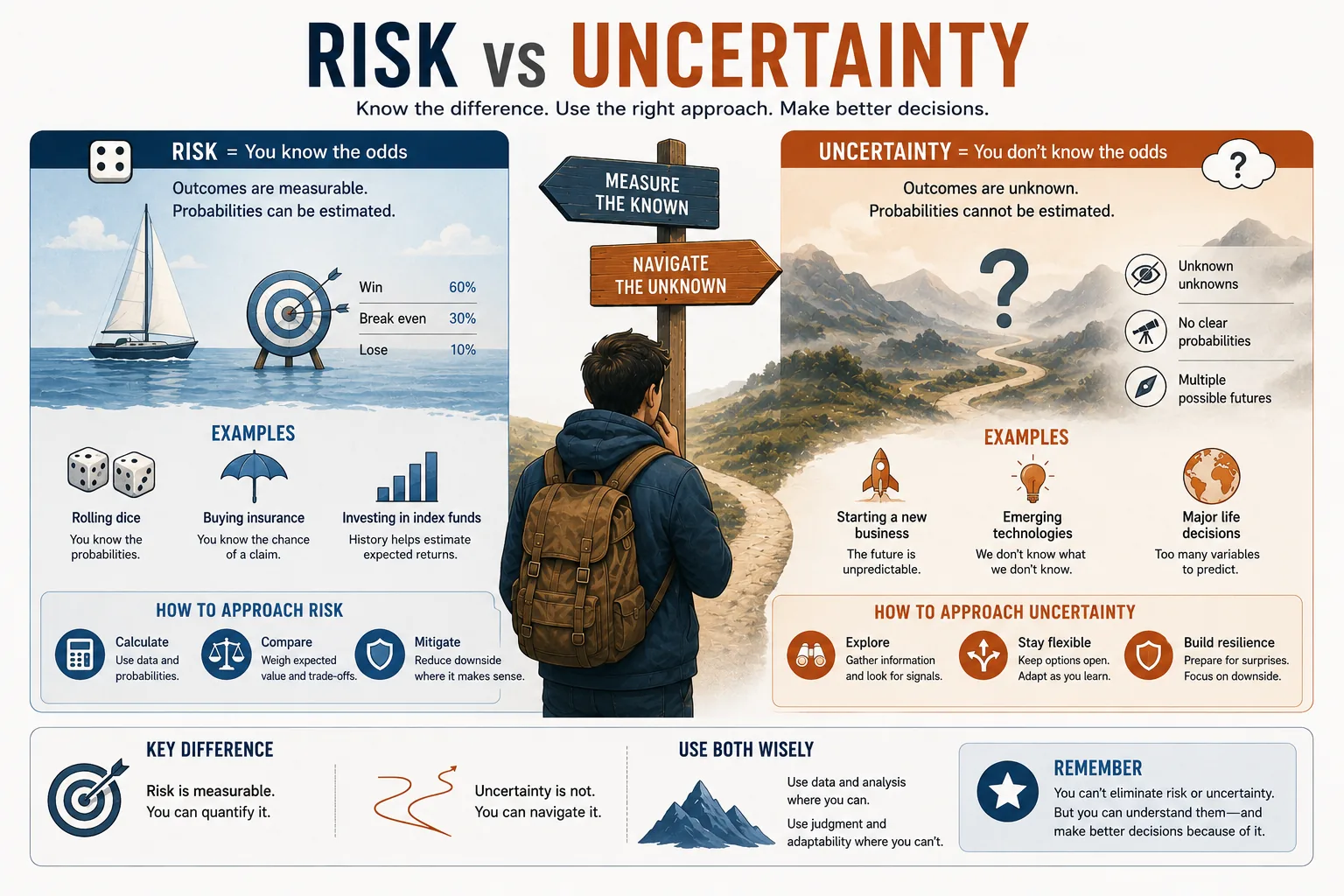
Risk vs uncertainty distinguishes situations with known possible outcomes and meaningful probabilities from situations where outcomes, probabilities, or both remain unknown. Statistical tools can manage repeatable risk, but novel, complex, unstable systems require robustness, optionality, and protection against catastrophic downside. Treating uncertainty as a precise calculation creates false confidence by hiding untestable assumptions behind numbers.
The Illusion of Quantifiable Danger
A CFO presents a detailed risk analysis: "This expansion has a 68% probability of 15-22% ROI, with downside risk quantified at 12% loss maximum."
The precision is comforting. The spreadsheet is convincing. The confidence is unwarranted.
Why? Because what looks like calculable risk is actually fundamental uncertainty-and the difference matters profoundly.
Frank Knight (1921) drew the distinction that most people still miss:
- Risk: You know the possible outcomes and their probabilities (even if you don't know which specific outcome will occur)
- Uncertainty: You don't know the full range of outcomes, or you don't know the probabilities, or both
Casino roulette = risk: Known outcomes (numbers 0-36), known probabilities (1/37 each), calculable expected value.
Launching a novel product = uncertainty: Unknown customer response, unknown competitive reaction, unknown technological changes, unknown regulatory shifts. You can guess probabilities, but you're not calculating-you're estimating under uncertainty.
The dangerous confusion: Treating uncertainty as if it were quantifiable risk. This produces false precision, overconfidence, and systematic underestimation of tail events (rare but extreme outcomes).
"Uncertainty is not the absence of knowledge. It is the presence of unknowns." (a widely circulated paraphrase of themes from Frank Knight's 1921 work Risk, Uncertainty and Profit, though this exact wording does not appear to be a direct quotation from the text) - Frank Knight
Most important decision making decisions-business strategy, career moves, investment in innovation, policy choices-involve uncertainty, not risk.[5] Yet we reach for risk management tools (probability distributions, expected value calculations, VaR models) and pretend we've eliminated the uncertainty.
We haven't. We've just hidden it behind confident numbers.
Knight's Distinction: Risk vs. Uncertainty
Risk: Known Probabilities
Definition: You can enumerate outcomes and assign meaningful probabilities, either through:
- Frequentist probability: Based on observed frequencies (rolling dice, failure rates of components)
- Subjective probability: Based on structured analysis of similar situations (medical diagnosis based on symptoms + base rates)
Examples of genuine risk:
| Domain | Knowable Factors | Risk Type |
|---|---|---|
| Insurance | Historical claim rates, actuarial tables | Frequentist (large data) |
| Manufacturing quality | Defect rates from production runs | Frequentist (process control) |
| Clinical trials | Response rates in controlled populations | Frequentist (experimental) |
| Poker | Card probabilities, pot odds | Frequentist (known deck composition) |
Key feature: You might lose any individual bet, but over many iterations, probabilities converge to known values (law of large numbers).
Management approach: Calculate expected value, diversify, use statistical methods, manage through volume.
Uncertainty: Unknown Probabilities
Definition: You cannot assign meaningful probabilities because:
- The situation is novel (no frequency data)
- The system is complex (too many interacting variables)
- The distribution is unstable (probabilities shift over time)
- You don't know all possible outcomes (unknown unknowns)
Examples of genuine uncertainty:
| Domain | Uncertain Factors | Why Probability Is Meaningless |
|---|---|---|
| Startup success | Market reception, competitive dynamics, team execution, timing | Novel situation, no reference class with stable probabilities |
| Technology disruption | Which technologies emerge, adoption rates, regulatory response | System complexity, unknown innovations |
| Geopolitical events | Wars, revolutions, policy shifts | Too many hidden variables, inherently unstable |
| Climate tipping points | When/if critical thresholds crossed | Non-linear systems, no historical precedent |
Key feature: You can't use frequency-based reasoning. Each situation is sufficiently unique that past patterns don't reliably predict future probabilities.
Management approach: Build robustness, maintain optionality, avoid catastrophic downside, use heuristics instead of calculations.
Why the Confusion Is Dangerous
False Precision
Example - Financial risk models:
Pre-2008, banks used Value at Risk (VaR) models: "99% confident that daily losses won't exceed $X."
This sounds like rigorous risk management. It's actually uncertainty disguised as risk.
What the models assumed:
- Asset price movements follow normal distributions (they don't-fat tails exist)
- Correlations remain stable (they don't-correlations spike during crises)
- Historical patterns predict future (they don't-regimes shift)
Result: Models showed low risk. Reality delivered catastrophic losses. The precision was false-the numbers gave confidence that wasn't justified.
Nassim Taleb's critique: VaR models work fine in stable environments (genuine risk), but fail catastrophically in Black Swan events (genuine uncertainty). Since Black Swans dominate outcomes, the models are worse than useless-they create false security.
Lesson: Precise numbers feel scientific. They're not, if the underlying situation is fundamentally uncertain.
Overconfidence
Treating uncertainty as risk produces overconfidence because of several cognitive biases:
- Quantification feels like knowledge: "I've calculated the probability" feels more solid than "I have no idea"
- Models anchor judgment: Once you've built a spreadsheet, you forget its assumptions
- Confirming evidence is overweighted: Your model "predicted" some outcomes (by chance), reinforcing confidence
Example - Business case projections:
Typical approach: Build 5-year financial model with "conservative," "base," and "optimistic" scenarios. Present expected NPV and IRR.
What's actually happening: You're estimating revenues (uncertain), costs (uncertain), competitive response (uncertain), technology evolution (uncertain), regulatory changes (uncertain)-then multiplying uncertainties to produce a precise-looking number.
Philip Tetlock's research: Experts making predictions in complex domains (economics, geopolitics) perform barely better than chance, yet express high confidence. They confuse their model's precision with reality's predictability.
Better approach: Acknowledge uncertainty explicitly. "We have no idea what revenue will be in Year 5. Here's our Year 1 plan, and we'll adapt as we learn."
Ignoring Tail Risk
Risk thinking focuses on expected values and variance around the mean.
Uncertainty produces fat tails-extreme events far more common than normal distributions predict.
Example - Pandemic risk:
Risk framing: "Pandemic occurs approximately once per century based on historical frequency. Annual probability ~1%."
Uncertainty reality:
- Pandemic timing isn't random Poisson process (depends on interconnected factors: travel, density, zoonotic spillover, health systems)
- When pandemic occurs, impact is non-linear (overwhelmed hospitals → cascading failures)
- "Once per century" is misleading because distribution has fat tails (clustering possible)
Result: Risk models said "low annual probability, manageable." Reality: COVID-19 caused trillions in damage. Models weren't wrong about frequency-they were categorically wrong about the type of problem.
Taleb's point: In domains with fat tails, don't optimize for average cases. Optimize to survive tail events, because tail events dominate.
The Spectrum: From Risk to Uncertainty
Most situations aren't pure risk or pure uncertainty-they're somewhere on a spectrum.
| Type | Characteristics | Examples | Approach |
|---|---|---|---|
| Pure Risk | Known outcomes, known probabilities, stable system | Casino games, quality control, actuarial insurance | Calculate expected value, diversify, use statistics |
| Statistical Risk | Unknown outcomes, estimable probabilities, large data sets | A/B testing, medical trials, credit scoring | Use frequentist methods, gather data, refine models |
| Structured Uncertainty | Known frameworks, uncertain parameters, some analogies | New product launch (in familiar market), hiring decisions, competitive strategy | Scenario planning, analogies, Bayesian updating |
| Deep Uncertainty | Unknown unknowns, no meaningful probabilities, novel situation | Technological paradigm shifts, geopolitical transformations, startup in new market | Robustness, optionality, fast adaptation, avoid catastrophe |
| Radical Uncertainty | Unquantifiable, non-repeatable, unique events | "Will AGI emerge by 2030?", "Will democracy survive in country X?" | Heuristics, judgment, humility, preparation without prediction |
Movement along spectrum: Sometimes uncertainty becomes risk through learning. Early iPhone launch = deep uncertainty. By iPhone 15 = statistical risk (you have massive data on adoption patterns).
But not all uncertainty becomes risk. Some domains remain fundamentally uncertain no matter how much you study them (complex adaptive systems, novel situations, regime changes).
Strategies for Risk vs. Strategies for Uncertainty
For Risk: Optimize
When you know probabilities, you can optimize:
Expected value maximization: Choose option with highest probability-weighted outcome
Diversification: Pool uncorrelated risks to reduce variance
Hedging: Offset one risk with opposite exposure
Insurance: Transfer risk to parties who can pool it
Example - Manufacturing:
You know defect rates (historical data), failure modes (testing), costs (accounting). You can:
- Calculate optimal quality control investment (balance false positives vs. false negatives)
- Optimize inventory levels (balance carrying costs vs. stockout risk)
- Set prices to maximize expected profit given known demand curves
This works because the system is stable, data is reliable, probabilities are meaningful.
For Uncertainty: Build Robustness
"It is better to be roughly right than precisely wrong." - John Maynard Keynes
When you don't know probabilities, optimization fails. You need robustness-strategies that work across many possible futures.
1. Avoid Catastrophic Downside
Principle: Survive the worst case, don't optimize for the best case.
Example - Capital structure:
Risk thinking: "Maximize ROI by leveraging balance sheet 90%" (works great in base case)
Uncertainty thinking: "Maintain low leverage to survive revenue crashes we can't predict" (works across many futures)
Buffett's rule: "Rule #1: Don't lose money. Rule #2: Don't forget Rule #1." In uncertainty, preservation >> optimization.
2. Maintain Optionality
Nassim Taleb: "Options are the antidote to fragility."
Principle: Keep multiple paths open, delay irreversible commitments.
Example - Technology choices:
Low optionality: Build on proprietary platform, tightly couple to vendor (optimizes for current state)
High optionality: Use open standards, modular architecture, multiple vendors (preserves flexibility for unknown futures)
Cost of optionality: Usually higher short-term cost, lower long-term fragility.
When to prioritize optionality: High uncertainty about technology evolution, competitive landscape, customer needs.
3. Fast Feedback Loops
Principle: Since you can't predict, build systems that learn and adapt quickly.
Example - Startup strategy:
Risk approach: Build detailed 5-year plan, execute methodically (works if predictions are accurate)
Uncertainty approach: Build minimal viable product, test, learn, iterate rapidly (works when you don't know what will succeed)
Eric Ries's Lean Startup: Entire methodology is designed for uncertainty, not risk. You don't calculate probabilities-you run experiments and adapt.
4. Use Heuristics, Not Calculations
Principle: When probabilities are unknowable, use rules of thumb that work across contexts.
Example heuristics:
| Heuristic | Rationale | Domain |
|---|---|---|
| "1/N rule" (equal allocation) | When you can't calculate optimal, diversify equally | Investment allocation under uncertainty |
| "Satisficing" (good enough > optimal) | Finding optimum is too costly/uncertain | Complex decisions with many variables |
| "Margin of safety" (30-50% buffer) | Unknown risks require buffer | Estimates, timelines, resources |
| "Reversibility threshold" (easily reversible = lower bar) | Preserve optionality when uncertain | Prioritization, commitments |
Gerd Gigerenzer: Simple heuristics often outperform complex models in uncertain environments because they're more robust to distributional assumptions.
Common Mistakes
Mistake 1: Spurious Precision
Error: Calculating probabilities to three decimal places when you're fundamentally guessing.
"This acquisition has a 67.3% probability of succeeding" (meaningless precision)
Better: "I'd guess 60-75% chance of success" (acknowledges estimation uncertainty)
Or even better: "I have no confidence in any specific probability, but here are scenarios and how we'd respond to each"
Mistake 2: Neglecting Model Uncertainty
Error: Building one model, using its outputs as if they're reality.
Financial crisis example: Risk models assumed housing prices wouldn't fall nationally (no precedent in modern data). This assumption was wrong, making all downstream calculations wrong.
Solution: Model ensembles (use multiple models with different assumptions) + stress testing (what if core assumptions break?)
Humility: Your model is a simplification. Reality is more complex. The map is not the territory. Robust mental models account for this gap explicitly.
Mistake 3: Treating Unique Events as Repeatable
Error: Using frequency-based reasoning on non-repeatable situations.
"What's the probability this startup succeeds?" (This specific startup, with these specific people, in this specific market, at this specific time-has never happened before and will never happen again.)
You can estimate based on reference classes ("VC-backed SaaS startups succeed ~20%"), but that's uncertainty (rough estimate), not risk (calculable probability).
Better framing: "Based on rough analogies, maybe 15-30% chance. But this is fundamentally uncertain." This is probabilistic thinking applied honestly-acknowledging the limits of the estimate rather than hiding them.
Mistake 4: Ignoring Unknown Unknowns
"There are known knowns... there are known unknowns... But there are also unknown unknowns." - Donald Rumsfeld
Donald Rumsfeld (in different context): "There are known knowns, known unknowns, and unknown unknowns."
Risk models handle known unknowns (you know you don't know exact demand, so you model it as distribution).
Uncertainty includes unknown unknowns (factors you haven't even considered).
Example - COVID-19:
Most pandemic plans assumed "flu-like" virus. COVID was different:
- Asymptomatic spread (not modeled)
- Long-haul symptoms (not anticipated)
- Supply chain cascades (not central to pandemic planning)
- Misinformation dynamics on social media (not traditional pandemic factor)
These weren't bad estimates-they were unknown unknowns. No amount of risk analysis would have found them before the event.
Implication: In genuine uncertainty, your model will miss important factors. Build slack for what you can't anticipate.
Mistake 5: Optimizing for Last War
Error: Using recent crises to define risk models, missing that next crisis will be different.
2008 Financial Crisis: Focused risk management on housing, leverage, mortgage-backed securities
Next crisis could be: Sovereign debt, cyberattack, climate cascade, geopolitical conflict-completely different causal structure
Solution: Don't fight the last war. Build general robustness (strong capital buffers, diversification, adaptability) rather than optimizing for specific past crisis.
Real-World Applications
Business Strategy
Most strategic decisions involve uncertainty, not risk:
- Entering new markets (no good precedent)
- Technology bets (evolution uncertain)
- M&A (integration outcomes uncertain)
- Innovation (by definition, novel)
Bad approach: Detailed 5-year financial projections with precise NPV/IRR (false precision)
Better approach:
- Identify key uncertainties (What must be true for this to work?)
- Scenario planning (What happens in different futures?)
- Robust strategies (What works across scenarios?)
- Real options (How do we stage investment to learn before committing?)
- Triggers and pivots (What signals indicate which scenario is unfolding?)
Example - Technology investment:
Don't ask: "What's ROI of investing in AI?" (unknowable)
Ask:
- "What if AI develops faster/slower than expected?"
- "What's our strategy if competitors adopt aggressively?"
- "How do we build capability while preserving optionality?"
- "What's the reversible vs. irreversible components?"
Investment and Finance
Public markets: More risk-like (liquid, large data, many comparable securities)
Private markets / VC: More uncertainty-like (illiquid, unique assets, novel companies)
Risk approach (works for public markets):
- Modern portfolio theory (optimize mean-variance)
- Factor models (quantify risk exposures)
- VaR (measure downside)
Uncertainty approach (works for private/VC):
- Portfolio construction by heuristic (diversity, not optimization)
- Margin of safety (Buffett's approach-buy at big discount to value)
- Antifragility (Taleb-position for asymmetric upside)[4]
- Real options (stage capital, preserve flexibility)
Mistake: Using public market risk models for private/VC investments. The mathematics doesn't transfer because the underlying structure is different.
Personal Decisions
Career, relationships, major life choices: These are uncertainty, not risk.
You cannot calculate:
- Probability this career path makes you happy
- Probability this relationship works long-term
- Probability moving to new city is right decision
You can:
- Make educated guesses based on partial information
- Run experiments (internships, dating, visits)
- Build optionality (skills that transfer, relationships you maintain)
- Choose robustness over optimization (financial buffer, maintain flexibility, avoid catastrophic errors)
Better framing: "I can't predict the future, but I can position myself to adapt to many futures."
Policy and Governance
Most major policy challenges involve uncertainty:
- Climate change (complex system, tipping points, technological shifts)
- Pandemic preparedness (timing, type, response uncertain)
- Geopolitical stability (too many interacting variables)
- Technological regulation (AI, biotech-can't predict capabilities or risks precisely)
Risk-based policy (when appropriate): Cost-benefit analysis, expected value optimization
Uncertainty-based policy (more often needed):
- Precautionary principle (avoid catastrophic downside when uncertain)
- Adaptive management (monitor, learn, adjust)
- Scenario planning (prepare for multiple futures)
- Resilience over efficiency (build slack for unknown shocks)
Example - Climate policy:
Risk framing: "Calculate optimal carbon tax based on social cost of carbon" (requires precise probability distributions of climate impacts-which don't exist)
Uncertainty framing: "We don't know exact impacts or timing, but catastrophic outcomes are plausible. Reduce emissions substantially as insurance, adapt policy as we learn more."
Converting Uncertainty to Risk
"Risk comes from not knowing what you're doing." - Warren Buffett
Sometimes you can reduce uncertainty through:
1. Data collection: Early in technology lifecycle = uncertainty. After millions of users = statistical risk.
2. Experimentation: Run small tests to learn probabilities before large commitment.
3. Reference classes: Novel to you → novel to world. Find analogies with data.
4. Breaking down complexity: Large uncertain problem → multiple smaller problems (some uncertain, some risk).
Example - New product launch:
Initial state: Complete uncertainty (will customers want this?)
Reduce uncertainty:
- User research (convert "will they want it?" to testable hypotheses)
- Prototype testing (measure actual behavior)
- Limited launch (gather frequency data)
- Scale (now you have conversion rates, churn, LTV-statistical risk)
Remaining uncertainty: Competitive response, market evolution, technology shifts (can't be fully reduced)
Strategy: Move what you can from uncertainty → risk (through learning), then manage remaining uncertainty through robustness.
The Wisdom of Uncertainty
Acknowledging uncertainty isn't pessimism or defeatism-it's intellectual honesty.
You make better decisions when you:
- Recognize the limits of prediction
- Distinguish what you can know from what you can't
- Use appropriate tools for each (calculation for risk, robustness for uncertainty)
- Stay humble about model limitations
Daniel Kahneman: "We're generally overconfident in our opinions and impressions." This is especially true when we confuse uncertainty with calculable risk.[6]
The paradox: Admitting "I don't know" increases decision quality. It shifts you from false precision → appropriate humility → better strategies (robustness, optionality, adaptation).
Risk is calculable. Uncertainty is navigable.
"The goal of forecasting is not to predict the future but to tell you what you need to know to take meaningful action in the present." - Paul Saffo
The difference matters. Stop pretending you can calculate what is fundamentally unknowable. Build robustness instead.
What Researchers Found About Risk and Uncertainty
Frank Knight's Risk, Uncertainty and Profit (1921) is the foundational text, but Knight's distinction built on a longer intellectual tradition.[1]
John Maynard Keynes published A Treatise on Probability in the same year (1921), independently developing a framework that distinguished between situations where probabilities could be meaningfully quantified and situations where they could not.[2]
Keynes argued that most economic decisions involve "uncertain" rather than "risky" situations in Knight's sense, and that the rational response to genuine uncertainty is not probability calculation but what he called "animal spirits" - judgment, confidence, and conventional behavior that allows action despite irreducible uncertainty.
Leonard Savage's The Foundations of Statistics (1954) attempted to resolve the tension by developing subjective expected utility theory - the argument that rational agents can always assign subjective probabilities to uncertain events and should act to maximize expected utility given those probabilities.
Savage's framework became the foundation of modern decision theory and financial economics. Daniel Ellsberg (of the Pentagon Papers) challenged it in 1961 with the "Ellsberg Paradox" - an experiment showing that people systematically prefer known probabilities over ambiguous ones, even when the expected value is the same.[9]
Ellsberg's result demonstrated that humans distinguish between risk and uncertainty in their decision-making even when formal theory says they should not.
Nassim Taleb extended the analysis into financial markets with The Black Swan (2007).[3]
Taleb's core argument is that financial risk models, by fitting probability distributions to historical data, convert genuine uncertainty into apparent risk - and that this conversion is catastrophically wrong when the underlying distribution has fat tails (extreme events much more common than Gaussian distributions predict).
Taleb documented the recurring pattern: traders and risk managers treat uncertainty as quantifiable risk, build precise models, take positions that the models show are "safe," and lose catastrophically when the tail event arrives.
The 2008 financial crisis, occurring one year after publication, confirmed Taleb's analysis in spectacular detail.
Gerd Gigerenzer, the German psychologist at the Max Planck Institute, approached the risk/uncertainty distinction from the psychology of decision-making.
Gigerenzer's research showed that simple heuristics - decision rules that ignore most available information and use only a few cues - frequently outperform complex probabilistic models in uncertain environments.[8]
In Risk Savvy (2014) and earlier technical papers, Gigerenzer demonstrated that the superiority of heuristics in uncertain environments is theoretically explicable: heuristics are more robust to distributional assumptions and better at extrapolating from small samples than models that overfit to historical data.
The implication directly contradicts standard decision theory: in genuine uncertainty, less information and simpler rules can produce better decisions.
Historical Case Studies in Risk vs. Uncertainty
Long-Term Capital Management and Uncertainty Masquerading as Risk (1994-1998): LTCM's collapse is the definitive case study in the catastrophe of converting uncertainty into apparent risk.
The fund's founders, including Nobel laureates Myron Scholes and Robert Merton, built models treating financial market behavior as calculable risk: they estimated correlations between asset classes, volatility distributions, and tail probabilities from historical data, then took leveraged positions that the models showed were "risk-managed." The models were sophisticated and the historical data extensive.
What the models could not capture was structural uncertainty: that correlations between asset classes become unstable during systemic crises, that the behavior of markets during a crisis is qualitatively different from their behavior during normal periods, and that the assumptions underlying the probability distributions were valid only within the regime of conditions the data had been drawn from.
The 1998 Russian debt crisis created a regime change: the historical correlations broke down, assets that were supposed to be uncorrelated moved together as every market participant simultaneously tried to reduce exposure.[10]
The fund lost $4.6 billion in four months. The models had successfully quantified risk within the known distribution; they could not quantify uncertainty about whether that distribution would remain valid.
The Space Shuttle Challenger Disaster and Organizational Uncertainty (1986): The Challenger disaster illustrates how organizations convert uncertainty into apparent risk to enable decision-making, with catastrophic consequences.
Engineers at Morton Thiokol, the O-ring manufacturer, had data showing that O-ring performance degraded at low temperatures but the data was sparse and variable - insufficient to calculate a reliable failure probability.
The launch decision required treating this genuine uncertainty as quantifiable risk: managers needed a probability estimate to compare against the acceptable risk threshold.
The organizational pressure to launch converted the engineers' qualitative concern ("we don't know whether these will fail at 28 degrees Fahrenheit because we've never tested them at that temperature") into a quantitative assessment that was then challenged by the launch-pressure argument that the data was insufficient to prove the rings would fail.
Diane Vaughan's analysis in The Challenger Launch Decision (1996) showed that the disaster resulted from the normalization of deviance - the gradual organizational acceptance of anomalous readings as within the "acceptable risk" range.
The genuine uncertainty about O-ring performance at low temperatures was never acknowledged as uncertainty; it was treated as risk within an organizational framework that needed a launch-or-no-launch decision.
COVID-19 Pandemic Preparedness and Unknown Unknowns (2020): The COVID-19 pandemic illustrated the gap between risk frameworks and genuine uncertainty. Most countries had pandemic preparedness plans based on influenza pandemic scenarios - the most likely form of pandemic based on historical patterns.
These plans addressed known risks: respiratory transmission, hospital surge capacity, stockpiling of ventilators and masks.
What COVID-19 presented were unknown unknowns that no preparedness plan had modeled: asymptomatic spread at high rates (influenza spreads much less from asymptomatic individuals), aerosol transmission as the dominant route (influenza is primarily droplet-transmitted), prolonged post-infection symptoms in a significant fraction of patients, and the social media dynamics that drove information and misinformation simultaneously.
The initial risk models underestimated deaths by factors of 10-100 in most countries not because the probability estimates were wrong within the assumed distribution, but because the underlying distribution assumptions were wrong - COVID-19 was not the kind of pandemic that previous pandemic experience had created distributions for.
Deepwater Oil Drilling and Low-Probability High-Impact Uncertainty (2010): Before the Deepwater Horizon disaster, the oil industry treated deepwater drilling safety as quantifiable risk: blowout probability was estimated from historical data, safety systems were designed to reduce that probability to an "acceptable" level, and regulatory approval was based on the probabilistic risk assessment.
What the risk framework could not capture was that the historical record was short (deepwater drilling at these depths was relatively new), the systems involved were complex and interactive in ways that historical data might not reveal, and the consequences of a low-probability event (catastrophic blowout at depth) were qualitatively different from the consequences of a low-probability event in shallower or simpler operations.
The Macondo well blowout, which triggered the Deepwater Horizon disaster, involved a combination of factors - compromised cement, defective blowout preventer, misinterpreted pressure tests - that had not previously combined in this way. It was a tail event in the Taleb sense: far outside the calibrated risk model's predictions.
Research Applications: Organizations Managing Under Uncertainty
Shell's Scenario Planning: Royal Dutch Shell developed scenario planning in the 1970s as an organizational response to genuine uncertainty about oil price futures.
The scenario planning process, developed by Pierre Wack and later Ted Newland, explicitly rejected the goal of predicting the future (which would require converting uncertainty to risk) in favor of developing multiple plausible narratives of possible futures and strategies that would be robust across them.
Wack's "two surprises" approach - developing scenarios that were internally consistent but surprising relative to conventional assumptions - was specifically designed to identify the unknown unknowns that organizations tend to plan around.
Shell's scenario planning allowed the company to partially anticipate the 1973 oil price shock and respond more quickly than competitors. The method has been adopted by governments, militaries, and corporations as the standard tool for strategy under deep uncertainty.
Knight Frank Knight's Entrepreneurial Theory and Venture Capital: Frank Knight's original analysis connected the risk/uncertainty distinction directly to entrepreneurship and profit.
Knight argued that genuine profit - not normal returns to capital or labor, but the excess returns that motivate risk-taking - arises specifically from operating under uncertainty rather than quantifiable risk. If outcomes were fully predictable (risk), competition would drive profits to zero.
Genuine profits exist because entrepreneurs bear genuine uncertainty - they cannot know in advance whether their judgment about future demand is correct.
Venture capital as an institutional form is the organized application of this insight: VC firms accept genuine uncertainty (most investments will fail), invest across a portfolio so that a few successes compensate for many failures, and compete on the quality of judgment about uncertain futures rather than on calculation of known probabilities.
The Good Judgment Project and Calibrated Uncertainty: Philip Tetlock and Barbara Mellers' Good Judgment Project, which ran from 2011-2015 as part of IARPA's forecasting tournament, identified the features of "superforecasters" - people who significantly outperform expert predictions in political and economic forecasting.[7]
The superforecasters' distinguishing practices included: explicitly acknowledging uncertainty rather than expressing false precision, updating beliefs in response to new evidence (Bayesian updating), decomposing complex questions into components with more tractable probability estimates, seeking out evidence that disconfirmed their current views, and using reference class forecasting (what has happened in comparable situations?) to anchor estimates.
Crucially, superforecasters also distinguished between questions where calibrated probability estimates were meaningful and questions where genuine uncertainty precluded reliable probability assignment - they knew when to say "I don't know" rather than forcing a number.
Essential Readings
Foundational Texts:
- Knight, F. H. (1921). Risk, Uncertainty and Profit. Boston: Houghton Mifflin. [The original distinction, still the clearest]
- Keynes, J. M. (1921). A Treatise on Probability. London: Macmillan. [Philosophical foundations of uncertainty]
- Kay, J., & King, M. (2020). Radical Uncertainty: Decision-Making Beyond the Numbers. New York: Norton. [Modern treatment, excellent examples]
Taleb's Work on Uncertainty and Black Swans:
- Taleb, N. N. (2007). The Black Swan: The Impact of the Highly Improbable. New York: Random House. [Fat tails, limits of prediction]
- Taleb, N. N. (2012). Antifragile: Things That Gain from Disorder. New York: Random House. [Building systems that benefit from uncertainty]
- Taleb, N. N. (2018). Skin in the Game: Hidden Asymmetries in Daily Life. New York: Random House. [Agency problems in risk vs uncertainty]
Risk Management Failures:
- Bookstaber, R. (2007). A Demon of Our Own Design: Markets, Hedge Funds, and the Perils of Financial Innovation. New York: Wiley. [Financial crisis, model failures]
- MacKenzie, D. (2006). An Engine, Not a Camera: How Financial Models Shape Markets. Cambridge, MA: MIT Press. [How risk models create the reality they claim to measure]
- Patterson, S. (2010). The Quants: How a New Breed of Math Whizzes Conquered Wall Street and Nearly Destroyed It. New York: Crown. [Quant finance, VaR failures]
Decision Theory:
- Savage, L. J. (1954). The Foundations of Statistics. New York: Wiley. [Subjective probability, decision under uncertainty]
- Gilboa, I. (2009). Theory of Decision under Uncertainty. Cambridge: Cambridge University Press. [Formal treatment]
- Peterson, M. (2009). An Introduction to Decision Theory. Cambridge: Cambridge University Press. [Accessible overview]
Heuristics and Simple Rules:
- Gigerenzer, G., Todd, P. M., & ABC Research Group. (1999). Simple Heuristics That Make Us Smart. New York: Oxford University Press. [When simple rules beat complex models]
- Gigerenzer, G. (2014). Risk Savvy: How to Make Good Decisions. New York: Viking. [Practical decision-making under uncertainty]
Forecasting and Overconfidence:
- Tetlock, P. E. (2005). Expert Political Judgment: How Good Is It? How Can We Know?. Princeton: Princeton University Press. [Experts predict poorly in uncertain domains]
- Silver, N. (2012). The Signal and the Noise: Why So Many Predictions Fail-But Some Don't. New York: Penguin. [When forecasting works vs. fails]
- Kahneman, D. (2011). Thinking, Fast and Slow. New York: Farrar, Straus and Giroux. [Overconfidence, planning fallacy]
Robustness and Adaptation:
- Lempert, R. J., Popper, S. W., & Bankes, S. C. (2003). Shaping the Next One Hundred Years: New Methods for Quantitative, Long-Term Policy Analysis. Santa Monica, CA: RAND. [Robust decision-making]
- Walker, B., & Salt, D. (2006). Resilience Thinking: Sustaining Ecosystems and People in a Changing World. Washington, DC: Island Press. [Ecological resilience principles]
- Ries, E. (2011). The Lean Startup: How Today's Entrepreneurs Use Continuous Innovation to Create Radically Successful Businesses. New York: Crown. [Adaptation under uncertainty]
Scenario Planning:
- Schwartz, P. (1996). The Art of the Long View: Planning for the Future in an Uncertain World. New York: Currency. [Scenario methodology]
- van der Heijden, K. (2005). Scenarios: The Art of Strategic Conversation (2nd ed.). New York: Wiley. [Corporate scenario planning]
Philosophy of Probability:
- Hacking, I. (1975). The Emergence of Probability. Cambridge: Cambridge University Press. [History of probability concept]
- Hájek, A. (2019). "Interpretations of Probability." Stanford Encyclopedia of Philosophy. [Philosophical foundations]
Sources & Further Reading
Knight, F. H. (1921). Risk, Uncertainty and Profit. Boston: Houghton Mifflin. The foundational text establishing the distinction between measurable risk and unmeasurable uncertainty (Knightian uncertainty).
Keynes, J. M. (1921). A Treatise on Probability. London: Macmillan. Argues that most probabilities are non-numerical and that rational belief under uncertainty cannot always be quantified.
Taleb, N. N. (2007). The Black Swan: The Impact of the Highly Improbable. New York: Random House. Documents how rare, high-impact events fall outside the scope of conventional risk models and why fat tails dominate outcomes in complex systems.
Taleb, N. N. (2012). Antifragile: Things That Gain from Disorder. New York: Random House. Extends Black Swan theory into a prescriptive framework: building systems that benefit from volatility rather than merely surviving it.
Kay, J., & King, M. (2020). Radical Uncertainty: Decision-Making Beyond the Numbers. New York: W. W. Norton. Argues that most consequential decisions involve radical uncertainty that cannot be resolved by probability calculations, and proposes narrative and robustness-based approaches.
Kahneman, D. (2011). Thinking, Fast and Slow. New York: Farrar, Straus and Giroux. Covers the cognitive biases-overconfidence, anchoring, availability-that cause people to systematically misperceive uncertainty as calculable risk.
Tetlock, P. E., & Gardner, D. (2015). Superforecasting: The Art and Science of Prediction. New York: Crown. Examines what separates skilled probabilistic forecasters from experts who conflate uncertainty with risk, based on the Good Judgment Project data.
Gigerenzer, G. (2014). Risk Savvy: How to Make Good Decisions. New York: Viking. Demonstrates that simple heuristics frequently outperform complex risk models under genuine uncertainty due to their robustness to distributional assumptions.
Ellsberg, D. (1961). "Risk, Ambiguity, and the Savage Axioms." Quarterly Journal of Economics, 75(4), 643-669. The seminal paper presenting the Ellsberg Paradox, showing that decision-makers treat ambiguous (uncertain) gambles differently from risky ones, contradicting expected utility theory.
Bookstaber, R. (2007). A Demon of Our Own Design: Markets, Hedge Funds, and the Perils of Financial Innovation. New York: Wiley. Insider account of how financial risk models (VaR) created false confidence by converting deep uncertainty into quantified risk, contributing to systemic crises.