
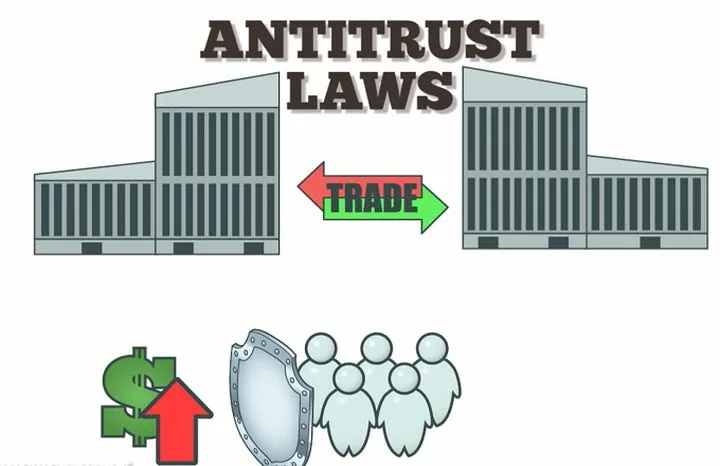
Antitrust law governs market power when dominance shifts from competing effectively to harming competition through exclusionary conduct. Its concern includes monopoly pricing, lost transactions, wealth transfers, market concentration, and disputed effects on innovation.
In the United States, the Sherman, Clayton, and FTC Acts provide the core framework, while enforcement has changed with competing views of consumer welfare and market structure.
Antitrust law - called competition law in most of the world outside the United States - is the body of statutes, regulations, and case law designed to prevent the concentration of market power in ways that harm competition, consumers, workers, and ultimately the broader economy.
From the breakup of Standard Oil in 1911 to the ongoing cases against Google and Meta, the central question has never changed: when does a firm's market dominance cross from the reward of superior performance into the abuse of power that demands a legal remedy?
The answers have changed dramatically across a century of enforcement, swinging from the structural suspicion of bigness in the mid-twentieth century through the Chicago School's consumer-welfare revolution to the neo-Brandeisian challenge now reshaping enforcement on both sides of the Atlantic.
The Problem Antitrust Law Addresses
The economic harm from monopoly is well-defined. In a competitive market, prices approach marginal cost and all mutually beneficial transactions take place.
A monopolist sets price above marginal cost to maximize profit, which means some consumers who would willingly pay the competitive price and whose purchase would have covered production costs do not buy - those transactions are lost to the economy forever as deadweight loss.
Beyond the static price effect, economists and lawyers debate the dynamic effects on innovation. Joseph Schumpeter argued that dominant firms generate the profits needed to fund R&D, and that the prospect of monopoly profits drives the innovative effort that creates those positions - creative destruction.
The competing view holds that dominant firms have incentives to suppress innovations that would disrupt their position, behavior economists call incumbent curse.
Historical evidence is mixed, but the technology industry provides vivid examples of both: large platforms have driven genuine innovation and simultaneously acquired or suppressed nascent competitors.
"The possession of monopoly power will not be found unlawful unless it is accompanied by an element of anticompetitive conduct." - Judge Learned Hand, United States v. Alcoa (1945)
US antitrust law rests on three main statutes: the Sherman Act of 1890, which prohibits contracts, combinations, and conspiracies in restraint of trade and monopolization; and the Clayton Act of 1914, which addresses mergers, tying, and price discrimination.
The third is the FTC Act of 1914, which created the Federal Trade Commission and prohibits unfair methods of competition.
The Welfare Loss from Monopoly: A Numerical Context
Economists have attempted to quantify the welfare cost of monopolistic pricing in the US economy. Estimates vary widely depending on methodology.
Cowling and Mueller's influential 1978 paper in the Economic Journal estimated welfare losses from market power at approximately 4-13% of gross corporate product, while later estimates using different assumptions have ranged from less than 1% to more than 10% of GDP annually.[4]
The imprecision reflects genuine difficulty in measuring counterfactual competitive outcomes, but even conservative estimates suggest that the deadweight loss from inadequately constrained market power is substantial at the macroeconomic level.
Beyond the deadweight loss, market power transfers welfare from consumers to producers - a distributive harm in addition to the efficiency harm.
When a pharmaceutical company charges $500 for a medication whose generic equivalent costs $5 to manufacture, the direct welfare transfer to shareholders at the expense of patients (and public health budgets) is the harm most visible to ordinary people, and it motivates much of the public concern about market concentration.
Standard Oil and the Foundations of American Antitrust
The Standard Oil case is the foundational event of American antitrust law. John D. Rockefeller founded Standard Oil of Ohio in 1870.
Through operational efficiency, aggressive negotiation of secret railroad rebates, predatory pricing against rivals, and strategic acquisitions, Standard Oil controlled approximately 91 percent of US oil refining capacity by 1880.
The company organized a trust structure in 1882 - shareholders of various Standard affiliates assigned their shares to nine trustees who controlled the combined enterprise while the individual companies nominally retained separate legal existence.
The trust device was specifically designed to circumvent state laws that prohibited corporations from holding stock in other corporations.
State-level antitrust efforts proved inadequate. Ohio courts dissolved the trust in 1892, but Standard reorganized as a holding company in New Jersey, whose corporation laws accommodated the structure. The federal government's case was filed in 1906 and reached the Supreme Court in 1911.
In Standard Oil Co. of New Jersey v. United States, the Court upheld the lower court's finding that Standard had monopolized the oil industry through anticompetitive practices - not merely by being large, but through deliberate exclusionary conduct.
The remedy was structural: Standard Oil was broken into 34 separate companies, including the predecessors of ExxonMobil, Chevron, BP America, and ConocoPhillips.
Critically, the Court also introduced the rule of reason in interpreting the Sherman Act, holding that only unreasonable restraints violated the Act.
This judicially created doctrine has defined antitrust analysis ever since, requiring courts to weigh the pro-competitive and anticompetitive effects of challenged conduct rather than treating all market-restricting behavior as automatically illegal.
AT&T and the Bell System Breakup (1984)
The 1984 breakup of AT&T represents the largest structural antitrust remedy in American history.
AT&T had controlled the US telephone network through a vertically integrated monopoly: it manufactured telephone equipment through Western Electric, operated local telephone networks through its Bell Operating Companies, and provided long-distance service through AT&T Long Lines.
The DOJ filed suit in 1974, alleging that AT&T used control of the local network to exclude competitors in equipment and long-distance markets.
The 1982 consent decree, which took effect in 1984, required AT&T to divest its local telephone operations into seven independent Regional Bell Operating Companies - the "Baby Bells."
The breakup is widely credited with enabling competition in long-distance telephony, reducing prices dramatically, and clearing the infrastructure for the eventual development of competitive internet service markets.
It stands as a model of structural relief achieving competitive benefits that behavioral remedies had failed to produce.
Per Se Violations vs. the Rule of Reason
The per se versus rule of reason distinction is the central organizing framework of US antitrust litigation, determining how much evidence courts require to find a violation and how defendants can justify challenged conduct.
Per se illegal conduct is treated as automatically violating antitrust law without inquiry into market conditions, the defendant's intent, or actual competitive effects.
The theory is that certain categories of conduct are so reliably harmful to competition and so rarely have legitimate justification that case-by-case analysis wastes judicial resources and creates unpredictability.
Horizontal price fixing is the paradigmatic per se violation. When two competing airlines agree on minimum fares, courts do not ask whether the agreed price was reasonable. The agreement itself is the violation.
Other per se violations include horizontal market allocation, group boycotts, and some tying arrangements.
The rule of reason, by contrast, requires courts to undertake a full economic analysis of the challenged conduct's effects. Courts examine market definition, competitive effects, the defendant's market power, and any procompetitive justifications.
If the defendant offers plausible efficiency benefits, the burden shifts to the plaintiff to show those benefits could be achieved through less restrictive means.
The choice of framework has large practical consequences. Per se treatment favors plaintiffs dramatically because it eliminates the need to prove harm.
Rule of reason analysis is expensive, expert-intensive, and has a historically low success rate for plaintiffs - a feature critics argue has allowed genuinely anticompetitive conduct to escape liability.
| Framework | Standard | Defendant Justifications | Plaintiff Burden |
|---|---|---|---|
| Per se | Automatic violation | Not permitted | Prove the category of conduct |
| Rule of reason | Full economic analysis | Permitted | Prove harm and lack of less restrictive alternatives |
| Quick look | Abbreviated analysis | Limited | Prove obvious anticompetitive effects |
The "quick look" standard, articulated in California Dental Association v.
FTC (1999), occupies an intermediate position: for conduct that appears obviously anticompetitive but does not fit established per se categories, courts can apply an abbreviated rule-of-reason analysis without the full evidentiary burden.
The Supreme Court has applied this standard inconsistently, and its boundaries remain contested.
The Chicago School Revolution
The Chicago School critique was developed primarily in the 1960s and 1970s by Aaron Director, Robert Bork, Frank Easterbrook, and Richard Posner at the University of Chicago.
It argued that mid-twentieth century antitrust enforcement was protecting competitors rather than competition, and that its legal doctrines were economically illiterate and ultimately harmful to consumers.
Bork's 1978 book The Antitrust Paradox was the movement's canonical text. Bork argued that the Sherman Act's legislative history showed its framers intended to maximize consumer welfare understood primarily as consumer prices.[1]
Under this framework, mergers, vertical restraints, and even some horizontal agreements that created efficiencies should be permitted regardless of their effect on the number of competitors, market concentration, or the distribution of power between large and small businesses.
Chicago School scholars also identified the double marginalization problem in earlier cases, noting that some vertical agreements that had been condemned as anticompetitive - manufacturers setting minimum resale prices, manufacturers integrating forward into distribution - could actually reduce prices.
These agreements could increase output by eliminating the successive mark-ups that arise when independent distributors each add their own margin.
The influence on enforcement was substantial. From the late 1970s through approximately 2015, US antitrust agencies became significantly more permissive in merger review, vertical restraints analysis, and predatory pricing cases. The Supreme Court's 1977 Continental T.V.
v. GTE Sylvania decision applying rule of reason to vertical territorial restrictions dramatically reduced the rate at which vertical conduct was challenged. By the late 1990s, Antitrust Division budgets and staff levels had declined substantially relative to the size of the economy, reflecting a diminished appetite for intervention.
The empirical track record of the Chicago School era is contested. Proponents point to sustained economic growth, declining prices in many industries, and limited evidence of consumer harm from the mergers that were permitted.
Critics, led by economists like Philippon (2019), document what they call a "great reversal" in US markets. Across industries, concentration ratios have risen, profit margins have increased, and business dynamism (new firm formation, job switching) has declined.
Corporate investment has also fallen relative to profits, patterns inconsistent with intensely competitive markets.[5]
The Neo-Brandeisian Challenge
The neo-Brandeisian movement - named after Justice Louis Brandeis, who worried about the political and social consequences of concentrated economic power - represents a fundamental intellectual challenge to the consumer welfare standard that has governed US antitrust enforcement for four decades.
The movement's intellectual catalyst was a 2017 Yale Law Journal article by then-student Lina Khan, "Amazon's Antitrust Paradox," which argued that the consumer welfare standard was systematically ill-equipped to evaluate harms caused by modern platform businesses.[2]
Amazon had long operated with very thin margins and often below-cost pricing, which under the Chicago School framework appeared entirely benign.
But Amazon was simultaneously using its platform position to collect competitive intelligence on third-party sellers, replicate their best-selling products under its Amazon Basics brand, and use its control of logistics infrastructure as leverage over sellers and suppliers.
These behaviors could harm competition in the long run without ever manifesting as conventional price increases.
Khan, appointed FTC chair by President Biden in 2021, and Jonathan Kanter at the DOJ Antitrust Division, pursued a more aggressive enforcement program: challenging acquisitions that would previously have passed without review, and bringing monopolization cases against major technology firms.
They also argued for new merger guidelines (published in 2023) that incorporate concentration levels, entry barriers, and ecosystem effects more prominently than prior guidelines.
The neo-Brandeisian argument is multi-pronged. Platform markets exhibit network effects - each additional user increases value for all users - and switching costs that create durable dominant positions even if the platform's current pricing is competitive.
The killer acquisition literature (Cunningham, Ederer, and Ma, 2021) documented that pharmaceutical companies systematically acquired nascent competitors not to develop them but to prevent competition - a pattern that standard merger analysis, focused on existing products and markets, would miss.
"The law of competition is not the law of the jungle - it is the law of civilization, designed to protect consumers, workers, and the democratic order from concentrations of private power." - Lina Khan, paraphrasing the neo-Brandeisian project's underlying premise
The 2024 verdict in United States v. Google - finding that Google had illegally maintained its monopoly in general search through exclusive deals with device manufacturers and browser makers - represented a significant enforcement victory aligned with neo-Brandeisian theories of harm.
The remedies phase, focusing on whether and how to restructure Google's relationships with distribution partners, is likely to define the practical meaning of that liability finding.
Merger Review and the HHI Index
Merger review is the process by which antitrust agencies evaluate proposed acquisitions before they close, determining whether the combination would substantially lessen competition in a relevant market.
In the United States, mergers above specified thresholds must be notified to both the DOJ Antitrust Division and the FTC under the Hart-Scott-Rodino Act.
The standard analytical tool for measuring market concentration is the Herfindahl-Hirschman Index (HHI), calculated by summing the squares of all firms' market shares. A market with 10 equal firms has an HHI of 1,000. A monopoly has an HHI of 10,000.
| HHI Range | Market Classification | Merger Scrutiny Level |
|---|---|---|
| Below 1,500 | Unconcentrated | Low - rarely challenged |
| 1,500 to 2,500 | Moderately concentrated | Moderate scrutiny |
| Above 2,500 | Highly concentrated | Presumptively anticompetitive if HHI rises more than 200 points |
The 2023 merger guidelines lowered these thresholds and added new considerations around market share thresholds, elimination of a potential competitor, and multi-market effects.
Killer acquisitions - a concept from Cunningham, Ederer, and Ma's paper in the Journal of Political Economy (2021) - concern how large firms use acquisitions not to develop but to eliminate potential competitive threats.[3]
They found that pharmaceutical companies systematically acquired drugs in development whose therapeutic areas overlapped with their own existing products, then discontinued development at significantly higher rates than non-overlapping acquisitions.
The mechanism is straightforward: the cost of an acquisition that kills a future competitor is small relative to the profit protected by preventing that competition.
Facebook's acquisitions of Instagram (2012, $1 billion) and WhatsApp (2014, $19 billion) were approved by the FTC at the time.
The FTC's subsequent complaint argued these acquisitions were designed to neutralize potential rivals - internal communications revealed during litigation showed Facebook executives explicitly discussing the threat posed by these platforms and the acquisition strategy as a solution.
The challenge for regulators is that assessing the competitive significance of an early-stage startup requires predicting its future trajectory with little historical data.
The Concentration Trend
A 2019 analysis by Grullon, Larkin, and Michaely in the Review of Finance documented that concentration had increased in more than 75% of US industries between 1997 and 2012, and that firms in more concentrated industries had earned significantly higher profit margins and stock returns - evidence the authors interpreted as consistent with increased market power rather than superior efficiency.[6]
Similar findings emerged from an IMF working paper by Diez, Leigh, and Tambunlertchai (2018) examining concentration trends across advanced economies.
The EU Digital Markets Act: Regulation Instead of Litigation
The European Union's Digital Markets Act (DMA), which entered into force in November 2022 and began applying to designated gatekeepers in March 2024, represents a structural departure from both the US antitrust tradition and the EU's own prior competition law approach.
US antitrust law is retrospective and case-by-case. The government must bring an enforcement action alleging specific violations, build an evidentiary record demonstrating competitive harm, survive years of litigation, and then negotiate or litigate a remedy.
The Google search antitrust case filed by the DOJ in 2020 produced a liability verdict in 2024, with remedies proceedings still ongoing - an elapsed time of four years just to the liability stage.
The DMA takes a fundamentally different approach: regulation ex ante rather than litigation ex post. The European Commission identifies platforms meeting quantitative thresholds (more than 45 million monthly end users in the EU, market capitalization above specified levels) as gatekeepers.
Gatekeepers must comply with specific prohibitions and obligations regardless of whether any particular conduct has been found anticompetitive in any specific case. Obligations include:
- Allowing users to uninstall pre-installed applications
- Not using data collected on a business platform to compete against those businesses in adjacent markets
- Ensuring interoperability with third-party services
- Allowing app developers to use alternative payment systems and distribution channels
The DMA avoids the need to prove market harm, competitive effects, or intent. Critics argue it is overinclusive and underinclusive. Defenders argue that the complexity and slowness of case-by-case analysis makes it structurally inadequate for fast-moving technology markets and that ex ante rules create investment certainty.
Comparison: US vs. EU Approaches
| Dimension | US Antitrust | EU DMA |
|---|---|---|
| Timing | Ex post (after harm) | Ex ante (before harm) |
| Trigger | Government enforcement action | Designation as gatekeeper |
| Proof required | Competitive harm | Meeting quantitative thresholds |
| Remedies | Case-specific | Pre-defined obligations |
| Speed | Years to decades | Compliance required within 6 months |
| Risk of over-enforcement | Lower | Higher |
| Risk of under-enforcement | Higher | Lower |
The DMA's first enforcement actions in 2024 targeted Apple's App Store, Google's self-preferencing in Search, and Meta's "pay or consent" model - reflecting European regulators' conviction that these practices require structural constraints rather than case-by-case adjudication.
Whether the DMA achieves its competitive objectives without creating unintended negative consequences for innovation and investment remains a live empirical question.
Practical Guidance: Understanding Antitrust Risk
For businesses and policymakers navigating antitrust compliance, several principles have consistent practical relevance.
Horizontal agreements carry the highest risk. Any communication between competitors about prices, capacity, or market allocation - even if informal, even if not ultimately acted upon - creates serious legal exposure. The per se category means intent and outcome are largely irrelevant; the communication itself is the problem.
The US Department of Justice has pursued criminal price-fixing prosecutions across industries from auto parts to financial instruments, with executives receiving prison sentences in the most egregious cases.
The EU has imposed record fines - including a EUR 2.93 billion fine against a truck manufacturer cartel in 2016 - for coordinated pricing among competitors.
Market definition is often dispositive. Most antitrust cases turn on how the relevant product and geographic market is defined. A firm with 70 percent of the US market for specialized industrial widgets may have no antitrust problem if the relevant market is global widget manufacturing.
Market definition determines whether market power exists.
Vertical agreements require contextual analysis. Exclusive dealing, resale price maintenance, and tying arrangements are generally analyzed under the rule of reason, meaning context matters. The key question is whether the arrangement forecloses competition or creates efficiencies.
Merger review timelines have expanded. The post-2021 enforcement environment has seen longer second request reviews, greater willingness to litigate challenged mergers, and new attention to acquisitions in nascent markets. Parties planning significant acquisitions should factor enforcement risk into transaction planning from the outset.
Of the 33 merger challenges the FTC brought between 2021 and 2023, roughly half were blocked or abandoned - a significantly higher litigation rate than the prior decade.
Data can constitute a competitive asset. The EU's competition authority and increasingly US regulators have examined whether access to unique data creates durable competitive advantages that undermine fair competition.
A firm that acquires a data-rich target may be acquiring market power that will only manifest in future markets not yet visible to standard analysis.
Antitrust and Labor Markets
A growing body of research and enforcement attention has turned to labor market monopsony - the market power of employers over workers.
When a single employer (or a small number of coordinating employers) dominates local labor markets, they can hold wages below competitive levels and restrict worker mobility, exactly as a product market monopolist raises prices above competitive levels.
Economists Azar, Marinescu, and Steinbaum (2020) analyzed job postings data across US labor markets and found that the majority of US labor markets are highly concentrated - meaning workers in many sectors and locations face limited employer choice.[7]
Their analysis estimated that this concentration suppresses wages by approximately 5-17% relative to competitive outcomes, representing a substantial and largely invisible form of market power.
The DOJ and FTC have brought cases against so-called no-poach agreements - arrangements between competing employers not to recruit each other's workers.
Several major technology companies settled no-poach class action suits in 2015 for approximately $415 million, after the DOJ found evidence of explicit agreements not to recruit workers across Apple, Google, Intel, Adobe, Intuit, Pixar, and Lucasfilm.
More recently, the agencies have signaled attention to non-compete clauses and other labor market restrictions as antitrust concerns.
Conclusion: The Contested Frontier
The antitrust landscape in 2026 is genuinely contested. The consumer welfare standard that dominated enforcement for four decades is challenged from the left by neo-Brandeisians arguing for broader competitive harm metrics and from technological development by platform economics that operates differently from the industrial markets the standard was designed for.
The outcome of this intellectual and institutional contest will shape the structure of markets - and the degree of economic power concentrated in a handful of firms - for decades to come.
What the history of antitrust makes clear is that the framework is not static. It has been remade before - in the Progressive Era response to the trusts, in the New Deal reorganization of regulatory authority, in the Chicago School's intellectual revolution, and now in the neo-Brandeisian reassessment.
Each phase was driven by new economic thinking, new political coalitions, and new forms of market power that existing tools were felt to inadequately address.
The current moment has all three: new economic frameworks for analyzing platform and data markets, new political coalitions spanning left and right populism in opposition to big tech, and new forms of market dominance - search, social media, cloud infrastructure - that do not fit comfortably in frameworks designed for oil refining and telephone switches.
The legal and intellectual work of developing adequate tools for these new forms of power is the defining antitrust challenge of the next decade.
Sources & Further Reading
- Bork, R. H. (1978). The Antitrust Paradox: A Policy at War with Itself. Basic Books.
- Khan, L. M. (2017). Amazon's antitrust paradox. Yale Law Journal, 126(3), 710-805.
- Cunningham, C., Ederer, F., & Ma, S. (2021). Killer acquisitions. Journal of Political Economy, 129(3), 649-702.
- Cowling, K., & Mueller, D. C. (1978). The social costs of monopoly power. Economic Journal, 88(352), 727-748.
- Philippon, T. (2019). The Great Reversal: How America Gave Up on Free Markets. Harvard University Press.
- Grullon, G., Larkin, Y., & Michaely, R. (2019). Are US industries becoming more concentrated? Review of Finance, 23(4), 697-743.
- Azar, J., Marinescu, I., & Steinbaum, M. (2020). Labor market concentration. Journal of Human Resources, 57(S), S167-S199.
Further Reading
- Financial Crisis Inquiry Commission. (2011). Final Report of the National Commission on the Causes of the Financial and Economic Crisis in the United States.