
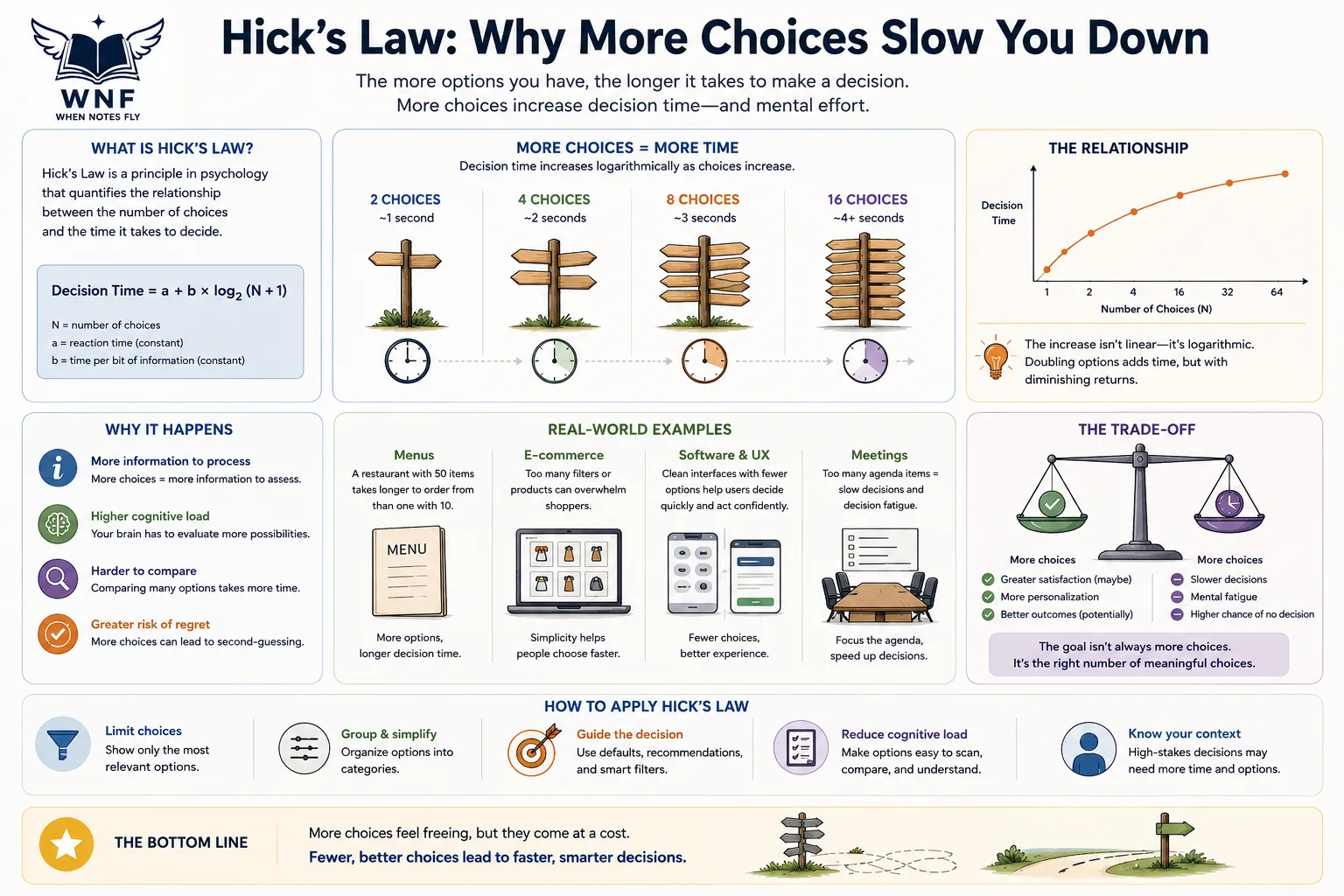
Hick: Stand in front of a vending machine with four options and you choose almost without thinking. Stand in front of one with sixty, and something shifts: your eyes dart, your hand hovers, and a decision that should take a second stretches into an awkward pause. You have just felt one of the oldest and most reliable findings in experimental psychology.
The time it takes to make a choice does not stay flat as options multiply, and it does not simply rise in a straight line either. It grows in a precise, predictable, logarithmic shape, and that shape has a name.
Hick’s Law, sometimes called the Hick-Hyman Law, states that the time required to make a decision increases with the number and complexity of the choices available. It is one of the few pieces of cognitive psychology that comes packaged with a clean mathematical equation, one borrowed directly from the birth of information theory.
More than seventy years after it was first measured, it quietly governs the design of remote controls, restaurant menus, software toolbars, and emergency-room triage protocols. Understanding it changes how you think about every interface and every list of options you will ever build or face.
“The amount of information in a stimulus situation, in the sense in which the term is here used, is a function of the number of equally probable alternatives.” - W. E. Hick, On the rate of gain of information (1952)
What Hick’s Law Actually Says
The plain-language version is simple: more choices mean slower decisions. But the precision is what made the finding famous. The relationship between the number of options and the time to choose is not linear. Doubling the options does not double the decision time. Instead, decision time rises with the logarithm of the number of choices.
The classic formulation is written as:
RT = a + b * log2(n + 1)
Here RT is the reaction time, n is the number of equally probable alternatives, and a and b are constants. The constant a captures the irreducible overhead of perceiving and responding even when there is no real choice to make, while b reflects how steeply decision time grows with each added unit of information. The “+1” inside the logarithm accounts for the option of making no response at all, and for the uncertainty about whether a stimulus will appear.
The logarithmic shape is the heart of it. Going from two choices to four feels like a big jump, but going from thirty-two to sixty-four costs the decider exactly the same additional time as going from two to four. Each doubling of options adds a fixed increment, not a proportional one. This is why a long but well-organized menu can still be navigable, and why the punishing cost of complexity is felt most sharply at the low end, when you first start adding choices.
It helps to see why this matters in everyday numbers. The jump from one option to two introduces an entire bit of new uncertainty, and the decider feels it. But by the time a list has grown to thirty-two items, adding a thirty-third barely registers, because it raises the information content by only a sliver of a bit. The curve is steep at first and then flattens toward a long, gentle tail.
Anyone who has ever felt that a menu of six dishes was somehow harder to settle than a menu of forty has met the counterintuitive geometry of the logarithm in person.
The Two Names Behind the Law
The law carries two surnames for a reason. In 1952, the British psychologist William Edmund Hick published a study at the Applied Psychology Unit in Cambridge in which he varied the number of stimulus-response alternatives and measured how reaction time changed.[1] He found the logarithmic relationship and, crucially, connected it to the freshly minted mathematics of information theory.
One year later, the American psychologist Ray Hyman published an independent and more systematic series of experiments that confirmed and extended the result.[2]
Hyman manipulated the amount of information not only by changing the number of alternatives but also by varying their probabilities and the sequential dependencies between them, showing that what mattered was the information content of the situation, measured in bits, rather than the raw count of buttons.
“The linear relation between reaction time and information could be obtained in three different ways: by varying the number of alternatives, by varying the probabilities of occurrence, and by varying the sequential dependencies.” - Ray Hyman, Stimulus information as a determinant of reaction time (1953)
Because the two arrived at the same principle from different directions, the relationship is properly called the Hick-Hyman Law. It is worth noting that the German physiologist Julius Merkel had documented as early as 1885 that reaction time grew with the number of possible stimuli. Hick and Hyman’s contribution was to give that observation its mathematical form and to tie it to Claude Shannon’s information theory.
The Information-Theory Connection
What makes Hick’s Law more than a tidy curve is its theoretical grounding. In 1948, Claude Shannon had formalized the idea that information could be measured in bits, where one bit is the amount of information needed to resolve a choice between two equally likely options.[3] The logarithm base 2 in Hick’s equation is no accident; it is the same logarithm Shannon used to quantify uncertainty.
Under this view, the human decision-maker behaves like a communication channel with a roughly fixed capacity. Each decision transmits a certain number of bits, and the time required is proportional to the bits that must be processed. Two choices require one bit; four choices require two bits; eight choices require three bits. The decision time tracks the bit count, not the option count, which is exactly why the relationship is logarithmic rather than linear.
| Number of Choices (n) | Information (bits, log2 of n) | Relative Decision Time |
|---|---|---|
| 2 | 1.0 | baseline |
| 4 | 2.0 | 2x the choice component |
| 8 | 3.0 | 3x the choice component |
| 16 | 4.0 | 4x the choice component |
| 32 | 5.0 | 5x the choice component |
The table makes the logarithm visible. Each time the number of choices doubles, the information content rises by exactly one bit, and the decision component of reaction time rises by one fixed step. This is the single most useful intuition the law provides: the cost of choices compounds slowly, but it compounds.
Hick himself estimated that the human channel processes information at a rate on the order of a few bits per second, which gives the abstract equation a concrete, almost biological feel. The brain is not infinitely fast at resolving uncertainty, and Hick’s Law puts a number on the limit.
When the Law Holds and When It Breaks
Hick’s Law was established under tightly controlled conditions, and those conditions matter. The original experiments used simple, equally probable, well-learned stimulus-response mappings, where the decider knew all the options in advance and each was reachable with equal ease. The cleaner the situation matches those assumptions, the better the law predicts.
Several factors bend or break the relationship. When options are not equally probable, the effective information drops, because likely choices carry fewer bits, and decision time falls accordingly. When the decider is highly practiced, the slope flattens, because overlearned responses become nearly automatic. And critically, the law assumes the person scans or considers the alternatives as a set.
When options are visually searched one by one rather than known in advance, the bottleneck shifts from decision to visual search, and the timing follows a different, more linear pattern.
| Condition | Effect on Decision Time | Why |
|---|---|---|
| Equally probable options | Standard logarithmic growth | Maximum information per choice |
| Unequal probabilities | Slower growth | Likely options carry fewer bits |
| High practice or expertise | Flatter slope | Responses become automatic |
| Visual search required | Closer to linear | Search, not choice, dominates |
| Familiar grouping or hierarchy | Reduced effective n | Subdividing cuts bits per step |
That last row is the designer’s escape hatch. If sixty options sit in one flat list, the decider faces the full information load at once. If those sixty are grouped into six categories of ten, the decision becomes a sequence of smaller choices, and the logarithm works in your favor. This is why hierarchical menus, well-labeled categories, and progressive disclosure are not just tidy; they are mathematically efficient.
The 2018 review by Robert Proctor and Darryl Schneider catalogs many of these boundary conditions, noting how stimulus-response compatibility, practice, and very large set sizes can all push real behavior away from the clean textbook line.[7]
Hick’s Law in Interface Design
Nowhere has Hick’s Law been more enthusiastically adopted than in user-experience design. The principle gives a respectable scientific name to a piece of common sense: do not bury the user under options. A cluttered toolbar, a navigation bar with twenty top-level items, or a settings page with no structure all impose an information tax on every interaction.
The practical advice that flows from the law is consistent. Reduce the number of options where you can. Where you cannot reduce them, organize them, because grouping turns one large decision into a chain of small ones. Highlight the most common or recommended choice, because making one option salient effectively lowers the entropy of the set. And defer rarely used options behind menus or advanced panels so they do not slow the common path.
A familiar example is the remote control. Older designs presented dozens of identical buttons, forcing a slow visual scan and a high-information decision every time. Modern streaming remotes strip the interface down to a handful of buttons and push the complexity into on-screen menus that can be organized and searched. The total functionality may be greater, but the moment-to-moment decision load is smaller.
The same logic explains the popularity of the single, prominent call-to-action button on a landing page, the curated “recommended for you” row on a streaming service, and the wizard that walks a user through setup one screen at a time instead of presenting every option on a single overwhelming page.
It is worth a note of caution often raised by careful practitioners: Hick’s Law is sometimes applied too literally in design. The law describes choices among known, equally weighted alternatives processed as a decision, not the experience of reading a webpage or hunting for a link, which is dominated by visual search and comprehension. Treating “fewer options is always better” as an unbreakable rule can lead to over-simplified, frustrating products.
The law is a lens, not a commandment.
The Cost of Too Much Choice
Hick’s Law is about the speed of a single decision, but it sits inside a broader and more troubling story about choice itself. Slower decisions are only the most measurable symptom. As options multiply, people also report lower satisfaction, more regret, and a greater tendency to avoid deciding altogether.[5]
“As the number of choices grows further, the negatives escalate until we become overloaded. At this point, choice no longer liberates, but debilitates.” - Barry Schwartz, The Paradox of Choice (2004)
The most cited demonstration of this comes from a field study by Sheena Iyengar and Mark Lepper, published in 2000.[4] In an upscale grocery store, they set up a tasting booth offering either a limited assortment of six jams or an extensive assortment of twenty-four.
The larger display attracted more passers-by, but the smaller one converted far better: about 30 percent of those who stopped at the six-jam table bought a jar, compared with roughly 3 percent at the twenty-four-jam table. More choice drew attention but suppressed action.
The jam study has not always replicated cleanly, and researchers continue to debate when choice overload appears and when it does not. But the core insight survives the scrutiny: beyond a certain point, additional options stop helping and start hurting, by raising the cognitive cost of choosing past the value of the extra variety. Hick’s Law describes the timing cost; choice overload describes the emotional and behavioral one. They are two faces of the same fundamental limit.
Speed, Accuracy, and the Trade-off
One subtlety that casual summaries of Hick’s Law miss is its entanglement with accuracy. Reaction time and error rate are not independent; deciders can trade one for the other. Rush a decision and you make more mistakes; slow down and you make fewer. This speed-accuracy trade-off means that any measurement of decision time has to hold accuracy constant to be meaningful, and it complicates simple claims about how fast people choose.
In real settings this trade-off is everywhere. An emergency-room physician faced with many possible diagnoses can decide quickly and risk error, or deliberate and risk delay. A well-designed triage protocol does not just reduce the number of options; it structures them so that the fast path and the accurate path coincide.
The deepest design wisdom drawn from Hick’s Law is therefore not merely “fewer choices” but “structure the choices so that speed and accuracy stop fighting each other.”
The Animal Dimension
The pull of Hick’s Law reaches well beyond the human user staring at a screen, because the relationship between choice and decision time appears to be a general property of nervous systems, not a quirk of human psychology. Comparative studies of decision-making in animals reveal the same fundamental pressure: as the number of alternatives grows, the time and cost of choosing rises, and evolution has built shortcuts to manage it.
Foraging animals face a continuous version of this problem. A bee in a flower patch, a bird selecting among feeding sites, or a fish choosing among shoals must weigh options under time pressure, and behavioral ecologists have documented that increasing the number of available options can slow choice and degrade decision quality.
To cope, many species rely on rules of thumb rather than exhaustive comparison, sampling a subset and committing once an option clears a threshold, a strategy that trades optimality for speed in exactly the way Hick’s Law would predict is necessary.
Social insects offer a striking collective parallel. When a honeybee swarm chooses a new nest site, scouts advertise candidate locations through the waggle dance, and the colony converges on a decision through a competition of evidence rather than a single brain weighing every option at once.
Research by Thomas Seeley and colleagues on swarm decision-making shows that scouts use inhibitory “stop signals” against rivals promoting other sites, a form of cross-inhibition that lets the swarm break a deadlock and settle even when two candidate sites are nearly equal in quality.[6]
Distributing the choice across many individuals lets the group handle more alternatives than any single bee could, effectively flattening the cost curve through parallelism.
The lesson echoes the designer’s: the way to beat the rising cost of choice is rarely to think harder about all options at once, but to restructure how the options are processed.
The animal evidence carries a quiet warning, too. The shortcuts that nervous systems evolved to cope with choice are exactly the heuristics that, in humans, produce predictable biases. The threshold rule that lets a bee commit quickly is the same kind of mechanism that makes a shopper grab the first acceptable product rather than survey the shelf. Speed has a price, and across species the price is paid in optimality.
Hick’s Law is, in this light, less a curiosity of laboratory psychology than a signature of how any finite mind copes with a world of options.
Practical Takeaways
The enduring value of Hick’s Law is that it converts a vague intuition into something you can reason about and design around. The intuition that “too many choices is bad” is correct but useless on its own. The law tells you the shape of the cost, where it bites hardest, and what levers actually move it.
The first takeaway is that the cost of choices is logarithmic, so the first few options you add are the most expensive in relative terms, and very large menus are not as catastrophic as raw counts suggest if they are well structured. The second is that structure beats reduction: grouping, hierarchy, and good labels lower the effective information of a decision without sacrificing functionality.
The third is that salience is free entropy reduction, because highlighting a default or recommended choice does much of the deciding for the user. And the fourth is humility about the law’s scope, since it governs known, weighted choices and not the messier processes of search and reading.
What unites every application, from the vending machine to the bee swarm to the triage room, is a single principle: minds have finite capacity for resolving uncertainty, and the time they spend doing it can be measured, predicted, and, with care, designed for. The next time a decision stalls in front of too many options, you will know it is not indecision or weakness. It is information theory, written in seconds.
Related Resources
- What Is Cognitive Load Theory
- The Paradox of Choice: When More Options Make Us Miserable
- Fitts’s Law: The Math Behind Fast and Accurate Movement
- Decision Fatigue: Why Willpower Runs Out
References
- Hick, W. E. (1952). On the rate of gain of information. Quarterly Journal of Experimental Psychology, 4(1), 11-26. https://doi.org/10.1080/17470215208416600
- Hyman, R. (1953). Stimulus information as a determinant of reaction time. Journal of Experimental Psychology, 45(3), 188-196. https://doi.org/10.1037/h0056940
- Shannon, C. E. (1948). A mathematical theory of communication. Bell System Technical Journal, 27(3), 379-423. https://doi.org/10.1002/j.1538-7305.1948.tb01338.x
- Iyengar, S. S., & Lepper, M. R. (2000). When choice is demotivating: Can one desire too much of a good thing? Journal of Personality and Social Psychology, 79(6), 995-1006. https://doi.org/10.1037/0022-3514.79.6.995
- Schwartz, B. (2004). The Paradox of Choice: Why More Is Less. Ecco/HarperCollins.
- Seeley, T. D., Visscher, P. K., Schlegel, T., Hogan, P. M., Franks, N. R., & Marshall, J. A. R. (2012). Stop signals provide cross inhibition in collective decision-making by honeybee swarms. Science, 335(6064), 108-111. https://doi.org/10.1126/science.1210361
- Proctor, R. W., & Schneider, D. W. (2018). Hick’s law for choice reaction time: A review. Quarterly Journal of Experimental Psychology, 71(6), 1281-1299. https://doi.org/10.1080/17470218.2017.1322622