
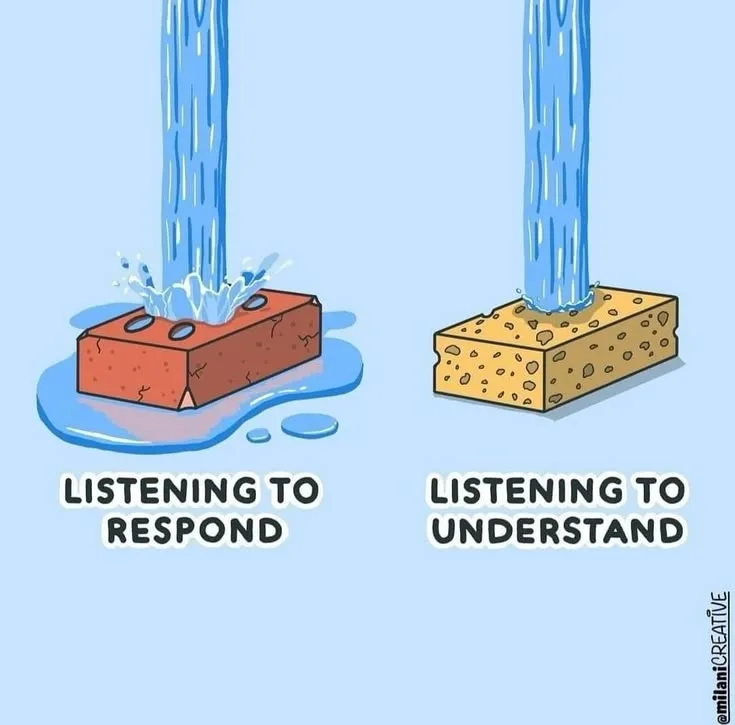
Listening well is more than hearing words or copying a speaker's phrasing. Active listening combines genuine attention, suspended judgment, and reflection that lets the other person confirm or correct what was understood. Its value rests on perceived responsiveness, warmth, and regard; techniques performed mechanically can make people feel patronized rather than heard.
Most people rate their own listening higher than the people they talk to would. That gap is the practical problem: self-perception is not a reliable measure of listening quality, and feedback from the other person usually is.
Active listening is a deliberate attentional posture in which you attend fully to the speaker, hold your own agenda in suspension, and reflect your understanding back in a form the speaker can confirm or correct. It is a learnable skill rather than a passive default.
It is also frequently taught badly. Workshops reduce it to nodding, sustained eye contact, and repeating back the speaker's last phrase. Performed without the underlying posture, those behaviors can land worse than not listening at all: someone whose colleague is mechanically paraphrasing while plainly not attending feels patronised rather than heard.
What Active Listening Means
Active listening grew out of Carl Rogers's person-centred approach and was articulated more explicitly in a 1957 piece by Rogers and Richard Farson.[2] Rogers proposed six necessary and sufficient conditions for therapeutic change, three of which describe the therapist's central relational qualities: unconditional positive regard, congruence, and accurate empathic understanding.[1]
Reflective listening was one way practitioners tried to communicate that third condition, not its definitive implementation.
Rogers proposed that empathic, non-judgmental understanding creates conditions in which a person can explore their own experience more openly and develop their own insight. That is the theory behind person-centred practice rather than a simple demonstrated causal sequence, and it is worth stating as the proposal it is.
What matters practically is that the posture came first and the behaviors second. A practitioner who performs the technique without genuine regard produces an uncanny effect, where the other person senses something is off without being able to name it. The procedure without the posture is theater; the posture with imperfect procedure usually works.
It is useful to distinguish four things often lumped together:
| Mode | What the listener is doing |
|---|---|
| Hearing | Registering words without processing meaning |
| Attentive listening | Following content and updating on new information |
| Reflective listening | Restating meaning in your own words and checking accuracy |
| Empathic listening | Attending to the speaker's experience and frame, not only their information |
Otto Scharmer's Theory U offers a related practitioner framework describing four modes of listening, from filtering everything through existing assumptions up to attending to what is not yet fully articulated. It is a conceptual model from organizational change work rather than an empirically validated hierarchy of listening depth, and it is worth reading as vocabulary rather than measurement.
What the Research Supports
Harry Reis and colleagues developed the construct of perceived partner responsiveness: the degree to which a person feels understood, validated, and cared for by the person they are talking to.[3] Across close relationships, stranger interactions, and workplace conversations, perceived responsiveness is a substantial predictor of relationship satisfaction, trust, and conversational benefit.
The finding that matters for practice is what happens when the surface behaviors appear without it. When a listener performs attention without genuine responsiveness, speakers often do not feel heard and can additionally feel condescended to. Exact-word paraphrasing is a common culprit. John Gottman's couples research found a parallel pattern with different methodology: technique without warmth and regard did little for outcomes.[7]
Itzchakov, Kluger, and Castro (2017) found that high-quality listening affected speakers' attitude ambivalence, letting people acknowledge inconsistencies in their own views more comfortably.[4]
Weger and colleagues (2014) examined the relative effectiveness of active-listening responses in initial interactions and found paraphrasing performed comparably to other supportive responses on feeling understood, which is a useful check on the assumption that reflection is always the strongest move.[5]
Research across several contexts associates high-quality listening with perceived understanding, trust, and disclosure, plus some workplace and healthcare benefits. The strength and design of that evidence differ considerably by context, and these are distinct literatures with different definitions and measures rather than one settled evidence base.
The healthcare case
In a study published online in 2018 and in print in 2019 in the Journal of General Internal Medicine, clinicians elicited patients' agendas in only a minority of encounters.[8] Among encounters where concerns were elicited, clinicians interrupted after a median of 11 seconds.
That is not a claim that every physician interrupts every patient at 11 seconds, and an older study reporting a different figure used different settings, samples, and coding, so the two should not be read as a direct before-and-after comparison.
The practical implication runs the other way from how it is usually stated: when clinicians do not adequately elicit and explore concerns, important information may remain undisclosed or unrecognised. That is a feature of how the consultation was structured, not a failing of patients.
Why Mechanical Listening Fails
In ordinary conversation, listeners cycle through several postures, most of which are not active listening even when they look like it.
Preparing to respond. Using the speaker's turn to compose a reply or locate a point to interject. The external behavior can look attentive, but attention is committed elsewhere and speakers can usually tell.
Waiting for a topic hook. Scanning for a chance to redirect to something the listener finds more interesting, then pivoting with "that reminds me of." Charles Derber named this pattern conversational narcissism.
Advising. Treating a statement as a problem requiring a solution. Valuable when solutions are wanted, and a misfire when they are not.
Interpreting and correcting. Reframing what was said into the listener's preferred categories, or correcting errors in framing or fact. Correction genuinely matters in safety, clinical, and compliance contexts. Uninvited, it derails conversations where accuracy was not the speaker's immediate concern.
What active listening actually is sits apart from these: reflecting in order to understand, then checking whether the reflection landed. A related move is validating, acknowledging that someone's experience makes sense in context without necessarily agreeing with their conclusions. Validation and agreement are separable, and active listening does not require you to agree.
What Gets in the Way
Many listening failures happen automatically rather than deliberately, though motivation, time pressure, capacity, fatigue, and power dynamics also matter, and not every failure is innocent.
Response preparation. Composing your reply while the other person is still talking, most pronounced when you expect to disagree.
Emotional reactivity. Certain topics or phrasings pull attention from the speaker to your own reaction.
Premature interpretation. Deciding where a statement is going and stopping listening before it arrives. This is worst with people you know well, where familiarity substitutes for attention.
Divided attention. Dividing attention between a conversation and another demanding task usually reduces comprehension or responsiveness. Some low-demand activities coexist with listening; a second cognitively demanding communication task does not.
Spare capacity. People can often process speech faster than it arrives, and attention drifts into the gap. How much spare capacity exists depends on complexity, accent, familiarity, memory demands, and noise, so the widely quoted fixed word-per-minute figures are best avoided.
The useful response is to spend available attention tracking meaning and noting uncertainty, then formulate questions once the speaker reaches a natural pause, since composing questions mid-stream competes with hearing what is being said.
Core Techniques
Paraphrasing. Restate the meaning in your own words and check it. Accurate, well-timed reflection helps speakers feel understood and surfaces misunderstandings before decisions get made.
Excessive or formulaic paraphrasing feels unnatural and can read as patronising, so this is a tool for moments that carry weight: when the topic is complex, the stakes are high, misunderstanding is plausible, the speaker seems uncertain, or you are about to disagree or act. Paraphrasing is translation, not repetition.
Reflecting emotion. Naming what you think you are picking up communicates attention to the person rather than only the information. Wrong inferences frustrate people, particularly across cultural and neurodivergent communication styles, so keep it tentative: "it sounds as though that may have been frustrating, is that close?" This is one way to communicate empathic understanding, not the whole of the person-centred relationship.
Clarifying questions. In supportive conversations, questions should generally follow the speaker's meaning rather than the listener's curiosity. In diagnostic, investigative, or decision-focused settings, redirecting toward important but unmentioned issues is not a failure of listening but part of the job.
Silence. Brief, attentive pauses give speakers room to reach for something more precise than their first pass. Koudenburg and colleagues found that brief conversational silences can support reflection, while unexpectedly prolonged ones may disrupt flow and connection.[6] Silence can also read as disapproval, withdrawal, or incomprehension, so its effect depends on timing, relationship, culture, and what your face is doing.
Non-verbal engagement. Orientation, expression, and gaze all signal attention, but the norms vary considerably across cultures and individuals. Lack of eye contact does not reliably indicate disengagement, and some people listen better while moving, doodling, or using a sensory aid.
On video calls, camera placement makes natural mutual gaze impossible: occasional camera-directed gaze while continuing to watch the speaker's expression works better than attempting constant artificial eye contact.
Workplace Applications
One-on-ones. An important context where listening quality affects what you actually learn. As a practice exercise, begin some one-on-ones by giving the other person uninterrupted space to set the agenda, then paraphrase before adding your own view. Managers perceived as poor listeners tend not to hear about problems early, which is the strategic cost.
Feedback. Receiving feedback is listening at its most demanding, because the content is about you. Committing to full comprehension before responding, and separating the receiving phase from the responding phase, both help.
When giving feedback, asking for the recipient's perspective first can improve shared understanding before you present an assessment, though what works depends on urgency, evidence, and whether the conversation is developmental or disciplinary. Feedback delivered without that phase may increase defensiveness, and defensiveness can also arise despite excellent listening.
Conflict and negotiation. High-quality listening can help identify underlying interests and possible tradeoffs that stated positions conceal, which is the basis of the interest-based approach in Getting to Yes.[9] Outcomes also depend on incentives, bargaining power, issue structure, and reservation values.
Some positional conflicts do contain interests that permit tradeoffs; others are genuinely distributive, and treating every standoff as a hidden win-win is its own failure mode.
Several conflict-resolution traditions, including William Ury's work, Marshall Rosenberg's nonviolent communication, and Chris Voss's negotiation approach, put accurate understanding of the other party first, since moving to problem-solving before someone feels understood tends to backfire.[10]
Remote and written communication. Written channels strip non-verbal cues and delay feedback rather than removing it: acknowledgements, threaded replies, and questions all still exist. Explicit acknowledgment and paraphrasing before responding help. Researchers have proposed several contributors to video-call fatigue, including sustained close-up gaze, self-view, reduced mobility, and the added effort of interpreting nonverbal cues through a constrained channel.
Customer-facing work. People who feel heard tend to give more honest information about what they actually need and are often more open to advice that diverges from their initial request. Feeling heard can improve satisfaction with an interaction, but it does not compensate for an unresolved problem or an unfair outcome.
How to Practise
Listening improves through deliberate practice with feedback, and the difficulty is that feedback in real conversations is indirect and delayed. Structured practice helps.
- Summarise before you disagree. Commit to paraphrasing accurately enough that the other person accepts your summary before you state your own view.
- Ask what you missed. "Was there a point where you felt I misunderstood you?" and "what would have made this conversation more useful?" produce more than "did you feel heard?" People may be reluctant to tell a manager or anyone more senior that they were not listened to, so specificity and privacy matter.
- Compare interpretations. State what you understood and ask the speaker to correct it.
- Review recordings only with informed permission. Consent requirements vary by jurisdiction, and workplace policy, sensitive content, secure storage, deletion, and the ability to withdraw all need handling before you record anything.
- Practise in a harder context. A conversation where you disagree tests whether the posture survives disagreement.
Perspective-taking exercises may help, though improvement is better assessed through actual conversation feedback than assumed from the exercise.
Two Standards, Not One
Listening quality has at least two dimensions, and collapsing them causes trouble.
The first is whether the speaker feels understood. The second is whether you accurately comprehended what they said. These come apart: a warm, agreeable listener can leave someone feeling thoroughly heard while misunderstanding the facts, missing a risk, or failing to retain what mattered. A precise listener can grasp every detail and leave the speaker feeling processed rather than heard.
Both matter, and which one dominates depends on the conversation. A clinical intake, an incident review, and a friend describing a hard week have different requirements.
Limits and Context
Active listening does not require agreement, and validating that an experience makes sense in context is separate from endorsing the conclusions drawn from it.
It is also not an endless performance. Full-intensity listening in every conversation is demanding and usually unnecessary, so it is applied deliberately where it matters. There are situations where reflective listening becomes intrusive, where urgent decisions leave no room for exploration, and where boundaries against unlimited emotional labour are appropriate.
The specific behaviors are not universal. Norms around eye contact, silence, turn-taking, and directness vary across cultures and among neurodivergent people. The underlying posture, which is genuine attention plus willingness to be corrected, transfers across contexts far better than any behavioral checklist.
Nor is the skill inherently benign. Voss's negotiation adaptation shows listening can serve persuasive goals; the underlying capacity to understand someone accurately is neutral about how it gets used. Deployed as a tactical veneer, it produces the same hollow feeling as the corporate checklist version.
Sources & Further Reading
- Rogers, C. R. (1957). "The Necessary and Sufficient Conditions of Therapeutic Personality Change." Journal of Consulting Psychology, 21(2), 95-103. DOI: 10.1037/h0045357(The six conditions.)
- Rogers, C. R., & Farson, R. E. (1957). "Active Listening." Industrial Relations Center, University of Chicago. (Where the term is articulated explicitly.)
- Reis, H. T., Clark, M. S., & Holmes, J. G. (2004). "Perceived Partner Responsiveness as an Organizing Construct in the Study of Intimacy and Closeness." In Handbook of Closeness and Intimacy (pp. 201-225). Erlbaum. DOI: 10.4324/9781410610010(Perceived responsiveness.)
- Itzchakov, G., Kluger, A. N., & Castro, D. R. (2017). "I Am Aware of My Inconsistencies but Can Tolerate Them: The Effect of High Quality Listening on Speakers' Attitude Ambivalence." Personality and Social Psychology Bulletin, 43(1), 105-120. DOI: 10.1177/0146167216675339(Listening and attitude ambivalence.)
- Weger, H., Castle Bell, G., Minei, E. M., & Robinson, M. C. (2014). "The Relative Effectiveness of Active Listening in Initial Interactions." International Journal of Listening, 28(1), 13-31. DOI: 10.1080/10904018.2013.813234(How paraphrasing compares with other responses.)
- Koudenburg, N., Postmes, T., & Gordijn, E. H. (2011). "Disrupting the Flow: How Brief Silences in Group Conversations Affect Social Needs." Journal of Experimental Social Psychology, 47(2), 512-515. DOI: 10.1016/j.jesp.2010.12.006(Conversational silence.)
- Gottman, J. M., & Levenson, R. W. (2000). "The Timing of Divorce: Predicting When a Couple Will Divorce Over a 14-Year Period." Journal of Marriage and Family, 62(3), 737-745. DOI: 10.1111/j.1741-3737.2000.00737.x(Warmth and regard versus technique.)
- Singh Ospina, N., et al. (2019). "Eliciting the Patient's Agenda: Secondary Analysis of Recorded Clinical Encounters." Journal of General Internal Medicine, 34(1), 36-40. DOI: 10.1007/s11606-018-4540-5(Agenda elicitation and the 11-second median.)
- Fisher, R., & Ury, W. Getting to Yes: Negotiating Agreement Without Giving In. Houghton Mifflin, 1981. (Interest-based negotiation.)
- Voss, C. (2016). Never Split the Difference. Harper Business. (Practitioner adaptation; experience-based rather than experimental.)