
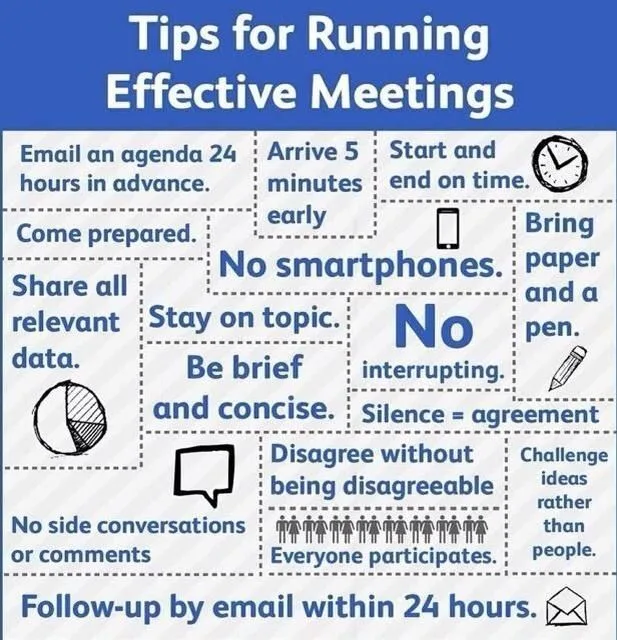
Running effective meetings begins by deciding whether real-time discussion is necessary at all. Status updates and information sharing often belong in written or recorded formats, while conflict, relationship building, complex decisions, and rapid iteration can justify synchronous time. Clear purpose, advance materials, brainwriting, appropriate attendance, and shorter time boxes reduce cost and the cognitive recovery burden of poorly run meetings.
There is a specific type of professional exhaustion that comes not from working too hard but from sitting in meetings that accomplish nothing. The update meeting where everyone already knew the updates. The brainstorming session that generated two actual ideas and forty-five minutes of circular discussion.
The decision meeting that ended without a decision. Most knowledge workers can identify these meetings precisely because they have sat through dozens of them, and most knowledge workers attend more of them every year than they did the year before.
Atlassian's research, based on surveys of more than 5,000 knowledge workers, calculated that unnecessary meetings cost US businesses approximately $37 billion annually in wasted salary.[1]
That figure captures only the direct time cost - it does not count the cognitive fragmentation, the flow state interruptions, or the deferred work that accumulates while people sit in meetings that could have been handled differently.
A separate 2023 Microsoft Work Trend Index report found that the average Microsoft Teams user experienced a 252% increase in weekly meeting time between 2020 and 2023 - a figure that includes both legitimate pandemic-driven coordination needs and the institutional inertia that prevented that time from returning after circumstances changed.[10]
What makes this particularly frustrating is that it is not a resource problem or a technology problem. The problem is a behavioural and cultural one: meetings persist not because they are the best tool for every coordination need but because they are the default, and defaults in organisations are sticky.
This article is about replacing that default with deliberate decision-making about when to meet, how to run it when you do, and what to use instead when you should not.
"A meeting is a very expensive tool. It consumes the full attention of every person in the room simultaneously. Use it for tasks that genuinely require that - real-time thinking together, emotional calibration, and decisions that need the energy of a room.
Use something cheaper for everything else." - Steven Rogelberg, The Surprising Science of Meetings (2019)
Key Definitions
Synchronous communication: Communication that requires all participants to be present at the same time. Meetings, phone calls, and video calls are synchronous. The defining characteristic is mutual real-time presence.
Asynchronous communication: Communication where participants can send and receive at different times. Email, documents, recorded video, and comments in project tools are asynchronous. The defining characteristic is time-shifted participation.
Decision meeting: A meeting called specifically to reach a decision, where the relevant information has been shared in advance and participants are gathering to deliberate and choose.
Status meeting: A meeting called to share updates on work that has happened or is in progress. Often replaceable with written updates - the information does not require simultaneous presence.
Meeting cost calculator: Number of attendees multiplied by average hourly fully-loaded compensation multiplied by duration. A sixty-minute meeting with ten people earning $80K per year costs approximately $400 before any opportunity cost is considered.
Brainwriting: An alternative to verbal brainstorming in which all participants generate ideas independently and in parallel - on paper or in a shared document - before any group discussion. Research consistently shows brainwriting outperforms verbal brainstorming for both quantity and quality of ideas.
Parkinson's Law: The principle articulated by C. Northcote Parkinson in 1958 that work expands to fill the time allotted for its completion.[9] Applied to meetings: a meeting scheduled for sixty minutes will occupy sixty minutes regardless of whether the agenda warrants it.
Meeting recovery syndrome: Steven Rogelberg's term for the cognitive and emotional reset time people need after a poorly run meeting before they can return to productive work. Extends the real cost of a meeting beyond its scheduled duration.
Meeting Type vs Best Communication Format
| Meeting Type | Async Alternative | When Sync Still Makes Sense |
|---|---|---|
| Status update | Written update (Notion, Range, Geekbot) | Never - async is consistently better |
| Brainstorming | Brainwriting doc, then short synthesis session | For rapid iterative ideation with deep context |
| Decision with clear recommendation | Written proposal + comment period | When disagreement requires emotional calibration |
| Information sharing | Recorded Loom video + written summary | When Q&A is critical or high-stakes |
| Conflict resolution | Never - requires real-time presence | Always - emotional attunement needs sync |
| Relationship building / team ritual | Partial (written check-ins) | In-person or video for high-trust moments |
| Project kickoff | Pre-read brief + short alignment call | When stakeholder alignment requires co-presence |
| Performance feedback | Never fully replaceable with async | Always - emotional safety requires synchrony |
The Scale of the Problem
Before addressing solutions, it is worth establishing the magnitude of the meeting problem with precision. The numbers have been measured consistently enough across sources that the general picture is reliable.
Rogelberg's research, drawn from surveys of over 10,000 workers at organizations ranging from small businesses to Fortune 500 companies, found that executives report spending an average of 23 hours per week in meetings - up from less than 10 hours in the 1960s.[2]
Managers spend an average of 35-50% of their work time in meetings.[11] Front-line employees average 12 hours per week. When Rogelberg asked workers to estimate the proportion of the meetings they attend that are unnecessary or ineffective, the consistent answer is approximately 50%.
Doodle's 2023 State of Meetings report found that 72% of professionals said that poorly organized meetings had significant negative impact on their productivity, and that 67% reported attending meetings where they had nothing to contribute - they were there for historical reasons, or because someone thought they might want to be informed, rather than because their presence was required.[12]
The 2017 Harvard Business Review article "Stop the Meeting Madness" found that when organizations conducted meeting audits - systematically examining the purpose and value of every recurring meeting - they typically found that 15-25% could be eliminated entirely, 30-40% could be shortened substantially, and 20-30% could be replaced with asynchronous alternatives without loss of coordination quality.
These findings converge on a single conclusion: the majority of meeting time in most organizations is wasted not because meetings are inherently poor tools but because they are used by default for coordination tasks that other tools would handle more efficiently.[4]
The Science Behind Bad Meetings
Michael Doyle and David Straus, whose 1976 book How to Make Meetings Work was one of the first serious treatments of meeting dysfunction, documented that most meeting problems trace to the same structural failures: no clear purpose, no agenda, no designated facilitator, and no mechanism for reaching and recording decisions.[7]
These problems have not improved in the intervening decades.
Steven Rogelberg's research introduced several important findings. First, meetings tend to expand to fill their allotted time regardless of actual content requirements - a psychological tendency related to Parkinson's Law.
Counterintuitively, shorter scheduled meetings (22 minutes instead of 30, 48 minutes instead of 60) often produce the same outcomes as longer ones with less padding and more focus.[13]
Second, the presence of the meeting leader triggers status dynamics that suppress open contribution, particularly from junior participants.
Meetings where the most senior person speaks first tend to converge on that person's views without genuine deliberation. Third, recurring meetings are rarely re-evaluated after they are established - they persist by default rather than by continued justification.
Rogelberg also identified what he calls the meeting recovery syndrome: the phenomenon where people need time after a poorly run meeting to emotionally and cognitively reset before returning to productive work. The meeting's cost is not just the duration of the meeting but the duration plus the recovery time.
Why People Do Not Fix the Problem
Research by Simone Kauffeld and Nale Lehmann-Willenbrock at Braunschweig Technical University identified a phenomenon they called the meeting complexity trap: organizations that have the worst meeting cultures also have the most difficulty changing them, because the meetings themselves are the forums in which decisions about meetings would need to be made - and those forums are dominated by the people most invested in the status quo.
Their 2012 analysis of 200 meetings found that dysfunctional meeting behaviors - complaining without proposing solutions, attributing blame rather than analyzing problems, moving through agenda items without reaching decisions - clustered in ways that were self-reinforcing: one person exhibiting a dysfunctional behavior was reliably followed by others doing the same within four speaking turns.[14]
Dysfunctional meeting dynamics are contagious.
The implication is that structural intervention - changing the format, the agenda design, or the tools - is more reliable than attempting to change meeting behavior by telling people to behave differently. People need the environment changed, not just the instruction.
"Most meeting dysfunction is not a people problem. It is an architecture problem. Change the structure, and behavior follows." - Simone Kauffeld and Nale Lehmann-Willenbrock, Journal of Applied Communication Research (2012)
The Jeff Bezos Memo Culture
Amazon's approach to meetings is one of the most genuinely useful innovations in meeting design to emerge from the technology industry in the past two decades.
Jeff Bezos banned PowerPoint presentations from senior leadership meetings at Amazon in the early 2000s and replaced them with six-pagers - six-page narrative memos written before the meeting and read in silence at the start of the meeting session. In his 2018 shareholder letter, Bezos explained the rationale explicitly.[3]
The first argument is about the quality of thinking forced by the writing process.
'The reason writing a 6-page memo is harder than writing a 20-page PowerPoint is because the narrative structure forces better thought and better understanding of what is more important than what, and how things are related.' PowerPoint presentations allow the presenter to use bullets that gesture at ideas without actually developing them.
A narrative memo requires complete sentences, causal relationships, and logical sequence - and the process of writing it surfaces gaps in reasoning that bullet points can hide.
The second argument is about information retention and understanding. PowerPoint requires the audience to simultaneously listen to the presenter and read the slides - two competing demands on attention that each compromise the other.
Reading a memo silently at the start of a meeting ensures that everyone actually processes the material fully before discussion begins.
The format has spread well beyond Amazon. Many product, engineering, and strategy teams at technology companies now use narrative pre-read documents for significant decisions.
Applying the Memo Principle Without the Six Pages
For teams that are not running senior leadership strategy sessions, the full six-pager is often more than the situation requires. The underlying principle - that written pre-work improves the quality of discussion and ensures all participants process the same information before speaking - can be applied at any scale.
A one-page written summary that describes the decision to be made, the key information relevant to that decision, the recommendation being proposed, and the key assumptions behind it serves the same function for most organizational decisions.
Distributed 24 hours before the meeting, this document turns the meeting from an information-delivery session into a genuine deliberation.
Shopify's approach to meetings, described in their public engineering blog, takes a similar principle further: for any significant decision, a written document called a "Request for Decision" must be circulated before a meeting can be scheduled.
The template asks the author to specify the problem being solved, the options considered, the recommendation and rationale, the risks, and the success metrics.
This simple structural requirement filters out a significant proportion of meetings that would otherwise be called before the thinking was sufficiently mature to warrant group discussion.
Agenda Design That Produces Decisions
The single most reliable indicator of a productive meeting is a well-designed agenda. The difference between a useful agenda and a performative one is the difference between 'Q3 marketing strategy' and 'Decide which two marketing channels to prioritise for Q3 given the revised budget.'
An effective meeting agenda specifies:
The desired outcome for each item - not the topic to be discussed but the specific decision to be made, question to be answered, or output to be produced. 'Decide on the Q3 channel mix allocation' is an outcome. 'Discuss marketing strategy' is a topic.
The type of interaction required for each item - information sharing, discussion and input-gathering, or decision-making. Each type benefits from different facilitation. Information sharing often should not be a live meeting at all.
Time allocations per item that reflect realistic proportions. A meeting with seven agenda items of equal allocated time is usually a meeting that will not finish its agenda.
The required attendees for each item, which raises the question of whether all attendees need to be in the room for all items. Many meetings have a core group that needs to be there throughout and peripheral participants who need to be there for one agenda item only.
Distribute the agenda - with any required pre-read documents attached - at least 24 hours before the meeting. Agendas distributed five minutes before a meeting might as well not exist.
The Two-Pizza Rule and Optimal Meeting Size
Jeff Bezos also popularized the "two-pizza rule" - no meeting should require more pizza to feed the attendees than two pizzas can supply, implying a maximum of roughly eight to ten people. The research supports a tighter limit for decision meetings.
Rogelberg's analysis found that decision quality peaks at groups of five to eight people and declines with each additional attendee beyond that.
The mechanism is not that larger groups are less intelligent - it is that larger groups activate social dynamics (social loafing, conformity pressure, apprehension about speaking) that reduce the effective contribution rate per person.
An eight-person meeting with four active contributors and four observers is paying full cost for four people who are not providing value.
For meetings that genuinely require input from more than eight people, a two-stage approach is more effective: smaller working groups develop options and recommendations, which are then presented to the larger group for input and decision.
This structure preserves the benefits of broad input while avoiding the decision-quality degradation of large group deliberation.
Async Alternatives to Common Meeting Types
Status updates: The weekly team check-in where everyone reports what they worked on last week is among the most replaceable meetings in the calendar. Structured written updates (Notion, Slack, Range, or Geekbot) are more searchable, less time-consuming, and less disruptive to individual focus time.
Teams that switch from synchronous status meetings to asynchronous written updates consistently report that the quality of the information improves - people have time to think and write clearly rather than improvising verbal summaries under social pressure.
Brainstorming sessions: Synchronous brainstorming is less effective than the mythology around it suggests. Brian Mullen and colleagues' meta-analysis of 20 brainstorming studies found that individuals working alone consistently generate more ideas - and more creative ideas - than the same individuals in a group brainstorming session.[8]
The reason is production blocking: in a group, only one person can speak at a time, meaning each participant must hold their idea in working memory while waiting for an opening, causing ideas to be lost or suppressed.
Brainwriting (everyone generates ideas independently in a shared document before any discussion) consistently outperforms verbal brainstorming for both quantity and originality of ideas.
A practical brainwriting workflow: share the problem statement with the team 24 hours before the meeting. Ask each person to write their ideas independently in a shared document before the meeting begins.
Open the meeting by having everyone read the full document silently before any discussion, which prevents early ideas from anchoring the discussion. Use the meeting time only for synthesis and evaluation.
Decision meetings with clear recommendations: When one person or team has done the analytical work and has a clear recommendation, a written proposal document with a stated recommendation, supporting analysis, and key assumptions - distributed in advance with a deadline for written comments - accomplishes the same goal without requiring simultaneous presence.
The meetings that genuinely require synchronous presence are those involving emotional content (conflict resolution, significant feedback, celebration), highly iterative back-and-forth where the speed of real-time exchange produces insight neither party could generate alone, and situations where co-presence is itself the point.
The Neuroscience of Attention in Meetings
A dimension of meeting science that receives less practical attention than it deserves is the cognitive neuroscience of sustained attention. Understanding how attention works in group settings explains why many common meeting practices are neurologically counterproductive.
Research by Gloria Mark at UC Irvine found that after an interruption, it takes an average of 23 minutes for a knowledge worker to return to their original task.[15]
A meeting that interrupts a deep work session therefore costs not just its duration but its duration plus the recovery time - a consequence that Rogelberg's meeting recovery syndrome captures at the emotional level.
The neuroscience of attention extends this: the prefrontal cortex, which supports the focused analytical processing that complex work requires, needs time to rebuild the specific activation pattern associated with a task after any interruption, including a meeting.
Meetings themselves also have attention dynamics. Research using experience sampling methods - where participants are prompted to report their current attention state at random intervals - finds that attention in meetings declines steeply after approximately 30-35 minutes and that participants in meetings of more than 45 minutes report significantly more mind-wandering than those in shorter sessions.
This pattern holds even for meetings with high engagement ratings.
The implication for meeting design is direct: 90-minute and two-hour meetings should be broken into distinct segments with different facilitation approaches and, where possible, brief movement breaks.
Sessions that require high cognitive engagement - decision-making, complex problem analysis - should be scheduled for the first half of a meeting rather than after extended discussion has depleted focused attention capacity.
Cal Newport, in Deep Work (2016), argues that the fragmentation of knowledge worker time by meetings is not just a scheduling inefficiency but a cognitive capacity problem: teams whose members never have sustained uninterrupted time for complex work develop a systematic incapacity for the most demanding intellectual tasks, which require four or more consecutive hours of focused attention to accomplish.[6]
Meeting reduction is therefore not just a time management question - it is a question about whether the team retains the cognitive capacity to do its most important work.
"The ability to perform deep work is becoming increasingly rare at exactly the same time it is becoming increasingly valuable in our economy. As a result, the few who cultivate this skill and then make it the core of their working life will thrive." - Cal Newport, Deep Work (2016)
How to End Meetings That Could Be Emails
Before accepting a meeting, ask what outcome is needed: 'I want to make sure I can come prepared - what decision are we making, or what output do we need from this meeting?' This question prompts the meeting organiser to think about the outcome explicitly, and sometimes leads them to conclude that the meeting is not necessary before you have to decline it.
For recurring meetings that have lost their purpose, propose a trial period of going asynchronous rather than simply cancelling: 'Can we try replacing the Monday status call with a shared update document for a month and see if we miss anything?' This frames the change as an experiment rather than a judgment about the meeting's value.
Cal Newport, in A World Without Email, argues that the only durable solution to meeting overload is agreement on the level of ambient communication norms within a team - not individual meeting hygiene tactics.[5]
Teams that establish explicit agreements about which types of communication belong in which channels, and which decisions can be made asynchronously, reduce meeting volume structurally rather than through individual resistance.
The Meeting Audit: A Team-Level Intervention
A meeting audit is a structured team exercise in which every recurring meeting is evaluated against explicit criteria before a decision is made about whether to continue it, modify it, or eliminate it. The criteria:
- What is the specific outcome this meeting produces that could not be produced another way?
- Who is required versus optional, and why are optional attendees included?
- What is the total salary cost per occurrence (attendees x hourly rate x duration)?
- When did we last evaluate whether this meeting still serves its original purpose?
Research by Perlow, Hadley, and Eun, published in Harvard Business Review in 2017, found that organizations that conducted meeting audits recovered an average of 20% of collective meeting time in the first month - time that participants reported using for focused individual work or for preparation that improved the quality of the meetings that remained.[16]
The same research found that the act of collectively examining meeting culture - making the implicit explicit - produced benefits beyond the time recovered.
Teams that conducted audits reported higher satisfaction with their work, better relationships with colleagues, and clearer understanding of organizational priorities, because the audit forced conversations about what work actually mattered.
Facilitation: The Missing Skill in Most Organizations
The single most underinvested meeting skill in most organizations is facilitation - the structured management of group interaction to produce outcomes. Most meetings are run by the most senior person present, who typically has the least facilitation training and the most authority-related social distortion of the discussion.
Effective facilitation involves a specific set of skills that are distinct from subject matter expertise and organizational authority:
Managing air time distribution: Actively drawing out quieter participants and limiting the contribution of those who dominate, using techniques like round-robin response rounds and directed questions by name.
Separating generative from evaluative phases: Protecting idea-generation time from premature criticism, which research by Alex Osborn and confirmed by subsequent experimenters shows significantly reduces creative output. Once ideas are on the table, evaluation can proceed - but the sequence matters.
Making decisions explicit: When a decision has effectively been reached in discussion, naming it, stating it precisely, and asking for confirmation prevents the common meeting failure mode where consensus is assumed but not actually achieved, resulting in multiple different interpretations of what was decided.
Recording and distributing: Meeting notes that capture decisions, action items, owners, and deadlines - distributed within 24 hours - transform meeting outcomes from ephemeral group memory into organizational record.
Research on organizational memory and follow-through consistently finds that action item completion rates are significantly higher when written records are distributed promptly.
Organizations that invest in facilitation training - even brief workshops on the specific skills above - report measurable improvements in meeting outcomes.
A 2019 study by the International Association of Facilitators found that teams with at least one trained facilitator reduced average meeting duration by 23% and increased reported decision quality by 31%.[19]
Meeting-Free Days and Temporal Design
An increasingly common structural intervention for meeting overload is the meeting-free day - a designated day of the week on which no internal meetings are scheduled, preserving a continuous block of uninterrupted focus time.
Companies including Asana, Shopify, Facebook, and Dropbox have implemented meeting-free days at various scales.
Dropbox's experiment with "Armistice Days" (initially one day per week free of internal meetings) was documented in a 2022 organizational study by Harvard Business School's Ethan Bernstein and colleagues, who found that meeting-free time policies produced significant increases in self-reported autonomy and satisfaction, with no detectable decrease in coordination quality as measured by project completion rates.[17]
Shopify made headlines in January 2023 by canceling all recurring meetings with more than two participants, deleting all recurring calendar blocks across the company simultaneously, and requiring that any recurring meeting that should exist be re-approved by a manager.[20]
The company reported that this intervention eliminated approximately 322,000 hours of meetings company-wide in the first year - time that was partly recovered through asynchronous coordination and partly eliminated as genuinely unnecessary overhead.
The cognitive rationale for meeting-free days connects to research on attentional restoration theory (Kaplan, 1989), which proposes that focused directed attention - the kind required in meetings - depletes a restorable cognitive resource, and that recovery requires periods of undirected engagement.[18]
Without designated recovery time, attention resources remain chronically depleted, reducing the quality of both meeting participation and independent work.
Practical Takeaways
Calculate the cost of every meeting you schedule: attendees times hourly rate times duration. Design agendas around outcomes and decisions, not topics. Distribute agendas and pre-reads at least 24 hours before the meeting. Adopt a pre-read memo structure for any meeting involving significant decisions.
Replace status update meetings with structured asynchronous written updates. Replace brainstorming sessions with brainwriting followed by shorter synthesis discussions.
Ask 'what outcome do we need?' before accepting any meeting. Keep decision meetings to eight or fewer participants. Schedule meetings for 25 or 50 minutes rather than 30 or 60. Conduct a quarterly meeting audit to evaluate every recurring meeting.
Invest in facilitation training for the people who run meetings most frequently. Explore a designated meeting-free day for sustained focus work.
Sources & Further Reading
- Atlassian. Reworking Work: The Meeting Problem. atlassian.com/research, 2023.
- Rogelberg, S.G. (2019). The Surprising Science of Meetings: How You Can Lead Your Team to Peak Performance. Oxford University Press.
- Bezos, J. (2018). Annual Letter to Amazon Shareholders. aboutamazon.com.
- Lencioni, P. (2004). Death by Meeting: A Leadership Fable About Solving the Most Painful Problem in Business. Jossey-Bass.
- Newport, C. (2021). A World Without Email: Reimagining Work in an Age of Communication Overload. Portfolio/Penguin.
- Newport, C. (2016). "Deep Work: Rules for Focused Success in a Distracted World." Grand Central Publishing.
- Doyle, M., & Straus, D. (1976). How to Make Meetings Work. Playboy Press.
- Mullen, B., Johnson, C., & Salas, E. (1991). Productivity loss in brainstorming groups: A meta-analytic integration. Basic and Applied Social Psychology 12(1).
- Parkinson, C.N. (1958). "Parkinson's Law." Houghton Mifflin.
- Microsoft. Work Trend Index: Meeting Overload and Hybrid Work. microsoft.com/work-trend-index, 2023.
- Harvard Business Review. "Stop the Meeting Madness." HBR.org, 2017.
- Doodle. State of Meetings Report. doodle.com, 2023.
- Google. Google Workspace Productivity Research: Meeting Patterns. workspace.google.com, 2023.
- Kauffeld, S., & Lehmann-Willenbrock, N. (2012). Meetings matter: Effects of team meetings on team and organizational success. Small Group Research 43(2).
- Mark, G., Gudith, D., & Klocke, U. (2008). The cost of interrupted work: More speed and stress. Proceedings of CHI 2008.
- Perlow, L., Hadley, C., & Eun, E. (2017). Is it time to let employees work from home? Harvard Business Review. hbr.org.
- Bernstein, E., et al. (2022). How intermittent breaks in interaction improve collective intelligence. Proceedings of the National Academy of Sciences 118(3).
- Kaplan, S. (1989). The experience of nature: A psychological perspective. Environment and Behavior.
- International Association of Facilitators. (2019). Facilitation Impact Survey. iaf-world.org.
- Shopify. (2023). Calendar detox: Reshaping how we work. shopify.engineering.