
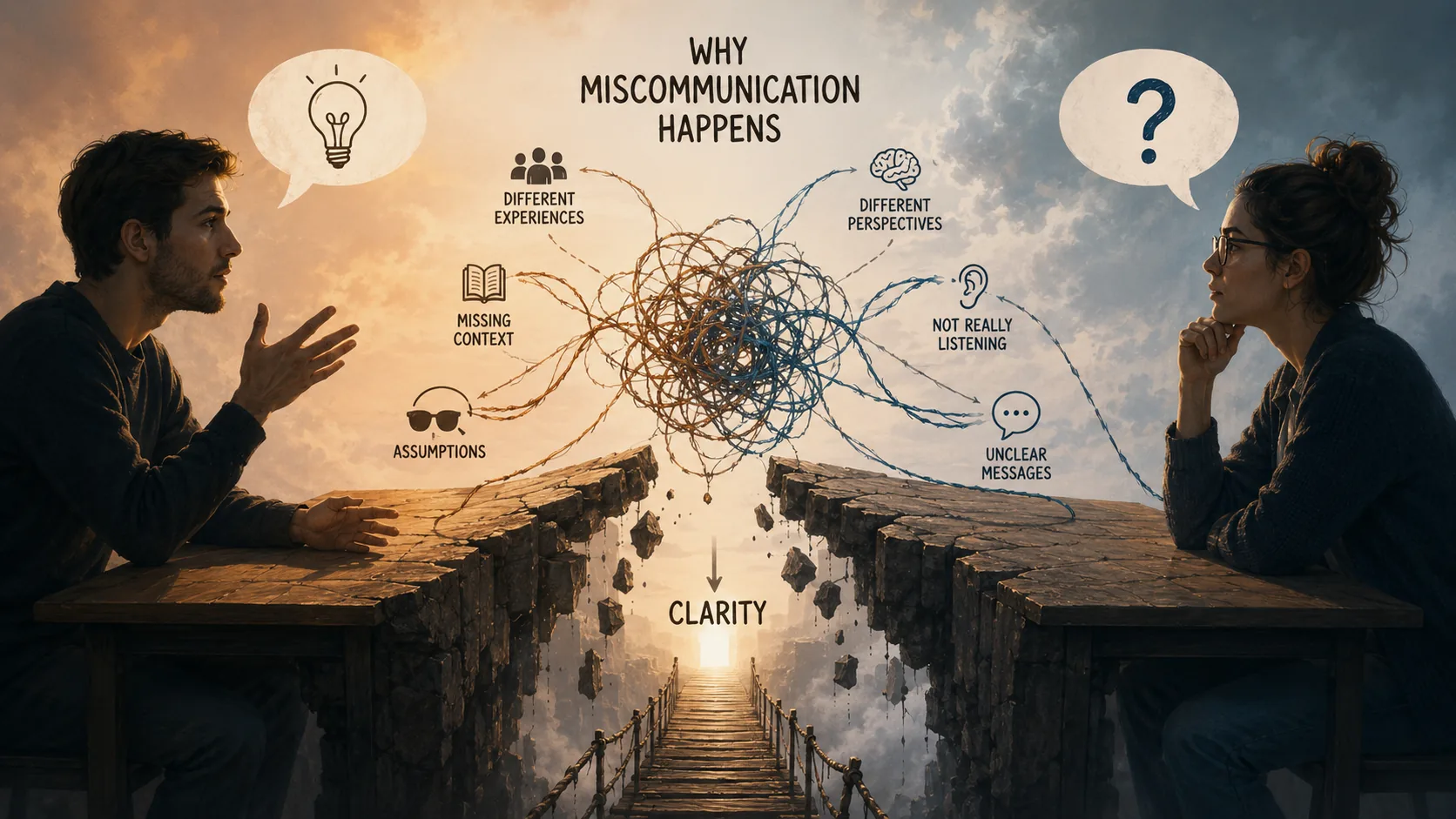
On March 27, 1977, KLM Flight 4805 and Pan American Flight 1736 collided on the runway at Tenerife's Los Rodeos Airport, killing 583 people. Both crews spoke English, radio contact was working, and everyone involved was an experienced professional. The disaster is one of the clearest illustrations of why miscommunication happens even when every individual word is understood perfectly.
The KLM crew began its takeoff roll without explicit takeoff clearance. Ambiguous phraseology, simultaneous radio transmissions that garbled a critical warning, poor visibility, runway congestion, authority gradients, and operational pressure all contributed. It was a chain of failures, not one misheard sentence.[10]
Tenerife is worth starting with, but it is worth being precise about what it shows. The words exchanged were not fully clear: the phrasing was non-standard, one transmission was obscured by interference, and the parties held incompatible models of where the other aircraft was. It is a case of ambiguous encoding and failed confirmation.
This article is about the harder problem that sits underneath: clear wording is necessary but not sufficient. Even when the words themselves are unambiguous, people can apply different contexts, assumptions, implications, and background knowledge to them, and end up with different meanings while both feeling perfectly understood.
Why Clear Words Are Not Enough
A central idea in pragmatics and psycholinguistics is that listeners construct meaning using words together with context, prior knowledge, and assumptions about the speaker.[2] Words are evidence for an interpretation rather than containers holding one.
Much of that construction happens quickly and automatically, so people may not notice the assumptions shaping it unless something prompts reflection or a request for clarification. Understanding tends to feel immediate and transparent, which is exactly why a wrong interpretation can feel as settled as a right one.
The asymmetry that follows is the practical problem. The sender knows what they intended. The receiver knows what they constructed. Neither has direct access to the other's version, and without meaning-level feedback, both assumptions can persist until consequences make the gap visible.
Six Causes of Miscommunication
The following taxonomy is a WhenNotesFly organisation of several distinct literatures rather than an established six-part research model. It groups the causes that recur most often in practice.
| Cause | How it operates | What helps |
|---|---|---|
| 1. Different definitions | The same word carries different meanings in different communities | Define the load-bearing terms explicitly |
| 2. Different situational assumptions | Participants assume different situations, goals, or stakes | State the context you are assuming |
| 3. Different inferred implications | Parties infer different unstated meanings from the same words | Make implications explicit when stakes are high |
| 4. Ambiguous wording | The sentence supports more than one parse or sense | Reread for alternative readings; rewrite |
| 5. Emotional and relational filtering | Emotion, hierarchy, and culture shape interpretation | Separate factual from evaluative content; create room to correct |
| 6. Unequal background knowledge | One party lacks context the other assumes is shared | Check prerequisites; ask for reconstruction |
1. Different definitions
Words are conventions whose meaning is established through use within a community, and different communities use the same words differently. This happens with ordinary vocabulary, not just technical terms.
In one team, "commitment" may mean a firm delivery promise; in a personal conversation it may mean long-term emotional investment. "Review" means editing in some settings and approving in others. "Priority" means different things to different people in the same organization.
The difficulty is not that people do not know the words. It is that they know their own local version confidently enough that it never occurs to them another exists.
2. Different situational assumptions
Every message arrives with a background set of assumptions about who is speaking, what situation is at issue, what the stakes are, and what response is appropriate.
"I'd like to get your thoughts on this proposal" from a manager means something different where managerial requests are understood as directives than where they are genuine invitations. The words are identical; the reading is not.
Harold Garfinkel's breaching demonstrations illustrate how heavily ordinary interaction depends on shared background expectations: when students repeatedly asked what a friend meant by a routine remark, the exchange broke down into confusion and irritation, because the shared assumptions doing the work had never been stated and could not easily be articulated. When those expectations differ, misunderstanding becomes more likely.[8]
Important contextual assumptions are often left unstated in ordinary conversation and cross-functional work, which is where this bites. Contracts, operating procedures, clinical forms, and technical specifications frequently do state context explicitly, and that is part of why they read the way they do.
Toyota's kaizen offers a useful illustration. Some organizations adopted short, intensive "kaizen events," while Toyota's broader use of the term emphasises continuous, everyday improvement by the people doing the work. Treating the event format as the whole philosophy narrows the original concept, which is a contextual mismatch rather than a translation error.
3. Different inferred implications
Much of what communication conveys is implied rather than stated. Paul Grice's theory of conversational implicature explains how listeners infer meanings beyond literal wording by assuming speakers are being cooperative.[1] "Can you pass the salt?" is literally about capability and is understood as a request.
Trouble arrives when the two parties infer differently. A job posting saying Python experience is "preferred" implies different requirements to different readers. A client saying "looking forward to the final version" implies different things about whether the current draft was acceptable.
What was not said may be filled in differently depending on background knowledge and expectations about the speaker's intent.
4. Ambiguous wording
Some sentences support multiple parses, and the writer usually cannot see it because their intended meaning is already active in their own mind.
"I saw the man with the telescope" is the classic case: did I use a telescope, or did he have one? "The manager told the employee that he was late" leaves the referent open. "We discussed the proposal with the consultant" can describe who was present or what was discussed. "Please review the document by Friday" leaves both the task and whether Friday is a deadline or a target unresolved.
Experience helps people spot these; it does not make ambiguity invisible. The reliable check is to reread as though you do not already know what you meant.
5. Emotional and relational filtering
Stress can narrow attention, increase threat sensitivity, and make careful wording or accurate interpretation harder in some situations, though not every kind of pressure degrades precision and some people become more focused under it.
Anger or anxiety can bias interpretation toward threat or criticism, particularly when the message is ambiguous. Someone anxious about their performance may read "how is the project going?" with more threat-loading than someone who feels secure. The sender rarely intends the emotional content the receiver reconstructs, but from inside the reconstruction it feels like understanding rather than inference.
Hierarchy operates similarly. Where correcting a senior person is costly, people confirm a misunderstanding rather than challenge it, so the misunderstanding survives.
Cultural norms around directness, indirectness, and face also shape interpretation. In some contexts indirect disagreement is expected in order to preserve face, while other environments value explicit refusal, and participants misread each other when they assume their own norm is universal.
Erin Meyer's The Culture Map describes broad tendencies of this kind[9], which are orientation tools rather than fixed traits of everyone from a given country: individuals, industries, organizations, and generations all vary.
6. Unequal background knowledge
Knowledge can bias people's estimates of what others know, making a novice perspective difficult, though not impossible, to reconstruct.[7] Experts skip steps that feel obvious, use terms without defining them, and do not notice that the scaffolding their message rests on was never supplied.
Greater expertise can widen this gap, but the relationship is not simply linear: teaching experience, audience feedback, and testing with real readers can substantially reduce it, and some experts are outstanding communicators. We cover this in depth in the curse of knowledge.
The False-Clarity Problem
Senders often overestimate how effectively they communicated. Keysar and Henly (2002) had speakers convey intended meanings of ambiguous statements and rate how well they thought they had done, then measured what listeners actually understood. Speakers consistently overestimated their success.[3] The finding concerns that specific task, so it is worth resisting the temptation to generalise it across every relationship type and medium.
Kruger, Epley, Parker, and Ng (2005) found the same overconfidence with tone: participants believed sarcasm and sincerity would come through in email far more reliably than they did, and were better calibrated when speaking.[4] The sender hears their own intended tone while reading their draft; the recipient has only the words.
Epley, Keysar, Van Boven, and Gilovich (2004) offer a mechanism.[5] Perspective-taking appears to work by anchoring on your own knowledge and adjusting outward, and the adjustment is typically insufficient. That predicts larger errors under time pressure, when the effortful adjustment does not get made, and smaller ones when you have explicit information about what the other person knows.
A related bias runs in the opposite direction from how it is often described. The illusion of transparency, documented by Gilovich, Savitsky, and Medvec (1998), is that people overestimate how visible their internal states are to others.[6]
Someone concealing an emotional reaction typically believes observers can detect more than observers actually can. The practical implication is not that your feelings are well hidden, but that you may assume others can read a state you never actually expressed.
Receivers may also feel confident in an interpretation that differs from what the sender meant, since a coherent reconstruction feels like comprehension. That is plausible and worth watching for, though it needs separate evidence from the speaker-side findings above. Subjective confidence alone is insufficient evidence that the intended meaning arrived.
How to Detect Misunderstanding
Complete certainty about another person's interpretation is rarely possible, but consequential misunderstandings can be reduced substantially.
The single highest-value move is to request reconstruction rather than acknowledgment. "Did you get that?" confirms only that transmission occurred. "Can you tell me what you understand us to have agreed?" surfaces the interpretation itself.
- Ask for a restatement in their own words rather than yours.
- Ask what happens next, since the described action reveals the interpretation.
- Ask what remains uncertain, which is easier to answer honestly than "do you understand?"
- Compare assumptions explicitly: "I'm assuming you have the draft; tell me if not."
- Confirm deadlines, ownership, and definitions, which is where most costly divergence hides.
Iteration helps too. Complex or high-stakes communication benefits from transmission, feedback, correction, and retransmission rather than one pass with the assumption it landed, which is what the feedback loops in communication are for.
On channel choice, richer is not automatically better. In-person and video carry more cues, but text can be preferable when someone needs time to process, when documentation matters, where there is a power imbalance, when live conversation feels unsafe, when language proficiency differs, or when accessibility favours writing. Choose according to the need for immediacy, documentation, nuance, privacy, and processing time rather than treating media richness as a hierarchy.
High-Stakes Systems
Where the cost of misunderstanding is severe, structure substitutes for individual vigilance. Three mechanisms are worth distinguishing because they do different jobs:
- Read-back confirms an instruction was heard and repeated accurately. It does not by itself establish that the underlying situation or rationale is understood.
- Teach-back or reconstruction asks the person to explain the meaning in their own words, which tests interpretation rather than reception.
- Closed-loop confirmation verifies that the action was executed and corrected if wrong.
In healthcare, structured handoff formats such as SBAR (Situation, Background, Assessment, Recommendation) give both parties a shared structure and a predictable order. A systematic review by Müller and colleagues (2018) found moderate evidence for improved patient safety following SBAR implementation, particularly where it was used to structure communication over the telephone.
The included studies were heterogeneous: of 26 patient outcomes measured across them, eight improved significantly, eleven were described as improved without supporting statistical tests, and six did not change.[11]
Communication breakdown is routinely identified as a leading contributor to adverse events in clinical settings, especially around handovers, which is why structured handover formats exist at all.
Figures putting a precise percentage on this circulate widely; they generally derive from analyses of voluntarily reported serious events rather than from all medical error, so they describe what was reported and reviewed rather than a fixed proportion of harm, and this article does not assert a specific number.
Aviation illustrates the same principle. Tenerife became one important catalyst for stricter phraseology and greater awareness of authority gradients, but standardised read-backs, phraseology, and crew resource management developed through broader safety reform across many accidents, investigations, and international standards. Structural protocols reduce reliance on individual memory and judgment; they complement personal skill rather than replacing it.
Limits and Nuance
Not all misunderstanding is avoidable, and not every disagreement is a misunderstanding. Two people can understand each other precisely and still want different things, and treating genuine conflict as a communication failure obscures the actual disagreement.
Redundancy is not waste in this context. Repeating a critical instruction, confirming it, and documenting it are what high-reliability settings do deliberately.
Cultural frameworks describe tendencies rather than individuals, and applying them as national character produces its own misreadings.
Finally, the goal is not perfect transmission. It is enough shared understanding for the purpose at hand, checked where the cost of being wrong is high.
A Practical Checklist
- Which terms here might mean something different to them?
- What context am I assuming they share?
- What might they infer that I did not intend?
- How will I verify understanding rather than acknowledgment?
- What would a mistaken interpretation actually cause?
Sources & Further Reading
- Grice, H. P. "Logic and Conversation." In P. Cole & J. Morgan (Eds.), Syntax and Semantics, Vol. 3. Academic Press, 1975. (Conversational implicature.)
- Sperber, D., & Wilson, D. Relevance: Communication and Cognition, 2nd ed. Blackwell, 1995. (Inference in comprehension.)
- Keysar, B., & Henly, A. S. "Speakers' Overestimation of Their Effectiveness." Psychological Science, 13(3), 207-212, 2002. DOI: 10.1111/1467-9280.00439(Speaker overestimation.)
- Kruger, J., Epley, N., Parker, J., & Ng, Z.-W. "Egocentrism Over E-Mail: Can We Communicate as Well as We Think?" Journal of Personality and Social Psychology, 89(6), 925-936, 2005. DOI: 10.1037/0022-3514.89.6.925(Tone over email.)
- Epley, N., Keysar, B., Van Boven, L., & Gilovich, T. "Perspective Taking as Egocentric Anchoring and Adjustment." Journal of Personality and Social Psychology, 87(3), 327-339, 2004. DOI: 10.1037/0022-3514.87.3.327(Insufficient adjustment.)
- Gilovich, T., Savitsky, K., & Medvec, V. H. "The Illusion of Transparency: Biased Assessments of Others' Ability to Read One's Emotional States." Journal of Personality and Social Psychology, 75(2), 332-346, 1998. DOI: 10.1037/0022-3514.75.2.332(Illusion of transparency.)
- Camerer, C., Loewenstein, G., & Weber, M. "The Curse of Knowledge in Economic Settings: An Experimental Analysis." Journal of Political Economy, 97(5), 1232-1254, 1989. DOI: 10.1086/261651(Where the curse of knowledge is named.)
- Garfinkel, H. Studies in Ethnomethodology. Prentice-Hall, 1967. (Breaching demonstrations and shared background expectations.)
- Meyer, E. The Culture Map. PublicAffairs, 2014. (Cross-cultural communication tendencies.)
- Netherlands Aviation Safety Board. Final Report: KLM 4805 / Pan Am 1736, Tenerife, 27 March 1977. (The official accident investigation.)
- Müller, M., Jürgens, J., Redaèlli, M., Klingberg, K., et al. "Impact of the Communication and Patient Hand-off Tool SBAR on Patient Safety: A Systematic Review." BMJ Open, 8(8), e022202, 2018. DOI: 10.1136/bmjopen-2018-022202(Moderate evidence for SBAR.)