
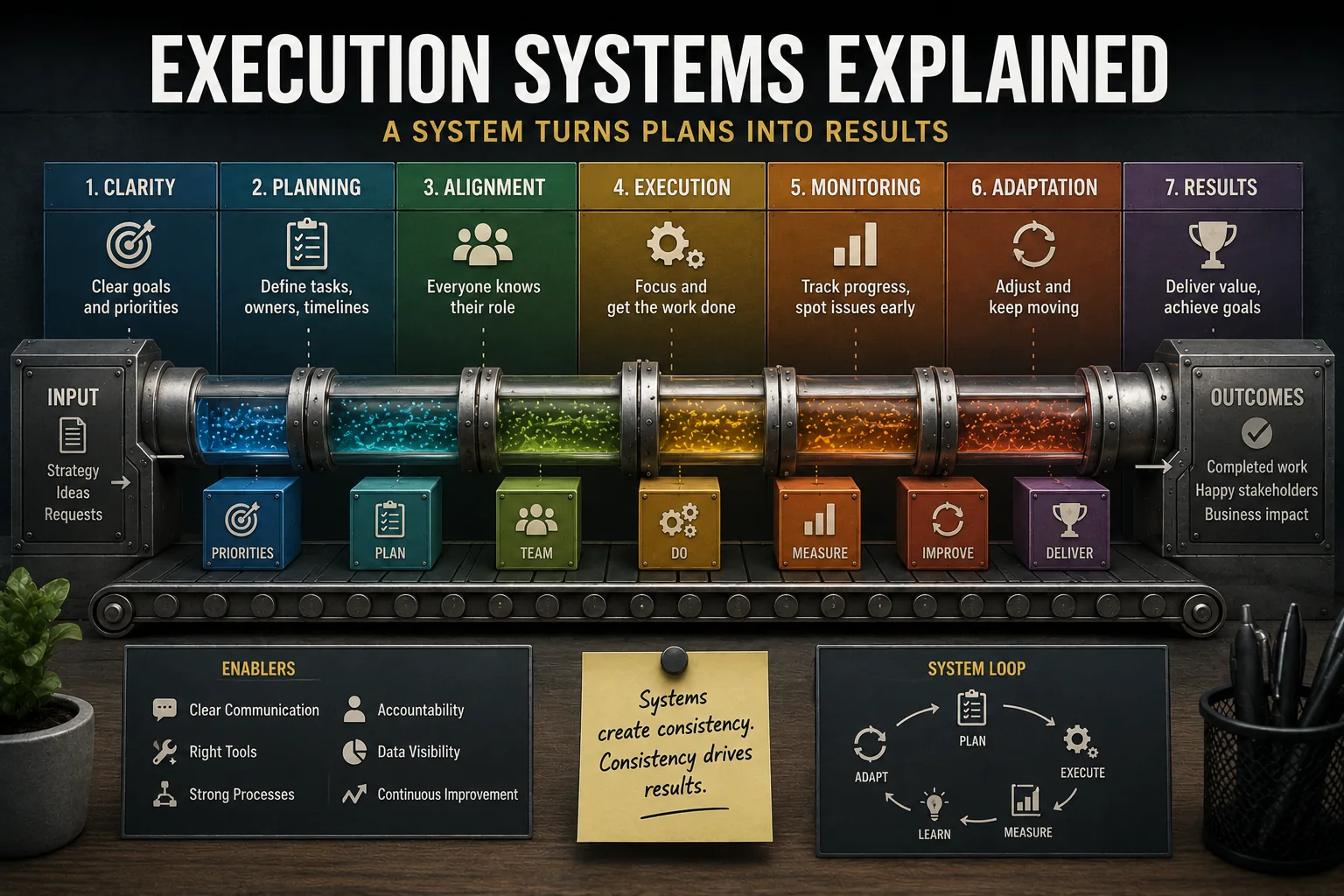
Strategy matters only when an organisation can turn it into consistent action. Execution systems explained this way are the practices that convert vision into results, making disciplined follow-through a source of advantage rather than treating execution as an afterthought in practice.
Andy Grove, the third employee and later CEO of Intel, had a phrase he repeated so often it became company doctrine: "Only the paranoid survive." He was also famous for the execution discipline he built into Intel's management systems. Grove believed that the difference between Intel and its competitors was not superior vision but superior execution - the systematic ability to turn decisions into results, week after week, quarter after quarter.
Most projects fail not because the plan was wrong but because execution broke down. The plan existed. People agreed with it. Resources were allocated. And then nothing happened - or the wrong things happened, or things happened too slowly, or coordination fell apart.
Execution systems are the mechanisms that prevent this drift from intention to inaction.
| Component | What It Answers | Key Failure Mode | Example Practice |
|---|---|---|---|
| Work breakdown | What specifically needs to be done? | Tasks too vague to act on | "Profile slowest 3 DB queries" not "improve performance" |
| Ownership model | Who is accountable for each item? | Shared ownership meaning no one is responsible | One named person per task; RACI for complex work |
| Cadence | Are we on track and what is blocking? | No regular rhythm; problems surface too late | Daily standups; weekly reviews; milestone check-ins |
| Progress visibility | How far along is the project really? | Status is "good" until it is suddenly "in crisis" | Objective metrics; task completion rates; burn-down charts |
What Execution Systems Actually Do
An execution system is the collection of practices, rhythms, and tools that answer five questions continuously throughout a project:
- What needs to be done? (Clarity of tasks and priorities)
- Who is doing it? (Clear ownership and accountability)
- When is it due? (Deadlines and milestones)
- What is blocking progress? (Visibility into obstacles)
- Are we on track? (Progress measurement and course correction)
If answering any of these questions requires hunting through multiple tools, lengthy meetings, or interpretation of ambiguous information, the execution system is failing.
Example: Amazon operates one of the most disciplined execution systems in corporate history. Their "six-pager" meeting format (detailed written narratives read silently at the start of meetings, followed by discussion) ensures that every meeting begins with shared understanding of the current state.
Their "working backwards" process (writing the press release before building the product) ensures that execution is always anchored to a clear definition of what success looks like.[4]
These are not bureaucratic rituals - they are execution mechanisms that enable a $1.5 trillion company to move with startup speed.
The Anatomy of an Effective Execution System
Component 1: The Work Breakdown
Every initiative must be decomposed into tasks that are:
- Specific: "Draft API endpoint documentation for user authentication module" not "work on docs"
- Assignable: One person owns each task (shared ownership is no ownership)
- Estimable: The team can roughly gauge the effort required
- Testable: There is a clear definition of "done"
The common failure: Tasks that are too vague to act on. "Improve performance" is a goal, not a task. "Profile database queries on the orders page and identify the three slowest" is a task.
Component 2: The Ownership Model
For every task, there must be exactly one person accountable for its completion. Not a team. Not a committee. One name.
The RACI framework (Responsible, Accountable, Consulted, Informed) provides useful structure:
- Responsible: The person doing the work
- Accountable: The person who answers for the outcome (often the same as Responsible for small teams)
- Consulted: People whose input is needed before the work is done
- Informed: People who need to know about the outcome but are not involved in doing the work
Example: At Bridgewater Associates, the world's largest hedge fund, founder Ray Dalio instituted a practice of "responsible parties" for every decision and action item.[3] Meeting notes always included specific names next to specific commitments.
Dalio's principle: "If you can't identify who is responsible for something, it won't get done."
Component 3: The Cadence
Execution systems need rhythm - regular checkpoints that maintain alignment and surface problems before they become crises.
Daily rhythm (5-15 minutes):
- What did you complete since yesterday?
- What will you work on today?
- What is blocking you?
This is the standard standup format, but the specific format matters less than the consistency. The goal is maintaining shared awareness without lengthy meetings.
Weekly rhythm (30-60 minutes):
- Progress against weekly commitments
- Blockers requiring escalation
- Priorities for the coming week
- Any scope or priority changes
Sprint/milestone rhythm (1-4 weeks):
- Demo of completed work
- Retrospective on what went well and what did not
- Planning for the next sprint or milestone
Monthly/quarterly rhythm:
- Progress against strategic goals
- Resource allocation adjustments
- Risk assessment and mitigation review
Component 4: The Visibility System
If the status of work is not visible without asking, the execution system is broken.
Effective visibility requires:
- A shared tracking tool (Asana, Jira, Linear, Notion, or even a shared spreadsheet) where task status is current
- A dashboard or summary view that shows overall project health at a glance
- Automated status updates where possible (integration between tools reduces manual reporting)
The anti-pattern: Status reports that require manual compilation, taking hours to produce and being outdated by the time they are read. Effective execution systems generate status visibility as a byproduct of doing the work, not as a separate reporting exercise.
Component 5: The Blocker Resolution Process
Every execution system needs a mechanism for rapidly resolving obstacles:
- Immediate escalation: When a blocker is identified, it is visible to people who can help within hours, not days
- Time-boxed resolution: "If we do not have a decision on X by Wednesday, we proceed with option A"
- Swarming: When critical work is blocked, temporarily reallocate people to unblock it rather than having the blocked person wait
Example: Toyota's famous "Andon cord" system allows any worker on the assembly line to stop production when they detect a quality problem.
This is an execution system mechanism: it gives frontline workers the authority and the mechanism to surface blockers immediately rather than letting defects propagate. The short-term cost (stopped production) prevents the long-term cost (defective products).
Execution Systems for Different Contexts
Co-Located Teams
Co-located teams have natural communication channels - overhearing conversations, seeing body language, quick desk-side questions. Execution systems can be lighter:
- Physical task boards (sticky notes, whiteboard)
- Brief daily standups (literally standing up)
- Quick desk-side conversations for blocker resolution
- Minimal formal documentation (shared understanding built through proximity)
Distributed and Remote Teams
Remote teams lack ambient awareness, making explicit execution systems essential. For guidance on remote communication, see async communication explained.
- Async standup updates in a shared channel (written daily updates replacing synchronous meetings)
- Comprehensive shared tracking (digital task boards that everyone maintains)
- Written decisions and context (what would be communicated verbally in an office must be documented)
- Explicit handoffs between time zones (documenting what is complete, what is next, what is blocked)
- Regular video calls for relationship building and complex discussions that do not work async
Example: GitLab, with over 2,000 employees across 65+ countries, operates with an explicit "handbook-first" approach where all processes, decisions, and context are documented in their publicly available handbook.[7] Their execution system is designed for a world where no two team members may ever be online simultaneously.
Small Teams (3-5 People)
Lightweight execution is sufficient:
- A shared task list or simple board
- Brief daily check-in (5 minutes, possibly async)
- Weekly planning session
- Informal blocker resolution through direct conversation
Large Teams (20+ People)
Coordination complexity requires more formal systems:
- Structured project management tool with defined workflows
- Formal sprint planning with capacity management
- Designated scrum masters or project managers facilitating execution
- Cross-team coordination meetings for managing dependencies
- Documented escalation paths for blockers
Building Accountability Without Micromanagement
The tension between accountability and autonomy is central to execution system design.
What Accountability Looks Like
- People commit to specific deliverables with specific deadlines
- Commitments are visible to the team
- Progress is reviewed regularly
- Missed commitments trigger honest conversation about what happened and how to prevent recurrence
- Adjusted commitments (when circumstances change) are communicated proactively, not discovered at the deadline
What Micromanagement Looks Like
- Managers dictate how tasks should be performed, not just what should be delivered
- Frequent status checks ("are you done yet?") replacing visible tracking
- Approval required for routine decisions within the team's competence
- Detailed time tracking to monitor activity rather than outcomes
- Punishment for missed commitments rather than problem-solving
The boundary: Accountability is about what gets delivered and when. Autonomy is about how the work gets done. Good execution systems maintain accountability while preserving autonomy.
Example: Netflix famously articulated this principle in their culture document: "We lead with context, not control." Teams are given clear goals and context, then trusted to determine how to achieve them.[5] Accountability is maintained through results, not surveillance.
Maintaining Momentum When Work Is Blocked
Blockers are inevitable. How the execution system handles them determines whether delays cascade or get contained.
Parallel Work Streams
Structure projects so multiple efforts can progress simultaneously. When one stream is blocked, people shift to another rather than sitting idle.
The Ready Backlog
Maintain a prioritized list of "ready" work - tasks that are fully specified, have no dependencies, and can be started immediately. When primary work is blocked, people pull from the ready backlog.
Time-Boxed Escalation
Set explicit deadlines for blocker resolution: "If this dependency is not resolved by Thursday, we proceed with the workaround." This prevents blockers from becoming indefinite waits.
Temporary Workarounds
When the ideal solution is blocked, implementing a temporary alternative that unblocks downstream work is often preferable to waiting. The cost of delay frequently exceeds the cost of rework.
Signs Your Execution System Needs Change
Slowing velocity despite consistent effort: If the team feels busy but delivery is declining, the system may be creating overhead.
Growing "we didn't know about that" surprises: Information is not flowing through the system as intended.
Meeting proliferation: If you keep adding coordination meetings to compensate for execution system failures, the system itself is the problem.
Different team members maintaining separate tracking: When people keep private lists because the official system does not work for them, the system is not serving diverse needs.
Tracking debt: If the project dashboard is days or weeks outdated, people have stopped maintaining it because it is too burdensome or provides insufficient value.
Declining morale: If the execution system feels like bureaucratic overhead rather than helpful structure, it is time to simplify.
For monitoring these signals with appropriate metrics, see KPIs explained without buzzwords.
OKRs, KPIs, and Other Measurement Frameworks Within Execution Systems
Execution systems need measurement to function, but the wrong measurements create perverse incentives that undermine the system.
OKRs (Objectives and Key Results)
Popularized by John Doerr at Intel under Andy Grove and later adopted by Google, OKRs connect execution to strategy by defining:
- Objectives: Qualitative descriptions of what you want to achieve ("Become the leading provider of enterprise analytics")
- Key Results: Quantitative measures that indicate progress ("Increase enterprise customer count from 50 to 200," "Achieve 99.99% uptime," "Reduce onboarding time from 14 days to 3 days")
The execution system role: OKRs define what the team is working toward. The execution system manages how the daily and weekly work connects to those objectives. Without an execution system, OKRs become aspirational statements posted on a wall and ignored.
Without OKRs (or similar strategic alignment), the execution system optimizes for busyness rather than impact.
Example: Google has used OKRs since 1999, when John Doerr introduced them to Larry Page and Sergey Brin.[9] Each quarter, every team sets OKRs that cascade from company-level objectives. The critical discipline: OKRs are graded publicly at the end of each quarter, creating accountability.
A team that consistently achieves 100% of its OKRs is setting them too conservatively - Google expects 60-70% achievement on "stretch" key results.
Velocity and Throughput
For teams using Agile frameworks:
- Velocity measures story points (or similar units) completed per sprint. It is useful for estimating capacity and detecting trends but dangerous as a performance metric (teams will inflate story point estimates to appear more productive).
- Throughput measures the number of work items completed per time period. Simpler and harder to game than velocity.
- Cycle time measures the average duration from starting a work item to completing it. The most actionable metric for process improvement.
The measurement trap: When execution metrics become performance targets, teams optimize for the metrics rather than for outcomes. Story points completed rises while actual customer value delivered stays flat or declines. This is Goodhart's Law in action: "When a measure becomes a target, it ceases to be a good measure."
For deeper treatment of project measurement, see project metrics explained.
Scaling Execution Systems Across Multiple Teams
When an organization runs multiple teams working on related projects, individual team execution systems must connect into a broader coordination framework.
The Program Level
A program coordinates multiple related projects toward a shared outcome. Program-level execution requires:
- Cross-team dependency management: Which teams are waiting on which other teams? Where are the handoff points? What happens if one team is late?
- Integration cadence: Regular points where separate team outputs are combined and tested together. The longer between integration points, the higher the risk of integration failure.
- Shared milestone tracking: Program milestones that all teams contribute to, creating shared accountability.
Example: Amazon manages cross-team execution through their "two-pizza team" structure (teams small enough to be fed by two pizzas, typically 6-10 people) combined with well-defined API contracts between teams. Each team owns a service and publishes an interface.
Other teams depend on the interface, not the implementation. This architecture enables independent execution while maintaining system coherence.
When Werner Vogels, Amazon's CTO, describes their architecture, he emphasizes that the organizational structure and the technical architecture mirror each other - small, autonomous teams owning small, autonomous services.
Coordination Without Bureaucracy
The temptation when scaling execution is to add coordination roles, meetings, and processes. Each addition is individually reasonable. Collectively, they create a coordination layer so heavy that teams spend more time in alignment meetings than doing work.
The principle: Minimize coordination by maximizing team autonomy. Give teams clear objectives and well-defined interfaces (what they consume and produce). Let them self-organize their internal execution. Coordinate only at the interfaces.
Coordination meetings should be:
- As infrequent as possible while maintaining alignment (weekly or bi-weekly at program level)
- Focused on dependencies and blockers, not status reporting (status should be visible in tools)
- Time-boxed (30 minutes maximum for most coordination meetings)
- Attended by representatives, not entire teams
The Inverse Conway Maneuver
Conway's Law states that organizations design systems that mirror their communication structures. The Inverse Conway Maneuver deliberately structures teams to produce the system architecture you want. If you want microservices, organize into small, autonomous teams.
If you want a tightly integrated product, organize into cross-functional teams with shared ownership.
This matters for execution systems because the execution system must match the organizational structure. An execution system designed for a single integrated team will not work for autonomous squads, and vice versa.
Execution Systems for Creative and Knowledge Work
Not all work fits neatly into the sprint-based, ticket-driven execution systems common in software engineering. Creative work, research, strategy development, and other knowledge-intensive activities require adapted approaches.
The Challenge
Creative work is inherently uncertain. You cannot estimate how long it takes to write a compelling strategy document, design an innovative user experience, or develop a research breakthrough. Traditional execution metrics (velocity, throughput, cycle time) either do not apply or create harmful pressure to rush creative processes.
Adapted Execution Principles
1. Time-box exploration, not outcomes. Instead of "deliver the strategy document by Friday," use "spend 8 hours this week on strategy exploration, and share what you have learned." The exploration may reveal that the strategy needs another week of thinking, or it may produce a finished document - both are valid outcomes.
2. Use intermediate artifacts as progress indicators. A research project may not have deliverables for weeks, but it should produce intermediate artifacts: literature summaries, hypothesis lists, data collection plans, preliminary analyses. These artifacts demonstrate progress and create opportunities for course correction.
3. Maintain creative autonomy within structural accountability. The creator decides how to approach the work. The execution system tracks whether they are making progress and surfacing that progress to stakeholders.
Example: Pixar's "Braintrust" meetings, described by Ed Catmull in Creativity, Inc., function as an execution system for creative work. Directors present their films-in-progress to a group of senior creative leaders who provide candid feedback.
The meetings are regularly scheduled (execution cadence), feedback is specific and actionable (blocker resolution), and the director retains final authority over decisions (ownership model). The Braintrust does not mandate changes - it surfaces problems. The director decides how to address them.
What Research Shows About Execution Effectiveness
The gap between organizational intent and organizational execution is one of the most extensively documented phenomena in management research.
Paul Niven and Ben Lamorte, authors of Objectives and Key Results (2016), argue that many organizations struggle to execute their stated strategies.
The primary failure mechanism was not strategy quality but execution system quality: organizations could articulate clear objectives but lacked the mechanisms to translate them into coordinated daily action.
Chris McChesney, Sean Covey, and Jim Huling at FranklinCovey drew on experience working with many organizations and tens of thousands of leaders and teams, publishing their findings in The 4 Disciplines of Execution (2012).[8]
Their research found that 87 percent of team members did not know what their organization's top priorities were, and that 81 percent could not articulate how their weekly work connected to organizational goals.
Teams with formal execution systems - defined as regular accountability meetings, visible scoreboards tracking leading measures, and explicit commitment protocols - outperformed teams without them by an average of 52 percent on goal achievement. The effect was consistent across industries, organization sizes, and stated strategy types.
Eliyahu Goldratt's Theory of Constraints, developed through his research with manufacturing organizations in the 1980s and documented in The Goal (1984), provides the theoretical foundation for blocker-resolution components of execution systems.[10]
Goldratt found that every system has a single binding constraint at any given time - the resource, process, or dependency that limits overall throughput.
Organizations that focused improvement efforts on the constraint improved total output regardless of where the effort was applied; organizations that improved non-constraint elements achieved no overall improvement.
The practical implication for execution systems is that identifying and resolving the current blocker is more valuable than improving the performance of non-blocked work streams.
Goldratt's Theory of Constraints has been reported to increase manufacturing throughput in many case studies from applying constraint identification systematically to a manufacturing execution process.
Amy Edmondson of Harvard Business School, whose research on psychological safety was originally published in Administrative Science Quarterly in 1999 and extended through multiple subsequent studies, found a counterintuitive result in her hospital team research: the teams that reported the highest rates of medication errors were the highest-performing teams, not the lowest.
The explanation was that high-performing teams with strong psychological safety surfaced errors for discussion, while lower-performing teams concealed them to avoid blame.
The connection to execution systems is direct: an execution system that does not surface blockers, problems, and failures for resolution is not functioning.
Edmondson's research, extended to project teams in Teaming (2012), found that teams with regular structured blocker-resolution processes resolved problems 60 percent faster than teams relying on ad hoc escalation.
McKinsey's organizational practice analyzed 1,027 companies across 100 countries from 2010 to 2018 and found that organizational health - defined as the ability to align, execute, and renew faster than competitors - predicted five-year financial performance better than any other single factor, including industry position, market share, or technology advantage.
Execution system quality was the second-strongest predictor of organizational health within this framework, after leadership quality.
Companies in the top quartile of execution system maturity generated total returns to shareholders 3.2 times higher than companies in the bottom quartile over the same period.
Case Studies in Execution System Design
Organizations that have invested deliberately in execution system design provide instructive examples of both successful and unsuccessful approaches.
Intel's OKR implementation, introduced by Andy Grove in the 1970s and documented in Grove's High Output Management (1983), represents one of the most thoroughly studied execution system designs in corporate history.
Grove's system linked quarterly objectives (directional goals) with key results (measurable outcomes) and required weekly one-on-one meetings between managers and direct reports in which commitments were reviewed against the previous week's key results.[1]
Intel's semiconductor market leadership from 1975 to 2000 was attributed in part to this execution discipline: the company could identify performance problems within weeks rather than quarters and redirect resources before problems became strategic failures.[2]
John Doerr, who introduced OKRs to Google after working at Intel, documented in Measure What Matters (2018) that Google's early adoption of OKRs in 1999 contributed to the company's ability to scale from about 40 to tens of thousands of employees while maintaining execution coherence.
Doerr cited Google's 10x growth in revenue per employee from 2000 to 2010 as evidence of the system's leverage.
Toyota's production system, analyzed extensively by Jeffrey Liker in The Toyota Way (2004) and by researchers at the MIT Center for Transportation and Logistics, represents the most thoroughly documented application of execution system principles in manufacturing.[6]
Toyota's system - encompassing the Andon cord blocker escalation mechanism, standardized work procedures, and visual management boards - reduced defect rates from an industry average of 4-5 defects per 100 vehicles in the 1970s to 1.2 defects per 100 vehicles by 1995, while also reducing production costs by 28 percent over the same period.
James Womack, Daniel Jones, and Daniel Roos documented these outcomes in The Machine That Changed the World (1990), based on a five-year MIT study of automotive plants across the US, Japan, and Europe.
The Toyota plants in their study outperformed the best non-Toyota plants by 2:1 on productivity and 2:1 on defect rates, with the execution system - not technology or workforce skill - as the primary differentiating factor identified by the researchers.
Spotify's engineering execution system, documented by Henrik Kniberg in his 2012 whitepaper and updated through subsequent blog posts on the Spotify Engineering blog, organized execution around autonomous squads with full stack ownership.
Each squad maintained a physical or digital board visible to the entire squad showing work in progress, committed work for the current iteration, and the squad's current quarterly objective.
Spotify's engineering blog documented that squads using this visible execution approach shipped features 40 percent more frequently than squads using informal tracking, and that the time from feature commitment to production deployment fell from an average of 6 weeks to 1.5 weeks over the three years following the system's introduction.
The outcomes were not uniformly positive: squads that lacked experienced engineering leadership struggled with the autonomous model, and Spotify's subsequent organizational evolution acknowledged that the 2012 system captured a specific stage of the company's development rather than a universally applicable template.
The US Digital Service's execution system, developed from 2014 onward and documented through their annual reports and case studies published on usds.gov, applied agile execution principles to government technology projects that had historically produced catastrophic outcomes.
The USDS playbook, published in 2014, specified execution practices including daily standups, two-week deployment cycles, and measurable success criteria defined before work began.
Comparing government IT projects that followed USDS execution practices to those that did not, the Government Accountability Office found in a 2018 report that USDS-methodology projects were 75 percent more likely to complete within 10 percent of original budget estimates.
The most cited case is the rescue of Healthcare.gov following its 2013 launch failure: a USDS team of 60 people, applying disciplined execution practices, stabilized the platform in six weeks that had resisted 300 contractors over two years.
The Execution System Paradox
The paradox of execution systems is this: the more effective the system, the less you notice it. A well-functioning execution system feels like common sense - of course we know what to work on, of course blockers get resolved quickly, of course everyone knows the project status.
When execution systems are absent or broken, the symptoms are obvious: confusion, duplication, surprises, and heroic individual effort compensating for systemic failure.
The investment in building a good execution system pays returns on every single task, every single day, for the life of the project. Few investments in project management offer comparable leverage.
Sources & Further Reading
Grove, A. S. "High Output Management." Vintage Books, 1983.
Grove, A. S. "Only the Paranoid Survive." Currency Doubleday, 1996.
Dalio, R. "Principles: Life and Work." Simon & Schuster, 2017.
Bryar, C. & Carr, B. "Working Backwards: Insights, Stories, and Secrets from Inside Amazon." St. Martin's Press, 2021.
Hastings, R. & Meyer, E. "No Rules Rules: Netflix and the Culture of Reinvention." Penguin Press, 2020.
Liker, J. K. "The Toyota Way: 14 Management Principles from the World's Greatest Manufacturer." McGraw-Hill, 2004.
GitLab. "GitLab Handbook." GitLab, 2024. View source
McChesney, C., Covey, S., & Huling, J. "The 4 Disciplines of Execution." Free Press, 2012.
Doerr, J. "Measure What Matters: How Google, Bono, and the Gates Foundation Rock the World with OKRs." Portfolio, 2018.
Goldratt, E. M. "The Goal: A Process of Ongoing Improvement." North River Press, 1984.