
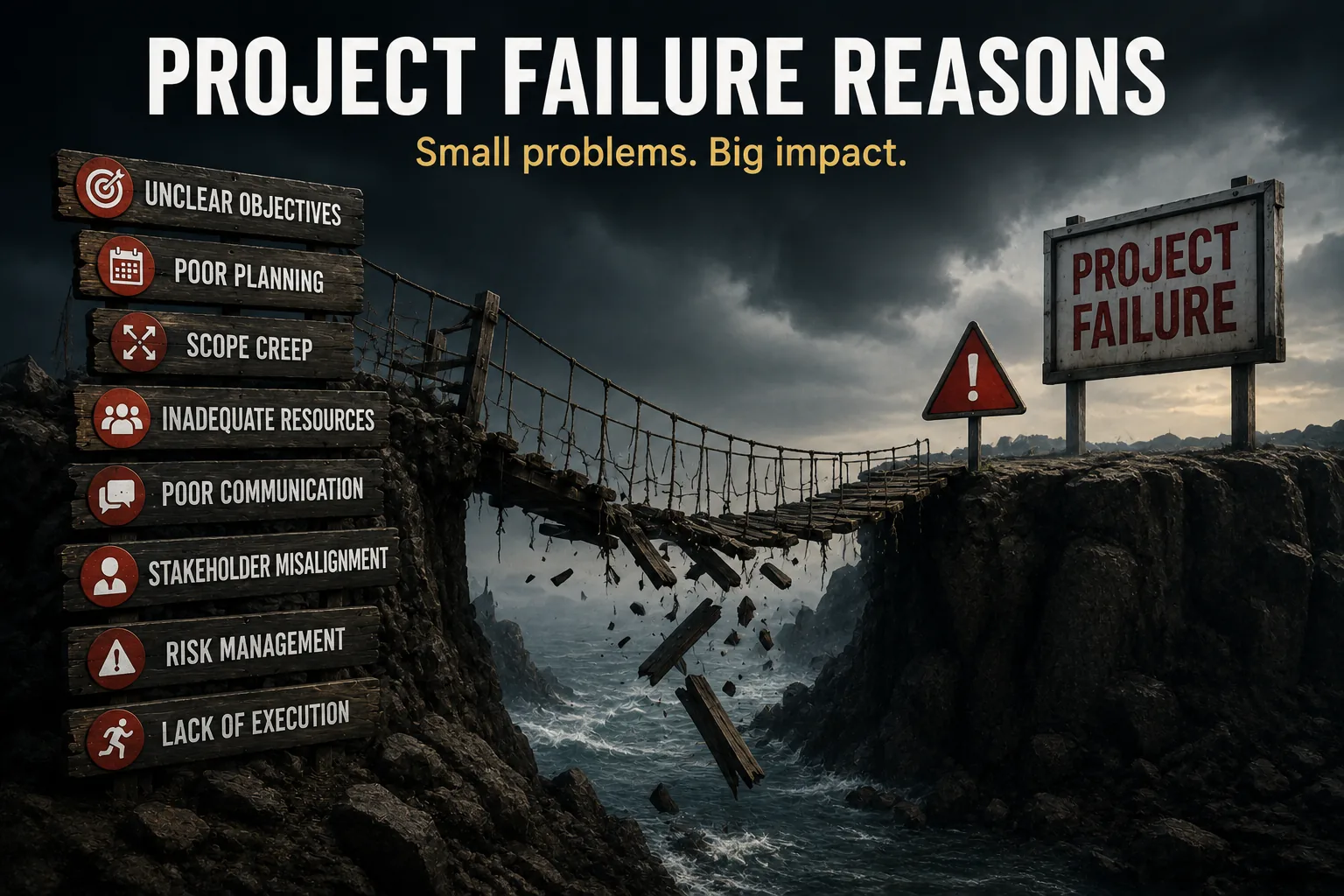
Common reasons projects fail appear early through unstable requirements, unrealistic forecasts, weak governance, stakeholder conflict, and unclear ownership. Complex work cannot be fully specified before building begins, so iterative development and formal change control help turn learning into deliberate adjustments. Projects also need visible status, historical reference data, early risk work, and resolved conflicts before they become late-stage crises.
Between 2004 and 2013, the FBI attempted to build a case management system called Virtual Case File, followed by its successor Sentinel. The first attempt was abandoned after consuming $170 million over five years with nothing to show.
The second attempt, following a waterfall approach, consumed an additional $400 million before being rescued by a small agile team that delivered a working system for a fraction of the cost. Total waste: approximately half a billion dollars.
The FBI project failures were not caused by incompetent people. They were caused by the predictable patterns through which projects go wrong: requirements that were too broad and too unstable to implement sequentially, contracts that locked the government into large deliveries rather than incremental ones, governance structures that were better at approving budgets than at detecting failure, and the organizational dynamics that prevent projects in trouble from changing course.
The Standish Group's CHAOS Report, published annually since 1994, has tracked software project outcomes and consistently found that fewer than 35% of projects are delivered on time, on budget, and with the intended scope.
The failure rate varies by project size - small projects succeed at significantly higher rates than large ones - but the baseline message is consistent: project failure is not an aberration. It is the statistically expected outcome that organizations regularly fail to account for.
This article examines the specific, recurrent patterns through which projects fail, with analysis of why each pattern persists despite being well-known.
"Projects do not fail in the final week. They fail in the first month, when requirements were not understood, risks were not identified, and stakeholders were not aligned. The final week is just when everyone notices." - adapted from Bent Flyvbjerg
| Failure Pattern | Root Cause | Early Warning Sign | Prevention |
|---|---|---|---|
| Requirements failure | Unstable or misunderstood scope | Requirements document that cannot be validated with users | Iterative development; formal change control |
| Planning failure | Optimism bias; strategic misrepresentation | Schedule built without historical reference data | Reference class forecasting; explicit buffer |
| Governance failure | No visibility into real status | Status is always "green" until suddenly "red" | Objective metrics; escalation paths defined upfront |
| Stakeholder misalignment | Conflicting needs not resolved before work begins | Disagreements re-emerge during development | Stakeholder mapping; explicit conflict resolution before start |
| Execution breakdown | Unclear ownership; no cadence | Tasks assigned but nobody following up | Named owners; regular status rhythms; visible tracking |
Pattern 1: Requirements Failure
The most common cause of project failure is requirements that are misunderstood, incomplete, changing, or conflicting. The Standish Group consistently identifies "lack of user input" as the top factor in project failure.
The Specification Trap
The instinct to specify requirements completely before beginning work is understandable: it seems like the way to prevent building the wrong thing. The problem is that complex requirements cannot be fully understood at the start of a project. They become fully understood through the process of building, testing, and using the system.
The specification trap is the circular problem this creates: complete specification requires understanding that only comes from building; building without complete specification produces the wrong thing. The resolution is iterative development - building partial versions to learn, then adjusting the plan based on what was learned.[7]
Projects that enter the specification trap produce enormous requirements documents that are detailed, internally inconsistent, and disconnected from user needs.
The development team builds to the specification; the users receive what was specified rather than what they needed; the users express dissatisfaction; the project is classified as a failure.
Example: The UK Government's Universal Credit IT system, begun in 2010 with a projected cost of 2.2 billion, eventually cost over 6 billion and took years longer than planned.
Post-mortem analysis identified requirements failure as a central cause: the policy requirements were not stable (they changed as the welfare policy evolved), the technical requirements derived from unstable policy were therefore also unstable, and the system being built was a moving target that the waterfall development process was not designed to track.
Scope Creep
Scope creep is the gradual, uncontrolled expansion of project scope after the project has begun. Each addition seems small and reasonable; the accumulated additions transform the project's scale, timeline, and cost.
Scope creep is fueled by the natural tendency of stakeholders to add requirements once they see what the system is becoming. Early-stage requirements are abstract; the working prototype makes concrete what was abstract, which reveals needs that were not visible before.
This is not irrational behavior - it reflects genuine learning - but without a formal change control process, the learning compounds into scope expansion that the original plan cannot accommodate.
The scope creep prevention mechanism is a formal change control process: every new requirement must be evaluated against its impact on schedule, cost, and other requirements before being accepted. The process does not prevent change - it ensures that changes are made with full awareness of their consequences.
Requirements Conflicts Between Stakeholders
Complex projects typically have multiple stakeholders with different, sometimes incompatible, needs. The finance function wants an audit trail; the operations function wants speed. The legal team wants data retained; the security team wants data minimized. Sales wants flexibility; engineering wants standardization.
Projects that do not resolve these conflicts before development begins will be forced to resolve them during development - at the highest possible cost. Requirements conflicts that surface during development produce rework, schedule delays, and sometimes complete architectural revisions.
Pattern 2: Planning Failure
Project plans that are unrealistic, incomplete, or disconnected from execution reality are the second major category of failure.
The Planning Fallacy
Daniel Kahneman and Amos Tversky identified the planning fallacy in 1979: the systematic tendency to underestimate the time, cost, and risks of planned actions while overestimating their benefits.[4]
The bias persists even when the planner is aware of it and even when they have direct experience with similar projects that ran over budget and schedule.
The planning fallacy is not random error - it is systematic. Project plans consistently underestimate duration and cost.
This is partly optimism bias (people naturally assume their project will go better than the average), partly strategic misrepresentation (proposals are more likely to be approved if they show shorter durations and lower costs), and partly genuine uncertainty (complex projects have complex uncertainty that is difficult to quantify upfront).
Bent Flyvbjerg, a professor at Oxford's Sad Business School, has studied megaproject failures extensively. His research across 258 transportation infrastructure projects found that 86% were over budget, by an average of 28%. For information technology projects, the overrun statistics are worse.
His prescription - reference class forecasting - uses the actual outcomes of similar past projects rather than the bottom-up estimates from project teams to produce more accurate predictions.
Inadequate Risk Identification
Risk management plans that list obvious risks without identifying the most consequential ones leave projects exposed to their most dangerous failure modes.
The most dangerous risks for most projects are the unknown unknowns - the factors that were not anticipated because they were outside the team's experience or visibility. These cannot be identified through brainstorming alone. They require deliberate techniques:
- Pre-mortem analysis: Assume the project has failed and work backward to identify what caused the failure
- Expert review: Engage domain experts with experience on similar projects to identify risks the team would not recognize
- Historical analysis: Review what went wrong on similar projects in similar contexts
Example: Boeing's 787 Dreamliner experienced some of the most severe schedule and cost overruns in commercial aviation history - three and a half years late and billions over budget.
Post-mortem analysis identified a risk that was identifiable upfront but not adequately evaluated: the reliance on a global supply chain for major component assembly was an unprecedented approach, and the coordination risks of managing 50+ major partners across dozens of countries were not adequately planned for.
Underestimating Complexity
Complex systems exhibit emergent behavior - the whole behaves in ways that the parts do not individually predict. Software systems, organizational changes, and large-scale operational initiatives all exhibit emergence. Planning based on the sum of parts will systematically underestimate the complexity of their interactions.
The most reliable indicator of project complexity is the number of dependencies - the degree to which the completion of any element depends on the completion of other elements. High-dependency projects require significantly more coordination overhead than low-dependency ones.
Planning that does not model dependencies accurately will underestimate duration and cost.
Pattern 3: People and Governance Failure
The human and organizational factors that determine how projects are managed, staffed, and overseen produce a significant fraction of project failures.
Insufficient Team Capability
Projects fail when the people doing the work lack the skills required to do it. This seems obvious, but it is consistently under-addressed in practice.
Skills gaps are embarrassing to acknowledge, difficult to measure, and politically complicated to address (it requires either admitting that existing staff are not adequate or that the project was inappropriately allocated to them).
Skills gaps are most dangerous at the project leadership level. A project led by someone without experience managing projects of that complexity will repeat the mistakes of their less experienced past.
The solution - assigning project leadership based on demonstrated capability at the relevant complexity level - is frequently overridden by organizational politics, availability, and the optimistic assumption that a capable person at one complexity level will scale to a higher one.
Governance That Approves Without Oversight
Most project governance structures are better at approving projects than at detecting and responding to projects in trouble. The approval decision is a single event; oversight is an ongoing function.
Organizations that invest heavily in approval process and lightly in ongoing oversight produce projects that are well-analyzed before they start and poorly monitored during execution.
Effective project governance includes:
- Regular, honest status reviews that distinguish between true progress and appearance of progress
- Explicit indicators that signal when a project requires intervention
- Authority to change scope, add resources, or stop a project when intervention is warranted
- Freedom from the political dynamics that suppress bad news
Example: McKinsey's research on large-scale IT project failures found that projects with strong, engaged executive sponsorship fail at significantly lower rates than projects where executive involvement ends after approval.
The governance failure pattern is consistent: projects are approved with optimistic plans; they begin to fall behind schedule; the news is managed optimistically upward; by the time senior sponsors are re-engaged, the project is in crisis rather than merely in difficulty, and options for recovery have narrowed.
The Sunk Cost Trap
Once a project has consumed significant resources, the organizational dynamics strongly favor continuing it over stopping it - regardless of whether continuing is the rational choice.
The sunk cost fallacy (investing more in a failing project because of what has already been invested, rather than evaluating the expected return on future investment) is the documented cognitive bias behind this pattern.
But the organizational dynamics amplify the cognitive bias: stopping a project is a visible decision with visible accountability.
Continuing a failing project diffuses accountability across time and people. The political costs of "killing" a project are often higher than the financial costs of continuing it.
The resolution is governance that explicitly separates "is this project worth continuing?" from "should we try to recover our investment?" The sunk cost is gone regardless. The decision is whether the expected value of future investment justifies the future investment.
Pattern 4: Communication and Coordination Failure
Projects involve multiple people who must coordinate work, share information, and make decisions together.[8] When coordination mechanisms fail, projects produce work that does not fit together, decisions that are not shared, and problems that are not surfaced in time to address.
The Information Filter Problem
Information about project status degrades as it moves upward through organizational hierarchies. Problems that are visible at the working level are softened by the time they reach project leadership, and further softened before reaching executive sponsors.
The softening is not always intentional dishonesty. It is rational behavior in organizational contexts where delivering bad news to superiors has career costs and delivering good news has career benefits.
The aggregate of individually rational softening decisions is systematic optimism about project status at senior levels - which produces delayed responses to problems that have been visible at lower levels for weeks or months.
The solution: Project governance structures that include direct observation of project artifacts (working software, test results, design documents) rather than relying solely on status reports.
Projects where sponsors attend sprint reviews or design reviews rather than weekly status meetings have significantly better visibility into actual project state.
Coordination Failures Across Handoffs
Complex projects involve multiple teams handing work to each other. Each handoff is an opportunity for information to be lost, for misaligned assumptions to be discovered late, and for integration problems to emerge.
Integration failures - where components built separately do not work together as expected - are one of the most common causes of project schedule overruns. They are also among the most predictable: any project with significant handoffs between teams is at risk of integration failure.
Early integration testing, continuous integration practices, and explicit handoff protocols all reduce integration failure rates.[5]
The Meta-Pattern: Optimism as Structural Failure
The thread connecting all of these failure patterns is optimism - not the motivational, healthy optimism that drives people to attempt difficult things, but the cognitive and organizational optimism that prevents accurate assessment of project risks and status.
Projects are approved based on optimistic assumptions. They are staffed based on optimistic capability assessments. They are executed against optimistic plans. Their status is reported optimistically. They are continued past the point of rational investment because stopping them would require acknowledging pessimistic realities.
The organizations that fail at projects less consistently than average share a structural characteristic: they have built mechanisms that counteract optimism systematically. They use reference class forecasting instead of bottom-up estimation.
They require pre-mortems before approval. They have governance that penalizes status misrepresentation as much as it penalizes being behind schedule. They have cultures where raising early warnings is rewarded rather than punished.
These are not particularly difficult mechanisms to implement. They are resisted because the optimism they counteract is organizationally convenient - it enables projects to be approved that would not survive honest scrutiny, and it protects the people whose reputations are tied to projects that are not going well.
For related frameworks on how to structure projects to reduce failure risk, see agile vs waterfall explained and project risk management.
What Research Shows About Why Projects Fail
The empirical literature on project failure is unusually rich, because project outcomes are measurable (delivered on time, on budget, with intended scope) and because several large-scale research programs have tracked failures systematically over decades.
Bent Flyvbjerg at Oxford's Sad Business School has conducted the most comprehensive empirical research on large project failure.[2] His database of over 16,000 projects across sectors and geographies, developed over two decades, has produced findings that consistently challenge optimistic project planning.
His 2003 book Megaprojects and Risk (with Bruzelius and Rothengatter) and his 2023 book How Big Things Get Done (with Gardner) synthesize the core findings: 91.5% of projects in his database experienced cost overruns, schedule overruns, or both.
For IT projects specifically, the statistics are worse than for infrastructure - the unique complexity of software means that the underestimation is systematic and large.[6]
Flyvbjerg's proposed solution, reference class forecasting, involves anchoring project estimates to the actual distribution of outcomes for similar past projects rather than to optimistic bottom-up estimates.
Research by Flyvbjerg and colleagues at the Sad Business School found that reference class forecasting reduced cost estimation error by approximately 50% compared to conventional estimation in a study of transport infrastructure projects.
The Standish Group CHAOS Report, published annually since 1994, has tracked software project outcomes across thousands of projects.[1]
The most recent decade of CHAOS data (2011-2021) shows modest improvement in project success rates, from roughly 29% success in 2011 to 31% success in 2020, but the baseline remains striking: more than two-thirds of software projects are impaired (over budget, over schedule, or under scope) or fail outright.
The CHAOS Report data shows a consistent and strong relationship between project size and failure rate: projects with budgets under $1 million succeed at roughly 70% rates; projects with budgets over $10 million succeed at under 10% rates.
The implication is that project size itself is a major risk factor, independent of other variables - something that organizational planning processes rarely treat as a primary risk.
The Project Management Institute's research in Pulse of the Profession (published annually since 2007) has documented the economic cost of project failure at organizational scale. PMI estimates that organizations waste an average of $97 million for every $1 billion invested in projects - a 9.7% waste rate.
Their research identifies talent gaps as the primary predictor of failure: organizations with high project management maturity (measured by process adherence, PM credential rates, and executive sponsorship quality) waste substantially less than organizations with low maturity.
PMI's research found a 21x difference in waste rates between high-maturity and low-maturity organizations.
Research by Matti Haverila and colleagues at the Helsinki School of Economics on IT project failure (2008) found that projects with dedicated, empowered project managers succeeded at significantly higher rates than projects managed by part-time or committee-led structures.
The finding - that clear, empowered leadership is more predictive of success than any methodology choice - challenges the common organizational practice of assigning project management as a secondary responsibility to functional managers.
Roger Atkinson's research (1999) challenged the iron triangle (time, cost, scope) as the primary measure of project success and failure. Atkinson's survey of project managers found that "success" in terms of delivering on time and on budget was frequently disassociated from actual organizational benefit from the project.
Projects that were delivered on time but solved the wrong problem were classified as successes; projects that were late but solved the right problem were classified as failures. This has been widely incorporated into project management education but remains inconsistently applied in practice.[9]
Real-World Case Studies in Project Failure
The Heathrow Terminal 5 construction (2008) is a well-documented case of a project that was delivered on time and on budget - a success by traditional metrics - and then became a disaster during launch.
The 4.3 billion terminal opened on March 27, 2008, and immediately failed operationally: baggage systems collapsed, flights were cancelled, and British Airways lost an estimated 16 million in the first two weeks.
The failure was a coordination and testing failure - the physical construction succeeded but the operational integration of 100 different systems was not adequately tested under realistic conditions before launch. It illustrates the Atkinson point: project delivery success and project outcome success are different measurements.
The Healthcare.gov launch (October 2013) is a case study in requirements and governance failure at scale.
The US federal healthcare exchange website, with an estimated development cost of $292 million (ultimately exceeding $2 billion), crashed immediately upon launch, unable to handle the traffic volumes that any reasonable planning would have anticipated.
Congressional investigations found multiple causes: requirements that were added and changed until weeks before launch, governance structures that lacked authority to enforce integration testing, contractors that were not held accountable for interoperability, and political pressure that prevented launch delay despite known technical problems.
Every major failure pattern in this article was present: requirements instability, planning fallacy, governance failure, sunk cost dynamics, and information filtering that prevented the technical reality from reaching decision makers.
The Sydney Opera House is the canonical case of planning fallacy applied to construction. Jorn Utzon's design, approved in 1957 with an estimated cost of 3.5 million and a four-year timeline, ultimately took 14 years and cost 49 million - roughly 14 times the original estimate.
The cause was requirements failure at the design stage: the distinctive sail roofs, which defined the building's appearance, had not been engineered when the project was approved.
The engineering was developed concurrently with construction, producing constant redesign and rework. Bent Flyvbjerg cites the Sydney Opera House in his research as the archetype of a project approved before it was sufficiently designed - a pattern he finds in the majority of large project failures.
The Denver International Airport baggage system (1994) failed so comprehensively that it has become a standard case study in project management curricula.
The automated baggage handling system - intended to be a competitive advantage for the airport - was projected to cost $186 million and became the primary cause of a 16-month airport opening delay that cost $560 million in additional construction finance.
The system was eventually abandoned, and the airport opened with a conventional baggage system.
Post-mortem analysis identified requirements complexity (the system was more ambitious than any previously deployed), inadequate testing time, and a governance structure that approved the system without adequate scrutiny of technical risks.
The airport's opening was delayed primarily because the political pressure to open with the automated system - already committed to publicly - prevented an earlier decision to abandon it and proceed with proven technology.
Evidence-Based Approaches to Reducing Project Failure
The research literature, combined with patterns from project failure case studies, identifies specific interventions with documented effectiveness.
Reference class forecasting, developed by Flyvbjerg based on Kahneman and Tversky's work on the planning fallacy, involves three steps: (1) identify the reference class of similar projects, (2) establish the distribution of outcomes for that class (average cost overrun, schedule overrun, failure rate), and (3) anchor your project estimate to that distribution before adjusting for project-specific factors.[3]
Flyvbjerg's research found that this approach, used in Danish government infrastructure planning, reduced average cost estimation error significantly compared to conventional bottom-up estimation. The UK Treasury now recommends reference class forecasting as standard practice for major infrastructure projects.
Stage-gating with genuine kill authority, supported by PMI research and multiple case studies, involves breaking projects into phases with explicit decision points where continuation is actively reviewed rather than automatically assumed.
The critical element is "genuine kill authority" - the governance structure must actually stop projects that do not meet criteria, not merely theoretically hold the power to do so.
Research by Robert Cooper on new product development found that companies with rigorous stage-gate processes (where projects are regularly killed based on performance against criteria) had significantly better portfolio outcomes than companies with nominal stage-gate processes that continued failing projects under sunk cost pressure.
Iterative delivery with short feedback cycles, supported by the Standish Group data (agile projects succeed at approximately twice the rate of waterfall projects in the CHAOS Report database) and validated in numerous organizational case studies, reduces the requirements failure risk by creating frequent opportunities to test assumptions against reality.
The key mechanism is not the agile methodology itself but the feedback cycle length: shorter cycles between building and testing reduce the cost of discovering that requirements were wrong, because less work must be discarded or reworked.
Psychological safety for project status reporting, supported by Edmondson's research, addresses the information filtering problem that produces optimistic reporting of failing projects.[10]
Research by Edmondson and colleagues found that project teams in psychologically safe environments reported problems an average of three weeks earlier than teams in low-safety environments, providing more time for recovery.
Creating explicit norms - that early problem reporting is rewarded and suppression of bad news is sanctioned - directly counteracts the rational individual behavior (filter bad news upward) that produces organizational disaster.
Sources & Further Reading
- Standish Group. "CHAOS Report 2020." Standish Group, 2020. View source
- Flyvbjerg, B., Bruzelius, N. & Rothengatter, W. Megaprojects and Risk: An Anatomy of Ambition. Cambridge University Press, 2003. View source
- Kahneman, D. & Tversky, A. "Intuitive Prediction: Biases and Corrective Procedures." Management Science, 1979. DOI: 10.1287/mnsc.12.4.B141
- Kahneman, D. Thinking, Fast and Slow. Farrar, Straus and Giroux, 2011.
- Kim, G. et al. The Phoenix Project. IT Revolution, 2013. View source
- McConnell, S. Rapid Development: Taming Wild Software Schedules. Microsoft Press, 1996. View source
- Sutherland, J. Scrum: The Art of Doing Twice the Work in Half the Time. Currency, 2014. View source
- Project Management Institute. A Guide to the Project Management Body of Knowledge (PMBOK Guide). PMI, 2021. View source
- Shenhar, A. J. & Dvir, D. Reinventing Project Management. Harvard Business School Press, 2007. View source
- Edmondson, A. The Fearless Organization: Creating Psychological Safety in the Workplace for Learning, Innovation, and Growth. Wiley, 2018. View source