
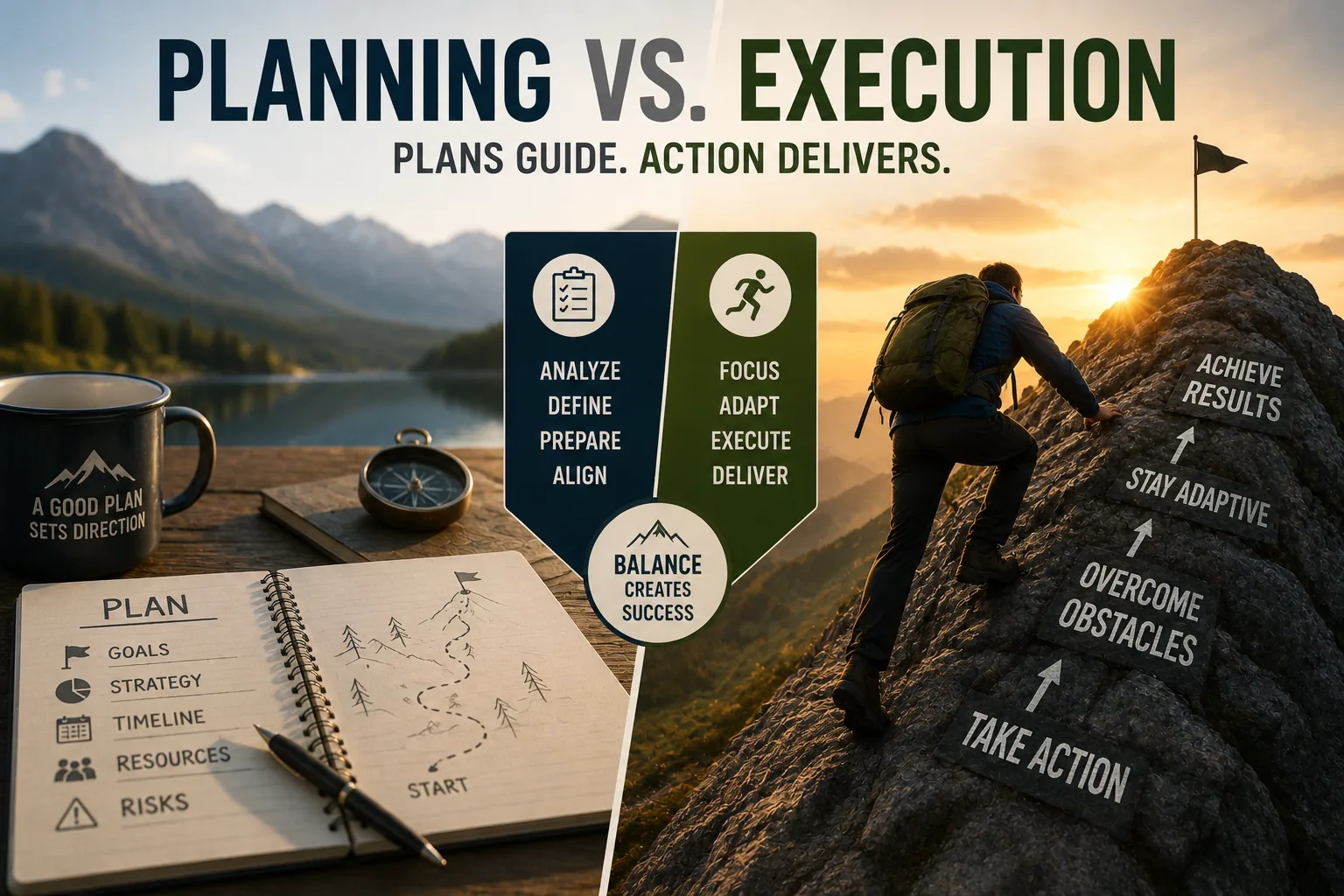
Dwight D. Eisenhower commanded the largest military operation in history - the D-Day invasion of Normandy on June 6, 1944. The planning was staggering: about 156,000 troops, nearly 7,000 naval vessels, 11,000+ aircraft, coordinated across five beaches, with contingencies for weather, enemy response, and equipment failure. The plan filled volumes.
And then the first paratroopers landed thirty kilometers from their drop zones, the landing craft hit the wrong beaches, and a significant portion of the early armor was lost to unexpected surf conditions.
Eisenhower, who knew Helmuth von Moltke the Elder's maxim that no plan survives contact with the enemy, had anticipated this.
The Allied forces had not been trained to execute a specific plan - they had been trained to achieve objectives, with the judgment to adapt when plans failed.
The result was one of history's most successful military operations, executed under conditions that bore almost no resemblance to the plans that produced it.
The relationship between planning and execution is one of the central practical tensions in project management. Too little planning produces chaotic execution, wasted effort, and uncoordinated teams.
Too much planning produces analysis paralysis, plans that are obsolete before execution begins, and organizations that mistake planning for progress.
The balance point is different for every project - it depends on the uncertainty involved, the cost of mistakes, the reversibility of decisions, and the organizational culture.
"Plans are worthless, but planning is everything. The plan is specific and quickly outdated; the thinking that produced it - the understanding of objectives, the analysis of alternatives, the identification of risks - is durable and valuable during execution." - Dwight D. Eisenhower
| Planning Level | Time Investment | Best For | Failure Mode |
|---|---|---|---|
| Minimal (sketch + start) | Hours | Small teams; high uncertainty; reversible decisions | Coordination failures; dependency blindness |
| Light (objectives + milestones) | Days | Most software projects; evolving requirements | Scope disagreement; resource gaps discovered late |
| Detailed (phase-gated) | Weeks to months | Regulated industries; fixed requirements; physical construction | Analysis paralysis; plan obsolescence before execution |
| Rolling wave | Ongoing | Complex multi-year projects; changing external conditions | Requires strong discipline to maintain planning rhythm |
What Planning Actually Provides
Before examining the balance, it is useful to be precise about what planning provides and what it does not.
Planning provides:
- Shared understanding of objectives, approach, and constraints
- Coordination - the basis for synchronized action by multiple people
- Identification of dependencies and risks before they become problems
- Resource commitment - the basis for staffing, budgeting, and scheduling
- Decision points - explicit moments to evaluate whether to proceed, adjust, or stop
Planning does not provide:
- Certainty about the future
- Elimination of the need for judgment during execution
- Protection against unknown unknowns
- A substitute for the capabilities required to execute
The fundamental insight is that the value of planning is in the thinking, not in the plan. Eisenhower's aphorism captures this precisely: the plan - the specific document with dates, assignments, and sequences - becomes obsolete quickly.
The thinking that produced the plan - the shared understanding of objectives, the analysis of alternatives, the identification of major risks - remains valuable throughout execution. Teams that know why they are doing something adapt more effectively when conditions change than teams that know only what they were supposed to do.
Roger Martin, former dean of the University of Toronto's Rotman School of Management, makes a similar argument in Playing to Win (2013, with A.G.[13]
Lafley): strategic planning produces the most value not as a document but as a shared strategic logic - a common understanding of the choices the organization has made about where to play and how to win. That logic guides adaptation; the specific plan does not.
The Planning Spectrum
Planning exists on a spectrum from minimal to comprehensive. Both extremes are failure modes.
The Under-Planning Failure
Teams that begin execution without adequate planning encounter problems that planning would have prevented. Common symptoms:
Coordination failures: Multiple team members working in the same area without coordination, producing conflicting outputs or duplicated work. Planning would have assigned clear ownership and identified coordination needs.
Dependency blindness: Work that requires input from another team begins before that input is requested, producing delays when the dependency surfaces. Planning would have mapped dependencies and sequenced work accordingly.
Scope disagreement: Team members have different understandings of what the project is supposed to produce. Planning would have established a shared definition.
Resource gaps: The project begins without the skills or capacity it requires. Planning would have identified capability needs and either sourced them or adjusted scope to match available capabilities.
Example: Healthcare.gov, the US federal health insurance marketplace that launched catastrophically in October 2013, was built by dozens of contractors working in parallel without adequate integration planning. Each contractor delivered their component; the components did not work together.
A subsequent review by the Government Accountability Office found that CMS did not adequately define requirements before contracting, did not establish end-to-end testing requirements until two months before launch, and did not have a single accountable point of integration management.
The coordination failure that produced the launch disaster was directly attributable to insufficient integration planning during a development process that had emphasized individual component delivery over overall system coordination.
The Over-Planning Failure
Organizations that plan compulsively before executing encounter a different set of problems. Common symptoms:
Analysis paralysis: Every decision requires more analysis, more information, more validation before work can begin. The team perpetually studies the project instead of doing it.
The philosophical version of this failure is captured in the concept of "satisficing" coined by Herbert Simon - decisions are good enough when they are "good enough," and the marginal value of additional analysis decreases rapidly.[19]
Organizations that do not apply this threshold spend resources on planning that could be spent on execution.
Plan obsolescence: Detailed plans created months before execution are outdated by the time execution begins. Market conditions, requirements, and constraints have changed; the team is executing against a plan that no longer reflects reality.
Planning as accountability theater: Detailed plans that satisfy governance requirements without reflecting achievable reality. The plan is produced to get approval; execution proceeds according to the actual constraints rather than the approved plan.
Bent Flyvbjerg's research at Oxford, examining over 2,000 major projects, found extensive evidence of strategic misrepresentation - plans deliberately constructed to win approval rather than to accurately predict outcomes (Flyvbjerg, Bruzelius & Rothengatter, 2003).[7]
The incentive to plan optimistically to secure funding consistently overwhelms the incentive to plan accurately.
Optimization of the model instead of the outcome: The team optimizes the plan - refining the schedule, improving the risk register, detailing the resource matrix - rather than executing against it. This is a particularly common failure in organizations where planners are rewarded for planning quality rather than delivery outcomes.
False confidence: Detailed planning creates the illusion that uncertainty has been reduced. In complex domains, detailed plans may increase confidence without reducing actual uncertainty, because the additional detail is speculative rather than analytically grounded.
Daniel Kahneman's research on the planning fallacy (Kahneman & Tversky, 1977; Kahneman, 2011) documented this precisely: people systematically underestimate how long and how much projects will cost, and adding planning detail increases confidence in the estimates without improving their accuracy.[9]
The Psychology of Planning: Why We Systematically Get It Wrong
The planning failures documented by researchers are not random - they reflect systematic cognitive biases that affect virtually all planners and organizations.
The planning fallacy, documented extensively by Kahneman and Tversky, is the tendency to predict optimistic time and cost outcomes for projects while knowing that similar projects have historically exceeded initial estimates.
The bias is not corrected by experience: even experienced project managers who know their track record of overruns consistently estimate their next project will be different.
The mechanism, as Kahneman explains in Thinking, Fast and Slow (2011), is the inside view - focusing on the specific project's features rather than the base rate of outcomes for similar projects.[10]
The inside view generates a detailed, coherent narrative of how the project will succeed; the outside view would ask "what percentage of projects like this come in on time and budget?" and anchor the estimate accordingly.
"Optimism is the engine of capitalism, but it is also the enemy of realistic planning.
The single most reliable predictor of project success is not the quality of the plan but the reference class of similar past projects - and the single most reliable way to improve project estimates is to use that reference class rather than starting from scratch for each project." - Bent Flyvbjerg, How Big Things Get Done (2023)
Bent Flyvbjerg's research on major infrastructure projects - published in How Big Things Get Done (2023) and the Oxford Handbook of Megaprojects - produced specific data on this optimism bias. Analyzing outcomes for over 16,000 major projects:
- 83% of IT projects came in over budget (Flyvbjerg and Budzier); average cost overrun was 73%
- 91.5% of megaprojects came in over budget or over schedule
- Nuclear power plants averaged 120% cost overrun
- Olympics came in, on average, 172% over budget in real terms (every Olympics from 1960 to 2016 exceeded initial budget)
The antidote Flyvbjerg advocates is reference class forecasting: identify the reference class of similar past projects, determine the statistical distribution of outcomes for that class, and anchor initial estimates to that distribution.[6]
Adjust from the base rate only when there is specific, verifiable evidence that this project differs from the reference class in ways that would improve outcomes.
Cognitive biases affecting planning also include:
- Optimism bias: the general tendency to believe outcomes will be better than the base rate predicts
- Scope neglect: failure to adequately model the full scope of work required, particularly for tasks that are novel or poorly understood
- Coordination neglect: underestimation of the time and cost required for coordination, integration, and communication as project scale increases
- Availability heuristic: overweighting vivid recent examples and underweighting the statistical base rate
Understanding these biases does not eliminate them - they are not reasoning errors but systematic features of human cognition.
However, process-level interventions can partially compensate: pre-mortems (imagining the project has failed and working backward to identify why), reference class forecasting, and explicit representation of optimistic and pessimistic scenarios reduce the worst effects of planning bias.
The Adaptive Planning Approach
The resolution to the planning-execution tension is adaptive planning: enough upfront planning to coordinate action and identify major risks, with explicit mechanisms for updating the plan as execution produces new information.
Adaptive planning treats the plan as a hypothesis rather than a commitment. The initial plan reflects the best available thinking at project start; execution tests that thinking and produces information that improves subsequent planning. This is the core insight of agile methodology applied beyond software development.[1]
Key principles of adaptive planning:
Plan at the appropriate horizon: Detailed planning is most useful close to the planning horizon. Plans for work two years away are speculation; plans for work two weeks away can be operational. Adaptive planning front-loads detail for near-term work and maintains outline-level planning for longer-term work.
Example: Amazon's annual planning cycle produces detailed plans for the current quarter and directional plans for subsequent quarters.
The detailed quarterly plans are developed in a planning sprint immediately before the quarter begins, when the information required for detailed planning is actually available. Annual budget allocation is set earlier, but operational plans are developed closer to execution.
Plan the iteration, not the year: For projects with significant uncertainty, detailed planning of the first iteration is more useful than detailed planning of all iterations. The first iteration produces information that makes planning of the second iteration both possible and more accurate.
Separate constraints from assumptions: Plans mix hard constraints (the regulatory deadline cannot move) with assumptions (the integration will take two weeks). Distinguishing them explicitly allows adaptive updates - assumptions can be revised as better information arrives; constraints require escalation or scope change.
Build in decision points: Explicit moments at which the team evaluates what has been learned and decides whether to continue, adjust, or stop.
Decision points are different from milestone reviews - they explicitly create permission to change direction based on new information, rather than simply tracking progress against the original plan.
Rita McGrath at Columbia Business School, in The End of Competitive Advantage (2013), argues that "stage-gate" project reviews that only allow "proceed" or "stop" decisions systematically underperform reviews that also allow "redirect" - keeping the investment but changing the direction based on what has been learned.[16]
The Execution Quality Problem
Even well-designed plans fail when execution is poor. The plan identifies what to do; execution capability determines whether it is done. This seems obvious, but organizations frequently invest heavily in planning while under-investing in the execution capabilities that make plans achievable.
Three execution quality factors that are consistently under-invested:
Skill
Work executed by people with insufficient skill produces lower-quality outputs at higher cost. Over-optimistic staffing assumptions - that a junior team can deliver what a senior team would deliver, given adequate planning - consistently disappoint.
Skill gaps in project execution are often identified late, because early outputs may look acceptable before the complexity of later work reveals capability limits. The software that looks correct in the first sprint may reveal architectural limitations in the fifth sprint that require expensive rework.
Tom DeMarco and Timothy Lister, in Peopleware (1987, revised 1999), documented this extensively: the best developers were approximately ten times more productive than the worst, and teams composed of highly capable individuals outperformed teams of average capability by margins that no amount of planning could compensate for.[3]
The corollary is that talent density - the ratio of high-capability people to total headcount - is one of the most powerful predictors of execution quality available to managers.
Patty McCord, former Chief People Officer at Netflix, argued in Powerful (2018) that Netflix's approach to talent - keeping only the highest performers and paying at the top of the market - was not a values statement but a productivity strategy: a small team of exceptional people executes better than a large team of average ones.[14]
Attention
Work executed by people whose attention is divided across too many simultaneous projects produces outputs that reflect divided attention.
Multitasking tax - the productivity cost of switching between multiple simultaneous work streams - has been quantified by Gerald Weinberg in Quality Software Management (1992): each additional simultaneous project costs roughly 20% of total time to context switching, so five simultaneous projects leaves only 5% effective time per project.[21]
| Simultaneous Projects | Available Time per Project | Time Lost to Context Switching |
|---|---|---|
| 1 | 100% | 0% |
| 2 | 40% | 20% |
| 3 | 20% | 40% |
| 4 | 10% | 60% |
| 5 | 5% | 75% |
The organizational norm of assigning people to multiple simultaneous projects produces efficient resource utilization in the schedule but inefficient output in practice. People who are assigned to one project at a time produce more total output than people assigned to five projects simultaneously, because the switching cost compounds.
Muri (overburden) is one of Toyota's three categories of waste alongside muda (waste) and mura (unevenness) - the recognition that overburdening workers or equipment produces lower throughput, not higher, is a lean principle that applies directly to knowledge work.
Communication
Execution quality degrades when team members do not share information effectively. Work that proceeds based on misunderstood requirements, without timely escalation of blockers, or without coordination on shared artifacts produces outputs that do not fit together or do not match expectations.
Daily standup meetings, the signature practice of scrum, are primarily a communication coordination mechanism - a regular, brief opportunity for team members to surface blockers, identify coordination needs, and maintain shared situational awareness.
Their value is not in the meeting itself but in the coordination problem they prevent.
Jeff Sutherland's research on scrum teams found that teams that ran effective daily standups consistently outperformed teams that did not, with the effect attributable primarily to earlier identification and escalation of blockers (Sutherland, 2014).[20]
Monitoring Execution Against Plan
A plan without execution monitoring is a one-time event rather than an ongoing management tool. The gap between plan and actual - tracked regularly, honestly, and at the right level of detail - is the primary input to adaptive planning decisions.
Effective execution monitoring characteristics:
Lead indicators, not lag indicators: Metrics that predict future performance rather than confirm past performance enable earlier intervention. Velocity (story points completed per sprint) predicts future delivery better than percentage complete (which can be manipulated).
Customer satisfaction scores predict future retention better than churn rate (which reports past failures).
Honest status reporting: The organizational culture that punishes bad news systematically distorts execution monitoring. Project status that is reported optimistically to avoid consequences produces delayed intervention - by the time the distortion becomes undeniable, options for correction have narrowed.[18]
Amy Edmondson's research on psychological safety (1999) found that teams in organizations where it was safe to report bad news identified problems 3-4 times earlier than teams in organizations where bad news was punished.[5]
The timing advantage compounds: early identification of a problem allows inexpensive course correction; late identification forces expensive remediation or failure.
Appropriate granularity: Daily tracking of details is waste for monthly decisions; monthly tracking is insufficient for daily execution. The monitoring frequency should match the decision frequency.
Example: Google's OKR review cadence - objectives and key results evaluated quarterly, with weekly check-ins on key results - matches monitoring frequency to decision types. Weekly check-ins enable adaptation to weekly-scale execution issues; quarterly reviews enable strategy-level adjustments.
The cadence is not arbitrary - it reflects the timescale at which each type of decision can be usefully made.
John Doerr, who introduced OKRs to Google and documented the system in Measure What Matters (2018), found that the two-cadence structure was essential: organizations that reviewed OKRs only quarterly missed execution problems that required weekly attention; organizations that reviewed strategy weekly created noise that obscured signal.[4]
What Planning and Execution Research Shows
The academic study of planning and execution has produced findings that contradict several common assumptions in project management practice.
Bent Flyvbjerg's research at Oxford University's Said Business School is the most comprehensive empirical study of large project outcomes.[8]
Analyzing large infrastructure projects across 20 nations, Flyvbjerg found that nine out of ten came in over budget, and most over schedule, and only a small fraction delivered the benefits that justified their original planning assumptions.
More significantly, Flyvbjerg identified that the scope of planning had almost no correlation with outcome accuracy - projects with the most detailed upfront plans were no more likely to come in on budget and schedule than projects with less planning.
What did predict better outcomes was a different planning approach: using reference class forecasting (anchoring estimates to the statistical distribution of outcomes for similar past projects) rather than inside-view planning (estimating from scratch based on the specific project's characteristics).
The practical implication, which Flyvbjerg documented in How Big Things Get Done (2023), is that planning accuracy is primarily limited not by the amount of planning effort but by a systematic optimism bias that detailed planning reinforces rather than corrects.
Teams that spend more time planning detailed schedules do not produce more accurate estimates; they produce more elaborate rationalizations of optimistic assumptions. The solution Flyvbjerg advocates - reference class forecasting - addresses the cognitive root of the problem rather than adding more planning effort.
Gary Klein's research on naturalistic decision-making, conducted originally for the US Army and published in Sources of Power (1999), studied how experienced commanders make decisions under genuine time pressure.[11]
Klein found that experienced decision-makers do not evaluate multiple options by comparing their features, which is what planning frameworks typically prescribe.
Instead, they use pattern recognition to identify a plausible course of action, mentally simulate its execution to check for obvious failure modes, then either proceed or revise.
This process is far faster than comparative analysis and produces decisions that are good enough under uncertainty far more reliably than formal deliberation.
Klein's research has significant implications for the planning-execution balance. It suggests that the benefit of planning experience is not in the plans it produces but in the pattern libraries it builds - the ability to rapidly recognize situations during execution and respond appropriately.
Organizations that value planning documents over experiential learning are building the wrong capability for the environment their teams will actually face.
Case Studies: How High-Performing Organizations Balance Planning and Execution
The NASA Mars Rover missions provide a case study in adaptive planning under extreme uncertainty. The Opportunity rover landed on Mars in January 2004 for a planned 90-day mission. It operated for 14 years, covering over 45 kilometers and returning data that significantly altered scientific understanding of Martian geological history.
The original 90-day plan was not a failure - it was a reasonable planning horizon given available information.
What enabled the mission's extraordinary extension was the team's approach to adaptive planning: each operational phase was planned in detail only for the near horizon, with broad objectives maintained for the longer horizon.
When unexpected conditions created new opportunities - geological features that warranted extended investigation, equipment that lasted far longer than designed - the team could adapt without abandoning the mission's scientific objectives.
The JPL engineering culture that produced this outcome explicitly trains engineers to distinguish between constraints (requirements that cannot be violated without mission failure) and preferences (desired outcomes that can be traded against each other).
This distinction, built into the planning process, is what enables efficient adaptation during execution. Teams that cannot distinguish constraints from preferences during planning create inflexible execution environments where any deviation from plan is treated as a crisis.
Agile software development at Spotify provides a contemporary organizational case study. The Spotify model, documented by Henrik Kniberg in 2012, organized development into autonomous squads with full-stack capability and clear missions, coordinated across chapters, tribes, and guilds.
The planning horizon for squads was short - typically two-week sprints - while organizational direction was maintained through OKRs set at the tribe and company level.
This structure resolved the planning-execution tension not by finding a single balance point but by creating different planning cadences for different organizational levels: longer-horizon direction at the top, shorter-horizon execution at the bottom.
The Spotify model has been widely studied and frequently misapplied: other organizations attempting to copy the structure without the underlying cultural conditions that made it work at Spotify produced poor results.
The key cultural condition was psychological safety - the willingness to surface problems, report honest execution status, and change plans based on evidence rather than defending original assumptions.
Without psychological safety, adaptive planning frameworks produce the same planning theater as traditional approaches: people report against the plan rather than updating it.
The Execution Quality Problem: Evidence and Interventions
The gap between planning quality and execution quality in organizations is well-documented. Research by McKinsey's organizational practice found that fewer than 30 percent of organizational transformations - major change programs with substantial planning investment - succeed at delivering their intended outcomes.
The failures were not primarily planning failures; they were execution failures in which organizational capability, attention, or commitment proved insufficient for the planned scope.
Heike Bruch and Sumantra Ghoshal's research on organizational action, published in A Bias for Action (2004), studied managers at ten major companies over several years.[2] They found that only 10 percent of managers were genuinely purposeful and productive - acting with directed energy on important goals.
Forty percent were distracted (high energy but unfocused, reactive, busy without being productive), another 40 percent were procrastinating (neither energy nor direction), and 10 percent were disengaged.
The distributions varied across organizations, and the primary drivers of where managers fell were cultural: organizations that provided clear direction, created genuine accountability for outcomes, and managed workload sustainably produced higher concentrations of purposeful action.
For execution quality, the implication is that the largest leverage point is usually not better planning methods but the organizational conditions that enable deliberate action: clarity of direction, appropriate autonomy, psychological safety to surface problems, and workload levels that leave cognitive capacity for intentional work rather than merely crisis management.
Chris McChesney, Sean Covey, and Jim Huling'sThe 4 Disciplines of Execution (2012) documented their consulting experience with many organizations across multiple industries.[15]
Their core finding was that execution failure is almost never caused by inadequate strategy - it is caused by the whirlwind: the massive amount of urgent, everyday work required to keep the organization running, which consumes most available attention and crowds out execution of strategic priorities.
The four disciplines they prescribe (focus on wildly important goals, act on lead measures, keep a compelling scoreboard, create a cadence of accountability) are all designed to protect strategic execution from whirlwind displacement.
The Pre-Mortem: Planning for Failure Before It Happens
One of the most practical interventions for improving both planning quality and execution preparedness is the pre-mortem, developed by Gary Klein and described in Seeing What Others Don't (2013).[12]
The technique is straightforward: before a project begins, the team imagines that the project has been completed and has failed badly. They are asked: "It is one year from now. The project failed completely. What happened?"
Team members individually write down the reasons for the failure, then share them. The exercise produces two benefits:
- It surfaces risks and concerns that team members have but are reluctant to raise in normal planning contexts, because normal planning rewards optimism and punishes skepticism
- It activates prospective hindsight - imagining a future failure as if it has already happened makes the causal chains feel more vivid and accessible than forward-looking risk analysis
Deborah Mitchell, J. Edward Russo, and Nancy Pennington (1989) found that prospective hindsight increased the ability to correctly identify reasons for future outcomes by 30%.[17]
The pre-mortem is one of the few planning interventions that demonstrably improves estimate accuracy by addressing the cognitive root of the planning fallacy rather than adding analytical detail that reinforces existing biases.
Conclusion: The Productive Tension
The relationship between planning and execution is not a problem to be solved once but a tension to be managed continuously.
The best organizations treat it as a dynamic - maintaining enough upfront planning to coordinate action and identify major risks, while building the adaptive capacity to update plans as execution reveals new information.
The research from Flyvbjerg, Klein, Kahneman, and others converges on a few durable conclusions:
- Detailed upfront planning does not produce more accurate outcomes; reference-class anchoring does
- The value of planning is in the shared understanding it creates, not the document it produces
- Execution capability - skill, attention, communication - matters at least as much as planning quality
- Psychological safety and honest status reporting determine whether adaptive planning works or collapses into theater
- The bias to plan optimistically is systematic and requires structural interventions to counteract
Eisenhower was right twice: the plan is quickly obsolete, and the planning is invaluable.
The organizations that navigate this tension best are those that hold both truths simultaneously - committing to the disciplined thinking that good planning requires, while maintaining the intellectual honesty to update their thinking when execution reveals that they were wrong.
Sources & Further Reading
- Beck, K. et al. (2001). Manifesto for Agile Software Development. Agilemanifesto.org.
- Bruch, H., & Ghoshal, S. (2004). A Bias for Action: How Effective Managers Harness Their Willpower, Achieve Results, and Stop Wasting Time. Harvard Business School Press.
- DeMarco, T., & Lister, T. (1999). Peopleware: Productive Projects and Teams (2nd ed.). Dorset House.
- Doerr, J. (2018). Measure What Matters: How Google, Bono, and the Gates Foundation Rock the World with OKRs. Portfolio.
- Edmondson, A. C. (1999). Psychological safety and learning behavior in work teams. Administrative Science Quarterly, 44(2), 350-383.
- Flyvbjerg, B. (2023). How Big Things Get Done: The Surprising Factors That Determine the Fate of Every Project, from Home Renovations to Space Exploration and Everything In Between. Currency.
- Flyvbjerg, B., Bruzelius, N., & Rothengatter, W. (2003). Megaprojects and Risk: An Anatomy of Ambition. Cambridge University Press.
- Flyvbjerg, B. (2014). What you should know about megaprojects and why: An overview. Project Management Journal, 45(2), 6-19.
- Kahneman, D. (2011). Thinking, Fast and Slow. Farrar, Straus and Giroux.
- Kahneman, D., & Tversky, A. (1977). Intuitive prediction: Biases and corrective procedures. Decision Research Technical Report. Eugene, Oregon.
- Klein, G. (1999). Sources of Power: How People Make Decisions. MIT Press.
- Klein, G. (2013). Seeing What Others Don't: The Remarkable Ways We Gain Insights. PublicAffairs.
- Martin, R., & Lafley, A. G. (2013). Playing to Win: How Strategy Really Works. Harvard Business Review Press.
- McCord, P. (2018). Powerful: Building a Culture of Freedom and Responsibility. Silicon Guild.
- McChesney, C., Covey, S., & Huling, J. (2012). The 4 Disciplines of Execution. Free Press.
- McGrath, R. G. (2013). The End of Competitive Advantage: How to Keep Your Strategy Moving as Fast as Your Business. Harvard Business Review Press.
- Mitchell, D. J., Russo, J. E., & Pennington, N. (1989). Back to the future: Temporal perspective in the explanation of events. Journal of Behavioral Decision Making, 2(1), 25-38.
- Project Management Institute. (2021). A Guide to the Project Management Body of Knowledge (PMBOK Guide), 7th Edition. PMI.
- Simon, H. A. (1956). "Rational choice and the structure of the environment". Psychological Review, 63(2), 129-138.
- Sutherland, J. (2014). Scrum: The Art of Doing Twice the Work in Half the Time. Currency.
- Weinberg, G. M. (1992). Quality Software Management, Volume 1: Systems Thinking. Dorset House.