You do not need "Project Manager" in your title to manage projects. Every professional who has ever coordinated work across people, juggled competing deadlines, or navigated the gap between a plan and reality has practiced project management - whether they recognized it or not.
A 2021 study by the Project Management Institute estimated that by 2030, the global economy would need 25 million new project professionals.[4] Not because project management is becoming more specialized, but because it is becoming more universal.
The skills of defining scope, managing timelines, allocating resources, and communicating progress are no longer the domain of certified practitioners with Gantt chart software. They are fundamental professional competencies.
This article explains those fundamentals without jargon, certification frameworks, or methodology wars.
"Project management is not a set of tools or a certification. It is the discipline of asking the right questions before work begins: What exactly are we building? Who is doing which part? What could go wrong? How will we know if we are on track?"
adapted from Harold Kerzner, Project Management
| Core Component | Primary Question | Most Common Failure | Key Practice |
|---|---|---|---|
| Scope | What exactly are we building? | Assuming shared understanding without writing it down | Written scope document with explicit exclusions |
| Time | When will each piece be ready? | Optimism bias; no buffer for dependencies | Historical reference data; 20-50% contingency buffer |
| Resources | What people, budget, and tools do we need? | Adding people to a late project to accelerate it | Skill-match staffing; Brooks' Law awareness |
| Quality | How good does it need to be, and in which dimensions? | Treating quality as a residual rather than a choice | Explicit acceptance criteria agreed before work starts |
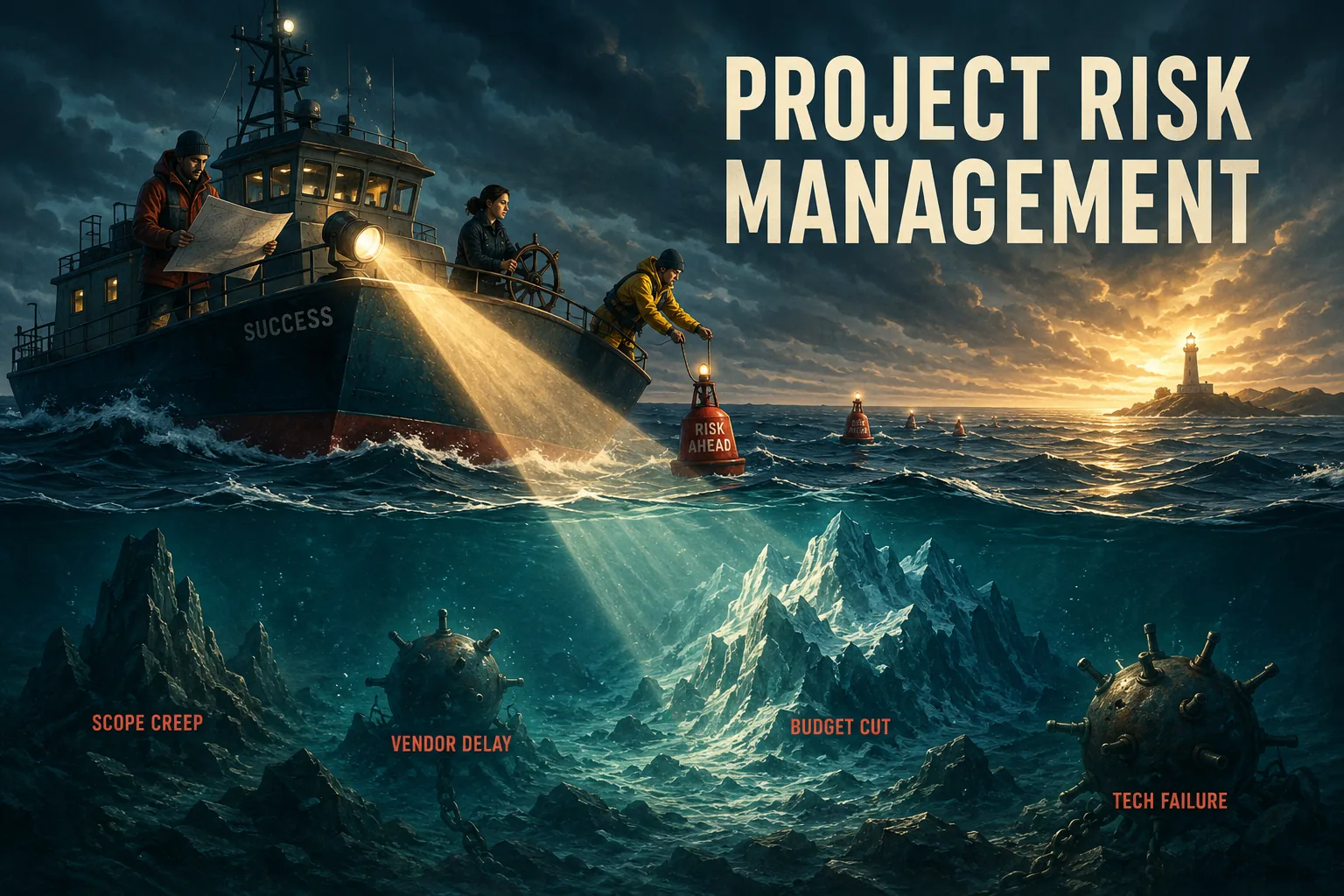
| Risk | What could go wrong, and how will we respond? | Listing obvious risks while ignoring unknown unknowns | Pre-mortem analysis; risk owner per identified risk |
The Five Core Components
Every project, regardless of size or methodology, involves managing five interconnected components. Getting any one wrong affects all the others.
1. Scope: What Are We Actually Building?
Scope defines the boundaries of the project - what will be delivered, what will not be delivered, and why.
A well-defined scope answers three questions:
- What are the deliverables? Specific, tangible outputs. Not "improve the website" but "redesign the homepage, product pages, and checkout flow with new brand identity."
- What is excluded? Equally important as what is included. "Blog redesign is out of scope for this phase. Content migration is handled by a separate team."
- What are the acceptance criteria? How will we know the deliverables are complete and satisfactory? "Homepage loads in under 2 seconds on mobile. Checkout conversion rate meets or exceeds current baseline."
The most common scope failure: Assuming everyone shares the same understanding without writing it down. The product owner imagines a Ferrari. The development team plans a Honda. The budget supports a bicycle.
Example: When Apple developed the first iPod in 2001, Steve Jobs defined the scope with ruthless clarity: "1,000 songs in your pocket." Not 500 songs with video playback and a camera.[6] Not a general-purpose mobile device. One clear deliverable, understood by everyone.
Tony Fadell and the engineering team could make a thousand decisions without going back to Jobs because the scope was unambiguous.
2. Time: When Will It Be Done?
Time management involves creating realistic schedules, identifying dependencies, and managing deadlines while accounting for the uncertainty that pervades every project.
Key concepts:
- Milestones: Significant checkpoints that mark the completion of major phases or deliverables
- Dependencies: Tasks that cannot start until other tasks complete ("cannot test until development is finished")
- Critical path: The longest sequence of dependent tasks that determines the minimum possible project duration
- Buffer: Contingency time built into the schedule to absorb inevitable delays[10]
The estimation problem: Humans consistently underestimate how long things take. Daniel Kahneman calls this the planning fallacy.[3]
The fix is not better estimation but better estimation processes: using historical data from similar projects, adding explicit contingency buffers (typically 20-50%), and breaking large estimates into smaller components where estimation error is lower.[8]
Example: Hofstadter's Law, named after cognitive scientist Douglas Hofstadter, states: "It always takes longer than you expect, even when you take into account Hofstadter's Law." The recursive nature of this observation captures the persistent optimism that afflicts project scheduling.[9]
3. Resources: What Do We Need?
Resources encompass people, budget, tools, and materials - everything required to execute the project.
People are the most complex resource. Unlike money or tools, people:
- Have varying skill levels and cannot be swapped interchangeably
- Have limited availability (they usually work on multiple things)
- Need time to ramp up on new domains
- Have interpersonal dynamics that affect team performance
Brooks' Law (from Fred Brooks' 1975 classic The Mythical Man-Month): Adding people to a late project makes it later.[2]
New team members require onboarding from existing members, communication overhead increases quadratically with team size, and work must be repartitioned to accommodate new people. There is no "10x more people = 10x faster" equation in knowledge work.
4. Quality: How Good Does It Need to Be?
Quality is not binary (good/bad) but a spectrum of dimensions, each of which can be tuned independently:
- Functional quality: Does it work correctly?
- Reliability: Does it work consistently?
- Usability: Is it easy to use?
- Performance: Is it fast enough?
- Maintainability: Can it be modified and improved?
- Polish: Does it look and feel professional?
The quality trade-off reality: Under time and budget pressure, quality dimensions get compromised - usually the less visible ones (maintainability, performance edge cases, error handling) rather than the obvious ones (appearance, basic functionality). This creates hidden debt that compounds over time.
5. Communication: Does Everyone Know What They Need to Know?
Communication is the connective tissue of project management. Without it, the other four components fall apart.
Effective project communication requires:
- Regular cadences: Predictable rhythms of updates and check-ins
- Tailored content: Different stakeholders need different information at different levels of detail
- Bidirectional flow: Not just broadcasting status but creating channels for questions, concerns, and feedback
- Honesty about problems: Bad news delivered early is manageable; bad news delivered late is catastrophic
Defining Project Success Beyond the Deadline
The traditional measure of project success - on time, on budget, within scope - misses what actually matters.
Real Success Criteria
1. Did the project solve the problem it was meant to solve?
Delivering exactly what was specified, on time, means nothing if the specification was wrong. A website redesign delivered on schedule that does not improve conversion rates has not succeeded.
2. Are stakeholders satisfied?
Technical success with disappointed stakeholders is political failure. Understanding and managing expectations is as important as managing deliverables.
3. Is the team in good shape?
A project delivered through 80-hour weeks, burnout, and turnover has not truly succeeded - it has borrowed from the future. The team needs to be able to continue working effectively on the next project.
4. Is the output sustainable?
Software that works but cannot be maintained. A process that functions but nobody understands. Documentation that is incomplete. These are success on paper, failure in practice.
Example: The Sydney Opera House was delivered 10 years late and 14 times over budget. By traditional project management metrics, it was a catastrophic failure.
By outcome metrics, it is one of the most successful building projects in history - a UNESCO World Heritage site, an architectural icon, and a major economic driver for Sydney. Success depends on which metrics you choose.
The Project Lifecycle: What Happens When
Phase 1: Initiation
Purpose: Determine whether the project should exist and define its charter.
- What problem does this project solve?
- Who is the sponsor, and are they committed?
- What are the rough scope, timeline, and budget?
- Is this worth doing compared to other priorities?
Phase 2: Planning
Purpose: Create the roadmap from current state to desired outcome.
- Break scope into deliverables, deliverables into tasks
- Estimate effort and duration for each task
- Identify dependencies and critical path
- Allocate resources and create the schedule
- Identify risks and develop mitigation plans
- Define communication plan for stakeholders
Phase 3: Execution
Purpose: Do the actual work.
- Coordinate team members and manage assignments
- Track progress against plan
- Resolve blockers and manage dependencies
- Communicate status to stakeholders
- Manage scope changes through a defined process
Phase 4: Monitoring and Control
Purpose: Ensure execution stays aligned with the plan, or adjust the plan when reality demands.
- Compare actual progress to planned progress
- Identify variances and determine causes
- Take corrective action when needed
- Update forecasts based on current performance
- Report status honestly
Phase 5: Closure
Purpose: Officially complete the project and capture lessons.
- Verify all deliverables meet acceptance criteria
- Obtain formal acceptance from stakeholders
- Document lessons learned
- Release resources
- Archive project documentation
- Celebrate completion
Small Projects vs. Large Projects: Different Approaches
Managing Small Projects (1-5 People, Weeks to Months)
- Communication: Informal - daily standups or chat channels
- Documentation: Minimal - shared document with scope, tasks, and decisions
- Decision-making: Centralized - one or two people can make calls quickly
- Tools: Simple - task list, shared calendar, communication channel
- Risk management: Reactive - handle problems as they arise
Managing Large Projects (10+ People, Months to Years)
- Communication: Formal - structured status meetings, written reports, defined escalation paths
- Documentation: Comprehensive - detailed plans, specifications, decision records
- Decision-making: Distributed - clear authority levels defining who decides what
- Tools: Structured - dedicated project management software, dashboards, reporting
- Risk management: Proactive - formal risk registers, mitigation plans, regular reviews
The critical insight: Complexity does not scale linearly with team size. A 20-person project is not four times more complex than a 5-person project - it is an order of magnitude more complex due to exponentially increasing communication paths and coordination overhead.
Project Management Skills Every Professional Needs
Even without the title, these capabilities distinguish effective professionals from those who struggle with multi-step work:
1. Work decomposition: Breaking ambiguous goals into specific, actionable tasks with clear completion criteria
2. Dependency mapping: Understanding what needs to happen before what, and who needs to be involved
3. Estimation: Developing realistic intuition for how long tasks take, accounting for interruptions and unknowns
4. Scope management: Knowing when to push back on additional requests and when to delegate
5. Risk identification: Thinking through what could go wrong and having contingency plans
6. Communication: Giving clear status updates, raising blockers promptly, and knowing who needs to know what
7. Prioritization: Focusing on high-impact work and saying no to distractions
8. Stakeholder awareness: Understanding who cares about your work and what they need from you
The Role of Documentation in Project Management
Documentation is the memory of a project. Without it, knowledge lives only in the heads of team members, making the project fragile and the organization dependent on specific individuals.
Essential Project Documents
1. Project Charter: The founding document that defines why the project exists, what it will deliver, who sponsors it, and what authority the project manager has.[1] Without a charter, the project has no official mandate and no reference point when disputes arise about scope or priority.
Example: When Spotify reorganized its engineering teams into autonomous "squads" in 2012, each squad operated like a mini-startup with its own charter-equivalent document defining its mission, success metrics, and boundaries. Henrik Kniberg, an agile coach at Spotify, documented this approach in a widely-shared paper.
The clarity of each squad's charter enabled hundreds of engineers to work autonomously without constant coordination overhead.
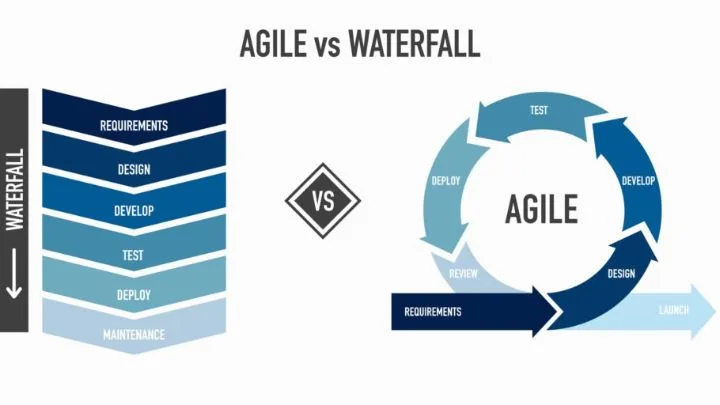
2. Requirements Documentation: Whether formal specification documents (waterfall) or user stories with acceptance criteria (Agile), the requirements define what "done" looks like. The format matters less than the discipline of writing down what was agreed.
3. Decision Records: When important decisions are made - technology choices, scope tradeoffs, vendor selections - recording the decision, the alternatives considered, and the reasoning prevents relitigating settled questions. Teams without decision records spend enormous energy debating issues they have already resolved but forgotten.
4. Status Reports: Regular written updates that create a historical record of progress, problems, and changes. When someone asks "what happened in March?" six months later, status reports provide the answer.
5. Lessons Learned: Post-project documentation of what worked, what did not, and what should be done differently next time. Organizations that skip this step repeat the same mistakes across projects.
Documentation Anti-Patterns
Over-documentation: Spending more time writing about work than doing work. Documentation should be proportional to project size and complexity. A two-person project does not need a 50-page project plan.
Documentation as bureaucracy: Creating documents because a process requires them, not because anyone will read them. If a document serves no audience, it should not exist.
Documentation without maintenance: Creating detailed documentation at the start of a project and never updating it. By month three, the documentation describes a plan that no longer exists, and the team has learned to ignore it.
Stakeholder Management: The Overlooked Fundamental
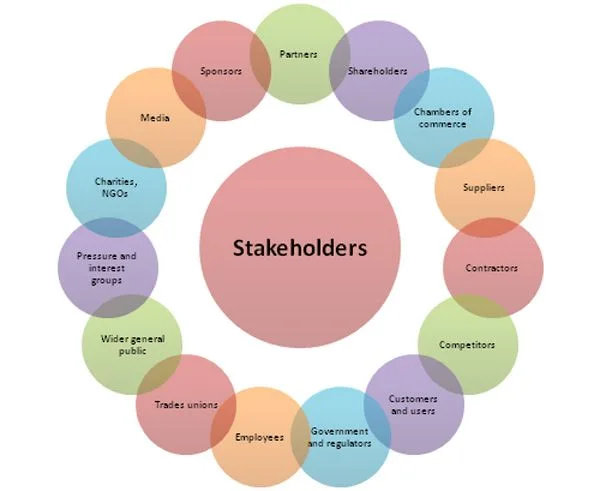
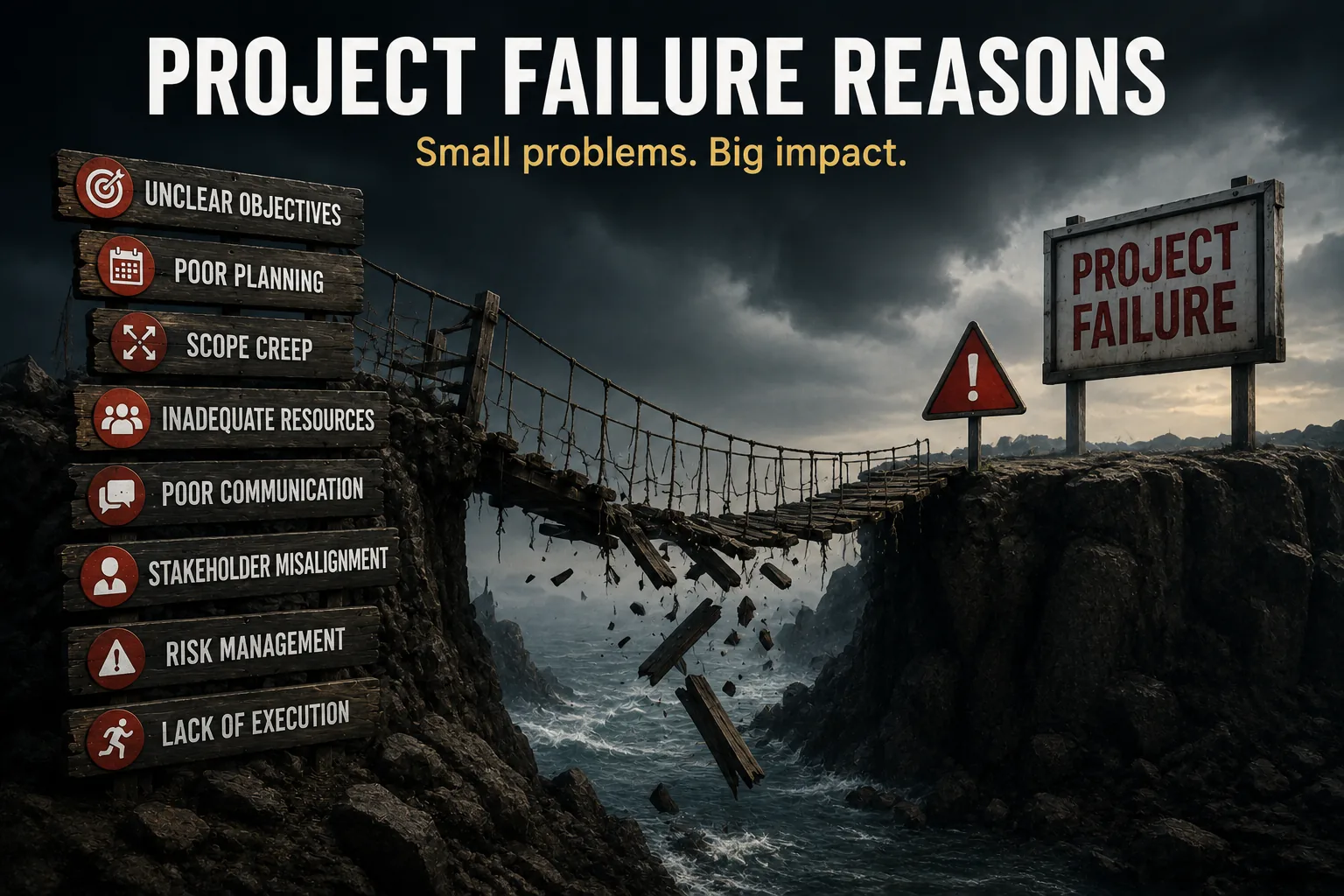
The number one reason projects fail is not technical problems. It is stakeholder misalignment. The people who fund, use, build, and are affected by the project have different expectations, and those differences are not surfaced until they cause damage.
The Stakeholder Communication Matrix
Different stakeholders need different information at different frequencies:
Executive sponsors: Monthly or milestone-based updates. One page maximum. Focus on: Are we on track? What risks exist? What decisions do you need to make?
Team members: Daily or weekly updates. Focus on: What do I need to do? What is blocking me? What context do I need?
End users: Periodic updates at major milestones. Focus on: What is changing for me? When? What do I need to prepare?
Dependent teams: Weekly coordination. Focus on: Are we going to deliver what you need, when you need it?
Example: The London Crossrail project (the Elizabeth Line), Europe's largest infrastructure project with a budget exceeding 18 billion pounds, maintained a stakeholder management system that tracked over 300 distinct stakeholder groups.
Each group received tailored communication at appropriate frequencies. When the project experienced significant delays (opening was pushed from 2018 to 2022), the stakeholder communication framework provided the mechanism for managing expectations and maintaining support through the extended timeline.
The project's eventual success owed much to stakeholder management that kept funding and political support intact through years of setbacks.
Managing Up: The Sponsor Relationship
The project sponsor is your most important stakeholder. They provide funding, political cover, and escalation authority. Managing the sponsor relationship effectively requires:
- No surprises: Always communicate bad news early. A sponsor who learns about a problem before it becomes a crisis has options. A sponsor who is blindsided has only blame.
- Decision framing: Present options with clear tradeoffs, not just problems. "We have three options" is more useful than "we have a problem."
- Regular rhythm: Consistent updates build trust. Sporadic communication signals that the project manager is either hiding something or disorganized.
- Credit sharing: When things go well, share credit with the sponsor and the team. When things go wrong, take responsibility as the project manager.
For a deeper exploration of stakeholder dynamics, see stakeholder management explained.
Common Mistakes New Project Managers Make
Mistake 1: Planning Everything Before Starting Anything
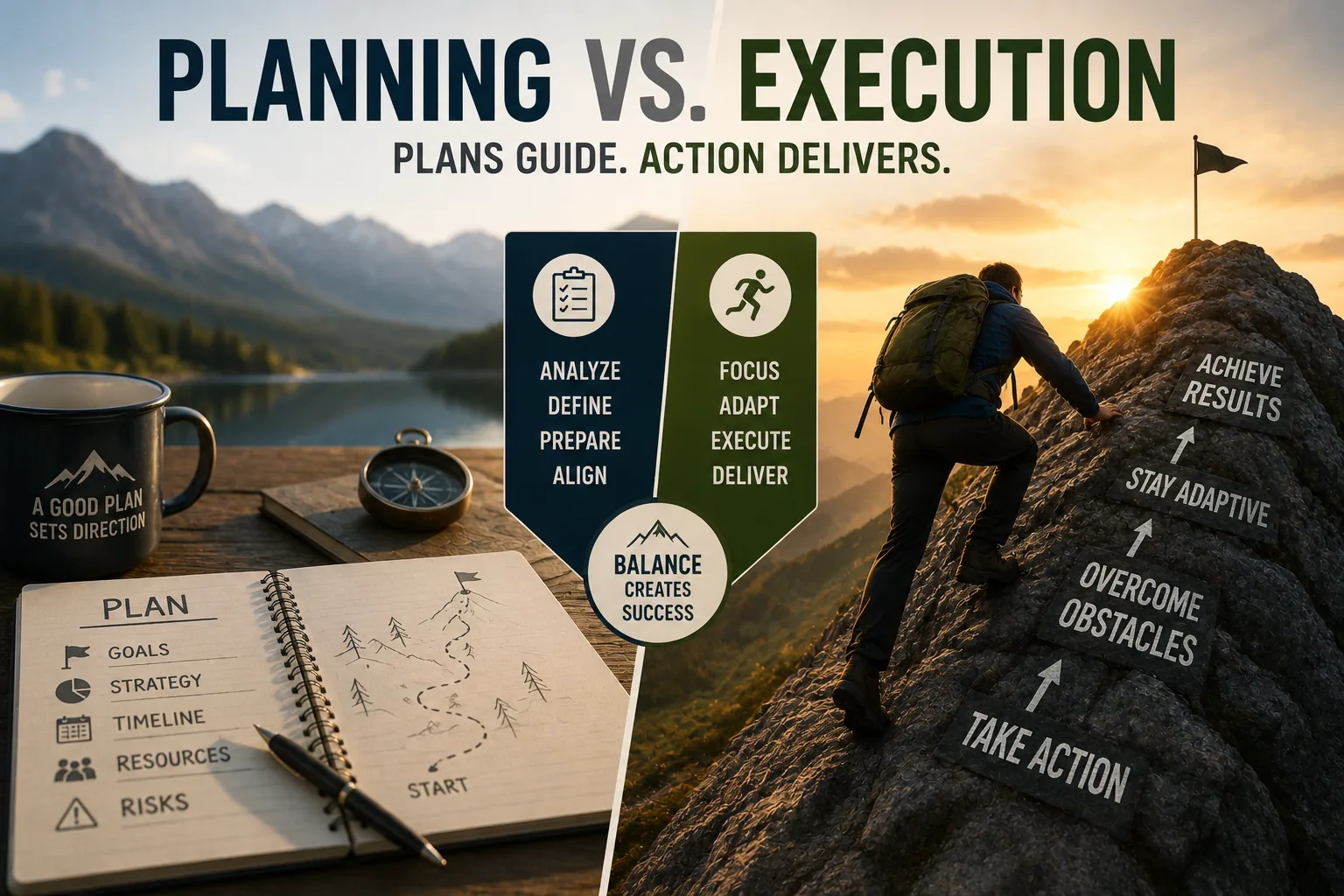
New project managers often believe they need a perfect plan before execution can begin. In reality, no plan survives first contact with execution. Plan enough to start, then adjust as you learn. The balance between planning and execution is explored in depth in planning vs execution explained.
Mistake 2: Saying Yes to Everything
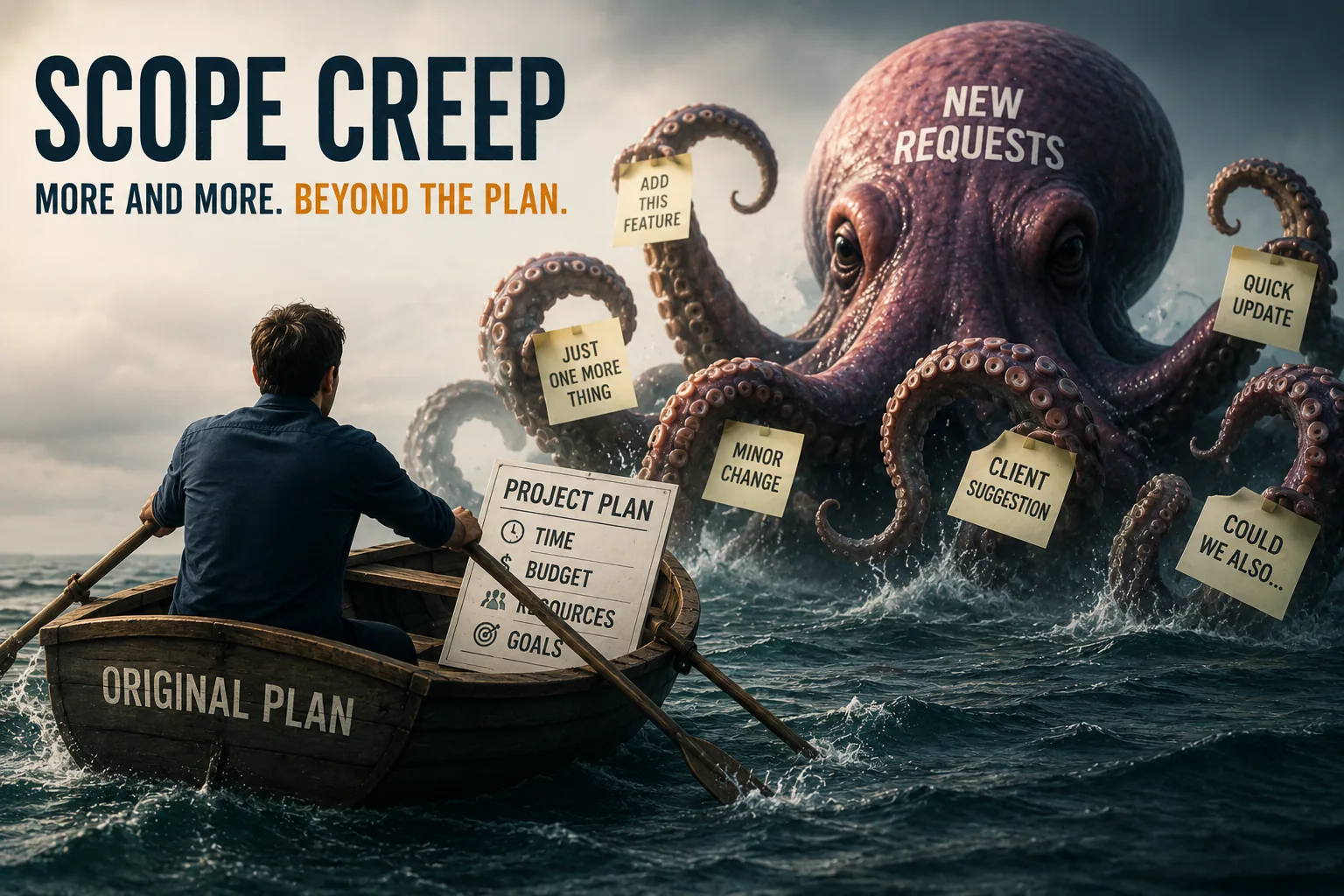
Every "yes" to a new feature, requirement, or request is also a "no" to something else - usually the schedule, the budget, or the quality.
Effective project managers are comfortable saying "yes, but that will affect the timeline by two weeks" or "we can include that if we remove something of equal effort."
Mistake 3: Confusing Activity with Progress
A team that attends many meetings, sends many emails, and appears very busy may be producing very little actual output. Progress is measured by completed deliverables that meet acceptance criteria, not by effort expended. Status reports that say "we are working on it" without specifying what is done are a red flag.
Mistake 4: Ignoring Team Health
A project that burns out its team has not succeeded even if it ships on time. The team's ability to sustain effort is a resource that must be managed, not exploited.[7] Signs of trouble include: increasing overtime, declining meeting energy, rising sick days, and growing cynicism.
For more on the relationship between sustainable effort and output, see burnout and productivity.
Mistake 5: Avoiding Difficult Conversations
When a team member is underperforming, when a stakeholder has unrealistic expectations, when a deadline is not achievable - these conversations are uncomfortable. Avoiding them makes every situation worse. The longer a difficult conversation is delayed, the harder it becomes and the more damage accumulates.
Example: Ed Catmull, co-founder of Pixar and author of Creativity, Inc., described how Pixar's culture of "candor" - honest feedback delivered with respect - was essential to their creative success. Every Pixar film goes through a "Braintrust" review where senior directors provide blunt assessment.
The films that emerge from this process are consistently better than the versions that went in. The same principle applies to project management: honest communication, even when uncomfortable, produces better outcomes than diplomatic silence.
Tools and Methodologies: A Brief Orientation
The tool and methodology landscape can be overwhelming. Here is what you actually need to know:
Gantt Charts
Visualize tasks over time with dependencies. Useful for understanding the critical path (the sequence of dependent tasks that determines minimum project duration). Available in Microsoft Project, Asana, Monday.com, and many other tools.
Kanban Boards
Visualize work as cards moving through stages (To Do, In Progress, Done). Useful for ongoing operations and maintenance work. Available in Trello, Jira, and most project management tools.
Sprint Planning
Breaking work into fixed-length iterations (typically 2 weeks) with defined commitments. Core to Scrum/Agile methodology. Suitable for software development and other work where requirements evolve.
The Honest Truth About Tools
No tool compensates for poor project management. A Gantt chart does not make an unrealistic schedule realistic. A Kanban board does not make a confused team organized. A sprint process does not make unclear requirements clear.
Choose the simplest tool that provides the visibility your project needs. For a small project with a co-located team, a shared spreadsheet or whiteboard may be sufficient. For a large project with distributed teams, invest in proper project management software.
What Research Shows About Project Failure and the Role of Fundamentals
The empirical record on project outcomes is sobering and consistent. The Project Management Institute's Pulse of the Profession research has, across different survey years, put the cost of poor project performance at roughly a tenth of every dollar invested: one edition reported about $97 million wasted for every $1 billion invested, while a later edition put overall waste at around 11 percent of investment.
Across editions of the report, the most consistently cited leading causes of project failure are changes in organizational priorities and inaccurate requirements gathering, each cited in roughly two out of every five failed projects, findings that map directly onto the five core components described above.
Bent Flyvbjerg at Oxford University's Said Business School conducted the most comprehensive empirical analysis of large project outcomes on record, drawing on a database that has grown to include more than 16,000 projects across dozens of countries.[5]
His findings, published in How Big Things Get Done (2023), established that only about half a percent of large projects hit their cost, schedule, and benefit targets simultaneously, while the large majority run over on cost, schedule, or both. The median cost overrun across his database is around 62 percent.
For information technology projects specifically, his earlier research with Alexander Budzier found that roughly one in six becomes a "black swan," with overruns averaging 200 percent, a small number of projects responsible for a disproportionate share of total cost overrun risk.
Flyvbjerg identified that the root cause was not usually technical complexity but optimism bias embedded in the planning process: project managers and sponsors systematically underestimate costs and timelines because they evaluate projects from the "inside view" (how this specific project looks) rather than the "outside view" (what typically happens to projects like this).
The Standish Group's CHAOS Report, which has tracked software project outcomes for decades, found in its 2020 edition that only about 31 percent of software projects are completed on time, within budget, and with satisfactory results, with roughly half rated "challenged" and the remainder outright failures.
The report has long identified user involvement, executive support, and clearly defined requirements among the most consistent factors separating successful projects from challenged ones, a finding that directly validates the "scope" and "communication" components described above: written, bounded, testable scope and consistent stakeholder engagement are not bureaucracy, they are the mechanism by which shared understanding is created and maintained.
Kathleen Eisenhardt of Stanford Graduate School of Business, whose landmark 1989 study of decision-making in high-velocity microcomputer firms appeared in the Academy of Management Journal, found that the fastest and highest-quality strategic decisions came from teams that gathered more real-time information, considered multiple alternatives simultaneously rather than one at a time, and used a small group of experienced advisors to pressure-test decisions before they were finalized.
The distinction maps directly to the project management skill of prioritization: knowing which elements of the five core components require intensive management attention on any given project, and gathering the right real-time information to make that call, is as important as knowing the components themselves.
Case Studies: When Fundamentals Fail and When They Work
The history of large project failures and successes provides consistent evidence for which fundamentals matter most and under what conditions.
The Denver International Airport baggage system, initiated in 1989 and analyzed extensively in academic case studies including research by Ramiro Montealegre and colleagues, is among the most instructive project failures on record.
The automated baggage handling system, intended to be a showcase technological achievement, was delivered about 16 months late with a total cost overrun commonly cited at around $560 million above original estimates, with the baggage system component alone originally budgeted around $186 million.
Analyses of the case have identified failures touching every one of the five core components described above: scope changed continuously without formal impact assessment, the timeline was based on optimistic rather than historical estimates, the team lacked relevant automated-baggage-system experience, quality was sacrificed under schedule pressure, and communication among the numerous contractors involved broke down within months of project initiation.
The project is now used as a teaching case at multiple business schools precisely because its failures are comprehensive and well documented.
The Heathrow Terminal 5 project, completed in 2008 by BAA (British Airports Authority) after roughly six years of construction, delivered a facility costing around 4.3 billion pounds essentially on time and within budget, a remarkable outcome for a project of its scale.
Andrew Wolstenholme, the project's programme director, later documented the approach in papers and interviews on major infrastructure delivery.
The project's success is widely attributed to practices that directly align with the fundamentals described above: BAA held project risk centrally rather than pushing it onto individual contractors, removing much of the adversarial relationship that typically drives scope disputes; extensive co-location of contractor and supplier teams enabled communication density across a project that ultimately involved dozens of first-tier contractors and thousands of suppliers; and a substantial centrally held risk budget was released only against documented risks, managing uncertainty explicitly rather than hiding it in individual contract prices.The Heathrow T5 case is frequently cited in project management research as an exemplar of fundamentals applied at scale.
Pixar Animation Studios' project management approach, documented by co-founder Ed Catmull in Creativity, Inc. (2014), demonstrates how project management fundamentals apply in creative, uncertain domains where they might seem least applicable.
Each Pixar film is managed as a project with defined scope (story, characters, runtime), resource constraints (production budget, team composition), and quality standards (the Braintrust review process).
Catmull documents that films that struggled and films that stayed on track showed a consistent pattern: films that went off track had lost clarity on what they were trying to achieve, while films that stayed on track maintained a shared understanding of the story's core purpose.
The most expensive rescue in Pixar's history, Toy Story 2, involved a near-total creative restart with roughly nine months left before its release date, a scope reset that came at enormous cost in overtime and strain on the crew, though not one Catmull ties to a single precise dollar figure. Catmull's account is notable for its candor about the human and organizational cost of allowing scope drift in creative projects.
The UK Government Digital Service's transformation of government technology delivery, begun in 2011 under Mike Bracken, demonstrates the fundamentals applied to organizational change.
By applying principles closely aligned with the five core components to government IT, replacing vague contractual requirements with user-research-based scope, replacing big-bang delivery timelines with iterative milestones, replacing large vendor teams with small multidisciplinary government teams, establishing explicit quality standards, and replacing episodic stakeholder reports with continuous open communication, GDS was credited with substantial savings to government IT spending over its first several years, figures that have been reported differently across sources and were also disputed by some outside analysts.The broader lesson often drawn from GDS is less about any single savings figure and more about the fact that a small, empowered, multidisciplinary team applying disciplined fundamentals outperformed the large, vendor-heavy structures it replaced.
The Foundation That Never Changes
Methodologies come and go. Agile, waterfall, lean, six sigma, prince2 - the frameworks evolve, split, merge, and rebrand. But the fundamentals remain constant:
Know what you are building. Know when it needs to be done. Know what you need to get it done. Maintain quality. Communicate relentlessly.
Every methodology is a different answer to the same questions. Master the questions, and you can adapt to any framework.
Sources & Further Reading
Project Management Institute. "A Guide to the Project Management Body of Knowledge (PMBOK Guide)." 7th Edition, PMI, 2021.
Brooks, F. P. "The Mythical Man-Month: Essays on Software Engineering." Addison-Wesley, 1995.
Kahneman, D. "Thinking, Fast and Slow." Farrar, Straus and Giroux, 2011.
Project Management Institute. "Talent Gap: Ten-Year Employment Trends, Costs, and Global Implications." PMI, 2021. View source
Flyvbjerg, B. "How Big Things Get Done." Currency, 2023.
Isaacson, W. "Steve Jobs." Simon & Schuster, 2011.
DeMarco, T. & Lister, T. "Peopleware: Productive Projects and Teams." Addison-Wesley, 2013.
McConnell, S. "Software Estimation: Demystifying the Black Art." Microsoft Press, 2006.
Hofstadter, D. R. "Godel, Escher, Bach: An Eternal Golden Braid." Basic Books, 1979.
Goldratt, E. M. "Critical Chain." North River Press, 1997.