
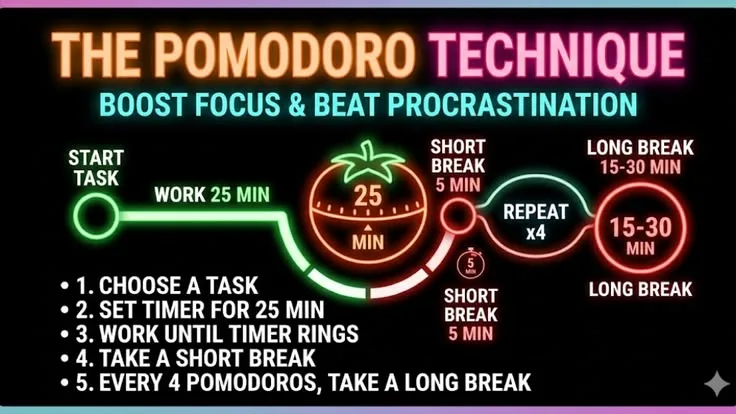
The pomodoro technique uses short, protected work intervals followed by deliberate breaks, traditionally 25 minutes of focused work and 5 minutes of rest. Its structure can reduce the barrier to starting, protect attention from interruptions, and provide recovery before sustained attention declines. Tracking completed intervals and interruptions can reveal workload patterns, while the method may need adjustment for different tasks and circumstances.
In the late 1980s, Francesco Cirillo was a university student in Rome struggling to focus on his studies. He grabbed a tomato-shaped kitchen timer, set it for 10 minutes, and challenged himself to work without interruption until it rang.
That experiment became the seed of the Pomodoro Technique, now one of the most widely practiced productivity methods in the world. "Pomodoro" is Italian for tomato, named after that original kitchen timer.
The method has survived more than three decades not because it is clever or novel, but because it aligns with how human attention actually works. Neuroscience and cognitive psychology research published since Cirillo's 2006 book have provided increasingly strong explanations for why timed focus intervals improve output.
This article examines the original method, the science underlying it, practical variations, situations where it fails, and the most common implementation mistakes.
The Original Method: Cirillo's Five Steps
Cirillo formalized the technique in his 2006 book The Pomodoro Technique and made the core method deliberately simple.[1] Complexity, he argued, is the enemy of consistent practice. The original protocol consists of five steps:
- Choose a task you want to work on.
- Set a timer for 25 minutes (one "Pomodoro").
- Work on the task without interruption until the timer rings.
- Take a short break of 5 minutes.
- After four Pomodoros, take a longer break of 15-30 minutes.
That is the entire system. Cirillo was emphatic that a Pomodoro is indivisible: if you are interrupted during a 25-minute block, the Pomodoro is void and must be restarted. This strictness is intentional. It forces you to protect focus time aggressively and to defer interruptions rather than accommodating them.
"A Pomodoro cannot be divided: there is no such thing as half a Pomodoro or a quarter of a Pomodoro. The atomic unit of time is a Pomodoro." --- Francesco Cirillo, The Pomodoro Technique (2006)
Cirillo also prescribed tracking: at the end of each day, you record how many Pomodoros you completed, which tasks consumed them, and how many interruptions occurred.
This tracking data becomes a personal productivity metric over time, revealing patterns in when you work best, which tasks consume disproportionate focus, and how frequently external interruptions derail your plans.
The Science Behind 25-Minute Focus Blocks
The Pomodoro Technique predates the neuroscience that explains it. Several converging research areas illuminate why timed intervals of approximately 20-30 minutes produce better cognitive output than open-ended work sessions.
Attention and the Vigilance Decrement
Human sustained attention is not constant. It degrades over time in a phenomenon psychologists call the vigilance decrement.
Research by Warm, Parasuraman, and Matthews (2008) demonstrated that the ability to detect targets in a sustained attention task declines measurably after approximately 15-20 minutes.[2] The decline accelerates with task monotony and cognitive load.
The 25-minute Pomodoro sits at the approximate boundary where attention begins to degrade for most people. By stopping before significant deterioration occurs, you maintain higher average attention quality across the day.
Working in 25-minute blocks with breaks produces more total high-quality focus time than working in unbroken 3-hour stretches where the last 90 minutes are spent in diminished cognitive capacity.
| Time Into Task | Attention Quality | Error Rate | Subjective Effort |
|---|---|---|---|
| 0-10 minutes | High | Low | Moderate (startup costs) |
| 10-25 minutes | Peak to moderate | Low to moderate | Low (flow state possible) |
| 25-45 minutes | Declining | Rising | Rising |
| 45-90 minutes | Significantly degraded | High | High |
| 90+ minutes | Highly variable | Very high | Very high or numbing |
Ultradian Rhythms
Beyond attention span, the body operates on ultradian rhythms: biological cycles shorter than 24 hours that govern energy and alertness. Research by Peretz Lavie (1985) and later by Rossi and Nimmons (1991) documented 90-120 minute cycles of high and low alertness throughout the waking day.[7]
Within each 90-minute alertness cycle, there appears to be a natural concentration peak at roughly 20-30 minutes, followed by a gradual decline.
The Pomodoro's 25-minute work / 5-minute rest pattern roughly maps onto the high-alertness phase of these ultradian cycles, though Cirillo did not design it with this science in mind. The alignment is coincidental but functionally relevant.
Attention Restoration Theory
Kaplan and Kaplan's Attention Restoration Theory (ART), developed in the 1989 book The Experience of Nature, distinguishes between directed attention (effortful, fatigable) and involuntary attention (effortless, restorative).[4] Directed attention is the resource you consume during focused work.
It depletes with use and requires rest to replenish.
The 5-minute break between Pomodoros provides a window for partial restoration of directed attention. The break is most effective when spent on activities that engage involuntary attention: looking at nature, stretching, walking, or simply staring out a window.
Breaks spent on social media, email, or other cognitively demanding activities do not restore directed attention and may actually degrade it further.
"Directed attention fatigue is not a character flaw or a failure of willpower. It is a predictable consequence of sustained cognitive effort, as inevitable as muscle fatigue during physical exertion." --- Rachel Kaplan and Stephen Kaplan, The Experience of Nature (1989)
The Zeigarnik Effect and Task Commitment
Bluma Zeigarnik's research in the 1920s demonstrated that incomplete tasks create psychological tension that improves memory and motivation for the task. When you start a Pomodoro and commit to 25 minutes, the timer creates an artificial boundary that activates this effect.
The bounded nature of the commitment ("just 25 minutes") reduces the activation energy required to begin a task, which is particularly powerful for overcoming procrastination on large or aversive projects.
The paradox is that by committing to less time, you often end up working more total time, because the reduced entry barrier leads to more frequent starts.
A person who tells themselves "I will work on this report all afternoon" is more likely to procrastinate than someone who says "I will do one Pomodoro on this report."
Variations on the Standard Pomodoro
The 25/5 ratio is a default, not a law. Research and practitioner experience have produced several effective variations:
The 52/17 Method
In 2014, the productivity tracking company DeskTime analyzed their user data and reported that the most productive 10% of their users worked in cycles of approximately 52 minutes on, 17 minutes off.[9]
This finding generated significant media coverage and offered an alternative ratio for workers whose tasks require longer sustained concentration.
The 52/17 ratio works better for tasks with high startup costs: programming, long-form writing, complex analysis, and design work. In these domains, 25 minutes may not be long enough to reach and sustain a flow state. The longer break (17 minutes) provides more thorough cognitive recovery.
90-Minute Deep Work Blocks
Cal Newport, in Deep Work (2016), advocates for longer focus blocks of 60-90 minutes for cognitively demanding creative and analytical work.[8] This aligns with the full ultradian cycle rather than a fraction of it.
Newport argues that the highest-value cognitive work, the work that produces breakthroughs, insights, and genuinely original output, requires sustained immersion that 25-minute intervals may interrupt.
Flexible Pomodoro
Some practitioners adjust the interval length based on task type:
| Task Type | Suggested Interval | Break Length |
|---|---|---|
| Administrative tasks (email, scheduling) | 15-20 minutes | 3-5 minutes |
| Writing, analysis, design | 45-50 minutes | 10-15 minutes |
| Programming, debugging | 50-90 minutes | 15-20 minutes |
| Studying for exams | 25-30 minutes | 5-10 minutes |
| Creative brainstorming | 15-20 minutes | 5 minutes |
When the Pomodoro Technique Does Not Work
No productivity method is universal. The Pomodoro Technique fails or underperforms in specific contexts:
Collaborative work environments: If your job involves frequent, legitimate interruptions (customer service, IT support, management roles with open-door policies), strict Pomodoro tracking becomes frustrating rather than productive. The "void Pomodoro" rule means you spend more time restarting timers than completing them.
Flow-dependent creative work: Musicians, artists, and some writers report that the timer interrupts deep creative immersion. When you are genuinely in a flow state, stopping at 25 minutes can break a productive rhythm that took 15 minutes to establish.
For these individuals, the 90-minute block or even untimed sessions with natural stopping points work better.
Emergency-driven roles: Security operations center analysts, emergency responders, and surgical teams cannot defer interruptions. The Pomodoro framework assumes you have the authority to protect your time, which is not true in all professional contexts.
Tasks requiring sustained context: Some debugging sessions, architectural design problems, or complex mathematical proofs require holding an enormous mental model in working memory. A 5-minute break can cause that model to collapse, forcing expensive reconstruction.
Very short tasks: If most of your tasks take 5-10 minutes each, the Pomodoro framework adds overhead without benefit. A simple checklist is more efficient for batching micro-tasks.
"The problem with productivity systems is not that they don't work. It is that people apply them to situations they were never designed for, then blame the system when results disappoint." --- David Allen, Making It All Work (2008)
Integrating Pomodoro with Task Management
The Pomodoro Technique works best when paired with a task management system rather than used in isolation. Cirillo's original method includes a "To Do Today" sheet where tasks are listed and estimated in Pomodoros.
This estimation practice is itself valuable: it forces you to think about how much effort a task actually requires, which improves planning accuracy over time.
Estimation heuristics:
- If a task will take more than 7 Pomodoros (roughly 3.5 hours), break it into subtasks.
- If a task will take less than 1 Pomodoro, batch it with similar small tasks into a single Pomodoro.
- Track your estimates vs. actuals for two weeks. Most people initially underestimate by 30-50%, which is consistent with the planning fallacy documented by Kahneman and Tversky.[10]
Digital tools that support Pomodoro tracking:
- Focus To-Do: Combines Pomodoro timer with task lists. Available on iOS, Android, Windows, and Mac.
- Pomofocus: Web-based, free, minimal interface. Good for trying the method without commitment.
- Toggl Track: Not Pomodoro-specific but supports timed intervals with project categorization.
- Forest: Gamifies focus by growing virtual trees during Pomodoro sessions. Trees die if you leave the app.
For knowledge workers who maintain extensive notes across projects, combining Pomodoro with structured note-taking creates a powerful workflow. Each Pomodoro session produces both output (work product) and metadata (what you learned, what problems you encountered, what needs follow-up).
Capturing that metadata in organized notes prevents the common pattern of completing a Pomodoro but losing the insights generated during it.
Research on Effectiveness: What the Studies Show
The Pomodoro Technique specifically has limited controlled experimental research, partly because productivity interventions are difficult to study rigorously (randomization and blinding are challenging). However, several studies on related constructs provide indirect evidence:
Ariga and Lleras (2011), published in Cognition, demonstrated that brief diversions from a task dramatically improved sustained attention.[3]
Participants who took two brief breaks during a 50-minute vigilance task maintained near-perfect performance, while the no-break group showed the typical vigilance decrement. This directly supports the Pomodoro break structure.
Biwer et al. (2023), in a study of university students published in Applied Cognitive Psychology, found that students who used structured time-blocking techniques (including Pomodoro) during study sessions scored higher on subsequent tests than students who studied in unstructured sessions of equal total duration.[5]
The effect was mediated by reduced mind-wandering during the structured sessions.
Mark, Gudith, and Klocke (2008), studying knowledge workers, found that interrupted work was completed faster than uninterrupted work but at the cost of higher stress and frustration.[6]
This suggests that while the Pomodoro framework may slow completion of individual tasks, it reduces the psychological toll of sustained work, potentially increasing total output across a full workday.
People with higher processing speed may benefit from longer intervals (45-60 minutes), while those who score lower on sustained attention measures may find the standard 25-minute Pomodoro more effective. The technique is not one-size-fits-all; self-experimentation over several weeks reveals your personal optimal interval.Common Mistakes When Using the Pomodoro Technique
Mistake 1: Treating the Timer as the Point
The timer is a tool, not the goal. Some practitioners become obsessed with completing Pomodoros rather than completing work. They count Pomodoros like a score, celebrating a "10-Pomodoro day" regardless of whether the work produced was valuable. The output matters, not the input.
Mistake 2: Skipping Breaks
This is the most common failure mode. "I'm on a roll, I'll skip the break." Over a single session, this seems harmless. Over a full day, skipped breaks lead to accumulated fatigue, declining work quality in the afternoon, and eventually burnout.
The breaks are not optional accessories; they are structural components of the system.
Mistake 3: Poor Break Activities
Checking email, scrolling social media, or reading news during breaks does not restore directed attention. These activities consume the same cognitive resources you are trying to replenish. Effective breaks involve physical movement, nature exposure, social conversation (non-work), or genuine mental rest.
Mistake 4: Using Pomodoro for Everything
Not every task benefits from time-boxing. Quick emails, routine administrative work, and collaborative meetings do not need a timer. Reserve the technique for tasks where you struggle to start, struggle to focus, or need to protect against interruptions.
Mistake 5: Rigid Adherence to 25 Minutes
If 25 minutes consistently feels too short or too long for your work, change the interval. Cirillo prescribed 25 minutes as a starting point, not a commandment. The principle (bounded focus intervals with mandatory breaks) matters more than the specific number.
Setting a 25-minute timer for drafting with the explicit rule "no editing during drafting Pomodoros" separates the creative and critical functions of writing, which research consistently shows improves both speed and quality.A One-Week Pomodoro Experiment
If you have never tried the technique, here is a structured one-week trial:
Day 1-2: Use the standard 25/5 ratio. Track how many Pomodoros you complete and how many are voided by interruptions. Do not judge the numbers; just record them.
Day 3-4: Based on your interruption data, implement one change to protect your focus time. This might mean closing email, putting your phone in another room, wearing headphones, or blocking certain websites.
Day 5: Experiment with the interval length. Try 30-minute or 45-minute Pomodoros and compare your subjective experience and output quality.
Day 6-7: Review your week. Calculate your average completed Pomodoros per day, your interruption rate, and which tasks benefited most from the technique. Decide whether to continue, modify, or abandon the method.
Most people who complete a full one-week trial continue using some form of the technique, even if they modify the intervals. The act of timing focus and tracking output is itself illuminating, regardless of whether you follow Cirillo's specific protocol long-term.
The Deeper Principle: Constraint Creates Focus
The Pomodoro Technique is a specific implementation of a broader principle: artificial constraints improve creative and productive output. A timer constrains time. A word count constrains length. A deadline constrains schedule.
In each case, the constraint eliminates the paralyzing openness of "work on this until it's done" and replaces it with a bounded, manageable commitment.
This principle appears across domains. Poets write sonnets (14 lines, iambic pentameter) not despite the constraints but because the constraints force creative solutions. Software sprints (2-week bounded iterations) produce more shipping code than open-ended development schedules.
Exam time limits force efficient resource allocation that untimed conditions do not.
The Pomodoro Technique's lasting contribution to productivity practice is not the specific 25/5 ratio. It is the demonstration that ordinary people, using nothing more sophisticated than a kitchen timer, can dramatically improve their focus, output, and work satisfaction by imposing simple temporal constraints on their attention.
Sources & Further Reading
Cirillo, F. (2006). The Pomodoro Technique. FC Garage. Retrieved from
Warm, J. S., Parasuraman, R., & Matthews, G. (2008). Vigilance requires hard mental work and is stressful. Human Factors, 50(3), 433-441. doi:10.1518/001872008X312152
Ariga, A., & Lleras, A. (2011). Brief and rare mental 'breaks' keep you focused: Deactivation and reactivation of task goals preempt vigilance decrements. Cognition, 118(3), 439-443. doi:10.1016/j.cognition.2010.12.007
Kaplan, R., & Kaplan, S. (1989). The Experience of Nature: A Psychological Perspective. Cambridge University Press. doi:10.1037/10519-000
Biwer, F., de Bruin, A., Egbrink, M. G. A., & de Groot, R. H. M. (2023). Study smart: Impact of a learning strategy training on students' study behavior and academic performance. Applied Cognitive Psychology, 37(1), 142-154. doi:10.1002/acp.4028
Mark, G., Gudith, D., & Klocke, U. (2008). The cost of interrupted work: More speed and stress. Proceedings of the SIGCHI Conference on Human Factors in Computing Systems, 107-110. doi:10.1145/1357054.1357072
Lavie, P. (1985). Ultradian rhythms in alertness: A pupillometric study. Biological Psychology, 20(1), 49-62. doi:10.1016/0301-0511(85)90020-6
Newport, C. (2016). Deep Work: Rules for Focused Success in a Distracted World. Grand Central Publishing. ISBN: 978-1-4555-8669-1
Gifford, J. (2014). The secret of the 10% most productive people? Breaking! DeskTime Blog.
Kahneman, D., & Tversky, A. (1979). Intuitive prediction: Biases and corrective procedures. TIMS Studies in Management Science, 12, 313-327.