
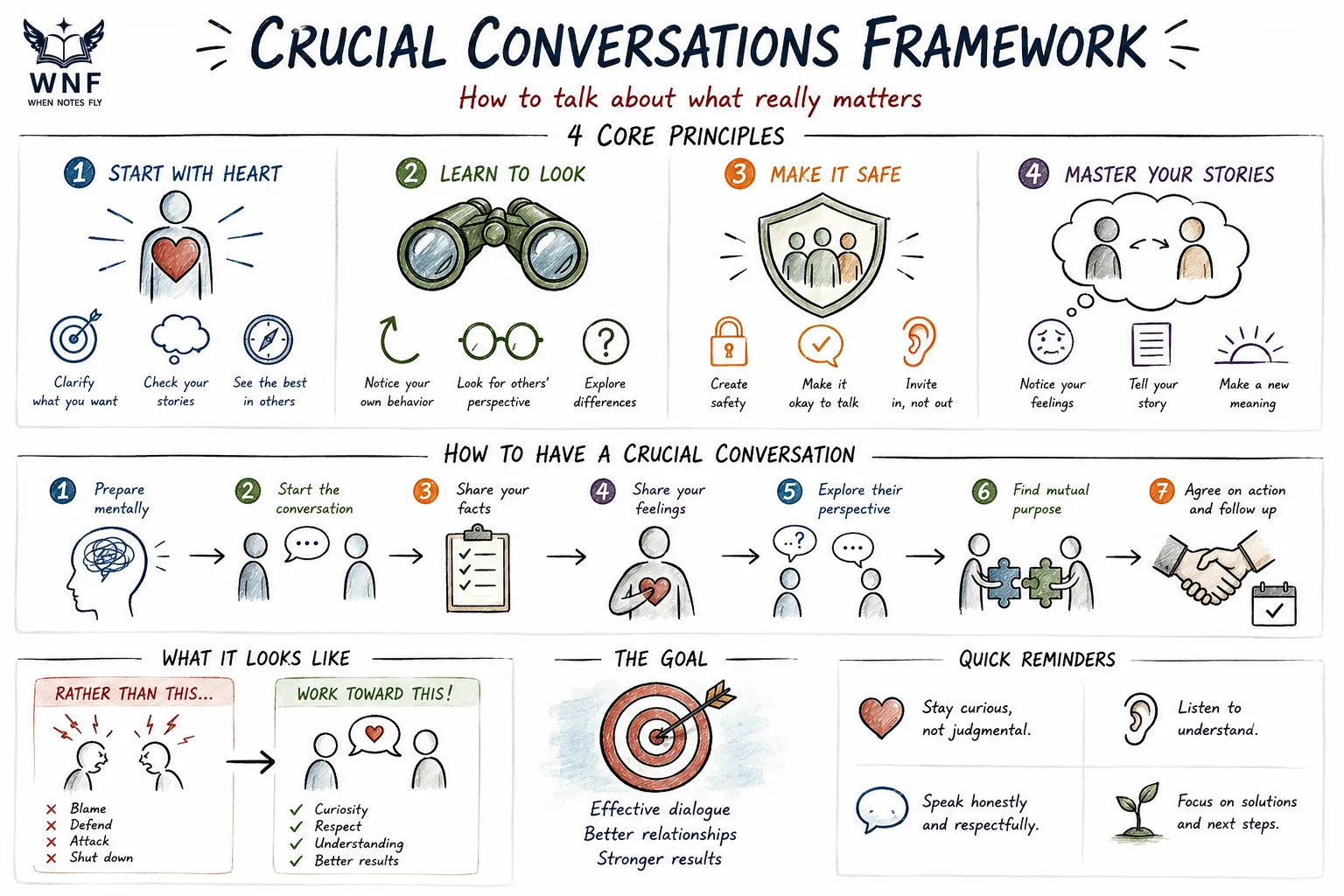
Teams differ less in the number of difficult issues they face than in whether people can discuss those issues productively. The crucial conversations framework focuses on dialogue when stakes are high, because avoiding hard subjects can damage outcomes such as safety, retention, and performance.
Kerry Patterson, Joseph Grenny, Ron McMillan, and Al Switzler published Crucial Conversations: Tools for Talking When Stakes Are High in 2002 after two decades of research on workplace communication failures at VitalSmarts, the consulting and training firm they co-founded.[1]
The core empirical observation was that organizations differed less in the number of difficult issues they faced and more in whether people talked about them productively.
Teams that handled hard conversations well outperformed teams that did not on measurable outcomes: revenue, employee retention, safety records, patient outcomes in hospitals.[2]
Teams that avoided hard conversations paid measurable costs. The book and its successor volumes packaged the research into a set of skills that can be taught and practiced.
Two decades later, the framework remains one of the most widely deployed in corporate communication training, partly because its claims are specific enough to test and the skills are concrete enough to practice. It is not a universal solvent.
It works better in some contexts than others. But for the workplace reader looking for tools to handle the conversation about a missed deadline, a failing partnership, a performance concern, or a values conflict with a leader, the framework provides practical scripts that most people do not arrive at on their own.
This piece walks through the framework faithfully, with added context from related research (Marshall Rosenbergs NVC, Douglas Stones Difficult Conversations, Amy Edmondsons psychological safety work), and provides scripts calibrated for specific situations.[3]
"At the core of every successful conversation lies the free flow of relevant information. People openly and honestly express their opinions, share their feelings, and articulate their theories. They willingly and capably share their views, even when their ideas are controversial or unpopular.
This skill set turns out to be the universal skill set of influence." - Kerry Patterson et al., Crucial Conversations (2002)
The Three Conditions That Make a Conversation Crucial
The framework defines a crucial conversation as one where three conditions converge: stakes are high, opinions differ, and emotions run strong. Any two of the three produce a normal difficult conversation. All three produce a crucial conversation, and the dynamics change.
High stakes: Outcomes matter. Promotions, firings, major project decisions, relationship continuity, financial consequences, safety.
Differing opinions: There is a real disagreement. Not a miscommunication where clarification resolves the issue. An actual difference in view that both parties hold with conviction.
Strong emotions: One or both parties are activated. Anger, fear, hurt, resentment, anxiety. The amygdala is engaged. Executive function is partially offline.
Under these conditions, the research identifies two default responses that produce worse outcomes than the conversation has to produce: silence and violence. Silence is the class of withdrawal behaviors, ranging from subtle (withholding the real issue) to overt (leaving the conversation).
Violence is the class of attack behaviors, ranging from controlling (forcing a conclusion) to labeling (characterizing the other person) to verbal force. Most people in most crucial conversations default to silence most of the time and violence occasionally, often alternating. Both fail.
The framework argues that the skilled alternative is dialogue: the free flow of information between people with differing views, conducted under conditions that allow all parties to contribute fully. Dialogue is not the absence of disagreement. It is disagreement expressed and explored without the conversation derailing.
Start With Heart: Getting Your Own Motives Right
The first skill the authors identify is self-examination before the conversation begins. What do you actually want? For yourself, for the other person, for the relationship, for the outcome. The question matters because crucial conversations often drift from their stated purpose as emotions rise.
The person who started the conversation wanting to improve a deliverable often ends it wanting to win an argument. The drift is subtle and damaging.
The skill is articulating your goals specifically before the conversation and testing them against what the authors call the fools choice: the belief that you must choose between getting your needs met and preserving the relationship. The fools choice is a false binary, and defaulting to it produces one of two bad outcomes.
The alternative is refusing the binary: asking how you can achieve the outcome you need while preserving the relationship, not as a compromise but as a genuine both.
| Drift Pattern | Symptom | Corrective Question |
|---|---|---|
| Winning the argument | Scorekeeping, one-upmanship | What do I actually want for the other person? |
| Punishing the other person | Bringing up past grievances | What do I want this conversation to produce? |
| Keeping the peace | Suppressing the real issue | What outcome do I want for the relationship long-term? |
| Being right | Refusing to consider new information | What would change my mind if it were true? |
| Protecting myself | Preemptive defense, counter-attack | What am I afraid of and is it accurate? |
Make It Safe: The Conditions for Dialogue
The second core skill is creating and maintaining the conditions under which the other person can actually engage with the conversation. The authors identify two conditions that must both be present for safety: mutual purpose and mutual respect.
Mutual purpose means both parties believe the conversation is working toward something both of them want. Not identical goals, but overlapping or compatible goals. When one party perceives the other is pursuing a goal that excludes or harms their interests, defensiveness rises and dialogue shuts down.
Mutual respect means both parties believe they are being treated as a fellow human with legitimate views, experience, and dignity. Loss of mutual respect produces the fastest shutdown of dialogue because the conversation stops being about the topic and becomes about the relational status.
When either condition is absent, the conversation moves into silence or violence regardless of the quality of the arguments. The skilled move is to notice the loss of safety quickly and to step out of the content to address the process.
This is counterintuitive for most people, who try to push harder on the content when the conversation becomes difficult. Pushing on content when safety is broken makes it worse.
The restoration techniques the framework teaches include:
Contrasting: A two-part statement that clarifies what you do not intend and what you do intend. "I do not want you to think I am questioning your competence. I do want to understand how we got to this outcome so we can address it." Contrasting is most useful when the other person has misinterpreted your intent.
Apologizing: When you have actually caused harm. Specific, not generalized. "I was harsh earlier. That was not fair to you. I want to try again." Generalized apologies (I am sorry for everything) often fail because they do not address the specific harm.
Creating mutual purpose: Explicit articulation of shared goals. "I think we both want this project to succeed and we both want this team to work well together. Can we focus on what serves those together?" Making the mutual purpose explicit, when it exists, restores the frame that the conversation is collaborative.
Master My Stories: The Path from Facts to Emotion
The third skill is the cognitive one. The framework observes that humans rarely respond directly to facts. We respond to the stories we construct about facts, and we often experience the story as the facts themselves.[4]
When the same event produces anger in one person and sympathy in another, the difference is in the stories, not in the event.
The authors model this as the path to action: see and hear facts, tell a story about them, feel emotions based on the story, act on the emotions.
Most people experience the sequence as a single moment (they angered me) rather than a sequence (I observed a behavior, I interpreted it as disrespectful, I felt angry, I responded). Seeing the sequence enables intervention.
The three common story distortions the framework identifies:
Victim stories: It is not my fault. Casts self as innocent. Produces resentment and disengagement.
Villain stories: It is all their fault. Casts other as malicious. Produces hostility and attack.
Helpless stories: There is nothing I could have done. Casts situation as fixed. Produces passivity and abandonment of the conversation.
All three stories feel true in the moment and may contain truths. But they tend to omit facts that complicate the story, and the omission drives unproductive behavior.
The counter-move is to deliberately examine the stories by asking: what facts does my story account for, what facts does it omit, what other stories could explain the same facts, and what might I be contributing to the situation that the story leaves out?
"The biggest communication problem is we do not listen to understand. We listen to reply. And when we do listen, we often listen through the filter of our pre-formed story about what the person is about to say, which means we do not actually hear them.
Dialogue requires suspending the story long enough to hear the facts." - Stephen Covey, The 7 Habits of Highly Effective People (1989)[6]
STATE: The Script for Raising a Hard Topic
The STATE method is the delivery script for bringing up a difficult topic. The acronym breaks down as:
S - Share your facts. Start with the observable, verifiable evidence. "In the last three meetings, the status update you committed to deliver has not been sent." Facts are harder to argue with than interpretations and they reduce immediate defensiveness.
T - Tell your story. Offer your interpretation, clearly labeled as your interpretation rather than fact. "I am starting to think this is not a priority for you, or that the commitment did not fit your actual capacity." Tentative language matters: I am starting to think, rather than you obviously do not care.
A - Ask for others paths. Invite their interpretation of the same facts. "What is going on from your side? I am sure I am missing something." This signals that you recognize your story is partial and are open to new information.
T - Talk tentatively. Throughout the delivery, use language that acknowledges uncertainty. I think, I am wondering, it seems to me, I may be wrong. This contrasts with absolute language that forces the other person to defend rather than explore.
E - Encourage testing. Explicitly invite disagreement. "Tell me where I am wrong." "What am I missing?" "Push back on this." Making disagreement safe is the final step that distinguishes dialogue from monologue.
The sequence matters. Opening with your story rather than facts produces defensiveness. Opening with an accusation rather than observation produces counter-attack. The STATE method frontloads the elements least likely to trigger defensiveness and backloads the elements that require trust to be productive.
| STATE Element | What It Does | Common Mistake |
|---|---|---|
| Share your facts | Establishes common ground; reduces defensiveness | Leading with interpretation or emotion |
| Tell your story | Makes your concern explicit; owns the interpretation | Presenting story as fact |
| Ask for others paths | Invites new information; signals openness | Asking after youve already concluded |
| Talk tentatively | Preserves room to be wrong; reduces escalation | Speaking in absolutes |
| Encourage testing | Invites disagreement; strengthens the final view | Closing off push-back |
Worked Scripts for Common Situations
The framework is most useful in specific situations. Below are scripts adapted from the frameworks patterns for common workplace conversations.
Giving Difficult Feedback to a Peer
"I wanted to raise something that has been on my mind. In the last two project meetings, when I proposed the timeline change, you cut in before I finished and reframed the proposal. [Facts.] I am starting to think you might have concerns about the proposal that I am not hearing, or that there is a dynamic between us I am missing.
[Story, tentative.] What is going on for you? I genuinely want to understand. [Ask for path.] I could be reading this wrong and I want to check. [Encourage testing.]"
Raising a Concern With Your Manager
"I wanted to talk about something that is affecting how I am showing up. In the last three quarters, the scope of my role has grown by [specific details], and my compensation has not adjusted.
[Facts.] I think of myself as committed to this team, and I am also starting to feel that the economics are not working, which is affecting my motivation.
[Story, labeled.] I want to understand how you see the trajectory here, and what options might be available. [Ask.] I am open to hearing this differently than I see it. [Tentative, encourage testing.]"
Addressing a Performance Issue With a Direct Report
"I want to have a direct conversation about where things are. In the last two deliverables [specific items], we missed timelines by more than a week, and the quality of the final outputs was below where we needed them.
[Facts.] I am uncertain whether this is a capacity issue, a prioritization issue, or something else happening for you.
[Story, labeled.] I want to understand what is going on from your perspective before we figure out what to do about it. [Ask.] I may be missing context, so push back on anything that doesnt fit. [Encourage testing.]"
Confronting Ethical or Values Issues
"I need to raise something I have been sitting with. In the proposal we sent to the client last week, the capacity estimates we included were more optimistic than what our team actually believes we can deliver.
[Facts.] I am concerned that if we close the deal and then underdeliver, it damages the relationship and puts the team in a difficult position.
[Story.] I want to understand how you are thinking about this and whether I am seeing the risk accurately. [Ask.] I may be missing considerations you are closer to. [Tentative.]"
Pushing Back on a Senior Leaders Direction
"I want to share a concern about the direction we are heading, while acknowledging this is your call to make. The evidence I am seeing on [specific signals] suggests the plan may not achieve the outcome we are targeting.
[Facts.] I may be wrong, and I want to raise the concern now rather than at the point where course-correction is expensive. [Story, humble.] What am I not seeing that you are? [Ask, acknowledging asymmetric information.]"
For writers wanting to draft these conversations in advance, our coverage atAMPP: Getting People to Engage When They Withdraw
Not every crucial conversation involves two engaged parties. Often one party is withholding, avoiding, or disengaging. The framework identifies two withdrawal patterns. Masking is pretending to engage while withholding the real issue. Avoiding is changing the topic or physically leaving.
The AMPP pattern is the encouragement toolkit:
Ask open-ended questions. "What is your view on this?" not "Do you agree?" Open-ended questions require more than yes or no and invite substantive response.
Mirror body language or tone to signal engagement. "You seem hesitant" or "Your voice just got quiet." Reflecting what you observe invites the other person to address the process rather than forcing them through the content.
Paraphrase what they have said to demonstrate understanding. "So if I am hearing you right, you are saying the timeline is the issue, not the scope itself?" Paraphrasing confirms that you have tracked what they said and invites correction.
Prime when all else fails. Offer your best guess at what they might be thinking, even if tentative. "I wonder if you might be frustrated that this decision is happening without your input?" Priming breaks the ice when the other person cannot or will not articulate directly.
The AMPP pattern is most effective for masking, where there is something to draw out.
For persistent avoiding, particularly when avoidance is structural (someone who consistently dodges hard conversations), AMPP helps less and the real move is addressing the broader safety or relational conditions that make avoidance the preferred strategy.
"When people feel psychologically safe, they speak up about mistakes, take risks that lead to innovation, and engage in collaborative learning. Without safety, the information stays unshared, the mistakes repeat, and the innovation never surfaces.[5]
The skills of crucial conversations are skills of creating this safety in the moment and repairing it when it breaks." - Amy Edmondson, The Fearless Organization (2018)
Move to Action: Documenting the Decision
The framework recognizes that conversations alone produce nothing unless they end in specific commitments. The final phase is converting dialogue into action with four questions:
Who is responsible for the action? Single named person for each commitment. Responsibility diffuses in groups and nothing happens.
Does what specifically? Observable action, not a vague intention. "Send the updated proposal" not "follow up on the proposal."
By when? Specific deadline. "By Friday end of day" not "soon."
How will we know? The verification step. How will we confirm the action happened and produced the intended effect? "I will reply-all to confirm receipt."
These four questions applied at the close of a difficult conversation dramatically increase the probability that the conversation produces change rather than cycling back to the same conflict in future weeks. Most failed crucial conversations fail not at the delivery but at the commitment step, where ambiguity permits drift.
For business contexts where the commitments involve contractual or partnership terms, the formal documentation resources atLimits and Honest Caveats
The framework has real strengths and real limits. The limits are worth naming.
Training decay. Like most communication training, skill gains from a one-time workshop decay over 6 to 12 months without reinforcement. Organizations that embed the framework in ongoing practice (team rituals, regular refresh training, leader modeling) see sustained effects.
Organizations that treat it as a one-time intervention see transient effects.
Power asymmetry. The framework assumes roughly symmetric positions. In situations of extreme power asymmetry (a junior employee raising concerns to senior leadership; a targeted employee confronting a harassing manager), the framework helps but does not fully protect against the structural power imbalance.
Additional structural support (HR, legal, professional representation) is often necessary.
Cultural variation. The directness of the American workplace context shapes the frameworks specific scripts. Different cultural contexts, both national and organizational, vary substantially in what direct communication looks like. Adapting the skills (not just translating the words) matters for cross-cultural application.
Persistent bad actors. The framework improves conversations with reasonable parties engaged in good faith. Parties engaging in bad faith (manipulating, lying, escalating for power) require different frameworks, including some of the patterns we cover in our dark psychology article.
The skills of dialogue do not fix relationships that are structurally adversarial.
Written versus spoken. The framework focuses on spoken conversations. Much difficult workplace communication now happens in writing (email, Slack, documents). The same skills translate but the rhythms differ.
Async communication, which removes the real-time feedback loop, requires modifications that we cover in our async communication playbook.
See also: Salary Negotiation Scripts That Actually Work | How to Say No Without Feeling Guilty
Sources & Further Reading
- Patterson, K., Grenny, J., McMillan, R., & Switzler, A. (2011). Crucial Conversations: Tools for Talking When Stakes Are High (2nd ed.). McGraw-Hill.
- Maxfield, D., Grenny, J., Lavandero, R., & Groah, L. (2010). "The Silent Treatment: Why Safety Tools and Checklists Aren't Enough to Save Lives." VitalSmarts / AACN / AORN joint study.
- Rosenberg, M. B. (2015). Nonviolent Communication: A Language of Life (3rd ed.). PuddleDancer Press.
- Stone, D., Patton, B., & Heen, S. (2010). Difficult Conversations: How to Discuss What Matters Most (10th anniversary ed.). Penguin.
- Edmondson, A. C. (2018). The Fearless Organization: Creating Psychological Safety in the Workplace for Learning, Innovation, and Growth. Wiley.
- Covey, S. R. (1989). The 7 Habits of Highly Effective People. Free Press.
Further Reading
- Goleman, D., Boyatzis, R., & McKee, A. (2002). Primal Leadership: Realizing the Power of Emotional Intelligence. Harvard Business School Press.
- Heen, S., & Stone, D. (2014). Thanks for the Feedback: The Science and Art of Receiving Feedback Well. Viking.