
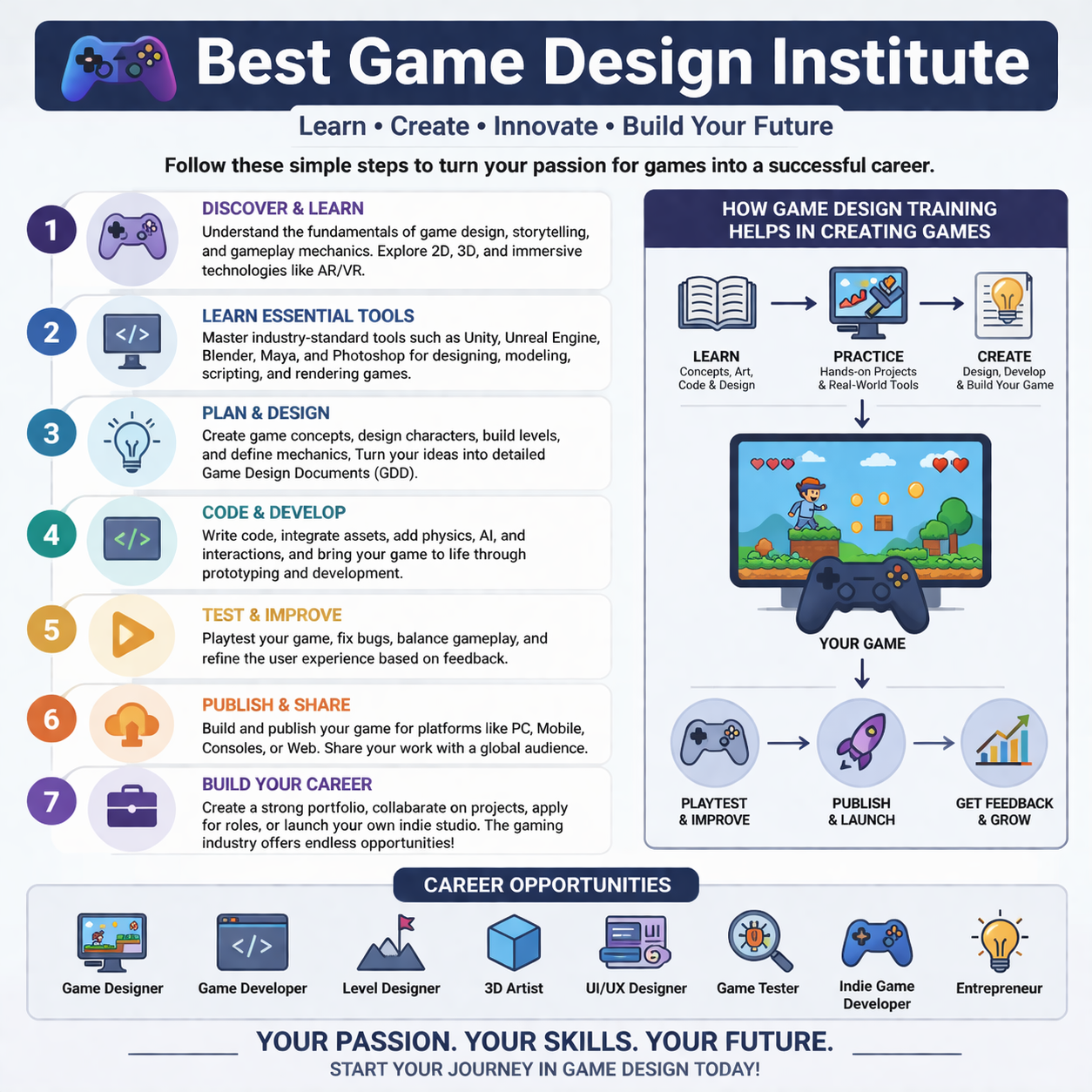
A game designer creates the rules, mechanics, systems, progression, spaces, and feedback that shape a player's experience, rather than simply writing code or making art. The game designer role relies on psychology, mathematics, narrative, user experience, prototyping, balancing, documentation, collaboration, and repeated playtesting. Strong designs are tested against real player behavior, since systems that seem elegant in theory can fail once people interact with them.
When most people hear 'game designer', they picture someone writing code or drawing character sprites. The reality is different. Game designers are architects of experience - they create the rules, mechanics, and systems that determine how players interact with a game world.
A game designer who cannot write a single line of code can still be responsible for the systems that make a game's economy, progression, and combat feel satisfying. The confusion between design and development has caused a lot of aspiring professionals to prepare for the wrong job.
Game design sits at an unusual intersection of disciplines. It draws on psychology (what makes players feel challenged versus frustrated?), mathematics (how do probability and reward schedules shape behaviour?), narrative theory (how do story and mechanics reinforce each other?), and user experience design (how do players learn a game's systems without explicit instruction?).
A strong game designer needs broad intellectual curiosity and the willingness to be wrong repeatedly - designs that seem elegant in theory often collapse in playtesting.
This article explains what game designers actually do, how the role differs across indie, mid-tier, and AAA studio contexts, what tools they use, what the salary landscape looks like, how the role differs from game development, the psychology principles underpinning effective design, and how to build a career in the field from a standing start.
"The job of the designer is not to make a game that you think is fun. It is to make a game that the player experiences as fun, which is a completely different problem." - Raph Koster, A Theory of Fun for Game Design
Key Definitions
Systems design: The discipline of creating the underlying rules, economies, and emergent interactions of a game - how combat numbers are balanced, how an in-game economy functions, how player progression is structured. Systems design is the most quantitatively rigorous of the design specialisations.
Narrative design: The discipline of integrating story, dialogue, world-building, and player choice into a coherent narrative experience. Distinct from creative writing, narrative design must account for player agency and non-linear progression.
Level design: Creating the physical spaces in which gameplay occurs - the layout of environments, the placement of enemies and obstacles, the flow of player movement, and the communication of objectives through environmental cues.
Emergent gameplay: Behaviour that arises from the interaction of simple game rules in ways not explicitly programmed or anticipated by designers. Games like Minecraft and Dwarf Fortress are celebrated for emergent gameplay - the designer creates the conditions; the player creates the experience.
GDD (Game Design Document): A living document that specifies a game's mechanics, systems, art direction, and narrative. The scope ranges from a brief pitch document to a multi-hundred-page specification, depending on studio and project scale.
Flow state: Psychologist Mihaly Csikszentmihalyi's concept of optimal experience - fully engaged, neither bored nor overwhelmed. Effective difficulty curves aim to keep players in flow by continuously matching challenge to growing player skill.
Game Designer Salary by Studio Type and Level (US, 2024)
| Level | AAA Studio | Mid-Tier Studio | Indie / Self-Published |
|---|---|---|---|
| Entry-level (0-3 years) | $50,000-$75,000 | $40,000-$65,000 | Highly variable ($0-$40k) |
| Mid-level (3-6 years) | $80,000-$115,000 | $65,000-$90,000 | Project-dependent |
| Senior Designer (6+ years) | $110,000-$160,000 | $85,000-$120,000 | Project-dependent |
| Lead Designer / Design Director | $150,000-$220,000 | $110,000-$150,000 | Equity/royalties-based |
| UK AAA Entry | 30,000-45,000 | 25,000-38,000 | - |
| UK AAA Senior | 65,000-90,000+ | 50,000-70,000 | - |
Salary data from the GDC State of the Game Industry survey (2024) and the IGDA Developer Satisfaction Survey (2023).[11][1] Indie game design income is project-dependent and wildly variable: Stardew Valley (solo developer ConcernedApe) generated over $30M in revenue; the median Steam game release earns under $1,000 in total lifetime sales.
What a Game Designer Does Day-to-Day
The daily work of a game designer is heavily dependent on production stage, studio size, and specialisation. The following reflects a typical mid-production phase at a studio of moderate size.
Designing and documenting systems: Writing detailed specifications for game mechanics - how a weapon upgrade system works, what triggers level transitions, how enemy AI responds to player behaviour. These documents are handed to programmers and artists who implement them.
Playtesting and iteration: Playing builds of the game repeatedly, observing other people playing, running formal playtesting sessions, and gathering feedback. Translating subjective playtest observations ('the second level feels unfair') into specific, testable design changes is a core competency.
Balancing: Adjusting numerical parameters - damage values, enemy health, economy rates, probability distributions - to achieve the intended difficulty curve and player experience. At larger studios, designers use data from analytics systems to make evidence-based balancing decisions.
A systems designer at a live service game may review daily player data to adjust drop rates or in-game economy values.
Collaboration: Coordinating with programmers to understand what is technically feasible, with artists to align visual language with design intent, with writers on narrative integration, and with producers to ensure design scope remains achievable within budget and timeline.
Communication is a larger part of the senior designer role than most entrants anticipate.
Prototyping: Building rough playable versions of mechanics - often in the game engine itself using visual scripting, or in a separate rapid-prototyping tool - to test ideas before committing to full development. A mechanic that takes three months to polish may take three days to prototype well enough to evaluate.
Documentation review: Keeping the GDD and related design specifications current as the game evolves. In most studios, design docs are working documents that drift from the shipped product; maintaining them accurately is a discipline that separates organised designers from chaotic ones.
Game Designer vs Game Developer: The Key Distinction
This distinction is important and frequently misunderstood by people outside the industry.
A game designer defines the experience: the rules of combat, the structure of levels, the player's goals and obstacles, the narrative beats, the emotional arc of a session. They answer the question: 'What should happen?'
A game developer (or game programmer) implements those definitions in code. They answer the question: 'How do we make it happen technically?'
At a large AAA studio, these are distinct departments staffed by different people with different training. A lead systems designer may have a degree in game design or psychology; a senior gameplay programmer will typically have a computer science degree and strong C++ skills.
At an indie studio of two or three people, the same person almost certainly does both. The distinction matters for career planning: if you want to design games and are not interested in programming, that path is viable at medium and large studios, but requires accepting that early-career opportunities may involve some technical scripting.
If you are drawn to the technical implementation side, game development (programming) is a better career label to pursue.
A useful middle path is the technical designer role, common at AAA studios: designers who can write simple gameplay scripts or work with visual scripting tools like Unreal Blueprints to prototype and implement their own designs without requiring dedicated programmer time.
Specialisations Within Game Design
Systems Designer: Focuses on the underlying rules and numerical architecture of the game - economy design, progression systems, combat tuning. Often the most quantitatively rigorous design role, requiring comfort with spreadsheets, probability, and data analysis.
Level Designer: Creates the physical environments of the game. Requires an understanding of player psychology, spatial design, difficulty pacing, and visual communication. Works closely with artists and programmers.
Entry-level opportunities in level design are slightly more accessible than systems design because level blockouts (rough geometry layouts) are easy to build and publish.
Narrative Designer: Structures how story is delivered in a game - quest design, dialogue trees, environmental storytelling, cutscene scripting. Must balance storytelling goals with player agency. Requires both writing skill and systems thinking; pure creative writing without mechanical understanding is insufficient for the role.
UX Designer: Focuses specifically on the user interface and player experience - menu systems, control schemes, tutorial design, accessibility features. This role bridges game design and product design, and is increasingly valued as games target broader audiences including older adults, players with disabilities, and players new to gaming.
Live Service Designer: Designs the ongoing content cadence, seasonal events, and monetisation mechanics for games with long-term live operations. Requires understanding of engagement psychology and data analytics.
This is one of the most commercially important design roles in the current market - live service games generate more revenue than single-player games by a substantial margin.
Tools Used by Game Designers
Game engines are the primary working environment:
- Unity: Widely used across indie, mobile, and mid-tier studios.[7] C# scripting; strong asset store ecosystem. The dominant engine for mobile game development.
- Unreal Engine: Industry standard for AAA and high-fidelity productions. Blueprints visual scripting allows designers to prototype without full C++ knowledge, making it more designer-accessible than its reputation suggests.
- Godot: Open-source engine growing rapidly in popularity for indie projects following Unity's controversial fee structure changes in 2023.
Prototyping and design tools:
- Twine: Browser-based tool for prototyping narrative and dialogue systems. Zero programming knowledge required. Essential for narrative designers.
- Machinations: Specifically designed for prototyping game economy systems and flows. Allows designers to model probability distributions and economy loops visually.
- Figma / Miro: Used for wireframing UI systems, mapping player journey flows, and creating whiteboard-style design explorations.
Documentation and collaboration:
- Confluence / Notion: Wiki-style documentation for GDDs and design specifications.
- JIRA / Trello: Task and bug tracking across development teams.
- Excel / Google Sheets: Essential for balance spreadsheets, probability modelling, and data analysis. The game designer who is proficient in spreadsheets has a practical advantage across every specialisation.
The Role of Player Psychology
Good game design is applied psychology. Several psychological principles are central to the discipline:
Flow state: Csikszentmihalyi's concept of optimal experience - fully engaged, neither bored nor overwhelmed. Effective difficulty curves aim to keep players in flow by continuously calibrating challenge to growing player skill.[5]
Games that fail to maintain flow either frustrate players (challenge exceeds skill) or bore them (skill exceeds challenge).
Operant conditioning: Variable reward schedules (the mechanism behind slot machines) create powerful engagement loops. Loot boxes and gacha mechanics are direct applications of this principle, and their ethics are actively debated within the industry.
Several European countries have regulated loot boxes as gambling; Belgium and the Netherlands have banned certain implementations outright.
Competence and mastery: Players find deep satisfaction in becoming measurably better at a skill. Games like Dark Souls succeed commercially because they make competence progression viscerally felt - dying repeatedly followed by a breakthrough creates a disproportionately powerful emotional reward.
Social comparison and cooperation: Leaderboards, guilds, and multiplayer systems tap into social motivations. The most successful live service games function as much as social platforms as they do as games. Fortnite retains players through social coordination at least as effectively as through its core mechanics.
Narrative transportation: Players who are emotionally invested in characters and story are more forgiving of mechanical roughness and more likely to continue playing. Narrative design is increasingly recognised as a retention tool, not just an artistic ambition.
The success of Baldur's Gate 3 demonstrated that story depth can drive commercial performance at a scale previously associated only with action games.
Career Path in Game Design
Junior Designer / Design Intern (0-2 years): Working on specific, well-defined tasks under direction - populating levels with assets according to a spec, testing balance sheets, documenting systems. Building familiarity with the studio's tools and production pipeline.
Game Designer (mid-level, 3-5 years): Owning specific systems or areas of the game with more autonomy. Contributing design proposals, running playtests, mentoring juniors. Beginning to develop a specialisation that will differentiate you at senior levels.
Senior Designer (5-8 years): Leading the design of major systems or areas. Contributing to design philosophy and production priorities. Mentoring the team.
At this level, communication skills become as important as design craft - a senior designer who cannot persuade a production team to prioritise a design change is ineffective regardless of the quality of the idea.
Lead Designer / Design Director (8+ years): Setting the overall design vision, managing a team of designers, coordinating with production and creative direction. Increasingly strategic rather than hands-on.
The transition to management is optional - at large studios, staff-level individual contributor paths exist for designers who want to remain hands-on.
Creative Director: The most senior creative role, responsible for the holistic creative vision of the game or game studio. Often a founder or very long-tenure senior. The role is more common at studios that produce a recurring franchise or multiple simultaneous titles.
How to Get Started With No Experience
The game design field has an unusually democratic entry mechanism: the ability to ship something playable. Employers consistently prioritise portfolios of shipped work over credentials.
Build and publish small games: Itch.io hosts hundreds of thousands of free browser-playable games and accepts new submissions from anyone.[8] Use Unity, Unreal, Twine, or Bitsy to create and publish even tiny, unpolished games. Each shipped project demonstrates the capacity to complete something - a skill that is rarer than it sounds.
Participate in game jams: Events like Global Game Jam, Ludum Dare, and GMTK Game Jam challenge participants to build a complete game in 48-72 hours.[9] Jam entries are routinely cited in portfolios and are recognised by employers as evidence of completing a project under constraints.
The GMTK Game Jam alone attracted over 6,000 entries in 2023.
Write design analyses: Documenting 'what makes this mechanic work, and how would I change it?' demonstrates design thinking even without a shipped game. Medium, Substack, and personal blogs are good platforms.
Writing a 1,500-word analysis of why a specific boss fight works is a better portfolio piece than a vague statement that you 'have a passion for games.'
Study design systematically: GDC Vault (free tier) contains thousands of talks from professional designers on every aspect of the craft.[6] Books by Raph Koster (A Theory of Fun), Keith Burgun (Game Design Theory), and Jesse Schell (The Art of Game Design: A Book of Lenses) are foundational reading.[10][4][3]
Pros and Cons of a Game Design Career
Strengths:
- Intellectually varied - systems, narrative, psychology, data, and art all intersect
- Growing global industry with increasing remote work options
- Significant creative satisfaction in shipped work
- Strong community culture and knowledge-sharing through GDC, Discord servers, and game jam networks
Challenges:
- Competitive entry, particularly for AAA studios where hundreds of applicants compete for each junior opening
- Industry prone to layoffs and studio closures - 2023 and 2024 saw significant AAA layoffs including at EA, Unity, Microsoft Gaming, and Epic
- Crunch culture persists at many studios despite public commitments to reform[2]
- Salary growth slower than software engineering, particularly at junior levels
- Geographic concentration (Seattle, Los Angeles, Austin, London, Montreal, Tokyo) may require relocation
Practical Takeaways
A portfolio of playable work is non-negotiable. Begin building it before you apply for jobs. Write design post-mortems explaining what worked and what you would change - the analysis demonstrates more design thinking than the game itself in many cases.
If you want to work in games without programming, specialise in systems design, narrative design, or UX - these are the roles most explicitly separated from development at medium and large studios.
Engage with the design community on Twitter/X, Discord game-dev servers, and LinkedIn. The industry is smaller than it appears from the outside, and reputations travel. Designers who share their work and thinking publicly are consistently more visible to recruiters than those who work privately.
The industry's layoff cycles are real: building financial resilience (a savings buffer, freelance income streams, transferable skills that apply to product design and UX outside games) protects the career you are building. Many of the most accomplished game designers have worked across multiple studios, some of which no longer exist.
Sources & Further Reading
- Game Developers Conference. State of the Game Industry Report 2024. gdconf.com
- International Game Developers Association. Developer Satisfaction Survey 2023. igda.org
- Koster, R. A Theory of Fun for Game Design. O'Reilly Media, 2013.
- Schell, J. The Art of Game Design: A Book of Lenses. CRC Press, 2019.
- Csikszentmihalyi, M. "Flow: The Psychology of Optimal Experience." Harper Perennial, 1990.
- GDC Vault, Free Talks Archive (2024). gdcvault.com
- Unity Technologies. Career in Game Development Guide 2023. unity.com
- Itch.io Platform Statistics Overview (2024). itch.io
- Ludum Dare Competition Archives and Statistics (2024). ludumdare.com
- Burgun, K. Game Design Theory. CRC Press, 2013.
- IGDA Foundation. Diversity in Games Report 2023. igdafoundation.org
Further Reading
- Bureau of Labor Statistics. Multimedia Artists and Animators, Occupational Outlook Handbook 2023. bls.gov