
The AI assistant market has matured significantly since the initial ChatGPT wave of late 2022.[12] In 2023, ChatGPT was the obvious default because it was the only serious option most people knew about.
In 2026, the landscape is genuinely competitive and the gaps between the top models matter in ways that are measurable, testable, and consequential for your work.
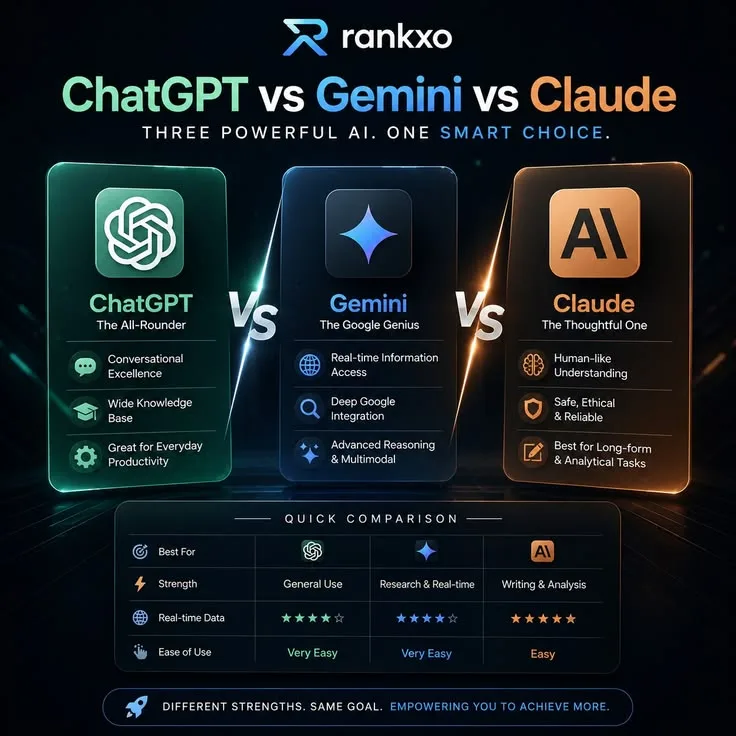
Claude from Anthropic is widely regarded as the best writer among the three. Gemini from Google has the largest context window available to consumers and deep integration with Google's search index and Workspace suite.[3]
ChatGPT has the largest ecosystem, the most integrations, and the o-series reasoning models that benchmark ahead of the field on hard logical and mathematical problems.
None of them is objectively the best for everything. But each one is objectively better than the others at specific categories of tasks, and most comparison articles are too cautious to say so directly. This one will not be.
We have run all three through extensive real-world testing across writing, coding, reasoning, research, document analysis, and general assistance, and cross-referenced that testing against published academic and industry benchmarks.
The stakes are real. At $20/month for a consumer subscription - and significantly more for API access at scale - choosing the wrong primary AI tool costs money and productivity.
Whether you are a solo creator, a software developer, a content team, or a business evaluating AI for workflows, the differences between these platforms are meaningful and worth understanding before you commit.
"The best AI assistant is not the smartest one. It is the one whose strengths align with what you actually spend your day doing."
Key Definitions
Large Language Model (LLM): A neural network trained on large text datasets to predict and generate human-like text. ChatGPT, Claude, and Gemini are all LLM-based assistants with additional instruction-following and safety training layers.
Context window: The maximum amount of text (measured in tokens, where one token approximates 0.75 words) that a model can process in a single conversation. Larger context windows allow analysis of longer documents.
Reasoning model: A model variant (such as OpenAI's o-series) trained specifically for multi-step logical deduction, often using chain-of-thought techniques that decompose complex problems before answering.[1]
Multimodal: The ability to process input beyond text, including images, audio, video, and documents. All three platforms offer multimodal capabilities on their paid plans.
Hallucination: A confident but factually incorrect output generated by an LLM. All three models hallucinate and should not be treated as authoritative sources without verification.
Feature Comparison at a Glance
| Feature | ChatGPT (OpenAI) | Claude (Anthropic) | Gemini (Google) |
|---|---|---|---|
| Best models (2026) | GPT-4o, o3, o4-mini | Claude 3.5 Sonnet, Claude 3.7 Sonnet | Gemini 2.0 Pro, Flash |
| Context window | 128k tokens (GPT-4o) | 200k tokens | 1M+ tokens (Gemini 1.5/2.0) |
| Consumer price | $20/month (Plus) | $20/month (Pro) | $20/month (Advanced, via Google One) |
| Free tier | Yes (limited GPT-4o access) | Yes (Claude 3.5 Haiku) | Yes (limited Gemini access) |
| Best for writing | Good | Excellent | Good |
| Best for coding | Excellent (o3/o4-mini) | Excellent | Good |
| Best for reasoning | Excellent (o-series leads) | Very good | Good |
| Real-time web access | Yes (paid, via browsing tool) | Yes (paid) | Yes (native Google Search) |
| Google Workspace integration | No | No | Yes (native Docs, Gmail, Drive) |
| Image generation | Yes (DALL-E 3, GPT-4o) | No (as of Q1 2026) | Yes (Imagen 3) |
| Image understanding | Yes | Yes | Yes |
| Voice mode | Yes (Advanced Voice) | No (as of Q1 2026) | Yes (Gemini Live) |
| Mobile apps | iOS and Android | iOS and Android | iOS and Android |
| Custom GPTs / Projects | Yes (GPT store, Projects) | Yes (Projects) | Yes (Gems) |
| Open source | No | No | Gemma variants (limited) |
Benchmark Performance
Published benchmarks provide a structured way to compare model capabilities across standardised tasks.[10] The following data is drawn from published evaluations and the LMSYS Chatbot Arena as of early 2026.[9]
| Benchmark | What it measures | ChatGPT (o3/GPT-4o) | Claude 3.7 | Gemini 2.0 Pro |
|---|---|---|---|---|
| MMLU (5-shot) | General knowledge breadth | ~90% (GPT-4o) | ~88% | ~87% |
| HumanEval | Python code generation accuracy | ~90% (o3) | ~88% | ~84% |
| MATH | Competition-level math problem solving | ~97% (o3) | ~78% | ~79% |
| GPQA Diamond | Expert-level science questions | ~83% (o3) | ~78% | ~72% |
| MMMU | Multimodal understanding (images + text) | ~82% | ~73% | ~81% |
| Chatbot Arena ELO (approx.) | Human preference voting | 1400+ (o3) | 1380+ | 1340+ |
Sources: OpenAI technical reports (2025), Anthropic model card (2025), Google DeepMind technical report (2025), LMSYS Chatbot Arena leaderboard (2026). Note: benchmark scores vary by evaluation methodology and model version; treat these as directional, not absolute.
The o3 model's MATH score of 97% is worth emphasising: this is a category-defining result that represents a step change from previous model generations. For mathematical and formal reasoning tasks, OpenAI's reasoning models are currently in a different performance bracket.
Pricing: Consumer and API
Consumer Subscriptions
All three flagship consumer subscriptions are priced at approximately $20 per month.[4] At this tier they are essentially commodities in terms of price; capability is the differentiator.
| Plan | Price | Key inclusions |
|---|---|---|
| ChatGPT Plus | $20/month | GPT-4o, o3-mini, DALL-E, browsing, file analysis |
| Claude Pro | $20/month | Claude 3.5 Sonnet, 3.7 Sonnet, Projects, extended context |
| Gemini Advanced | $20/month (via Google One AI Premium) | Gemini 2.0 Pro, Workspace integration, 2TB Drive storage |
The Gemini Advanced plan includes 2TB of Google Drive storage alongside the AI subscription, which makes it materially better value for users already in the Google ecosystem.[6]
API Pricing for Developers
API pricing matters significantly for teams building AI-powered products.
| Model | Input (per 1M tokens) | Output (per 1M tokens) | Context window |
|---|---|---|---|
| GPT-4o | $5.00 | $15.00 | 128k |
| o3-mini | $1.10 | $4.40 | 128k |
| Claude 3.5 Sonnet | $3.00 | $15.00 | 200k |
| Claude 3.5 Haiku | $0.80 | $4.00 | 200k |
| Gemini 1.5 Pro | $3.50 | $10.50 | 1M |
| Gemini Flash 2.0 | $0.10 | $0.40 | 1M |
| Gemini 2.0 Pro | $7.00 | $21.00 | 2M |
Sources: OpenAI pricing page, Anthropic pricing page, Google AI Studio pricing, as of Q1 2026. Prices vary by volume tier and region.
Gemini Flash 2.0 at $0.10 per million input tokens is one of the most cost-effective models available for high-volume tasks where quality requirements allow a capable but not frontier-tier model. For very large context applications, Gemini's million-plus token windows fundamentally change the architecture of what is possible.[8]
Writing Quality: Where Claude Leads
Writing is where Claude most clearly separates itself. This is not a marginal difference. Present all three with the same 1,500-word essay prompt on a complex topic, and the qualitative gap is visible to any careful reader.
Claude's prose varies sentence structure naturally, chooses words precisely, and takes genuine positions. It resists the pattern of hedging every claim and appending symmetrical 'however, on the other hand' qualifiers.
Its tonal range is wide: clinical analysis, warm personal essays, sharp criticism, and dry humour all feel coherent and intentional.
ChatGPT produces competent, versatile writing but has a recognisable house style: slightly formal, fond of numbered lists and headers, prone to the 'three key considerations' structure. For marketing copy, structured business documents, and templates, this is serviceable.
For literary or genuinely persuasive writing, it often feels manufactured.
Gemini's writing quality has improved substantially since early versions. It performs best when the writing task benefits from current information access - technology summaries, current events briefings, research memos - where its Google Search integration is a structural advantage. For pure prose, it generally places third.
Winner for writing: Claude. ChatGPT competitive for structured and commercial writing. Gemini best when real-time information is required.
Coding: OpenAI's Reasoning Models vs Claude's Clarity
For coding, the comparison is competitive and task-dependent.
OpenAI's o3 and o4-mini reasoning models lead on hard algorithmic problems, competitive programming challenges, and tasks requiring multi-step logical deduction.[7]
The MATH and HumanEval benchmark results are consistent with what developers experience: for complex algorithm design and mathematical computation, these models are the current ceiling.[11]
For everyday professional coding - feature development, debugging, refactoring, code review, and documentation - Claude 3.5 Sonnet and 3.7 are exceptional.
Many developers prefer Claude not just for code generation but for explanation: Claude is willing to walk through debugging logic step by step, write code with meaningful inline comments, and explain architectural decisions in language a junior developer can learn from.
Its output tends to be cleaner and more idiomatic in most languages.
Gemini is strong on code integrating with Google Cloud, Firebase, and Google APIs. For Google-ecosystem developers, the tight integration is genuinely useful. For general software development, it lags behind both OpenAI and Anthropic's best models on most benchmarks.
Winner for complex algorithmic coding: ChatGPT (o3/o4-mini). Winner for everyday professional coding and explanation: Claude. Gemini for Google-stack development.
Reasoning and Analysis
OpenAI's o-series models are a category apart for formal reasoning. They are trained to think through problems step by step before producing an answer - chain-of-thought reasoning implemented at the training level rather than prompted.
On mathematical benchmarks, logic puzzles, scientific reasoning, and multi-step planning, they consistently outperform everything currently available.
This matters for specific users: quantitative analysts, researchers, engineers, and anyone whose work involves sustained formal inference. For these users, o3 represents a genuine capability step change from previous AI generations.
For analytical reasoning in natural language - business strategy analysis, policy evaluation, research synthesis, structured argumentation - the gap narrows. Claude's analysis is thorough, well-structured, and reliable. It is less prone to the confident systematic errors that less capable models produce.
For qualitative reasoning tasks, Claude's ability to maintain nuance across long analytical documents gives it a practical edge.
Gemini's reasoning is solid for general-purpose tasks but does not lead the field in either formal or informal reasoning categories.
Winner for formal logical and mathematical reasoning: ChatGPT (o3/o4-mini). Winner for analytical writing and structured argumentation: Claude.
Research and Real-Time Information
All three platforms offer web access on paid plans, but Gemini's integration with Google Search is structurally different from the browser tools in ChatGPT and Claude. Gemini is effectively a reasoning layer on top of the world's largest search index.
For queries about current events, recent product releases, live pricing, or fast-moving technology topics, Gemini's results are more comprehensive and reliably current.
Claude with web access is strong for research synthesis: taking multiple sources and producing a coherent, well-written analysis. ChatGPT is similarly capable with browsing enabled.
For research requiring current information, Gemini leads. For research requiring synthesis, interpretation, and long-document analysis - reading a 200-page report and extracting insights - Claude's 200k context window and writing quality give it an advantage.
Winner for current information retrieval: Gemini. Winner for research synthesis and long-document analysis: Claude.
Context Windows: Gemini's Structural Advantage
| Model | Context window | Practical capacity |
|---|---|---|
| GPT-4o | 128k tokens | ~96,000 words (one large novel) |
| Claude 3.5 / 3.7 | 200k tokens | ~150,000 words (a large codebase) |
| Gemini 1.5 Pro | 1,000,000 tokens | ~750,000 words (10+ novels or a full codebase) |
| Gemini 2.0 Pro | 2,000,000 tokens | ~1,500,000 words (an entire software project) |
A one-million-token context window is not theoretical. It means Gemini can process an entire application codebase, a year of meeting transcripts, or a comprehensive research corpus and reason across all of it in a single conversation.
For enterprise use cases - legal document analysis, large codebase review, longitudinal data analysis - this is a genuine capability distinction.
Claude's 200k window handles most professional needs: a long book, a large module-level codebase, or a collection of documents. ChatGPT's 128k window occasionally becomes a constraint for complex multi-document tasks.
Winner for raw context capacity: Gemini. Claude second and sufficient for most professional use cases.
Safety Approaches: How the Three Companies Differ
The three companies have meaningfully different philosophies on AI safety, which affects model behavior in ways users experience daily.
OpenAI has moved toward what it calls 'preparedness' - systematic evaluation of frontier model capabilities before deployment, with a focus on preventing catastrophic misuse.
In practice, OpenAI's models tend to be less restrictive on contested topics than early ChatGPT versions, and the o-series models are more capable but also more direct in their outputs.
Anthropic was founded by former OpenAI researchers with constitutional AI and alignment research as core competencies.[2] Claude is trained using a 'Constitutional AI' approach that teaches the model to evaluate its own outputs against a set of principles rather than relying solely on human feedback labeling.
In practice, Claude is sometimes cautious on edge-case requests but is generally less restricted than early GPT-4 on nuanced topics.
Google DeepMind approaches safety as both an alignment and a reputation management concern. Gemini has had several high-profile public failures in its early versions around image generation and factual accuracy.
Google has invested significantly in addressing these issues, and Gemini's safety behavior in 2026 is substantially more consistent than it was in 2023-2024.
Pros and Cons Summary
ChatGPT
Pros: Best reasoning models (o3/o4) for hard problems; largest ecosystem and integrations; image generation via DALL-E 3; strong coding across all task types; massive community; Custom GPT marketplace; Advanced Voice mode.
Cons: Writing quality can feel formulaic; smaller context window than competitors; some features require Plus; rapid model releases create workflow uncertainty.
Claude
Pros: Best writing quality of the three; exceptional coding with clear explanations; 200k context window for large documents; nuanced, reliable responses; strong instruction following; less prone to confident hallucinations.
Cons: No native image generation (as of Q1 2026); no voice mode; smaller ecosystem than OpenAI; reasoning benchmarks lag o-series on formal tasks.
Gemini
Pros: Largest context window (1M-2M tokens); best real-time information access via Google Search; native Google Workspace integration; strong multimodal capabilities; Gemini Flash is one of the most cost-effective API options available.
Cons: Writing quality generally places third; reasoning benchmarks lag ChatGPT o-series; early versions had prominent factual reliability issues that affected brand trust; some regional feature limitations remain.
Final Verdict: Which to Use When
Use Claude if: writing quality, document analysis, and nuanced instruction following are your priorities. It is the best all-purpose AI assistant for knowledge workers who primarily write, research, and analyse. For content teams, consultants, researchers, and writers, Claude is the first choice.
Use ChatGPT if: you need the best reasoning models for hard problems, you want image generation built in, you use a specific integration in the OpenAI ecosystem, or you work on complex algorithmic or mathematical challenges where the o-series models are genuinely transformative.
Use Gemini if: you work inside Google Workspace and want AI deeply integrated with your existing documents, you need the largest possible context window for bulk document processing, or you require the most current web information as part of your workflow.
Use all three for different tasks. At $20/month each, using Claude for writing and ChatGPT for reasoning tasks costs $40/month - a reasonable budget for professionals whose work involves meaningful AI usage.[5] The tools are not interchangeable, and treating them as such leaves performance on the table.
Sources & Further Reading
- OpenAI model overview and technical reports, 2025-2026 - platform.openai.com/docs/models
- Anthropic Claude model card and benchmark results, 2025 - anthropic.com/research
- Google DeepMind Gemini technical report, 2025 - deepmind.google/technologies/gemini
- ChatGPT Plus and API pricing - openai.com/pricing
- Claude Pro and API pricing - anthropic.com/pricing
- Gemini Advanced and Google AI Studio pricing - ai.google.dev
- OpenAI o3 reasoning model announcement and MATH benchmark - openai.com/o3
- Gemini 1.5 Pro context window documentation - ai.google.dev/gemini-api/docs/models/gemini
- LMSYS Chatbot Arena leaderboard - chat.lmsys.org
- MMLU benchmark methodology - arxiv.org/abs/2009.03300
- HumanEval benchmark - arxiv.org/abs/2107.03374
- 'State of AI Report 2025,' Air Street Capital, 2025 - stateof.ai