
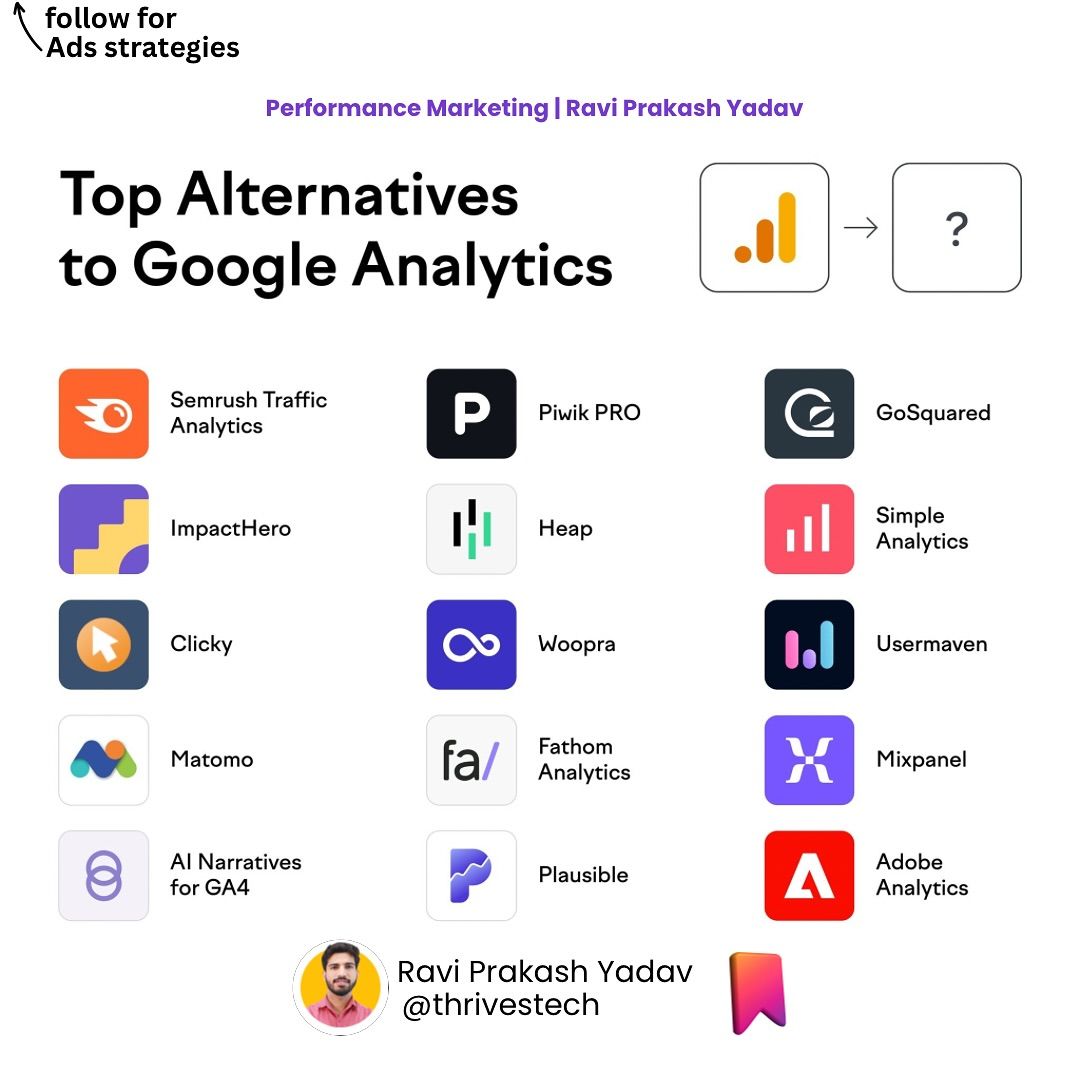
Google Analytics alternatives are web and product analytics platforms that organizations adopt to replace or supplement Google Analytics, typically motivated by privacy compliance requirements, usability frustrations with GA4, or the need for product-level behavioral data that Google Analytics was never designed to provide.
Google Analytics is installed on an estimated 55 to 70 percent of all websites with detectable analytics scripts (W3Techs, 2024), making it the dominant platform by a wide margin.
But dominance does not mean suitability. Between 2022 and 2024, a combination of European regulatory enforcement, a widely disliked interface redesign, and growing demand for privacy-first tools created the largest migration away from Google Analytics since its launch in 2005.
This article evaluates ten analytics alternatives across privacy compliance, feature depth, pricing, and the specific use cases each serves best - from lightweight privacy-first tools for content sites to enterprise product analytics platforms for SaaS applications processing billions of events.
"The data you do not collect cannot leak, cannot be subpoenaed, and cannot be used against your users. The best privacy feature is the absence of the problem." - Uku Taht, co-founder of Plausible Analytics, 2021
Why Organizations Are Leaving Google Analytics
GDPR Enforcement Actions
The European General Data Protection Regulation created legal exposure that many organizations using Google Analytics had not fully assessed.
Between 2022 and 2023, data protection authorities in Austria (DSB, January 2022), France (CNIL, February 2022), Denmark (Datatilsynet, September 2022), and Italy (Garante, June 2022) each issued formal decisions finding that Google Analytics violated GDPR by transferring visitor data to US servers without adequate safeguards under the Schrems II ruling.
These were not theoretical warnings. The Austrian decision specifically found that a website operator's use of standard Google Analytics configuration constituted an illegal data transfer. The French CNIL gave organizations one month to comply.
The cumulative effect was a meaningful wave of migrations to analytics tools that keep data within the EU, avoid transferring visitor data to third-party servers, or eliminate personally identifiable information collection entirely.
The EU-US Data Privacy Framework adopted in July 2023 partially addressed the transatlantic transfer issue, but privacy advocates - including the organization noyb led by Max Schrems - have signaled their intention to challenge it, creating ongoing legal uncertainty for organizations relying on US-hosted analytics.
The GA4 Usability Problem
Google Analytics 4 (GA4), which replaced Universal Analytics in July 2023, is a fundamentally different product. The shift from a session-based to an event-based data model is architecturally more flexible, but the interface is substantially harder to use for everyday questions.
Answering "How many people visited my site last week?" - a question Universal Analytics answered on its home screen - requires navigating a report builder that many marketers and website owners find unintuitive.
A 2023 survey by Databox found that 73% of marketers reported difficulty transitioning from Universal Analytics to GA4, with the most common complaints being the learning curve for the new interface, inconsistent metrics between the two platforms, and the loss of familiar reports.
The frustration drove many organizations to evaluate simpler alternatives for the first time.
Key Definitions
Session: A group of user interactions on a website within a given time frame. Universal Analytics used sessions as its primary measurement unit; GA4 shifted to events.
Bounce Rate: The percentage of sessions where a user visits only one page. GA4 redefined this metric in a way incompatible with Universal Analytics, causing widespread reporting confusion during the transition.
Cohort Analysis: Tracking groups of users who share a characteristic (e.g., users who signed up in January) over time. Essential for measuring retention in subscription businesses.
Funnel Analysis: Measuring the sequential steps users take toward a goal (e.g., sign up, verify email, complete onboarding) and identifying where drop-off occurs.
First-party data: Data collected directly from your users through your own platforms, as opposed to third-party data shared across sites. Privacy regulations have accelerated the shift toward first-party collection.
Autocapture: An analytics approach that records all user interactions automatically, enabling retroactive analysis of actions that were not pre-planned. Pioneered by Heap (founded 2013).
Analytics Tools Comparison
| Tool | Type | Self-Hostable | GDPR Cookie-Free | Pricing Entry | Best For |
|---|---|---|---|---|---|
| Plausible | Web analytics | Yes (AGPL) | Yes | $9/mo | Simple traffic metrics, GDPR compliance |
| Fathom | Web analytics | No | Yes | $14/mo | Agencies, multi-site management |
| Matomo | Full-featured | Yes (free) | Configurable | Free (self-host) | Complete GA replacement, data sovereignty |
| Mixpanel | Product analytics | No | No | Free tier | SaaS user behavior, funnel optimization |
| Amplitude | Product analytics | No | No | Free tier | Enterprise product analytics, experimentation |
| PostHog | Product + Web | Yes (MIT) | Configurable | Free tier | All-in-one: analytics + feature flags + recordings |
| Heap | Product analytics | No | No | Free tier | Retroactive event analysis (autocapture) |
| Umami | Web analytics | Yes (free) | Yes | Free (self-host) | Developer-friendly minimal web analytics |
| Pirsch | Web analytics | No | Yes | $6/mo | Developer API, server-side tracking |
| Clicky | Web analytics | No | No | Free (limited) | Real-time monitoring, US market |
Plausible Analytics: Privacy-First Simplicity
Plausible Analytics was founded in 2019 by Uku Taht and Marko Saric as a direct response to what they described as surveillance capitalism embedded in analytics tooling. The company is bootstrapped, EU-based, and stores all data on EU servers operated by Hetzner in Germany.
The tracking script is approximately 1 KB compared to Google Analytics' approximately 45 KB, providing a measurable page load performance benefit.
What Plausible Does Well
Plausible's single-screen dashboard answers the questions most website owners actually ask: visitor counts by day, week, and month; traffic sources; most popular pages; bounce rate; and geographic distribution. Setup takes approximately five minutes for most websites.
Because Plausible collects no personal data and sets no cookies, it is compliant with GDPR, CCPA, and PECR without requiring a consent banner.
The absence of a cookie consent wall is not just a legal benefit - it is a genuine UX improvement.
Research by Deloitte Digital (2022) found that consent management platforms reduce measured site engagement by 10-20% because a significant portion of visitors either reject cookies (removing them from analytics) or abandon the site when confronted with the banner.
Plausible sidesteps this entirely.
Where Plausible Falls Short
Plausible is intentionally simple. There is no user-level tracking, no funnel analysis, no session recordings, and no cohort retention curves. For SaaS applications that need to understand feature adoption and user journeys within the product, Plausible is not the right tool. It tracks traffic, not behavior.
Pricing
$9/month for up to 10,000 monthly pageviews. $19/month for 100,000. $69/month for 1 million. Self-hostable under AGPL license.
Fathom Analytics: Privacy Analytics for Agencies
Fathom Analytics, founded in 2018 by Jack Ellis and Paul Jarvis, shares Plausible's privacy-first philosophy: no cookies, GDPR compliant, simple interface. The technical implementation differs: Fathom processes data through Hetzner EU infrastructure but operates under Canadian corporate structure.
Fathom's differentiation lies in its commercial orientation. The platform supports unlimited sites on all plans with clear reporting separation, white-label options for agencies, email reports, and a well-documented API.
For consultants and agencies managing multiple client sites, Fathom's multi-site dashboard is the strongest in the privacy analytics category.
Pricing
$14/month for up to 100,000 monthly pageviews. $24/month for 200,000. $44/month for 500,000. Unlimited sites on all plans.
Matomo: The Full-Featured Self-Hosted Option
Matomo (formerly Piwik), founded in 2007 by Matthieu Aubry, is the most complete analytics platform available for self-hosting.
Its feature set covers traffic analytics, goal conversions, ecommerce reporting, heatmaps, session recordings, A/B testing, and media analytics - matching or exceeding GA4's capabilities for most marketing analytics use cases.
What Matomo Does Well
The self-hosted Community Edition is free (excluding server costs) and keeps all data under the organization's control.
This is the most defensible position for European organizations facing GDPR enforcement: no data leaves your infrastructure, no third parties access it, and you control retention policies completely.
The European Commission itself uses Matomo for its web properties, as do numerous EU government agencies.
Matomo offers 100% data ownership with no sampling (GA4's free tier samples data above certain thresholds), no sharing with advertising networks, and configurable cookie/cookieless modes.
For healthcare organizations, financial institutions, and government agencies with strict data governance requirements, Matomo is the standard choice.
Where Matomo Falls Short
Self-hosted Matomo requires server administration. High-traffic sites (1M+ monthly visits) demand meaningful infrastructure investment - typically a dedicated database server and regular archiving configuration.
The cloud-hosted version (matomo.cloud) starts at EUR 23/month but scales to prices that smaller sites find difficult to justify. The interface, while comprehensive, has a steeper learning curve than Plausible or Fathom.
Pricing
Self-hosted: free (Community Edition). Matomo Cloud starts at EUR 23/month for 50,000 hits. Premium plugins (heatmaps, session recordings, A/B testing) are separately priced.
Mixpanel: Product Analytics for SaaS
Mixpanel, founded in 2009 by Suhail Doshi and Tim Trefren, is one of the foundational tools in the product analytics category. It tracks events - discrete user actions within an application - and enables analysis of funnels, retention curves, user paths, and segmented cohorts.
Mixpanel answers questions that GA4 cannot: "What percentage of users who complete onboarding become weekly active users?" or "Which feature correlates most strongly with 90-day retention?"
What Mixpanel Does Well
Mixpanel's funnel analysis is best-in-class for product teams. You can define any sequence of events, segment the funnel by user properties (plan type, signup source, geography), and compare cohort performance over time.
Retention curves show clearly how different segments retain over weeks and months. The interface requires learning but is accessible for product managers without SQL knowledge.
Research by Lenny Rachitsky (former Airbnb growth PM, 2023) found that Mixpanel was the most commonly used product analytics tool among high-growth startups, cited by 42% of product teams surveyed, followed by Amplitude at 28% and PostHog at 15%.
Where Mixpanel Falls Short
Mixpanel does not replace web analytics for marketing teams. It does not track sessions, pageviews, or referral sources in the way GA4 does. Most SaaS companies run both a web analytics tool (for marketing) and Mixpanel or Amplitude (for product) - they serve different teams with different measurement needs.
Pricing
Free plan: 20 million monthly events. Growth: starts at $20/month for 100 million events. Enterprise: custom pricing.
Amplitude: Enterprise Product Analytics
Amplitude, founded in 2012 by Spenser Skates and Curtis Liu, went public via direct listing in 2021 and serves enterprise clients including Intuit, Capital One, NBC Universal, and Dropbox. Its feature set competes directly with Mixpanel, with additional emphasis on experimentation, feature flags, and predictive analytics.
What Amplitude Does Well
Amplitude's Pathfinder feature visualizes the actual journeys users take through a product - not the intended journeys designers mapped, but what users actually do. This reveals unexpected behavior patterns that structured funnel analysis would miss.
The experimentation module (A/B testing with built-in statistical significance calculations) integrates directly with behavioral data, closing the loop between shipping a feature and measuring its impact.
For enterprises with dedicated data teams, Amplitude's Behavioral Graph and SQL access provide analytical flexibility that Mixpanel's interface-driven approach does not match at scale.
Where Amplitude Falls Short
Amplitude's enterprise pricing is significant - growth and enterprise tiers require sales conversations, and published case studies suggest annual contracts in the six-figure range for large deployments. For smaller teams, Mixpanel or PostHog offer comparable core analytics at substantially lower cost.
Pricing
Starter plan: free with limited features. Plus: starts at $61/month. Growth and Enterprise: custom pricing via sales.
PostHog: Open-Source All-in-One Analytics
PostHog, founded in 2020 by James Hawkins and Tim Glaser during Y Combinator's W20 batch, is the most ambitious open-source entry in the analytics space.
It combines product analytics, feature flags, session recordings, heatmaps, surveys, and A/B testing in a single platform - addressing the tool sprawl that product teams typically accumulate.
What PostHog Does Well
The all-in-one approach means product teams can run analytics, feature flags, and experiments from a single platform without maintaining separate tools from separate vendors. The open-source core (MIT license) means enterprises can self-host for data sovereignty without per-event pricing at scale.
PostHog's development velocity is notable - the changelog updates weekly - and the developer experience, including well-documented APIs and client libraries for all major platforms, is strong.
Where PostHog Falls Short
PostHog's interface, while rapidly improving, remains less polished than Amplitude's. Self-hosting at scale requires meaningful DevOps investment. Some advanced Amplitude features - particularly predictive analytics and advanced behavioral cohorts - are less mature in PostHog.
Pricing
Free cloud tier: 1 million events/month, 5,000 session recordings/month. Paid: $0.00045/event above free threshold. Self-hosted open-source: free with no event limits.
Heap: Retroactive Analysis Through Autocapture
Heap, founded in 2013, introduced the concept of autocapture: rather than requiring developers to instrument specific events before analysis, Heap captures all user interactions automatically and allows analysts to define events retroactively.
This means questions that arise after a feature ships are still answerable from historical data - solving the endemic planning problem where analytics teams must predict every question before collecting the relevant data.
Heap was acquired by Contentsquare in September 2023 for a reported $120 million. The product roadmap alignment with Contentsquare's digital experience platform is still developing, creating some uncertainty about Heap's long-term independence as a standalone product.
Pricing
Free plan with limited data history. Growth and Enterprise: custom pricing via sales.
Umami: Simple Open-Source Web Analytics
Umami is a lightweight, open-source web analytics tool built with Next.js and Node.js. It provides a clean, minimal dashboard showing pageviews, visitors, bounce rate, and referrer data. Self-hosting requires a PostgreSQL or MySQL database and a Node.js environment - minimal infrastructure by any standard.
For developers who want a self-hosted analytics solution simpler to operate than Matomo and more control-oriented than Plausible's cloud offering, Umami is a strong choice. The codebase is approachable for customization, and the hosting requirements are minimal.
As of 2024, Umami reports over 3,000 GitHub stars and an active contributor community.
Pricing
Self-hosted: free (MIT license). Umami Cloud: starts at $9/month.
Pirsch: Privacy-Friendly with a Developer API
Pirsch, launched in 2020 by German company Emvi Software, stores data on German servers, complies with GDPR without cookies, and offers a clean dashboard similar to Plausible.
Its differentiator is a first-class developer API and server-side event tracking - particularly valuable for single-page applications and API-heavy architectures where traditional client-side pageview tracking is insufficient.
Pricing
Free plan: 10,000 pageviews/month. Solo: $6/month for 100,000 pageviews. Business: $12/month and higher.
Clicky: Real-Time Monitoring
Clicky has operated since 2006 and occupies a niche between simple analytics and full-featured platforms. Its real-time visitor monitoring - showing individual sessions as they happen - is useful for monitoring campaign launches, product announcements, or time-sensitive traffic events.
The platform also includes heatmaps and uptime monitoring.
Clicky's data is US-hosted, creating the same GDPR transfer considerations as Google Analytics for European organizations. The interface is functional but dated compared to newer tools. For US-based businesses with specific real-time monitoring needs, it serves a defined use case.
Pricing
Free plan: 1 website, 3,000 daily pageviews. Pro: $9.99/month. Pro Plus: $14.99/month.
How to Choose the Right Tool
The choice depends on what you are actually measuring and why:
For content sites, blogs, and marketing teams needing GDPR compliance: Plausible or Fathom resolve the privacy issue cleanly with no consent banners required. Choose Plausible for simplicity and self-hosting options; choose Fathom for multi-site agency management.
For organizations requiring complete data sovereignty: Matomo self-hosted covers the most comprehensive feature set. Umami covers the simplest operational footprint for developers comfortable with Node.js.
For SaaS products understanding in-app user behavior: PostHog offers the best value for teams wanting analytics, feature flags, and experiments in one platform. Mixpanel offers the most focused and polished product analytics experience.
Amplitude provides the most sophisticated analytical capabilities for enterprises with dedicated data teams.
For retroactive analysis without pre-planned instrumentation: Heap's autocapture approach remains unique, though PostHog has added similar capabilities.
Do not conflate web analytics with product analytics when evaluating tools. Most SaaS products need both, serving different teams with different questions. GA4 is not disappearing, and running it alongside a privacy-first tool as a secondary measurement is a reasonable interim approach during transition.
Sources & Further Reading
- Austrian Data Protection Authority (DSB). (2022). Decision on Google Analytics GDPR Compliance. View source
- French CNIL. (2022). "Use of Google Analytics and Data Transfers to the United States." View source
- W3Techs. (2024). Usage Statistics and Market Share of Traffic Analysis Tools. View source
- Databox. (2023). "GA4 Migration Survey Results."
- Plausible Analytics. (2024). About Plausible. View source
- Fathom Analytics. (2024). Privacy-First Analytics. View source
- Matomo. (2024). Web Analytics Platform. View source
- Mixpanel. (2024). Product Analytics. View source
- Amplitude. (2024). Digital Analytics Platform. View source
- PostHog. (2024). Open-Source Product Analytics. View source
- Contentsquare. (2023). "Contentsquare Acquires Heap." View source
- Deloitte Digital. (2022). "The Impact of Consent Management on Digital Analytics." Deloitte Insights.